Short answer: both are discontinued, so this only matters if you are buying used. Used, the KRK Rokit 5 G4 is the better pick: it ranks #42 of 68 powered bookshelf speakers by sound quality (rated 3.7/5), against #47 (rated 3.5/5) for the Presonus Eris E5 XT. If you want one new, the JBL 305P MKII ranks #13 at $289.
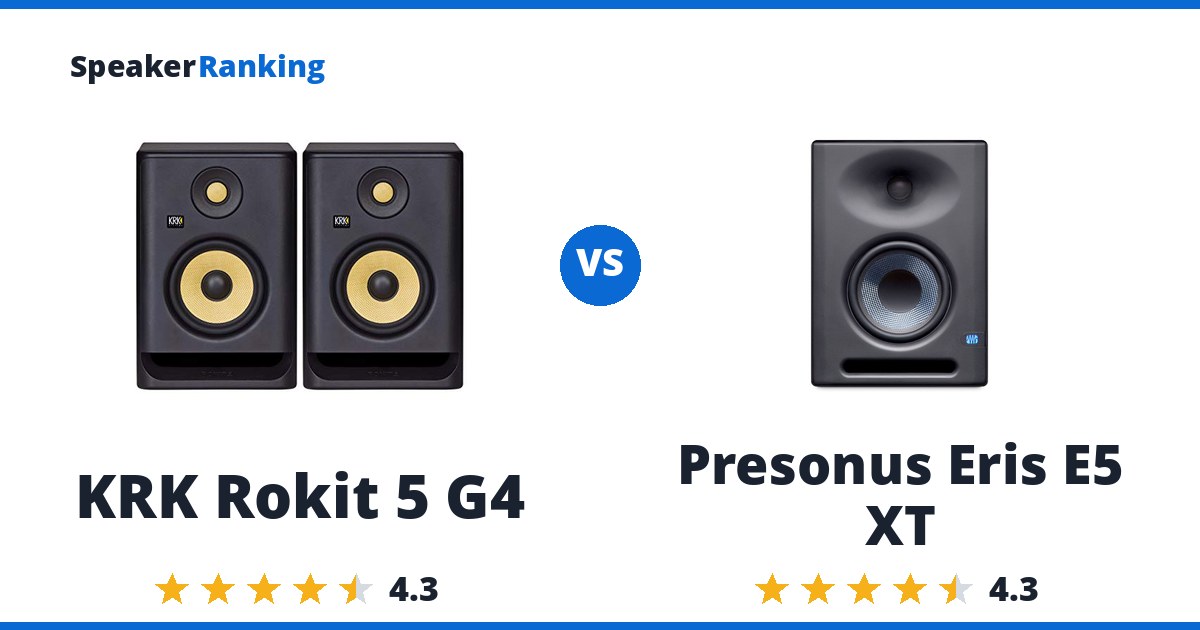
What the KRK Rokit 5 G4 gets right: Deeper bass than the HS5. Good horizontal directivity - the small woofer mates well with the waveguided tweeter. The tradeoff: Not quite as detailed as the HS5, not as good for mixing. A little more hifi sounding.
The case for the Presonus Eris E5 XT: CEA2034 spinorama shows very smooth, consistent directivity through the crossover region and into the treble, with early reflections tracking the on-axis curve closely. Set against that: On-axis response is uneven, with peaks at both frequency extremes and a dip around the roughly 3kHz crossover, giving a bass-and-treble-heavy tonal balance with the midrange partially recessed.
Buy the KRK Rokit 5 G4 only if you find one used in good condition; both are discontinued, and it is the better rated of the two. For a new speaker, start with the JBL 305P MKII instead.
Looking for alternatives? See the complete Powered Home rankings.
Specifications Side By Side
| KRK Rokit 5 G4 | Presonus Eris E5 XT | |
|---|---|---|
| Price | $337 per pair Discontinued | $239.98 per pair Discontinued |
| Ranked | #42 of 68 in Medium Size Powered Bookshelf Speakers | #47 of 68 in Medium Size Powered Bookshelf Speakers |
| Bass Extension (-3dB) | 55.7Hz (measured, Audio Science Review) | 56.4Hz (measured, Audio Science Review) |
| Bass Extension (-10dB) | 44.4Hz (derived, log-interpolated between spinorama.org -9dB/-12dB points) | 46.9Hz (derived, log-interpolated between spinorama.org -9dB/-12dB points) |
| Dimensions | 11.2”H x 7.5”W x 9.5”D (284.5 x 190.5 x 241.3 mm) | 10.2”H x 7”W x 7.7”D (259.1 x 177.8 x 195.6 mm) |
| Frequency Response | 58Hz - 24kHz (-3dB) (Manufacturer specified) | 53Hz - 22kHz (Manufacturer specified) |
| Inputs | TRS/XLR | TRS, XLR, RCA |
| Weight | 10.8 lbs (4.9 kg) each | 10.1 lbs (4.6 kg) each |
| Drivers | 5” (127mm) woofer | 5” (127mm) woofer |
| App | No | No |
| Bluetooth | No | No |
| EQ | Yes (Room adjustment) | Yes (Room adjustment) |
| Amplifier Power | 55w Per Speaker | 80w Per Speaker |
| Spinorama Preference Score | 3.92 | 3.58 |
| Spinorama Preference Score with Perfect Sub | 6.29 | 6.00 |
| XLR Input | Yes | Yes |
| RCA Input | No | Yes |
| TRS Input | Yes | Yes |
| Optical Input | No | No |
| Coaxial Input | No | No |
| USB Input | No | No |
| HDMI Input | No | No |
| AES Input | No | No |
| Aux Input | No | No |
Related Speaker Comparisons
More worthwhile head-to-heads for KRK Rokit 5 G4:
- KRK Rokit 5 G4 vs Genelec 8331A
- KRK Rokit 5 G4 vs Neumann KH120 MKII
- Genelec 8030C vs KRK Rokit 5 G4
- KRK Rokit 5 G4 vs Neumann KH80 DSP
- KRK Rokit 5 G4 vs Dynaudio LYD 5
Prices on this page were last checked October 3, 2026 at 10:26 PM UTC. Product prices and availability are accurate as of that date/time and are subject to change; the price and availability shown on Amazon at the time of purchase will apply to the purchase of this product.
As an eBay Partner, we may be compensated if you make a purchase.
The Two Speakers In Full
 KRK Rokit 5 G4: $337 per pair Discontinued eBay
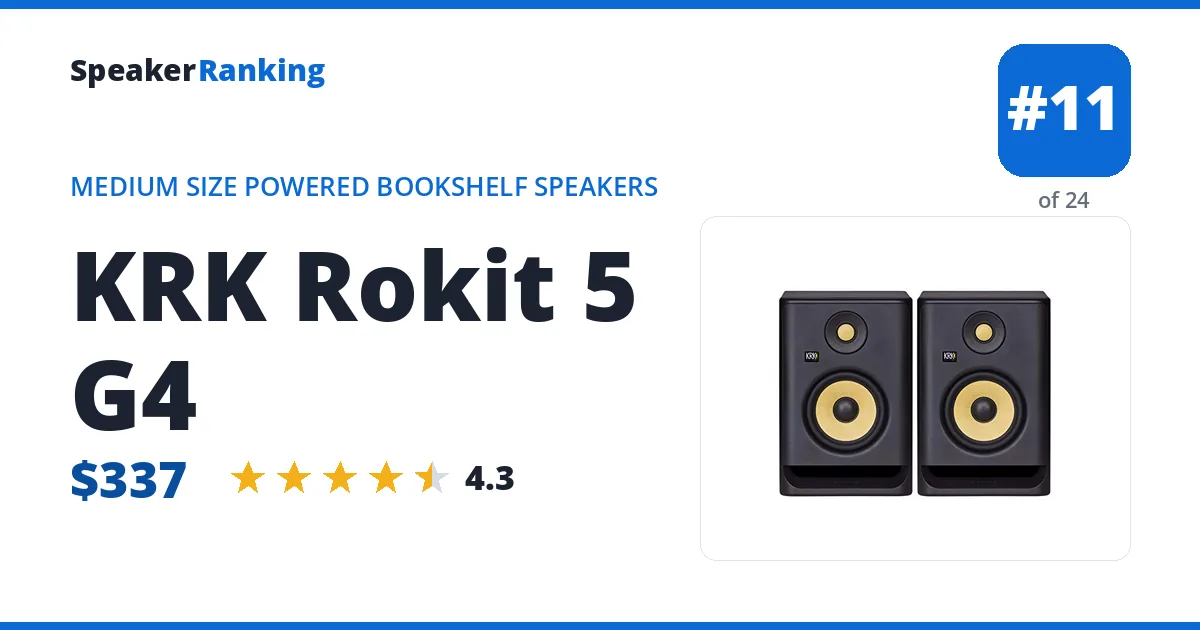
Newer model: the KRK Rokit 5 G5. It’s likely to perform similarly, though we don’t have measurements to confirm that yet.
Pros: ASR’s data gives -3dB bass around 56Hz and scores of 3.92 standalone and 6.29 with an ideal subwoofer. The waveguide provides useful horizontal directivity control, while onboard adjustments help tailor broad balance. The existing review reports low distortion at 86dB and low audible hiss. Measured bass extension of 55.7Hz (-3dB).
Cons: The 3.6dB midrange span and listening-window narrow-band deviation of 0.502 show that native response is not reference-flat. A port-region resonance and other tonal irregularities remain. Its deeper bass does not establish greater detail or mixing accuracy than another monitor. EQ can help, but the unequalized measurements determine the starting recommendation. Discontinued.
Full KRK Rokit 5 G4 review and specifications →
| AES Input | No |
|---|---|
| Amplifier Power | 55w Per Speaker |
| App | No |
| Aux Input | No |
| Bass Extension (-10dB) | 44.4Hz (derived, log-interpolated between spinorama.org -9dB/-12dB points) |
| Bass Extension (-3dB) | 55.7Hz (measured, Audio Science Review) |
| Bluetooth | No |
| Coaxial Input | No |
| Dimensions | 11.2”H x 7.5”W x 9.5”D (284.5 x 190.5 x 241.3 mm) |
| Drivers | 5” (127mm) woofer |
| EQ | Yes (Room adjustment) |
| Frequency Response | 58Hz - 24kHz (-3dB) (Manufacturer specified) |
| HDMI Input | No |
| Inputs | TRS/XLR |
| Optical Input | No |
| RCA Input | No |
| Spinorama Preference Score | 3.92 |
| Spinorama Preference Score with Perfect Sub | 6.29 |
| TRS Input | Yes |
| USB Input | No |
| Weight | 10.8 lbs (4.9 kg) each |
| XLR Input | Yes |
- Links
- Reviews, Comparisons and Sound Samples
- Audio Science Review Measurements More from Audio Science Review →
- DSAUDIO.review: DSAUDIO.review Focal Alpha 50 EVO vs KRK Rokit 5 G4 RP5G4 sound.DEMO More from DSAUDIOreview →
- DSAUDIO.review: KRK Rokit 5 G4 RP5G4 vs Adam Audio T5V Sound & Frequency Response Comparison
- DSAUDIO.review: DSAUDIO.review KRK Classic 5 CL5G3 vs KRK Rokit 5 RP5G4 sound.DEMO
- DSAUDIO.review: KRK Rokit 5 G4 RP5G4 vs Yamaha HS5 Sound & Frequency Response Comparison
- DSAUDIO.review: KRK Rokit 5 G4 RP5G4 vs Presonus Eris E5 Sound & Frequency Response Comparison
- DSAUDIO.review: PreSonus E5 XT vs KRK Rokit 5 G4 Sound & Frequency Response Comparison
- DSAUDIO.review: Genelec 8020D & KRK Rokit 5 G4 PR5G4 - Same, same, but different Sound & Response Comparison
- DSAUDIO.review: Neumann KH80 DSP vs KRK Rokit 5 G4 RP5G4 Sound & Frequency Response Comparison
- DSAUDIO.review: Tannoy Gold 5 vs KRK Rokit 5 G4 RP5G4 Sound & Frequency Response Comparison
- DSAUDIO.review: IK Multimedia iLoud MTM vs KRK Rokit 5 G4 Sound & Frequency Response Comparison
- Audio Science Review Measurements (spinorama.org)
- Head-to-Head Comparisons
 Presonus Eris E5 XT: $239.98 per pair Discontinued eBay
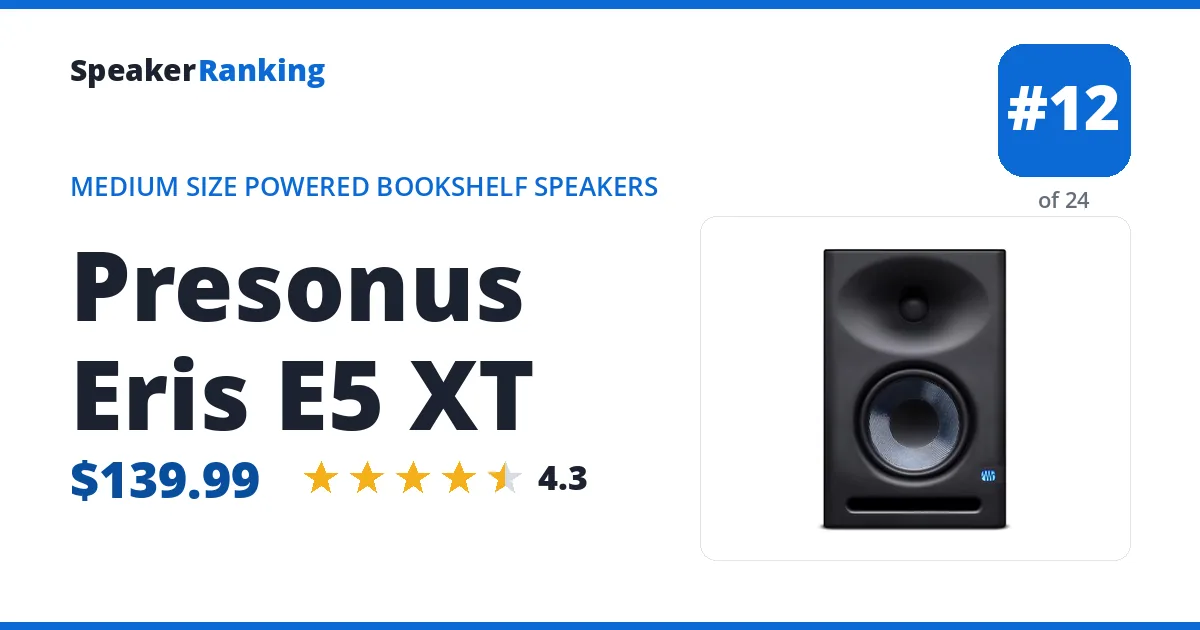
Newer model: the PreSonus Eris Studio 5. It’s likely to perform similarly, though we don’t have measurements to confirm that yet.
Pros: ASR’s measurements show reasonably consistent directivity through the crossover, so EQ changes are more likely to benefit both direct and reflected sound. Bass reaches -3dB around 56Hz. A standalone preference score of 3.58 rises to 6.00 with an ideal subwoofer, indicating useful bass reach but only moderate native tonal performance. Measured bass extension of 56.4Hz (-3dB).
Cons: The response has bass and treble emphasis with a recessed crossover region; smooth directivity carries that imbalance into room reflections rather than fixing it. Existing distortion testing shows problems across a broad range when pushed to 96dB. Tone correction and moderate levels help, but it is not a reference-flat monitor out of the box. Discontinued.
Full Presonus Eris E5 XT review and specifications →
| AES Input | No |
|---|---|
| Amplifier Power | 80w Per Speaker |
| App | No |
| Aux Input | No |
| Bass Extension (-10dB) | 46.9Hz (derived, log-interpolated between spinorama.org -9dB/-12dB points) |
| Bass Extension (-3dB) | 56.4Hz (measured, Audio Science Review) |
| Bluetooth | No |
| Coaxial Input | No |
| Dimensions | 10.2”H x 7”W x 7.7”D (259.1 x 177.8 x 195.6 mm) |
| Drivers | 5” (127mm) woofer |
| EQ | Yes (Room adjustment) |
| Frequency Response | 53Hz - 22kHz (Manufacturer specified) |
| HDMI Input | No |
| Inputs | TRS, XLR, RCA |
| Optical Input | No |
| RCA Input | Yes |
| Spinorama Preference Score | 3.58 |
| Spinorama Preference Score with Perfect Sub | 6.00 |
| TRS Input | Yes |
| USB Input | No |
| Weight | 10.1 lbs (4.6 kg) each |
| XLR Input | Yes |
- Links
- Reviews, Comparisons and Sound Samples
- DSAUDIO.review: New PreSonus E5 XT and Yamaha HS5 could not sound any more different! SOUND AND RESPONSE COMPARISON More from DSAUDIOreview →
- DSAUDIO.review: Bright and brighter. PreSonus E5 XT takes on Adam Audio T5V SOUND & FREQUENCY RESPONSE COMPARISON
- DSAUDIO.review: PreSonus Eris E5 XT vs PreSonus Eris E5 (new vs old) Sound & Frequency Response Comparison
- DSAUDIO.review: PreSonus E7 XT vs PreSonus E5 XT Sound & Frequency Response Comparison
- DSAUDIO.review: PreSonus Eris E8 XT vs PreSonus Eris E5 XT Sound & Frequency Response Comparison
- DSAUDIO.review: PreSonus E5 XT vs KRK Rokit 5 G4 Sound & Frequency Response Comparison
- Audio Science Review Measurements More from Audio Science Review →
- Audio Science Review Measurements (spinorama.org)
- Head-to-Head Comparisons
- Presonus Eris E5 XT vs Edifier S2000MKIII
- Presonus Eris E5 XT vs Edifier MR4.5
- Presonus Eris E5 XT vs Edifier MR4
- Presonus Eris E5 XT vs Palmer STUDIMON 5
- Presonus Eris E5 XT vs KRK Classic 5
- Presonus Eris E5 XT vs Adam Audio A4V
- Presonus Eris E5 XT vs Yamaha HS5
- Presonus Eris E5 XT vs M-Audio BX4 D3
- See all 55 comparisons