Short answer: the KH80 DSP, if the price gap is acceptable. It ranks #4 of 108 powered bookshelf speakers at $1,198; the Rokit 5 G4 ranks #59 at $337, $861 less. The KRK Rokit 5 G4 is discontinued; its replacement is the KRK Rokit 5 G5.
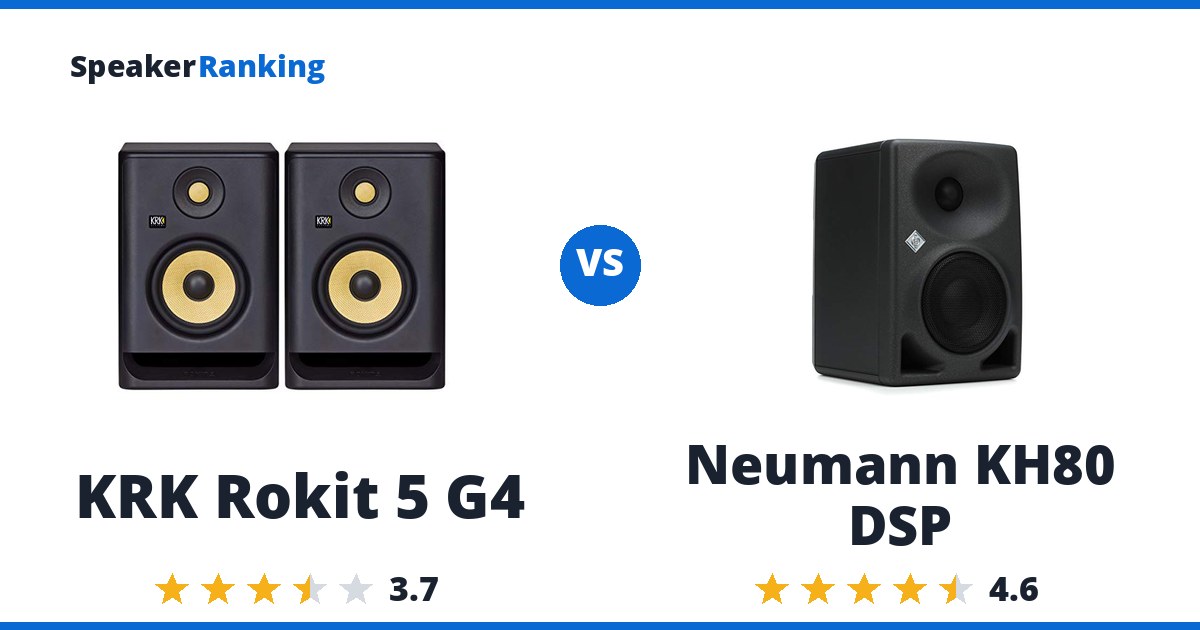
The Rokit 5 G4 is described as deeper in bass than the Yamaha HS5, with good horizontal directivity from its waveguided tweeter and low distortion that scales gradually with volume. Our notes call it a little more hifi sounding and not as good for mixing as the HS5 by comparison.
The KH80’s real limitation is its control app, which is iPad-only with no Android or Bluetooth option despite being control-only, an odd gap at this price. One reviewer even found the smoother-measuring KH80 sounded smaller and less present than the cheaper JBL 305P MkII in a direct listening test.
Buy the Rokit 5 G4 for the strong value case. Buy the KH80 DSP for the higher ranking if the iPad-only app isn’t a dealbreaker.
Want more options? Browse the full Powered Home rankings.
Prices on this page were last checked November 7, 2026 at 7:34 PM UTC. Product prices and availability are accurate as of that date/time and are subject to change; the price and availability shown on Amazon at the time of purchase will apply to the purchase of this product.
As an eBay Partner, we may be compensated if you make a purchase.
Specifications Side By Side
| KRK Rokit 5 G4 | Neumann KH80 DSP | |
|---|---|---|
| Price | $337 per pair Discontinued | $1,198 per pair |
| Ranked | #59 of 108 in Medium Size Powered Bookshelf Speakers | #4 of 108 in Medium Size Powered Bookshelf Speakers |
| Bass Extension (-3dB) | 55.7Hz (measured, Audio Science Review) | 57Hz (measured, Erin’s Audio Corner) |
| Bass Extension (-10dB) | 44.4Hz (derived, log-interpolated between spinorama.org -9dB/-12dB points) | 51Hz (measured, Erin’s Audio Corner) |
| Dimensions | 11.2”H x 7.5”W x 9.5”D (284.5 x 190.5 x 241.3 mm) | 13.6”H x 10.8”W x 9.6”D (345.4 x 274.3 x 243.8 mm) |
| Frequency Response | 58Hz - 24kHz (-3dB) (Manufacturer specified) | 57 Hz - 25 kHz (+-3 dB) (Manufacturer specified) |
| Inputs | TRS/XLR | XLR |
| Weight | 10.8 lbs (4.9 kg) each | 9 lbs (4.1 kg) each |
| Drivers | 5” (127mm) woofer | 4.1” woofer, 1” fabric dome tweeter |
| App | No | Yes (MA 1 alignment) |
| Bluetooth | No | No |
| EQ | Yes (Room adjustment) | Yes (via DSP) |
| Amplifier Power | 55w Per Speaker | 140W (90W woofer + 50W tweeter) |
| Spinorama Preference Score | 3.92 | 5.89 |
| Spinorama Preference Score with Perfect Sub | 6.29 | 8.25 |
| XLR Input | Yes | Yes |
| RCA Input | No | No |
| TRS Input | Yes | No |
| Optical Input | No | No |
| Coaxial Input | No | No |
| USB Input | No | No |
| HDMI Input | No | No |
| AES Input | No | No |
| Aux Input | No | No |
| DSP | - | Yes |
| Sensitivity | - | 91.9dB (measured at 0.3V/1m, Erin’s Audio Corner) |
| Maximum SPL | - | 110.7dB @ 1m (manufacturer specified) |
Watch Them Compared
Videos and reviews that test both speakers side by side.
Related Speaker Comparisons
How Neumann KH80 DSP compares with other leading options: