Short answer: the Sonos Era 100. It ranks #14 of 19 powered desktop speakers by sound quality, rated 3.6/5, at $219; the Klipsch The Three Plus ranks #18, rated 3.4/5, and costs $269.99, so there is not much of a tradeoff to weigh.
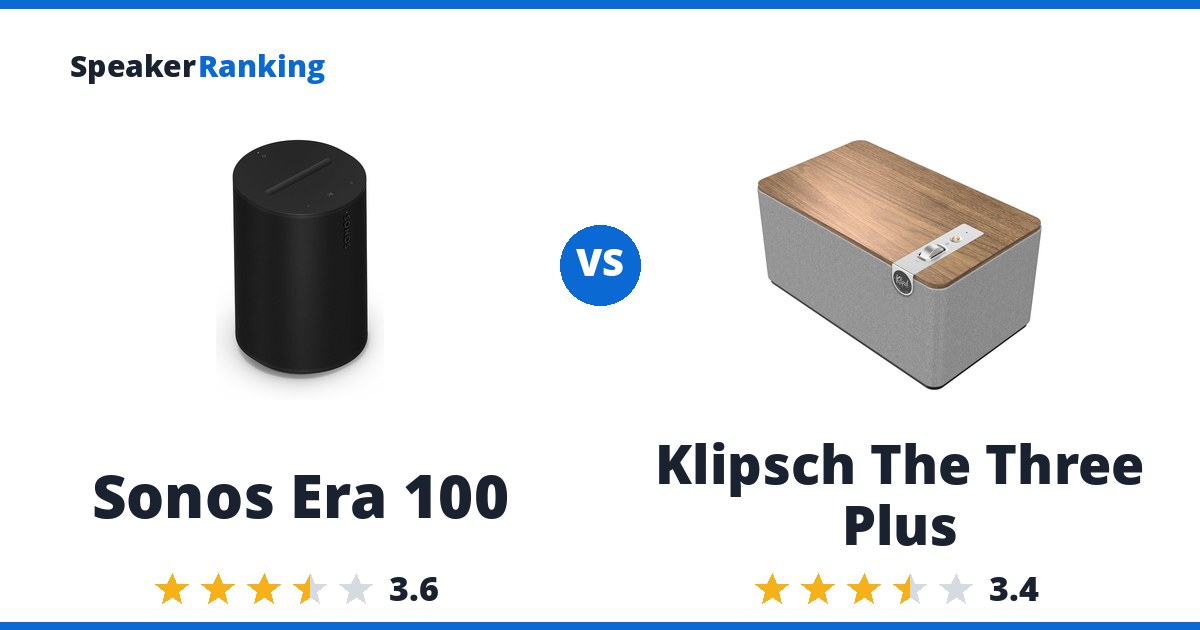
What the Sonos Era 100 does well: RTINGS lists room correction tools and bass/treble adjustments as its real strengths, and its balanced midrange suits a wide range of genres, with wider stereo separation than the mono Sonos One SL it replaced thanks to two angled tweeters plus a 25% larger mid-woofer than the original Sonos One. The tradeoff: RTINGS’ own two listed cons are not loud enough for larger rooms and very little low-bass thump, so genres like EDM and hip-hop lack rumble even with the tone adjustments.
The case for the Klipsch The Three Plus: Two 2.25in full-range drivers and a 5.25in woofer with two opposing passive radiators, biamplified with 120W, play far louder than the small tabletop cabinet suggests: TechRadar and Trusted Reviews both found it stayed composed and unstressed at very high volume, with controlled, textured bass and a fairly detailed, communicative midrange. Watch for: The tuning leans heavily on bass: TechRadar called it on the warm side of neutral with the treble only just holding its own, and HomeTheaterHifi found the treble turned sharp and piercing at higher volumes.
Buy the Sonos Era 100. It is rated higher for sound quality than the Klipsch The Three Plus and costs less, so it is the default pick unless a specific strength of the other one matters more to you.
Want more options? Browse the full Powered Home rankings.
Specifications Side By Side
| Sonos Era 100 | Klipsch The Three Plus | |
|---|---|---|
| Price | $219.00 each | $269.99 each |
| Ranked | #14 of 19 in Medium Size Powered Desktop Speakers | #18 of 19 in Medium Size Powered Desktop Speakers |
| Aux Input | No | No (RCA line input) |
| Battery Life | No Battery | No Battery |
| IP Rating | None | - |
| Party Mode | Yes (Sonos multi-room, AirPlay 2) | - |
| Power Input | External AC adapter | - |
| Stereo | Yes | Partially (1 woofer) |
| Weight | 4.5 lbs (2.02 kg) | 10.6 lbs (4.8 kg) |
| Wi-Fi | Yes (Wi-Fi 6) | No |
| App | Yes (Sonos S2) | Yes (Klipsch Connect) |
| Bluetooth Codecs | SBC | - |
| Built-in Microphone | Yes (far-field, mic mute button) | No |
| EQ | Yes (Bass/Treble + Trueplay room correction) | Yes |
| Power Bank | No | - |
| TWS | Yes (stereo pairing via Sonos app) | - |
| Drivers | 2x angled tweeters, 1x mid-woofer | 2x 2.25” full-range drivers, 5.25” long-throw woofer, 2x 5.25” passive radiators |
| Inputs | Wi-Fi, Bluetooth, USB-C (line-in adapter sold separately) | Bluetooth, Optical, Phono/RCA, USB-C |
| XLR Input | No | No |
| RCA Input | No | Yes |
| TRS Input | No | No |
| Optical Input | No | Yes (24-bit/96kHz) |
| Coaxial Input | No | No |
| USB Input | Yes (line-in adapter sold separately) | Yes |
| HDMI Input | No | No |
| AES Input | No | No |
| Bluetooth | Yes, 5.0 | Yes, 5.3 |
| Dimensions | 7.2” x 4.7” x 5.1” (182.5 x 120 x 130.5 mm) | 7”H x 14”W x 8.4”D (178 x 356 x 213 mm) |
| Voice Assistants | Amazon Alexa | None |
| Streaming Services | Sonos app streaming (Spotify, Apple Music, Amazon Music and more), AirPlay 2 | - |
| Amplifier Power | - | 120W total |
| Frequency Response | - | 45Hz - 20kHz (Manufacturer specified) |
| Maximum SPL | - | 106dB |
| Bluetooth Version | - | 5.3 |
Related Speaker Comparisons
More worthwhile head-to-heads for Sonos Era 100:
- Sonos Era 100 vs Audio Pro C5 MkII
- Sonos Era 100 vs Marshall Woburn III
- Apple HomePod 2nd Gen vs Sonos Era 100
- Sonos Era 100 vs Marshall Stanmore III
- Sonos Era 100 vs Edifier D12
Prices on this page were last checked September 29, 2026 at 3:43 PM UTC. Product prices and availability are accurate as of that date/time and are subject to change; the price and availability shown on Amazon at the time of purchase will apply to the purchase of this product.
As an eBay Partner, we may be compensated if you make a purchase.
The Two Speakers In Full
 Sonos Era 100: $219.00 each Amazon eBay
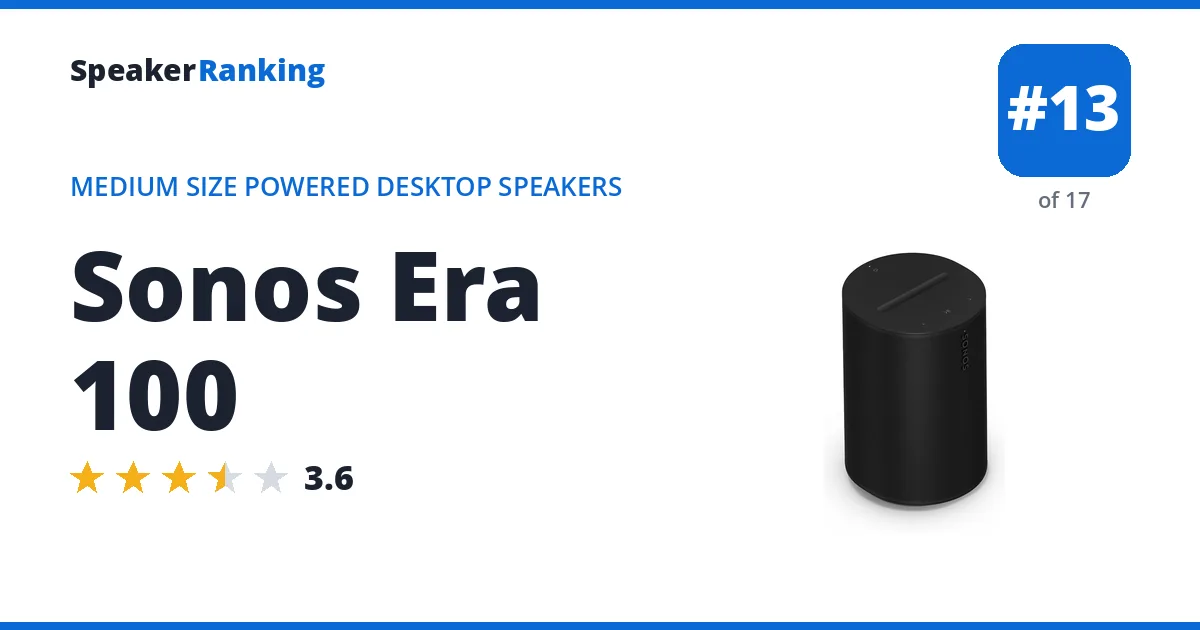
Pros: RTINGS lists room correction tools and bass/treble adjustments as its real strengths, and its balanced midrange suits a wide range of genres, with wider stereo separation than the mono Sonos One SL it replaced thanks to two angled tweeters plus a 25% larger mid-woofer than the original Sonos One. Alexa is built in with a far-field mic, and it ties into the wider Sonos S2 app ecosystem for multi-room audio.
Cons: RTINGS’ own two listed cons are not loud enough for larger rooms and very little low-bass thump, so genres like EDM and hip-hop lack rumble even with the tone adjustments. There’s no Google Assistant, the USB-C line-in needs a separately purchased adapter, and there’s no battery.
Full Sonos Era 100 review and specifications →
| AES Input | No |
|---|---|
| App | Yes (Sonos S2) |
| Aux Input | No |
| Battery Life | No Battery |
| Bluetooth | Yes, 5.0 |
| Bluetooth Codecs | SBC |
| Built-in Microphone | Yes (far-field, mic mute button) |
| Coaxial Input | No |
| Dimensions | 7.2” x 4.7” x 5.1” (182.5 x 120 x 130.5 mm) |
| Drivers | 2x angled tweeters, 1x mid-woofer |
| EQ | Yes (Bass/Treble + Trueplay room correction) |
| HDMI Input | No |
| IP Rating | None |
| Inputs | Wi-Fi, Bluetooth, USB-C (line-in adapter sold separately) |
| Optical Input | No |
| Party Mode | Yes (Sonos multi-room, AirPlay 2) |
| Power Bank | No |
| Power Input | External AC adapter |
| RCA Input | No |
| Stereo | Yes |
| Streaming Services | Sonos app streaming (Spotify, Apple Music, Amazon Music and more), AirPlay 2 |
| TRS Input | No |
| TWS | Yes (stereo pairing via Sonos app) |
| USB Input | Yes (line-in adapter sold separately) |
| Voice Assistants | Amazon Alexa |
| Weight | 4.5 lbs (2.02 kg) |
| Wi-Fi | Yes (Wi-Fi 6) |
| XLR Input | No |
- Links
- Reviews, Comparisons and Sound Samples
- Head-to-Head Comparisons
- Sonos Era 100 vs Google Home Max
- Sonos Era 100 vs Bose Lifestyle Ultra Speaker
- Sonos Era 100 vs Denon Home 250
- Sonos Era 100 vs Marshall Acton III
- Sonos Era 100 vs Klipsch The One II
- Sonos Era 100 vs JBL Authentics 200
- Sonos Era 100 vs Edifier D12
- Sonos Era 100 vs Marshall Stanmore III
- See all 35 comparisons
 Klipsch The Three Plus: $269.99 each Amazon eBay
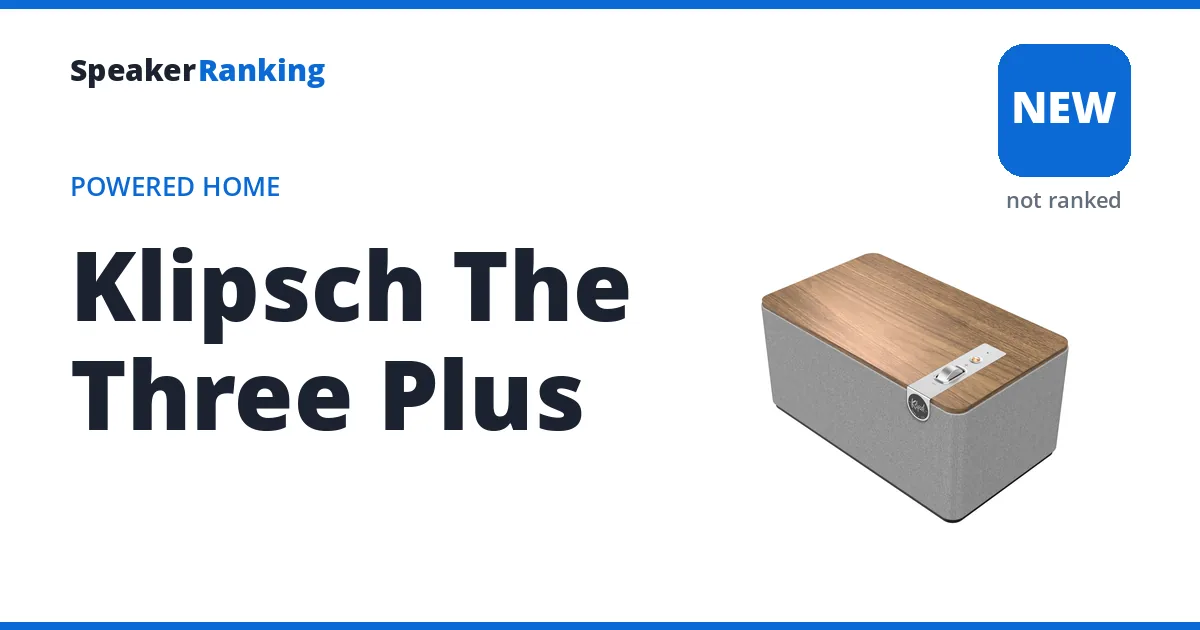
Older model: the Klipsch The Three II (ranked higher, rated 3.4/5).
Pros: Two 2.25in full-range drivers and a 5.25in woofer with two opposing passive radiators, biamplified with 120W, play far louder than the small tabletop cabinet suggests: TechRadar and Trusted Reviews both found it stayed composed and unstressed at very high volume, with controlled, textured bass and a fairly detailed, communicative midrange. Inputs cover Bluetooth 5.3, a switchable phono/line RCA input for a turntable, 24-bit/96kHz optical and USB-C playback, and the Klipsch Connect app adds a three-band EQ with presets and a night mode.
Cons: The tuning leans heavily on bass: TechRadar called it on the warm side of neutral with the treble only just holding its own, and HomeTheaterHifi found the treble turned sharp and piercing at higher volumes. Both TechRadar and Trusted Reviews found the built-in phono stage flat and less dynamic than the other inputs, so vinyl sounds its weakest here. Stereo separation is limited by the single cabinet, there is no 3.5mm aux or subwoofer output, and HomeTheaterHifi found the app and volume wheel laggy. ASR’s measurements of the original Klipsch The Three, which used the same driver layout, showed an uneven response, so treat its tonal balance with some caution.
Full Klipsch The Three Plus review and specifications →
| AES Input | No |
|---|---|
| Amplifier Power | 120W total |
| App | Yes (Klipsch Connect) |
| Aux Input | No (RCA line input) |
| Battery Life | No Battery |
| Bluetooth | Yes, 5.3 |
| Bluetooth Version | 5.3 |
| Built-in Microphone | No |
| Coaxial Input | No |
| Dimensions | 7”H x 14”W x 8.4”D (178 x 356 x 213 mm) |
| Drivers | 2x 2.25” full-range drivers, 5.25” long-throw woofer, 2x 5.25” passive radiators |
| EQ | Yes |
| Frequency Response | 45Hz - 20kHz (Manufacturer specified) |
| HDMI Input | No |
| Inputs | Bluetooth, Optical, Phono/RCA, USB-C |
| Maximum SPL | 106dB |
| Optical Input | Yes (24-bit/96kHz) |
| RCA Input | Yes |
| Stereo | Partially (1 woofer) |
| TRS Input | No |
| USB Input | Yes |
| Voice Assistants | None |
| Weight | 10.6 lbs (4.8 kg) |
| Wi-Fi | No |
| XLR Input | No |
- Links
- Reviews, Comparisons and Sound Samples
- Head-to-Head Comparisons