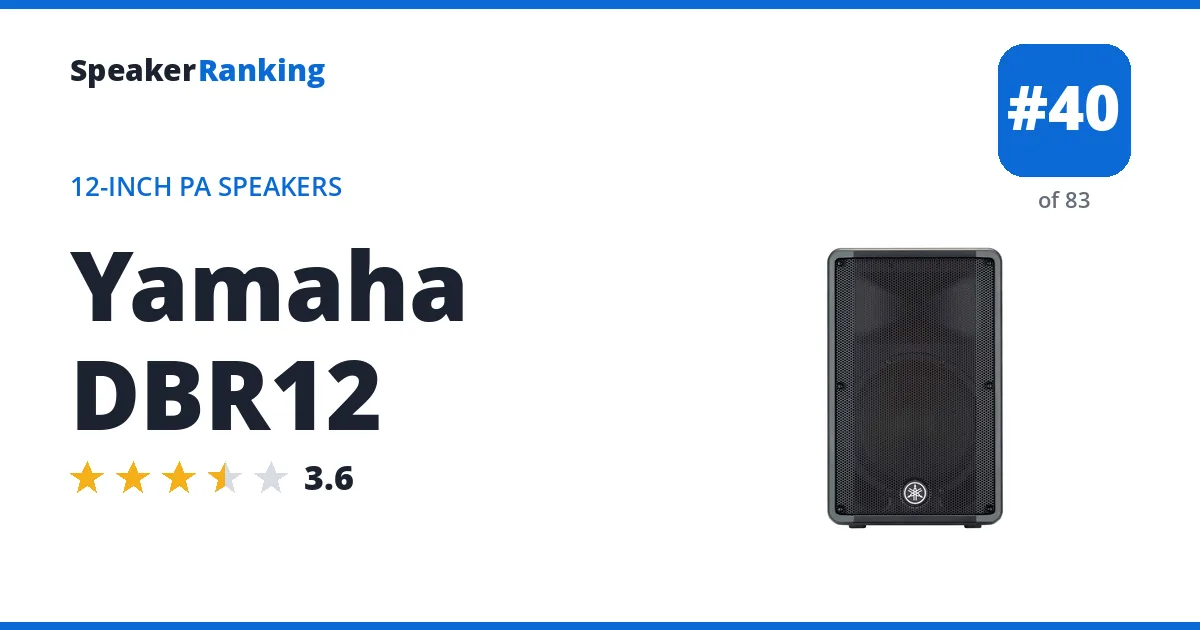
The Yamaha DBR12 is rated 3.6/5 for sound quality, #40 of 83 12-Inch PA Speakers. See all PA & Live Sound rankings for every top pick.
Prices on this page were last checked October 24, 2026 at 4:42 PM UTC. Product prices and availability are accurate as of that date/time and are subject to change; the price and availability shown on Amazon at the time of purchase will apply to the purchase of this product.
As an eBay Partner, we may be compensated if you make a purchase.
Brand: Yamaha
#40 Yamaha DBR12: $459.99 Amazon $459.99 B&H Photo Video $459.99 Guitar Center $459.99 eBay
Same family: the Yamaha DBR10 (smaller powered model, rated 3.4/5), the Yamaha DBR15 (larger powered model, rated 2.9/5), the Yamaha CBR10 (smallest passive model, estimated 3.2/5), the Yamaha CBR12 (passive model, ranked lower, estimated 3.4/5) and the Yamaha CBR15 (largest passive model, estimated 2.7/5).
Pros: An affordable, light 12 inch powered PA speaker with a two channel mixer and simple main and monitor presets. A lightweight, widely supported entry point with a useful two-channel mixer, FIR-X crossover processing and straightforward main/monitor presets. The 58Hz measured extension is adequate for speech and modest music playback without a subwoofer. Measured bass extension of 58Hz (-3dB).
Cons: Medium-quality vendor data produces a below-average 4.92 ideal-subwoofer preference score, indicating substantial tonal/directivity compromises. Its 131dB output claim and controls also sit below Yamaha’s DXR and DZR tiers.
Is the Yamaha DBR12 right for you?
Buy it if
- you can use EQ: our neutral preset raises its predicted score by about 1.1.
Skip it if
- you want neutral sound: its measured preference score is 4.9 even with a subwoofer.
| Released | Sep 2014 (12 years ago) |
|---|---|
| AES Input | No |
| Amplifier Power | 1000W dynamic / 465W continuous (800W LF + 200W HF dynamic) |
| Aux Input | No |
| Bass Extension (-3dB) | 58Hz (measured, vendor Spinorama data) |
| Bluetooth | No |
| Cabinet Material | Plastic |
| Coaxial Input | No |
| Configuration | Active 2-way bass-reflex PA speaker |
| Coverage | 90° x 60° |
| DSP | Yes |
| Dimensions | 23.7”H x 14.8”W x 13.7”D (601 x 376 x 348 mm) |
| Drivers | 12” woofer, 1.4” compression driver |
| Frequency Response | 52Hz - 20kHz (manufacturer specified) |
| Guitar Input | No |
| HDMI Input | No |
| Inputs | 2 x XLR/TRS combo, stereo RCA |
| Maximum SPL | 131dB peak (manufacturer specified) |
| Microphone Input | No |
| Optical Input | No |
| Passive | No |
| RCA Input | Yes |
| Rigging | 3 x M8 points; 35mm pole mount |
| Spinorama Preference Score | 2.32 |
| Spinorama Preference Score with Perfect Sub | 4.92 |
| TRS Input | Yes |
| USB Input | No |
| Weight | 34.8 lbs (15.8 kg) |
| XLR Input | Yes |
Price history
$459.99 is about its usual price. The lowest we have tracked since Sep 2026 is $379, in Sep 2026.
- Links
- Reviews, Comparisons and Sound Samples
Frequency Response
How the Yamaha DBR12 measures across the audible range. A flatter listening window (the sound arriving straight at you) is more neutral: peaks sound forward or harsh, dips sound recessed. The estimated in-room response adds what a typical room does, and there a gentle, even tilt down toward the treble is ideal. Both curves are shifted so their 300 Hz to 3 kHz average sits at 0 dB.
Measurement data: spinorama.org, measured by the manufacturer.
EQ for a Neutral Response
Flattens the measured listening window from the Yamaha DBR12's own bass extension up to 16 kHz. Set a preamp of -2.3 dB, then add these filters to any parametric equalizer in the signal path: the speaker's app or DSP if it has parametric EQ, a miniDSP, Equalizer APO or Wavelet. Boosts are kept to 3 dB, and EQ cannot fix how evenly the speaker spreads sound off-axis, which is why some speakers gain more than others. Predicted preference score with this EQ: 3.3, up from 2.3 (6.1 with an ideal subwoofer, up from 4.9). Calculated by Speaker Ranking from the spinorama measurements above.
| Filter | Frequency | Gain | Q |
|---|---|---|---|
| Peak | 98 Hz | -2.2 dB | 2.00 |
| Peak | 230 Hz | -2.3 dB | 0.53 |
| Peak | 266 Hz | -1.6 dB | 4.00 |
| Peak | 370 Hz | +1.3 dB | 4.00 |
| Peak | 420 Hz | +3.0 dB | 3.25 |
| Peak | 2,806 Hz | +2.3 dB | 1.88 |
| Peak | 11,888 Hz | -1.5 dB | 2.31 |
Head-to-Head Comparisons
27 comparisons- Yamaha DBR12 vs RCF ART 712-A MK5
- Yamaha DBR12 vs Coda Audio G512
- Yamaha DBR12 vs HK Audio LINEAR 5 112 FA
- Yamaha DBR12 vs DAS Audio Vantec 12A
- Yamaha DBR12 vs RCF HD 12-A MK5
- Yamaha DBR12 vs Martin Audio XP12
- Yamaha DBR12 vs RCF ART 732-A MK5
- Yamaha DBR12 vs Yamaha CBR12
- Yamaha DBR12 vs Yamaha DZR12
- Yamaha DBR12 vs RCF NX 912-A
- Yamaha DBR12 vs RCF ART 732-A MK4
- Yamaha DBR12 vs Axiom ED120A
- Yamaha DBR12 vs Yamaha DXR12mkII
- Yamaha DBR12 vs RCF ART 712-A MK4
- Yamaha DBR12 vs Yamaha DXR12mkIII
- Yamaha DBR12 vs RCF ART 912-A
- Yamaha DBR12 vs RCF NX 932-A
- Yamaha DBR12 vs RCF ART 932-A
- Yamaha DBR12 vs RCF KX 32-A
- Yamaha DBR12 vs JBL PRX912
- Yamaha DBR12 vs KV2 Audio EX12
- Yamaha DBR12 vs PreSonus ULT12
- Yamaha DBR12 vs QSC K12.2
- Yamaha DBR12 vs Behringer Eurolive B212XL
- Yamaha DBR12 vs RCF ART 708-A MK5
- Yamaha DBR12 vs RCF ART 935-A
- Yamaha DBR12 vs RCF ART 710-A MK5
No comparisons match that search.