Short answer: these Yamaha DXR12mkII and Yamaha DBR12 alternatives share a brand and size class, but their coverage, driver architecture, cabinet format, processing, and output priorities can make them fit very different jobs. The Yamaha DXR12mkII is discontinued; its replacement is the Yamaha DXR12mkIII. If you are buying new, get the Yamaha DXR12mkIII.
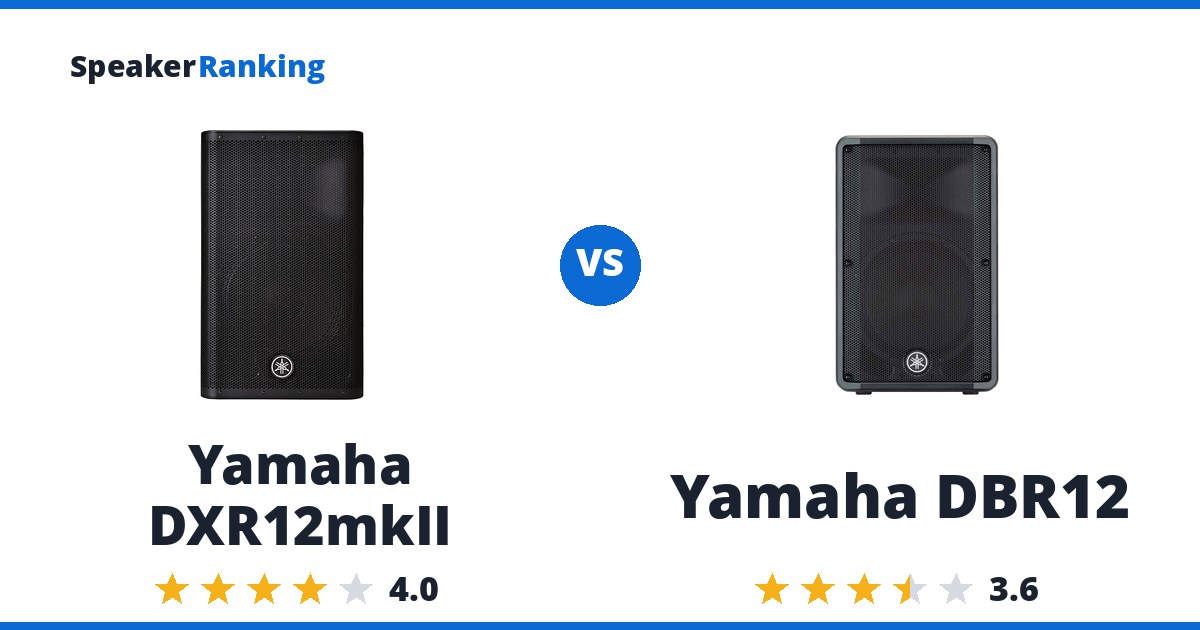
Why choose the Yamaha DXR12mkII. A proven, broadly distributed workhorse with a flexible three-channel input section and 134dB claimed maximum output. Medium-quality vendor Spinorama data and 61Hz measured extension provide more evidence than many PA competitors, while Yamaha’s FIR-X processing and D-CONTOUR presets simplify setup.
Why choose the Yamaha DBR12. A lightweight, widely supported entry point with a useful two-channel mixer, FIR-X crossover processing and straightforward main/monitor presets. The 58Hz measured extension is adequate for speech and modest music playback without a subwoofer.
What to weigh before buying. The 5.49 ideal-subwoofer preference score is only mid-pack, with meaningful response/directivity irregularity in the supplied data. It lacks app control and Bluetooth audio, and newer competitors offer more user-adjustable DSP. Medium-quality vendor data produces a below-average 4.92 ideal-subwoofer preference score, indicating substantial tonal/directivity compromises. Its 131dB output claim and controls also sit below Yamaha’s DXR and DZR tiers.
Buy the Yamaha DXR12mkII when its stated coverage, output, processing, and deployment format best match the job.
Buy the Yamaha DBR12 when its stated strengths are the better match for the room and the rest of the PA.
Still deciding? The full PA & Live Sound rankings cover every ranked option.

A proven 12 inch PA workhorse with good sound, loud output, three input channels and easy processing presets.

An affordable, light 12 inch powered PA speaker with a two channel mixer and simple main and monitor presets.
Prices on this page were last checked October 23, 2026 at 8:27 AM UTC. Product prices and availability are accurate as of that date/time and are subject to change; the price and availability shown on Amazon at the time of purchase will apply to the purchase of this product.
As an eBay Partner, we may be compensated if you make a purchase.
Specifications Side By Side
| Yamaha DXR12mkII | Yamaha DBR12 | |
|---|---|---|
| Price | $864.99 Discontinued | $459.99 |
| Ranked | #17 of 83 in 12-Inch PA Speakers | #40 of 83 in 12-Inch PA Speakers |
| Passive | No | No |
| Configuration | Active 2-way bass-reflex PA speaker | Active 2-way bass-reflex PA speaker |
| Drivers | 12” woofer, 1.75” compression driver | 12” woofer, 1.4” compression driver |
| Frequency Response | 52Hz - 20kHz (manufacturer specified) | 52Hz - 20kHz (manufacturer specified) |
| Dimensions | 23.7”H x 14.3”W x 13.8”D (601 x 362 x 350 mm) | 23.7”H x 14.8”W x 13.7”D (601 x 376 x 348 mm) |
| Amplifier Power | 1100W dynamic / 700W continuous (950W LF + 150W HF dynamic) | 1000W dynamic / 465W continuous (800W LF + 200W HF dynamic) |
| Cabinet Material | Matte-finish ABS | Plastic |
| Rigging | 3 x M10 points; 35mm dual-angle pole mount | 3 x M8 points; 35mm pole mount |
| Bass Extension (-3dB) | 61Hz (measured, vendor Spinorama data) | 58Hz (measured, vendor Spinorama data) |
| Coverage | 90° x 60° | 90° x 60° |
| Maximum SPL | 134dB peak (manufacturer specified) | 131dB peak (manufacturer specified) |
| Inputs | 2 x XLR/TRS combo, stereo RCA | 2 x XLR/TRS combo, stereo RCA |
| DSP | Yes | Yes |
| Bluetooth | No | No |
| Weight | 41 lbs (18.6 kg) | 34.8 lbs (15.8 kg) |
| Spinorama Preference Score | 2.78 | 2.32 |
| Spinorama Preference Score with Perfect Sub | 5.49 | 4.92 |
| XLR Input | Yes | Yes |
| RCA Input | Yes | Yes |
| TRS Input | Yes | Yes |
| Optical Input | No | No |
| Coaxial Input | No | No |
| USB Input | No | No |
| HDMI Input | No | No |
| AES Input | No | No |
| Aux Input | No | No |
| Microphone Input | No | No |
| Guitar Input | No | No |
Frequency Response Compared
Both speakers’ spinorama measurements, overlaid. A flatter line is more neutral: peaks sound forward or harsh, dips sound recessed. Each curve is shifted so its average from 300 Hz to 3 kHz sits at 0 dB, so loudness differences between the two are removed and only the shape is compared.
Measurement data: Yamaha DXR12mkII (measured by the manufacturer) and Yamaha DBR12 (measured by the manufacturer), via spinorama.org.
Related Speaker Comparisons
More top alternatives to Yamaha DXR12mkII: