Coverage note. Speaker Ranking currently covers 26 Yamaha models across portable bluetooth speakers, powered speakers, pa speakers, passive speakers and subwoofers. These are the products in our database, not a complete list of everything Yamaha makes.
What this page covers. The Yamaha models ranked here span portable bluetooth speakers, powered speakers, pa speakers, passive speakers and subwoofers, including Yamaha DXR8mkII, Yamaha DZR15 and Yamaha DXR12mkIII. Use each model’s category position to compare it with alternatives of the same size and use case.
This page lists all 26 Yamaha speakers ranked on this site across portable bluetooth speakers, powered speakers, pa speakers, passive speakers and subwoofers. Each model is shown in the category where it competes, with its current rank and the size of that ranking.
Use the category position rather than the brand name alone: speakers from the same manufacturer can perform very differently by size, price and product family.
Prices on this page were last checked September 30, 2026 at 2:57 PM UTC. Product prices and availability are accurate as of that date/time and are subject to change; the price and availability shown on Amazon at the time of purchase will apply to the purchase of this product.
As an eBay Partner, we may be compensated if you make a purchase.
Quick Navigation
- Medium Size Portable Bluetooth Speakers
- Medium Size Powered Bookshelf Speakers
- Large Size Powered Bookshelf Speakers
- 8-Inch PA Speakers
- 10-Inch PA Speakers
- 12-Inch PA Speakers
- 15-Inch PA Speakers
- Large Size Bookshelf Speakers
- Small Home Subwoofers (Under 30 lbs)
- Discontinued Yamaha Models
Medium Size Portable Bluetooth Speakers
 Ranked #106 of 150 in Medium Size Portable Bluetooth Speakers - Yamaha True X Speaker 1A: $150 Amazon eBay
Pros: Doubles as a wireless surround speaker for Yamaha True X soundbars, or a standalone speaker via ‘Solo’ mode. IP67 rated. Clear Voice technology boosts dialogue clarity.
Cons: Not very deep bass, upper mids peak that makes voices sibilant
Full Yamaha True X Speaker 1A review and specifications →
| Amplifier Power | 10W |
|---|---|
| App | No |
| Aux Input | No |
| Battery Life | 12 hours (Manufacturer specified) |
| Bluetooth | Yes |
| Bluetooth Codecs | SBC (inferred; additional codecs unverified) |
| Bluetooth Version | 5.0 |
| Built-in Microphone | No |
| Digital Aux Input | No |
| Dimensions | 4.1” x 3.5” x 3.5” (105 x 90 x 90 mm) |
| Drivers | 1x 55mm (2.2”) full-range driver + 2x passive radiators |
| EQ | No |
| IP Rating | IP67 |
| Omnidirectional | No |
| Power Bank | No |
| Power Input | USB-C |
| Stereo | Yes |
| TWS | No |
| Weight | 1.1 lbs (500 g) |
- Links
- Reviews, Comparisons and Sound Samples
- Head-to-Head Comparisons
- Yamaha True X Speaker 1A vs Sony SRS-XB20
- Yamaha True X Speaker 1A vs Tribit Stormbox
- Yamaha True X Speaker 1A vs Sony SRS-XE300
- Yamaha True X Speaker 1A vs Bose SoundLink Color II
- Yamaha True X Speaker 1A vs Marshall Emberton III
- Yamaha True X Speaker 1A vs Marshall Emberton II
- Yamaha True X Speaker 1A vs Klipsch Groove/Heritage Groove
- Yamaha True X Speaker 1A vs Ultimate Ears Boom 3
- See all 11 comparisons
Medium Size Powered Bookshelf Speakers
 Ranked #43 of 68 in Medium Size Powered Bookshelf Speakers - Yamaha HS5: $399.98 per pair Amazon eBay
Pros: ASR found reasonably smooth early-reflection directivity, which makes broad EQ correction more promising than on speakers whose off-axis response changes abruptly. Balanced inputs and placement controls suit studio use. The measured preference scores are 3.70 standalone and 6.32 with an ideal subwoofer. Measured bass extension of 88Hz (-3dB).
Cons: The measurements do not support describing it as very neutral: excess midrange and reduced lower-midrange/upper-bass weight produce a bass-light balance. The 300Hz-5kHz span is 4.3dB. Its automated -3dB crossing is affected by response shape, so it should not be treated as a simple bass-cutoff specification. A subwoofer adds low bass but does not fix the elevated midrange.
Full Yamaha HS5 review and specifications →
| AES Input | No |
|---|---|
| Amplifier Power | 45w Per Speaker |
| App | No |
| Aux Input | No |
| Bass Extension (-10dB) | 68Hz (measured, Audio Science Review) |
| Bass Extension (-3dB) | 88Hz (measured, Audio Science Review) |
| Bluetooth | No |
| Coaxial Input | No |
| Dimensions | 11.2”H x 6.7”W x 8.7”D (284.5 x 170.2 x 221 mm) |
| Drivers | 5” (127mm) woofer |
| EQ | Yes (Room adjustment) |
| Frequency Response | 58Hz - 24kHz (-3dB) (Manufacturer specified) |
| HDMI Input | No |
| Inputs | XLR |
| Optical Input | No |
| RCA Input | No |
| Spinorama Preference Score | 3.70 |
| Spinorama Preference Score with Perfect Sub | 6.32 |
| TRS Input | No |
| USB Input | No |
| Weight | 12.1 lbs (5.5 kg) each |
| XLR Input | Yes |
- Links
- Reviews, Comparisons and Sound Samples
- Audio Science Review Measurements More from Audio Science Review →
- DSAUDIO.review: DSAUDIO.review KRK Classic 5 CL5G3 vs Yamaha HS5 sound.DEMO More from DSAUDIOreview →
- DSAUDIO.review: DSAUDIO.review Focal Alpha 50 EVO vs Yamaha HS5 sound.DEMO
- DSAUDIO.review: Genelec 8020D vs Yamaha HS5 Soun & Frequency Response Comparison
- DSAUDIO.review: JBL 305P MKII vs Yamaha HS5 6-Track Comparison
- DSAUDIO.review: Adam Audio T5V vs Yamaha HS5 5 Track Comparison
- DSAUDIO.review: Yamaha HS5 vs Presonus Eris E5 Sound Demo
- DSAUDIO.review: KRK Rokit 5 G4 RP5G4 vs Yamaha HS5 Sound & Frequency Response Comparison
- DSAUDIO.review: New PreSonus E5 XT and Yamaha HS5 could not sound any more different! SOUND AND RESPONSE COMPARISON
- DSAUDIO.review: Yamaha HS8 vs Yamaha HS5 Sound & Frequency Response Comparison
- DSAUDIO.review: Genelec 8010A (Genelec G One) vs Yamaha HS5 Sound Demo w/ Bass Test
- Audio Science Review Measurements (spinorama.org)
- Head-to-Head Comparisons
Large Size Powered Bookshelf Speakers
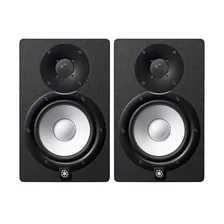 Ranked #24 of 68 in Large Size Powered Bookshelf Speakers - Yamaha HS8: $797.98 per pair Amazon eBay
Pros: ASR measurements support broadly neutral sound: a 2.3dB response span from 300Hz to 5kHz and 7.58 ideal-subwoofer score. Measured -3dB bass extension of 43.9Hz gives useful weight for music, with straightforward analog connections and room-adjustment controls. Measured bass extension of 43.9Hz (-3dB).
Cons: Its response and off-axis behavior are not as refined as the leading monitors. Vertical positioning around the crossover matters, and a subwoofer remains useful for deep bass. Basic rear-panel controls do not replace measured room correction.
Full Yamaha HS8 review and specifications →
| AES Input | No |
|---|---|
| Amplifier Power | 120w Per Speaker |
| App | No |
| Aux Input | No |
| Bass Extension (-10dB) | 34.7Hz (measured, Audio Science Review) |
| Bass Extension (-3dB) | 43.9Hz (measured, Audio Science Review) |
| Bluetooth | No |
| Coaxial Input | No |
| DSP | No |
| Dimensions | 15.4”H x 9.8”W x 13.1”D (391.2 x 248.9 x 332.7 mm) |
| Drivers | 8” woofer, 1” dome tweeter |
| EQ | Yes (Room adjustment) |
| Frequency Response | 47Hz - 24kHz (-3dB) (Manufacturer specified) |
| HDMI Input | No |
| Inputs | XLR |
| Optical Input | No |
| RCA Input | No |
| Spinorama Preference Score | 5.85 |
| Spinorama Preference Score with Perfect Sub | 7.58 |
| TRS Input | No |
| USB Input | No |
| Weight | 22.5 lbs (10.2 kg) |
| XLR Input | Yes |
- Links
- Reviews, Comparisons and Sound Samples
- Audio Science Review: Yamaha HS8 Studio Monitor Review More from Audio Science Review →
- Sercan Solmaz: Adam Audio T8V vs Yamaha HS8 vs KRK Rokit 8 (STUDIO SPEAKER SOUND TEST)
- DSAUDIO.review: DSAUDIO.review Edifier R2850DB vs Yamaha HS8 sound.DEMO More from DSAUDIOreview →
- DSAUDIO.review: DSAUDIO.review Adam Audio A7X vs Yamaha HS8 sound.DEMO
- DSAUDIO.review: Yamaha HS7 vs Yamaha HS8 Sound & Frequency Response Comparison
- DSAUDIO.review: Yamaha HS8 vs Yamaha HS5 Sound & Frequency Response Comparison
- DSAUDIO.review: Genelec 8020D vs Yamaha HS8 Sound & Frequency Response Comparison
- DSAUDIO.review: DSAUDIO.review APS Klasik 2020 vs Yamaha HS8 sound.DEMO
- DSAUDIO.review: DSAUDIO.review Focal Alpha 65 EVO vs Yamaha HS8 sound.DEMO
- DSAUDIO.review: Yamaha HS8 vs PreSonus Eris E8 XT Sound & Frequency Response Comparison
- DSAUDIO.review: Yamaha HS8 vs Kali Audio LP-8 Sound & Frequency Response Comparison
- DSAUDIO.review: KRK Rokit 8 G4 RP8G4 vs Yamaha HS8 Sound & Frequency Response Comparison
- DSAUDIO.review: Neumann KH80 DSP vs Yamaha HS8 Sound & Frequency Response Comparison
- DSAUDIO.review: Yamaha HS8 vs IK Multimedia iLoud MTM Sound & Frequency Response Comparison
- Audio Science Review Measurements (spinorama.org)
- Head-to-Head Comparisons
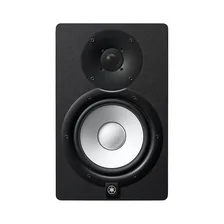 Ranked #53 of 68 in Large Size Powered Bookshelf Speakers - Yamaha HS7: $699.98 per pair Amazon eBay
Pros: A straightforward analog monitor with boundary and treble controls. The measured -6dB point is 43.9Hz, so there is useful bass below the upper-bass region; the ideal-subwoofer score is 6.48.
Cons: Its uneven bass response crosses -3dB around 87.9Hz in the normalized measurement, so quoting the 41Hz low-frequency score input as flat bass extension is misleading. A 2.8dB response span from 300Hz to 5kHz and crossover-related variation also limit neutrality. Bass support does not fix all midrange and treble irregularities.
Full Yamaha HS7 review and specifications →
| AES Input | No |
|---|---|
| Amplifier Power | 95W each (60W LF, 35W HF) |
| Aux Input | No |
| Bluetooth | No |
| Coaxial Input | No |
| Country | Japan (design) |
| Dimensions | 13.1H x 8.3W x 11.2D in |
| Drivers | 1” dome tweeter, 6.5” cone woofer |
| Enclosure | 2-way active, rear-ported |
| Frequency Response | 43Hz - 30kHz (Manufacturer specified) |
| HDMI Input | No |
| Inputs | Balanced XLR and 1/4” TRS |
| Optical Input | No |
| RCA Input | No |
| Spinorama Preference Score | 4.54 |
| Spinorama Preference Score with Perfect Sub | 6.48 |
| TRS Input | Yes |
| USB Input | No |
| Weight | 18.1 lbs (8.2 kg) each |
| XLR Input | Yes |
- Links
- Reviews, Comparisons and Sound Samples
- Head-to-Head Comparisons
8-Inch PA Speakers
 Ranked #4 of 22 in 8-Inch PA Speakers - Yamaha DXR8mkII: $769.99 Amazon B&H Photo Video Guitar Center eBay
Pros: Medium-quality vendor data shows a 5.89 ideal-subwoofer preference score with 64Hz measured extension, among the strongest results here. Yamaha’s FIR-X processing, a 1.75-inch neodymium compression driver and a 90° x 60° constant-directivity horn carry over the larger DXR models’ engineering into a compact cabinet. Measured bass extension of 69Hz (-3dB).
Cons: No mkIII successor exists for this size yet, so it is the oldest design generation in this ranking’s Yamaha lineup, without app control or Bluetooth audio.
Full Yamaha DXR8mkII review and specifications →
| AES Input | No |
|---|---|
| Amplifier Power | 1100W dynamic / 700W continuous (950W LF + 150W HF dynamic) |
| Aux Input | No |
| Bass Extension (-3dB) | 69Hz (measured, vendor Spinorama data) |
| Bluetooth | No |
| Cabinet Material | Matte-finish ABS |
| Coaxial Input | No |
| Configuration | Active 2-way bass-reflex PA speaker |
| Coverage | 90° x 60° |
| DSP | Yes |
| Dimensions | 18”H x 11”W x 11”D (458 x 280 x 280 mm) |
| Drivers | 8” woofer, 1.75” compression driver |
| Frequency Response | 57Hz - 20kHz (-10dB, manufacturer specified) |
| Guitar Input | No |
| HDMI Input | No |
| Inputs | XLR, dual 1/4-inch, stereo RCA; XLR thru and link outputs |
| Maximum SPL | 130dB peak (manufacturer specified) |
| Microphone Input | No |
| Optical Input | No |
| RCA Input | Yes |
| Rigging | 3 x M8 points; 35mm dual-angle pole mount |
| Spinorama Preference Score | 3.08 |
| Spinorama Preference Score with Perfect Sub | 5.89 |
| TRS Input | Yes |
| USB Input | No |
| Weight | 28.2 lbs (12.8 kg) |
| XLR Input | Yes |
- Links
- Reviews, Comparisons and Sound Samples
- Head-to-Head Comparisons
10-Inch PA Speakers
 Ranked #11 of 28 in 10-Inch PA Speakers - Yamaha DXR10mkIII: $899.99 Amazon B&H Photo Video Guitar Center eBay
Pros: The third-generation DXR10 raises claimed output to 132dB with refined porting and Yamaha’s newest onboard DSP, while staying light at 14.5kg with a familiar 90° x 60° pattern. Measured bass extension of 61.5Hz (-3dB).
Cons: The low-quality local data is truncated and cannot produce a preference score, so its tonal advantage over the proven DXR10mkII is unconfirmed.
Full Yamaha DXR10mkIII review and specifications →
| AES Input | No |
|---|---|
| Amplifier Power | 2000W peak / 1000W RMS (1700W LF + 300W HF peak) |
| Aux Input | No |
| Bass Extension (-3dB) | 61.5Hz (measured, vendor Spinorama data) |
| Bluetooth | Yes, 5.0 (audio streaming and D-Remote control) |
| Cabinet Material | PP plastic |
| Coaxial Input | No |
| Configuration | Active 2-way bass-reflex PA speaker |
| Coverage | 90° x 60° |
| Crossover Frequency | 1800Hz (FIR-X) |
| DSP | Yes, FIR-X tuning, Drive Motion Calibration and D-Remote |
| Dimensions | 19.8”H x 12.2”W x 12.2”D (502 x 310 x 310 mm) |
| Drivers | 10” woofer, 1” throat/1.75” diaphragm compression driver |
| Frequency Response | 53Hz - 20kHz (-10dB, manufacturer specified) |
| Guitar Input | No |
| HDMI Input | No |
| Inputs | 2 x XLR/TRS combo; XLR thru and DSP outputs |
| Maximum SPL | 132dB peak (manufacturer specified) |
| Microphone Input | No |
| Optical Input | No |
| RCA Input | No |
| Rigging | 3 x M8 points plus U-bracket points; 35mm dual-angle pole mount |
| TRS Input | Yes |
| USB Input | No |
| Weight | 32 lbs (14.5 kg) |
| XLR Input | Yes |
- Links
- Reviews, Comparisons and Sound Samples
- Head-to-Head Comparisons
- Yamaha DXR10mkIII vs Yamaha DXR10mkII
- Yamaha DXR10mkIII vs dBTechnologies Opera Reevo 210
- Yamaha DXR10mkIII vs Seeburg X4
- Yamaha DXR10mkIII vs RCF KX 10-A
- Yamaha DXR10mkIII vs Vue Audiotechnik A-10
- Yamaha DXR10mkIII vs Turbosound NuQ102
- Yamaha DXR10mkIII vs KV2 Audio EX10
- Yamaha DXR10mkIII vs RCF ART 710-A MK5
- See all 18 comparisons
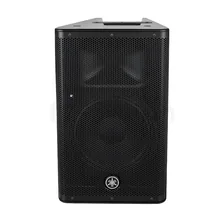 Ranked #12 of 28 in 10-Inch PA Speakers - Yamaha DXR10mkII: $814.99 Amazon B&H Photo Video Guitar Center eBay
Pros: A proven, broadly distributed workhorse: medium-quality vendor data shows a 5.16 ideal-subwoofer preference score with 67Hz measured extension, and Yamaha’s FIR-X processing and D-Contour compressor simplify setup. Measured bass extension of 73Hz (-3dB).
Cons: It lacks app control or Bluetooth audio found on some newer competitors, and its measured preference sits mid-pack for this ranking.
Full Yamaha DXR10mkII review and specifications →
| AES Input | No |
|---|---|
| Amplifier Power | 1100W dynamic / 700W continuous (950W LF + 150W HF dynamic) |
| Aux Input | No |
| Bass Extension (-3dB) | 73Hz (measured, vendor Spinorama data) |
| Bluetooth | No |
| Cabinet Material | Matte-finish ABS |
| Coaxial Input | No |
| Configuration | Active 2-way bass-reflex PA speaker |
| Coverage | 90° x 60° (wide-dispersion constant directivity horn) |
| DSP | Yes |
| Dimensions | 19.8”H x 12”W x 12.2”D (502 x 305 x 310 mm) |
| Drivers | 10” woofer, 1.75” compression driver |
| Frequency Response | 56Hz - 20kHz (-10dB, manufacturer specified) |
| Guitar Input | No |
| HDMI Input | No |
| Inputs | XLR, dual 1/4-inch, stereo RCA; XLR thru and link outputs |
| Maximum SPL | 132dB peak (manufacturer specified) |
| Microphone Input | No |
| Optical Input | No |
| RCA Input | Yes |
| Rigging | 3 x M8 points; 35mm dual-angle pole mount |
| Spinorama Preference Score | 2.30 |
| Spinorama Preference Score with Perfect Sub | 5.16 |
| TRS Input | Yes |
| USB Input | No |
| Weight | 30.6 lbs (13.9 kg) |
| XLR Input | Yes |
- Links
- Reviews, Comparisons and Sound Samples
- Head-to-Head Comparisons
- Yamaha DXR10mkII vs Yamaha DXR10mkIII
- Yamaha DXR10mkII vs Vue Audiotechnik A-10
- Yamaha DXR10mkII vs dBTechnologies Opera Reevo 210
- Yamaha DXR10mkII vs KV2 Audio EX10
- Yamaha DXR10mkII vs RCF KX 10-A
- Yamaha DXR10mkII vs RCF ART 710-A MK5
- Yamaha DXR10mkII vs FBT ProMaxX 110A
- Yamaha DXR10mkII vs RCF NX 910-A
- See all 16 comparisons
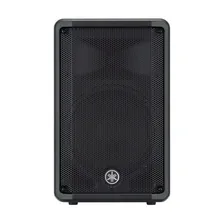 Ranked #23 of 28 in 10-Inch PA Speakers - Yamaha DBR10: $348.49 Amazon B&H Photo Video Guitar Center eBay
Pros: Yamaha’s most portable 10-inch powered speaker carries the same DSP and amplification platform as the DXR and DZR series, with a built-in 2-channel mixer accepting XLR, 1/4-inch and RCA sources. Measured bass extension of 69Hz (-3dB).
Cons: Medium-quality vendor data shows a 4.75 ideal-subwoofer preference score, mid-pack for this ranking, so a subwoofer partner matters for full-range material.
Full Yamaha DBR10 review and specifications →
| AES Input | No |
|---|---|
| Amplifier Power | 700W dynamic / 325W continuous (500W LF + 200W HF dynamic) |
| Aux Input | No |
| Bass Extension (-3dB) | 69Hz (measured, vendor Spinorama data) |
| Bluetooth | No |
| Cabinet Material | Plastic |
| Coaxial Input | No |
| Configuration | Active 2-way bass-reflex PA speaker |
| Coverage | 90° x 60° |
| DSP | Yes |
| Dimensions | 19.4”H x 12.1”W x 11.4”D (493 x 308 x 289 mm) |
| Drivers | 10” woofer, 1” compression driver |
| Frequency Response | 55Hz - 20kHz (-10dB, manufacturer specified) |
| Guitar Input | No |
| HDMI Input | No |
| Inputs | 2 x XLR/TRS combo and stereo RCA; XLR output |
| Maximum SPL | 129dB peak (manufacturer specified) |
| Microphone Input | No |
| Optical Input | No |
| RCA Input | Yes |
| Rigging | 2 x M8 points; 35mm pole mount |
| Spinorama Preference Score | 2.00 |
| Spinorama Preference Score with Perfect Sub | 4.75 |
| TRS Input | Yes |
| USB Input | No |
| Weight | 23.1 lbs (10.5 kg) |
| XLR Input | Yes |
- Links
- Reviews, Comparisons and Sound Samples
- Head-to-Head Comparisons
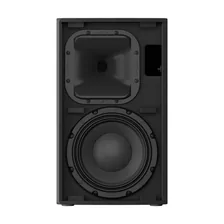 Ranked #24 of 28 in 10-Inch PA Speakers - Yamaha DZR10: $1,309.99 Amazon B&H Photo Video Guitar Center eBay
Pros: The bi-amped 2-inch titanium compression driver and 137dB claimed peak, the highest maximum-output claim in this ranking, give it genuine main-speaker capability in a 10-inch cabinet with sophisticated onboard DSP. Measured bass extension of 60Hz (-3dB).
Cons: Medium-quality vendor data shows a 4.7 ideal-subwoofer preference score, one of the more modest results here relative to its price, and it lacks Bluetooth audio or app control.
Full Yamaha DZR10 review and specifications →
| AES Input | No |
|---|---|
| Amplifier Power | 2000W dynamic / 1100W burst / 950W continuous |
| Aux Input | No |
| Bass Extension (-3dB) | 60Hz (measured, vendor Spinorama data) |
| Bluetooth | No |
| Cabinet Material | Plywood with polyurea coating |
| Coaxial Input | No |
| Configuration | Active 2-way bi-amped bass-reflex PA speaker |
| Coverage | 90° x 60°, rotatable |
| Crossover Frequency | 1800Hz (FIR-X) |
| DSP | Yes, FIR-X tuning and Drive Motion Calibration |
| Dimensions | 21.1”H x 12.4”W x 13.6”D (537 x 315 x 345 mm) |
| Drivers | 10” woofer, 2” compression driver |
| Frequency Response | 44Hz - 20kHz (-10dB, manufacturer specified) |
| Guitar Input | No |
| HDMI Input | No |
| Inputs | 2 x XLR/TRS combo; 2 x XLR output |
| Maximum SPL | 137dB peak (manufacturer specified) |
| Microphone Input | No |
| Optical Input | No |
| RCA Input | No |
| Rigging | 8 x M10 and 2 x M8 points; dual 35mm pole mounts |
| Spinorama Preference Score | 2.24 |
| Spinorama Preference Score with Perfect Sub | 4.72 |
| TRS Input | Yes |
| USB Input | No |
| Weight | 39.5 lbs (17.9 kg) |
| XLR Input | Yes |
- Links
- Reviews, Comparisons and Sound Samples
- Head-to-Head Comparisons
12-Inch PA Speakers
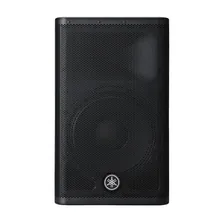 Ranked #13 of 51 in 12-Inch PA Speakers - Yamaha DXR12mkIII: $999.99 Amazon B&H Photo Video Guitar Center eBay
Pros: The third-generation DXR raises claimed output to 134dB and adds 2000W amplification, app-based control and more capable onboard DSP while staying light at 17.4kg. Medium-quality vendor data shows measured extension around 60Hz. Measured bass extension of 60Hz (-3dB).
Cons: The truncated Spinorama data does not produce a preference score, so its tonal advantage over the proven DXR12mkII is not yet quantified. Wireless connectivity is for remote control, not a substitute for a wired production-audio input.
Full Yamaha DXR12mkIII review and specifications →
| AES Input | No |
|---|---|
| Amplifier Power | 2000W peak / 1000W RMS (1700W LF + 300W HF peak) |
| Aux Input | No |
| Bass Extension (-3dB) | 60Hz (measured, vendor Spinorama data) |
| Bluetooth | Yes, 5.0 (audio streaming and D-Remote control) |
| Cabinet Material | PP plastic |
| Coaxial Input | No |
| Configuration | Active 2-way bass-reflex PA speaker |
| Coverage | 90° x 60° |
| Crossover Frequency | 1800Hz (FIR-X) |
| DSP | Yes, FIR-X tuning, Drive Motion Calibration and D-Remote |
| Dimensions | 23.6”H x 14.4”W x 13.8”D (600 x 366 x 350 mm) |
| Drivers | 12” woofer, 1” throat/1.75” diaphragm compression driver |
| Frequency Response | 50Hz - 20kHz (-10dB, manufacturer specified) |
| Guitar Input | No |
| HDMI Input | No |
| Inputs | Balanced mic/line inputs and link output |
| Maximum SPL | 134dB peak (manufacturer specified) |
| Microphone Input | Yes |
| Optical Input | No |
| RCA Input | No |
| Rigging | 3 x M10 points plus U-bracket points; 35mm dual-angle pole mount |
| TRS Input | No |
| USB Input | No |
| Weight | 38.4 lbs (17.4 kg) |
| XLR Input | No |
- Links
- Reviews, Comparisons and Sound Samples
- Head-to-Head Comparisons
- Yamaha DXR12mkIII vs RCF ART 912-A
- Yamaha DXR12mkIII vs HK Audio LINEAR 7 112 XA
- Yamaha DXR12mkIII vs RCF NX 932-A
- Yamaha DXR12mkIII vs RCF ART 932-A
- Yamaha DXR12mkIII vs Yamaha DXR12mkII
- Yamaha DXR12mkIII vs Axiom ED120A
- Yamaha DXR12mkIII vs RCF KX 32-A
- Yamaha DXR12mkIII vs RCF NX 912-A
- See all 25 comparisons
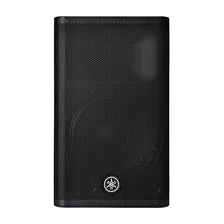 Ranked #17 of 51 in 12-Inch PA Speakers - Yamaha DXR12mkII: $909.99 Amazon B&H Photo Video Guitar Center eBay
Pros: A proven, broadly distributed workhorse with a flexible three-channel input section and 134dB claimed maximum output. Medium-quality vendor Spinorama data and 61Hz measured extension provide more evidence than many PA competitors, while Yamaha’s FIR-X processing and D-CONTOUR presets simplify setup. Measured bass extension of 61Hz (-3dB).
Cons: The 5.49 ideal-subwoofer preference score is only mid-pack, with meaningful response/directivity irregularity in the supplied data. It lacks app control and Bluetooth audio, and newer competitors offer more user-adjustable DSP.
Full Yamaha DXR12mkII review and specifications →
| AES Input | No |
|---|---|
| Amplifier Power | 1100W dynamic / 700W continuous (950W LF + 150W HF dynamic) |
| Aux Input | No |
| Bass Extension (-3dB) | 61Hz (measured, vendor Spinorama data) |
| Bluetooth | No |
| Cabinet Material | Matte-finish ABS |
| Coaxial Input | No |
| Configuration | Active 2-way bass-reflex PA speaker |
| Coverage | 90° x 60° |
| DSP | Yes |
| Dimensions | 23.7”H x 14.3”W x 13.8”D (601 x 362 x 350 mm) |
| Drivers | 12” woofer, 1.75” compression driver |
| Frequency Response | 52Hz - 20kHz (manufacturer specified) |
| Guitar Input | No |
| HDMI Input | No |
| Inputs | 2 x XLR/TRS combo, stereo RCA |
| Maximum SPL | 134dB peak (manufacturer specified) |
| Microphone Input | No |
| Optical Input | No |
| RCA Input | Yes |
| Rigging | 3 x M10 points; 35mm dual-angle pole mount |
| Spinorama Preference Score | 2.78 |
| Spinorama Preference Score with Perfect Sub | 5.49 |
| TRS Input | Yes |
| USB Input | No |
| Weight | 41 lbs (18.6 kg) |
| XLR Input | Yes |
- Links
- Reviews, Comparisons and Sound Samples
- Head-to-Head Comparisons
- Yamaha DXR12mkII vs Axiom ED120A
- Yamaha DXR12mkII vs EAW MKD1200
- Yamaha DXR12mkII vs HK Audio LINEAR 9 112 XA
- Yamaha DXR12mkII vs FBT Mitus 112A
- Yamaha DXR12mkII vs HK Audio LINEAR 7 112 XA
- Yamaha DXR12mkII vs RCF NX 912-A
- Yamaha DXR12mkII vs Yamaha DXR12mkIII
- Yamaha DXR12mkII vs Yamaha DZR12
- See all 23 comparisons
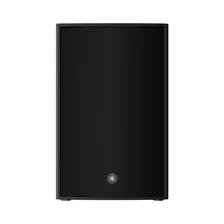 Ranked #21 of 51 in 12-Inch PA Speakers - Yamaha DZR12: $1,409.99 Amazon B&H Photo Video Guitar Center eBay
Pros: Premium cabinet construction, 139dB claimed output and deep onboard 96kHz DSP suit demanding live work. The local vendor data shows useful 48Hz measured extension, the deepest result among the scored Yamaha models here. Measured bass extension of 48Hz (-3dB).
Cons: Its medium-quality vendor measurement produces only a 4.91 ideal-subwoofer preference score, so the price buys output, processing and build more than neutral tonality. It is heavy at roughly 21kg and has no Bluetooth audio.
Full Yamaha DZR12 review and specifications →
| AES Input | No |
|---|---|
| Amplifier Power | 2000W dynamic / 1100W burst / 950W continuous |
| Aux Input | No |
| Bass Extension (-3dB) | 48Hz (measured, vendor Spinorama data) |
| Bluetooth | No |
| Cabinet Material | Plywood with polyurea coating |
| Coaxial Input | No |
| Configuration | Active 2-way bass-reflex PA speaker |
| Coverage | 90° x 60° |
| Crossover Frequency | 1800Hz (FIR-X) |
| DSP | Yes |
| Dimensions | 25.4”H x 16.1”W x 15.5”D (646 x 410 x 394 mm) |
| Drivers | 12” woofer, 2” compression driver |
| Frequency Response | 39Hz - 20kHz (manufacturer specified) |
| Guitar Input | No |
| HDMI Input | No |
| Inputs | 2 x XLR/TRS combo |
| Maximum SPL | 139dB peak (manufacturer specified) |
| Microphone Input | No |
| Optical Input | No |
| RCA Input | No |
| Rigging | M10 points; dual 35mm pole mounts |
| Spinorama Preference Score | 2.64 |
| Spinorama Preference Score with Perfect Sub | 4.91 |
| TRS Input | Yes |
| USB Input | No |
| Weight | 47.2 lbs (21.4 kg) |
| XLR Input | Yes |
- Links
- Reviews, Comparisons and Sound Samples
- Head-to-Head Comparisons
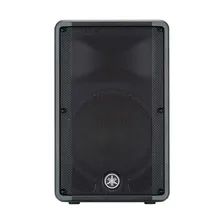 Ranked #33 of 51 in 12-Inch PA Speakers - Yamaha DBR12: $459.99 Amazon B&H Photo Video Guitar Center eBay
Pros: A lightweight, widely supported entry point with a useful two-channel mixer, FIR-X crossover processing and straightforward main/monitor presets. The 58Hz measured extension is adequate for speech and modest music playback without a subwoofer. Measured bass extension of 58Hz (-3dB).
Cons: Medium-quality vendor data produces a below-average 4.92 ideal-subwoofer preference score, indicating substantial tonal/directivity compromises. Its 131dB output claim and controls also sit below Yamaha’s DXR and DZR tiers.
Full Yamaha DBR12 review and specifications →
| AES Input | No |
|---|---|
| Amplifier Power | 1000W dynamic / 465W continuous (800W LF + 200W HF dynamic) |
| Aux Input | No |
| Bass Extension (-3dB) | 58Hz (measured, vendor Spinorama data) |
| Bluetooth | No |
| Cabinet Material | Plastic |
| Coaxial Input | No |
| Configuration | Active 2-way bass-reflex PA speaker |
| Coverage | 90° x 60° |
| DSP | Yes |
| Dimensions | 23.7”H x 14.8”W x 13.7”D (601 x 376 x 348 mm) |
| Drivers | 12” woofer, 1.4” compression driver |
| Frequency Response | 52Hz - 20kHz (manufacturer specified) |
| Guitar Input | No |
| HDMI Input | No |
| Inputs | 2 x XLR/TRS combo, stereo RCA |
| Maximum SPL | 131dB peak (manufacturer specified) |
| Microphone Input | No |
| Optical Input | No |
| RCA Input | Yes |
| Rigging | 3 x M8 points; 35mm pole mount |
| Spinorama Preference Score | 2.32 |
| Spinorama Preference Score with Perfect Sub | 4.92 |
| TRS Input | Yes |
| USB Input | No |
| Weight | 34.8 lbs (15.8 kg) |
| XLR Input | Yes |
- Links
- Reviews, Comparisons and Sound Samples
- Head-to-Head Comparisons
- Yamaha DBR12 vs RCF ART 712-A MK5
- Yamaha DBR12 vs Coda Audio G512
- Yamaha DBR12 vs HK Audio LINEAR 5 112 FA
- Yamaha DBR12 vs DAS Audio Vantec 12A
- Yamaha DBR12 vs RCF HD 12-A MK5
- Yamaha DBR12 vs Martin Audio XP12
- Yamaha DBR12 vs RCF ART 732-A MK5
- Yamaha DBR12 vs RCF ART 732-A MK4
- See all 26 comparisons
15-Inch PA Speakers
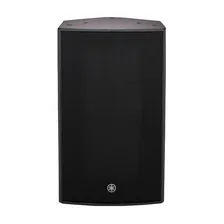 Ranked #8 of 39 in 15-Inch PA Speakers - Yamaha DZR15: $1,519.99 Amazon B&H Photo Video Guitar Center eBay
Pros: Medium-quality vendor data returns a 5.25 ideal-subwoofer preference score with 39Hz measured extension, deeper than the DZR12. The bi-amped 2-inch compression driver and sophisticated onboard DSP target serious main-speaker duty. Measured bass extension of 46.2Hz (-3dB).
Cons: The bass-extension figure comes from truncated manufacturer data and should be read cautiously. It lacks Bluetooth audio and app control, and at this price competes with systems-grade alternatives from RCF and HK Audio.
Full Yamaha DZR15 review and specifications →
| AES Input | No |
|---|---|
| Amplifier Power | 2000W dynamic / 1100W burst / 950W continuous |
| Aux Input | No |
| Bass Extension (-3dB) | 46.2Hz (measured, vendor Spinorama data) |
| Bluetooth | No |
| Cabinet Material | Plywood with polyurea coating |
| Coaxial Input | No |
| Configuration | Active 2-way bi-amped bass-reflex PA speaker |
| Coverage | 90° x 50°, rotatable |
| Crossover Frequency | 1700Hz (FIR-X) |
| DSP | Yes, FIR-X tuning and Drive Motion Calibration |
| Dimensions | 30”H x 17.7”W x 18.1”D (761 x 450 x 460 mm) |
| Drivers | 15” woofer, 2” compression driver |
| Frequency Response | 34Hz - 20kHz (-10dB, manufacturer specified) |
| Guitar Input | No |
| HDMI Input | No |
| Inputs | 2 x XLR/TRS combo; 2 x XLR output |
| Maximum SPL | 139dB peak (manufacturer specified) |
| Microphone Input | No |
| Optical Input | No |
| RCA Input | No |
| Rigging | 12 x M10 points; dual 35mm pole mounts |
| Spinorama Preference Score | 3.35 |
| Spinorama Preference Score with Perfect Sub | 5.25 |
| TRS Input | Yes |
| USB Input | No |
| Weight | 55.6 lbs (25.2 kg) |
| XLR Input | Yes |
- Links
- Reviews, Comparisons and Sound Samples
- Head-to-Head Comparisons
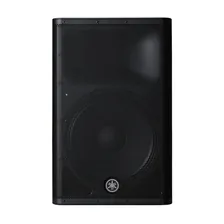 Ranked #15 of 39 in 15-Inch PA Speakers - Yamaha DXR15mkIII: $1,099.99 Amazon B&H Photo Video Guitar Center eBay
Pros: The third-generation DXR15 raises claimed output to 134dB with 2000W amplification, app-based control and Yamaha’s newest onboard DSP, while its 90° x 60° pattern matches the well-regarded DXR12mkIII. Measured bass extension of 54.5Hz (-3dB).
Cons: The low-quality local data is truncated and cannot produce a preference score, so its tonal advantage over the proven DXR15mkII is unconfirmed. Wireless connectivity is for remote control, not audio streaming.
Full Yamaha DXR15mkIII review and specifications →
| AES Input | No |
|---|---|
| Amplifier Power | 2000W peak / 1000W RMS (1700W LF + 300W HF peak) |
| Aux Input | No |
| Bass Extension (-3dB) | 54.5Hz (measured, vendor Spinorama data) |
| Bluetooth | Yes, 5.0 (audio streaming and D-Remote control) |
| Cabinet Material | PP plastic |
| Coaxial Input | No |
| Configuration | Active 2-way bass-reflex PA speaker |
| Coverage | 90° x 60° |
| Crossover Frequency | 1800Hz (FIR-X) |
| DSP | Yes, FIR-X tuning, Drive Motion Calibration and D-Remote |
| Dimensions | 27.5”H x 17.6”W x 15”D (699 x 447 x 380 mm) |
| Drivers | 15” woofer, 1” throat/1.75” diaphragm compression driver |
| Frequency Response | 46Hz - 20kHz (-10dB, manufacturer specified) |
| Guitar Input | No |
| HDMI Input | No |
| Inputs | 2 x XLR/TRS combo; XLR thru and DSP outputs |
| Maximum SPL | 134dB peak (manufacturer specified) |
| Microphone Input | No |
| Optical Input | No |
| RCA Input | No |
| Rigging | 3 x M10 points plus U-bracket points; 35mm dual-angle pole mount |
| TRS Input | Yes |
| USB Input | No |
| Weight | 46.3 lbs (21 kg) |
| XLR Input | Yes |
- Links
- Reviews, Comparisons and Sound Samples
- Head-to-Head Comparisons
- Yamaha DXR15mkIII vs Coda Audio G715
- Yamaha DXR15mkIII vs Axiom ED150A
- Yamaha DXR15mkIII vs FBT Mitus 115A
- Yamaha DXR15mkIII vs RCF ART 935-A
- Yamaha DXR15mkIII vs Yamaha DXR15mkII
- Yamaha DXR15mkIII vs JBL PRX915
- Yamaha DXR15mkIII vs RCF ART 715-A MK5
- Yamaha DXR15mkIII vs Yamaha DZR15
- See all 22 comparisons
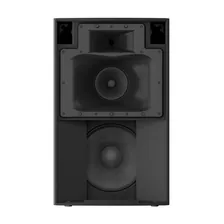 Ranked #16 of 39 in 15-Inch PA Speakers - Yamaha DZR315: $1,829.99 B&H Photo Video eBay
Pros: A 3-way design with a 15-inch woofer, 8-inch midrange and 2-inch compression driver, powered by a 2000W bi-amp and rated to 143dB, so it covers a large room on its own. Manufacturer measurements give a 5.06 preference score with an ideal subwoofer, and bass reaches 82.5Hz at -3dB and about 65Hz at -10dB. Onboard FIR DSP with an LCD screen handles presets, PEQ, delay and routing, with two combo inputs. Measured bass extension of 82.5Hz (-3dB).
Cons: A 4.4dB reference band and a 7.19 directivity-index deviation mean tonal balance and off-axis consistency are uneven, and the standalone preference score is only 1.93. It is large and expensive next to the 2-way DZR15.
Full Yamaha DZR315 review and specifications →
| AES Input | No |
|---|---|
| Amplifier Power | 2,000W Class-D bi-amplified |
| Aux Input | No |
| Bass Extension (-10dB) | about 64.6Hz (measured, vendor Spinorama data) |
| Bass Extension (-3dB) | 82.5Hz (measured, vendor Spinorama data) |
| Bluetooth | No |
| Coaxial Input | No |
| Configuration | Active 3-way PA speaker |
| Coverage | 75° x 50° |
| DSP | Yes, 96kHz FIR DSP with LCD, presets, PEQ, delay |
| Drivers | 15” woofer, 8” midrange, 2” compression driver |
| Frequency Response | 31Hz - 20kHz (-10dB, manufacturer specified) |
| Guitar Input | No |
| HDMI Input | No |
| Maximum SPL | 143dB (manufacturer specified) |
| Microphone Input | No |
| Optical Input | No |
| RCA Input | No |
| Spinorama Preference Score | 1.93 |
| Spinorama Preference Score with Perfect Sub | 5.06 |
| TRS Input | Yes |
| USB Input | No |
| XLR Input | Yes |
- Links
- Reviews, Comparisons and Sound Samples
- Head-to-Head Comparisons
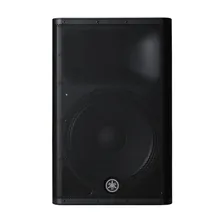 Ranked #19 of 39 in 15-Inch PA Speakers - Yamaha DXR15mkII: $899.99 Amazon B&H Photo Video Guitar Center eBay
Pros: A proven, broadly distributed workhorse: medium-quality vendor data shows a 4.98 ideal-subwoofer preference score with 61Hz measured extension, and Yamaha’s FIR-X processing and D-CONTOUR presets simplify setup. Measured bass extension of 67Hz (-3dB).
Cons: The preference score sits mid-pack for this ranking, and it lacks app control or Bluetooth audio found on some newer competitors.
Full Yamaha DXR15mkII review and specifications →
| AES Input | No |
|---|---|
| Amplifier Power | 1100W dynamic / 700W continuous (950W LF + 150W HF dynamic) |
| Aux Input | No |
| Bass Extension (-3dB) | 67Hz (measured, vendor Spinorama data) |
| Bluetooth | No |
| Cabinet Material | Matte-finish ABS |
| Coaxial Input | No |
| Configuration | Active 2-way bass-reflex PA speaker |
| Coverage | 90° x 60° (constant directivity horn) |
| DSP | Yes |
| Dimensions | 27.6”H x 17.5”W x 15”D (700 x 445 x 380 mm) |
| Drivers | 15” woofer, 1.75” compression driver |
| Frequency Response | 49Hz - 20kHz (-10dB, manufacturer specified) |
| Guitar Input | No |
| HDMI Input | No |
| Inputs | XLR, dual 1/4-inch, stereo RCA; XLR thru and link outputs |
| Maximum SPL | 134dB peak (manufacturer specified) |
| Microphone Input | No |
| Optical Input | No |
| RCA Input | Yes |
| Rigging | 3 x M10 points; 35mm dual-angle pole mount |
| Spinorama Preference Score | 2.28 |
| Spinorama Preference Score with Perfect Sub | 4.98 |
| TRS Input | Yes |
| USB Input | No |
| Weight | 48.1 lbs (21.8 kg) |
| XLR Input | Yes |
- Links
- Reviews, Comparisons and Sound Samples
- Head-to-Head Comparisons
- Yamaha DXR15mkII vs FBT Mitus 115A
- Yamaha DXR15mkII vs Electro-Voice MFX-15MC
- Yamaha DXR15mkII vs Turbosound NuQ152
- Yamaha DXR15mkII vs RCF ART 715-A MK5
- Yamaha DXR15mkII vs Yamaha DXR15mkIII
- Yamaha DXR15mkII vs RCF NX 915-A
- Yamaha DXR15mkII vs RCF ART 745-A MK5
- Yamaha DXR15mkII vs RCF ART 935-A
- See all 22 comparisons
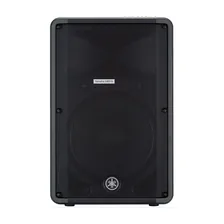 Ranked #37 of 39 in 15-Inch PA Speakers - Yamaha DBR15: $559.99 B&H Photo Video Guitar Center eBay
Pros: Yamaha’s most portable 15-inch powered speaker carries the same DSP and amplification platform as the DXR and DZR series, with a built-in 2-channel mixer accepting XLR, 1/4-inch, RCA and 3.5mm sources. Measured bass extension of 53Hz (-3dB).
Cons: Medium-quality vendor data shows a 2.87 ideal-subwoofer preference score, one of the weaker results in this ranking and well below the DBR12’s own measured result, so a subwoofer partner matters more here than with most alternatives.
Full Yamaha DBR15 review and specifications →
| AES Input | No |
|---|---|
| Amplifier Power | 1000W dynamic / 465W continuous (800W LF + 200W HF dynamic) |
| Aux Input | No |
| Bass Extension (-3dB) | 53Hz (measured, vendor Spinorama data) |
| Bluetooth | No |
| Cabinet Material | Plastic |
| Coaxial Input | No |
| Configuration | Active 2-way bass-reflex PA speaker |
| Coverage | 90° x 60° (constant directivity horn) |
| DSP | Yes |
| Dimensions | 27.6”H x 17.9”W x 14.9”D (700 x 455 x 378 mm) |
| Drivers | 15” woofer, 1.4” compression driver |
| Frequency Response | 50Hz - 20kHz (-10dB, manufacturer specified) |
| Guitar Input | No |
| HDMI Input | No |
| Inputs | 2 x XLR/TRS combo and stereo RCA; XLR output |
| Maximum SPL | 132dB peak (manufacturer specified) |
| Microphone Input | No |
| Optical Input | No |
| RCA Input | Yes |
| Rigging | 3 x M8 points; 35mm pole mount |
| Spinorama Preference Score | 0.49 |
| Spinorama Preference Score with Perfect Sub | 2.87 |
| TRS Input | Yes |
| USB Input | No |
| Weight | 42.5 lbs (19.3 kg) |
| XLR Input | Yes |
- Links
- Reviews, Comparisons and Sound Samples
- Head-to-Head Comparisons
Large Size Bookshelf Speakers
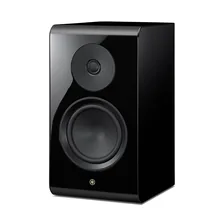 Ranked #58 of 134 in Large Size Bookshelf Speakers - Yamaha NS-800A: $4,999.90 per pair The Music Room eBay
Pros: Exceptionally well-built cabinet with no internal resonance issues at all: confirmed clean in both burst decay and impedance measurements. Good, wide directivity (~75 degrees horizontal) that stays consistent enough to EQ successfully. Distortion is low, staying under 3% at 96dB, and dynamic range holds up well until right near its 102dB limit. A shallower, higher-frequency bass rolloff profile (F3 68Hz, F10 35Hz) means it can be placed closer to the wall (about a foot) without turning boomy, actually gaining bass presence rather than losing it. Measured bass extension of 68Hz (-3dB), with a measured sensitivity of 84.9dB.
Cons: A wide, roughly 2kHz-10kHz scoop in the upper-midrange/lower-treble gives it a laidback, soft, low-attack character: notably worse than the reviewer’s Audio First Fidelia reference in an A/B comparison. On top of that, treble breaks up badly above 10kHz, swinging up as much as 8dB: a significant, named flaw. Sounds inconsistently voiced as a result (bright on some material like cymbals and shakers, dull/laidback on vocals and instrument attack) until corrected with real parametric EQ (the reviewer needed a +2dB boost around 4.5kHz at Q0.5 plus taming the treble spike to bring it to life) combined with near-wall placement and 30-degree toe-out. Without that combination, it’s a tough sale for a $5000 bookshelf speaker.
Full Yamaha NS-800A review and specifications →
| Bass Extension (-10dB) | 35Hz (measured, Erin’s Audio Corner) |
|---|---|
| Bass Extension (-3dB) | 68Hz (measured, Erin’s Audio Corner) |
| Crossover Frequency | 2600Hz |
| DIY Kit | No |
| Dimensions | 16.5”H x 9.1”W x 14.1”D (419.1 x 231.8 x 358.8 mm) |
| Drivers | 1.25” dome tweeter, 6.5” mid-woofer |
| Impedance | 6 ohms nominal, 4.3 ohms minimum (measured above 80Hz, Erin’s Audio Corner) |
| Power Handling | 40W nominal, 120W max |
| Sensitivity | 84.9dB (measured average 300Hz-3kHz @ 2.83V/1m, Erin’s Audio Corner; 86.5dB manufacturer specified) |
| Spinorama Preference Score | 4.66 |
| Spinorama Preference Score with Perfect Sub | 6.43 |
| Weight | 28.7 lbs (13.0 kg) each |
| Woofer Cabinet | Bass reflex |
- Links
- Reviews, Comparisons and Sound Samples
- Head-to-Head Comparisons
- Yamaha NS-800A vs Definitive Technology Demand D11
- Yamaha NS-800A vs ELAC DBR62
- Yamaha NS-800A vs Technics SB-C700
- Yamaha NS-800A vs Dynaudio Contour 20i
- Yamaha NS-800A vs ELAC Uni-Fi Reference UBR62
- Yamaha NS-800A vs SVS Ultra Bookshelf
- Yamaha NS-800A vs Revel Concerta2 M16
- Yamaha NS-800A vs Infinity Reference R162
- See all 23 comparisons
Small Home Subwoofers (Under 30 lbs)
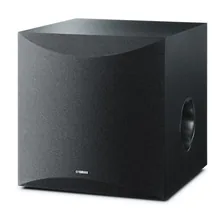 Ranked #35 of 48 in Small Home Subwoofers (Under 30 lbs) - Yamaha NS-SW100: $269.95 Amazon eBay
Pros: 10-inch ported with 100W RMS. Compact 26-pound design delivers surprising deep bass at tight price point. Twisted flare port provides accurate, powerfully rich response. Stylish design complements home decor while delivering satisfying bass depth.
Full Yamaha NS-SW100 review and specifications →
| CEA-2010-A Average (40-80Hz) | 105.0 dB |
|---|---|
| Cabinet Color | black |
| Country | Japan |
| Dimensions | 13.9”H x 13.9”W x 16.1”D (352.3 x 352.3 x 409.4 mm) |
| Drivers | 10” (254mm) driver |
| Enclosure | ported, side |
| Measurement Source | ErinsAudioCorner |
| Output SPL at 40 Hz | 97.4 dB |
| Output SPL at 50 Hz | 103.2 dB |
| Output SPL at 63 Hz | 108.6 dB |
| Output SPL at 80 Hz | 110.7 dB |
| Output SPL at 100 Hz | 109.7 dB |
| Output SPL at 125 Hz | 107.8 dB |
| Warranty | 2 |
| Weight | 26.5 lbs (12.0 kg) |
- Links
- Reviews, Comparisons and Sound Samples
- Head-to-Head Comparisons
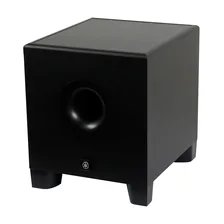 Ranked #36 of 48 in Small Home Subwoofers (Under 30 lbs) - Yamaha HS8S: $499.99 Amazon eBay
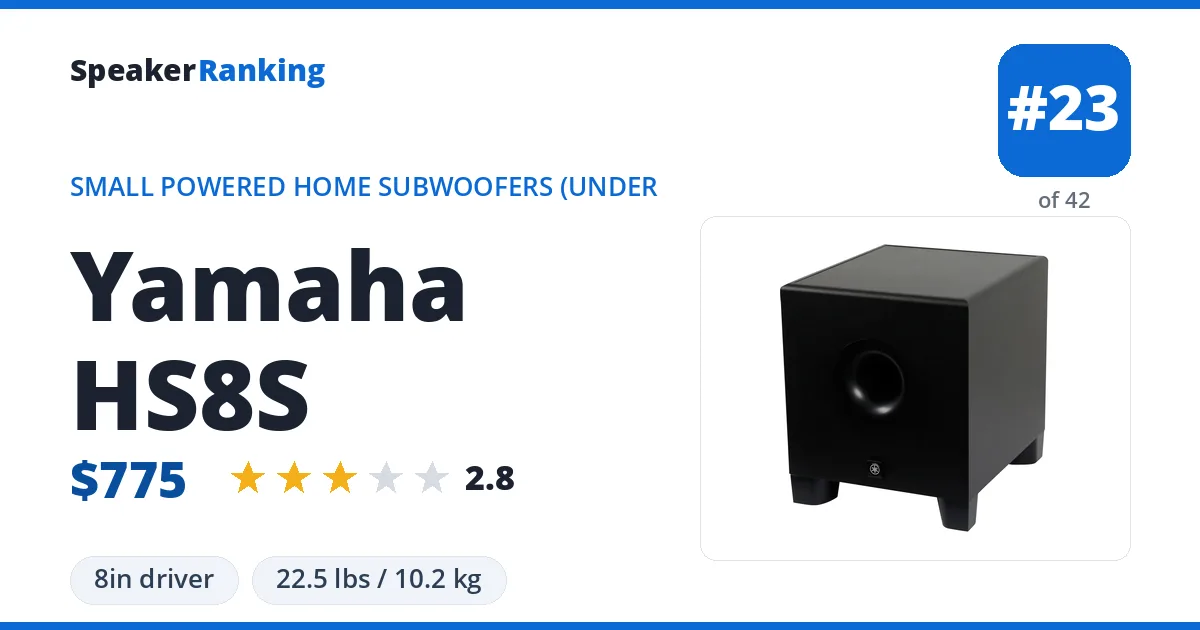
Pros: Independent CEA-2010 testing records 104.8 dB through 40-80 Hz. The ported, front enclosure with 8” (203mm) driver is intended to add useful bass support without a full-size cabinet.
Cons: Without a published 20 Hz output result, deep-bass capability is less certain than its midbass figure. The 349.2H x 300.0W x 388.9D mm cabinet and 10.2 kg mass still need careful placement and calibration.
Full Yamaha HS8S review and specifications →
| AES Input | No |
|---|---|
| Aux Input | No |
| CEA-2010-A Average (40-80Hz) | 104.8 dB |
| Cabinet Color | black |
| Coaxial Input | No |
| Country | Japan |
| Dimensions | 13.7”H x 11.8”W x 15.3”D (349.2 x 300.0 x 388.9 mm) |
| Drivers | 8” (203mm) driver |
| Enclosure | ported, front |
| HDMI Input | No |
| Inputs | XLR (2), TRS (2, balanced) |
| Measurement Source | ErinsAudioCorner |
| Optical Input | No |
| Output SPL at 31.5 Hz | 90.8 dB |
| Output SPL at 40 Hz | 100.7 dB |
| Output SPL at 50 Hz | 104.9 dB |
| Output SPL at 63 Hz | 106.3 dB |
| Output SPL at 80 Hz | 107.2 dB |
| Output SPL at 100 Hz | 105.7 dB |
| RCA Input | No |
| TRS Input | Yes |
| USB Input | No |
| Warranty | 2 |
| Weight | 22.5 lbs (10.2 kg) |
| XLR Input | Yes |
- Links
- Reviews, Comparisons and Sound Samples
- Head-to-Head Comparisons
Discontinued Yamaha Models
Still ranked, and often still worth buying used, but no longer in production. Check availability before planning around one of these.
Large Size Bookshelf Speakers
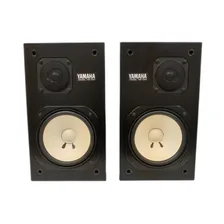 Ranked #129 of 134 in Large Size Bookshelf Speakers - Yamaha NS-10: $499 per pair Discontinued eBay
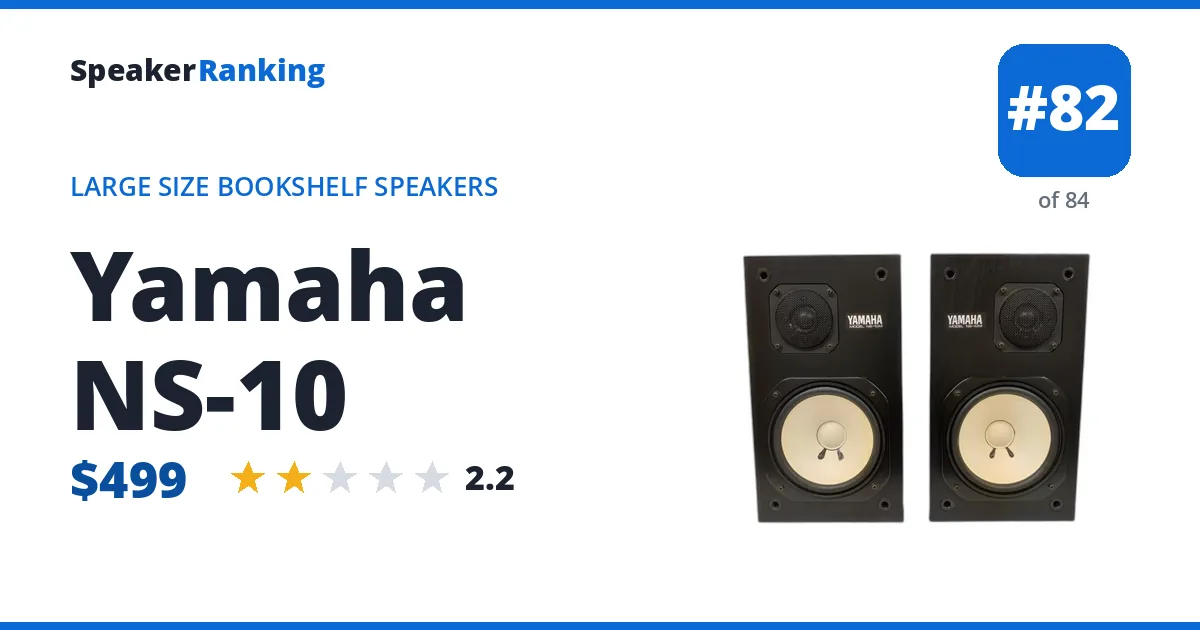
Pros: Legendary studio reference monitor with a well-documented history; Yamaha’s original spec sheet included genuine measured data (frequency response, distortion, impedance, polar response) rather than just marketing numbers, unusually transparent for the era. Distortion, compression, and multitone performance all measured better than the reviewer expected for a decades-old design: in some respects competitive with newer speakers he’s tested. Vertical dispersion holds up reasonably well for a speaker of this vintage. The redesigned “Studio” cabinet is more robust than the original, with crossover tweaks and nicer binding-post terminals. Sealed cabinet design allows placement close to a wall without added boominess, though at the cost of overall bass extension. Measured bass extension of 126Hz (-3dB), with a measured sensitivity of 90.2dB.
Cons: A pronounced peak of about 7dB above the midrange average around 1.7kHz gives the sound a forward, bright, or “tinny” character: this is the real underlying issue, and it wasn’t actually fixed by the “Studio” revision. Comparing the Studio version’s measured response to the original NS-10M’s published data, the original arguably measures more linear: Yamaha’s fix (lowering tweeter level by 2-3dB) left the core midrange peak largely untouched, addressing the wrong problem. The famous “tissue paper over the tweeter” mixing-engineer trick doesn’t actually help: testing it directly showed it adds diffraction and comb filtering rather than correcting the real midrange peak. Poor horizontal directivity, especially in its designed on-console orientation: usable window is only about ±20° off the tweeter axis before tonal character shifts noticeably. Directivity mismatches between direct and reflected sound make this difficult to properly correct with EQ in a typical farfield listening setup with nearby wall reflections. Bass is quite limited (F3 around 100Hz in most rooms once corrected for the inflated on-axis sensitivity reading), typical of a small sealed monitor design. Correcting the main midrange peak with EQ likely requires two bands rather than a single simple filter, since the peak isn’t perfectly symmetrical. Possible age-related tweeter compression at very high output, potentially from degraded ferrofluid affecting heat dissipation in these decades-old drivers. Discontinued.
Full Yamaha NS-10 review and specifications →
| Bass Extension (-10dB) | 75Hz (measured, Erin’s Audio Corner) |
|---|---|
| Bass Extension (-3dB) | 126Hz (measured, Erin’s Audio Corner) |
| DIY Kit | No |
| Dimensions | 15”H x 8.5”W x 7.8”D (382.0 x 215.0 x 198.0 mm) |
| Drivers | 7.1” woofer, 1.4” soft dome tweeter |
| Impedance | 8 ohms nominal, 5.4 ohms minimum (measured, Erin’s Audio Corner) |
| Sensitivity | 90.2dB (measured, Erin’s Audio Corner) |
| Spinorama Preference Score | 2.24 (spinorama.org) |
| Spinorama Preference Score with Perfect Sub | 5.63 (spinorama.org) |
| Weight | 9.5 lbs (4.3 kg) |
| Woofer Cabinet | sealed |
- Reviews, Comparisons and Sound Samples
- Head-to-Head Comparisons
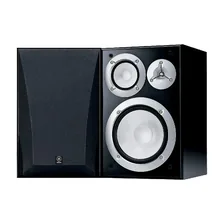 Ranked #134 of 134 in Large Size Bookshelf Speakers - Yamaha NS-6490: $129.95 per pair Discontinued eBay
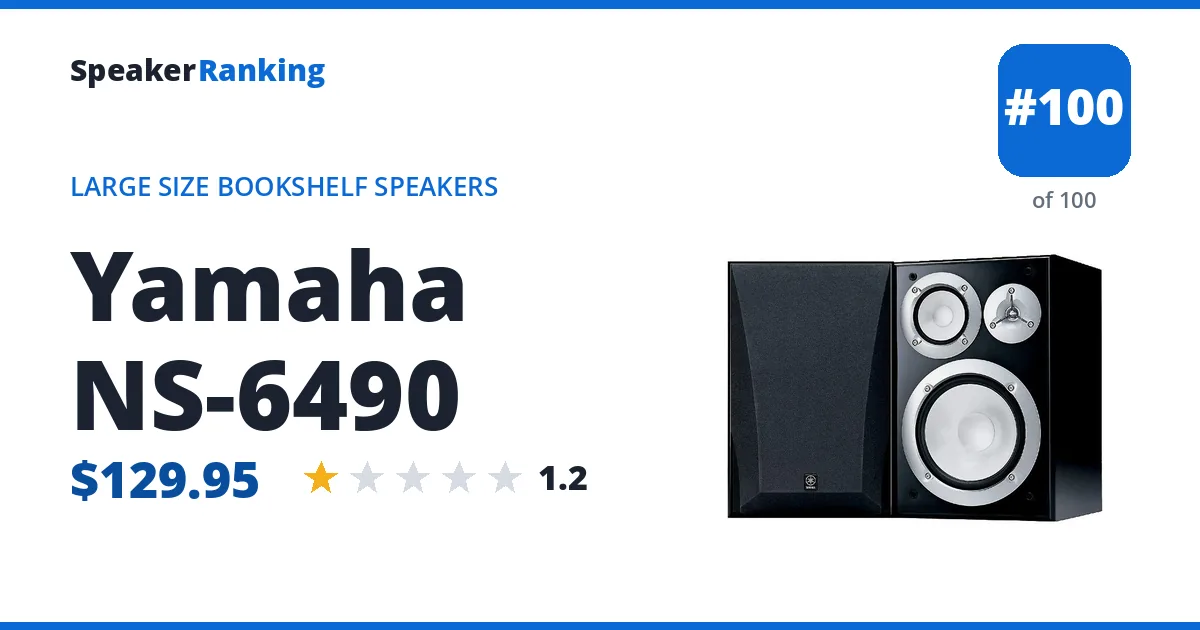
Pros: Attractive industrial design with a large 8-inch woofer for the price. Simple direct-driven woofer with capacitor-only mid/tweeter crossovers keeps the design straightforward. Measured bass extension of 54.4Hz (-10dB), with a measured sensitivity of 89.6dB.
Cons: Amir found the woofer runs essentially full-range with only a capacitor separating the mid and tweeter, letting all three drivers bleed into each other’s range and causing “rising amplitude” across the response. Extensive narrow peaking indicates numerous cabinet resonances: Amir noted, “we have more of them than I have ever seen.” Distortion is high across the measurement range, and directivity is highly variable, particularly vertically. With a 1.6 preference score, Amir concluded, “I just can’t recommend it,” noting that extensive EQ would not fix the underlying resonance issues. Discontinued and no longer sold new.
Full Yamaha NS-6490 review and specifications →
| Bass Extension (-10dB) | 54.4Hz (measured, Audio Science Review) |
|---|---|
| DIY Kit | No |
| Dimensions | 16.2H x 10.5W x 13.2D in |
| Drivers | 8” woofer, 4” midrange cone, 7/8” balanced dome tweeter (3-way, acoustic suspension) |
| Frequency Response | 45Hz - 23kHz (Manufacturer specified) |
| Impedance | 8 ohms |
| Power Handling | 70W nominal, 140W max |
| Sensitivity | 89.6dB (2.83V/1m, measured, Audio Science Review) |
| Spinorama Preference Score | 2.17 |
| Spinorama Preference Score with Perfect Sub | 5.05 |
| Weight | 13.2 lbs (6 kg) each |
- Links
- Reviews, Comparisons and Sound Samples
- Head-to-Head Comparisons
Small Home Subwoofers (Under 30 lbs)
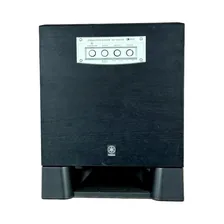 Ranked #22 of 48 in Small Home Subwoofers (Under 30 lbs) - Yamaha YST-SW215: $399 Discontinued eBay
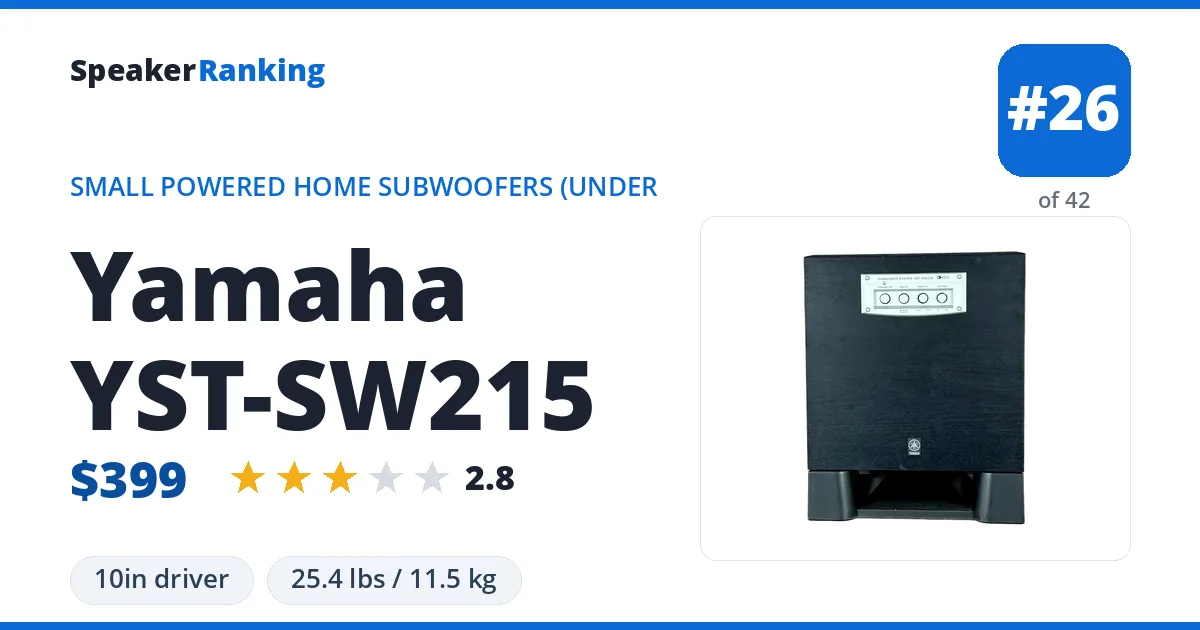
Pros: Independent CEA-2010 testing records 74.5 dB at 20 Hz and 109.6 dB through 40-80 Hz. The ported, side enclosure with 8” (203mm) driver is best suited to upper-bass support in a modest room.
Cons: Deep-bass output is limited relative to its midbass result, so it is not the right choice for the lowest movie effects. The 360.2H x 290.3W x 322.1D mm cabinet and 11.5 kg mass still need deliberate placement and calibration. Discontinued.
Full Yamaha YST-SW215 review and specifications →
| CEA-2010-A Average (40-80Hz) | 109.6 dB |
|---|---|
| Country | Japan |
| Dimensions | 14.2”H x 11.4”W x 12.7”D (360.2 x 290.3 x 322.1 mm) |
| Drivers | 8” (203mm) driver |
| Enclosure | ported, side |
| Measurement Source | Brent Butterworth |
| Output SPL at 20 Hz | 74.5 dB |
| Output SPL at 25 Hz | 85.7 dB |
| Output SPL at 31.5 Hz | 92.6 dB |
| Output SPL at 40 Hz | 99.7 dB |
| Output SPL at 50 Hz | 106.8 dB |
| Output SPL at 63 Hz | 113.5 dB |
| Output SPL at 80 Hz | 118.5 dB |
| Warranty | 2 |
| Weight | 25.4 lbs (11.5 kg) |
- Links
- Reviews, Comparisons and Sound Samples
- Independently measured by Brent Butterworth; the published figures above come from this ASR subwoofer measurement thread.
- Head-to-Head Comparisons
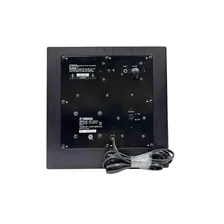 Ranked #28 of 48 in Small Home Subwoofers (Under 30 lbs) - Yamaha YST-SW012: $299 Discontinued eBay
Pros: Independent CEA-2010 testing records 62.0 dB at 20 Hz and 107.6 dB through 40-80 Hz. The ported, side enclosure with 8” (203mm) driver is best suited to upper-bass support in a modest room.
Cons: Deep-bass output is limited relative to its midbass result, so it is not the right choice for the lowest movie effects. The 288.8H x 288.8W x 326.9D mm cabinet and 8.5 kg mass still need deliberate placement and calibration. Discontinued.
Full Yamaha YST-SW012 review and specifications →
| CEA-2010-A Average (40-80Hz) | 107.6 dB |
|---|---|
| Country | Japan |
| Dimensions | 11.4”H x 11.4”W x 12.9”D (288.8 x 288.8 x 326.9 mm) |
| Drivers | 8” (203mm) driver |
| Enclosure | ported, side |
| Measurement Source | Brent Butterworth |
| Output SPL at 20 Hz | 62.0 dB |
| Output SPL at 25 Hz | 80.0 dB |
| Output SPL at 31.5 Hz | 91.5 dB |
| Output SPL at 40 Hz | 98.7 dB |
| Output SPL at 50 Hz | 105.5 dB |
| Output SPL at 63 Hz | 109.9 dB |
| Output SPL at 80 Hz | 116.2 dB |
| Warranty | 2 |
| Weight | 18.7 lbs (8.5 kg) |
- Links
- Reviews, Comparisons and Sound Samples
- Independently measured by Brent Butterworth; the published figures above come from this ASR subwoofer measurement thread.
- Head-to-Head Comparisons
Medium Home Subwoofers (30-75 lbs)
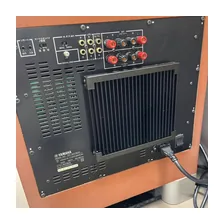 Ranked #38 of 146 in Medium Home Subwoofers (30-75 lbs) - Yamaha YST-SW1500: $699 Discontinued eBay
Pros: 12-inch ported with 1000W RMS. Extra-long stroke driver for outstanding power and low distortion. Heavy-duty construction with robust output capability. Compact yet powerful performance. Award recognition from multiple reviewers.
Cons: Discontinued.
Full Yamaha YST-SW1500 review and specifications →
| Amplifier Power | 1000W RMS |
|---|---|
| CEA-2010-A Average (40-80Hz) | 115.8 dB |
| Cabinet Color | black |
| Country | Japan |
| Dimensions | 20.1”H x 16.6”W x 17.6”D (511.0 x 420.6 x 447.5 mm) |
| Drivers | 12” (305mm) driver |
| Enclosure | ported, front |
| Frequency Response | 16-160Hz, -10dB |
| Measurement Source | Ilkka Rissanen |
| Output SPL at 20 Hz | 81.5 dB |
| Output SPL at 25 Hz | 96.1 dB |
| Output SPL at 31.5 Hz | 107.8 dB |
| Output SPL at 40 Hz | 111.7 dB |
| Output SPL at 50 Hz | 114.7 dB |
| Output SPL at 63 Hz | 118.0 dB |
| Output SPL at 80 Hz | 118.8 dB |
| Warranty | 2? |
| Weight | 63.9 lbs (29.0 kg) |
- Reviews, Comparisons and Sound Samples
- Independently measured by Ilkka Rissanen; the published figures above come from this ASR subwoofer measurement thread.