Short answer: choose between the QSC K12.2 and Yamaha DBR12 for the requirements of the venue and system, not from rank alone. In this size class, coverage, bass extension, output capability, DSP, cabinet construction, and service support often decide the better fit.
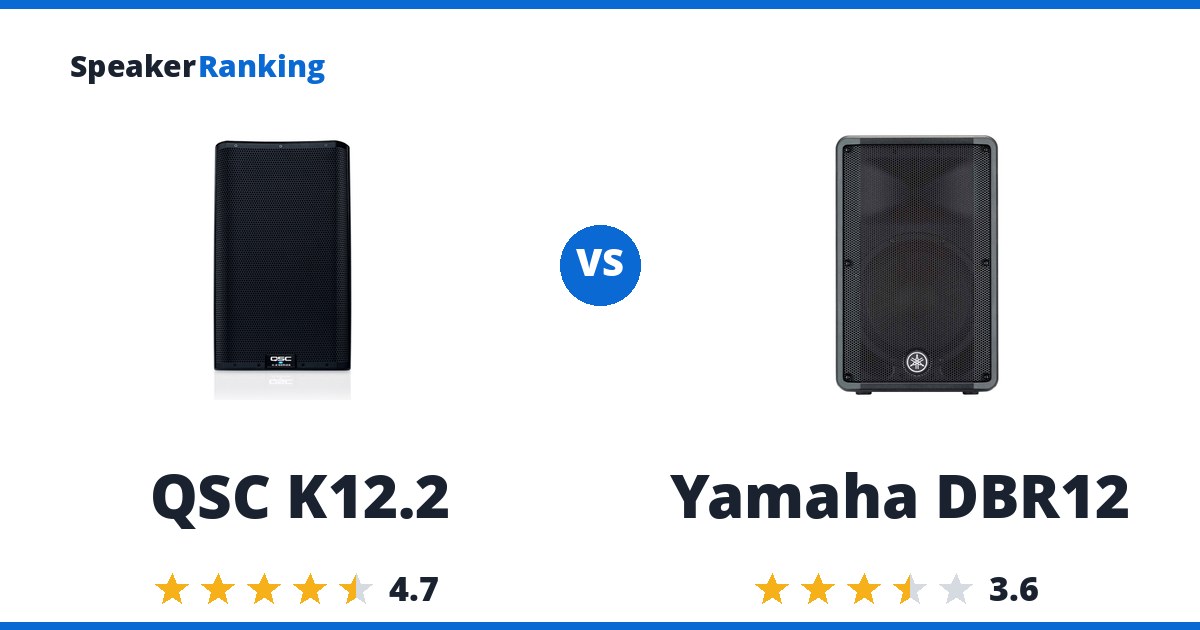
Why choose the QSC K12.2. The strongest all-round tonal result in this popular-model group: the vendor Spinorama data produces a 7.73 ideal-subwoofer preference score and 48Hz measured bass extension. Extensive onboard DSP, flexible main/monitor use and a long market track record make it an unusually safe general-purpose choice.
Why choose the Yamaha DBR12. A lightweight, widely supported entry point with a useful two-channel mixer, FIR-X crossover processing and straightforward main/monitor presets. The 58Hz measured extension is adequate for speech and modest music playback without a subwoofer.
What to weigh before buying. The underlying Spinorama source is low quality, so its apparent measured lead deserves caution. It is not the cheapest 12-inch option, and serious dance music or high-output live use still benefits from a subwoofer. Medium-quality vendor data produces a below-average 4.92 ideal-subwoofer preference score, indicating substantial tonal/directivity compromises. Its 131dB output claim and controls also sit below Yamaha’s DXR and DZR tiers.
Buy the QSC K12.2 when its stated coverage, output, processing, and deployment format best match the job.
Buy the Yamaha DBR12 when its stated strengths are the better match for the room and the rest of the PA.
Looking for alternatives? See the complete PA & Live Sound rankings.

A reliable 12 inch PA speaker with excellent sound and flexible built in processing, a safe choice for most events.

An affordable, light 12 inch powered PA speaker with a two channel mixer and simple main and monitor presets.
Prices on this page were last checked October 23, 2026 at 8:27 AM UTC. Product prices and availability are accurate as of that date/time and are subject to change; the price and availability shown on Amazon at the time of purchase will apply to the purchase of this product.
As an eBay Partner, we may be compensated if you make a purchase.
Specifications Side By Side
| QSC K12.2 | Yamaha DBR12 | |
|---|---|---|
| Price | $899.99 | $459.99 |
| Ranked | #1 of 83 in 12-Inch PA Speakers | #40 of 83 in 12-Inch PA Speakers |
| Passive | No | No |
| Configuration | Active 2-way bass-reflex PA speaker | Active 2-way bass-reflex PA speaker |
| Drivers | 12” woofer, 1.4” compression driver | 12” woofer, 1.4” compression driver |
| Frequency Response | 45Hz - 20kHz (-10dB, manufacturer specified) | 52Hz - 20kHz (manufacturer specified) |
| Dimensions | 23.7”H x 14”W x 13.8”D (602 x 356 x 350 mm) | 23.7”H x 14.8”W x 13.7”D (601 x 376 x 348 mm) |
| Amplifier Power | 2025W peak (1800W LF + 225W HF) | 1000W dynamic / 465W continuous (800W LF + 200W HF dynamic) |
| Cabinet Material | Impact-resistant ABS | Plastic |
| Rigging | 2 x M10 inserts and pull-back point; 35mm pole mount | 3 x M8 points; 35mm pole mount |
| Bass Extension (-3dB) | 48Hz (measured, vendor Spinorama data) | 58Hz (measured, vendor Spinorama data) |
| Coverage | 75° conical | 90° x 60° |
| Maximum SPL | 132dB peak (manufacturer specified) | 131dB peak (manufacturer specified) |
| Inputs | 2 x XLR/TRS combo, 3.5mm aux | 2 x XLR/TRS combo, stereo RCA |
| DSP | Yes | Yes |
| Bluetooth | No | No |
| Weight | 39 lbs (17.7 kg) | 34.8 lbs (15.8 kg) |
| Spinorama Preference Score | 5.46 | 2.32 |
| Spinorama Preference Score with Perfect Sub | 7.73 | 4.92 |
| XLR Input | Yes | Yes |
| RCA Input | No | Yes |
| TRS Input | Yes | Yes |
| Optical Input | No | No |
| Coaxial Input | No | No |
| USB Input | No | No |
| HDMI Input | No | No |
| AES Input | No | No |
| Aux Input | Yes | No |
| Microphone Input | No | No |
| Guitar Input | No | No |
Frequency Response Compared
Both speakers’ spinorama measurements, overlaid. A flatter line is more neutral: peaks sound forward or harsh, dips sound recessed. Each curve is shifted so its average from 300 Hz to 3 kHz sits at 0 dB, so loudness differences between the two are removed and only the shape is compared.
Measurement data: QSC K12.2 (measured by the manufacturer) and Yamaha DBR12 (measured by the manufacturer), via spinorama.org.
Related Speaker Comparisons
More top alternatives to QSC K12.2: