The Bose 141 ranks #150 out of 177 total Medium Size Bookshelf Speakers for sound quality. See all Passive Home rankings for every top pick.
Brand: Bose
Prices on this page were last checked October 14, 2026 at 2:38 PM UTC. Product prices and availability are accurate as of that date/time and are subject to change; the price and availability shown on Amazon at the time of purchase will apply to the purchase of this product.
As an eBay Partner, we may be compensated if you make a purchase.
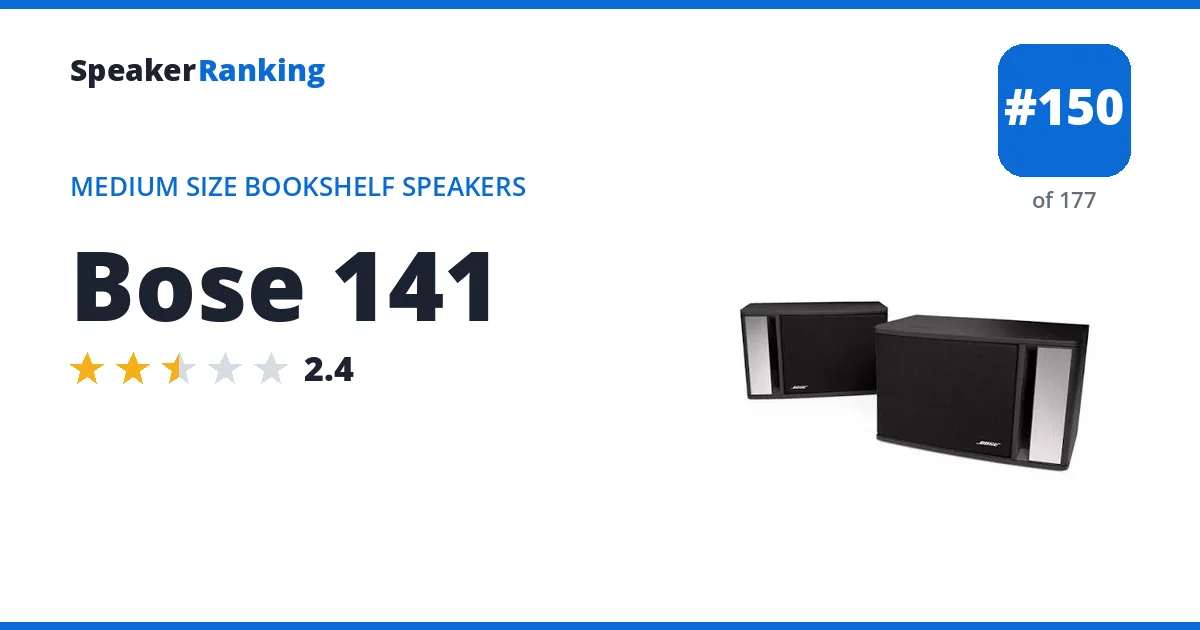
#150 Bose 141: $150 per pair Discontinued eBay
Pros: A small, inexpensive Bose bookshelf from the 1980s and 1990s with a single full-range driver, easy to place and to drive. Measured bass extension of 61.5Hz (-10dB).
Cons: Discontinued and found used. Bose’s own measurements show a very uneven response (1.19 band deviation) and a rough in-room response, scoring -0.39 on its own and 2.70 with an ideal subwoofer, and bass stops at 88.5Hz (-3dB).
| Bass Extension (-10dB) | about 61.5Hz (derived, log-interpolated between spinorama.org -9dB/-12dB points) |
|---|---|
| Bass Extension (-3dB) | 88.5Hz (measured, manufacturer data via spinorama.org) |
| DIY Kit | No |
| Drivers | 4.5” full-range driver |
| Spinorama Preference Score | -0.39 (spinorama.org) |
| Spinorama Preference Score with Perfect Sub | 2.70 (spinorama.org) |
- Reviews, Comparisons and Sound Samples
Frequency Response
How the Bose 141 measures across the audible range. A flatter listening window (the sound arriving straight at you) is more neutral: peaks sound forward or harsh, dips sound recessed. The estimated in-room response adds what a typical room does, and there a gentle, even tilt down toward the treble is ideal. Both curves are shifted so their 300 Hz to 3 kHz average sits at 0 dB.
Measurement data: spinorama.org, measured by the manufacturer.
EQ for a Neutral Response
Flattens the measured listening window from the Bose 141's own bass extension up to 16 kHz. Set a preamp of -3.1 dB, then add these filters to any parametric equalizer in the signal path: the speaker's app or DSP if it has parametric EQ, a miniDSP, Equalizer APO or Wavelet. Boosts are kept to 3 dB, and EQ cannot fix how evenly the speaker spreads sound off-axis, which is why some speakers gain more than others. Predicted preference score with this EQ: 1.3, up from -0.4 (4.4 with an ideal subwoofer, up from 2.7). Calculated by Speaker Ranking from the spinorama measurements above.
| Filter | Frequency | Gain | Q |
|---|---|---|---|
| Peak | 828 Hz | -2.4 dB | 4.00 |
| Peak | 1,108 Hz | +1.9 dB | 4.00 |
| Peak | 1,500 Hz | -1.1 dB | 2.10 |
| Peak | 4,042 Hz | +2.9 dB | 4.00 |
| Peak | 6,857 Hz | +3.0 dB | 2.79 |
| Peak | 10,020 Hz | -4.8 dB | 4.00 |
| Peak | 14,125 Hz | -2.6 dB | 4.00 |