Coverage note. Speaker Ranking currently covers 41 Bose models across portable bluetooth speakers, powered speakers, pa speakers, passive speakers, subwoofers and headphones. These are the products in our database, not a complete list of everything Bose makes.
What this page covers. The Bose models ranked here span portable bluetooth speakers, powered speakers, pa speakers, passive speakers, subwoofers and headphones, including Bose SoundLink Max, Bose Soundlink Flex 2nd gen and Bose Soundlink Flex. Use each model’s category position to compare it with alternatives of the same size and use case.
This page lists all 41 Bose speakers ranked on this site across portable bluetooth speakers, powered speakers, pa speakers, passive speakers, subwoofers and headphones. Each model is shown in the category where it competes, with its current rank and the size of that ranking.
Use the category position rather than the brand name alone: speakers from the same manufacturer can perform very differently by size, price and product family.
Prices on this page were last checked October 15, 2026 at 5:41 PM UTC. Product prices and availability are accurate as of that date/time and are subject to change; the price and availability shown on Amazon at the time of purchase will apply to the purchase of this product.
As an eBay Partner, we may be compensated if you make a purchase.
Quick Navigation
- Small Size Portable Bluetooth Speakers
- Medium Size Portable Bluetooth Speakers
- Large Size Portable Bluetooth Speakers
- Medium Size Powered Desktop Speakers
- Small Size Powered Bookshelf Speakers
- 8-Inch PA Speakers
- 12-Inch PA Speakers
- Column and Line Array PA Speakers
- Surface-Mount and Background Music Speakers
- Battery-Powered PA Speakers
- Medium Home Subwoofers (30-75 lbs)
- Discontinued Bose Models
- Product Line History
Small Size Portable Bluetooth Speakers
 Ranked #18 of 62 in Small Size Portable Bluetooth Speakers - Bose Soundlink Micro 2: $129.00 Amazon $129.00 eBay
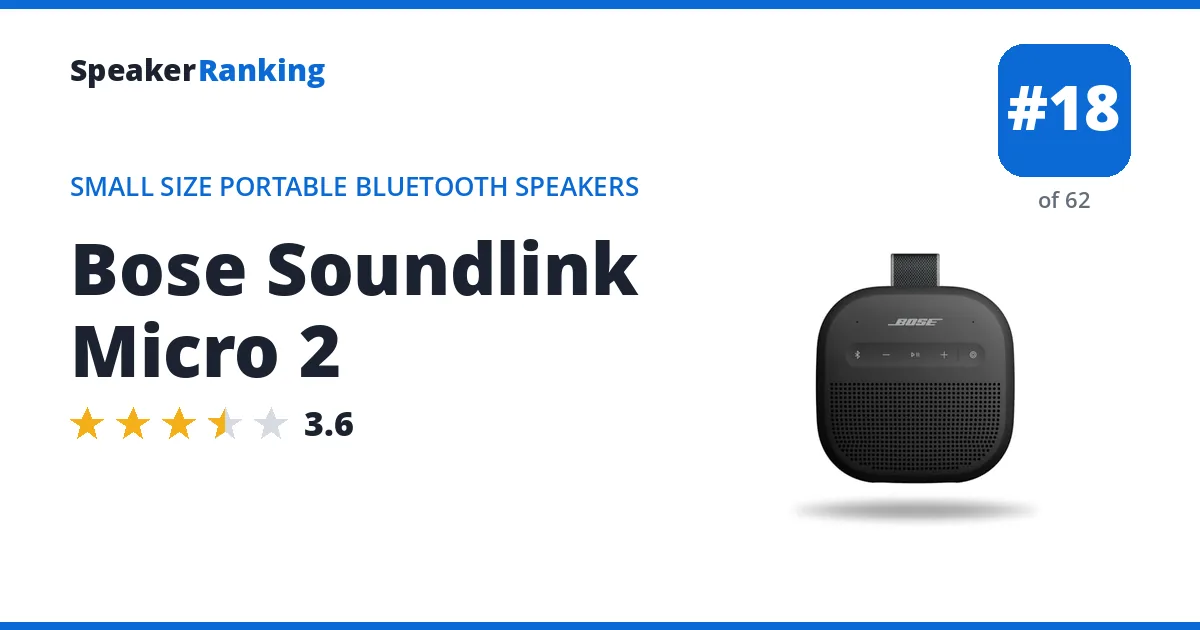
Older model: the Bose Soundlink Micro (ranked lower, rated 3.5/5). See every Bose SoundLink Flex, Micro, Max and Plus generation.
Same family: the Bose Soundlink Flex 2nd gen (smaller model, rated 3.8/5), the Bose SoundLink Max (smaller model, rated 4.3/5) and the Bose SoundLink Plus (larger model, rated 4.2/5).
Pros: IP67 rated, survives a 1m dunk for 30 minutes. Compact fabric strap for clipping to bags/bikes: replaces the 1st-gen’s hook clip, which was prone to breaking. USB-C charging. Surprisingly good bass when mounted outdoors, like on a bike.
Cons: Lack of clarity. Overly boosted bass that causes some thudding, and can overdrive/distort at higher volumes: worse in this regard than the 1st-gen model. Overly boosted treble, turn down bass and treble in the EQ. Falls clearly behind the Tribit Stormbox Micro 2 on bass depth, cleanliness, and loudness.
Full Bose Soundlink Micro 2 review and specifications →
| Released | Aug 2025 (1 year ago) |
|---|---|
| App | Yes |
| Aux Input | No |
| Battery Life | 12 hours (Manufacturer specified) |
| Bluetooth | Yes |
| Bluetooth Codecs | AAC, aptX, SBC |
| Bluetooth Version | 5.4 |
| Built-in Microphone | No |
| Charging Time | 3 hours |
| Digital Aux Input | No |
| Dimensions | 4.1” x 4.1” x 1.7” (104 x 104 x 43 mm) |
| Drivers | 40mm full-range driver with passive radiator |
| EQ | Yes |
| IP Rating | IP67 |
| Omnidirectional | Pointing up |
| Party Mode | Yes (Bose Party mode) |
| Power Bank | No |
| Power Input | USB-C |
| Stereo | No |
| Strap | Yes (built-in strap) |
| TWS | Yes |
| Weight | 0.7 lbs (329 g) |
- Links
- Reviews, Comparisons and Sound Samples
- Head-to-Head Comparisons
- Bose Soundlink Micro 2 vs Vifa Reykjavik
- Bose Soundlink Micro 2 vs Bose Soundlink Micro
- Bose Soundlink Micro 2 vs B&O Beoplay P2
- Bose Soundlink Micro 2 vs Klipsch Austin
- Bose Soundlink Micro 2 vs TOZO PE1
- Bose Soundlink Micro 2 vs JBL Clip 5
- Bose Soundlink Micro 2 vs Marshall Willen
- Bose Soundlink Micro 2 vs JBL Clip 4
- See all 56 comparisons
 Ranked #20 of 62 in Small Size Portable Bluetooth Speakers - Bose Soundlink Micro: $99.99 Amazon $99.99 eBay
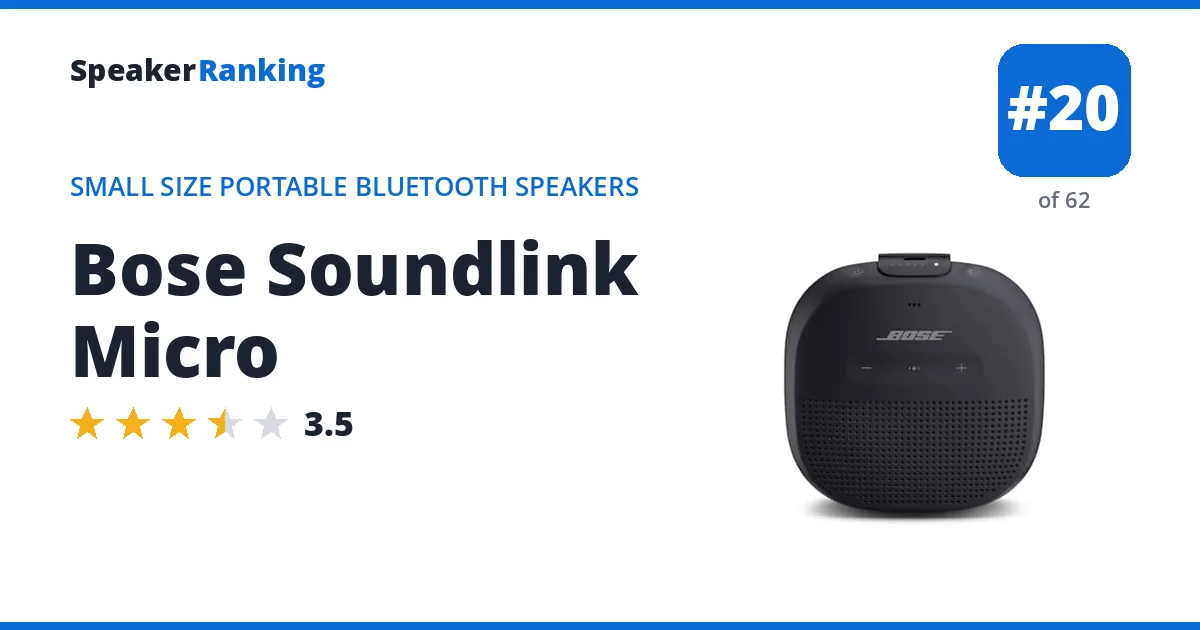
Newer model: the Bose Soundlink Micro 2, ranked higher, rated 3.6/5, released Aug 2025. It adds adjustable EQ, AAC and aptX, but drops the built-in mic. Battery life goes from 6 to 12 hours. See every Bose SoundLink Flex, Micro, Max and Plus generation.
Pros: Bose Soundlink Micro uses 40mm with dual passive radiators. Its 289 g, claimed 6 hours (Manufacturer specified) battery life, IP67 protection, up to 90dB and mono playback make it a practical option for its intended room or portable use. A rugged rubberized coating, a strap and Bose Party mode for pairing multiple speakers. Measured bass extension of 66Hz (-10dB).
Cons: Bass is limited by its 66Hz specification. No EQ adjustment.
Full Bose Soundlink Micro review and specifications →
| Released | Sep 2017 (9 years ago) |
|---|---|
| Amplifier Power | 5W |
| App | Yes |
| Aux Input | No |
| Bass Extension (-10dB) | 66Hz |
| Battery Life | 6 hours (Manufacturer specified) |
| Bluetooth | Yes |
| Bluetooth Codecs | SBC |
| Bluetooth Latency | 50ms |
| Bluetooth Version | 4.2 |
| Built-in Microphone | Yes |
| Charging Time | 3 hours |
| Digital Aux Input | No |
| Dimensions | 3.9” x 3.9” x 1.4” (98 x 98 x 35 mm) |
| Drivers | 40mm with dual passive radiators |
| EQ | No |
| IP Rating | IP67 |
| Maximum SPL | 90dB (measured by Alan Ross Reviews) |
| Omnidirectional | Pointing up |
| Party Mode | Yes (Bose Party mode) |
| Power Bank | No |
| Power Input | Micro USB |
| Stereo | No |
| Strap | Yes (built-in strap) |
| TWS | Yes |
| Weight | 0.6 lbs (289 g) |
- Links
- Reviews, Comparisons and Sound Samples
- Alan Ross Reviews: Tribit Stormbox Micro 2 vs Bose Soundlink Micro for best small speaker! 👌 More from alanrossreviews →
- Alan Ross Reviews: Minirig Mini v Tribit Stormbox Micro or Bose Soundlink Micro
- Danny Pops: MICRO SPEAKERS - my take on JBL Clip 4 VS Wonderboom 2 VS Bose Micro More from DannyPops →
- Speakertech: Bose Soundlink Micro Vs Minirig Mini 2
- Head-to-Head Comparisons
- Bose Soundlink Micro vs TOZO PE1
- Bose Soundlink Micro vs Bose Soundlink Micro 2
- Bose Soundlink Micro vs JBL Clip 5
- Bose Soundlink Micro vs JBL Clip 4
- Bose Soundlink Micro vs B&O Beoplay P2
- Bose Soundlink Micro vs Klipsch Austin
- Bose Soundlink Micro vs Soundcore Select 4 Go
- Bose Soundlink Micro vs Marshall Willen
- See all 52 comparisons
Medium Size Portable Bluetooth Speakers
 Ranked #37 of 175 in Medium Size Portable Bluetooth Speakers - Bose Soundlink Flex 2nd gen: $159.00 Amazon $159.00 eBay
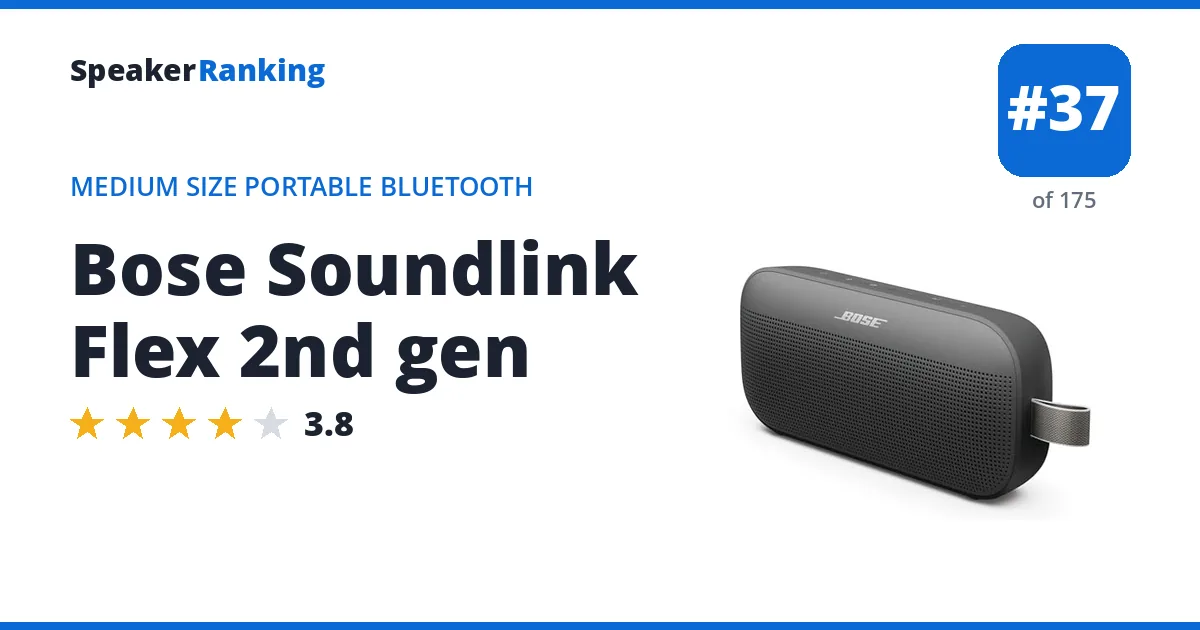
Older model: the Bose Soundlink Flex (ranked lower, rated 3.8/5). See every Bose SoundLink Flex, Micro, Max and Plus generation.
Same family: the Bose SoundLink Max (larger model, rated 4.3/5), the Bose Soundlink Micro 2 (larger model, rated 3.6/5) and the Bose SoundLink Plus (larger model, rated 4.2/5).
Pros: A very portable 586g, IP67-rated speaker with a clear, well-balanced midrange that keeps voices and instruments intelligible. The second generation adds a Bose app with 3-band EQ, better-placed controls and stereo pairing with another Bose Soundlink Flex 2nd gen. It supports AAC and aptX Adaptive in addition to SBC, making it a stronger wireless option than most small rivals.
Cons: One Flex remains mono and cannot deliver genuine low-bass rumble; RTINGS also found the elevated treble can turn hi-hats and other high-frequency detail piercing. The claimed battery life is only 12 hours, and some owners report accelerated standby drain after firmware updates. It is expensive for its size, so the added app and codec support, not a transformational sound upgrade over the original, are the main reasons to choose it.
Full Bose Soundlink Flex 2nd gen review and specifications →
| Released | Sep 2024 (2 years ago) |
|---|---|
| App | Yes |
| Aux Input | No |
| Battery Life | 12 hours (Manufacturer specified) |
| Bluetooth | Yes |
| Bluetooth Codecs | SBC, AAC, aptX Adaptive |
| Bluetooth Version | 5.3 |
| Built-in Microphone | Yes |
| Digital Aux Input | No |
| Dimensions | 7.9” x 3.5” x 2” (201 x 90 x 52 mm) |
| Drivers | 60mm full-range driver with passive radiators |
| EQ | Yes (3 band) |
| IP Rating | IP67 |
| Omnidirectional | No |
| Party Mode | Yes (Bose Party mode) |
| Power Input | USB-C |
| Stereo | No |
| Strap | Yes (built-in loop) |
| TWS | Yes |
| Weight | 1.3 lbs (586 g) |
- Links
- Reviews, Comparisons and Sound Samples
- Joy & Oluv’Sone: Bose Soundlink Flex 2nd gen vs Flex More from Oluv’Sone →
- Joy & Oluv’Sone: Bose Soundlink Flex 2nd gen & Soundcore Motion 300 sound test
- Oluv Patreon: Bose Soundlink Flex 2nd gen - sound demo
- Alan Ross: Hall of Fame classic vs latest Bose tech! More from alanrossreviews →
- Alan Ross - The Anti Shill!: Small speaker, mighty sound, The Flex gen 2 shatters physics!
- Alan Ross - The Anti Shill!: DBSONO X-Blast F37 vs Bose Soundlink Flex 2 - They all want to be me 😊
- Mateusz Cholewa: JBL Charge Essential 3 SE vs BOSE SoundLink FLEX 2 More from Mateusz Cholewa →
- CEONTHEMAKING: Bose Soundlink Flex 2nd Gen VS Marshall Emberton III - What’s NEW?? More from CEONTHEMAKING →
- Tô Thái Trí Hùng: Unbox & Sound Test - Bose Soundlink Flex 2
- Musou1: JBL flip 7 vs KEF muo vs Bose flex 2
- Head-to-Head Comparisons
- Bose Soundlink Flex 2nd gen vs Bose Soundlink Flex
- Bose Soundlink Flex 2nd gen vs Tribit Xsound Plus 2
- Bose Soundlink Flex 2nd gen vs JBL Charge Essential 2
- Bose Soundlink Flex 2nd gen vs Teufel Rockster XS
- Bose Soundlink Flex 2nd gen vs Huawei Sound Joy
- Bose Soundlink Flex 2nd gen vs Cleer Audio Scene
- Bose Soundlink Flex 2nd gen vs Soundcore Boom 3i
- Bose Soundlink Flex 2nd gen vs JBL Charge Essential 3 SE
- See all 147 comparisons
 Ranked #38 of 175 in Medium Size Portable Bluetooth Speakers - Bose Soundlink Flex: $79.99 Amazon $79.99 eBay
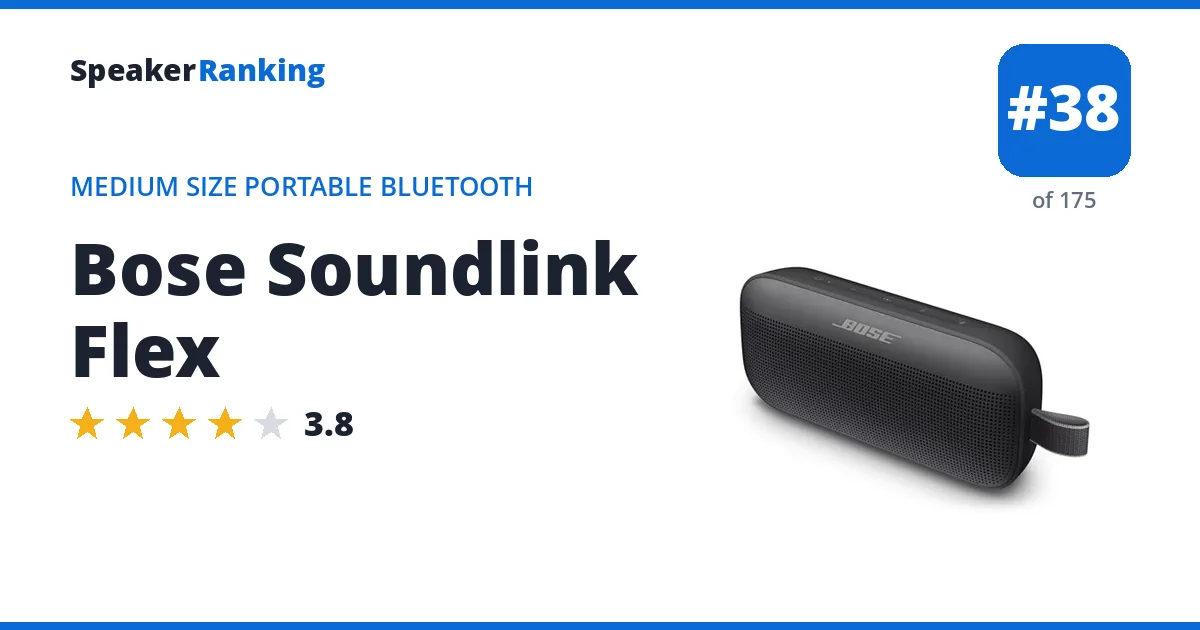
Newer model: the Bose Soundlink Flex 2nd gen, ranked higher, rated 3.8/5, released Sep 2024. It adds adjustable EQ, AAC and aptX Adaptive. See every Bose SoundLink Flex, Micro, Max and Plus generation.
Pros: IP67 rated; rugged enough to survive drops from several feet and floats. Around 12 hours of battery at moderate volume. Measured bass extension of 56Hz (-10dB).
Cons: Not stereo. Warm sounding with overly boosted bass which drowns out midrange detail
Full Bose Soundlink Flex review and specifications →
| Released | Oct 2021 (5 years ago) |
|---|---|
| App | Yes |
| Aux Input | No |
| Bass Extension (-10dB) | 56Hz |
| Battery Life | 12 hours (Manufacturer specified) |
| Bluetooth | Yes |
| Bluetooth Codecs | SBC |
| Bluetooth Latency | 33ms |
| Bluetooth Version | 4.2 |
| Built-in Microphone | Yes |
| Digital Aux Input | No |
| Dimensions | 7.9” x 3.5” x 2” (201 x 90 x 52 mm) |
| Drivers | 1x 60mm full-range driver + 2x passive radiators |
| EQ | No |
| IP Rating | IP67 |
| Maximum SPL | 96dB (measured by Alan Ross Reviews) |
| Omnidirectional | No |
| Party Mode | Yes (Bose Party mode) |
| Power Input | USB-C |
| Stereo | No |
| Strap | Yes (built-in loop) |
| TWS | Yes |
| Weight | 1.3 lbs (589 g) |
- Links
- Reviews, Comparisons and Sound Samples
- Joy & Oluv’Sone: Bose Soundlink Flex 2nd gen vs Flex More from Oluv’Sone →
- Joy & Oluv’Sone: JBL, Bose, B&O, Sonos, Earfun, SoundCore… which portable speaker sounds best?
- Oluv Patreon: Bose Soundlink Plus & Flex compared
- Oluv Patreon: Soundcore Motion 300 = Bose Soundlink Flex = Earfun UBoom L?
- Alan Ross Reviews: Bose Soundlink Flex or Beosound A1 (1st gen) - ultimate compact speaker 😇 More from alanrossreviews →
- Alan Ross Reviews: Bose Soundlink Flex vs Minirig MK3 and Marshall Emberton - best bluetooth speaker?
- Alan Ross - The Anti Shill!: Small speaker, mighty sound, The Flex gen 2 shatters physics!
- Alan Ross Reviews: Travel Speakers! Soundcore Motion 300 or Bose Flex or Tribit Stormbow Flow
- Alan Ross Reviews: Bose Soundlink Flex Review! vs JBL Flip 6 and JBL Charge 5. Travel heaven?? 🤞
- Alan Ross Reviews: Bose Soundlink Flex vs Soundcore Boost vs Bogasing M4 - cheap or Bose?
- Alan Ross Reviews: Bose Soundlink Flex or JBL Flip 6 (eq adjusted) or Denon Envaya - best speaker for travel!
- Alan Ross Reviews: 1 million views! Best Budget Tws? Tozo Pa1 Review and sound test
- Alan Ross Reviews: Beats Pill vs Harman Luna vs Bose Flex vs Soundcore Motion Plus
- Alan Ross Reviews: Tribit Xsound Mega vs the world! (JBL Charge 5, Bose Flex, Sony XB33, LG PL7) 👍
- Alan Ross Reviews: Tribit Stormbox Flow has deeper bass than the Bose Flex but………..
- Jay’s Straight Up Reviews & More: Tribit Stormbox Flow vs Soundcore Motion 300 (LDAC) 😵 Budget Bose Soundlink Flex "Inspired" Speakers More from JaysStraightUpReviews →
- Danny Pops: BEST Bose Speaker?? Bose Soundlink Flex vs micro, Color II, and revolve + More from DannyPops →
- Danny Pops: BEST Bose Speaker? Bose is getting lazy.
- Patricio Benadon: Bose SoundLink Flex vs. Mini 2 SE. Music audio quality sound test. Listen 4 different genres!
- Head-to-Head Comparisons
- Bose Soundlink Flex vs Bose Soundlink Flex 2nd gen
- Bose Soundlink Flex vs JBL Charge Essential 2
- Bose Soundlink Flex vs Tribit Xsound Plus 2
- Bose Soundlink Flex vs Huawei Sound Joy
- Bose Soundlink Flex vs Teufel Rockster XS
- Bose Soundlink Flex vs Cleer Audio Scene
- Bose Soundlink Flex vs JBL Charge Essential 3 SE
- Bose Soundlink Flex vs EarFun Uboom Slim
- See all 143 comparisons
 Ranked #51 of 175 in Medium Size Portable Bluetooth Speakers - Bose Soundlink Revolve+ II: $299.00 Amazon $299.00 eBay
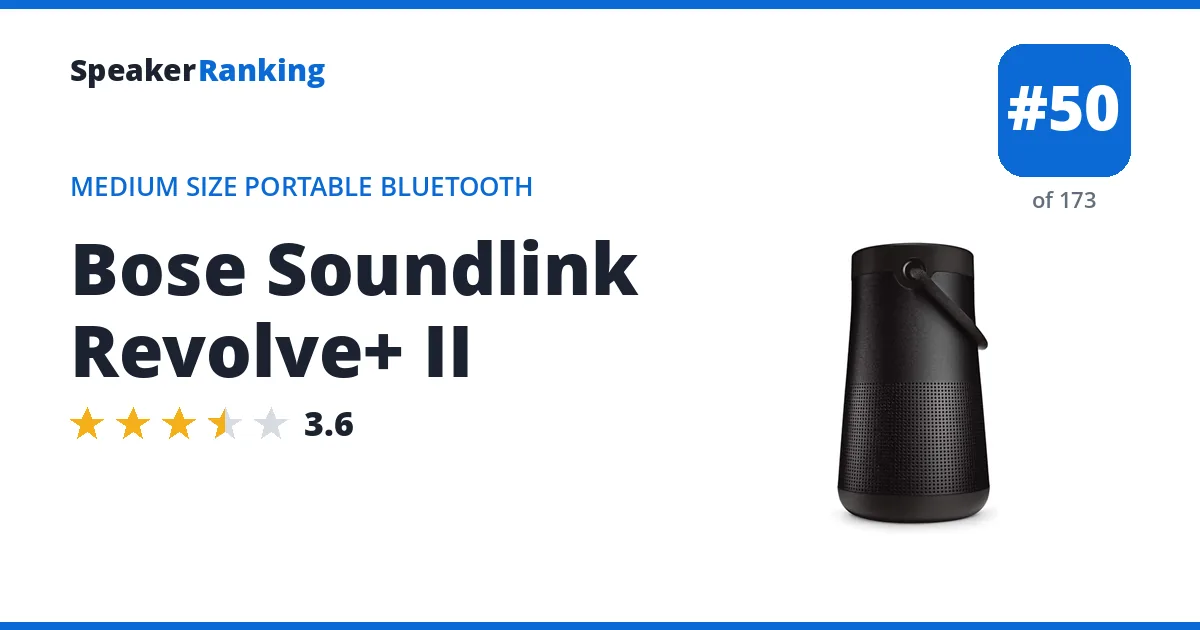
Older model: the Bose Soundlink Revolve+ (ranked lower, rated 3.6/5). See every Bose SoundLink Revolve generation.
Same family: the Bose SoundLink Revolve (Series II) (smaller model, ranked lower, rated 3.6/5).
Pros: True 360° sound stays consistent no matter where you stand around it, unlike most portable speakers.
Cons: Overly boosted bass, warm sounding. Boosted mids. Rolled off treble. Only IP55.
Full Bose Soundlink Revolve+ II review and specifications →
| Released | Jan 2021 (5 years ago) |
|---|---|
| App | Bose Connect |
| Aux Input | Yes |
| Battery Life | 17 hours (Manufacturer specified) |
| Bluetooth | Yes |
| Bluetooth Codecs | SBC |
| Bluetooth Version | 4.1 |
| Built-in Microphone | Yes |
| Digital Aux Input | No |
| Dimensions | 3.2” x 6” x 3.2” (82 x 152 x 82 mm) |
| Drivers | 1x omnidirectional full-range transducer + 2x passive radiators (driver size undisclosed by Bose) |
| EQ | No |
| IP Rating | IP55 |
| Omnidirectional | Yes |
| Power Input | Micro USB |
| Stereo | No |
| Strap | No |
| TWS | Yes |
| Weight | 2 lbs (0.91 kg) |
- Links
- Reviews, Comparisons and Sound Samples
- Alan Ross Reviews: Soundcore Glow: best budget 360 degree speaker or get the Bose Revolve+? 1 hour of fun! More from alanrossreviews →
- Danny Pops: BEST Bose Speaker? Bose is getting lazy. More from DannyPops →
- Kanwar Anand: Bose Revolve Plus 1 vs 2
- techkiste.net: B&O Beosound A1 (2nd Gen) vs Bose Revolve 2 vs Bose Revolve+ 2 sound-comparison
- Head-to-Head Comparisons
- Bose Soundlink Revolve+ II vs Bose Soundlink Revolve+
- Bose Soundlink Revolve+ II vs W-King D320
- Bose Soundlink Revolve+ II vs Soundcore Glow
- Bose Soundlink Revolve+ II vs JBL Pulse 5
- Bose Soundlink Revolve+ II vs Bose SoundLink Revolve (Series II)
- Bose Soundlink Revolve+ II vs Xiaomi Sound Outdoor
- Bose Soundlink Revolve+ II vs Tribit Stormbox Pro
- Bose Soundlink Revolve+ II vs JBL Cove P1
- See all 94 comparisons
 Ranked #54 of 175 in Medium Size Portable Bluetooth Speakers - Bose SoundLink Revolve (Series II): $194.00 Amazon $194.00 eBay
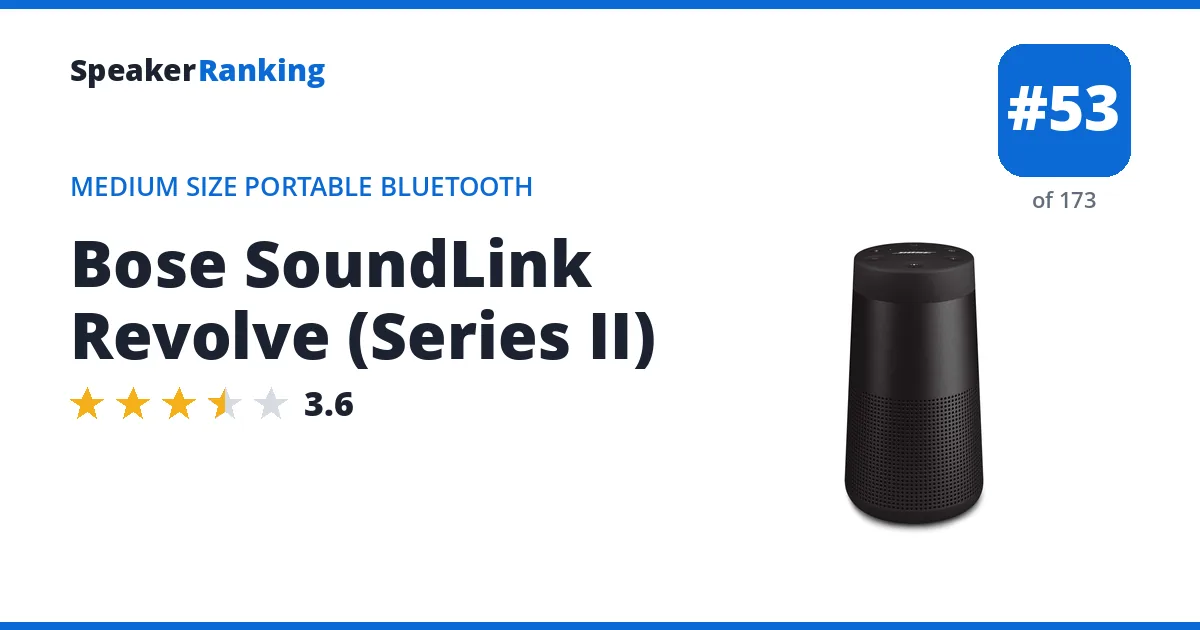
Older model: the Bose Soundlink Revolve (ranked lower, rated 3.5/5). See every Bose SoundLink Revolve generation.
Same family: the Bose Soundlink Revolve+ II (larger model, ranked higher, rated 3.6/5).
Pros: RTINGS measured a fairly neutral sound with a balanced midrange, so vocals and lead instruments come through clearly, and excellent directivity from the 360° design for an open, even sound around the room. In a side by side test against the Revolve+ II and B&O Beosound A1 2nd gen, several listeners preferred its clearer, less bass heavy tuning to the Revolve+ II. Up to 13 hours of battery, IP55 dust and water resistance, a built-in microphone for calls and voice assistants, and multi-connect for two devices at once.
Cons: RTINGS found it lacks low bass, so there’s little deep thump or rumble. It doesn’t get loud either: DXOMARK measured only about 73 to 74 dBA at maximum volume, against 85 to 89 dBA for speakers like the Sony SRS-XB43 in the same test, and bass compresses and pumps as you turn it up. There is no EQ in the Bose Connect app, a single unit plays mono, and it still charges over micro USB.
Full Bose SoundLink Revolve (Series II) review and specifications →
| Released | Jan 2021 (5 years ago) |
|---|---|
| App | Bose Connect |
| Aux Input | Yes |
| Battery Life | 13 hours (Manufacturer specified) |
| Bluetooth | Yes |
| Bluetooth Version | 4.1 |
| Built-in Microphone | Yes |
| Dimensions | 6”H x 3.2”W x 3.2”D (152 x 82 x 82 mm) |
| Drivers | 1x full-range driver, 2x passive radiator |
| IP Rating | IP55 |
| Omnidirectional | Yes |
| Power Input | Micro USB |
| Stereo | No |
| TWS | Yes |
| Weight | 1.5 lbs (680 g) |
- Links
- Reviews, Comparisons and Sound Samples
- Danny Pops: BEST Bose Speaker? Bose is getting lazy. More from DannyPops →
- SoundGuys: Bose SoundLink Revolve II review More from Soundguys →
- RTINGS: Bose SoundLink Revolve II Review More from Rtings.com →
- techkiste.net: B&O Beosound A1 (2nd Gen) vs Bose Revolve 2 vs Bose Revolve+ 2 sound-comparison
- DXOMARK: Bose SoundLink Revolve II Speaker review
- Head-to-Head Comparisons
- Bose SoundLink Revolve (Series II) vs Bose Soundlink Revolve+ II
- Bose SoundLink Revolve (Series II) vs Sonos Play
- Bose SoundLink Revolve (Series II) vs JBL Pulse 5
- Bose SoundLink Revolve (Series II) vs Xiaomi Sound Outdoor
- Bose SoundLink Revolve (Series II) vs JBL Charge 4
- Bose SoundLink Revolve (Series II) vs JBL Charge Essential 3 SE
- Bose SoundLink Revolve (Series II) vs JBL Charge Essential 2
- Bose SoundLink Revolve (Series II) vs Bose Soundlink Flex
- See all 32 comparisons
 Ranked #72 of 175 in Medium Size Portable Bluetooth Speakers - Bose SoundLink Home: $179.00 Bose $179.00 eBay
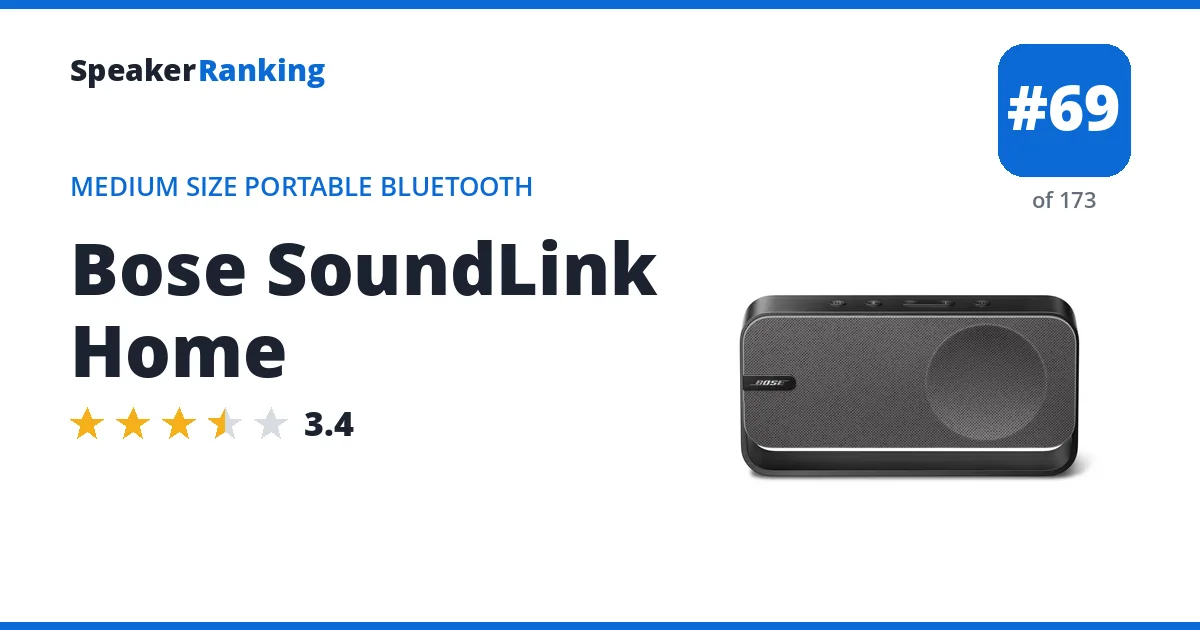
Pros: Delivers remarkably even on-axis midrange and treble linearity, rendering vocals, podcasts, and acoustic instruments clearly without harshness. Dual passive radiators provide punchy mid-bass down to ~65Hz that sounds full and warm for its compact 890g size. Premium anodized aluminum enclosure with a built-in stand, USB-C digital audio input for wired playback from computers, and a built-in microphone for speakerphone calls. Supports wireless stereo pairing when linked with a second unit.
Cons: Single full-range driver produces mono sound with limited soundstage width, and it lacks true deep sub-bass rumble. There is no companion app support or customizable EQ to adjust the tonal balance. Battery life is rated at only 9 hours, and recharging takes up to 4 hours via USB-C. Unlike most portable SoundLink models, it has no IP water or dust resistance rating and no 3.5mm analog auxiliary input.
Full Bose SoundLink Home review and specifications →
| Released | Sep 2024 (2 years ago) |
|---|---|
| App | No |
| Aux Input | No |
| Battery Life | 9 hours (Manufacturer specified) |
| Bluetooth | Yes |
| Bluetooth Codecs | SBC, AAC |
| Bluetooth Version | 5.3 |
| Built-in Microphone | Yes |
| Digital Aux Input | Yes (USB-C audio) |
| Dimensions | 8.5” x 4.4” x 2.3” (216 x 112 x 58 mm) |
| Drivers | 1x full-range transducer with dual passive radiators |
| EQ | No |
| IP Rating | None |
| Omnidirectional | No |
| Party Mode | No |
| Power Input | USB-C |
| Stereo | No |
| Strap | No |
| TWS | Yes |
| Weight | 2 lbs (890 g) |
- Links
- Reviews, Comparisons and Sound Samples
- Head-to-Head Comparisons
 Ranked #78 of 175 in Medium Size Portable Bluetooth Speakers - Bose Portable Smart Speaker: $297.77 Amazon $297.77 Lowest Bose $399.00 eBay
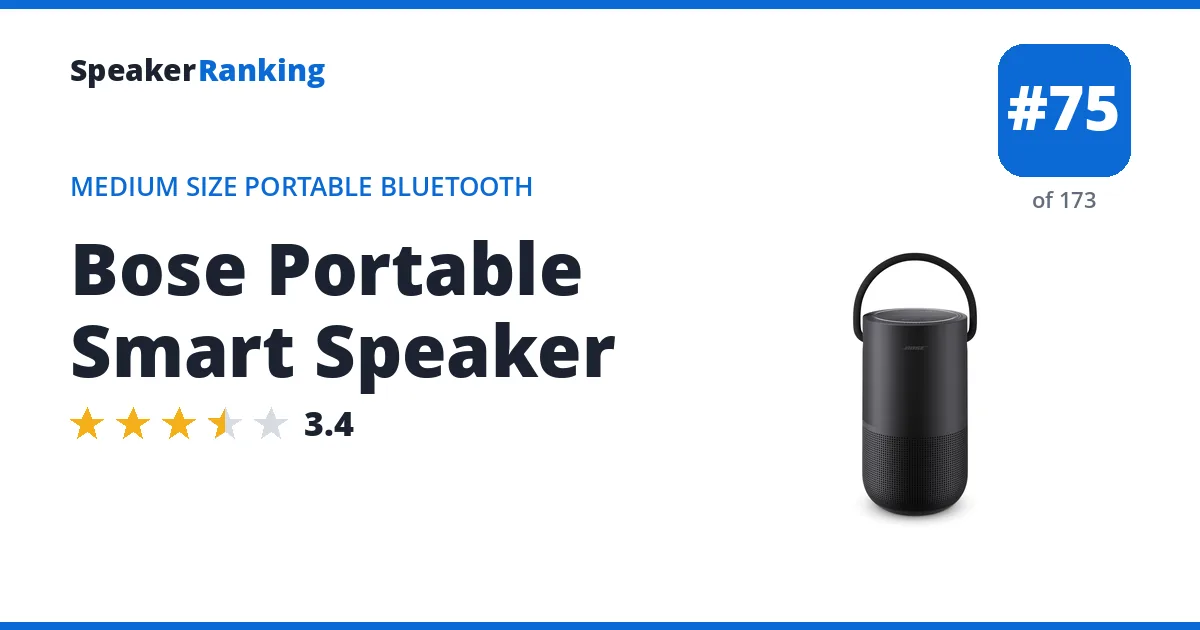
Pros: Both Alexa and Google Assistant are built in, and RTINGS rates its microphones as excellent at hearing commands from far away or in a noisy room. It works as a Wi-Fi speaker at home (AirPlay 2, Chromecast built-in, Spotify Connect) and as a Bluetooth speaker away from Wi-Fi, weighs about 1 kg with a carry handle, and is IPX4 splash resistant. SoundGuys measured 13 hours 6 minutes of playback at 75 dB, beating Bose’s 12 hour claim, and found the bass impressive for its size, especially near a wall or corner. Its 360 degree design spreads sound evenly around a room.
Cons: RTINGS found the out of the box tuning boomy and says it doesn’t get very loud; the app’s bass and treble sliders help, and SoundGuys recommended cutting bass by 10 to 20 steps to balance it. Pushed to full volume, Tom’s Guide heard unbalanced sound and Pocket-lint found the bass struggling and turning incoherent. RTINGS measured only about 5 hours of battery in its own test. It is mono, has no aux input (the USB-C port only charges), uses Bluetooth 4.2, and the Bose Music app supports a limited list of streaming services. IPX4 covers splashes only, not submersion or dust.
Full Bose Portable Smart Speaker review and specifications →
| Released | Sep 2019 (7 years ago) |
|---|---|
| App | Yes (Bose Music) |
| Aux Input | No |
| Battery Life | 12 hours (Manufacturer specified) |
| Bluetooth | Yes |
| Bluetooth Codecs | SBC, AAC |
| Bluetooth Version | 4.2 |
| Built-in Microphone | Yes (far-field mic array, mic mute button) |
| Digital Aux Input | No |
| Dimensions | 7.6” x 4.7” x 4.1” (192 x 119 x 104 mm) (H x W x D) |
| Drivers | 1x high-excursion driver with 360-degree deflector + 3x passive radiators |
| EQ | Yes (Bass/Treble) |
| IP Rating | IPX4 |
| Omnidirectional | Pointing up |
| Party Mode | Yes (Bose Music multi-room, SimpleSync, AirPlay 2) |
| Power Bank | No |
| Power Input | USB-C |
| Stereo | No |
| Strap | No |
| Streaming Services | AirPlay 2, Chromecast built-in, Spotify Connect, Amazon Music, Pandora, SiriusXM, TuneIn |
| TWS | No |
| Voice Assistants | Amazon Alexa & Google Assistant |
| Weight | 2.3 lbs (1.06 kg) |
| Wi-Fi | Yes |
- Links
- Reviews, Comparisons and Sound Samples
- Head-to-Head Comparisons
- Bose Portable Smart Speaker vs Beats Pill 2024
- Bose Portable Smart Speaker vs JBL Flip 5
- Bose Portable Smart Speaker vs JBL Flip Essential 2
- Bose Portable Smart Speaker vs Sony ULT Field 3
- Bose Portable Smart Speaker vs Bose Soundlink Mini
- Bose Portable Smart Speaker vs Klipsch Nashville
- Bose Portable Smart Speaker vs Bose Soundlink Mini 2
- Bose Portable Smart Speaker vs JBL Pulse 6
- See all 71 comparisons
Large Size Portable Bluetooth Speakers
 Ranked #17 of 105 in Large Size Portable Bluetooth Speakers - Bose SoundLink Max: $399.00 Amazon $399.00 eBay
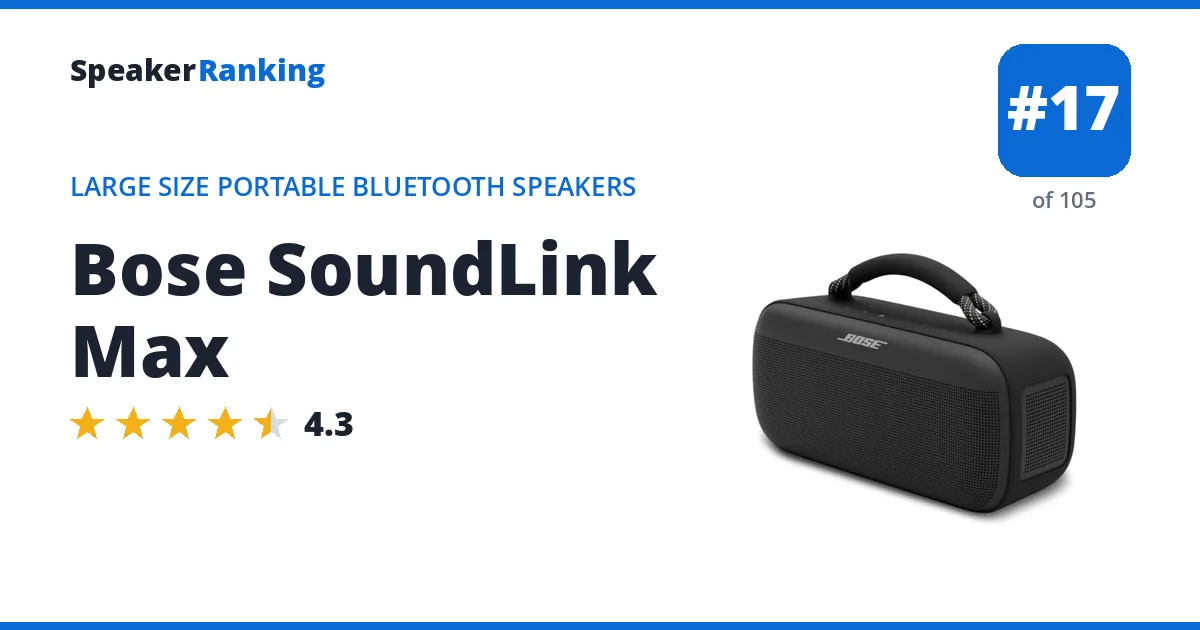
Same family: the Bose Soundlink Flex 2nd gen (smaller model, rated 3.8/5), the Bose Soundlink Micro 2 (larger model, rated 3.6/5) and the Bose SoundLink Plus (larger model, ranked lower, rated 4.2/5). See every Bose SoundLink Flex, Micro, Max and Plus generation.
Pros: IP67 rated: dustproof and waterproof to 1m. Up to 20 hour battery; real-world testing found 43+ hours. Deep, rich bass with neutral tuning, app EQ. USB-C doubles as device charger. Sturdy carry handle. The aux input has lower latency (about 33ms) than most Bluetooth connections. Measured bass extension of 48Hz (-10dB).
Cons: Big peak in the upper bass, dipped midrange and lots of peaks and dips above the midrange. Bass not as deep as a Soundcore Boom 2. Gets distorted above 80%. Self drains the battery about 20% a week.
Full Bose SoundLink Max review and specifications →
| Released | May 2024 (2 years ago) |
|---|---|
| App | Yes |
| Aux Input | Yes |
| Aux Latency | 33ms |
| Bass Extension (-10dB) | 48Hz |
| Battery Life | 20 hours (Manufacturer specified) |
| Bluetooth | Yes |
| Bluetooth Codecs | SBC |
| Bluetooth Latency | 116ms |
| Bluetooth Version | 5.3 |
| Built-in Microphone | No |
| Digital Aux Input | No |
| Dimensions | 10.4” x 4.7” x 4.1” (264.7 x 120.1 x 104.9 mm) |
| Drivers | 2x 2.5” (63.5mm) midrange drivers + 1x 0.79” (20mm) tweeter |
| EQ | No |
| IP Rating | IP67 |
| Omnidirectional | No |
| Party Mode | No |
| Power Bank | Yes (USB-C) |
| Power Input | USB-C |
| Stereo | Partially (1 tweeter) |
| Strap | No |
| TWS | Yes |
| Weight | 4.9 lbs (2.2 kg) |
- Links
- Reviews, Comparisons and Sound Samples
- Joy & Oluv’Sone: Bose SoundLink Max & SoundCore Boom 2 - indoor soundtest More from Oluv’Sone →
- Joy & Oluv’Sone: Bose SoundLink Max & SoundCore Boom 2 - outdoor soundtest
- Oluv Patreon: Marshall Middleton II - first impressions
- Alan Ross Reviews: Bose Max, the worlds most overpriced speaker? its a shocker! More from alanrossreviews →
- Mateusz Cholewa: BOGASING S8 Pro Max 100W vs BOSE Soundlink MAX More from Mateusz Cholewa →
- Jay’s Straight Up Reviews & More: Bose SoundLink Max vs. Ultimate Ears EpicBoom 🤑Big Bucks No Whammies? 💣 Let’s Find Out 😧 More from JaysStraightUpReviews →
- Jay’s Straight Up Reviews & More: Bose SoundLink Max vs Tribit XSound Mega 😲 Can the Budget Priced Speaker Hang With the Big $ One?
- Scott’s Reviews: Bose SoundLink Max First Impressions, Unboxing, and Sound Test. More from ScottsReviews →
- Head-to-Head Comparisons
- Bose SoundLink Max vs B&O Beoplay A2 active
- Bose SoundLink Max vs JBL Xtreme 3
- Bose SoundLink Max vs Soundcore Motion X600
- Bose SoundLink Max vs Soundcore Select Pro
- Bose SoundLink Max vs Soundcore Motion Boom
- Bose SoundLink Max vs Loewe We. Hear Pro
- Bose SoundLink Max vs Soundcore Rave Neo 2
- Bose SoundLink Max vs Harman Kardon Citation 200
- See all 89 comparisons
 Ranked #25 of 105 in Large Size Portable Bluetooth Speakers - Bose SoundLink Plus: $269.00 Amazon $269.00 eBay
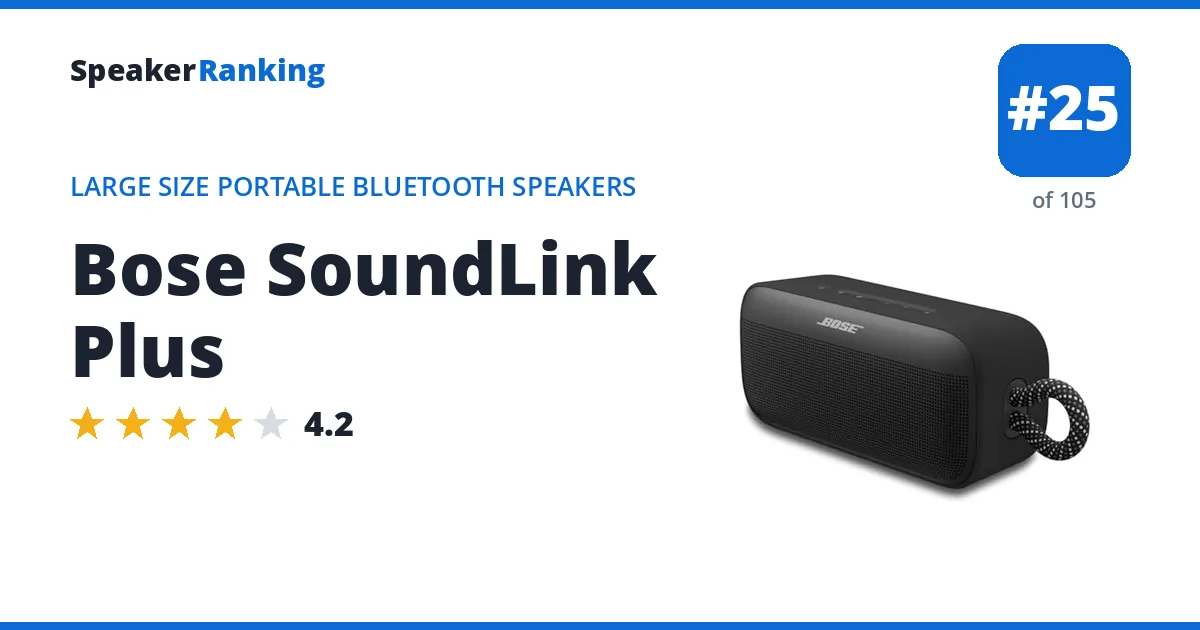
Same family: the Bose Soundlink Flex 2nd gen (smaller model, rated 3.8/5), the Bose SoundLink Max (smaller model, ranked higher, rated 4.3/5) and the Bose Soundlink Micro 2 (smaller model, rated 3.6/5). See every Bose SoundLink Flex, Micro, Max and Plus generation.
Pros: IP67 rated, IP67 water/dustproof. Close to 20 hour battery life. Vibrant sound with booming bass, clean mids. Bluetooth 5.4 with good range. Premium tactile grille, smooth silicone. Quality build at $269.
Cons: Boosted thuddy bass, but not as deep as the SoundLink Flex and you should probably just buy one of those instead if you want a Bose.
Full Bose SoundLink Plus review and specifications →
| Released | Jun 2025 (1 year ago) |
|---|---|
| App | Yes |
| Aux Input | No |
| Battery Life | 20 hours (Manufacturer specified) |
| Bluetooth | Yes |
| Bluetooth Codecs | SBC |
| Bluetooth Version | 5.4 |
| Built-in Microphone | No |
| Digital Aux Input | No |
| Dimensions | 9.1” x 3.9” x 3.4” (231 x 99 x 86 mm) |
| Drivers | 1x 2.5” (63.5mm) woofer + 1x ~0.78” (20mm) tweeter + 4x passive radiators |
| EQ | No |
| IP Rating | IP67 |
| Omnidirectional | No |
| Party Mode | Yes (Bose Party mode) |
| Power Bank | Yes (USB-C) |
| Power Input | USB-C |
| Stereo | Yes |
| Strap | Yes (built-in loop) |
| TWS | Yes |
| Weight | 3.3 lbs (1.5 kg) |
- Links
- Reviews, Comparisons and Sound Samples
- Head-to-Head Comparisons
- Bose SoundLink Plus vs Onn Portable FM Boombox
- Bose SoundLink Plus vs Bogasing S8 Pro Max
- Bose SoundLink Plus vs Soundcore Motion X500
- Bose SoundLink Plus vs Teufel Rockster Cross
- Bose SoundLink Plus vs Sonos Move 2
- Bose SoundLink Plus vs Teufel Rockster Cross 2
- Bose SoundLink Plus vs Soundcore Rave Neo 2
- Bose SoundLink Plus vs Sonos Move
- See all 90 comparisons
Medium Size Powered Desktop Speakers
 Ranked #14 of 28 in Medium Size Powered Desktop Speakers - Bose Lifestyle Ultra Speaker: $299.00 each Amazon $299.00 eBay
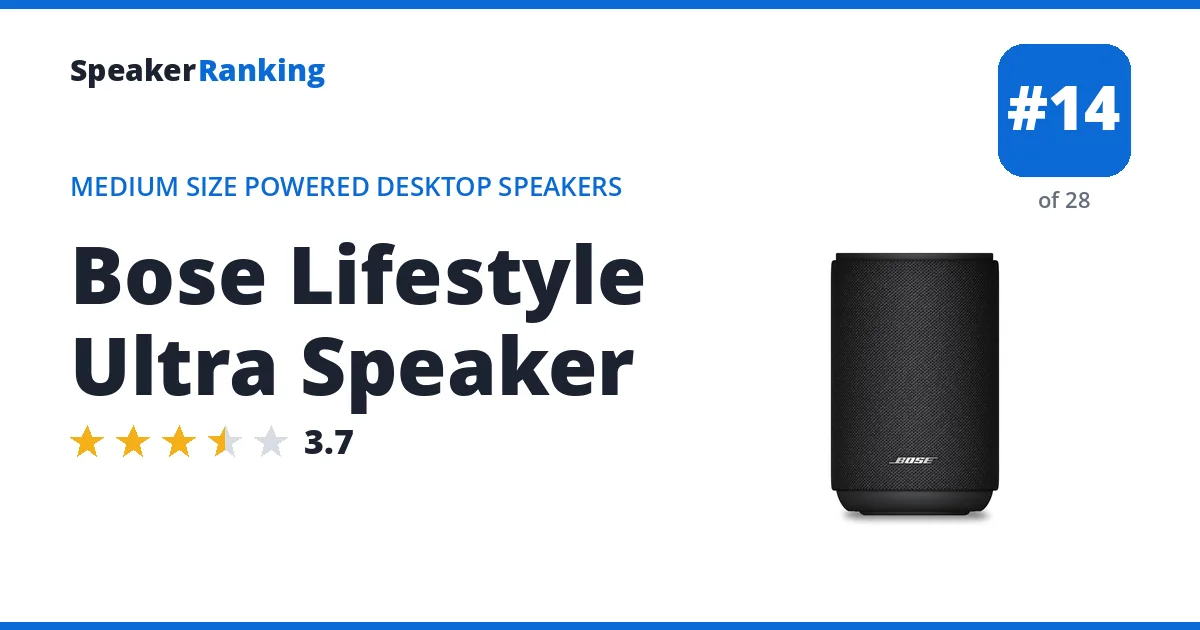
Same family: the Bose Lifestyle Ultra Subwoofer (subwoofer, rated 3.8/5).
Pros: Three drivers (a 3in woofer and 1in tweeter facing forward, plus a 1.5in driver firing upward) give it a noticeably taller sound than most compact home speakers. Stuff gave it the edge over the Sonos Era 100, and TechRadar called its tonal balance fairly neutral, with tight bass control and high detail. Alexa, including Alexa+, is built in, and RTINGS found its microphones picked up commands easily from across a noisy room. It streams over AirPlay 2, Google Cast, Spotify Connect and Bluetooth 5.3, keeps a 3.5mm aux input that the Sonos Era 100 lacks, and two units can be stereo paired or used as rear surrounds with the Lifestyle Ultra Soundbar.
Cons: RTINGS lists sub-par directivity as its main weakness, and reviewers agree a single unit sounds narrow from side to side, so it works best as a stereo pair. Deep bass is limited: Engadget found the low end restrained and preferred the Denon Home 200’s sound, Stuff noted it can’t separate sub-bass from the bassline and that DSP pulls bass back at maximum volume, and TechRadar heard a slight toothiness in the treble that needed EQ to calm. The EQ is only bass, mid and treble with no automatic room calibration. Bose warns the aux and Bluetooth inputs add lip sync delay for TV use, it has no battery or IP rating, and both SoundGuys and Engadget needed several restarts to get stereo pairing working.
Full Bose Lifestyle Ultra Speaker review and specifications →
| Released | May 2026 (5 months ago) |
|---|---|
| AES Input | No |
| App | Yes (Bose) |
| Aux Input | Yes |
| Battery Life | No Battery |
| Bluetooth | Yes |
| Bluetooth Version | 5.3 |
| Built-in Microphone | Yes (far-field, mic mute button) |
| Coaxial Input | No |
| Dimensions | 7.2” x 4.8” x 6.6” (184 x 121 x 167 mm) (H x W x D) |
| Drivers | 3in woofer, 1in tweeter, 1.5in up-firing mid/high driver |
| EQ | Yes (Bass/Mid/Treble + up-firing driver level) |
| HDMI Input | No |
| IP Rating | None |
| Inputs | Wi-Fi, Bluetooth, 3.5mm aux |
| Optical Input | No |
| Party Mode | Yes (Bose app multi-room, AirPlay 2, Google Cast) |
| Power Bank | No |
| Power Input | AC power cord |
| RCA Input | No |
| Stereo | No |
| Streaming Services | AirPlay 2, Google Cast, Spotify Connect |
| TRS Input | Yes (3.5mm) |
| TWS | Yes (stereo pairing via Bose app) |
| USB Input | No |
| Voice Assistants | Amazon Alexa / Alexa+ |
| Weight | 3.7 lbs (1.68 kg) |
| Wi-Fi | Yes |
| XLR Input | No |
- Links
- Reviews, Comparisons and Sound Samples
- Head-to-Head Comparisons
- Bose Lifestyle Ultra Speaker vs Denon Home 250
- Bose Lifestyle Ultra Speaker vs Sonos Era 100
- Bose Lifestyle Ultra Speaker vs Marshall Stanmore II
- Bose Lifestyle Ultra Speaker vs Marshall Acton III
- Bose Lifestyle Ultra Speaker vs JBL Authentics 200
- Bose Lifestyle Ultra Speaker vs Marshall Acton II
- Bose Lifestyle Ultra Speaker vs Marshall Stanmore IV
- Bose Lifestyle Ultra Speaker vs Edifier D12
- See all 43 comparisons
Small Size Powered Bookshelf Speakers
 Ranked #29 of 47 in Small Size Powered Bookshelf Speakers - Bose Companion 2 Series III: $199.61 per pair Amazon $199.61 eBay
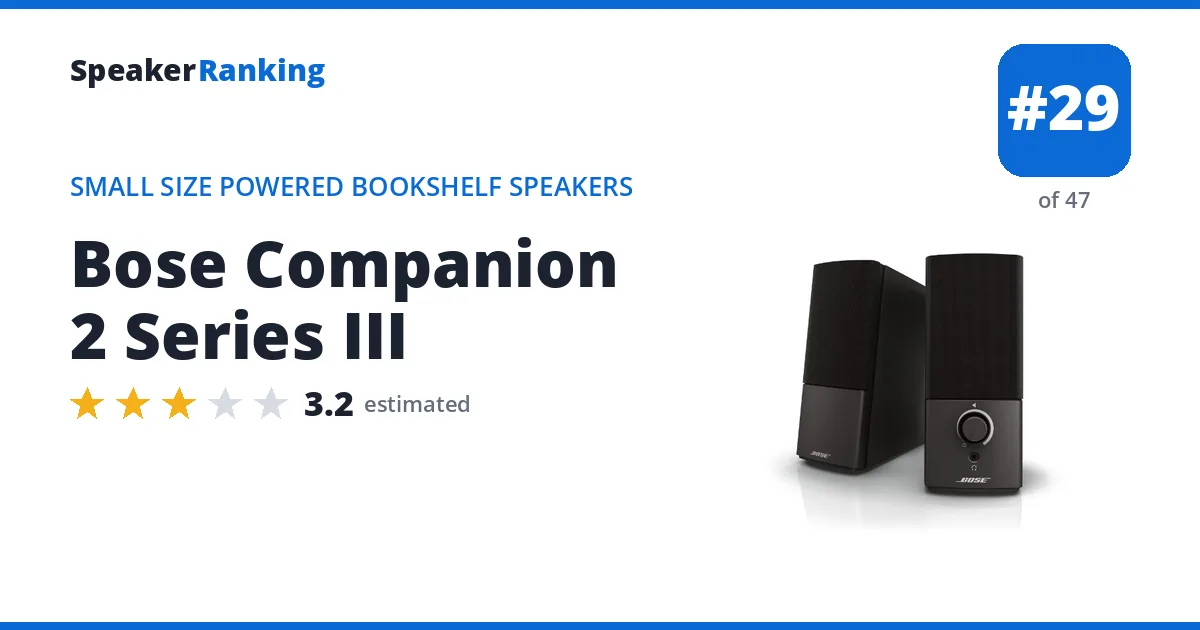
Pros: Amazon’s longest-running #1 premium desktop multimedia speaker system. Features Bose’s TrueSpace stereo digital signal processing circuitry that creates a wide, immersive soundstage that extends well past the physical width of the satellites. Dual 3.5mm aux inputs permit simultaneous audio playback from a computer and an auxiliary audio device without unplugging cables. Features a clean front volume knob with integrated headphone jack.
Cons: No Spinorama or independent anechoic data available. Relies on proprietary DSP loudness curves that boost mid-bass and highs while scooping the midrange. Lacks Bluetooth or digital inputs.
Full Bose Companion 2 Series III review and specifications →
| Released | Jun 2013 (13 years ago) |
|---|---|
| Aux Input | Yes (dual 3.5mm inputs) |
| Bluetooth | No |
| Dimensions | 7.5” x 3.1” x 5.9” (190 x 80 x 150 mm) each |
| Drivers | 2.5” full-range driver in ported enclosure |
| Headphone Output | Yes |
| Inputs | Dual 3.5mm Aux |
| RCA Input | No |
| USB Input | No |
| Weight | 4 lbs (1.8 kg) per pair |
- Links
- Reviews, Comparisons and Sound Samples
- Head-to-Head Comparisons
8-Inch PA Speakers
 Ranked #35 of 47 in 8-Inch PA Speakers - Bose AMM108: $2,289.00 Passive B&H $2,289.00 eBay
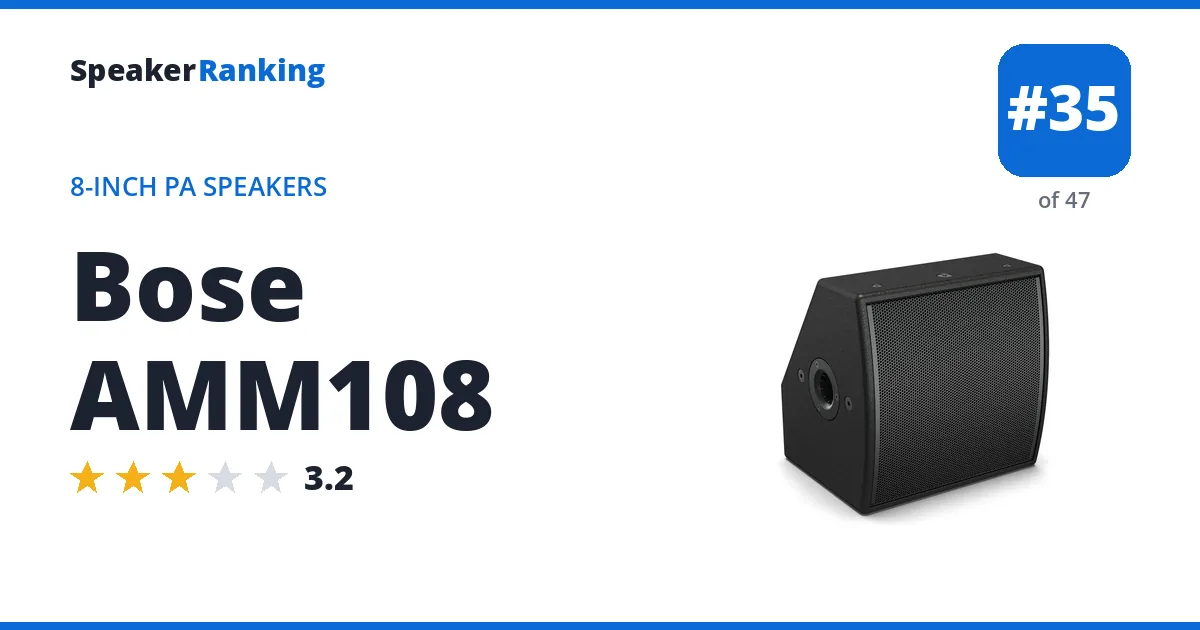
Same family: the Bose AMM112 (larger model, rated 3.3/5).
Pros: High-quality manufacturer measurements show a smooth on-axis response (0.76dB average deviation), and the compact wedge cabinet doubles as a fill or floor monitor with 110° x 60° coverage and a 128dB peak. Measured bass extension of 87.5Hz (-3dB).
Cons: Preference scores of 1.09 standalone and 4.34 with an ideal subwoofer are low because the listening window spreads across 4.4dB. Bass reaches only 88Hz at -3dB, so it needs a subwoofer for music. It is passive.
Full Bose AMM108 review and specifications →
| Released | Apr 2021 (5 years ago) |
|---|---|
| AES Input | No |
| Amplifier Power | Passive speaker; requires external amplification |
| Aux Input | No |
| Bass Extension (-10dB) | about 76.0Hz (measured, vendor Spinorama data) |
| Bass Extension (-3dB) | 87.5Hz (measured, vendor Spinorama data) |
| Bluetooth | No |
| Coaxial Input | No |
| Configuration | Passive 2-way coaxial PA speaker |
| Coverage | 110° x 60° |
| DSP | No (passive) |
| Dimensions | 12.5”H x 12.5”W x 10.6”D (318 x 318 x 268 mm) |
| Drivers | 8” coaxial woofer and compression driver |
| Frequency Response | 88Hz - 17kHz (-3dB, manufacturer specified) |
| Guitar Input | No |
| HDMI Input | No |
| Maximum SPL | 128dB peak (manufacturer calculated) |
| Microphone Input | No |
| Optical Input | No |
| Passive | Yes |
| RCA Input | No |
| Rigging | 35mm pole cup; 4 x M8 inserts; 6 x M10 inserts |
| Sensitivity | 94dB |
| Spinorama Preference Score | 1.09 |
| Spinorama Preference Score with Perfect Sub | 4.34 |
| TRS Input | No |
| USB Input | No |
| Weight | 28.7 lbs (13 kg) |
| XLR Input | No |
- Links
- Reviews, Comparisons and Sound Samples
- Head-to-Head Comparisons
12-Inch PA Speakers
 Ranked #59 of 83 in 12-Inch PA Speakers - Bose AMM112: $3,540.00 Passive B&H $3,540.00 eBay
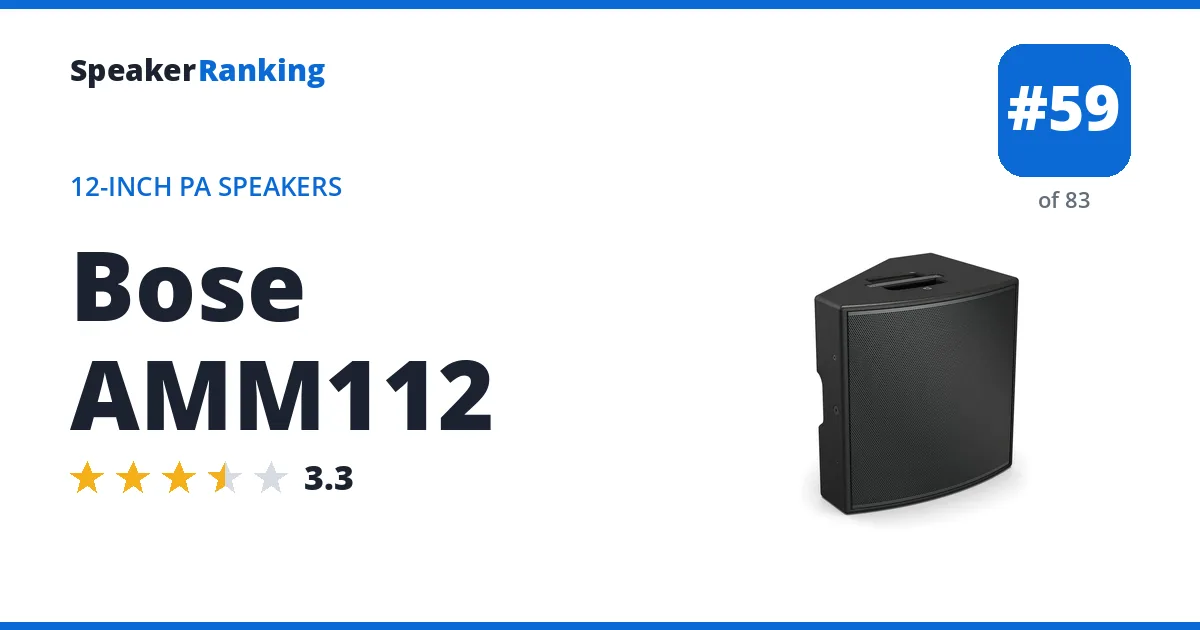
Same family: the Bose AMM108 (smaller model, rated 3.2/5).
Pros: High-quality manufacturer measurements show a smooth on-axis response (0.87dB average deviation), and the wedge-shaped cabinet works as a main, fill or floor monitor with wide 110° x 60° coverage and a 131dB peak. Measured bass extension of 87.5Hz (-3dB).
Cons: Preference scores of 1.38 standalone and 4.58 with an ideal subwoofer are modest, with bass to 88Hz at -3dB and only about 74Hz at -10dB, shallow for a 12-inch woofer. It is passive and weighs 22kg.
Full Bose AMM112 review and specifications →
| Released | Apr 2021 (5 years ago) |
|---|---|
| AES Input | No |
| Amplifier Power | Passive speaker; requires external amplification |
| Aux Input | No |
| Bass Extension (-10dB) | about 73.6Hz (measured, vendor Spinorama data) |
| Bass Extension (-3dB) | 87.5Hz (measured, vendor Spinorama data) |
| Bluetooth | No |
| Coaxial Input | No |
| Configuration | Passive 2-way coaxial PA speaker |
| Coverage | 110° x 60° |
| DSP | No (passive) |
| Dimensions | 18”H x 18”W x 15.1”D (457 x 457 x 383 mm) |
| Drivers | 12” coaxial woofer and compression driver |
| Frequency Response | 70Hz - 18kHz (-3dB, manufacturer specified) |
| Guitar Input | No |
| HDMI Input | No |
| Maximum SPL | 131dB peak / 121dB continuous (manufacturer specified) |
| Microphone Input | No |
| Optical Input | No |
| Passive | Yes |
| RCA Input | No |
| Rigging | 2 x 35mm pole cups; 6 x M10 inserts |
| Sensitivity | 96dB |
| Spinorama Preference Score | 1.38 |
| Spinorama Preference Score with Perfect Sub | 4.58 |
| TRS Input | No |
| USB Input | No |
| Weight | 48.5 lbs (22 kg) |
| XLR Input | No |
- Links
- Reviews, Comparisons and Sound Samples
- Head-to-Head Comparisons
Column and Line Array PA Speakers
 Ranked #19 of 33 in Column and Line Array PA Speakers - Bose ArenaMatch AM10: $5,714.00 Passive SoundPro $5,714.00 eBay
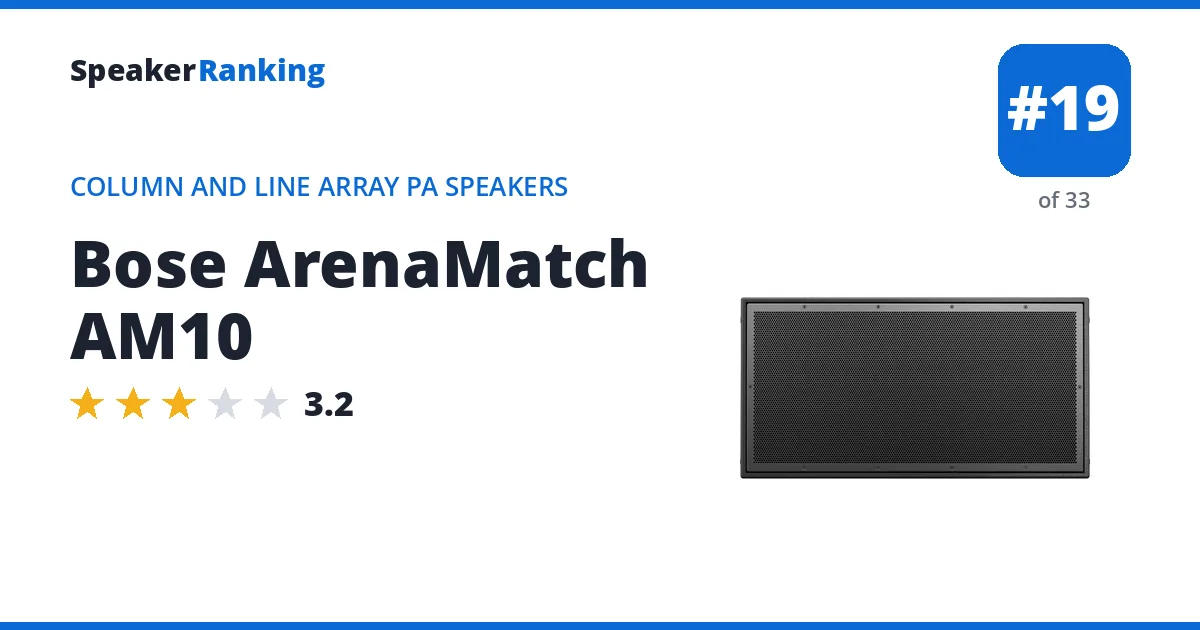
Pros: Weatherproof (IP55) array module for stadiums whose DeltaQ waveguides match each box’s vertical coverage to its throw distance. Vendor measurements of the 100 degree version show bass to 56Hz at -3dB and about 50Hz at -10dB, with scores of 1.95 on its own and 4.27 with an ideal subwoofer, the best of the ArenaMatch range. Measured bass extension of 56Hz (-3dB).
Cons: Built to be arrayed: on its own the narrow 10 degree vertical pattern gives uneven directivity (4.37dB variation) and a rough predicted in-room response (0.36 smoothness). At 36kg and 783mm wide it needs a rigging plan and a pro installer.
Full Bose ArenaMatch AM10 review and specifications →
| AES Input | No |
|---|---|
| Amplifier Power | Passive speaker; requires external amplification |
| Aux Input | No |
| Bass Extension (-10dB) | about 49.6Hz (measured, vendor Spinorama data) |
| Bass Extension (-3dB) | 56Hz (measured, vendor Spinorama data) |
| Bluetooth | No |
| Coaxial Input | No |
| Configuration | Passive 2-way DeltaQ array module (outdoor, IP55) |
| Coverage | 100° x 10° (60° and 80° horizontal versions available) |
| DSP | No (passive) |
| Dimensions | 16.1”H x 30.8”W x 16.5”D (409 x 783 x 420 mm) |
| Drivers | 14” woofer, 6 x EMB2S compression drivers |
| Frequency Response | 55Hz - 18kHz (manufacturer specified) |
| Guitar Input | No |
| HDMI Input | No |
| Impedance | 8 ohms (70V/100V transformer version available) |
| Maximum SPL | 127dB to 129dB peak (calculated, manufacturer specified) |
| Microphone Input | No |
| Optical Input | No |
| Passive | Yes |
| Power Handling | 750W continuous, 3,000W peak |
| RCA Input | No |
| Sensitivity | 100dB |
| Spinorama Preference Score | 1.95 |
| Spinorama Preference Score with Perfect Sub | 4.27 |
| TRS Input | No |
| USB Input | No |
| Weight | 80 lbs (36.3 kg) |
| XLR Input | No |
- Links
- Reviews, Comparisons and Sound Samples
 Ranked #24 of 33 in Column and Line Array PA Speakers - Bose ArenaMatch AM20: $5,714.00 Passive SoundPro $5,714.00 eBay
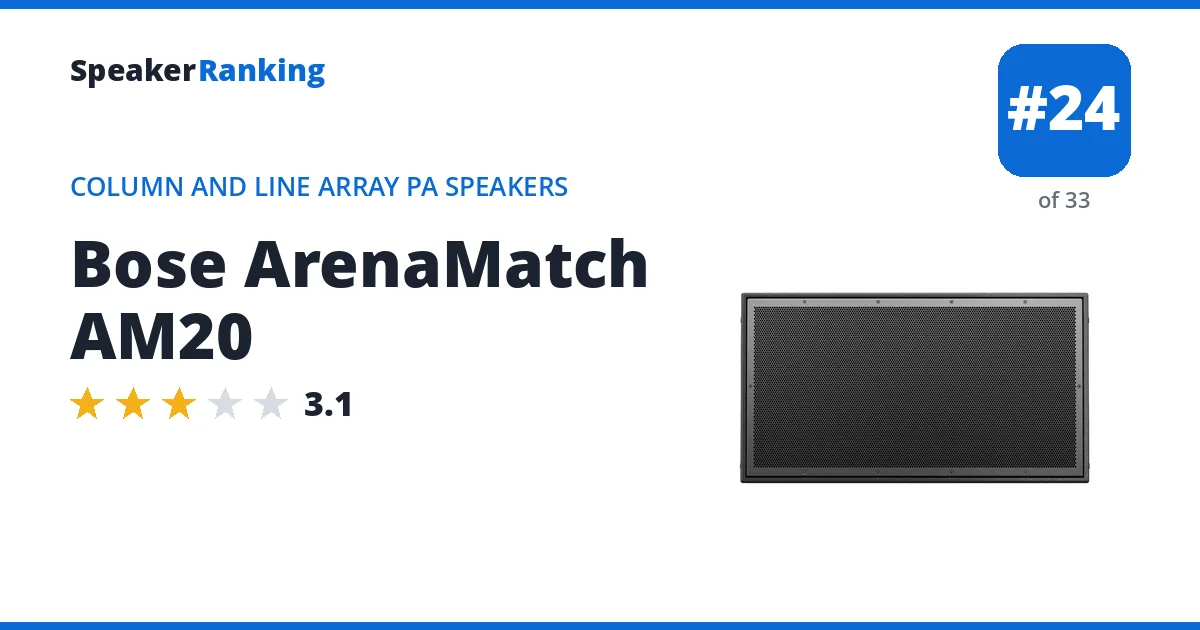
Pros: Weatherproof (IP55) DeltaQ array module with a 20 degree vertical pattern for mid-distance seating. Vendor measurements show bass to 56Hz at -3dB and about 50Hz at -10dB, and its directivity is the most consistent of the ArenaMatch range (3.67dB variation). Measured bass extension of 56Hz (-3dB).
Cons: Scores are low at 1.67 on its own and 3.99 with an ideal subwoofer, from a rough predicted in-room response (0.41 smoothness). It is designed to be arrayed and installed by a pro, at about 36kg per module.
Full Bose ArenaMatch AM20 review and specifications →
| AES Input | No |
|---|---|
| Amplifier Power | Passive speaker; requires external amplification |
| Aux Input | No |
| Bass Extension (-10dB) | about 49.6Hz (measured, vendor Spinorama data) |
| Bass Extension (-3dB) | 56Hz (measured, vendor Spinorama data) |
| Bluetooth | No |
| Coaxial Input | No |
| Configuration | Passive 2-way DeltaQ array module (outdoor, IP55) |
| Coverage | 100° x 20° (60° and 80° horizontal versions available) |
| DSP | No (passive) |
| Dimensions | 17.2”H x 30.8”W x 16.4”D (437 x 783 x 416 mm) |
| Drivers | 14” woofer, 6 x EMB2S compression drivers |
| Frequency Response | 55Hz - 18kHz (manufacturer specified) |
| Guitar Input | No |
| HDMI Input | No |
| Impedance | 8 ohms (70V/100V transformer version available) |
| Maximum SPL | 126dB to 128dB peak (calculated, manufacturer specified) |
| Microphone Input | No |
| Optical Input | No |
| Passive | Yes |
| Power Handling | 750W continuous, 3,000W peak |
| RCA Input | No |
| Sensitivity | 100dB |
| Spinorama Preference Score | 1.67 |
| Spinorama Preference Score with Perfect Sub | 3.99 |
| TRS Input | No |
| USB Input | No |
| Weight | 79.8 lbs (36.2 kg) |
| XLR Input | No |
- Links
- Reviews, Comparisons and Sound Samples
 Ranked #25 of 33 in Column and Line Array PA Speakers - Bose ArenaMatch AM40 Passive eBay
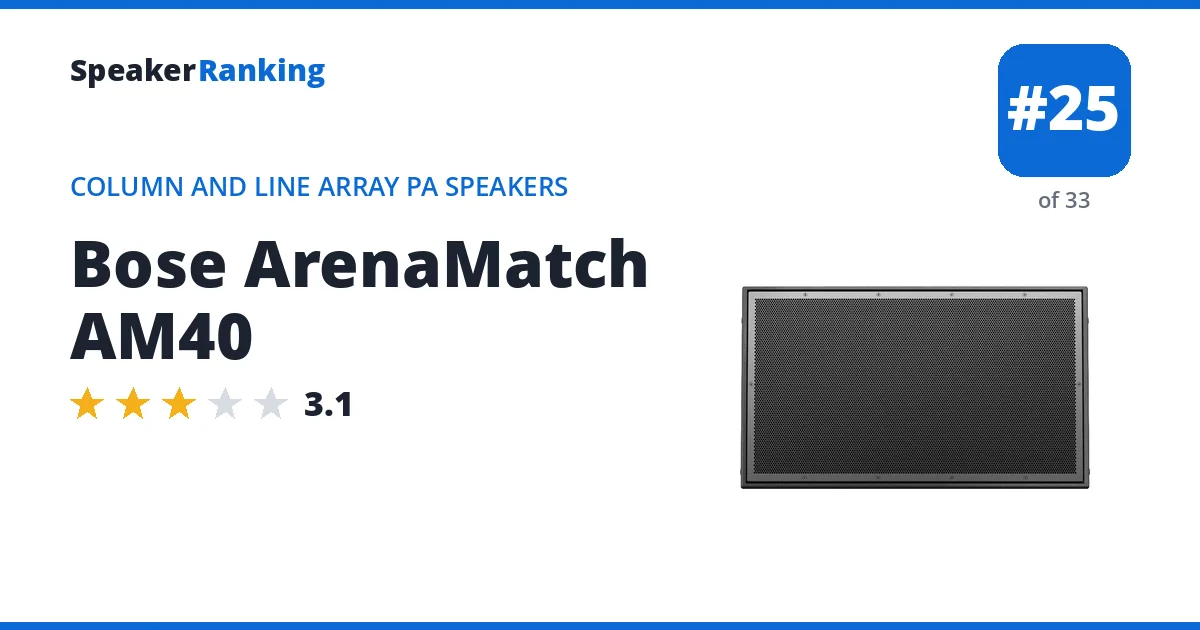
Pros: Weatherproof (IP55) DeltaQ module whose 40 degree vertical pattern makes it the most usable on its own of the ArenaMatch range, with a very even on-axis response in vendor measurements (0.20dB average deviation) and bass to 54.5Hz at -3dB. Measured bass extension of 54.5Hz (-3dB).
Cons: Scores are low at 1.58 on its own and 3.90 with an ideal subwoofer, from a rough predicted in-room response (0.38 smoothness). No US retailer lists it, so it is bought through Bose Professional dealers.
Full Bose ArenaMatch AM40 review and specifications →
| AES Input | No |
|---|---|
| Amplifier Power | Passive speaker; requires external amplification |
| Aux Input | No |
| Bass Extension (-10dB) | about 49.6Hz (measured, vendor Spinorama data) |
| Bass Extension (-3dB) | 54.5Hz (measured, vendor Spinorama data) |
| Bluetooth | No |
| Coaxial Input | No |
| Configuration | Passive 2-way DeltaQ array module (outdoor, IP55) |
| Coverage | 100° x 40° (60° and 80° horizontal versions available) |
| DSP | No (passive) |
| Dimensions | 19.3”H x 30.8”W x 15.7”D (489 x 783 x 400 mm) |
| Drivers | 14” woofer, 6 x EMB2S compression drivers |
| Frequency Response | 55Hz - 18kHz (manufacturer specified) |
| Guitar Input | No |
| HDMI Input | No |
| Impedance | 8 ohms (70V/100V transformer version available) |
| Maximum SPL | 125dB to 127dB peak (calculated, manufacturer specified) |
| Microphone Input | No |
| Optical Input | No |
| Passive | Yes |
| Power Handling | 750W continuous, 3,000W peak |
| RCA Input | No |
| Sensitivity | 100dB |
| Spinorama Preference Score | 1.58 |
| Spinorama Preference Score with Perfect Sub | 3.90 |
| TRS Input | No |
| USB Input | No |
| Weight | 76.9 lbs (34.9 kg) |
| XLR Input | No |
- Links
- Reviews, Comparisons and Sound Samples
Surface-Mount and Background Music Speakers
 Ranked #29 of 32 in Surface-Mount and Background Music Speakers - Bose DesignMax DM8SE: $869.00 each Passive Amazon $869.00 eBay
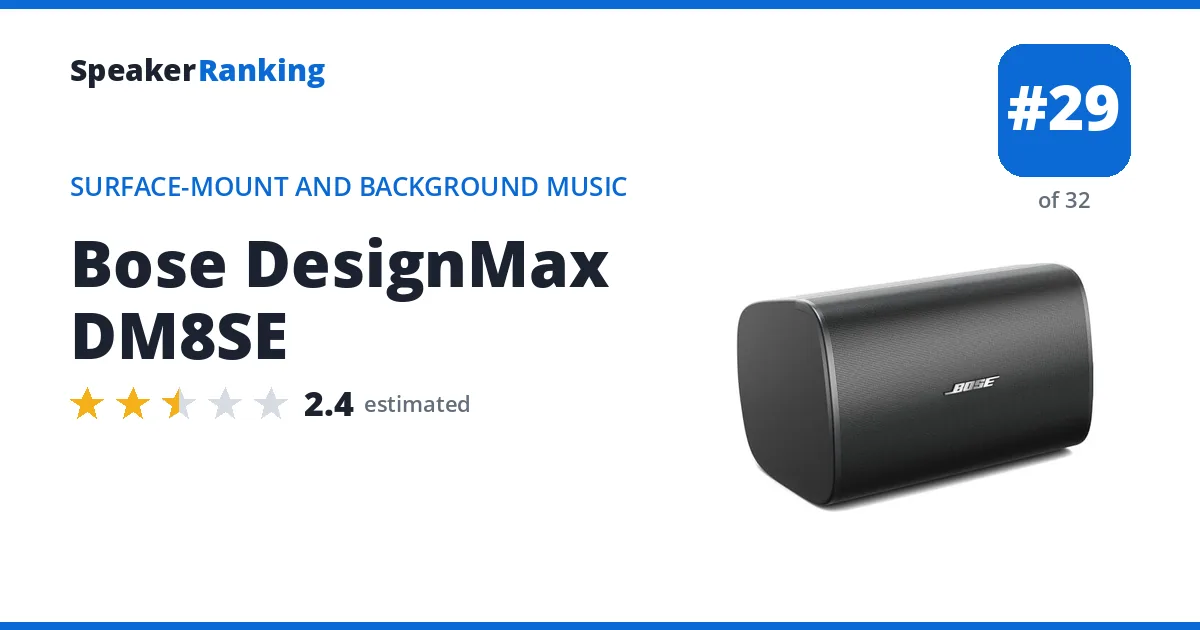
Older model: the Bose DesignMax DM8S (ranked higher, rated 2.4/5). See every Bose DesignMax generation.
Same family: the Bose DesignMax DM5SE (smaller model, ranked lower, rated 2.2/5) and the Bose DesignMax DM6SE (smaller model, ranked lower, rated 2.2/5).
Pros: The outdoor-rated replacement for the measured Bose DesignMax DM8S, keeping its 8” woofer and center-firing coaxial 1” compression driver with 150W handling and a 52Hz to 20kHz range. It adds IP55 weather sealing, an aluminum grille with a rust-resistant finish and a sealed cover over the input terminals.
Cons: No independent measurements yet, so it can’t be compared with ranked PA speakers. The measured DM8S it is based on had an uneven response for its price, and it needs an external amplifier.
Full Bose DesignMax DM8SE review and specifications →
| Released | Mar 2025 (1 year ago) |
|---|---|
| Amplifier Power | Passive speaker; requires external amplification |
| Bass Extension (-3dB) | 60Hz (manufacturer specified) |
| Bluetooth | No |
| Configuration | Passive 2-way coaxial surface-mount speaker |
| DSP | No (passive) |
| Drivers | 8” woofer, coaxial 1” compression driver |
| Frequency Response | 52Hz - 20kHz (manufacturer specified) |
| IP Rating | IP55 |
| Maximum SPL | 121dB peak (manufacturer specified) |
| Passive | Yes |
| Power Handling | 150W |
| Rigging | QuickHold U-bracket; 2 x M8 bracket inserts; M8 safety cable insert |
| Weight | 22.7 lbs (10.3 kg) |
| XLR Input | No |
- Links
- Reviews, Comparisons and Sound Samples
- No independent measurement review is linked for this model; it is ranked from hands-on listening and comparison against similarly priced speakers.
- Head-to-Head Comparisons
 Ranked #31 of 32 in Surface-Mount and Background Music Speakers - Bose DesignMax DM5SE: $897.05 per pair Passive Amazon $897.05 eBay
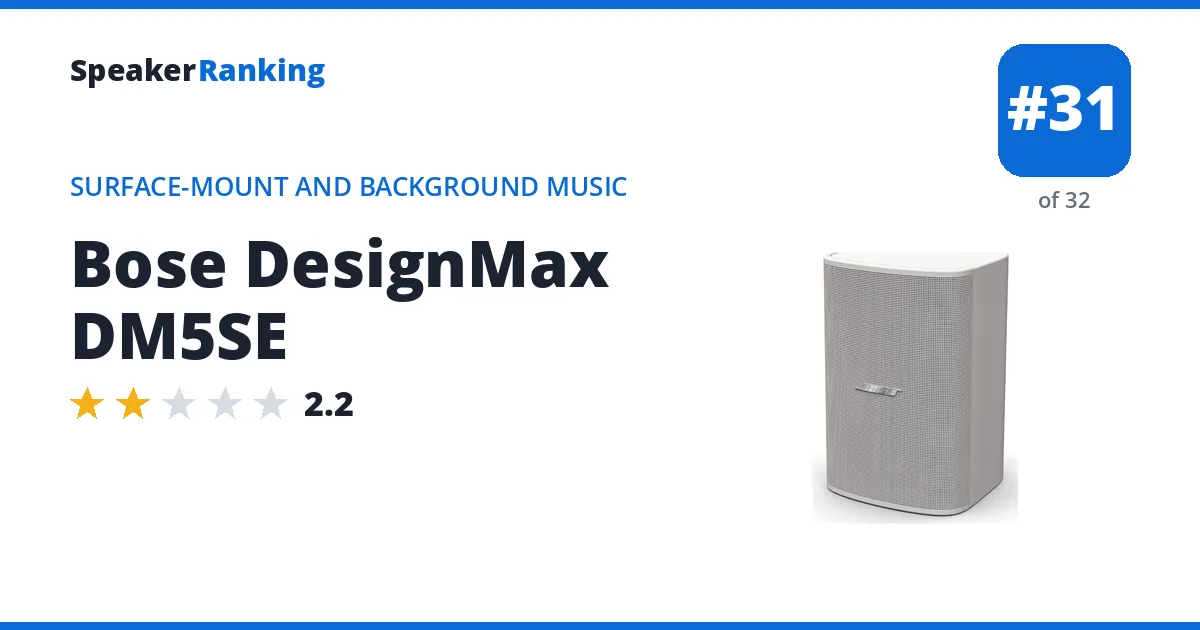
Same family: the Bose DesignMax DM6SE (larger model, ranked lower, rated 2.2/5) and the Bose DesignMax DM8SE (larger model, ranked higher, estimated 2.4/5). See every Bose DesignMax generation.
Pros: An IP55 surface-mount installation speaker from Bose Professional with a 5.25” coaxial driver. Bose’s measurements show a preference score of -0.41 that reaches 2.61 with an ideal subwoofer, with 1.03 listening window deviation.
Cons: The response is uneven and bass is limited, for a low preference score. The data comes from Bose. Bass reaches 77.5Hz (-3dB) and about 68Hz (-10dB).
Full Bose DesignMax DM5SE review and specifications →
| Released | Oct 2020 (6 years ago) |
|---|---|
| Bass Extension (-10dB) | about 68.3Hz (measured, manufacturer data via spinorama.org) |
| Bass Extension (-3dB) | 77.5Hz (measured, manufacturer data via spinorama.org) |
| Bluetooth | No |
| DIY Kit | No |
| Drivers | 5.25” coaxial driver |
| IP Rating | IP55 |
| Maximum SPL | 111dB peak (manufacturer specified) |
| Passive | Yes |
| Rigging | QuickHold U-bracket; M8 inserts for pan and tilt bracket |
| Spinorama Preference Score | -0.41 |
| Spinorama Preference Score with Perfect Sub | 2.61 |
| Weight | 9.7 lbs (4.38 kg) |
- Links
- Reviews, Comparisons and Sound Samples
- Head-to-Head Comparisons
 Ranked #32 of 32 in Surface-Mount and Background Music Speakers - Bose DesignMax DM6SE: $936.00 per pair Passive Amazon $936.00 eBay
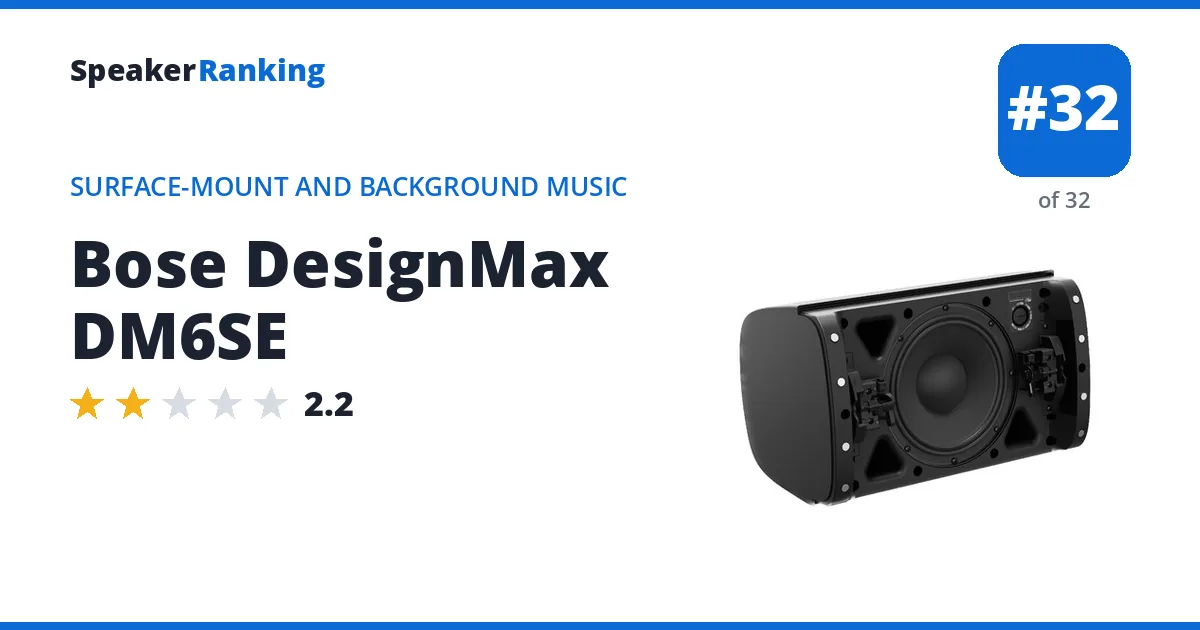
Same family: the Bose DesignMax DM5SE (smaller model, ranked higher, rated 2.2/5) and the Bose DesignMax DM8SE (larger model, ranked higher, estimated 2.4/5). See every Bose DesignMax generation.
Pros: An IP55 surface-mount installation speaker from Bose Professional with a 6.5” coaxial driver. Bose’s measurements show a preference score of -0.04 that reaches 2.87 with an ideal subwoofer, with 1.00 listening window deviation.
Cons: The on-axis response is very uneven (3.11 average deviation). The data comes from Bose. Bass reaches 71.0Hz (-3dB) and about 62Hz (-10dB).
Full Bose DesignMax DM6SE review and specifications →
| Released | Oct 2020 (6 years ago) |
|---|---|
| Bass Extension (-10dB) | about 62.0Hz (measured, manufacturer data via spinorama.org) |
| Bass Extension (-3dB) | 71.0Hz (measured, manufacturer data via spinorama.org) |
| Bluetooth | No |
| DIY Kit | No |
| Drivers | 6.5” coaxial driver |
| IP Rating | IP55 |
| Maximum SPL | 107dB peak (manufacturer specified) |
| Passive | Yes |
| Rigging | QuickHold U-bracket; 2 x M8 bracket inserts; M8 safety tether insert |
| Spinorama Preference Score | -0.04 |
| Spinorama Preference Score with Perfect Sub | 2.87 |
| Weight | 13.1 lbs (5.93 kg) |
- Links
- Reviews, Comparisons and Sound Samples
- Head-to-Head Comparisons
Battery-Powered PA Speakers
 Ranked #6 of 16 in Battery-Powered PA Speakers - Bose S1 Pro+: $699.00 Amazon $699.00 eBay
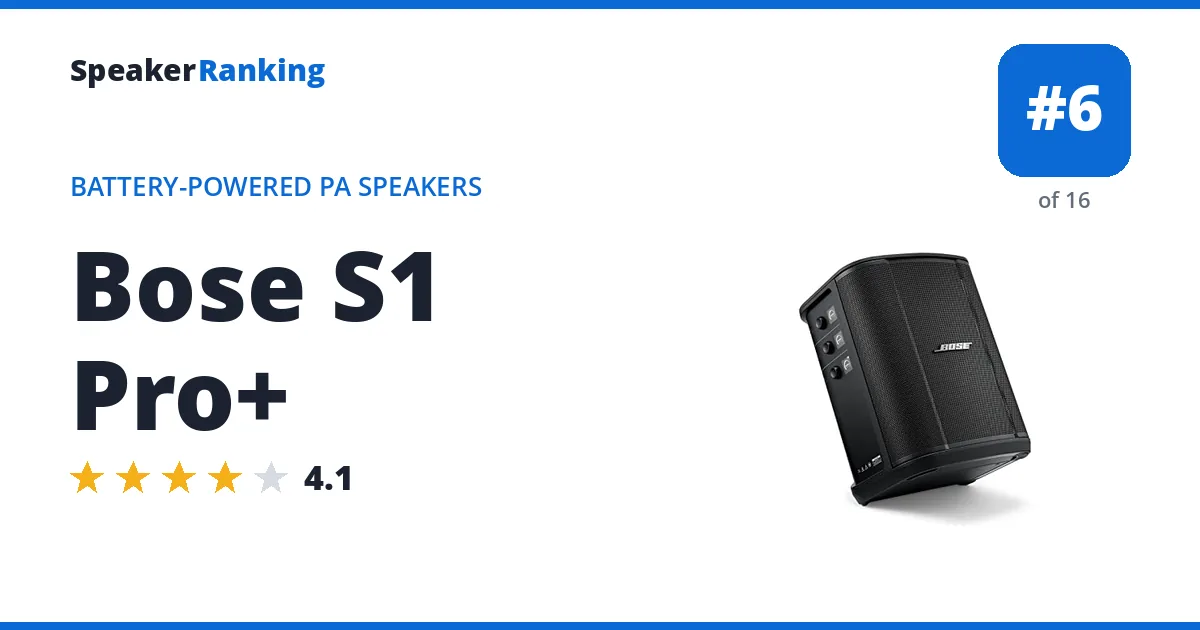
Older model: the Bose S1 Pro (ranked lower, rated 4/5). See every Bose S1 Pro generation.
Pros: Extremely compact and light with flexible placement options, and very loud for its size. Three-channel mixer (2 XLR/quarter-inch combo mic-instrument + 1 line/Bluetooth), each with its own OLED display for quick treble/bass/reverb adjustment. Auto EQ adjusts sound based on orientation. Multiple angled surfaces for various positioning including tilted portrait mode, plus a line out to daisy-chain a second unit. Optional WT-XLR/WT-INST wireless transmitters dock, pair, and charge right in the speaker for a cable-free mic or instrument. Up to 11 hours battery life. High efficiency drivers reach 2-3x the volume of typical speakers for the same wattage. Measured bass extension of 62Hz (-3dB).
Cons: Leans toward a bright sound signature, and its bass bottoms out as the volume rises, so full range music suffers well before maximum loudness. Better suited for voice and instrument amplification than for casual music listening. Treble is pretty boosted. Not stereo. Designed for more loudness than deeper bass. Ports are fully exposed with no water resistance. Charges via a less common three-prong AC cable instead of the two-prong barrel cable most rivals use.
Full Bose S1 Pro+ review and specifications →
| Released | Jul 2023 (3 years ago) |
|---|---|
| Amplifier Power | 150W |
| App | Yes |
| Aux Input | Yes |
| Bass Extension (-10dB) | 55Hz |
| Bass Extension (-3dB) | 62Hz |
| Battery Life | 11 hours (Manufacturer specified) |
| Bluetooth | Yes |
| Bluetooth Codecs | AAC, SBC |
| Bluetooth Version | 5.0 |
| Cabinet Material | Polypropylene |
| Charging Time | 5 hours |
| Configuration | Battery-powered 2-way active PA |
| Coverage | 120° H x 50° V |
| DSP | 3-channel mixer with EQ, reverb and Auto EQ |
| Digital Aux Input | No |
| Dimensions | 13.1” x 9.4” x 11” (332.7 x 238.8 x 279.4 mm) |
| Drivers | 1x 6” (152mm) woofer + 3x 2.25” (57mm) tweeters |
| EQ | Yes |
| Guitar Input | Yes |
| IP Rating | None |
| Inputs | 2x XLR/6.3mm combo (mic/line/instrument), 6.3mm line, 3.5mm stereo, Bluetooth |
| Maximum SPL | 109dB |
| Microphone Input | Yes |
| Omnidirectional | No |
| Party Mode | Yes (Bose Party mode) |
| Passive | No |
| Power Bank | No |
| Power Input | AC Power cord |
| Rigging | 35mm pole mount; multi-position cabinet |
| Stereo | No |
| TWS | Yes |
| USB Playback | No |
| Weight | 14.3 lbs (6.5 kg) |
| XLR Input | Yes |
- Links
- Reviews, Comparisons and Sound Samples
- Head-to-Head Comparisons
Medium Home Subwoofers (30-75 lbs)
 Ranked #50 of 212 in Medium Home Subwoofers (30-75 lbs) - Bose Lifestyle Ultra Subwoofer: $849.00 Amazon $849.00 eBay
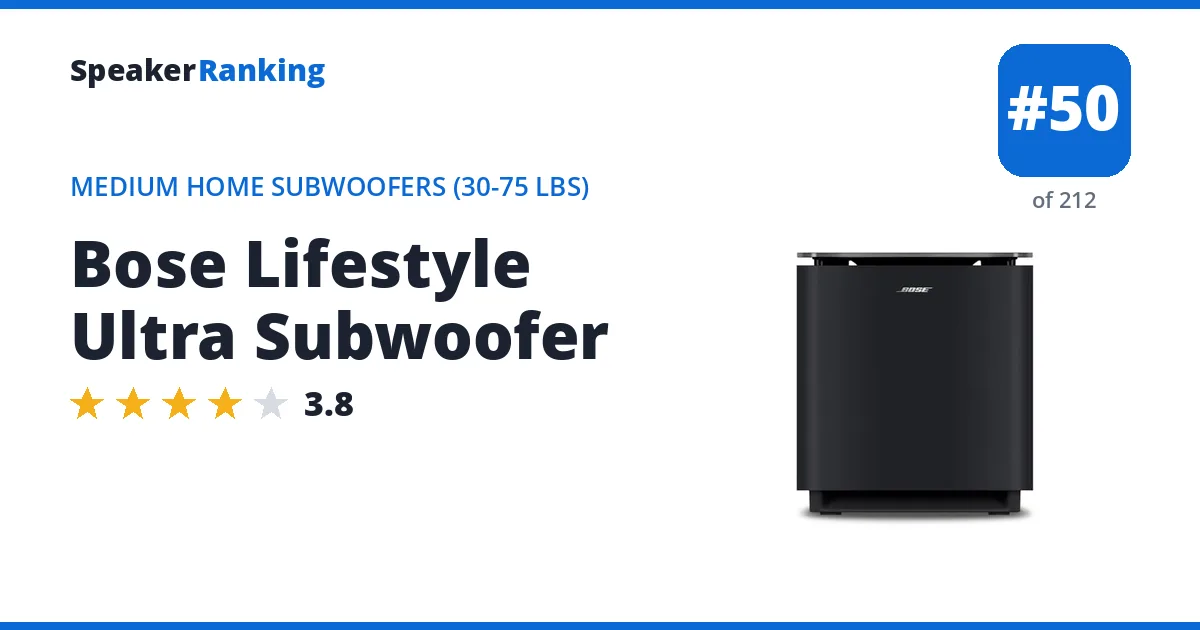
Same family: the Bose Lifestyle Ultra Speaker (model, rated 3.7/5).
Pros: Independent CEA-2010 testing records 90.6 dB at 20 Hz and 115.4 dB (avg of 3/4 bands) through 40-80 Hz. The ported enclosure with a 12” driver is well suited to a mid-size room.
Cons: The 326.8H x 294.7W x 294.7D mm cabinet and 15.3 kg mass still need deliberate placement and calibration.
Full Bose Lifestyle Ultra Subwoofer review and specifications →
| Released | May 2026 (5 months ago) |
|---|---|
| CEA-2010-A Average (40-80Hz) | 115.4 dB (avg of 3/4 bands) |
| Country | Thailand |
| Dimensions | 12.9”H x 11.6”W x 11.6”D (326.8 x 294.7 x 294.7 mm) |
| Drivers | 12” (305mm) driver |
| Enclosure | ported |
| Measurement Source | Brent Butterworth |
| Output SPL at 20 Hz | 90.6 dB |
| Output SPL at 25 Hz | 102.5 dB |
| Output SPL at 31.5 Hz | 108.8 dB |
| Output SPL at 40 Hz | 113.9 dB |
| Output SPL at 50 Hz | 115.8 dB |
| Output SPL at 63 Hz | 116.6 dB |
| Warranty | 1 |
| Weight | 33.7 lbs (15.3 kg) |
- Links
- Reviews, Comparisons and Sound Samples
- Independently measured by Brent Butterworth; the published figures above come from this ASR subwoofer measurement thread.
- Head-to-Head Comparisons
Discontinued Bose Models
Still ranked, and often still worth buying used, but no longer in production. Check availability before planning around one of these.
Medium Size Portable Bluetooth Speakers
 Ranked #52 of 175 in Medium Size Portable Bluetooth Speakers - Bose Soundlink Revolve+: $269.99 Discontinued Amazon $269.99 eBay
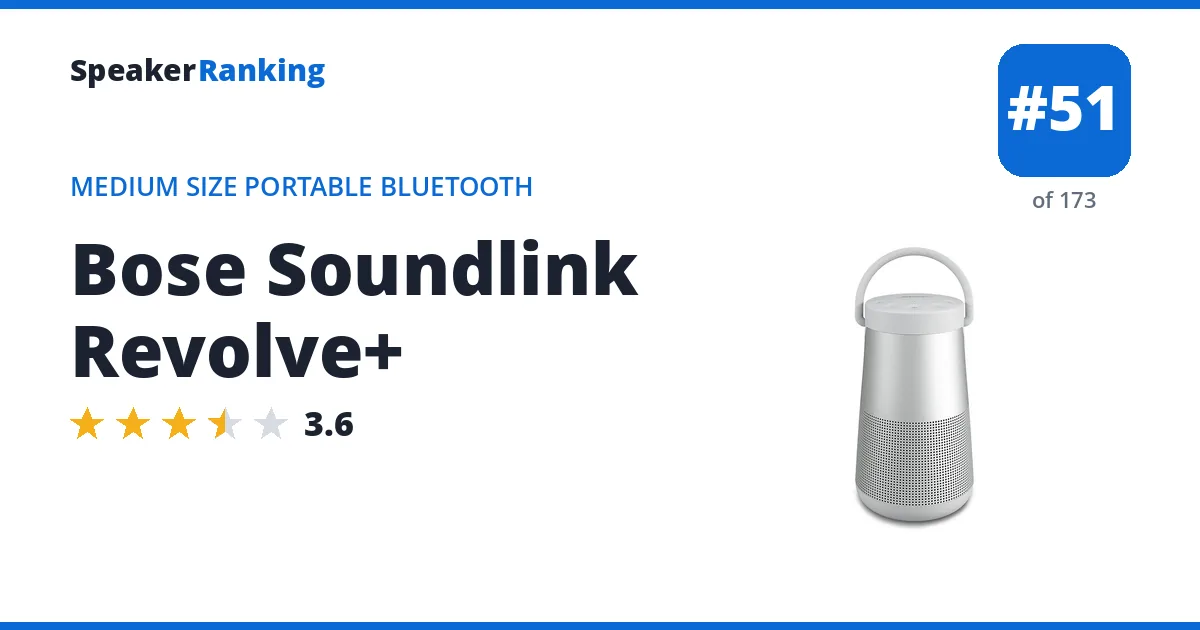
Newer model: the Bose Soundlink Revolve+ II, ranked higher, rated 3.6/5, released Jan 2021. See every Bose SoundLink Revolve generation.
Same family: the Bose Soundlink Revolve (smaller model, ranked lower, rated 3.5/5).
Pros: True 360° sound stays consistent no matter where you stand. Built-in carry handle, useful even with wet hands; can hang from a hook via carabiner. ~12 hour battery at medium-high volume. Measured bass extension of 54.2Hz (-3dB).
Cons: Overly boosted bass, warm sounding. Boosted mids. Rolled off treble. Discontinued.
Full Bose Soundlink Revolve+ review and specifications →
| Released | Apr 2017 (9 years ago) |
|---|---|
| App | Yes |
| Aux Input | Yes |
| Bass Extension (-10dB) | 56Hz |
| Bass Extension (-3dB) | 54.2Hz (measured, Erin’s Audio Corner) |
| Battery Life | 16 hours (Manufacturer specified) |
| Bluetooth | Yes |
| Bluetooth Codecs | SBC |
| Bluetooth Version | 4.2 |
| Digital Aux Input | No |
| Dimensions | 4.1” x 7.2” x 4.1” (105 x 184 x 105 mm) |
| Drivers | 91mm fullrange |
| EQ | No |
| IP Rating | IP55 |
| Omnidirectional | Yes |
| Party Mode | Yes (Bose Party mode) |
| Power Input | Micro USB |
| Stereo | No |
| Strap | No |
| TWS | Yes |
| Weight | 2 lbs (0.91 kg) |
- Reviews, Comparisons and Sound Samples
- Erin’s Audio Corner: Live Reviews and Q&A! Bose Soundbar, Monoprice Monitors, Bluetooth Speakers and more. More from Erin’s Audio Corner →
- Erin’s Audio Corner Measurements (spinorama.org)
- Erin’s Audio Corner Website: Bose Soundlink Revolve+
- Alan Ross Reviews: The Ultimate 360 Degree Bluetooth Speaker Showdown: Bose Soundlink Revolve Vs Tribit Stormbox Pro More from alanrossreviews →
- Alan Ross Reviews: Soundcore Glow: best budget 360 degree speaker or get the Bose Revolve+? 1 hour of fun!
- Head-to-Head Comparisons
- Bose Soundlink Revolve+ vs Bose Soundlink Revolve+ II
- Bose Soundlink Revolve+ vs W-King D320
- Bose Soundlink Revolve+ vs Soundcore Glow
- Bose Soundlink Revolve+ vs JBL Pulse 5
- Bose Soundlink Revolve+ vs Xiaomi Sound Outdoor
- Bose Soundlink Revolve+ vs Tribit Stormbox Pro
- Bose Soundlink Revolve+ vs Soundcore Motion 100
- Bose Soundlink Revolve+ vs Sonos Play
- See all 74 comparisons
 Ranked #60 of 175 in Medium Size Portable Bluetooth Speakers - Bose Soundlink Revolve: $187.00 Discontinued Amazon $187.00 eBay
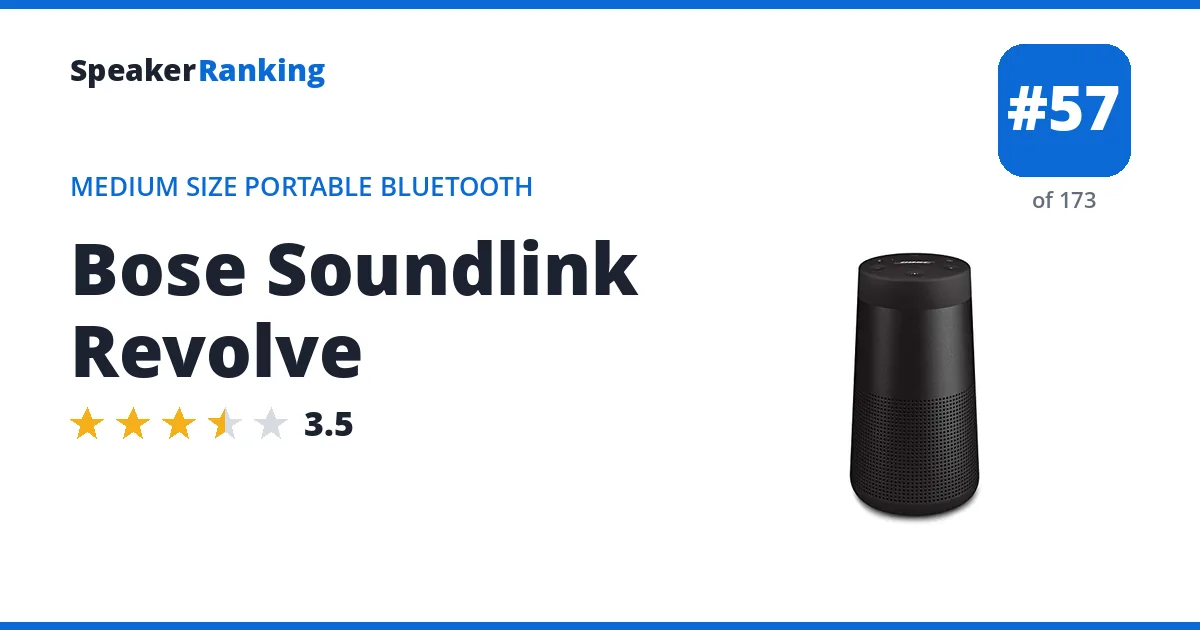
Newer model: the Bose SoundLink Revolve (Series II), ranked higher, rated 3.6/5, released Jan 2021. Water resistance goes from IPX4 to IP55. See every Bose SoundLink Revolve generation.
Same family: the Bose Soundlink Revolve+ (larger model, ranked higher, rated 3.6/5).
Pros: True 360° sound stays consistent no matter where you stand around it, unlike most portable speakers. Measured bass extension of 64.5Hz (-3dB).
Cons: Not stereo. Strange sizzling treble, peaks and dips. Overly boosted boomy bass at 75Hz. Discontinued.
Full Bose Soundlink Revolve review and specifications →
| Released | Apr 2017 (9 years ago) |
|---|---|
| App | Bose Connect |
| Aux Input | Yes |
| Bass Extension (-10dB) | 60Hz |
| Bass Extension (-3dB) | 64.5Hz (measured, Erin’s Audio Corner) |
| Battery Life | 12 hours (Manufacturer specified) |
| Bluetooth | Yes |
| Bluetooth Codecs | SBC |
| Bluetooth Version | 4.2 |
| Built-in Microphone | Yes |
| Digital Aux Input | No |
| Dimensions | 3.2” x 6” x 3.2” (82 x 152 x 82 mm) |
| Drivers | 1x omnidirectional full-range transducer (~45mm) + 2x passive radiators |
| EQ | No |
| IP Rating | IPX4 |
| Omnidirectional | Yes |
| Party Mode | Yes (Bose Party mode) |
| Power Input | Micro USB |
| Stereo | No |
| TWS | Yes |
| Weight | 1.5 lbs (660 g) |
- Reviews, Comparisons and Sound Samples
- Erin’s Audio Corner: Live Reviews and Q&A! Bose Soundbar, Monoprice Monitors, Bluetooth Speakers and more. More from Erin’s Audio Corner →
- Erin’s Audio Corner Measurements (spinorama.org)
- Erin’s Audio Corner Website: Bose Soundlink Revolve
- Alan Ross Reviews: The Ultimate 360 Degree Bluetooth Speaker Showdown: Bose Soundlink Revolve Vs Tribit Stormbox Pro More from alanrossreviews →
- Head-to-Head Comparisons
- Bose Soundlink Revolve vs Tribit Stormbox Flow
- Bose Soundlink Revolve vs Sonos Play
- Bose Soundlink Revolve vs JBL Charge 4
- Bose Soundlink Revolve vs Turtlebox Ranger
- Bose Soundlink Revolve vs Bose Soundlink Revolve+
- Bose Soundlink Revolve vs Soundcore 3
- Bose Soundlink Revolve vs Bose Soundlink Revolve+ II
- Bose Soundlink Revolve vs W-King D320
- See all 74 comparisons
 Ranked #71 of 175 in Medium Size Portable Bluetooth Speakers - Bose Soundlink Mini 2: $184.00 Discontinued Amazon $184.00 eBay
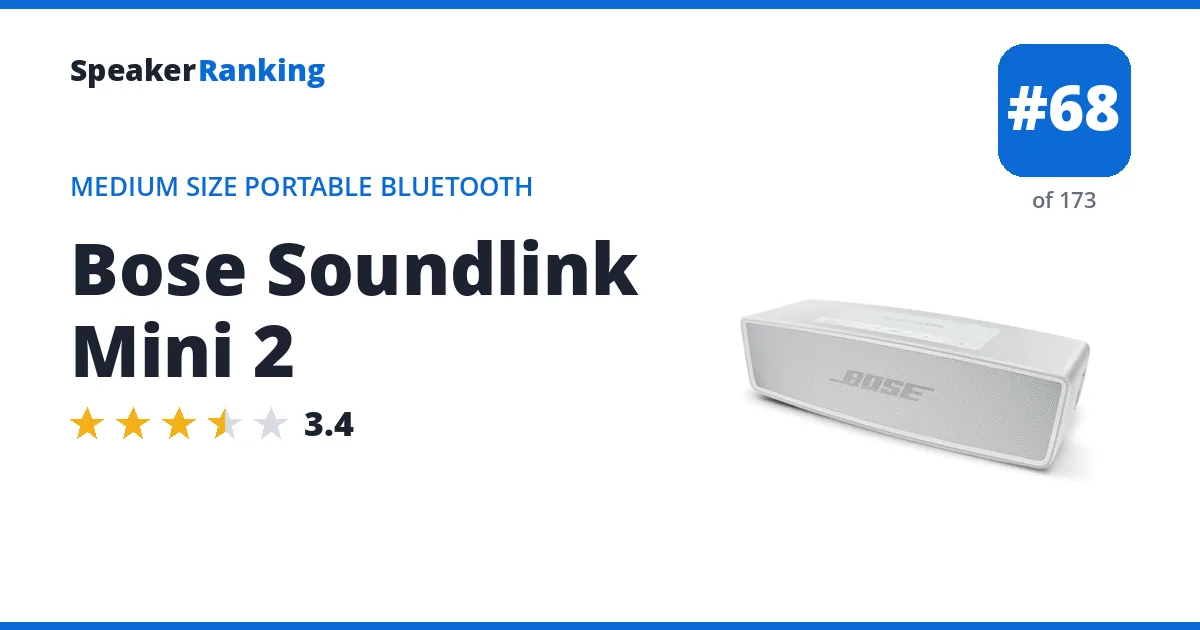
Older model: the Bose Soundlink Mini (ranked lower, rated 3.4/5). See every Bose SoundLink Mini generation.
Pros: Compact aluminum build feels sturdy and dense. ~10 hour battery life; can pair to two devices at once and remembers up to 8. Measured bass extension of ~58Hz (-10dB).
Cons: Boosted upper bass like most Bose speakers. Upper treble rolled off. Bass is 2db less boosted than the Bose Soundlink Mini. Bass doesn’t go as deep as others. Failures of the mainboard are common. Discontinued.
Full Bose Soundlink Mini 2 review and specifications →
| Released | Jul 2015 (11 years ago) |
|---|---|
| App | Yes (Bose Connect) |
| Aux Input | Yes |
| Bass Extension (-10dB) | ~58Hz |
| Battery Life | 10 hours (Manufacturer specified) |
| Bluetooth | Yes |
| Bluetooth Codecs | SBC |
| Bluetooth Version | 4.2 |
| Built-in Microphone | Yes |
| Digital Aux Input | No |
| Dimensions | 7.1” x 2” x 2.3” (180 x 51 x 58 mm) |
| Drivers | 2x 33mm fullrange |
| EQ | No |
| IP Rating | None |
| Omnidirectional | No |
| Power Input | Micro-USB or charging cradle |
| Stereo | Yes |
| Strap | No |
| TWS | Yes |
| Weight | 1.5 lbs (680 g) |
- Links
- Reviews, Comparisons and Sound Samples
- Head-to-Head Comparisons
- Bose Soundlink Mini 2 vs Bose Soundlink Mini
- Bose Soundlink Mini 2 vs Soundcore 3
- Bose Soundlink Mini 2 vs Sony ULT Field 3
- Bose Soundlink Mini 2 vs Xiaomi Mi Portable
- Bose Soundlink Mini 2 vs Sony XB33
- Bose Soundlink Mini 2 vs Turtlebox Ranger
- Bose Soundlink Mini 2 vs Bose Portable Smart Speaker
- Bose Soundlink Mini 2 vs Beats Pill 2024
- See all 97 comparisons
 Ranked #73 of 175 in Medium Size Portable Bluetooth Speakers - Bose Soundlink Mini: $125.00 Discontinued Amazon $125.00 eBay
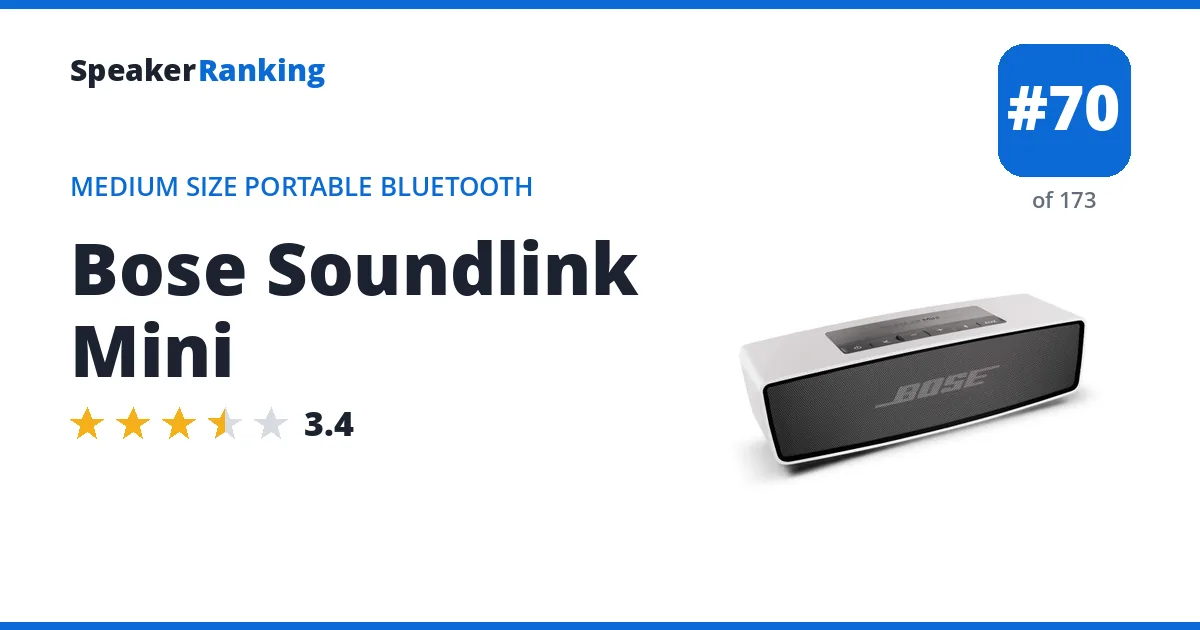
Newer model: the Bose Soundlink Mini 2, ranked higher, rated 3.4/5, released Jul 2015 (also discontinued). It adds stereo pairing. Battery life goes from 7 to 10 hours. See every Bose SoundLink Mini generation.
Pros: Compact aluminum build feels sturdy and dense. Comes with a charging cradle. Measured bass extension of ~58Hz (-10dB).
Cons: Boosted upper bass like most Bose speakers. Upper treble rolled off. Bass doesn’t go as deep as others. Failures of the mainboard are common. Discontinued.
Full Bose Soundlink Mini review and specifications →
| Released | Jul 2013 (13 years ago) |
|---|---|
| App | Yes (Bose Connect) |
| Aux Input | Yes |
| Bass Extension (-10dB) | ~58Hz |
| Battery Life | 7 hours (Manufacturer specified) |
| Bluetooth | Yes |
| Bluetooth Codecs | SBC |
| Built-in Microphone | Yes |
| Digital Aux Input | No |
| Dimensions | 7.1” x 2” x 2.3” (180 x 51 x 58 mm) |
| Drivers | 50mm full-range driver with passive radiators |
| EQ | No |
| IP Rating | None |
| Omnidirectional | No |
| Power Input | Proprietary connector |
| Stereo | Yes |
| Strap | No |
| TWS | No |
| Weight | 1.5 lbs (680 g) |
- Links
- Reviews, Comparisons and Sound Samples
- Head-to-Head Comparisons
- Bose Soundlink Mini vs Sony ULT Field 3
- Bose Soundlink Mini vs Bose Soundlink Mini 2
- Bose Soundlink Mini vs Xiaomi Mi Portable
- Bose Soundlink Mini vs Sony XB33
- Bose Soundlink Mini vs Soundcore 3
- Bose Soundlink Mini vs Bose Portable Smart Speaker
- Bose Soundlink Mini vs Beats Pill 2024
- Bose Soundlink Mini vs JBL Flip 5
- See all 93 comparisons
 Ranked #125 of 175 in Medium Size Portable Bluetooth Speakers - Bose SoundLink Color II: $139.00 Discontinued Amazon $139.00 eBay
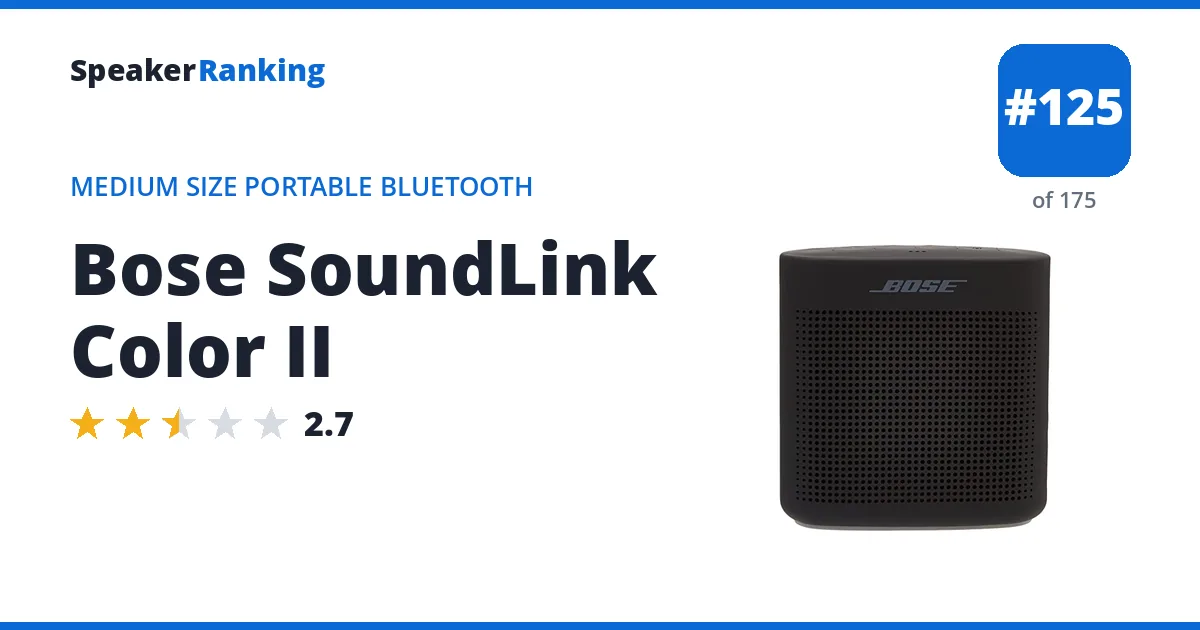
Pros: Soft-touch rubber coating is comfortable to hold and tough enough for bumps and scrapes. IPX4 splashproof. Supports multipoint pairing to two devices at once.
Cons: Boosted bass on Color II. Not as deep of bass as other models. Lacking midrange detail. Rolled off treble. Discontinued.
Full Bose SoundLink Color II review and specifications →
| Released | May 2017 (9 years ago) |
|---|---|
| App | Yes (Bose Connect) |
| Aux Input | No |
| Battery Life | 8 hours (Manufacturer specified) |
| Bluetooth | Yes |
| Bluetooth Codecs | SBC, AAC |
| Bluetooth Version | 4.2 |
| Built-in Microphone | Yes |
| Digital Aux Input | No |
| Dimensions | 5.2” x 5” x 2.2” (132 x 127 x 56 mm) |
| Drivers | 2x 40mm full-range drivers |
| EQ | No |
| IP Rating | IPX4 |
| Omnidirectional | No |
| Party Mode | Yes (Bose Party mode) |
| Power Bank | No |
| Power Input | Micro USB |
| Stereo | Yes |
| TWS | Yes |
| Weight | 1.3 lbs (600 g) |
- Links
- Reviews, Comparisons and Sound Samples
- Head-to-Head Comparisons
- Bose SoundLink Color II vs Marshall Emberton III
- Bose SoundLink Color II vs Marshall Emberton II
- Bose SoundLink Color II vs Yamaha True X Speaker 1A
- Bose SoundLink Color II vs Sony SRS-XB20
- Bose SoundLink Color II vs Cabasse Swell
- Bose SoundLink Color II vs Tribit Stormbox
- Bose SoundLink Color II vs Teufel Rockster Go
- Bose SoundLink Color II vs Sony SRS-XE300
- See all 75 comparisons
Large Size Portable Bluetooth Speakers
 Ranked #64 of 105 in Large Size Portable Bluetooth Speakers - Bose SoundLink Bluetooth Speaker III: $299.95 Discontinued eBay
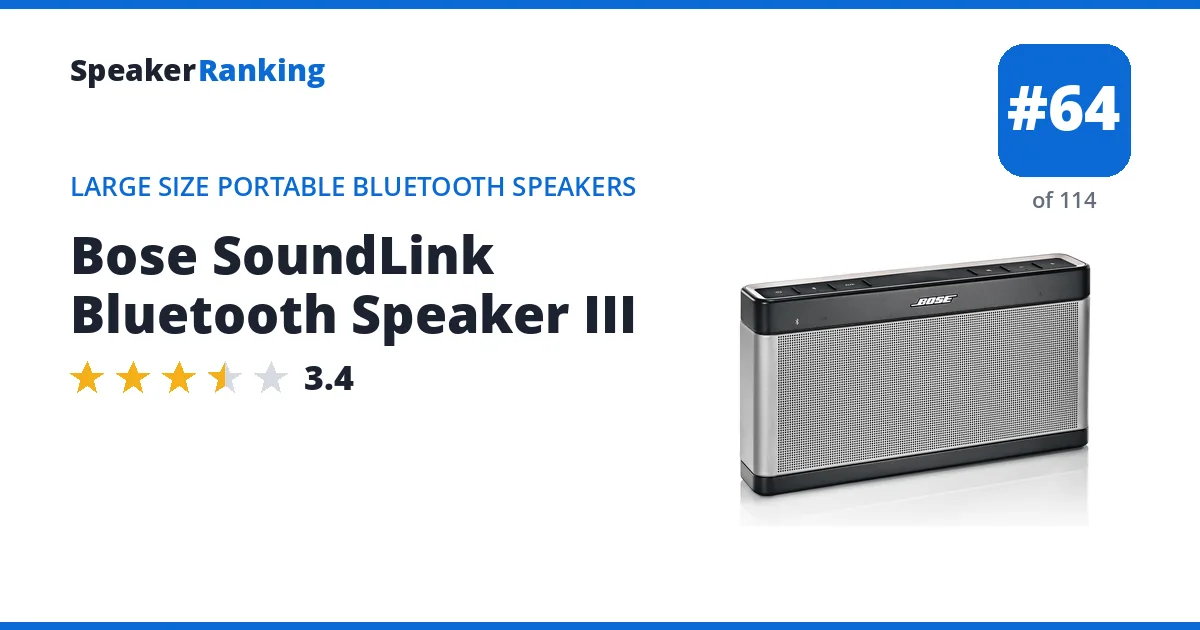
Pros: Four drivers and two opposing passive radiators give fuller, deeper bass than the Bose Soundlink Mini 2. Two drivers per side play left and right channels. Up to 14 hours of battery. Wraparound metal grille and sealed silicone buttons hold up to daily handling. Has a 3.5mm aux input.
Cons: No water or dust resistance. No app, EQ, speakerphone or multi speaker pairing. Charges through a proprietary AC adapter rather than USB. Bose boosts the upper bass, so voices can sound thick. Discontinued, so only used or renewed units remain.
Full Bose SoundLink Bluetooth Speaker III review and specifications →
| Released | Feb 2014 (12 years ago) |
|---|---|
| App | No |
| Aux Input | Yes |
| Battery Life | 14 hours (Manufacturer specified) |
| Bluetooth | Yes |
| Bluetooth Codecs | SBC |
| Built-in Microphone | No |
| Dimensions | 10.1” x 5.3” x 1.9” (256 x 135 x 48 mm) |
| Drivers | 4x neodymium full-range drivers + 2x passive radiators |
| EQ | No |
| IP Rating | None |
| Party Mode | No |
| Power Bank | No |
| Power Input | AC Power brick |
| Stereo | Yes |
| TWS | No |
| Weight | 3 lbs (1.37 kg) |
- Reviews, Comparisons and Sound Samples
- CNET: Bose SoundLink Bluetooth Speaker III: Revamped design, better sound and battery life More from Cnet →
- Android Authority: Bose SoundLink 3 Review
- Solo Trips: BOSE soundlink 3 vs JBL Xtreme
- Solo Trips: BOSE soundtouch 10 vs BOSE Soundlink 3
- Reviews, Tutorials & Tech: Review Bose SoundLink III Bluetooth Speaker
- Aaron X Loud and Wireless: Bose SoundLink III Speaker in 2018? Watch This Before you buy!
- Head-to-Head Comparisons
Surface-Mount and Background Music Speakers
 Ranked #28 of 32 in Surface-Mount and Background Music Speakers - Bose DesignMax DM8S: $758.94 each Passive Discontinued Amazon $758.94 eBay
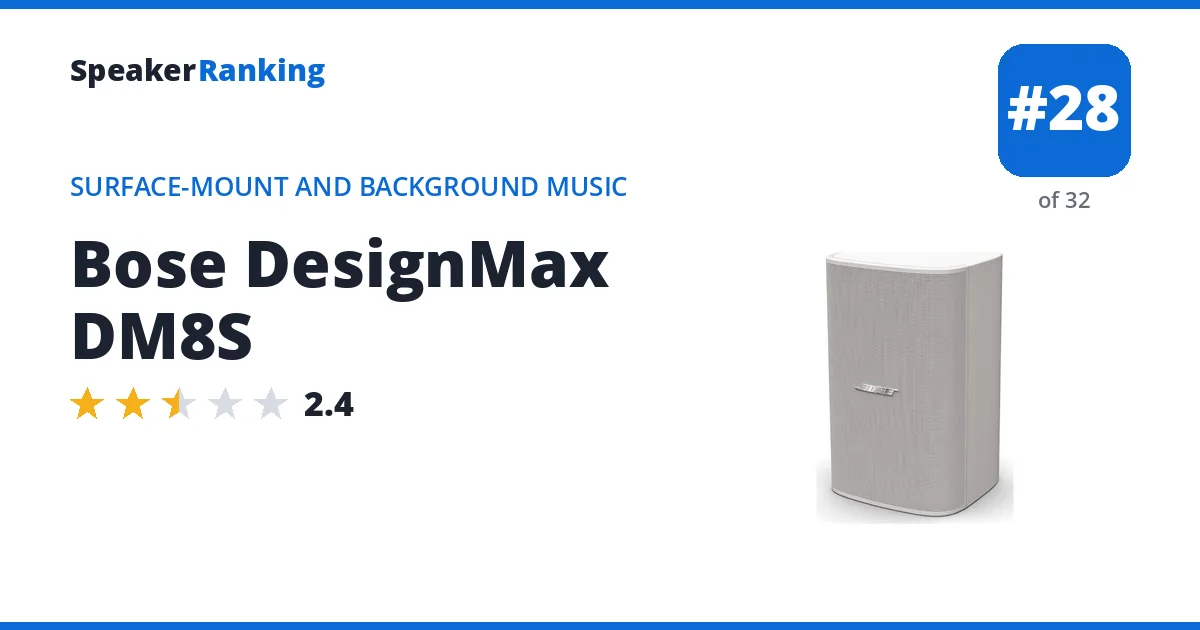
Newer model: the Bose DesignMax DM8SE, ranked lower, estimated 2.4/5, released Mar 2025. See every Bose DesignMax generation.
Pros: A two-way surface-mount installation speaker from Bose Professional with an 8” woofer. Bose’s measurements show a preference score of 0.3 that reaches 3.05 with an ideal subwoofer, with 0.96 listening window deviation.
Cons: The on-axis response is uneven (1.32 average deviation). The data comes from Bose. Bass reaches 67.0Hz (-3dB) and about 57Hz (-10dB). Discontinued.
Full Bose DesignMax DM8S review and specifications →
| Released | Nov 2019 (6 years ago) |
|---|---|
| Bass Extension (-10dB) | about 56.8Hz (measured, manufacturer data via spinorama.org) |
| Bass Extension (-3dB) | 67.0Hz (measured, manufacturer data via spinorama.org) |
| Bluetooth | No |
| DIY Kit | No |
| Drivers | 8” woofer, tweeter |
| Maximum SPL | 115dB peak (manufacturer specified) |
| Passive | Yes |
| Rigging | 2 x M8 inserts for pan/tilt bracket; 1 x M8 safety-tether insert; U-bracket |
| Spinorama Preference Score | 0.3 |
| Spinorama Preference Score with Perfect Sub | 3.05 |
| Weight | 22.8 lbs (10.34 kg) |
- Reviews, Comparisons and Sound Samples
Battery-Powered PA Speakers
 Ranked #7 of 16 in Battery-Powered PA Speakers - Bose S1 Pro: $599 Discontinued eBay
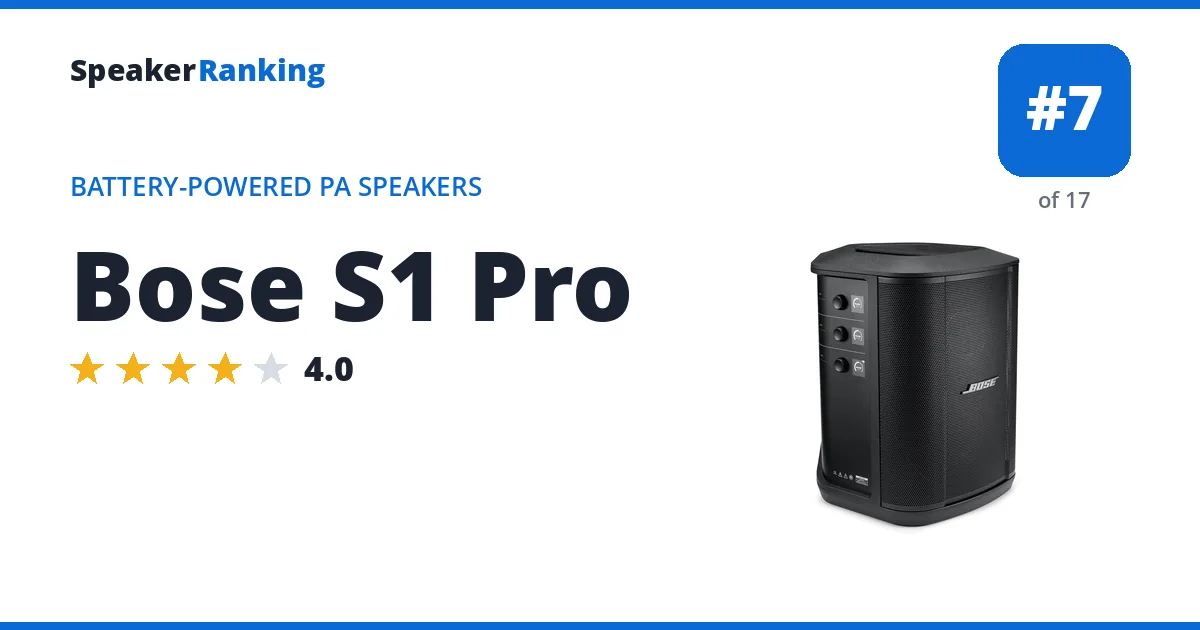
Newer model: the Bose S1 Pro+, ranked higher, rated 4.1/5, released Jul 2023. See every Bose S1 Pro generation.
Pros: Sounds cleaner and more hi-fi than the Mackie Thump Go and JBL Eon One Compact at low and moderate volume, the best sound quality of the three in W. Weiss’s shootout. Very compact and lighter than those rivals, with a 6 inch woofer and three 2.25 inch drivers, Auto EQ that adapts to its orientation, ToneMatch presets and built in reverb on the two mic/instrument channels. An 11 hour battery, Bluetooth with Bose Connect party mode, a line out to chain a second speaker and several placement angles make it a flexible small gig or busking speaker. Measured bass extension of 62Hz (-3dB).
Cons: Peaks at about 109 dB, roughly 3 dB quieter than the Mackie Thump Go and far below the Electro-Voice Everse 8, and with full range music it becomes distorted above two thirds volume. There is little real low end, and the Everse 8 digs much deeper, so it is better suited to voice and acoustic instruments than to DJ or party use. Treble is boosted and it is not stereo. Ports are fully exposed with no water resistance. Discontinued.
Full Bose S1 Pro review and specifications →
| Released | May 2018 (8 years ago) |
|---|---|
| App | Yes (Bose Connect) |
| Aux Input | Yes |
| Bass Extension (-3dB) | 62Hz |
| Battery Life | 11 hours (Manufacturer specified) |
| Bluetooth | Yes |
| Cabinet Material | Polypropylene |
| Configuration | Battery-powered 2-way active PA |
| Coverage | 120° H x 50° V |
| DSP | 3-channel mixer with tone, reverb, ToneMatch and Auto EQ |
| Digital Aux Input | No |
| Dimensions | 13” x 9.5” x 11.3” (330 x 241 x 286 mm) |
| Drivers | 1x 6” (152mm) woofer + 3x 2.25” (57mm) drivers |
| EQ | Yes |
| Frequency Response | 62Hz - 17kHz (Manufacturer specified, ±3dB) |
| Guitar Input | Yes |
| IP Rating | None |
| Inputs | 2x XLR/6.3mm combo (mic/line/instrument), 6.3mm line, 3.5mm stereo, Bluetooth |
| Maximum SPL | 109dB |
| Microphone Input | Yes |
| Omnidirectional | No |
| Party Mode | Yes (Bose Connect) |
| Passive | No |
| Power Input | AC Power cord |
| Rigging | 35mm pole mount; multi-position cabinet |
| Stereo | No |
| USB Playback | No |
| Weight | 15.7 lbs (7.1 kg) |
| XLR Input | Yes |
- Reviews, Comparisons and Sound Samples
- Precision Drive Audio: Music test for BOSE S1 PRO& PD K8 & JBL EON ONE COMPACT
- Precision Drive Audio: Bose S1 pro VS PD K8 VS JBL EON ONE COMPACT
- HQ AUDIO Exchange: Bose S1 Pro vs. JBL PartyBox 100 Bass Sound Test 😱💥🔥
- briansredd: Electro-Voice Everse 8 VS Bose S1 Pro - Side By Side Shoot-Out (Attempt)
- briansredd: Q&A - Electro-Voice Everse 8 Vs Bose S1 Pro AND (Warning) My Opinion
- True Techy: BOSE S1 Pro vs JBLPartybox ENCORE This Comparison SHOCKED me!!!
- W. Weiss: Part 2 NEW MACKIE THUMP GO review/sound demo VS JBL Compact & Bose S1Pro Most Popular portable PAs
- W. Weiss: Part 3 Shootout MACKIE THUMP GO vs BOSE S1 PRO vs JBL EON ONE COMPACT Max Volume Demo A New Winner!
- James from Canada: SOUND TESTS - Soundboks, Minirig 3, dB Technologies, Bose S1 Pro, etc - RAVE TEST
- Head-to-Head Comparisons
Medium Size Bookshelf Speakers
 Ranked #151 of 178 in Medium Size Bookshelf Speakers - Bose 141: $150 per pair Discontinued eBay
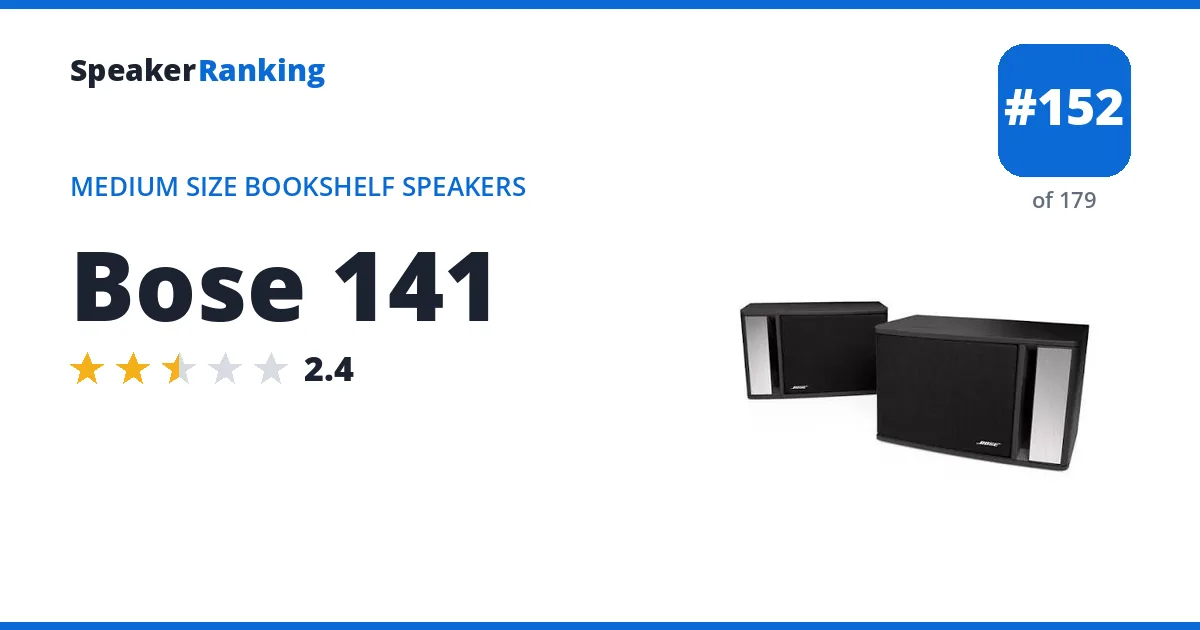
Pros: A small, inexpensive Bose bookshelf from the 1980s and 1990s with a single full-range driver, easy to place and to drive. Measured bass extension of 61.5Hz (-10dB).
Cons: Discontinued and found used. Bose’s own measurements show a very uneven response (1.19 band deviation) and a rough in-room response, scoring -0.39 on its own and 2.70 with an ideal subwoofer, and bass stops at 88.5Hz (-3dB).
Full Bose 141 review and specifications →
| Bass Extension (-10dB) | about 61.5Hz (derived, log-interpolated between spinorama.org -9dB/-12dB points) |
|---|---|
| Bass Extension (-3dB) | 88.5Hz (measured, manufacturer data via spinorama.org) |
| DIY Kit | No |
| Drivers | 4.5” full-range driver |
| Spinorama Preference Score | -0.39 (spinorama.org) |
| Spinorama Preference Score with Perfect Sub | 2.70 (spinorama.org) |
- Reviews, Comparisons and Sound Samples
Large Size Bookshelf Speakers
 Ranked #195 of 222 in Large Size Bookshelf Speakers - Bose 301 Series IV: $318 per pair Discontinued eBay
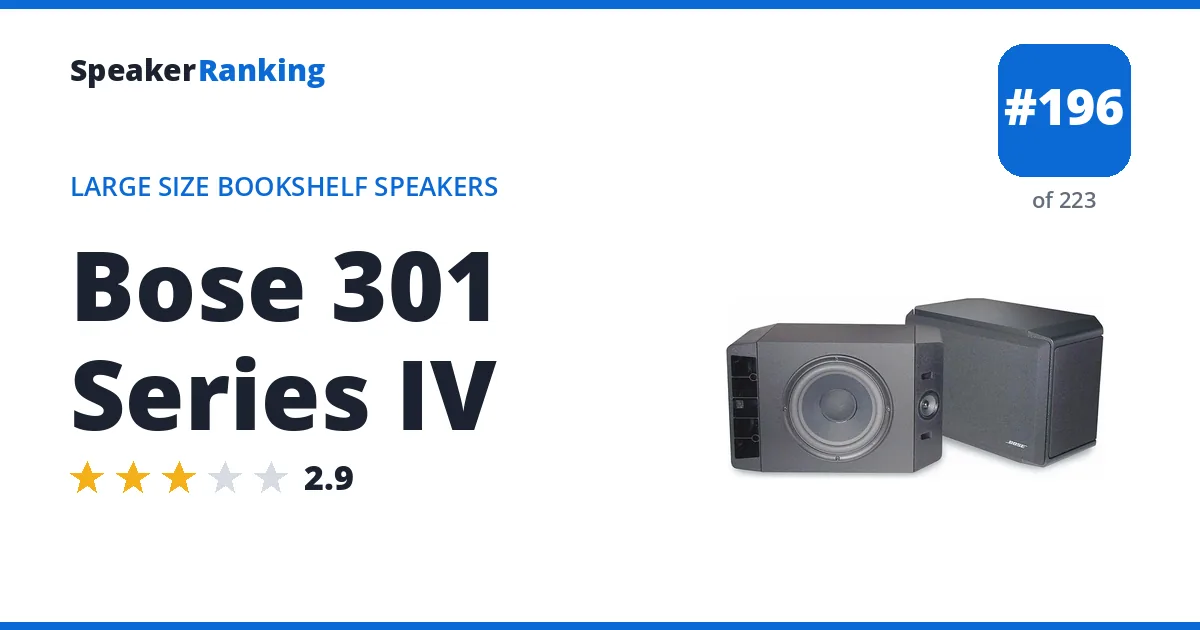
Pros: Bose’s long-running Direct/Reflecting bookshelf, with an 8-inch woofer that reaches 51.1Hz at -3dB in Bose’s own measurements, deep for an inexpensive box, and very even directivity (1.89dB variation in the directivity index) from its front and rear-angled tweeters. Measured bass extension of 29.7Hz (-10dB).
Cons: Discontinued and found used. The on-axis response is very uneven (1.29 band deviation), with the rear-firing tweeter adding reflected treble by design, so it scores 2.18 on its own and 4.26 with an ideal subwoofer, well below modern budget bookshelves.
Full Bose 301 Series IV review and specifications →
| Bass Extension (-10dB) | about 29.7Hz (derived, log-interpolated between spinorama.org -9dB/-12dB points) |
|---|---|
| Bass Extension (-3dB) | 51.1Hz (measured, manufacturer data via spinorama.org) |
| DIY Kit | No |
| Drivers | 8” woofer, two 2.5” tweeters (one front, one rear-angled) |
| Spinorama Preference Score | 2.18 (spinorama.org) |
| Spinorama Preference Score with Perfect Sub | 4.26 (spinorama.org) |
- Reviews, Comparisons and Sound Samples
Large Size Floorstanding Speakers
 Ranked #226 of 228 in Large Size Floorstanding Speakers - Bose 901 Series V: $1,400 per pair Discontinued eBay
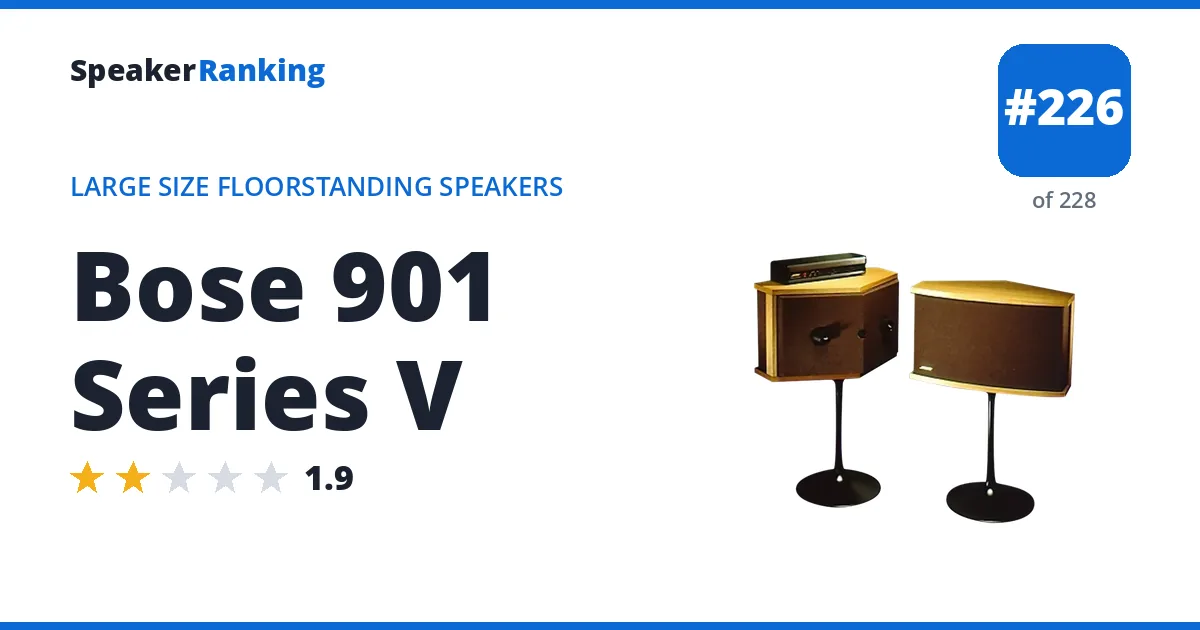
Newer model: the Bose 901 Series VI, ranked lower, estimated 1.9/5, released 1987 (also discontinued). See every Bose 901 generation.
Pros: Historically distinctive direct/reflecting architecture uses eight rear-firing and one front-firing full-range drivers to create a very large, room-filling presentation. Erin measured a benign 6.2-ohm minimum impedance, so the raw electrical load is easier than many modern four-ohm speakers. The supplied active equalizer offers user-adjustable tonal balance and is integral to obtaining usable bandwidth. Measured bass extension of 55.8Hz (-3dB), with a measured sensitivity of 81dB.
Cons: Even with the required EQ, Erin measured only about 81dB sensitivity, grossly non-flat response, numerous impedance/resonance irregularities and very high distortion. Output above roughly 90-95dB at his seat became audibly poor; multitone testing reached only about 98dB before the distortion limit. The reflection-dominant radiation prevents precise imaging and makes results strongly room-dependent. It requires the proprietary equalizer and substantial amplifier power despite its benign impedance. Discontinued.
Full Bose 901 Series V review and specifications →
| Released | 1983 (43 years ago) |
|---|---|
| Bass Extension | Strongly dependent on supplied active equalizer and room (measured, Erin’s Audio Corner) |
| Bass Extension (-10dB) | 34.5Hz (measured, Erin’s Audio Corner) |
| Bass Extension (-3dB) | 55.8Hz (measured, Erin’s Audio Corner) |
| DIY Kit | No |
| DSP | External analog active equalizer required |
| Dimensions | 21”H x 21”W x 12.6”D (533.4 x 533.4 x 320.7 mm) |
| Drivers | Nine full-range drivers: eight rear-firing, one front-firing |
| Impedance | 6.2 ohms minimum (measured, Erin’s Audio Corner) |
| Sensitivity | Approximately 81dB/2.83V/1m with tested EQ setting (measured, Erin’s Audio Corner) |
| Spinorama Preference Score | 0.43 |
| Spinorama Preference Score with Perfect Sub | 2.11 |
| Weight | 35.3 lbs (16 kg) each |
- Reviews, Comparisons and Sound Samples
- Head-to-Head Comparisons
- Bose 901 Series V vs Bose 901 Series VI
- Bose 901 Series V vs Triangle Esprit Antal Ez
- Bose 901 Series V vs JBL Studio 590
- Bose 901 Series V vs Sony SS-CS3
- Bose 901 Series V vs Børresen X3
- Bose 901 Series V vs JBL Stage 2 280F
- Bose 901 Series V vs Magnepan LRS+
- Bose 901 Series V vs Infinity Reference 253
- See all 26 comparisons
 Ranked #227 of 228 in Large Size Floorstanding Speakers - Bose 901 Series VI: $1,400 per pair Discontinued eBay
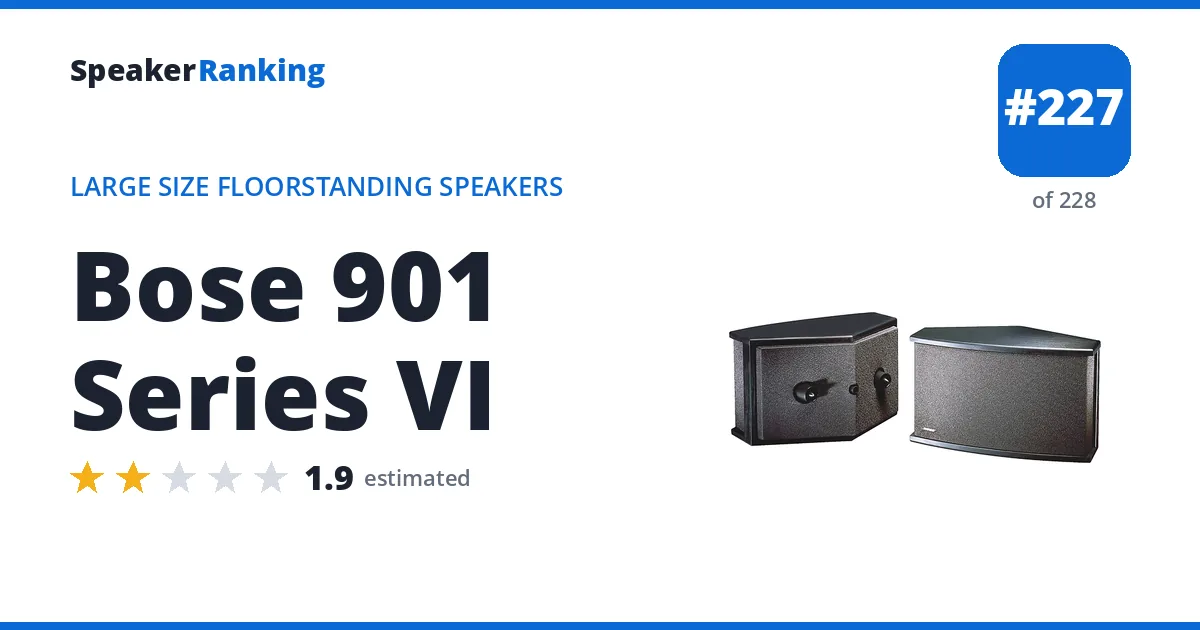
Older model: the Bose 901 Series V (ranked higher, rated 1.9/5). See every Bose 901 generation.
Pros: The last version of the Bose 901 Series V design: nine 4.5” full-range drivers per cabinet, eight firing toward the back wall for a diffuse, room-filling sound.
Cons: No independent measurements yet, so its tonal balance and directivity can’t be compared with ranked speakers. It needs its active equalizer between the amplifier and speakers, and the reflected, heavily equalized design gives vague imaging and coloured sound. It is discontinued.
Full Bose 901 Series VI review and specifications →
| Released | 1987 (39 years ago) |
|---|---|
| Dimensions | 12.7”H x 21”W x 13”D (322 x 533 x 330 mm) |
| Drivers | 9x 4.5” full-range drivers |
| Enclosure | Direct/reflecting, 89% reflected and 11% direct radiation |
| Impedance | 8 ohms nominal (manufacturer specified) |
| Weight | 37.9 lbs (17.2 kg) |
- Reviews, Comparisons and Sound Samples
- No independent measurement review is linked for this model; it is ranked from hands-on listening and comparison against similarly priced speakers.
- Head-to-Head Comparisons
Over-Ear Headphones
 Ranked #163 of 455 in Over-Ear Headphones - Bose QuietComfort 25: $300 Discontinued eBay
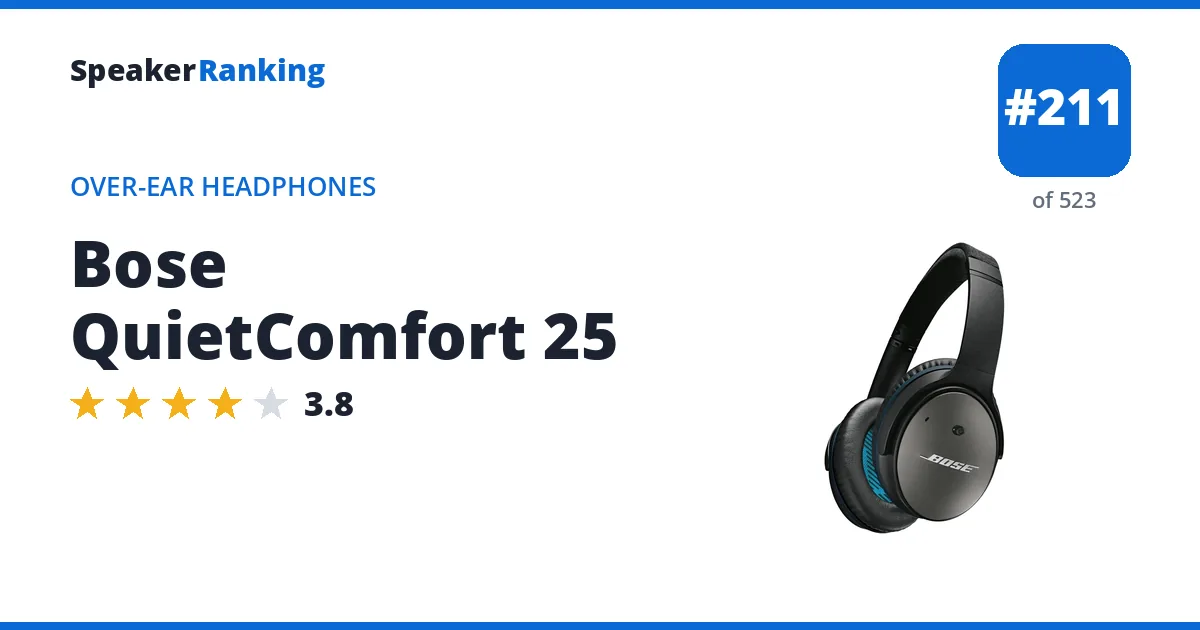
Pros: Measured response gives it a very good Harman preference score of 77 with a 2.25 dB spread. Bass sits close to target and holds down to 20 Hz, so low end sounds full without bloat.
Cons: Discontinued, so it is mainly found used. A 5.9 dB peak near 6.1 kHz can make cymbals and sibilance sound sharp.
Full Bose QuietComfort 25 review and specifications →
| Released | 2014 (12 years ago) |
|---|---|
| Back | Closed |
| Connection | Wired |
| Deviation From Target | 2.25 dB standard deviation |
| Driver Type | Dynamic |
| Form Factor | Over-ear |
| Harman Preference Score | 77 (measured by oratory1990, via AutoEQ) |
| Sub-bass Extension | Within 6 dB of target down to 20 Hz (-0.8 dB at 30 Hz) |
| Tonal Tilt | -0.55 (negative is warmer, positive brighter) |
| Weight | 0.4 lbs (196 g) |
EQ Presets
Harman target
Set a preamp of -4.4 dB, then add these filters in any parametric equalizer (Wavelet, Equalizer APO, Peace, or a player with parametric EQ). Calculated by AutoEQ from its measured frequency response. Predicted Harman match with this EQ: 87 out of 100, up from 77.
| Filter | Frequency | Gain | Q |
|---|---|---|---|
| Low shelf | 105 Hz | +11.4 dB | 0.70 |
| Peak | 44 Hz | -11.3 dB | 0.44 |
| Peak | 8,885 Hz | +3.1 dB | 2.73 |
| Peak | 6,317 Hz | -5.7 dB | 5.73 |
| Peak | 471 Hz | +2.1 dB | 4.74 |
| High shelf | 10,000 Hz | -1.3 dB | 0.70 |
| Peak | 1,321 Hz | -2.2 dB | 3.62 |
| Peak | 2,242 Hz | -1.8 dB | 2.57 |
| Peak | 3,113 Hz | +3.6 dB | 5.38 |
| Peak | 3,879 Hz | -2.0 dB | 6.00 |
Neutral target
Set a preamp of -6.0 dB, then add these filters in any parametric equalizer (Wavelet, Equalizer APO, Peace, or a player with parametric EQ). Calculated by Speaker Ranking from AutoEQ’s measurement, in the filter layout AutoEQ uses. Predicted Neutral match with this EQ: 77 out of 100, up from 56.
| Filter | Frequency | Gain | Q |
|---|---|---|---|
| Low shelf | 105 Hz | -4.1 dB | 0.70 |
| High shelf | 10,000 Hz | -1.4 dB | 0.70 |
| Peak | 3,219 Hz | +6.0 dB | 6.00 |
Studio flat target
Set a preamp of -6.0 dB, then add these filters in any parametric equalizer (Wavelet, Equalizer APO, Peace, or a player with parametric EQ). Calculated by Speaker Ranking from AutoEQ’s measurement, in the filter layout AutoEQ uses. Predicted Studio flat match with this EQ: 63 out of 100, up from 26.
| Filter | Frequency | Gain | Q |
|---|---|---|---|
| Low shelf | 105 Hz | -6.0 dB | 0.70 |
| High shelf | 10,000 Hz | +2.0 dB | 0.70 |
| Peak | 3,048 Hz | +6.0 dB | 2.86 |
Warm target
Set a preamp of -5.2 dB, then add these filters in any parametric equalizer (Wavelet, Equalizer APO, Peace, or a player with parametric EQ). Calculated by Speaker Ranking from AutoEQ’s measurement, in the filter layout AutoEQ uses. Predicted Warm match with this EQ: 92 out of 100, up from 89.
| Filter | Frequency | Gain | Q |
|---|---|---|---|
| Low shelf | 105 Hz | +1.8 dB | 0.70 |
| High shelf | 10,000 Hz | -4.9 dB | 0.70 |
| Peak | 23 Hz | +3.4 dB | 3.97 |
| Peak | 174 Hz | -1.4 dB | 1.11 |
| Peak | 582 Hz | +2.0 dB | 2.05 |
| Peak | 1,315 Hz | -2.0 dB | 6.00 |
| Peak | 2,201 Hz | -2.0 dB | 1.62 |
| Peak | 3,196 Hz | +4.6 dB | 6.00 |
| Peak | 5,998 Hz | -3.8 dB | 6.00 |
| Peak | 7,589 Hz | +2.0 dB | 4.35 |
Bright target
Set a preamp of -5.5 dB, then add these filters in any parametric equalizer (Wavelet, Equalizer APO, Peace, or a player with parametric EQ). Calculated by Speaker Ranking from AutoEQ’s measurement, in the filter layout AutoEQ uses. Predicted Bright match with this EQ: 67 out of 100, up from 36.
| Filter | Frequency | Gain | Q |
|---|---|---|---|
| Low shelf | 105 Hz | -4.2 dB | 0.70 |
| High shelf | 10,000 Hz | +1.7 dB | 0.70 |
| Peak | 3,573 Hz | +3.9 dB | 1.43 |
| Peak | 5,153 Hz | +4.1 dB | 6.00 |
V-shaped target
Set a preamp of -6.3 dB, then add these filters in any parametric equalizer (Wavelet, Equalizer APO, Peace, or a player with parametric EQ). Calculated by Speaker Ranking from AutoEQ’s measurement, in the filter layout AutoEQ uses. Predicted V-shaped match with this EQ: 67 out of 100, up from 64.
| Filter | Frequency | Gain | Q |
|---|---|---|---|
| Low shelf | 105 Hz | +5.3 dB | 0.70 |
| High shelf | 10,000 Hz | +2.0 dB | 0.70 |
| Peak | 458 Hz | +2.2 dB | 1.49 |
| Peak | 1,471 Hz | -2.0 dB | 1.90 |
| Peak | 2,436 Hz | -1.7 dB | 6.00 |
| Peak | 3,354 Hz | +4.8 dB | 1.75 |
| Peak | 5,168 Hz | +5.4 dB | 6.00 |
- Reviews, Comparisons and Sound Samples
- Head-to-Head Comparisons
 Ranked #174 of 455 in Over-Ear Headphones - Bose QuietComfort 45: $330 Wireless Discontinued eBay
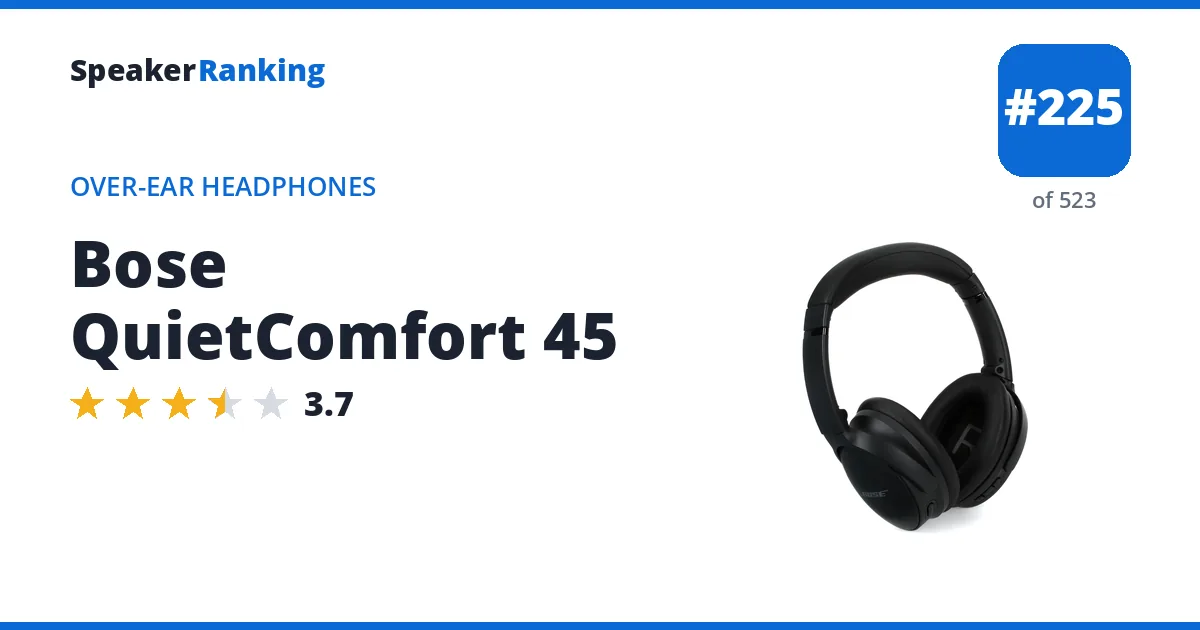
Pros: Excellent noise cancelling and a comfortable, light 240 g build. The measured tuning scores 76 on the Harman scale with a 2.29 dB spread, with clean bass about 2 dB above target that extends to 20 Hz and mids close to neutral.
Cons: Discontinued. A 9.1 dB dip near 8.7 kHz and an upper treble lift make cymbals sound uneven, and the original release had no EQ beyond a later bass and treble slider. There is no high resolution codec beyond AAC.
Full Bose QuietComfort 45 review and specifications →
| Released | Sep 2021 (5 years ago) |
|---|---|
| Active Noise Cancelling | Yes |
| Battery Life | 24 hours |
| Bluetooth Codecs | SBC, AAC |
| Bluetooth Version | 5.1 |
| Built-in Microphone | Yes |
| Connection | Wireless and wired |
| Deviation From Target | 2.29 dB standard deviation |
| Form Factor | Over-ear |
| Harman Preference Score | 76 (measured by oratory1990, via AutoEQ) |
| Sub-bass Extension | Within 6 dB of target down to 20 Hz (+2.1 dB at 30 Hz) |
| Tonal Tilt | -0.63 (negative is warmer, positive brighter) |
| Weight | 0.5 lbs (240 g) |
EQ Presets
Harman target
Set a preamp of -2.2 dB, then add these filters in any parametric equalizer (Wavelet, Equalizer APO, Peace, or a player with parametric EQ). Calculated by AutoEQ from its measured frequency response. Predicted Harman match with this EQ: 92 out of 100, up from 76.
| Filter | Frequency | Gain | Q |
|---|---|---|---|
| Low shelf | 105 Hz | -1.4 dB | 0.70 |
| Peak | 161 Hz | -2.2 dB | 1.15 |
| Peak | 5,490 Hz | -7.7 dB | 2.06 |
| Peak | 4,242 Hz | +3.5 dB | 0.24 |
| Peak | 2,328 Hz | -5.2 dB | 2.15 |
| High shelf | 10,000 Hz | -7.0 dB | 0.70 |
| Peak | 8,352 Hz | +2.9 dB | 1.93 |
| Peak | 390 Hz | +0.5 dB | 2.32 |
| Peak | 6,508 Hz | -1.0 dB | 5.04 |
| Peak | 70 Hz | -0.1 dB | 1.97 |
Neutral target
Set a preamp of -0.3 dB, then add these filters in any parametric equalizer (Wavelet, Equalizer APO, Peace, or a player with parametric EQ). Calculated by Speaker Ranking from AutoEQ’s measurement, in the filter layout AutoEQ uses. Predicted Neutral match with this EQ: 86 out of 100, up from 51.
| Filter | Frequency | Gain | Q |
|---|---|---|---|
| Low shelf | 105 Hz | -8.0 dB | 0.70 |
| High shelf | 10,000 Hz | -6.0 dB | 0.70 |
| Peak | 164 Hz | -2.8 dB | 0.86 |
| Peak | 2,333 Hz | -3.6 dB | 3.93 |
| Peak | 5,282 Hz | -5.4 dB | 4.20 |
| Peak | 7,505 Hz | +2.0 dB | 4.06 |
Studio flat target
Set a preamp of -2.6 dB, then add these filters in any parametric equalizer (Wavelet, Equalizer APO, Peace, or a player with parametric EQ). Calculated by Speaker Ranking from AutoEQ’s measurement, in the filter layout AutoEQ uses. Predicted Studio flat match with this EQ: 82 out of 100, up from 22.
| Filter | Frequency | Gain | Q |
|---|---|---|---|
| Low shelf | 105 Hz | -9.9 dB | 0.70 |
| Peak | 182 Hz | -4.5 dB | 0.70 |
| Peak | 1,505 Hz | +1.3 dB | 2.22 |
| Peak | 3,179 Hz | +2.7 dB | 3.83 |
| Peak | 4,780 Hz | -1.4 dB | 6.00 |
| Peak | 5,415 Hz | -5.9 dB | 4.92 |
| Peak | 7,476 Hz | +2.0 dB | 5.86 |
Warm target
Set a preamp of -0.1 dB, then add these filters in any parametric equalizer (Wavelet, Equalizer APO, Peace, or a player with parametric EQ). Calculated by Speaker Ranking from AutoEQ’s measurement, in the filter layout AutoEQ uses. Predicted Warm match with this EQ: 94 out of 100, up from 86.
| Filter | Frequency | Gain | Q |
|---|---|---|---|
| Low shelf | 105 Hz | -2.1 dB | 0.70 |
| High shelf | 10,000 Hz | -6.0 dB | 0.70 |
| Peak | 164 Hz | -2.8 dB | 1.11 |
| Peak | 2,346 Hz | -4.3 dB | 3.47 |
| Peak | 5,187 Hz | -6.9 dB | 2.23 |
| Peak | 7,634 Hz | +2.0 dB | 4.70 |
Bright target
Set a preamp of -1.8 dB, then add these filters in any parametric equalizer (Wavelet, Equalizer APO, Peace, or a player with parametric EQ). Calculated by Speaker Ranking from AutoEQ’s measurement, in the filter layout AutoEQ uses. Predicted Bright match with this EQ: 75 out of 100, up from 33.
| Filter | Frequency | Gain | Q |
|---|---|---|---|
| Low shelf | 105 Hz | -8.1 dB | 0.70 |
| High shelf | 10,000 Hz | -3.2 dB | 0.70 |
| Peak | 164 Hz | -2.8 dB | 0.87 |
| Peak | 1,216 Hz | +1.2 dB | 3.73 |
| Peak | 2,285 Hz | -3.3 dB | 4.87 |
| Peak | 3,434 Hz | +2.0 dB | 5.06 |
| Peak | 5,363 Hz | -2.1 dB | 6.00 |
| Peak | 7,381 Hz | +2.0 dB | 3.55 |
- Reviews, Comparisons and Sound Samples
- Head-to-Head Comparisons
 Ranked #244 of 455 in Over-Ear Headphones - Bose QuietComfort 35 II: $378.99 Wireless Discontinued Amazon $378.99 eBay
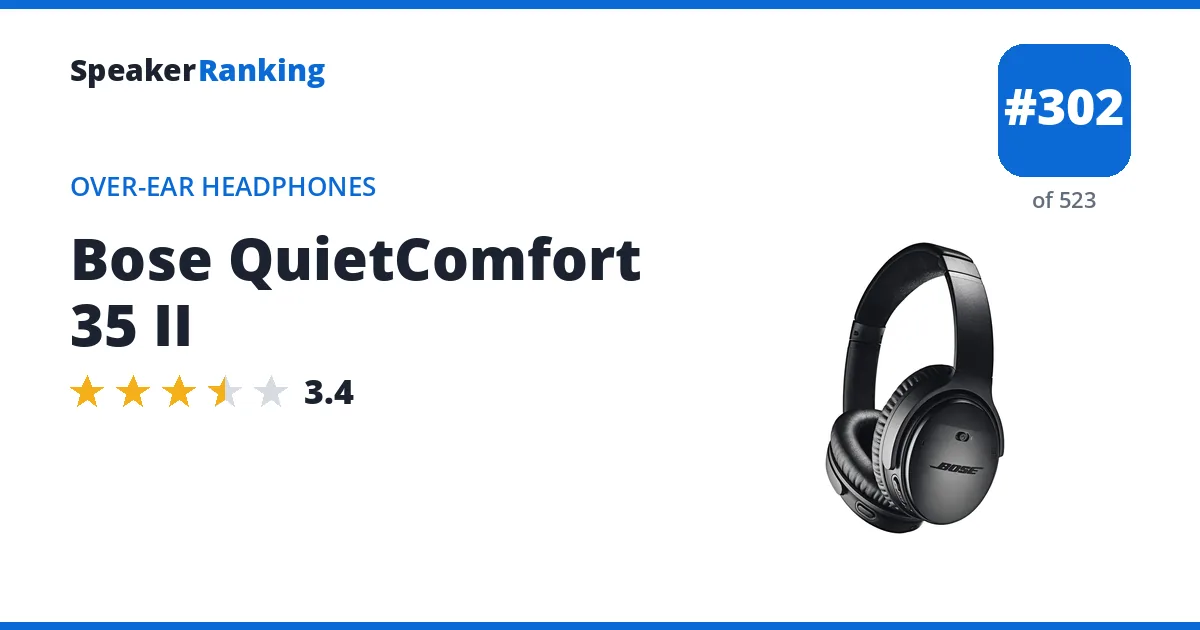
Pros: Active noise cancelling and a 20 hour battery make it a practical choice for commuting and flights. Bluetooth with SBC and AAC suits iPhones, and a wired connection is available when the battery runs out. At 240 g it is light for an over-ear with a built-in microphone, and its preference score of 69 in crinacle’s measurement is respectable for a noise cancelling model.
Cons: Bluetooth 4.0 and no aptX or LDAC support limit wireless audio quality and connection features compared with newer models. The Focal Azurys has a higher rating as a wired closed-back, though it lacks wireless and noise cancelling. The design dates from 2017, and the Fairphone Fairbuds XL offers newer Bluetooth, aptX HD and a longer battery at a lower price. Discontinued.
Full Bose QuietComfort 35 II review and specifications →
| Released | Oct 2017 (9 years ago) |
|---|---|
| Active Noise Cancelling | Yes |
| Back | Closed |
| Battery Life | 20 hours (Manufacturer specified) |
| Bluetooth Codecs | SBC, AAC |
| Bluetooth Version | 4.0 |
| Built-in Microphone | Yes |
| Connection | Wireless and wired |
| Deviation From Target | 2.61 dB standard deviation |
| Form Factor | Over-ear |
| Harman Preference Score | 69 (measured by crinacle, via AutoEQ) |
| Tonal Tilt | -0.81 (negative is warmer, positive brighter) |
| Weight | 0.5 lbs (240 g) |
EQ Presets
Harman target
Set a preamp of -4.3 dB, then add these filters in any parametric equalizer (Wavelet, Equalizer APO, Peace, or a player with parametric EQ). Calculated by AutoEQ from its measured frequency response.
| Filter | Frequency | Gain | Q |
|---|---|---|---|
| Low shelf | 105 Hz | +2.4 dB | 0.70 |
| Peak | 99 Hz | -3.4 dB | 0.26 |
| Peak | 1,332 Hz | +3.2 dB | 0.62 |
| Peak | 2,633 Hz | -4.5 dB | 3.08 |
| Peak | 5,938 Hz | -5.2 dB | 6.00 |
| High shelf | 10,000 Hz | +1.4 dB | 0.70 |
| Peak | 9,646 Hz | +3.7 dB | 0.99 |
| Peak | 4,334 Hz | -2.3 dB | 3.66 |
| Peak | 7,076 Hz | +2.6 dB | 5.94 |
| Peak | 6,213 Hz | -3.9 dB | 6.00 |
- Reviews, Comparisons and Sound Samples
- Head-to-Head Comparisons
- Bose QuietComfort 35 II vs Fairphone Fairbuds XL
- Bose QuietComfort 35 II vs Focal Azurys
- Bose QuietComfort 35 II vs Bose QuietComfort 45
- Bose QuietComfort 35 II vs Bose QuietComfort 25
- Bose QuietComfort 35 II vs Sony WH-1000XM6
- Bose QuietComfort 35 II vs Sony WH-1000XM3
- Bose QuietComfort 35 II vs Bose QuietComfort 20
 Ranked #327 of 455 in Over-Ear Headphones - Bose Noise Cancelling Headphones 700: $449.00 Wireless Discontinued Amazon $449.00 eBay
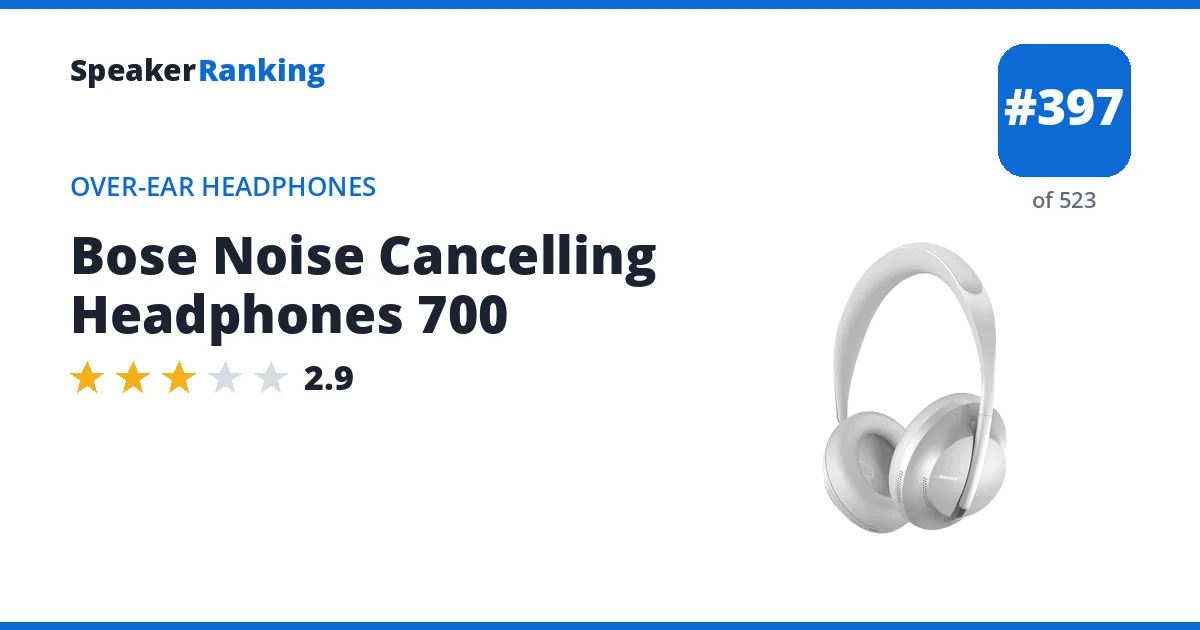
Pros: Wireless noise cancelling headphones with SBC and AAC, Bluetooth 5.0, a built-in microphone, a wired option, an IPX4 splash rating and a rated 20 hours of battery. At 250 g it is light for a full-size ANC headphone. The warm tuning, with the upper bass about 3 dB over target, suits listeners who like a smooth and relaxed sound.
Cons: Treble is rolled off, about 5.4 dB under target from 6 to 10 kHz and 3.5 dB under above that, with a 9 dB dip near 10.9 kHz, so cymbals and vocal detail sound dull. The Harman preference score of 58 shows a response well off the target. Battery life of 20 hours is short for a wireless ANC model, and there is no aptX or LDAC support. Discontinued.
Full Bose Noise Cancelling Headphones 700 review and specifications →
| Released | Apr 2019 (7 years ago) |
|---|---|
| Active Noise Cancelling | Yes |
| Back | Closed |
| Battery Life | 20 hours (Manufacturer specified) |
| Bluetooth Codecs | SBC, AAC |
| Bluetooth Version | 5.0 |
| Built-in Microphone | Yes |
| Connection | Wireless and wired |
| Deviation From Target | 2.75 dB standard deviation |
| Form Factor | Over-ear |
| Harman Preference Score | 58 (measured by oratory1990, via AutoEQ) |
| IP Rating | IPX4 |
| Sub-bass Extension | Within 6 dB of target down to 20 Hz (-1.4 dB at 30 Hz) |
| Tonal Tilt | -1.39 (negative is warmer, positive brighter) |
| Weight | 0.6 lbs (250 g) |
EQ Presets
Harman target
Set a preamp of -7.0 dB, then add these filters in any parametric equalizer (Wavelet, Equalizer APO, Peace, or a player with parametric EQ). Calculated by AutoEQ from its measured frequency response. Predicted Harman match with this EQ: 100 out of 100, up from 58.
| Filter | Frequency | Gain | Q |
|---|---|---|---|
| Low shelf | 105 Hz | -2.5 dB | 0.70 |
| Peak | 180 Hz | -3.8 dB | 0.99 |
| Peak | 1,236 Hz | +2.7 dB | 4.06 |
| Peak | 27 Hz | +3.7 dB | 0.98 |
| Peak | 8,335 Hz | +6.8 dB | 1.58 |
| High shelf | 10,000 Hz | +0.3 dB | 0.70 |
| Peak | 4,828 Hz | -4.2 dB | 5.68 |
| Peak | 3,430 Hz | +1.4 dB | 2.66 |
| Peak | 6,625 Hz | +1.8 dB | 6.00 |
| Peak | 816 Hz | -0.7 dB | 2.91 |
Neutral target
Set a preamp of -2.5 dB, then add these filters in any parametric equalizer (Wavelet, Equalizer APO, Peace, or a player with parametric EQ). Calculated by Speaker Ranking from AutoEQ’s measurement, in the filter layout AutoEQ uses. Predicted Neutral match with this EQ: 87 out of 100, up from 33.
| Filter | Frequency | Gain | Q |
|---|---|---|---|
| Low shelf | 105 Hz | -6.4 dB | 0.70 |
| High shelf | 10,000 Hz | -0.5 dB | 0.70 |
| Peak | 27 Hz | +1.6 dB | 2.55 |
| Peak | 56 Hz | -1.1 dB | 3.33 |
| Peak | 159 Hz | -4.1 dB | 0.71 |
| Peak | 1,236 Hz | +2.3 dB | 4.63 |
| Peak | 3,398 Hz | +1.5 dB | 3.58 |
| Peak | 4,819 Hz | -2.4 dB | 6.00 |
| Peak | 6,734 Hz | +2.5 dB | 3.02 |
Studio flat target
Set a preamp of -3.9 dB, then add these filters in any parametric equalizer (Wavelet, Equalizer APO, Peace, or a player with parametric EQ). Calculated by Speaker Ranking from AutoEQ’s measurement, in the filter layout AutoEQ uses. Predicted Studio flat match with this EQ: 79 out of 100, up from 1.
| Filter | Frequency | Gain | Q |
|---|---|---|---|
| Low shelf | 105 Hz | -8.4 dB | 0.70 |
| High shelf | 10,000 Hz | +2.0 dB | 0.70 |
| Peak | 28 Hz | +1.4 dB | 2.28 |
| Peak | 180 Hz | -5.8 dB | 0.68 |
| Peak | 798 Hz | -1.1 dB | 2.38 |
| Peak | 1,219 Hz | +1.9 dB | 6.00 |
| Peak | 2,648 Hz | +3.9 dB | 1.33 |
| Peak | 4,743 Hz | -2.8 dB | 6.00 |
| Peak | 6,534 Hz | +1.9 dB | 2.72 |
Warm target
Set a preamp of -2.1 dB, then add these filters in any parametric equalizer (Wavelet, Equalizer APO, Peace, or a player with parametric EQ). Calculated by Speaker Ranking from AutoEQ’s measurement, in the filter layout AutoEQ uses. Predicted Warm match with this EQ: 96 out of 100, up from 76.
| Filter | Frequency | Gain | Q |
|---|---|---|---|
| Low shelf | 105 Hz | -0.5 dB | 0.70 |
| High shelf | 10,000 Hz | -3.2 dB | 0.70 |
| Peak | 27 Hz | +1.8 dB | 2.22 |
| Peak | 58 Hz | -1.0 dB | 3.01 |
| Peak | 163 Hz | -4.0 dB | 0.82 |
| Peak | 1,202 Hz | +2.4 dB | 5.76 |
| Peak | 2,169 Hz | -1.4 dB | 2.85 |
| Peak | 4,771 Hz | -4.7 dB | 6.00 |
| Peak | 7,223 Hz | +2.0 dB | 2.42 |
Bass target
Set a preamp of -5.0 dB, then add these filters in any parametric equalizer (Wavelet, Equalizer APO, Peace, or a player with parametric EQ). Calculated by Speaker Ranking from AutoEQ’s measurement, in the filter layout AutoEQ uses. Predicted Bass match with this EQ: 87 out of 100, up from 69.
| Filter | Frequency | Gain | Q |
|---|---|---|---|
| Low shelf | 105 Hz | +3.0 dB | 0.70 |
| High shelf | 10,000 Hz | -0.5 dB | 0.70 |
| Peak | 27 Hz | +2.1 dB | 1.98 |
| Peak | 58 Hz | -0.9 dB | 2.93 |
| Peak | 171 Hz | -4.2 dB | 0.84 |
| Peak | 795 Hz | -1.0 dB | 3.68 |
| Peak | 1,237 Hz | +2.3 dB | 4.77 |
| Peak | 3,400 Hz | +1.5 dB | 3.60 |
| Peak | 4,819 Hz | -2.4 dB | 6.00 |
| Peak | 6,734 Hz | +2.5 dB | 3.03 |
Bright target
Set a preamp of -3.1 dB, then add these filters in any parametric equalizer (Wavelet, Equalizer APO, Peace, or a player with parametric EQ). Calculated by Speaker Ranking from AutoEQ’s measurement, in the filter layout AutoEQ uses. Predicted Bright match with this EQ: 74 out of 100, up from 11.
| Filter | Frequency | Gain | Q |
|---|---|---|---|
| Low shelf | 105 Hz | -6.5 dB | 0.70 |
| High shelf | 10,000 Hz | +1.3 dB | 0.70 |
| Peak | 27 Hz | +1.6 dB | 2.51 |
| Peak | 57 Hz | -1.1 dB | 3.15 |
| Peak | 164 Hz | -4.1 dB | 0.70 |
| Peak | 1,224 Hz | +2.2 dB | 5.64 |
| Peak | 5,541 Hz | +2.9 dB | 0.79 |
V-shaped target
Set a preamp of -5.6 dB, then add these filters in any parametric equalizer (Wavelet, Equalizer APO, Peace, or a player with parametric EQ). Calculated by Speaker Ranking from AutoEQ’s measurement, in the filter layout AutoEQ uses. Predicted V-shaped match with this EQ: 68 out of 100, up from 47.
| Filter | Frequency | Gain | Q |
|---|---|---|---|
| Low shelf | 105 Hz | +3.7 dB | 0.70 |
| High shelf | 10,000 Hz | +1.7 dB | 0.70 |
| Peak | 27 Hz | +2.0 dB | 2.11 |
| Peak | 159 Hz | -2.9 dB | 0.87 |
| Peak | 814 Hz | -1.5 dB | 3.75 |
| Peak | 1,246 Hz | +1.5 dB | 6.00 |
| Peak | 5,345 Hz | +3.2 dB | 0.70 |
- Reviews, Comparisons and Sound Samples
- Head-to-Head Comparisons
In-Ear Headphones
 Ranked #416 of 1002 in In-Ear Headphones - Bose SoundSport Free: $250 TWS Discontinued eBay
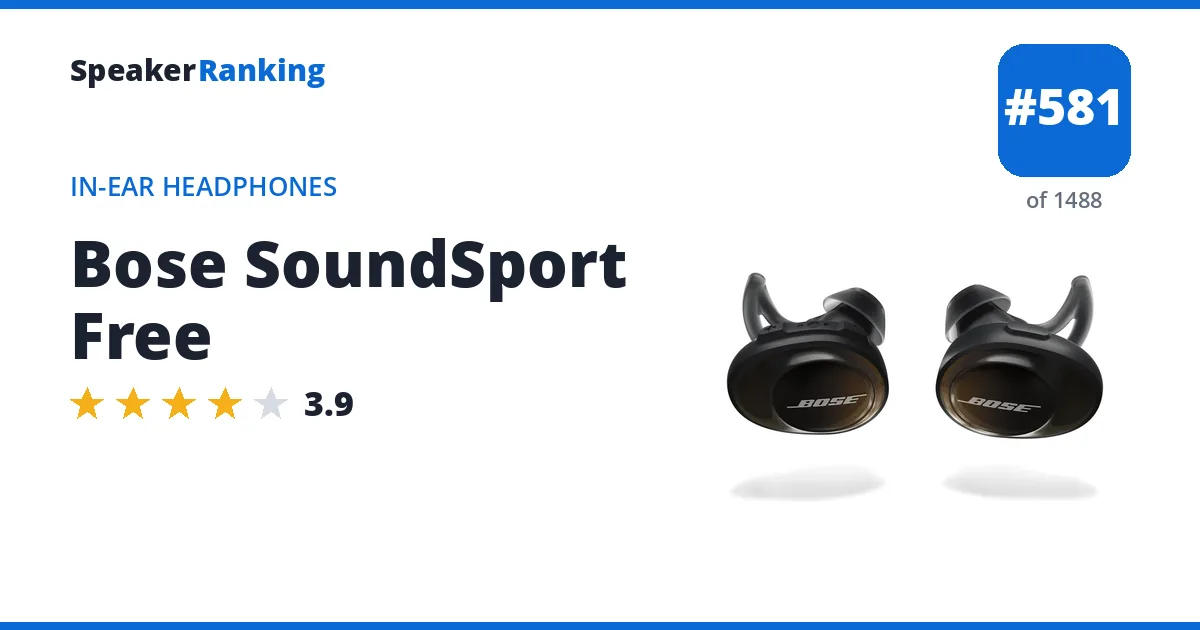
Pros: Measured response gives it a solid Harman preference score of 73 with a 2.50 dB spread, and its mids sit within about 1.2 dB of target, so vocals and instruments sound natural.
Cons: Discontinued, so it is mainly found used. Presence sits about 4.8 dB low with a 6 dB dip near 4.5 kHz, so vocals and instruments lose some bite. Sub-bass is 6 dB short at 30 Hz, so deep bass lacks rumble.
Full Bose SoundSport Free review and specifications →
| Released | 2017 (9 years ago) |
|---|---|
| Connection | True wireless |
| Deviation From Target | 2.50 dB standard deviation |
| Form Factor | In-ear |
| Frequency Response | 20Hz - 20kHz |
| Harman Preference Score | 73 (measured by oratory1990, via AutoEQ) |
| Sub-bass Extension | Falls 6 dB below target at 28 Hz (-6.0 dB at 30 Hz) |
| Tonal Tilt | +0.03 (negative is warmer, positive brighter) |
| Weight | 0 lbs (9 g) per earbud |
EQ Presets
Harman target
Set a preamp of -5.7 dB, then add these filters in any parametric equalizer (Wavelet, Equalizer APO, Peace, or a player with parametric EQ). Calculated by AutoEQ from its measured frequency response. Predicted Harman match with this EQ: 90 out of 100, up from 73.
| Filter | Frequency | Gain | Q |
|---|---|---|---|
| Low shelf | 105 Hz | +9.6 dB | 0.70 |
| Peak | 55 Hz | -7.6 dB | 0.41 |
| Peak | 4,664 Hz | +3.9 dB | 2.54 |
| Peak | 7,598 Hz | +2.7 dB | 4.18 |
| Peak | 976 Hz | -1.3 dB | 2.85 |
| High shelf | 10,000 Hz | +5.1 dB | 0.70 |
| Peak | 9,632 Hz | -2.8 dB | 3.44 |
| Peak | 2,486 Hz | -0.6 dB | 2.43 |
| Peak | 3,790 Hz | +0.5 dB | 5.99 |
| Peak | 6,319 Hz | -1.0 dB | 6.00 |
Neutral target
Set a preamp of -5.7 dB, then add these filters in any parametric equalizer (Wavelet, Equalizer APO, Peace, or a player with parametric EQ). Calculated by Speaker Ranking from AutoEQ’s measurement, in the filter layout AutoEQ uses. Predicted Neutral match with this EQ: 92 out of 100, up from 52.
| Filter | Frequency | Gain | Q |
|---|---|---|---|
| Low shelf | 105 Hz | -4.5 dB | 0.70 |
| High shelf | 10,000 Hz | +1.0 dB | 0.70 |
| Peak | 23 Hz | +2.9 dB | 1.77 |
| Peak | 85 Hz | -2.9 dB | 0.85 |
| Peak | 223 Hz | -1.2 dB | 1.41 |
| Peak | 947 Hz | -1.3 dB | 4.16 |
| Peak | 1,490 Hz | +1.1 dB | 5.55 |
| Peak | 4,553 Hz | +5.6 dB | 1.44 |
Studio flat target
Set a preamp of -5.0 dB, then add these filters in any parametric equalizer (Wavelet, Equalizer APO, Peace, or a player with parametric EQ). Calculated by Speaker Ranking from AutoEQ’s measurement, in the filter layout AutoEQ uses. Predicted Studio flat match with this EQ: 86 out of 100, up from 32.
| Filter | Frequency | Gain | Q |
|---|---|---|---|
| Low shelf | 105 Hz | -7.1 dB | 0.70 |
| High shelf | 10,000 Hz | +2.0 dB | 0.70 |
| Peak | 155 Hz | -4.0 dB | 0.58 |
| Peak | 3,893 Hz | +4.9 dB | 0.97 |
Warm target
Set a preamp of -6.4 dB, then add these filters in any parametric equalizer (Wavelet, Equalizer APO, Peace, or a player with parametric EQ). Calculated by Speaker Ranking from AutoEQ’s measurement, in the filter layout AutoEQ uses. Predicted Warm match with this EQ: 93 out of 100, up from 74.
| Filter | Frequency | Gain | Q |
|---|---|---|---|
| Low shelf | 105 Hz | +4.0 dB | 0.70 |
| High shelf | 10,000 Hz | -0.8 dB | 0.70 |
| Peak | 25 Hz | +2.5 dB | 1.52 |
| Peak | 85 Hz | -2.4 dB | 1.06 |
| Peak | 4,486 Hz | +3.8 dB | 2.17 |
Bass target
Set a preamp of -5.8 dB, then add these filters in any parametric equalizer (Wavelet, Equalizer APO, Peace, or a player with parametric EQ). Calculated by Speaker Ranking from AutoEQ’s measurement, in the filter layout AutoEQ uses. Predicted Bass match with this EQ: 83 out of 100, up from 57.
| Filter | Frequency | Gain | Q |
|---|---|---|---|
| Low shelf | 105 Hz | +5.7 dB | 0.70 |
| High shelf | 10,000 Hz | +1.0 dB | 0.70 |
| Peak | 190 Hz | -1.8 dB | 0.85 |
| Peak | 958 Hz | -1.3 dB | 5.03 |
| Peak | 1,492 Hz | +1.1 dB | 5.83 |
| Peak | 4,554 Hz | +5.6 dB | 1.44 |
Bright target
Set a preamp of -6.3 dB, then add these filters in any parametric equalizer (Wavelet, Equalizer APO, Peace, or a player with parametric EQ). Calculated by Speaker Ranking from AutoEQ’s measurement, in the filter layout AutoEQ uses. Predicted Bright match with this EQ: 82 out of 100, up from 38.
| Filter | Frequency | Gain | Q |
|---|---|---|---|
| Low shelf | 105 Hz | -4.5 dB | 0.70 |
| High shelf | 10,000 Hz | +2.0 dB | 0.70 |
| Peak | 23 Hz | +2.8 dB | 1.75 |
| Peak | 85 Hz | -3.0 dB | 0.82 |
| Peak | 226 Hz | -1.2 dB | 1.38 |
| Peak | 949 Hz | -1.4 dB | 3.25 |
| Peak | 4,321 Hz | +6.0 dB | 1.18 |
| Peak | 5,636 Hz | +1.8 dB | 6.00 |
V-shaped target
Set a preamp of -6.3 dB, then add these filters in any parametric equalizer (Wavelet, Equalizer APO, Peace, or a player with parametric EQ). Calculated by Speaker Ranking from AutoEQ’s measurement, in the filter layout AutoEQ uses. Predicted V-shaped match with this EQ: 78 out of 100, up from 53.
| Filter | Frequency | Gain | Q |
|---|---|---|---|
| Low shelf | 105 Hz | +5.9 dB | 0.70 |
| High shelf | 10,000 Hz | +2.0 dB | 0.70 |
| Peak | 965 Hz | -2.0 dB | 3.48 |
| Peak | 4,321 Hz | +6.0 dB | 1.06 |
| Peak | 5,647 Hz | +1.6 dB | 6.00 |
- Reviews, Comparisons and Sound Samples
 Ranked #552 of 1002 in In-Ear Headphones - Bose QuietComfort 20: $299.95 Discontinued eBay
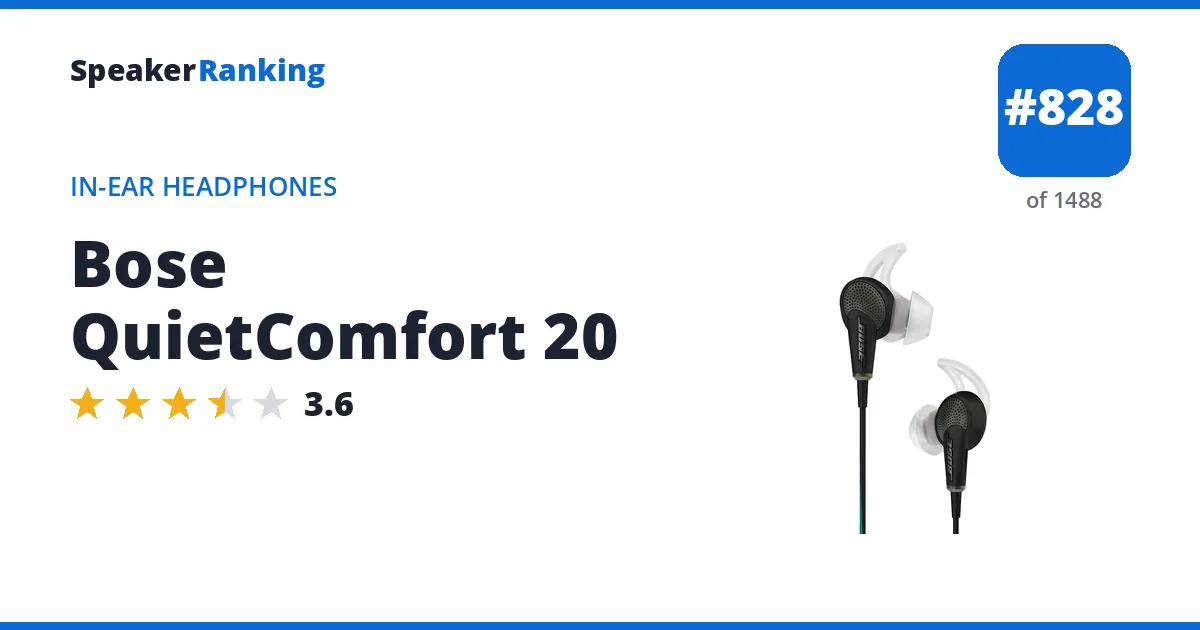
Pros: Measured response gives it a solid Harman preference score of 69 with a 2.63 dB spread, and its mids sit within about 0.5 dB of target, so vocals and instruments sound natural.
Cons: Discontinued, so it is mainly found used. A 5.6 dB peak near 7.5 kHz can make cymbals and sibilance sound sharp.
Full Bose QuietComfort 20 review and specifications →
| Released | 2013 (13 years ago) |
|---|---|
| Connection | Wired |
| Deviation From Target | 2.63 dB standard deviation |
| Driver Type | Dynamic |
| Form Factor | In-ear |
| Harman Preference Score | 69 (measured by oratory1990, via AutoEQ) |
| Sub-bass Extension | Within 6 dB of target down to 20 Hz (-2.1 dB at 30 Hz) |
| Tonal Tilt | +0.12 (negative is warmer, positive brighter) |
| Weight | 0.1 lbs (44 g) (with cable and control module) |
EQ Presets
Harman target
Set a preamp of -7.1 dB, then add these filters in any parametric equalizer (Wavelet, Equalizer APO, Peace, or a player with parametric EQ). Calculated by AutoEQ from its measured frequency response. Predicted Harman match with this EQ: 82 out of 100, up from 69.
| Filter | Frequency | Gain | Q |
|---|---|---|---|
| Low shelf | 105 Hz | +3.6 dB | 0.70 |
| Peak | 154 Hz | -2.1 dB | 0.18 |
| Peak | 888 Hz | +5.7 dB | 1.32 |
| Peak | 1,798 Hz | -5.3 dB | 2.41 |
| Peak | 5,947 Hz | +4.8 dB | 3.69 |
| High shelf | 10,000 Hz | +7.1 dB | 0.70 |
| Peak | 4,134 Hz | -3.1 dB | 4.32 |
| Peak | 37 Hz | -1.0 dB | 2.29 |
| Peak | 209 Hz | +0.3 dB | 1.78 |
| Peak | 60 Hz | +0.6 dB | 2.44 |
Neutral target
Set a preamp of -5.7 dB, then add these filters in any parametric equalizer (Wavelet, Equalizer APO, Peace, or a player with parametric EQ). Calculated by Speaker Ranking from AutoEQ’s measurement, in the filter layout AutoEQ uses. Predicted Neutral match with this EQ: 86 out of 100, up from 49.
| Filter | Frequency | Gain | Q |
|---|---|---|---|
| Low shelf | 105 Hz | -6.5 dB | 0.70 |
| High shelf | 10,000 Hz | +2.0 dB | 0.70 |
| Peak | 124 Hz | -2.7 dB | 0.42 |
| Peak | 398 Hz | -1.8 dB | 2.49 |
| Peak | 708 Hz | +1.6 dB | 4.00 |
| Peak | 904 Hz | +3.8 dB | 3.62 |
| Peak | 1,802 Hz | -5.5 dB | 4.14 |
| Peak | 4,106 Hz | -2.3 dB | 6.00 |
| Peak | 5,718 Hz | +6.0 dB | 5.89 |
| Peak | 7,686 Hz | -2.0 dB | 6.00 |
Studio flat target
Set a preamp of -4.9 dB, then add these filters in any parametric equalizer (Wavelet, Equalizer APO, Peace, or a player with parametric EQ). Calculated by Speaker Ranking from AutoEQ’s measurement, in the filter layout AutoEQ uses. Predicted Studio flat match with this EQ: 85 out of 100, up from 31.
| Filter | Frequency | Gain | Q |
|---|---|---|---|
| Low shelf | 105 Hz | -9.1 dB | 0.70 |
| High shelf | 10,000 Hz | +2.0 dB | 0.70 |
| Peak | 67 Hz | +1.5 dB | 2.12 |
| Peak | 141 Hz | -4.4 dB | 0.54 |
| Peak | 398 Hz | -2.4 dB | 2.04 |
| Peak | 899 Hz | +3.9 dB | 3.01 |
| Peak | 1,749 Hz | -4.8 dB | 6.00 |
| Peak | 2,881 Hz | +2.4 dB | 3.81 |
| Peak | 4,252 Hz | -2.7 dB | 6.00 |
| Peak | 5,797 Hz | +5.6 dB | 6.00 |
Warm target
Set a preamp of -4.0 dB, then add these filters in any parametric equalizer (Wavelet, Equalizer APO, Peace, or a player with parametric EQ). Calculated by Speaker Ranking from AutoEQ’s measurement, in the filter layout AutoEQ uses. Predicted Warm match with this EQ: 85 out of 100, up from 67.
| Filter | Frequency | Gain | Q |
|---|---|---|---|
| Low shelf | 105 Hz | +2.2 dB | 0.70 |
| High shelf | 10,000 Hz | +1.7 dB | 0.70 |
| Peak | 132 Hz | -2.5 dB | 0.50 |
| Peak | 398 Hz | -1.8 dB | 2.43 |
| Peak | 696 Hz | +1.6 dB | 4.35 |
| Peak | 905 Hz | +4.2 dB | 3.27 |
| Peak | 1,862 Hz | -5.7 dB | 3.02 |
| Peak | 4,083 Hz | -4.0 dB | 4.20 |
| Peak | 5,814 Hz | +4.6 dB | 6.00 |
| Peak | 7,630 Hz | -4.4 dB | 6.00 |
Bass target
Set a preamp of -5.7 dB, then add these filters in any parametric equalizer (Wavelet, Equalizer APO, Peace, or a player with parametric EQ). Calculated by Speaker Ranking from AutoEQ’s measurement, in the filter layout AutoEQ uses. Predicted Bass match with this EQ: 86 out of 100, up from 54.
| Filter | Frequency | Gain | Q |
|---|---|---|---|
| Low shelf | 105 Hz | +5.3 dB | 0.70 |
| High shelf | 10,000 Hz | +2.0 dB | 0.70 |
| Peak | 239 Hz | -2.9 dB | 0.63 |
| Peak | 456 Hz | -1.2 dB | 4.63 |
| Peak | 713 Hz | +1.8 dB | 4.00 |
| Peak | 904 Hz | +3.8 dB | 3.62 |
| Peak | 1,802 Hz | -5.5 dB | 4.13 |
| Peak | 4,107 Hz | -2.3 dB | 6.00 |
| Peak | 5,718 Hz | +6.0 dB | 5.90 |
| Peak | 7,686 Hz | -2.0 dB | 6.00 |
Bright target
Set a preamp of -6.1 dB, then add these filters in any parametric equalizer (Wavelet, Equalizer APO, Peace, or a player with parametric EQ). Calculated by Speaker Ranking from AutoEQ’s measurement, in the filter layout AutoEQ uses. Predicted Bright match with this EQ: 81 out of 100, up from 37.
| Filter | Frequency | Gain | Q |
|---|---|---|---|
| Low shelf | 105 Hz | -6.6 dB | 0.70 |
| High shelf | 10,000 Hz | +2.0 dB | 0.70 |
| Peak | 124 Hz | -2.7 dB | 0.42 |
| Peak | 398 Hz | -1.9 dB | 2.41 |
| Peak | 708 Hz | +1.6 dB | 4.03 |
| Peak | 903 Hz | +3.8 dB | 3.68 |
| Peak | 1,785 Hz | -5.5 dB | 4.59 |
| Peak | 5,518 Hz | +6.0 dB | 3.28 |
V-shaped target
Set a preamp of -6.0 dB, then add these filters in any parametric equalizer (Wavelet, Equalizer APO, Peace, or a player with parametric EQ). Calculated by Speaker Ranking from AutoEQ’s measurement, in the filter layout AutoEQ uses. Predicted V-shaped match with this EQ: 79 out of 100, up from 53.
| Filter | Frequency | Gain | Q |
|---|---|---|---|
| Low shelf | 105 Hz | +5.7 dB | 0.70 |
| High shelf | 10,000 Hz | +2.0 dB | 0.70 |
| Peak | 116 Hz | -1.4 dB | 1.94 |
| Peak | 398 Hz | -1.8 dB | 1.09 |
| Peak | 679 Hz | +1.6 dB | 4.06 |
| Peak | 888 Hz | +3.3 dB | 3.45 |
| Peak | 1,763 Hz | -5.4 dB | 5.03 |
| Peak | 3,162 Hz | +1.4 dB | 5.47 |
| Peak | 5,451 Hz | +6.0 dB | 2.88 |
- Reviews, Comparisons and Sound Samples
- Head-to-Head Comparisons
 Ranked #861 of 1002 in In-Ear Headphones - Bose SoundSport Wireless: $150 Discontinued eBay
Pros: Bass is lifted about 4.2 dB with extension to 20 Hz, giving kick drums and bass lines extra weight. Lower mids sit within about 0.8 dB of target, keeping voices and guitars natural.
Cons: Discontinued, so it is mainly found used. Presence sits about 3.5 dB low with a 5.3 dB dip near 9.4 kHz, so vocals and instruments lose some bite. A 6.8 dB peak near 11.5 kHz can make cymbals and sibilance sound sharp. The 4.2 dB bass lift can sound boomy and mask midrange detail. A Harman score of 50 places it in the lower part of the in-ear rankings.
Full Bose SoundSport Wireless review and specifications →
| Released | 2016 (10 years ago) |
|---|---|
| Connection | Bluetooth |
| Deviation From Target | 3.30 dB standard deviation |
| Driver Type | Dynamic |
| Form Factor | In-ear |
| Frequency Response | 20Hz - 20kHz |
| Harman Preference Score | 50 (measured by oratory1990, via AutoEQ) |
| Sub-bass Extension | Within 6 dB of target down to 20 Hz (+2.8 dB at 30 Hz) |
| Tonal Tilt | -1.63 (negative is warmer, positive brighter) |
| Weight | 0.1 lbs (23 g) |
EQ Presets
Harman target
Set a preamp of -3.5 dB, then add these filters in any parametric equalizer (Wavelet, Equalizer APO, Peace, or a player with parametric EQ). Calculated by AutoEQ from its measured frequency response. Predicted Harman match with this EQ: 90 out of 100, up from 50.
| Filter | Frequency | Gain | Q |
|---|---|---|---|
| Low shelf | 105 Hz | -4.1 dB | 0.70 |
| Peak | 196 Hz | -4.5 dB | 0.73 |
| Peak | 1,534 Hz | +2.7 dB | 1.19 |
| Peak | 6,346 Hz | +3.4 dB | 1.30 |
| Peak | 594 Hz | +0.9 dB | 1.25 |
| High shelf | 10,000 Hz | +1.0 dB | 0.70 |
| Peak | 39 Hz | -0.7 dB | 2.54 |
| Peak | 69 Hz | +0.4 dB | 1.68 |
| Peak | 4,344 Hz | +1.1 dB | 5.54 |
| Peak | 5,236 Hz | -1.2 dB | 6.00 |
Neutral target
Set a preamp of -2.4 dB, then add these filters in any parametric equalizer (Wavelet, Equalizer APO, Peace, or a player with parametric EQ). Calculated by Speaker Ranking from AutoEQ’s measurement, in the filter layout AutoEQ uses. Predicted Neutral match with this EQ: 90 out of 100, up from 9.
| Filter | Frequency | Gain | Q |
|---|---|---|---|
| Low shelf | 105 Hz | -12.0 dB | 0.70 |
| High shelf | 10,000 Hz | -1.2 dB | 0.70 |
| Peak | 86 Hz | -1.3 dB | 3.39 |
| Peak | 198 Hz | -6.0 dB | 0.62 |
| Peak | 1,483 Hz | +1.5 dB | 3.93 |
| Peak | 3,157 Hz | -1.0 dB | 4.48 |
| Peak | 5,345 Hz | +2.4 dB | 0.40 |
Studio flat target
Set a preamp of -3.5 dB, then add these filters in any parametric equalizer (Wavelet, Equalizer APO, Peace, or a player with parametric EQ). Calculated by Speaker Ranking from AutoEQ’s measurement, in the filter layout AutoEQ uses. Predicted Studio flat match with this EQ: 76 out of 100, up from -12.
| Filter | Frequency | Gain | Q |
|---|---|---|---|
| Low shelf | 105 Hz | -12.0 dB | 0.70 |
| High shelf | 10,000 Hz | +1.8 dB | 0.70 |
| Peak | 182 Hz | -8.3 dB | 0.68 |
| Peak | 2,559 Hz | +3.5 dB | 0.87 |
| Peak | 7,163 Hz | +1.4 dB | 3.99 |
Warm target
Set a preamp of -1.6 dB, then add these filters in any parametric equalizer (Wavelet, Equalizer APO, Peace, or a player with parametric EQ). Calculated by Speaker Ranking from AutoEQ’s measurement, in the filter layout AutoEQ uses. Predicted Warm match with this EQ: 94 out of 100, up from 62.
| Filter | Frequency | Gain | Q |
|---|---|---|---|
| Low shelf | 105 Hz | -4.7 dB | 0.70 |
| High shelf | 10,000 Hz | -4.6 dB | 0.70 |
| Peak | 200 Hz | -5.7 dB | 0.72 |
| Peak | 1,485 Hz | +1.7 dB | 2.19 |
| Peak | 6,103 Hz | +1.2 dB | 6.00 |
Bass target
Set a preamp of -2.3 dB, then add these filters in any parametric equalizer (Wavelet, Equalizer APO, Peace, or a player with parametric EQ). Calculated by Speaker Ranking from AutoEQ’s measurement, in the filter layout AutoEQ uses. Predicted Bass match with this EQ: 94 out of 100, up from 63.
| Filter | Frequency | Gain | Q |
|---|---|---|---|
| Low shelf | 105 Hz | -1.2 dB | 0.70 |
| High shelf | 10,000 Hz | -1.2 dB | 0.70 |
| Peak | 23 Hz | +1.6 dB | 2.01 |
| Peak | 205 Hz | -6.0 dB | 0.75 |
| Peak | 1,495 Hz | +1.4 dB | 4.42 |
| Peak | 3,152 Hz | -1.0 dB | 4.67 |
| Peak | 5,345 Hz | +2.3 dB | 0.40 |
Bright target
Set a preamp of -5.3 dB, then add these filters in any parametric equalizer (Wavelet, Equalizer APO, Peace, or a player with parametric EQ). Calculated by Speaker Ranking from AutoEQ’s measurement, in the filter layout AutoEQ uses. Predicted Bright match with this EQ: 83 out of 100, up from -3.
| Filter | Frequency | Gain | Q |
|---|---|---|---|
| Low shelf | 105 Hz | -12.0 dB | 0.70 |
| High shelf | 10,000 Hz | +1.4 dB | 0.70 |
| Peak | 87 Hz | -1.2 dB | 3.79 |
| Peak | 198 Hz | -6.0 dB | 0.59 |
| Peak | 1,559 Hz | +1.7 dB | 1.80 |
| Peak | 4,338 Hz | +1.1 dB | 5.40 |
| Peak | 5,345 Hz | +4.7 dB | 0.91 |
| Peak | 6,954 Hz | -2.1 dB | 6.00 |
V-shaped target
Set a preamp of -5.4 dB, then add these filters in any parametric equalizer (Wavelet, Equalizer APO, Peace, or a player with parametric EQ). Calculated by Speaker Ranking from AutoEQ’s measurement, in the filter layout AutoEQ uses. Predicted V-shaped match with this EQ: 82 out of 100, up from 52.
| Filter | Frequency | Gain | Q |
|---|---|---|---|
| Low shelf | 105 Hz | -0.5 dB | 0.70 |
| High shelf | 10,000 Hz | +1.9 dB | 0.70 |
| Peak | 23 Hz | +1.5 dB | 2.28 |
| Peak | 207 Hz | -4.6 dB | 0.69 |
| Peak | 888 Hz | -0.9 dB | 3.32 |
| Peak | 1,740 Hz | +1.6 dB | 1.98 |
| Peak | 5,016 Hz | +5.3 dB | 0.99 |
| Peak | 6,898 Hz | -2.1 dB | 6.00 |
- Reviews, Comparisons and Sound Samples
Product Line History
How these product lines changed from one generation to the next.
- Bose 901 generations (2): 901 Series V → 901 Series VI
- Bose DesignMax generations (2): DesignMax DM8S → DesignMax DM8SE
- Bose S1 Pro generations (2): S1 Pro → S1 Pro+
- Bose SoundLink Flex, Micro, Max and Plus generations (2): Soundlink Micro → Soundlink Micro 2
- Bose SoundLink Mini generations (2): Soundlink Mini → Soundlink Mini 2
- Bose SoundLink Revolve generations (2): Soundlink Revolve → SoundLink Revolve (Series II)