Short answer: choose the CI250RRM-THX when the ceiling can accept its large 300mm opening and deep mount; choose the CI130.2CR when physical constraints rule out the flagship model.
The CI250RRM-THX is the higher-performance ceiling channel. Its 10-inch three-way coaxial design reaches 51.3Hz at -3dB and is optimized for the off-axis angles of immersive-audio and surround locations. Receiver correction can materially improve its measured preference result.
The CI130.2CR is a compact placement tool. Its 158mm square cutout, 82.3mm total depth, and 1.3kg weight work in tight joist bays. Its 5.25-inch driver only reaches about 100Hz at -3dB, making a subwoofer crossover essential for anything beyond light surround or background duty.
Buy the CI250RRM-THX for high-output, deep-reaching ceiling channels.
Buy the CI130.2CR for shallow or small cavities where the flagship cannot physically fit.
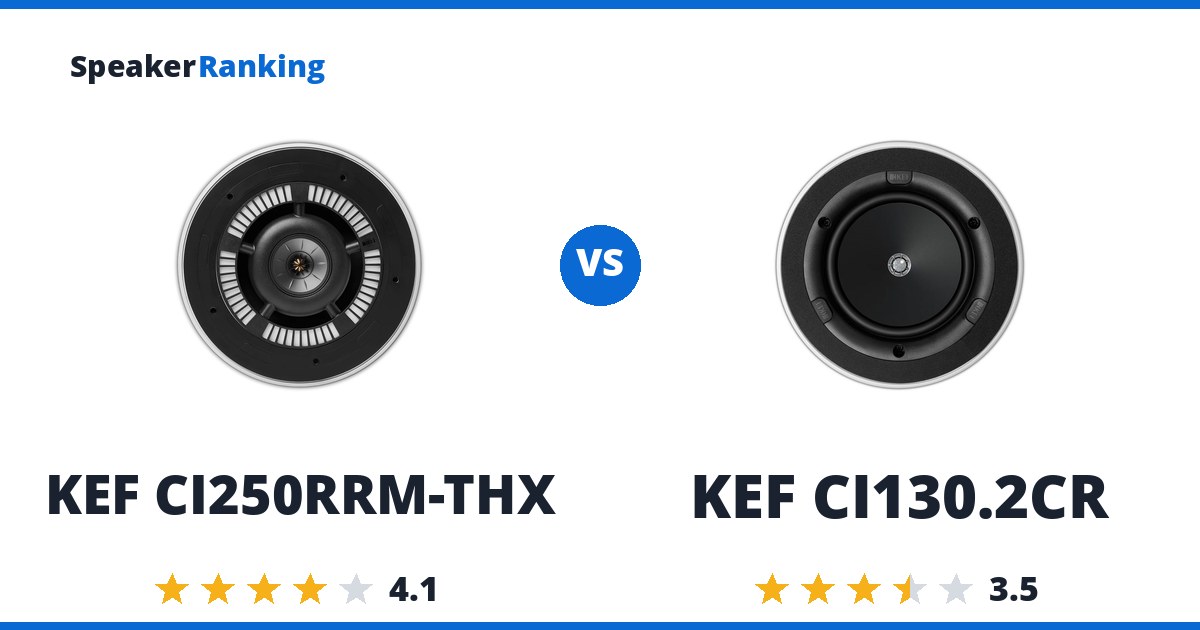
Specifications Side By Side
| KEF CI250RRM-THX | KEF CI130.2CR | |
|---|---|---|
| Price | $2,999.99 | $299.99 |
| Ranked | #2 of 5 in In-Wall & In-Ceiling Speakers | #4 of 5 in In-Wall & In-Ceiling Speakers |
| Drivers | 10" LF woofer, 4" Uni-Q midrange, 1" vented aluminum dome tweeter with MAT (3-way coaxial) | 5.25" Uni-Q coaxial woofer with 16mm aluminum dome tweeter |
| Enclosure | Open-backed, in-ceiling | Open-backed, in-ceiling |
| Mounting Cutout | 300mm (11.81 in) | 158 x 158mm |
| Dimensions | 13.6" x 13.6" x 6.9" (346 x 346 x 175 mm) (168mm mounting depth) | 7.6" x 7.6" x 3.2" (193.4 x 193.4 x 82.3 mm) (77.7mm mounting depth) |
| Weight | 13.2 lbs / 6kg (13.2 lbs) | 2.9 lbs / 1.3kg |
| Sensitivity | 89dB | 87dB |
| Impedance | 8 ohms | 8 ohms |
| Power Handling | 50-250W recommended amplifier power | 10-80W recommended amplifier power |
| Frequency Response | 28Hz-20kHz +/-6dB (manufacturer, open-backed) | 52Hz-20kHz +/-6dB (manufacturer, open-backed) |
| Bass Extension (-3dB) | 51.3Hz (measured, spinorama.org ASR data) | 100Hz (measured, spinorama.org vendor data) |
| Bass Extension (-10dB) | 23.3Hz (measured, spinorama.org ASR data) | 53.5Hz (measured, spinorama.org vendor data) |
| Certification | THX | - |
Related Speaker Comparisons
A few more comparisons worth a look in the same class:
- KEF Ci3160RLM-THX vs KEF CI50R
- KEF Ci3160RLM-THX vs KEF CI200RR-THX
- KEF CI200RR-THX vs KEF CI50R
- KEF CI250RRM-THX vs KEF CI200RR-THX
- KEF Ci3160RLM-THX vs KEF CI250RRM-THX
Prices on this page were last checked September 7, 2026 at 7:47 AM UTC. Product prices and availability are accurate as of that date/time and are subject to change; the price and availability shown on Amazon at the time of purchase will apply to the purchase of this product.
As an eBay Partner, we may be compensated if you make a purchase.
The Two Speakers In Full
 KEF CI250RRM-THX: $2,999.99 Abt Electronics eBay
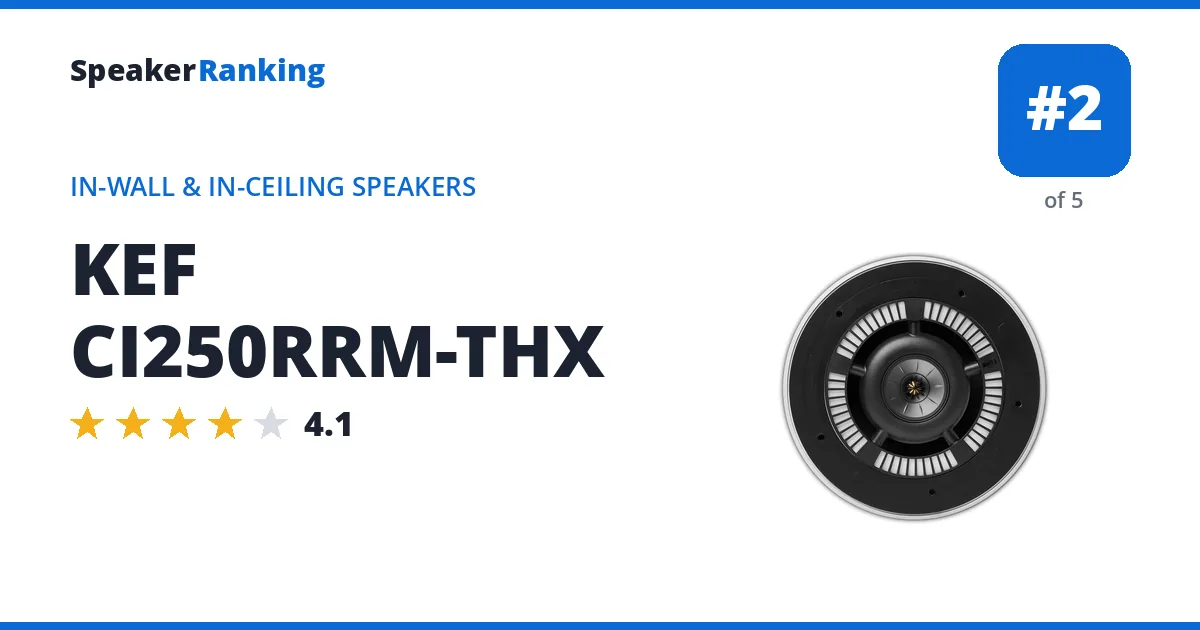
Pros: Independently measured by Audio Science Review to a genuine 51.3Hz at -3dB and roughly 23.3Hz at -10dB, the deepest bass extension of any in-wall or in-ceiling speaker in this category. It’s a THX-certified 3-way coaxial design, a 10” woofer built around a 4” Uni-Q midrange and 1” aluminum dome tweeter, deliberately voiced for the 30-60 degree off-axis angle typical of a ceiling-mounted Dolby Atmos height or surround channel rather than a straight-down listening position. Run through a receiver’s automated room correction, spinorama’s EQ-adjusted figures show its preference score climbing from 3.76 to 4.78, so it responds well to correction.
Cons: At $2,999.99 each, this is the most expensive speaker in this category. Its raw on-axis measurement trails the Ci3160RLM-THX (preference score 3.76 vs. 4.62) since the driver array is tuned for off-axis dispersion rather than a flat straight-ahead response, and its on-axis deviation averages 1.14dB, one of the roughest of the batch measured on-axis.
Full KEF CI250RRM-THX review and specifications →
| Bass Extension (-10dB) | 23.3Hz (measured, spinorama.org ASR data) |
|---|---|
| Bass Extension (-3dB) | 51.3Hz (measured, spinorama.org ASR data) |
| Certification | THX |
| Dimensions | 13.6" x 13.6" x 6.9" (346 x 346 x 175 mm) (168mm mounting depth) |
| Drivers | 10" LF woofer, 4" Uni-Q midrange, 1" vented aluminum dome tweeter with MAT (3-way coaxial) |
| Enclosure | Open-backed, in-ceiling |
| Frequency Response | 28Hz-20kHz +/-6dB (manufacturer, open-backed) |
| Impedance | 8 ohms |
| Mounting Cutout | 300mm (11.81 in) |
| Power Handling | 50-250W recommended amplifier power |
| Sensitivity | 89dB |
| Weight | 13.2 lbs / 6kg (13.2 lbs) |
- Links
- Reviews, Comparisons and Sound Samples
- Head-to-Head Comparisons
 KEF CI130.2CR: $299.99 World Wide Stereo eBay
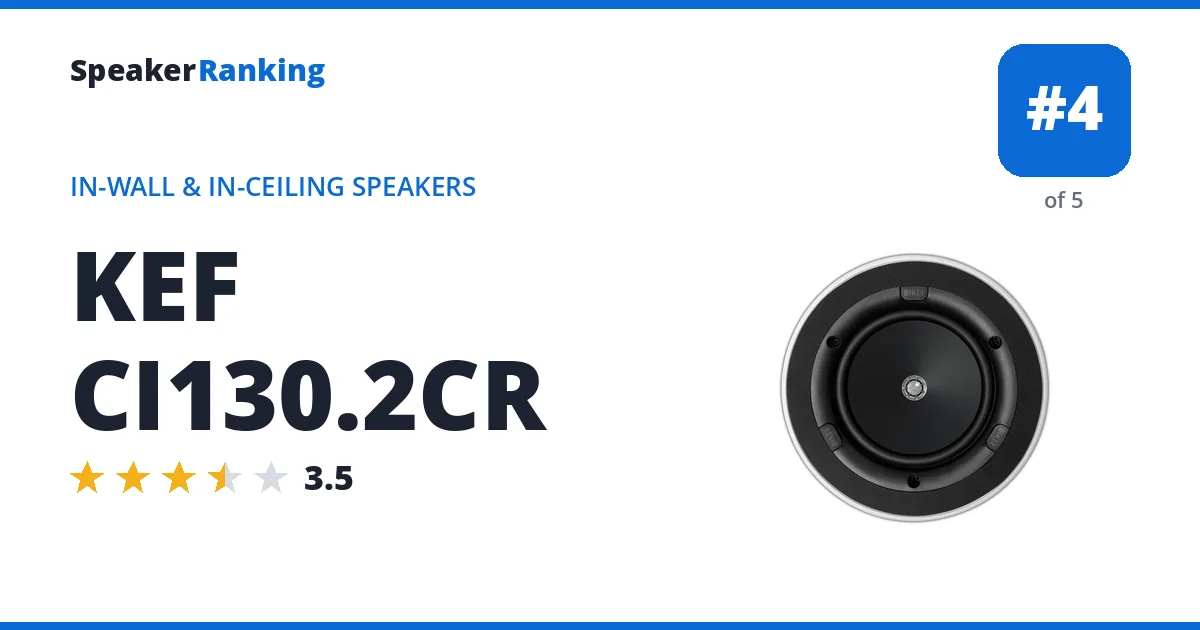
Pros: A compact 158 x 158mm cutout and 82.3mm depth fit tight joist bays and shallow ceiling cavities where the larger Ci-THX models in this category won’t. At $299.99 each it’s the most affordable speaker in this category by a wide margin. The 5.25” Uni-Q driver keeps its 16mm aluminum dome tweeter coaxially centered on the woofer, so the two acoustic centers stay aligned regardless of listening position.
Cons: KEF’s own frequency response spec bottoms out at 52Hz, and the measured curve reaches only about 100Hz at -3dB and roughly 53.5Hz at -10dB, the shallowest low end among the models in this category with a THX certification, so pairing it with a subwoofer is worth planning for. It’s open-backed with only medium-quality vendor measurement data behind it, not an independently verified Klippel scan.
Full KEF CI130.2CR review and specifications →
| Bass Extension (-10dB) | 53.5Hz (measured, spinorama.org vendor data) |
|---|---|
| Bass Extension (-3dB) | 100Hz (measured, spinorama.org vendor data) |
| Dimensions | 7.6" x 7.6" x 3.2" (193.4 x 193.4 x 82.3 mm) (77.7mm mounting depth) |
| Drivers | 5.25" Uni-Q coaxial woofer with 16mm aluminum dome tweeter |
| Enclosure | Open-backed, in-ceiling |
| Frequency Response | 52Hz-20kHz +/-6dB (manufacturer, open-backed) |
| Impedance | 8 ohms |
| Mounting Cutout | 158 x 158mm |
| Power Handling | 10-80W recommended amplifier power |
| Sensitivity | 87dB |
| Weight | 2.9 lbs / 1.3kg |
- Links
- Reviews, Comparisons and Sound Samples
- Head-to-Head Comparisons