The Arendal Sound 1610 Tower 8 ranks #41 out of 188 total Large Size Floorstanding Speakers for sound quality. See all Passive Home rankings for every top pick.
Brand: Arendal
Prices on this page were last checked October 7, 2026 at 9:25 PM UTC. Product prices and availability are accurate as of that date/time and are subject to change; the price and availability shown on Amazon at the time of purchase will apply to the purchase of this product.
As an eBay Partner, we may be compensated if you make a purchase.
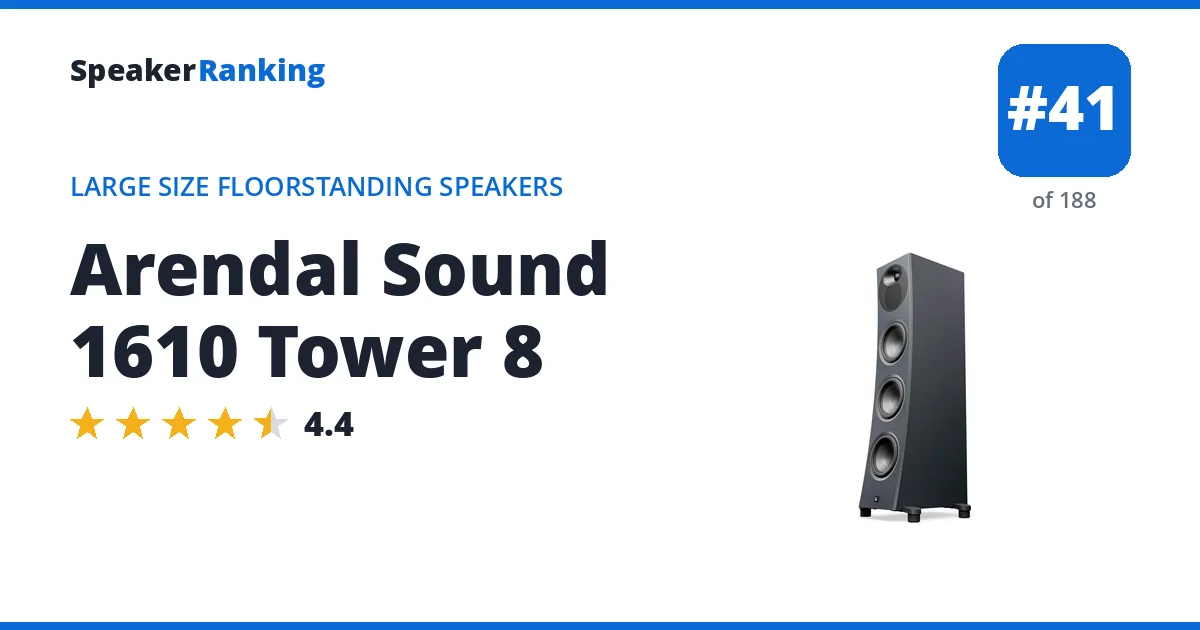
#41 Arendal Sound 1610 Tower 8: $7,600 per pair Arendal Sound eBay
Same family: the Arendal Sound 1610 Bookshelf 8 (bookshelf, estimated 4.3/5) and the Arendal Sound 1610 Center 8 (center, estimated 4.1/5).
Pros: Arendal’s flagship passive tower, a 5-driver 3-way design with a dedicated carbon-cone midrange in its own sealed sub-enclosure and triple 8” aluminum woofers, measuring a -3dB extension point of 42.8Hz (manufacturer measurement); Erin’s Audio Corner independently measured F3 at 41Hz and F10 at 27Hz, with sensitivity of about 88dB at 2.83V/1m. Listening-window smoothness of 0.687 is strong for a tower this size. Erin’s Audio Corner also measured about plus or minus 60 degrees of horizontal dispersion, a wide-but-focused soundstage the reviewer specifically liked, plus a roughly 2-3dB mid-bass bump around 80Hz that adds real punch and weight to kick drum and low male vocals versus flatter competitors, and lower multi-tone distortion in the higher frequencies than two similarly priced coaxial rivals tested alongside it. Measured bass extension of 27Hz (-10dB), with a measured sensitivity of 89.5dB.
Cons: At 45.4kg each and nearly 4 feet tall, it’s a serious room commitment, and sound-power smoothness (0.378) is more middling than the on-axis figures suggest. Directivity-index standard deviation of 3.69, on the higher side, and a -0.22dB per octave downward tilt both point to a moderately dark tonal character, and predicted in-room smoothness (0.45) is only middling. Erin’s Audio Corner found the same 80Hz mid-bass bump pulls the F3 higher than a flatter tuning would, so bass appears to roll off more sharply below that point, and content under about 40Hz will need a subwoofer. Because it’s a 3-way design with a vertical gap between the tweeter and midrange, there’s a lobing null around 3kHz that causes an audible suck-out just below the tweeter’s axis, worth noting for home theater rows with more than one seating height. A dip through the upper mid-range to lower treble crossover softens the bite of brass and other transient-heavy instruments compared to a flatter response.
| Bass Extension (-10dB) | 27Hz (measured, Erin’s Audio Corner) |
|---|---|
| Bass Extension (-3dB) | 41Hz (measured, Erin’s Audio Corner); 42.8Hz (manufacturer measurement) |
| Country | Norway (designed); manufactured overseas |
| DIY Kit | No |
| Dimensions | 115.0H x 26.5W x 45.0D cm (119.8cm tall with feet) |
| Drivers | 28mm Al-Mg dome tweeter, 5” carbon-cone midrange (sealed sub-enclosure), 3x 8” aluminum-cone woofers |
| Enclosure | 3-way, ported (optional sealed configuration) |
| Impedance | 4 ohms nominal |
| Sensitivity | 89.5dB @ 2.83V/1m (manufacturer); 88dB @ 2.83V/1m (measured, Erin’s Audio Corner) |
| Spinorama Preference Score | 7.03 |
| Spinorama Preference Score with Perfect Sub | 8.20 |
| Weight | 100 lbs (45.37 kg) each |
- Links
- Reviews, Comparisons and Sound Samples
Head-to-Head Comparisons
2 comparisonsNo comparisons match that search.