Short answer: the Revel F228Be. It ranks #29 of 228 floorstanding speakers by sound quality, rated 4.5/5, at $11,000. The Arendal Sound 1610 Tower 8 ranks #43, rated 4.4/5, at $7,600, $3,400 cheaper, which does not close the gap in sound quality.
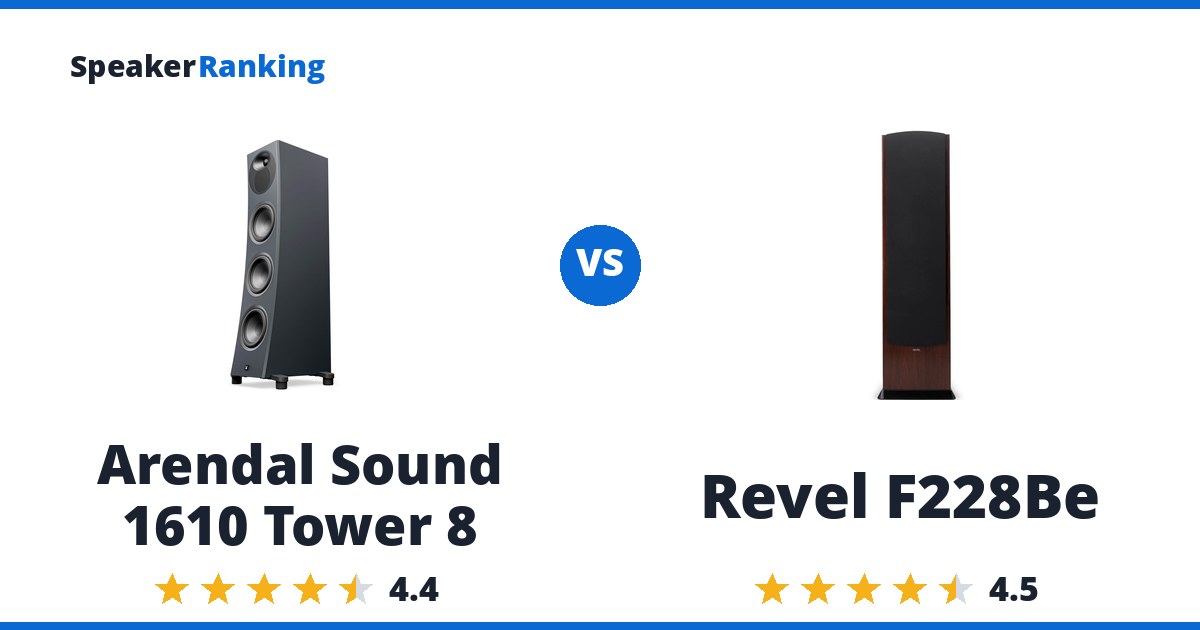
The F228Be is the more neutral reference tower. A beryllium tweeter in a waveguide, a 5.25-inch midrange and two 8-inch woofers give an essentially flat on-axis response, a nearly perfect predicted in-room response and wide coverage of about 70 degrees each side, with very low distortion even at 96dB. Its impedance dips to 3.4 ohms, and each speaker weighs 112.4 lbs (51 kg).
The 1610 Tower 8 has more bass punch and the higher preference score. Three 8-inch woofers, a sealed 5-inch carbon midrange and a 28mm dome reach 41Hz before falling 3dB, with a mid-bass bump near 80Hz that adds weight to kick drums and a preference score of 7.03. Its balance is slightly dark, and a lobing null near 3kHz affects listeners sitting below the tweeter.
Buy the Revel F228Be. It is rated higher for sound quality, and the $3,400 saving on the Arendal Sound 1610 Tower 8 is not enough to make up the difference.
Want more options? Browse the full Passive Home rankings.
Specifications Side By Side
| Arendal Sound 1610 Tower 8 | Revel F228Be | |
|---|---|---|
| Price | $7,600 per pair | $11,000 per pair |
| Ranked | #43 of 228 in Large Size Floorstanding Speakers | #29 of 228 in Large Size Floorstanding Speakers |
| Enclosure | 3-way, ported (optional sealed configuration) | - |
| Drivers | 28mm Al-Mg dome tweeter, 5” carbon-cone midrange (sealed sub-enclosure), 3x 8” aluminum-cone woofers | Dual 8” (200mm) Deep Ceramic Composite aluminum cones, with cast frames woofers, 5-1/4” (130mm) Deep Ceramic Composite aluminum cone, with cast frame midrange, 1” (25mm) Beryllium dome, with acoustic lens waveguide tweeter |
| Dimensions | 115.0H x 26.5W x 45.0D cm (119.8cm tall with feet) | 50.9”H x 13.5”W x 17.6”D (1292.9 x 342.9 x 447 mm) |
| Weight | 100 lbs (45.37 kg) each | 112.4 lbs (51 kg) each |
| Bass Extension (-3dB) | 41Hz (measured, Erin’s Audio Corner); 42.8Hz (manufacturer measurement) | 61Hz (measured, Audio Science Review) |
| Bass Extension (-10dB) | 27Hz (measured, Erin’s Audio Corner) | 25Hz (measured, Audio Science Review) |
| Sensitivity | 89.5dB @ 2.83V/1m (manufacturer); 88dB @ 2.83V/1m (measured, Erin’s Audio Corner) | 89.3dB (300Hz-3kHz @ 2.83V/1m, measured by Audio Science Review; 90dB manufacturer specified) |
| Impedance | 4 ohms nominal | 8 ohms |
| Country | Norway (designed); manufactured overseas | - |
| Spinorama Preference Score | 7.03 | 6.01 |
| Spinorama Preference Score with Perfect Sub | 8.20 | 7.51 |
| DIY Kit | No | No |
| Woofer Cabinet | - | ported, front |
Frequency Response Compared
Both speakers’ spinorama measurements, overlaid. A flatter line is more neutral: peaks sound forward or harsh, dips sound recessed. Each curve is shifted so its average from 300 Hz to 3 kHz sits at 0 dB, so loudness differences between the two are removed and only the shape is compared. The two were measured by different sources, so small differences, especially in the bass, can come from the measurement setup rather than the speakers.
Measurement data: Arendal Sound 1610 Tower 8 (measured by an independent reviewer) and Revel F228Be (measured by Audio Science Review), via spinorama.org.
Related Speaker Comparisons
More worthwhile head-to-heads for Revel F228Be:
- KEF Blade Two Meta vs Revel F228Be
- MoFi SourcePoint V10 Master Edition vs Revel F228Be
- MoFi SourcePoint 888 vs Revel F228Be
- Revel F228Be vs Revel F328Be
- Radiant Acoustics Clarity 66 vs Revel F228Be
Prices on this page were last checked October 15, 2026 at 5:41 PM UTC. Product prices and availability are accurate as of that date/time and are subject to change; the price and availability shown on Amazon at the time of purchase will apply to the purchase of this product.
As an eBay Partner, we may be compensated if you make a purchase.
The Two Speakers In Full
 Arendal Sound 1610 Tower 8: $7,600 per pair Arendal Sound $7,600 eBay
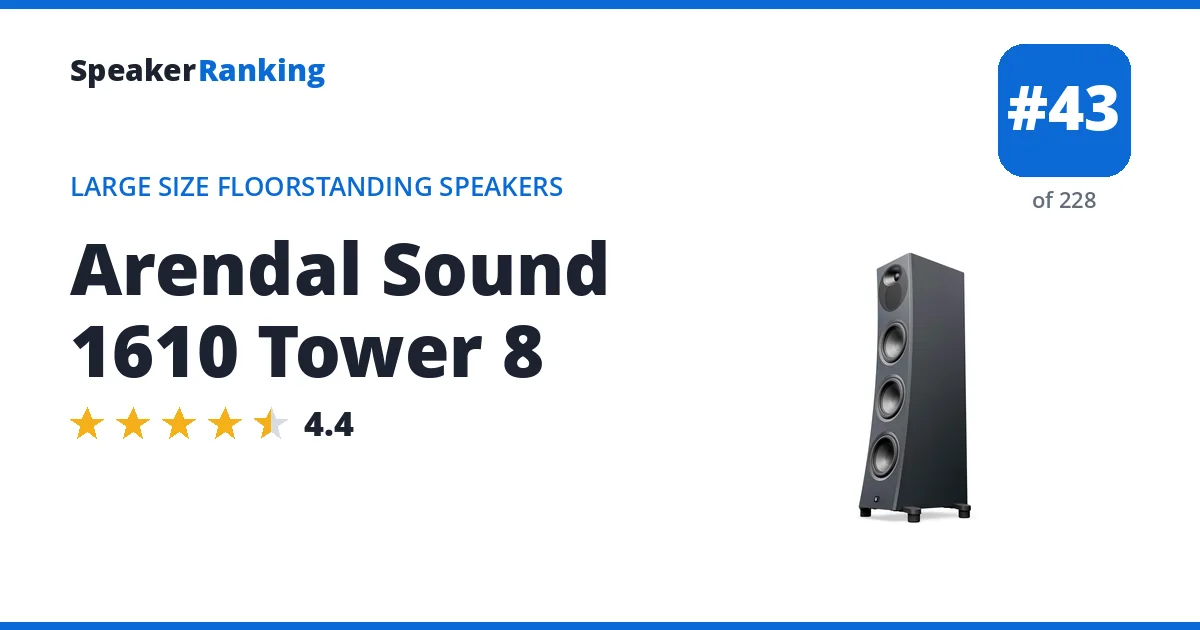
Same family: the Arendal Sound 1610 Bookshelf 8 (bookshelf, estimated 4.3/5) and the Arendal Sound 1610 Center 8 (center, estimated 4.1/5).
Pros: Arendal’s flagship passive tower, a 5-driver 3-way design with a dedicated carbon-cone midrange in its own sealed sub-enclosure and triple 8” aluminum woofers, measuring a -3dB extension point of 42.8Hz (manufacturer measurement); Erin’s Audio Corner independently measured F3 at 41Hz and F10 at 27Hz, with sensitivity of about 88dB at 2.83V/1m. Listening-window smoothness of 0.687 is strong for a tower this size. Erin’s Audio Corner also measured about plus or minus 60 degrees of horizontal dispersion, a wide-but-focused soundstage the reviewer specifically liked, plus a roughly 2-3dB mid-bass bump around 80Hz that adds real punch and weight to kick drum and low male vocals versus flatter competitors, and lower multi-tone distortion in the higher frequencies than two similarly priced coaxial rivals tested alongside it. Measured bass extension of 27Hz (-10dB), with a measured sensitivity of 89.5dB.
Cons: At 45.4kg each and nearly 4 feet tall, it’s a serious room commitment, and sound-power smoothness (0.378) is more middling than the on-axis figures suggest. Directivity-index standard deviation of 3.69, on the higher side, and a -0.22dB per octave downward tilt both point to a moderately dark tonal character, and predicted in-room smoothness (0.45) is only middling. Erin’s Audio Corner found the same 80Hz mid-bass bump pulls the F3 higher than a flatter tuning would, so bass appears to roll off more sharply below that point, and content under about 40Hz will need a subwoofer. Because it’s a 3-way design with a vertical gap between the tweeter and midrange, there’s a lobing null around 3kHz that causes an audible suck-out just below the tweeter’s axis, worth noting for home theater rows with more than one seating height. A dip through the upper mid-range to lower treble crossover softens the bite of brass and other transient-heavy instruments compared to a flatter response.
Full Arendal Sound 1610 Tower 8 review and specifications →
| Released | Mar 2026 (7 months ago) |
|---|---|
| Bass Extension (-10dB) | 27Hz (measured, Erin’s Audio Corner) |
| Bass Extension (-3dB) | 41Hz (measured, Erin’s Audio Corner); 42.8Hz (manufacturer measurement) |
| Country | Norway (designed); manufactured overseas |
| DIY Kit | No |
| Dimensions | 115.0H x 26.5W x 45.0D cm (119.8cm tall with feet) |
| Drivers | 28mm Al-Mg dome tweeter, 5” carbon-cone midrange (sealed sub-enclosure), 3x 8” aluminum-cone woofers |
| Enclosure | 3-way, ported (optional sealed configuration) |
| Impedance | 4 ohms nominal |
| Sensitivity | 89.5dB @ 2.83V/1m (manufacturer); 88dB @ 2.83V/1m (measured, Erin’s Audio Corner) |
| Spinorama Preference Score | 7.03 |
| Spinorama Preference Score with Perfect Sub | 8.20 |
| Weight | 100 lbs (45.37 kg) each |
- Links
- Reviews, Comparisons and Sound Samples
- Head-to-Head Comparisons
 Revel F228Be: $11,000 per pair Crutchfield $5,500.00 eBay
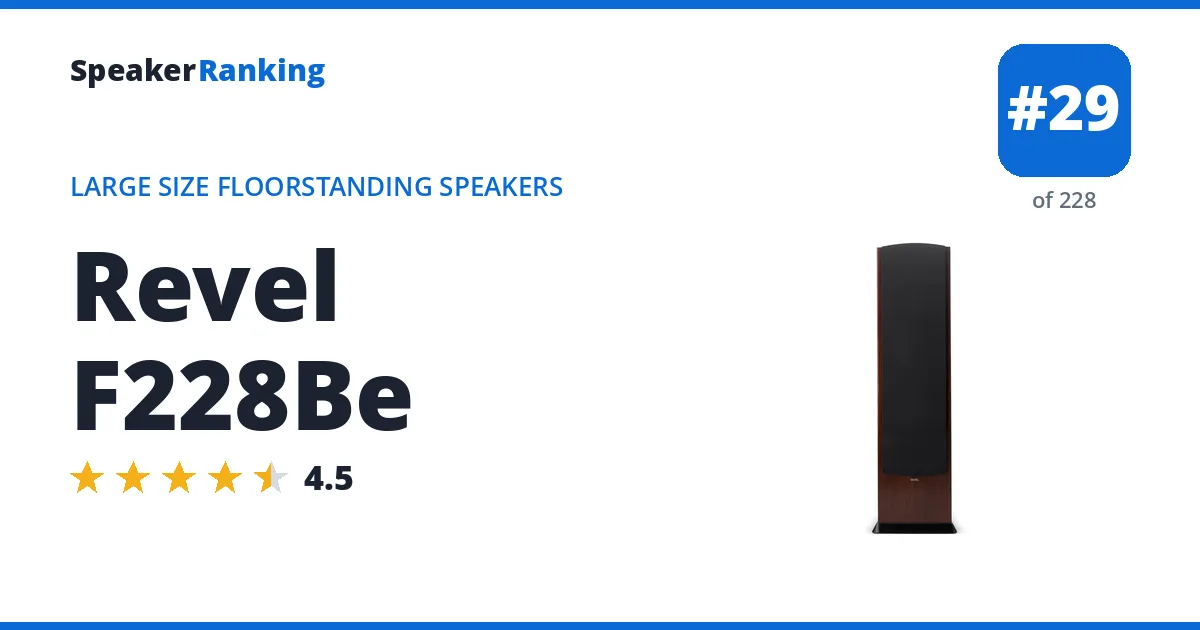
Older model: the Revel F208 (ranked higher, rated 4.5/5). See every Revel Performa generation.
Same family: the Revel M126Be (bookshelf, rated 4.3/5), the Revel F226Be (smaller floorstanding, ranked higher, rated 4.6/5), the Revel F328Be (larger floorstanding, ranked higher, rated 4.7/5) and the Revel C426Be (center, rated 4/5).
Pros: CEA2034 spinorama shows an essentially flat on-axis response with very nice directivity. Predicted in-room response is nearly perfect, with a smooth slope down from bass to treble. Horizontal beamwidth of about ±70 degrees is wide and holds up well until narrowing above 8kHz. Vertical directivity offers more degrees of listening-height freedom than a typical bookshelf design, a benefit of this tower’s driver layout. Distortion is extremely low across the full audio range at 86dB SPL/1m and stays comfortable even at 96dB SPL/1m. Near-field measurements of the individual drivers show nice, well-integrated crossover behavior with only low-level resonances. Measured bass extension of 61Hz (-3dB), with a measured sensitivity of 89.3dB.
Cons: Minimum impedance dips to 3.4 ohms with a secondary rise around 2kHz, calling for an amplifier comfortable with a demanding load. Very expensive and very heavy (51 kg each).
Full Revel F228Be review and specifications →
| Released | 2018 (8 years ago) |
|---|---|
| Bass Extension (-10dB) | 25Hz (measured, Audio Science Review) |
| Bass Extension (-3dB) | 61Hz (measured, Audio Science Review) |
| DIY Kit | No |
| Dimensions | 50.9”H x 13.5”W x 17.6”D (1292.9 x 342.9 x 447 mm) |
| Drivers | Dual 8” (200mm) Deep Ceramic Composite aluminum cones, with cast frames woofers, 5-1/4” (130mm) Deep Ceramic Composite aluminum cone, with cast frame midrange, 1” (25mm) Beryllium dome, with acoustic lens waveguide tweeter |
| Impedance | 8 ohms |
| Sensitivity | 89.3dB (300Hz-3kHz @ 2.83V/1m, measured by Audio Science Review; 90dB manufacturer specified) |
| Spinorama Preference Score | 6.01 |
| Spinorama Preference Score with Perfect Sub | 7.51 |
| Weight | 112.4 lbs (51 kg) each |
| Woofer Cabinet | ported, front |
- Links
- Reviews, Comparisons and Sound Samples
- Head-to-Head Comparisons