Short answer: the Marshall Acton IV. It ranks #3 of 13 powered desktop speakers by sound quality (rated 3.7/5) at $329.99 and is still sold new; the Google Nest Audio ranks #8 (rated 3.3/5) and is discontinued, so it is only an option used.
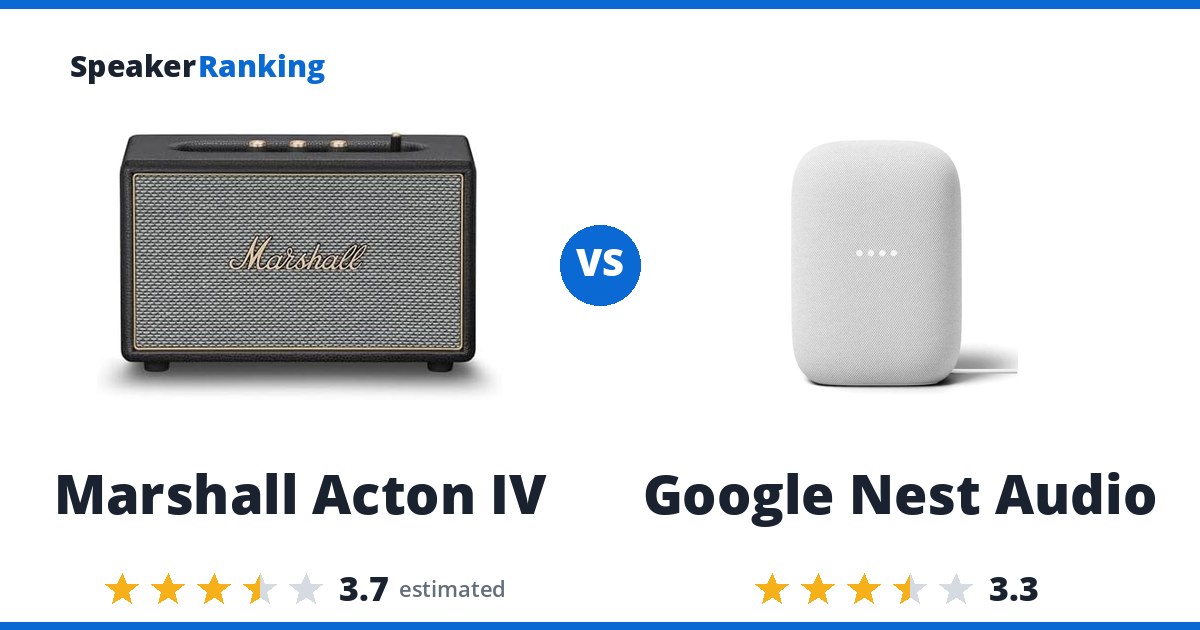
The Marshall Acton IV is the better-sounding pick. A 4 inch woofer on a 60W amplifier and two 0.75 inch tweeters on 25W each, now with waveguides and a redesigned bass port, and Marshall rates it down to 37Hz. It supports LDAC Bluetooth, which the Google Nest Audio lacks. It keeps a wired aux input, which the Google Nest Audio lacks. The catch: No independent measurements or side by side comparisons against speakers we rank have been published yet, so it can’t be ranked.
What the Google Nest Audio does well: Google Assistant is built in at no extra cost, and Chromecast lets you cast from almost any music app over Wi-Fi rather than only Bluetooth. It streams over Wi-Fi as well as Bluetooth, which the Marshall Acton IV cannot. The tradeoff: Each unit is mono; a genuine left-right stereo pair means buying two and pairing them over Wi-Fi.
Buy the Marshall Acton IV. It is rated higher for sound quality, and the Google Nest Audio is discontinued, so it is only available used.
Looking for alternatives? See the complete Powered Home rankings.
Specifications Side By Side
| Marshall Acton IV | Google Nest Audio | |
|---|---|---|
| Price | $329.99 each | $99.99 each Discontinued |
| Ranked | #3 of 13 in Small Size Powered Desktop Speakers | #8 of 13 in Small Size Powered Desktop Speakers |
| AES Input | No | No |
| Amplifier Power | 110W (woofer 60W, tweeters 2x 25W) | 30W (2x Class D) |
| App | Yes (Marshall) | Yes (Google Home) |
| Aux Input | Yes | No |
| Battery Life | No Battery | No Battery |
| Bluetooth | Yes | Yes |
| Bluetooth Codecs | SBC, AAC, LDAC, LC3 | SBC, AAC |
| Bluetooth Version | 5.3 | 5.0 |
| Built-in Microphone | No | Yes (3 far-field mics, hardware mute switch) |
| Cabinet Color | black, cream | - |
| Coaxial Input | No | No |
| Dimensions | 6.7”H x 10.2”W x 5.9”D (171 x 260 x 150 mm) | 6.9” x 4.9” x 3.1” (175 x 124 x 78 mm) (H x W x D) |
| Drivers | 1x 4” woofer + 2x 0.75” tweeters with waveguides | 75mm woofer, 19mm tweeter |
| EQ | Yes (bass/treble knobs, app EQ, room calibration) | Yes (Bass/Treble, via Google Home app) |
| Frequency Response | 37Hz - 38kHz (Manufacturer specified) | - |
| HDMI Input | No | No |
| IP Rating | None | None |
| Inputs | Bluetooth, 3.5mm aux | Wi-Fi, Bluetooth, Chromecast |
| Maximum SPL | 95dB at 1m (Manufacturer specified) | - |
| Optical Input | No | No |
| Party Mode | Yes (Auracast) | Yes (Wi-Fi multi-room, Chromecast built-in) |
| Power Bank | No | No |
| Power Input | AC Power cord | External AC adapter (30W, 24V, DC jack) |
| RCA Input | No | No |
| Stereo | Partially (1 woofer) | No |
| TRS Input | No | No |
| TWS | No | Yes (Wi-Fi stereo pairing via Google Home app) |
| USB Input | No | No |
| Weight | 5.8 lbs (2.65 kg) | 2.6 lbs (1.2 kg) |
| Wi-Fi | No | Yes (802.11 b/g/n/ac, 2.4GHz/5GHz) |
| Woofer Cabinet | ported | - |
| XLR Input | No | No |
| Bass Extension (-3dB) | - | 60.4Hz (measured, Audio Science Review via spinorama.org) |
| Bass Extension (-10dB) | - | 44.3Hz (derived, log-interpolated between ASR’s spinorama -9dB/-12dB points) |
| Spinorama Preference Score | - | 1.71 |
| Spinorama Preference Score with Perfect Sub | - | 4.06 |
| Voice Assistants | - | Google Assistant |
| Streaming Services | - | Chromecast built-in, Spotify Connect |
Related Speaker Comparisons
How Marshall Acton IV compares with other leading options:
- Amazon Echo Studio 2nd Gen vs Marshall Acton IV
- Marshall Acton IV vs Amazon Echo Dot Max
- Marshall Acton IV vs Apple HomePod Mini
- Marshall Acton IV vs Amazon Echo Dot 5th Gen
- Marshall Acton IV vs Google Home Speaker
Prices on this page were last checked October 4, 2026 at 9:58 PM UTC. Product prices and availability are accurate as of that date/time and are subject to change; the price and availability shown on Amazon at the time of purchase will apply to the purchase of this product.
As an eBay Partner, we may be compensated if you make a purchase.
The Two Speakers In Full
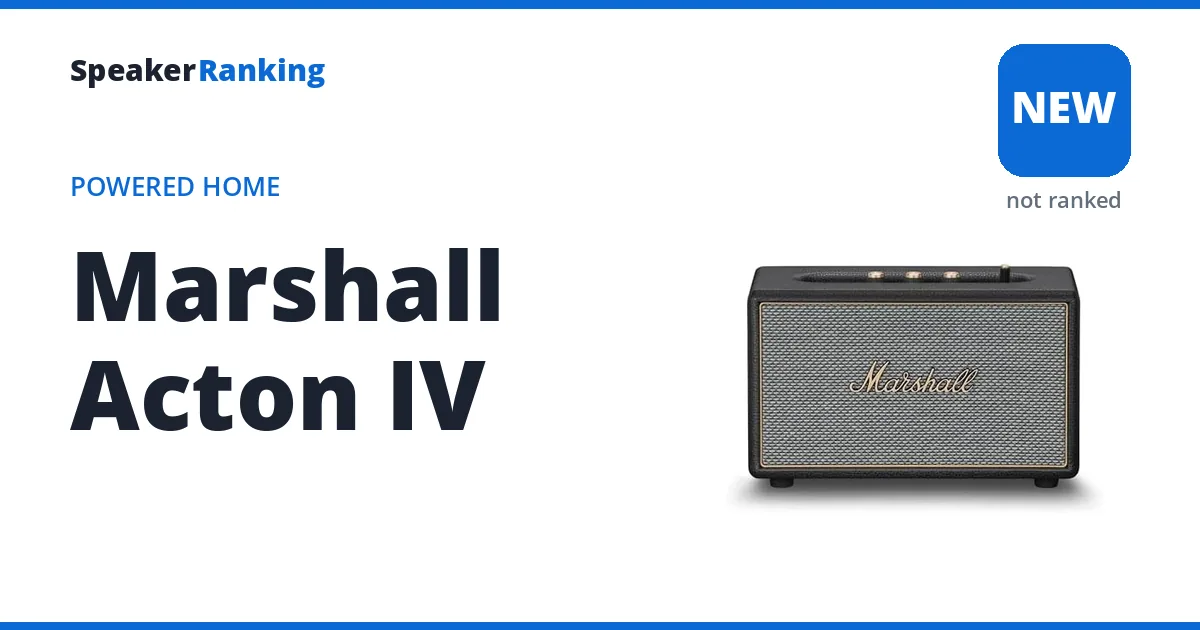
 Marshall Acton IV: $329.99 each Estimated Amazon eBay
Older models: the Marshall Acton III (rated 3.7/5) and the Marshall Acton II (rated 3.5/5).
Larger model: the Marshall Stanmore IV (estimated 3.8/5).
Pros: A 4 inch woofer on a 60W amplifier and two 0.75 inch tweeters on 25W each, now with waveguides and a redesigned bass port, and Marshall rates it down to 37Hz. Bluetooth 5.3 with SBC, AAC, LDAC and LC3, multipoint, Auracast for linking more speakers, and a 3.5 mm aux input. The Marshall app adds EQ and room calibration, and the new M-button jumps to a saved EQ or Spotify Tap.
Cons: No independent measurements or side by side comparisons against speakers we rank have been published yet, so it can’t be ranked. One woofer serves both channels, so its stereo is limited to the tweeters. It needs mains power, has no RCA input (the Stanmore IV adds one), no Wi-Fi streaming and no microphone for voice control.
Full Marshall Acton IV review and specifications →
| AES Input | No |
|---|---|
| Amplifier Power | 110W (woofer 60W, tweeters 2x 25W) |
| App | Yes (Marshall) |
| Aux Input | Yes |
| Battery Life | No Battery |
| Bluetooth | Yes |
| Bluetooth Codecs | SBC, AAC, LDAC, LC3 |
| Bluetooth Version | 5.3 |
| Built-in Microphone | No |
| Cabinet Color | black, cream |
| Coaxial Input | No |
| Dimensions | 6.7”H x 10.2”W x 5.9”D (171 x 260 x 150 mm) |
| Drivers | 1x 4” woofer + 2x 0.75” tweeters with waveguides |
| EQ | Yes (bass/treble knobs, app EQ, room calibration) |
| Frequency Response | 37Hz - 38kHz (Manufacturer specified) |
| HDMI Input | No |
| IP Rating | None |
| Inputs | Bluetooth, 3.5mm aux |
| Maximum SPL | 95dB at 1m (Manufacturer specified) |
| Optical Input | No |
| Party Mode | Yes (Auracast) |
| Power Bank | No |
| Power Input | AC Power cord |
| RCA Input | No |
| Stereo | Partially (1 woofer) |
| TRS Input | No |
| TWS | No |
| USB Input | No |
| Weight | 5.8 lbs (2.65 kg) |
| Wi-Fi | No |
| Woofer Cabinet | ported |
| XLR Input | No |
- Links
- Reviews, Comparisons and Sound Samples
- No independent measurement review is linked for this model; it is ranked from hands-on listening and comparison against similarly priced speakers.
- Head-to-Head Comparisons
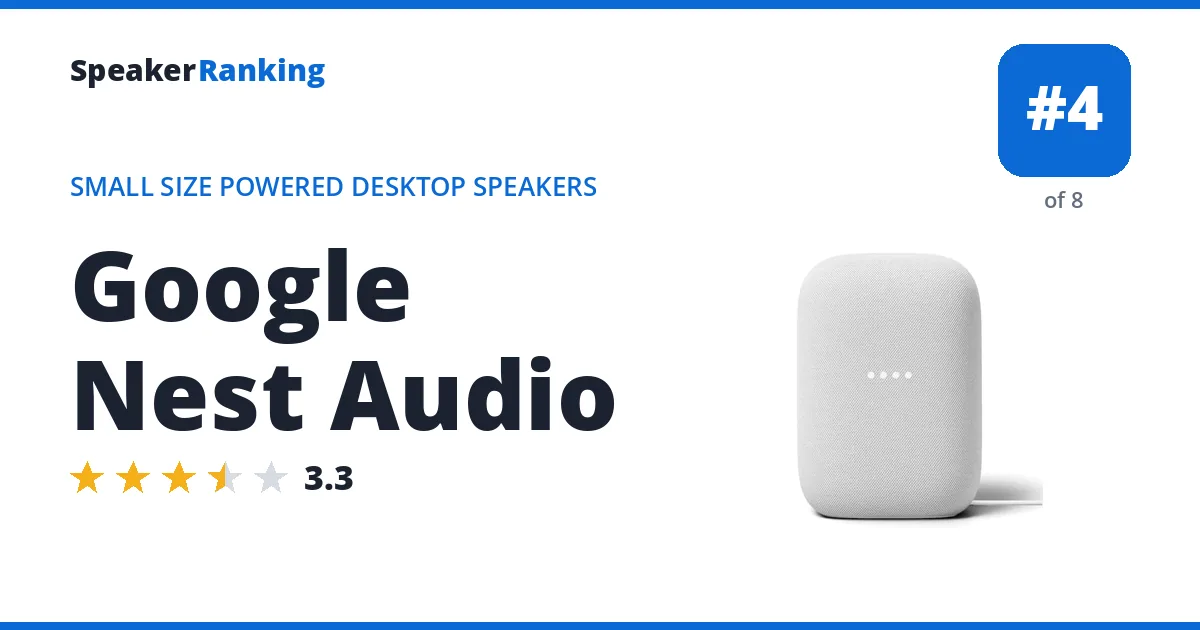
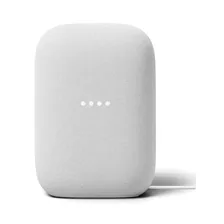 Google Nest Audio: $99.99 each Discontinued Amazon eBay
Newer model: the Google Home Speaker, ranked lower, rated 3/5.
Pros: Google Assistant is built in at no extra cost, and Chromecast lets you cast from almost any music app over Wi-Fi rather than only Bluetooth. Audio Science Review’s Klippel measurements put bass at 50Hz at -6dB and 60.4Hz at -3dB, respectable output for a single 75mm woofer at this price, and the predicted in-room response is unusually smooth for a compact single-box speaker. The Google Home app includes a two-band bass and treble EQ. Measured bass extension of 60.4Hz (-3dB).
Cons: Each unit is mono; a genuine left-right stereo pair means buying two and pairing them over Wi-Fi. On-axis measurements show more unevenness than a dedicated monitor, an average deviation of 0.569dB against roughly a tenth of that on the most neutral speakers measured this way. There is no 3.5mm or other analog input at all, no battery, and no IP rating, so it needs a stable Wi-Fi connection and a permanent outlet to work at its best. Discontinued.
Full Google Nest Audio review and specifications →
| AES Input | No |
|---|---|
| Amplifier Power | 30W (2x Class D) |
| App | Yes (Google Home) |
| Aux Input | No |
| Bass Extension (-10dB) | 44.3Hz (derived, log-interpolated between ASR’s spinorama -9dB/-12dB points) |
| Bass Extension (-3dB) | 60.4Hz (measured, Audio Science Review via spinorama.org) |
| Battery Life | No Battery |
| Bluetooth | Yes |
| Bluetooth Codecs | SBC, AAC |
| Bluetooth Version | 5.0 |
| Built-in Microphone | Yes (3 far-field mics, hardware mute switch) |
| Coaxial Input | No |
| Dimensions | 6.9” x 4.9” x 3.1” (175 x 124 x 78 mm) (H x W x D) |
| Drivers | 75mm woofer, 19mm tweeter |
| EQ | Yes (Bass/Treble, via Google Home app) |
| HDMI Input | No |
| IP Rating | None |
| Inputs | Wi-Fi, Bluetooth, Chromecast |
| Optical Input | No |
| Party Mode | Yes (Wi-Fi multi-room, Chromecast built-in) |
| Power Bank | No |
| Power Input | External AC adapter (30W, 24V, DC jack) |
| RCA Input | No |
| Spinorama Preference Score | 1.71 |
| Spinorama Preference Score with Perfect Sub | 4.06 |
| Stereo | No |
| Streaming Services | Chromecast built-in, Spotify Connect |
| TRS Input | No |
| TWS | Yes (Wi-Fi stereo pairing via Google Home app) |
| USB Input | No |
| Voice Assistants | Google Assistant |
| Weight | 2.6 lbs (1.2 kg) |
| Wi-Fi | Yes (802.11 b/g/n/ac, 2.4GHz/5GHz) |
| XLR Input | No |
- Links
- Reviews, Comparisons and Sound Samples
- Head-to-Head Comparisons
- Google Nest Audio vs Apple HomePod Mini
- Google Nest Audio vs Amazon Echo Dot 5th Gen
- Google Nest Audio vs Google Home Speaker
- Google Nest Audio vs Denon Home 150
- Google Nest Audio vs Amazon Echo Dot Max
- Google Nest Audio vs Google Nest Mini 2nd Gen
- Google Nest Audio vs Amazon Echo Pop
- Google Nest Audio vs Amazon Echo Studio 2nd Gen
- See all 27 comparisons