The DIYSG Elusive 1099 ranks #132 out of 223 total Large Size Bookshelf Speakers for sound quality. See all Passive Home rankings for every top pick.
Brand: DIYSG
Prices on this page were last checked October 20, 2026 at 10:35 PM UTC. Product prices and availability are accurate as of that date/time and are subject to change; the price and availability shown on Amazon at the time of purchase will apply to the purchase of this product.
As an eBay Partner, we may be compensated if you make a purchase.
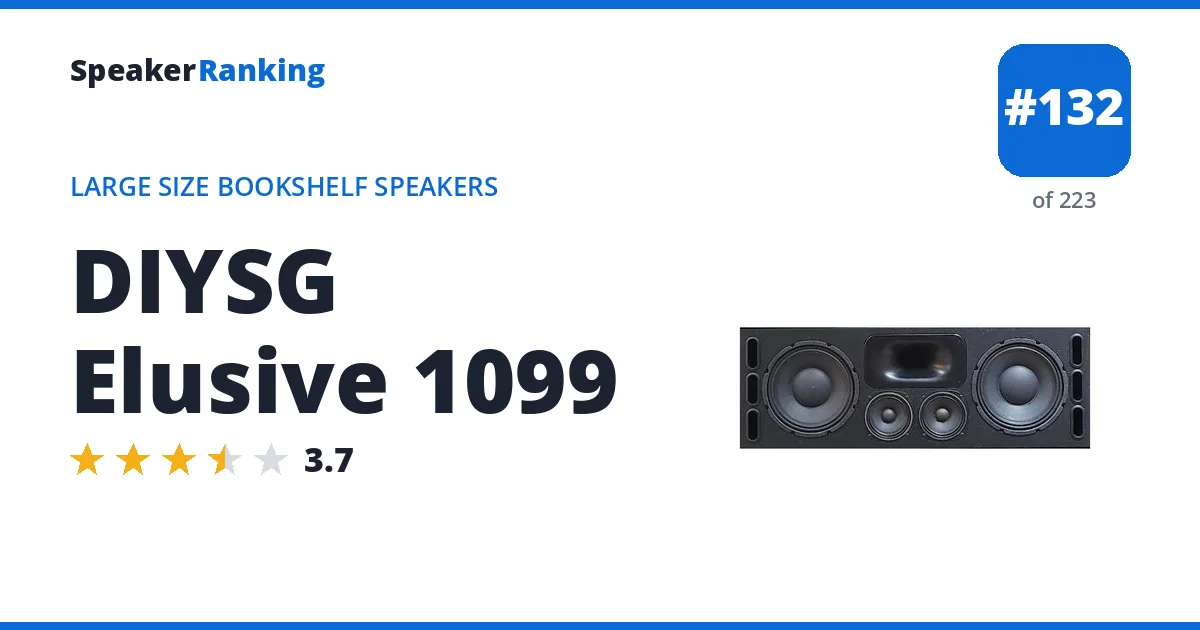
#132 DIYSG Elusive 1099: $820 per pair per kit eBay
Pros: A high-efficiency three-way kit built around two 10-inch Eminence woofers, a pair of midranges and a compression driver in a SEOS waveguide. Erin measured about 96dB at 2.83V/1m, so modest amplifiers drive it very loud: it showed zero compression under continuous 96dB multitone playback and reached about 111dB at the seat from roughly 4m. Horizontal directivity is narrow and controlled (about 40 degrees each side in the Spinorama data), which keeps side-wall reflections down in a lively room. With a subwoofer covering the bass its preference score climbs from 2.75 to 5.93, and the wide, low cabinet suits a horizontal LCR role in a home theater. Measured bass extension of 98Hz (-3dB), with a measured sensitivity of 96dB.
Cons: Bass is thin for a speaker with two 10-inch woofers: Spinorama puts the -3dB point at 98Hz and -10dB near 56Hz, well short of the DIYSG HTM-12 v2 (67Hz), so a subwoofer crossed at 80Hz or higher is required. The on-axis response is uneven (narrow-band deviation 0.585, smoothness 0.44), with a midrange trough, a peaky 400 to 600Hz region and a treble lift that Erin heard as sibilance and hot hi-hats. Vertical coverage is only about 20 degrees each side, so ear height matters, and off-axis asymmetry limits how much EQ can fix. Soundstage width and envelopment were narrow. Parts availability has been intermittent and the kit needs cabinet building and finishing.
Is the DIYSG Elusive 1099 right for you?
Buy it if
- you have a modest amplifier (96 dB sensitivity is easy to drive).
- you can use EQ: our neutral preset raises its predicted score by about 1.2.
Skip it if
- you will not add a subwoofer: bass rolls off below about 98 Hz.
- you want the best value: the higher-rated ELAC Debut 3.0 DB63 costs about $350 less.
| Released | 2013 (13 years ago) |
|---|---|
| Bass Extension (-10dB) | 56Hz (measured, Erin’s Audio Corner) |
| Bass Extension (-3dB) | 98Hz (measured, Erin’s Audio Corner) |
| DIY Kit | Yes |
| Drivers | 2 10” Eminence woofers, 2 Celestion midranges, compression driver in SEOS waveguide |
| Sensitivity | 96dB/2.83V/1m (measured, Erin’s Audio Corner); 99dB claimed |
| Spinorama Preference Score | 2.75 |
| Spinorama Preference Score with Perfect Sub | 5.93 |
| Woofer Cabinet | ported |
- Reviews, Comparisons and Sound Samples
Frequency Response
How the DIYSG Elusive 1099 measures across the audible range. A flatter listening window (the sound arriving straight at you) is more neutral: peaks sound forward or harsh, dips sound recessed. The estimated in-room response adds what a typical room does, and there a gentle, even tilt down toward the treble is ideal. Both curves are shifted so their 300 Hz to 3 kHz average sits at 0 dB.
Measurement data: spinorama.org, measured by Erin’s Audio Corner.
EQ for a Neutral Response
Flattens the measured listening window from the DIYSG Elusive 1099's own bass extension up to 16 kHz. Set a preamp of -2.1 dB, then add these filters to any parametric equalizer in the signal path: the speaker's app or DSP if it has parametric EQ, a miniDSP, Equalizer APO or Wavelet. Boosts are kept to 3 dB, and EQ cannot fix how evenly the speaker spreads sound off-axis, which is why some speakers gain more than others. Predicted preference score with this EQ: 6.5, up from 2.8 (7.1 with an ideal subwoofer, up from 5.9). Calculated by Speaker Ranking from the spinorama measurements above.
| Filter | Frequency | Gain | Q |
|---|---|---|---|
| High shelf | 8,000 Hz | -0.9 dB | 0.70 |
| Peak | 300 Hz | +1.9 dB | 3.91 |
| Peak | 554 Hz | -3.4 dB | 3.58 |
| Peak | 2,095 Hz | +1.9 dB | 1.77 |
| Peak | 3,109 Hz | +1.8 dB | 4.00 |
| Peak | 5,528 Hz | -2.0 dB | 1.65 |
| Peak | 15,255 Hz | +2.0 dB | 4.00 |