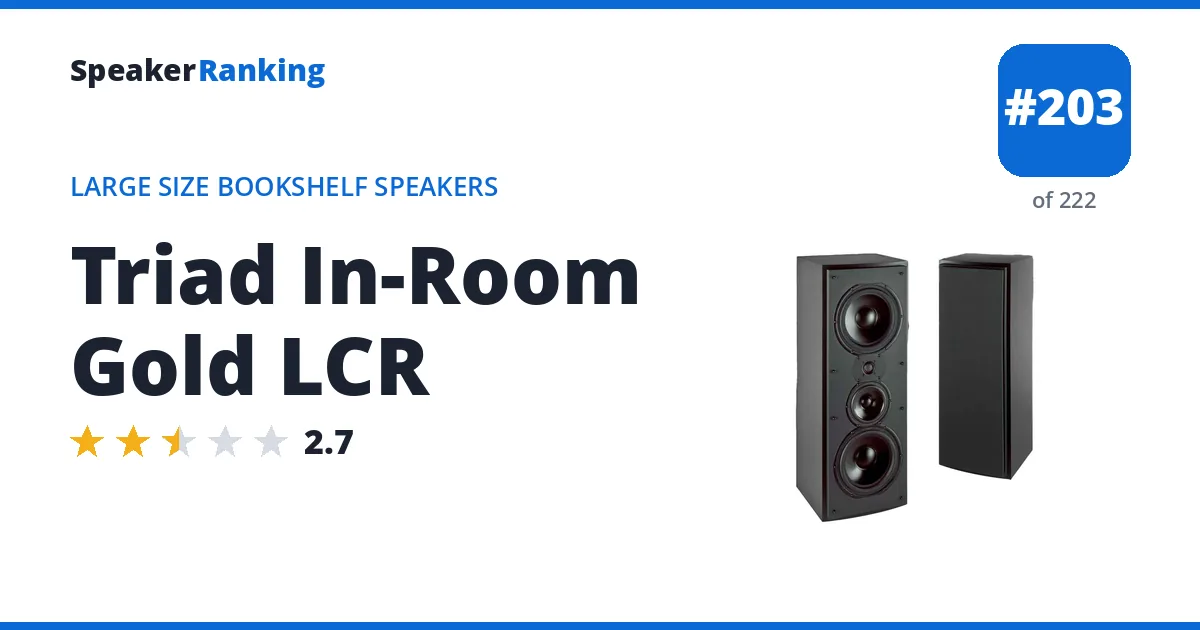
The Triad In-Room Gold LCR is rated 2.7/5 for sound quality, #203 of 222 Large Size Bookshelf Speakers. See all Passive Home rankings for every top pick.
Prices on this page were last checked November 11, 2026 at 3:26 AM UTC. Product prices and availability are accurate as of that date/time and are subject to change; the price and availability shown on Amazon at the time of purchase will apply to the purchase of this product.
As an eBay Partner, we may be compensated if you make a purchase.
#203 Triad In-Room Gold LCR: $6,600 per pair Triad Authorized Dealer $6,600 eBay
Pros: A sealed three way home theater speaker with dual 8.5 inch woofers, very low distortion at high volume and broad coverage. Built for serious home theater output: the sealed three-way layout uses dual 8.5-inch woofers, a 5.5-inch midrange and a 1-inch fabric dome. At 86dB/1m, Erin measured under 1% distortion to 50Hz; at 96dB it remained under 1% only above about 80Hz, supporting Triad’s intended 80Hz subwoofer crossover. Compression and 32-band multitone distortion were both low, even at high playback levels. Broad horizontal coverage (about +/-70 to 80 degrees through the midrange) and a roughly +/-20-degree vertical window give a generous listening area. It can be made substantially more linear with EQ, and its 89dB measured sensitivity is suitable for a capable AVR or power amplifier. Measured bass extension of 57Hz (-3dB), with a measured sensitivity of 88.9dB.
Cons: At $6600/pair, Erin found the raw response and value hard to defend without EQ: a 100-300Hz dip makes male vocals thin, a 1kHz dip adds hollowness, and a 4-5kHz rise makes sibilants harsh. The directivity begins to narrow above about 5kHz as the tweeter beams. Despite its dual woofers, it requires a subwoofer; Erin measured F3 57Hz and F10 40Hz. Load dips below 3 ohms, so it needs an amplifier stable into 4 ohms. Plain, utilitarian styling will not suit everyone.
| Released | Apr 2023 (3 years ago) |
|---|---|
| Bass Extension (-10dB) | 40Hz (measured, Erin’s Audio Corner) |
| Bass Extension (-3dB) | 57Hz (measured, Erin’s Audio Corner) |
| Country | USA (handcrafted, manufacturer specified) |
| DIY Kit | No |
| Dimensions | 29”H x 10.75”W x 11.375”D |
| Drivers | Two 8.5” metal woofers, 5.5” paper/fiber midrange, 1” fabric-dome tweeter |
| Frequency Response | 50Hz - 20kHz +/-3dB (manufacturer specified) |
| Impedance | 4 ohms nominal; dips below 3 ohms (measured, Erin’s Audio Corner) |
| Power Handling | 100W - 450W recommended (manufacturer specified) |
| Sensitivity | 88.9dB (2.83V/1m, measured, Erin’s Audio Corner; 92dB manufacturer specified) |
| Spinorama Preference Score | 4.04 |
| Spinorama Preference Score with Perfect Sub | 6.41 |
| Weight | 54.9 lbs (24.9 kg) each |
| Woofer Cabinet | sealed / acoustic suspension |
- Links
- Reviews, Comparisons and Sound Samples
Head-to-Head Comparisons
9 comparisons- Triad In-Room Gold LCR vs Wharfedale Diamond 9.1
- Triad In-Room Gold LCR vs ATC SCM19
- Triad In-Room Gold LCR vs Harbeth Super HL5plus XD2
- Triad In-Room Gold LCR vs Klipsch RP-600M II
- Triad In-Room Gold LCR vs Danley SH50
- Triad In-Room Gold LCR vs ELAC Debut 3.0 DB63
- Triad In-Room Gold LCR vs KEF R3
- Triad In-Room Gold LCR vs KEF Q Concerto Meta
- Triad In-Room Gold LCR vs KEF R3 Meta
No comparisons match that search.