Short answer: the Triad In-Room Gold LCR, though neither ranks well in its class. It ranks #115 of 131 bookshelf speakers by sound quality, rated 2.7/5, at $6,600. The ATC SCM19 ranks #120, rated 2.4/5, at $3,750, $2,850 cheaper, not enough of a saving to outweigh the sound-quality gap. Both are rated below 3.0/5 among the 131 bookshelf speakers, so if sound quality matters, consider the Perlisten S4b instead, ranked #2 at $8,000.
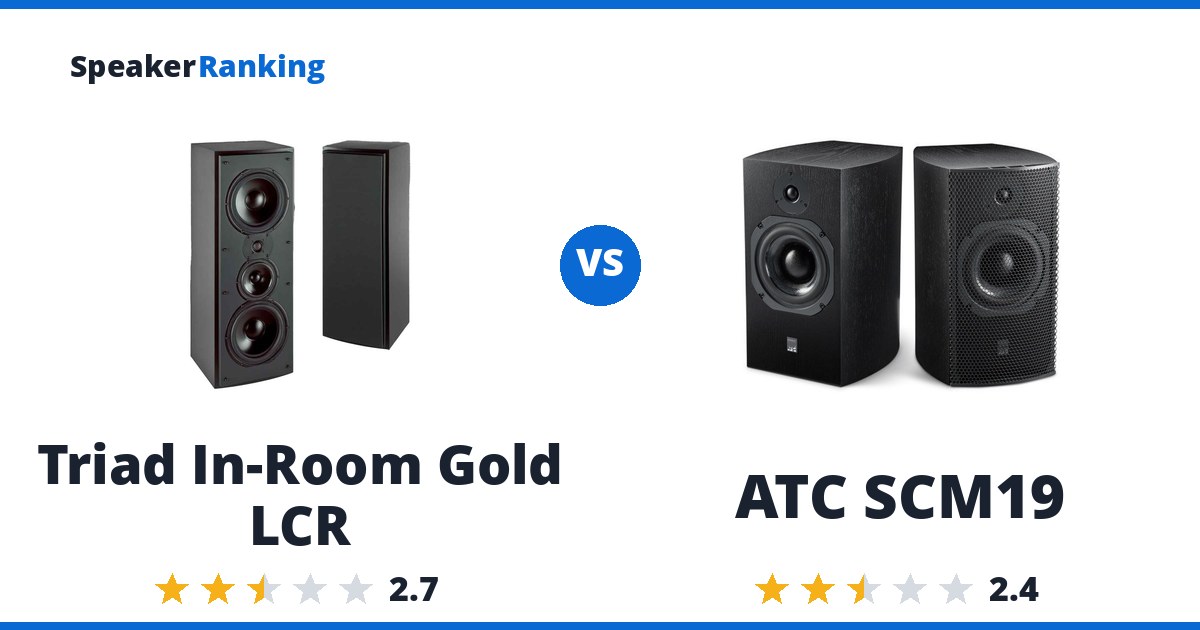
The case for the Triad In-Room Gold LCR: Built for serious home theater output: the sealed three-way layout uses dual 8.5-inch woofers, a 5.5-inch midrange and a 1-inch fabric dome. The tradeoff: At $6600/pair, Erin found the raw response and value hard to defend without EQ: a 100-300Hz dip makes male vocals thin, a 1kHz dip adds hollowness, and a 4-5kHz rise makes sibilants harsh.
The case for the ATC SCM19: Harmonic distortion at 96dB SPL/1m stays generally low across the range aside from the spike tied to the 700-800Hz resonance. Watch for: Some stored energy resonance around 500-700Hz, 4dB bump around 700Hz.
Buy the Triad In-Room Gold LCR. It is rated higher for sound quality, and saving $2,850 with the ATC SCM19 does not make up for the sound-quality gap.
Still deciding? The full Passive Home rankings cover every ranked option.
Specifications Side By Side
| Triad In-Room Gold LCR | ATC SCM19 | |
|---|---|---|
| Price | $6,600 per pair | $3750 per pair |
| Ranked | #115 of 131 in Large Size Bookshelf Speakers | #120 of 131 in Large Size Bookshelf Speakers |
| Drivers | Two 8.5” metal woofers, 5.5” paper/fiber midrange, 1” fabric-dome tweeter | 5.9” Super Linear Magnet cone woofer, 1” soft dome tweeter |
| Dimensions | 29”H x 10.75”W x 11.375”D | 17.2”H x 10.4”W x 11.8”D (436.9 x 264.2 x 299.7 mm) |
| Weight | 54.9 lbs (24.9 kg) each | 39.2 lbs (17.8 kg) each |
| Impedance | 4 ohms nominal; dips below 3 ohms (measured, Erin’s Audio Corner) | 6 ohms |
| Sensitivity | 88.9dB (2.83V/1m, measured, Erin’s Audio Corner; 92dB manufacturer specified) | 85dB (measured, Audio Science Review) |
| Bass Extension (-3dB) | 57Hz (measured, Erin’s Audio Corner) | 60Hz (measured, Audio Science Review) |
| Bass Extension (-10dB) | 40Hz (measured, Erin’s Audio Corner) | 34Hz (measured, Audio Science Review) |
| Power Handling | 100W - 450W recommended (manufacturer specified) | - |
| Frequency Response | 50Hz - 20kHz +/-3dB (manufacturer specified) | - |
| Woofer Cabinet | sealed / acoustic suspension | sealed |
| Country | USA (handcrafted, manufacturer specified) | - |
| Spinorama Preference Score | 4.04 | 4.61 |
| Spinorama Preference Score with Perfect Sub | 6.41 | 7.03 |
| DIY Kit | No | No |
Related Speaker Comparisons
More top alternatives to Triad In-Room Gold LCR:
- ELAC Debut 3.0 DB63 vs Triad In-Room Gold LCR
- Danley SH50 vs Triad In-Room Gold LCR
- Klipsch RP-600M II vs Triad In-Room Gold LCR
- Wharfedale Diamond 9.1 vs Triad In-Room Gold LCR
- Dynaudio Heritage Special vs ATC SCM19
Prices on this page were last checked September 29, 2026 at 3:43 PM UTC. Product prices and availability are accurate as of that date/time and are subject to change; the price and availability shown on Amazon at the time of purchase will apply to the purchase of this product.
As an eBay Partner, we may be compensated if you make a purchase.
The Two Speakers In Full
 Triad In-Room Gold LCR: $6,600 per pair Triad Authorized Dealer eBay
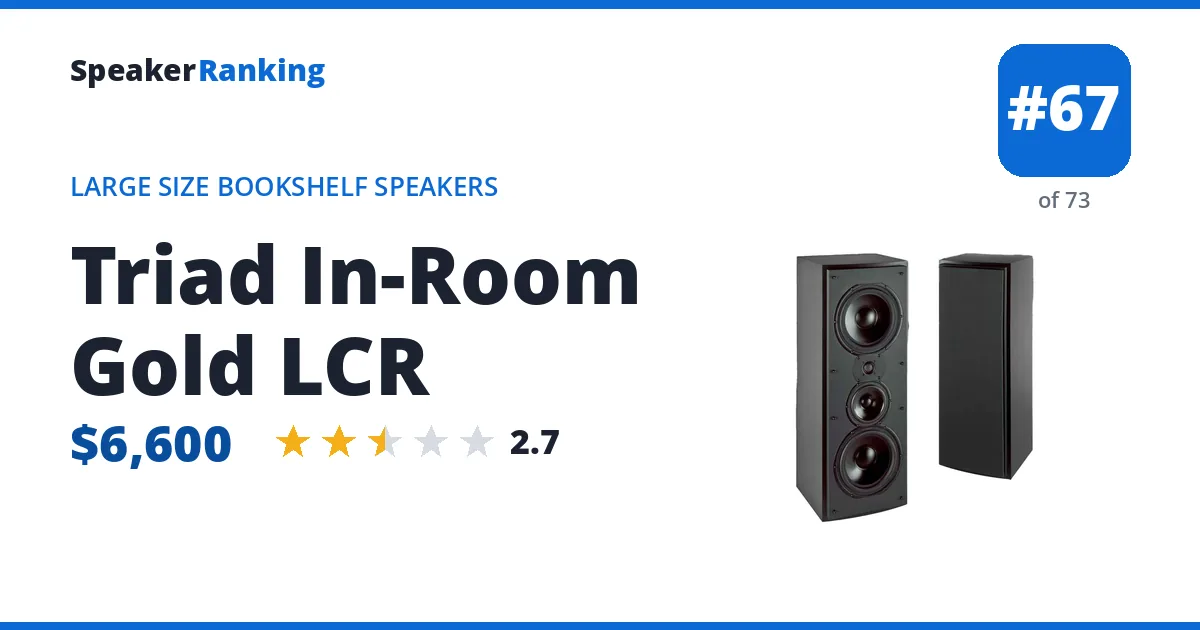
Pros: Built for serious home theater output: the sealed three-way layout uses dual 8.5-inch woofers, a 5.5-inch midrange and a 1-inch fabric dome. At 86dB/1m, Erin measured under 1% distortion to 50Hz; at 96dB it remained under 1% only above about 80Hz, supporting Triad’s intended 80Hz subwoofer crossover. Compression and 32-band multitone distortion were both low, even at high playback levels. Broad horizontal coverage (about +/-70 to 80 degrees through the midrange) and a roughly +/-20-degree vertical window give a generous listening area. It can be made substantially more linear with EQ, and its 89dB measured sensitivity is suitable for a capable AVR or power amplifier. Measured bass extension of 57Hz (-3dB), with a measured sensitivity of 88.9dB.
Cons: At $6600/pair, Erin found the raw response and value hard to defend without EQ: a 100-300Hz dip makes male vocals thin, a 1kHz dip adds hollowness, and a 4-5kHz rise makes sibilants harsh. The directivity begins to narrow above about 5kHz as the tweeter beams. Despite its dual woofers, it requires a subwoofer; Erin measured F3 57Hz and F10 40Hz. Load dips below 3 ohms, so it needs an amplifier stable into 4 ohms. Plain, utilitarian styling will not suit everyone.
Full Triad In-Room Gold LCR review and specifications →
| Bass Extension (-10dB) | 40Hz (measured, Erin’s Audio Corner) |
|---|---|
| Bass Extension (-3dB) | 57Hz (measured, Erin’s Audio Corner) |
| Country | USA (handcrafted, manufacturer specified) |
| DIY Kit | No |
| Dimensions | 29”H x 10.75”W x 11.375”D |
| Drivers | Two 8.5” metal woofers, 5.5” paper/fiber midrange, 1” fabric-dome tweeter |
| Frequency Response | 50Hz - 20kHz +/-3dB (manufacturer specified) |
| Impedance | 4 ohms nominal; dips below 3 ohms (measured, Erin’s Audio Corner) |
| Power Handling | 100W - 450W recommended (manufacturer specified) |
| Sensitivity | 88.9dB (2.83V/1m, measured, Erin’s Audio Corner; 92dB manufacturer specified) |
| Spinorama Preference Score | 4.04 |
| Spinorama Preference Score with Perfect Sub | 6.41 |
| Weight | 54.9 lbs (24.9 kg) each |
| Woofer Cabinet | sealed / acoustic suspension |
- Links
- Reviews, Comparisons and Sound Samples
- Head-to-Head Comparisons
 ATC SCM19: $3750 per pair The Music Room eBay
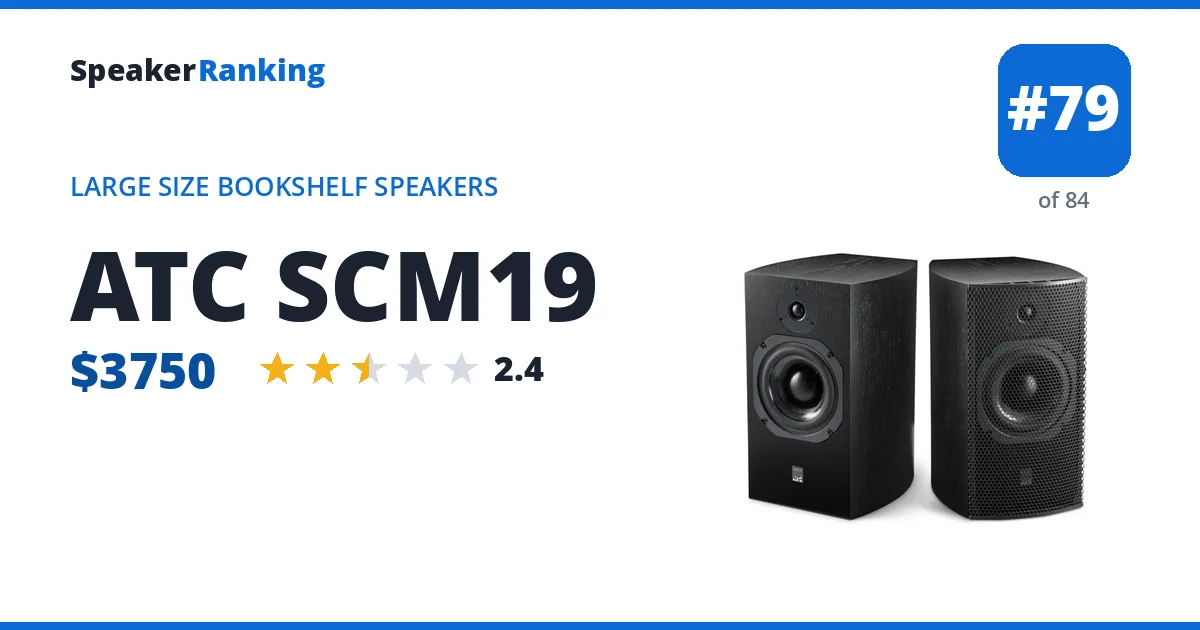
Pros: Harmonic distortion at 96dB SPL/1m stays generally low across the range aside from the spike tied to the 700-800Hz resonance. Sealed (unported) cabinet avoids port noise and resonance, and the extremely dense, heavy-duty enclosure (17.8kg/39lb each) reflects ATC’s pro-audio build standards. Measured bass extension of 60Hz (-3dB), with a measured sensitivity of 85dB.
Cons: Some stored energy resonance around 500-700Hz, 4dB bump around 700Hz. Not recommended for the price. CEA2034 spinorama and predicted in-room response both show a very uneven overall balance (a broad accentuation from midrange to treble paired with too little bass) along with directivity error. At 96dB SPL/1m, harmonic distortion tied to the 500-700Hz resonance rises to a level the reviewer says “should not be there.”
Full ATC SCM19 review and specifications →
| Bass Extension (-10dB) | 34Hz (measured, Audio Science Review) |
|---|---|
| Bass Extension (-3dB) | 60Hz (measured, Audio Science Review) |
| DIY Kit | No |
| Dimensions | 17.2”H x 10.4”W x 11.8”D (436.9 x 264.2 x 299.7 mm) |
| Drivers | 5.9” Super Linear Magnet cone woofer, 1” soft dome tweeter |
| Impedance | 6 ohms |
| Sensitivity | 85dB (measured, Audio Science Review) |
| Spinorama Preference Score | 4.61 |
| Spinorama Preference Score with Perfect Sub | 7.03 |
| Weight | 39.2 lbs (17.8 kg) each |
| Woofer Cabinet | sealed |
- Links
- Reviews, Comparisons and Sound Samples
- Head-to-Head Comparisons