The Chesky LC1 ranks #149 out of 157 total Large Size Bookshelf Speakers for sound quality. See all Passive Home rankings for every top pick.
Prices on this page were last checked October 5, 2026 at 10:21 PM UTC. Product prices and availability are accurate as of that date/time and are subject to change; the price and availability shown on Amazon at the time of purchase will apply to the purchase of this product.
As an eBay Partner, we may be compensated if you make a purchase.
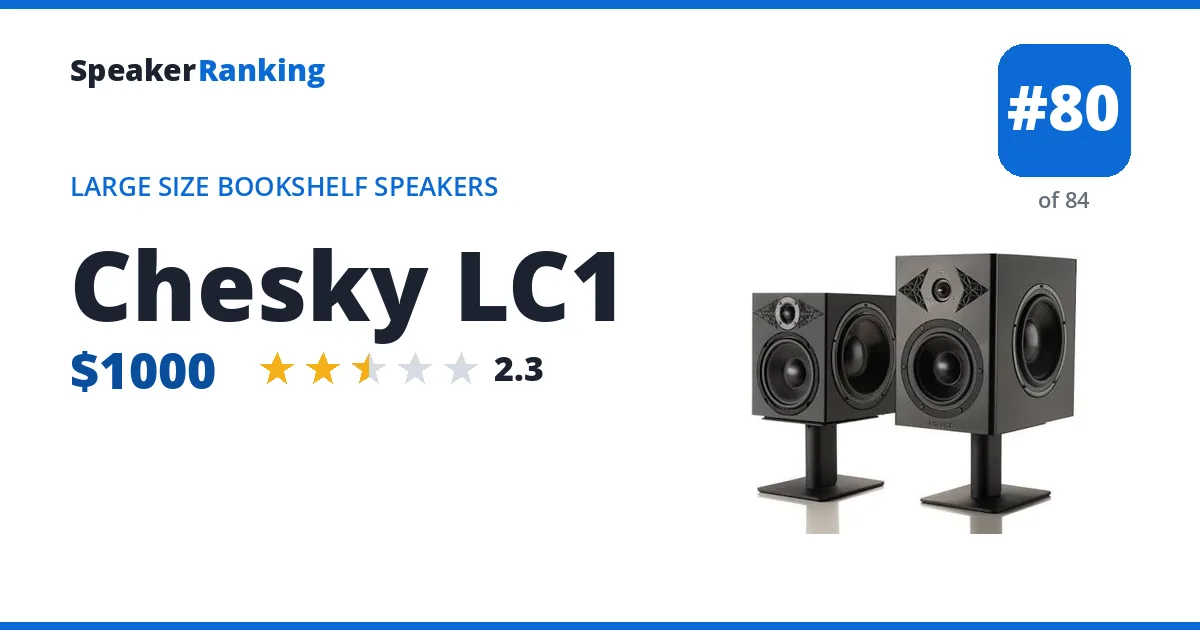
#149 Chesky LC1: $1,000 per pair Discontinued eBay
Pros: Premium build details: silver-soldered crossover with film capacitors, dual inertially-balanced 8” passive radiators, and a multi-layer, non-resonant cabinet construction. Wide horizontal radiation of about ±60-70° through the midrange, in the reviewer’s preferred range. Extremely easy to drive electrically (minimum impedance about 8.4 ohms, minimum EPDR 5.4 ohms). Distortion shows good separation between second- and third-order harmonics at both 86dB and 96dB. The reviewer took the unusual step of verifying his measurements weren’t due to a defective unit: he impedance-swept both speakers, then corresponded directly with the manufacturer, whose own measurements matched his, confirming the sound reflects the actual product design. Measured bass extension of 71Hz (-3dB), with a measured sensitivity of 81.4dB.
Cons: Overall tonal balance sounded dull, hollow, and unengaging in extensive listening, with recessed vocals (both male and female) and minimal bass: the reviewer independently confirmed the same impressions auditioning the speakers at an audio show, ruling out a fluke with his own pair. Essentially no meaningful bass below about 90-100Hz in-room (F3 71Hz, F10 49Hz), well short of the 50Hz frequency-response spec, and measured sensitivity (about 81.4dB) runs well below the 86dB claimed. A pattern of peaks and dips across the spectrum, rather than a simple tilt, makes different instruments sound inconsistent depending on what frequency range they occupy: an unusually difficult profile to characterize or EQ around. Center-image focus never locked in properly regardless of listening position: traced to a measurable mismatch between the two individual speaker samples’ on-axis response, an unusual quality-control issue for a simple dome-tweeter design. A cancellation/lobing region just below the tweeter axis, likely from shallow first-order crossover slopes and some crossover-region overlap, means listening position needs to stay right at or slightly above tweeter level. Elevated multitone distortion in a region tied to a cone-edge/surround resonance (a known issue across several driver brands), only marginally improved by adding a subwoofer. Sample-to-sample driver measurements showed real inconsistency between the two review units’ tweeters and midwoofers. A cosmetic gap around the tweeter’s flush-mount cutout suggests room for tighter fit-and-finish. Discontinued.
How it compares: Just above it: Dayton Audio MK602X - $851 cheaper, 3.6Hz higher bass extension (-3dB). Just below it: HSU Research CCB-8 - $301 cheaper, 9Hz higher bass extension (-3dB).
| Bass Extension (-10dB) | 49Hz (measured, Erin’s Audio Corner) |
|---|---|
| Bass Extension (-3dB) | 71Hz (measured, Erin’s Audio Corner) |
| DIY Kit | No |
| Dimensions | 10”H x 8”W x 10”D (254.0 x 203.2 x 254.0 mm) |
| Drivers | 1” tweeter + 4” woofer |
| Impedance | 8 ohms nominal (8.4 ohms minimum, measured, Erin’s Audio Corner) |
| Sensitivity | 81.4dB (measured, Erin’s Audio Corner) |
| Spinorama Preference Score | 3.21 |
| Spinorama Preference Score with Perfect Sub | 5.87 |
| Weight | 17.6 lbs (8 kg) |
| Woofer Cabinet | passive radiator |
- Links
- Reviews, Comparisons and Sound Samples