Jasper Tech is ranked #8 of 49 in the speaker-review source reliability ranking. The ranking weighs measurement quality, repeatability, useful comparisons, disclosure, and editorial independence; it is an assessment of the work used for speaker decisions, not a claim about personal character.
Reliability assessment: Provides practical product overviews and is willing to discuss limitations, but offers little standardized speaker measurement or controlled audio comparison. Use it mainly for features and usability, with acoustic conclusions corroborated elsewhere.
Prices on this page were last checked October 11, 2026 at 4:59 PM UTC. Product prices and availability are accurate as of that date/time and are subject to change; the price and availability shown on Amazon at the time of purchase will apply to the purchase of this product.
As an eBay Partner, we may be compensated if you make a purchase.
Quick Navigation
- Medium Size Powered Desktop Speakers
- Small Size Powered Bookshelf Speakers
- Medium Size Powered Bookshelf Speakers
Every speaker on this site Jasper Tech has reviewed, highest-rated first, with a direct link to each review below its card.
Medium Size Powered Desktop Speakers
 Ranked #19 of 25 in Medium Size Powered Desktop Speakers - Apple HomePod: $299 each Discontinued eBay
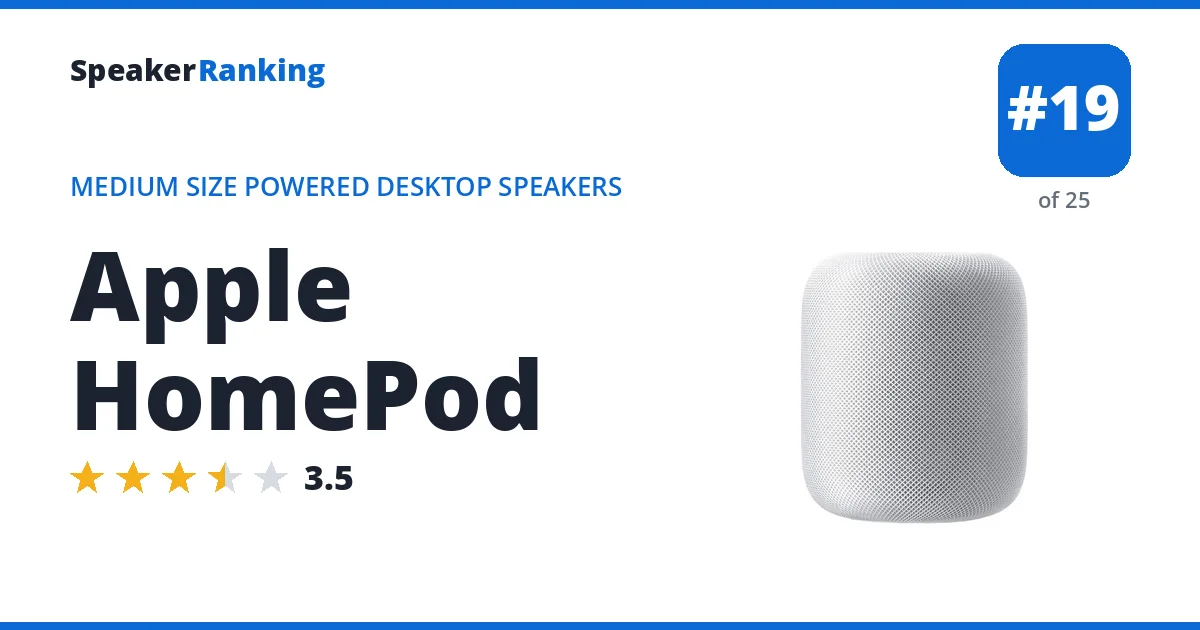
Newer model: the Apple HomePod 2nd Gen, ranked higher, rated 4/5, released Jan 2023. See every Apple HomePod generation.
Pros: A Wi-Fi smart speaker with a 4” high-excursion woofer, seven horn-loaded tweeters arranged in a ring and a six-microphone array it uses to measure the room and adjust its sound. Audio Science Review’s measurements show remarkably deep bass for its size, 26.4Hz (-3dB), and very even sound in every direction, so where it sits in a room matters little. Measured bass extension of 26.4Hz (-3dB).
Cons: The on-axis response is uneven (1.15 average deviation), for a preference score of 4.09 that reaches 4.99 with an ideal subwoofer. Music arrives only over AirPlay 2 or from Apple Music by voice: Bluetooth is used for setup, and there is no wired input. Apple discontinued it in 2021 and later released the Apple HomePod 2nd Gen.
Full Apple HomePod review and specifications →
| Released | Feb 2018 (8 years ago) |
|---|---|
| AES Input | No |
| App | Yes (Apple Home) |
| Aux Input | No |
| Bass Extension (-10dB) | about 22.4Hz (measured, Audio Science Review) |
| Bass Extension (-3dB) | 26.4Hz (measured, Audio Science Review) |
| Battery Life | No Battery |
| Bluetooth | No |
| Built-in Microphone | Yes (six-microphone array) |
| Coaxial Input | No |
| Dimensions | 6.8”H x 5.6”W x 5.6”D (172 x 142 x 142 mm) |
| Drivers | 4” high-excursion woofer, 7x horn-loaded tweeters |
| EQ | Yes (automatic room correction) |
| HDMI Input | No |
| IP Rating | None |
| Inputs | Wi-Fi, AirPlay 2 |
| Optical Input | No |
| Party Mode | Yes (AirPlay 2 multi-room) |
| Power Bank | No |
| RCA Input | No |
| Spinorama Preference Score | 4.09 |
| Spinorama Preference Score with Perfect Sub | 4.99 |
| Stereo | No |
| Streaming Services | AirPlay 2, Apple Music (direct voice control); other services via AirPlay only |
| TRS Input | No |
| TWS | Yes (stereo pairing via Home app) |
| USB Input | No |
| Voice Assistants | Apple Siri |
| Weight | 5.5 lbs (2.5 kg) |
| Wi-Fi | Yes |
| XLR Input | No |
- Reviews, Comparisons and Sound Samples
- Head-to-Head Comparisons
Small Size Powered Bookshelf Speakers
 Ranked #3 of 47 in Small Size Powered Bookshelf Speakers - ADAM Audio D3v: $349.99 per pair Amazon eBay

Pros: Excellent midrange linearity for a tiny desktop speaker: Erin’s Klippel data spans just 1.7dB from 300Hz to 5kHz. Side passive radiators help bass reach -3dB at about 51Hz, substantially deeper than the Genelec 8010A or Audio Smile Little British Monitor. Predicted preference scores of 5.37 standalone and 7.59 with an ideal subwoofer support it as a particularly useful compact system without a sub. USB-C, analog inputs and placement filters simplify desk setup. Measured bass extension of 50Hz (-3dB), with a measured sensitivity of 86.5dB.
Cons: A rising upper-frequency balance and vertical crossover interference keep it from being uniformly neutral at every angle; aim the tweeters toward ear height. The limiter reduces bass and midrange output as volume rises, with the existing review’s compression tests putting usable maximum output around 89-90dB at 1m. Deep bass at moderate volume should not be confused with high output capability.
Full ADAM Audio D3v review and specifications →
| Released | Nov 2024 (1 year ago) |
|---|---|
| AES Input | No |
| Amplifier Power | 100W RMS per speaker (70W woofer + 30W tweeter) (Manufacturer specified) |
| App | No |
| Aux Input | No |
| Bass Extension (-10dB) | 45Hz (measured, Erin’s Audio Corner) |
| Bass Extension (-3dB) | 50Hz (measured, Erin’s Audio Corner) |
| Bluetooth | No |
| Coaxial Input | No |
| Dimensions | 200H (240H on included stand) x 115W x 150D mm |
| Drivers | 3.5” aluminium woofer, D-ART folded ribbon tweeter, 2 x 3.5” passive radiators (each) |
| EQ | Yes (Room adjustment filters) |
| Frequency Response | 48Hz - 22.6kHz (-3dB) (Manufacturer specified) |
| HDMI Input | No |
| Headphone Output | Yes |
| Inputs | USB-C, balanced 1/4-inch TRS |
| Maximum SPL | 98dB peak @ 1m (IEC-weighted noise, manufacturer specified) |
| Optical Input | No |
| Outputs | 3.5mm headphone |
| RCA Input | No |
| Sensitivity | 86.5dB (measured at 0.3V/1m, Erin’s Audio Corner) |
| Spinorama Preference Score | 5.37 |
| Spinorama Preference Score with Perfect Sub | 7.59 |
| TRS Input | Yes |
| USB Input | Yes |
| Weight | 7.9 lbs (3.58 kg) (pair) |
| XLR Input | No |
- Links
- Reviews, Comparisons and Sound Samples
- Erin’s Audio Corner: ADAM Audio D3V: Mighty Small But Mighty Awesome Desktop Speaker More from Erin’s Audio Corner →
- Erin’s Audio Review Adam Audio D3v
- Erin’s Audio Corner Measurements (spinorama.org)
- Jasper Tech: Best Desktop Computer Speakers for Every Budget – 2026 More from Jasper Tech →
- Jasper Tech: Are the D3V The Best Studio Monitors For The Money?
- Erin’s Audio Corner: The Best Budget Desktop Speakers, Tested & Rated
- Head-to-Head Comparisons
- ADAM Audio D3v vs Genelec 8010A
- ADAM Audio D3v vs Cambridge Audio L/R S
- ADAM Audio D3v vs Audio Smile Little British Monitor
- ADAM Audio D3v vs IK Multimedia iLoud Micro Monitor
- ADAM Audio D3v vs IK Multimedia iLoud Micro Monitor Pro
- ADAM Audio D3v vs Edifier M60
- ADAM Audio D3v vs HiVi Swan X3
- ADAM Audio D3v vs Edifier MR3
- See all 24 comparisons
 Ranked #6 of 47 in Small Size Powered Bookshelf Speakers - IK Multimedia iLoud Micro Monitor: $199.99 per pair Amazon eBay
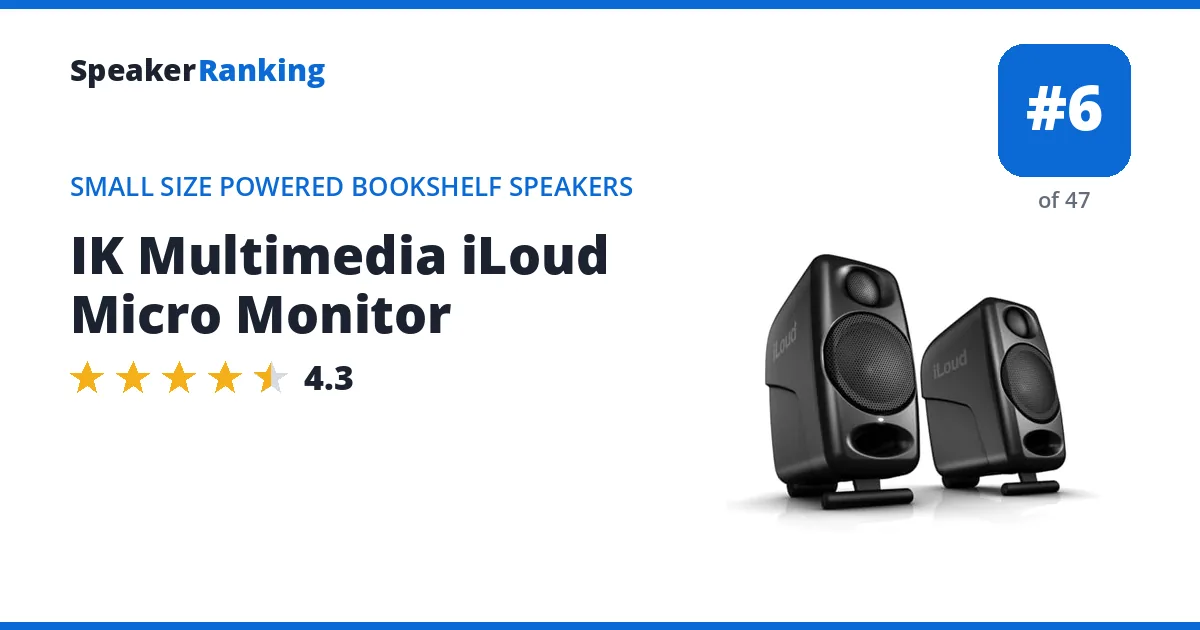
Newer model: the IK Multimedia iLoud Micro Monitor Pro, ranked lower, estimated 4.3/5, released Sep 2024. It adds XLR input, but drops the aux input and Bluetooth. See every IK Multimedia iLoud generation.
Pros: Unusually substantial bass for such a small desktop pair. The linked quasi-anechoic measurement review reports broad, reasonably consistent horizontal radiation and useful tolerance above the tweeter axis, helpful when the speakers sit below ear height. Its compact size and bass balance make it a practical close-listening alternative to small monitors that need a subwoofer. Measured bass extension of 55Hz (-3dB).
Cons: The existing review evidence indicates some bass emphasis and upper-treble rolloff rather than strict neutrality. Deep bass from tiny drivers does not establish loud-playback headroom; use these for close desktop listening, not as a substitute for larger room speakers.
Full IK Multimedia iLoud Micro Monitor review and specifications →
| Released | Oct 2016 (10 years ago) |
|---|---|
| AES Input | No |
| Amplifier Power | 50W total (combined) |
| App | No |
| Aux Input | Yes |
| Bass Extension (-10dB) | 45Hz (measured, Audio Science Review) |
| Bass Extension (-3dB) | 55Hz (measured, Audio Science Review) |
| Bluetooth | Yes (A2DP) |
| Coaxial Input | No |
| Dimensions | 7.1”H x 3.5”W x 5.3”D (180.3 x 88.9 x 134.6 mm) |
| Drivers | 3” woofer, 0.75” silk dome tweeter |
| EQ | Yes (Bass/Treble switches, Desktop/Free field) |
| Frequency Response | 55Hz - 20kHz (-3dB) (Manufacturer specified) |
| HDMI Input | No |
| Inputs | RCA, Aux |
| Maximum SPL | 96dB @ 1m (manufacturer specified) |
| Optical Input | No |
| RCA Input | Yes |
| TRS Input | No |
| USB Input | No |
| Weight | 2 lbs (0.9 kg) |
| XLR Input | No |
- Links
- Reviews, Comparisons and Sound Samples
- Audio Science Review Measurements More from Audio Science Review →
- DSAUDIO.review: DSAUDIO.review Edifier MR4 vs iLoud Micro Monitor sound.DEMO More from DSAUDIOreview →
- DSAUDIOreview: IK Multimedia iLoud MTM vs iLoud Micro Sound & Frequency Response Comparison
- Jasper Tech: Best Desktop Computer Speakers for Every Budget – 2026 More from Jasper Tech →
- Jasper Tech: Are the D3V The Best Studio Monitors For The Money?
- Jasper Tech: Best Premium Computer Speakers: Kanto ORA4 Review & Comparison
- Jasper Tech: Are the iLoud Micro Monitor Pro the Best Studio Monitor Speakers for your Home Studio?
- Jasper Tech: Best Desktop Computer Speakers for Every Budget
- Head-to-Head Comparisons
- IK Multimedia iLoud Micro Monitor vs IK Multimedia iLoud Micro Monitor Pro
- IK Multimedia iLoud Micro Monitor vs Cambridge Audio L/R S
- IK Multimedia iLoud Micro Monitor vs ADAM Audio D3v
- IK Multimedia iLoud Micro Monitor vs Edifier M60
- IK Multimedia iLoud Micro Monitor vs Genelec 8010A
- IK Multimedia iLoud Micro Monitor vs HiVi Swan X3
- IK Multimedia iLoud Micro Monitor vs Edifier MR3
- IK Multimedia iLoud Micro Monitor vs Audioengine A2+
- See all 20 comparisons
 Ranked #8 of 47 in Small Size Powered Bookshelf Speakers - KEF LSX II: $1,499.99 per pair Estimated Amazon KEF eBay
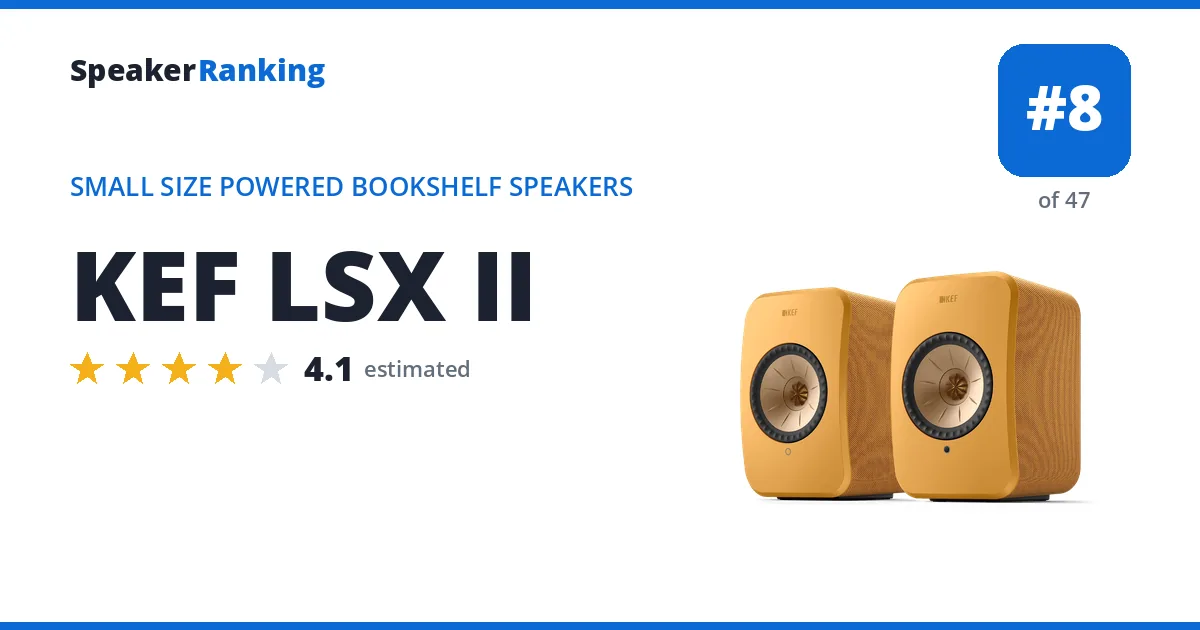
Same family: the KEF LSX II LT (smaller bookshelf, rated 4/5), the KEF LS50 Wireless II (larger bookshelf, rated 4.3/5) and the KEF LS60 (floorstanding, rated 4.8/5).
Pros: Full-featured active stereo bookshelf system featuring an 11th-generation 4.5-inch Uni-Q driver with 200W of system bi-amplification. Unlike the LT variant, it includes 3.5mm analog auxiliary input, Roon Ready certification, wireless inter-speaker pairing without requiring a tether cable, and expanded streaming options over dual-band Wi-Fi (AirPlay 2, Chromecast, Spotify Connect, Tidal Connect) plus HDMI ARC and USB-C.
Cons: Compact 4.5-inch drivers run into bass compression and rising distortion beyond 88dB/1m, making the system ideal for desktop and small-room listening rather than large living areas without a companion subwoofer.
Full KEF LSX II review and specifications →
| Amplifier Power | 200W |
|---|---|
| Aux Input | Yes |
| Bluetooth | Yes |
| Bluetooth Version | 5.0 |
| Cabinet Color | Carbon Black, Mineral White, Cobalt Blue, Lava Red, Soundwave by Terence Conran |
| Country | United Kingdom |
| Dimensions | 9.4”H x 6.1”W x 7.1”D (240 x 155 x 180 mm) |
| Drivers | 0.75” aluminum dome tweeter, 4.5” magnesium/aluminum alloy cone woofer |
| Enclosure | ported, rear |
| Ethernet | Yes |
| Frequency Response | 54Hz - 28kHz (±3dB) (manufacturer specified) |
| HDMI Input | Yes |
| Maximum SPL | 102 dB |
| Optical Input | Yes |
| Stereo | pair |
| Subwoofer Output | Yes |
| USB Input | Yes |
| Weight | 15.9 lbs (7.2 kg) |
| Wi-Fi | Yes |
- Links
- Reviews, Comparisons and Sound Samples
- Head-to-Head Comparisons
 Ranked #9 of 47 in Small Size Powered Bookshelf Speakers - Edifier M60: $169.99 per pair Amazon eBay

Same family: the Edifier M90 (larger bookshelf, ranked lower, estimated 3.3/5).
Pros: Erin’s Klippel data shows a reasonably even midrange, spanning 2.8dB from 300Hz to 5kHz, with broad horizontal coverage for desktop listening. Predicted preference scores are 4.60 standalone and 7.33 with an ideal subwoofer, a comparatively strong result in this compact category. USB-C, auxiliary input, Bluetooth and included angled stands make it easy to integrate into a small desk setup. LDAC Bluetooth support and illuminated touch controls round out the features. Measured bass extension of 67Hz (-3dB), with a measured sensitivity of 87.5dB.
Cons: The on-axis response rises by about 0.57dB per octave, so the tonal balance becomes brighter toward the treble. Measured -3dB bass extension is about 70Hz; it cannot reproduce deep bass at full level. Sitting below the tweeter axis worsens the crossover-region response. Limiting and compression constrain louder playback, so use it nearfield rather than expecting room-filling output.
Full Edifier M60 review and specifications →
| Released | Nov 2024 (1 year ago) |
|---|---|
| AES Input | No |
| Amplifier Power | 66W total (33W per speaker) |
| App | Yes |
| Aux Input | Yes |
| Bass Extension (-10dB) | 57Hz (measured, Erin’s Audio Corner) |
| Bass Extension (-3dB) | 67Hz (measured, Erin’s Audio Corner) |
| Bluetooth | Yes |
| Bluetooth Codecs | SBC, LDAC |
| Bluetooth Version | 5.3 |
| Coaxial Input | No |
| Dimensions | 6.6”H x 3.9”W x 5.8”D (167.6 x 99.1 x 147.3 mm) |
| Drivers | 3” woofer, 1” silk dome tweeter |
| EQ | Yes |
| Frequency Response | 55Hz - 40kHz (Manufacturer specified) |
| HDMI Input | No |
| Inputs | Bluetooth, Aux, USB-C |
| Maximum SPL | 96dB @ 1m (manufacturer specified) |
| Optical Input | No |
| RCA Input | No |
| Sensitivity | 87.5dB (measured at 0.3V/1m, Erin’s Audio Corner) |
| Spinorama Preference Score | 4.60 |
| Spinorama Preference Score with Perfect Sub | 7.33 |
| TRS Input | No |
| USB Input | Yes |
| Weight | 6.6 lbs (3 kg) |
| XLR Input | No |
- Links
- Reviews, Comparisons and Sound Samples
- Erin’s Audio Corner: Edifier M60 Desktop Speaker Delivers Big Fun! More from Erin’s Audio Corner →
- Erin’s Audio Corner: The Best Budget Desktop Speakers, Tested & Rated
- Erin’s Audio Corner Website: Edifier M60
- Erin’s Audio Corner Measurements (spinorama.org)
- Jasper Tech: Best Desktop Computer Speakers for Every Budget – 2026 More from Jasper Tech →
- Head-to-Head Comparisons
- Edifier M60 vs HiVi Swan X3
- Edifier M60 vs Edifier MR3
- Edifier M60 vs IK Multimedia iLoud Micro Monitor Pro
- Edifier M60 vs IK Multimedia iLoud Micro Monitor
- Edifier M60 vs Kanto ORA4
- Edifier M60 vs Cambridge Audio L/R S
- Edifier M60 vs Sovox MiniMax3
- Edifier M60 vs ADAM Audio D3v
- See all 36 comparisons
 Ranked #11 of 47 in Small Size Powered Bookshelf Speakers - Edifier MR3: $149.99 per pair Amazon eBay
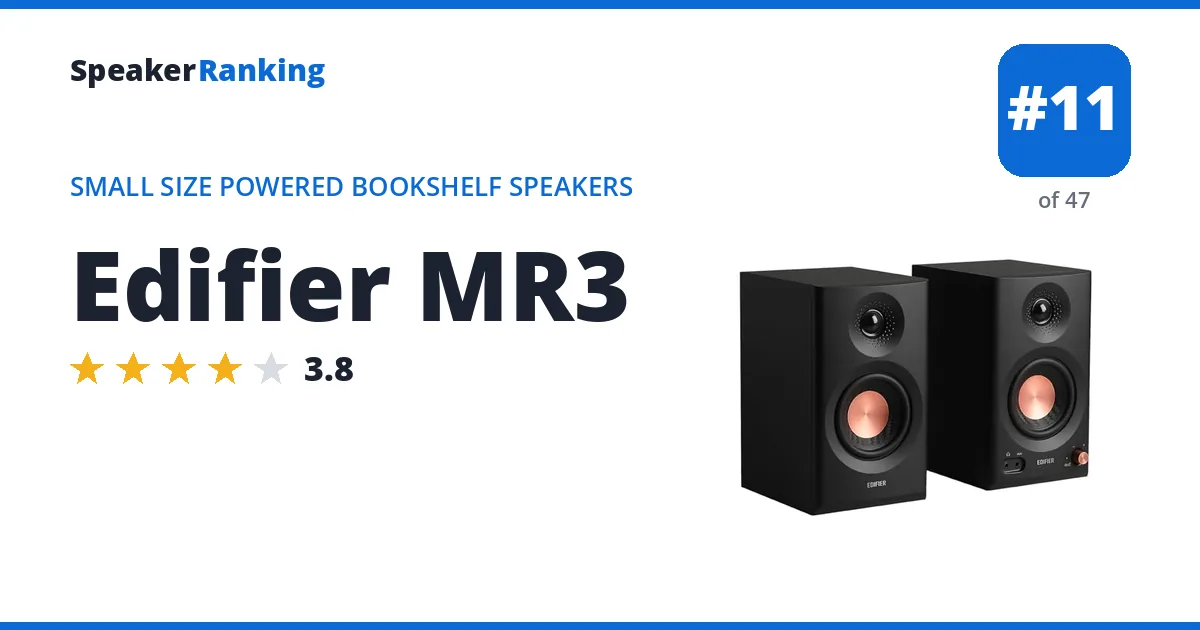
Same family: the Edifier MR4 (larger bookshelf, rated 3.5/5), the Edifier MR4.5 (larger bookshelf, rated 3.6/5) and the Edifier MR5 (larger bookshelf, rated 3.3/5).
Pros: Erin’s measurements show little overall tilt across the listening window, helping voices retain a broadly natural balance at a desk. Scores of 3.91 standalone and 6.53 with an ideal subwoofer support it as a useful budget nearfield option rather than a reference monitor. Tone controls and app-based EQ provide unusually flexible adjustment, and its bass extends farther than the Fostex PM03’s. Measured bass extension of 70Hz (-3dB), with a measured sensitivity of 83.3dB.
Cons: Local response ripples remain: the measured 300Hz-5kHz span is 4.5dB and listening-window narrow-band deviation is 0.538. Bass reaches -3dB at about 70Hz. The limiter protects the drivers but prevents much extra loudness when pushed; existing compression testing puts effective single-speaker output around 86-87dB at 1m. Vertical crossover interference makes tweeter height and tilt important.
Full Edifier MR3 review and specifications →
| Released | Oct 2024 (2 years ago) |
|---|---|
| AES Input | No |
| Amplifier Power | 36W total (18W per speaker) |
| App | Yes (Edifier ConneX) |
| Aux Input | Yes |
| Bass Extension (-10dB) | 53Hz (measured, Erin’s Audio Corner) |
| Bass Extension (-3dB) | 70Hz (measured, Erin’s Audio Corner) |
| Bluetooth | Yes |
| Bluetooth Codecs | SBC |
| Bluetooth Version | 5.4 |
| Coaxial Input | No |
| Dimensions | 8.7”H x 4.9”W x 7.3”D (220 x 125.5 x 185 mm) (active); 220H x 125.5W x 176D mm (passive) |
| Drivers | 3.5” mid-low driver, 1” silk dome tweeter |
| EQ | Yes (rear knobs and app room compensation) |
| Frequency Response | 52Hz - 40kHz (Manufacturer specified) |
| HDMI Input | No |
| Headphone Output | Yes |
| Inputs | Balanced TRS, RCA, Aux, Bluetooth |
| Maximum SPL | 93dB @ 1m (manufacturer specified) |
| Optical Input | No |
| Outputs | 3.5mm headphone |
| RCA Input | Yes |
| Sensitivity | 83.3dB (measured at 0.3V/1m, Erin’s Audio Corner) |
| Spinorama Preference Score | 3.91 |
| Spinorama Preference Score with Perfect Sub | 6.53 |
| TRS Input | Yes |
| USB Input | No |
| Weight | 8.5 lbs (3.85 kg) |
| XLR Input | No |
- Links
- Reviews, Comparisons and Sound Samples
- Head-to-Head Comparisons
 Ranked #12 of 47 in Small Size Powered Bookshelf Speakers - Kanto ORA4: $449.99 per pair Amazon eBay

Same family: the Kanto ORA (smaller bookshelf, ranked lower, rated 3.7/5).
Pros: Compact powered desktop speakers with 4-inch aluminum-cone woofers and 3/4-inch silk-dome tweeters in waveguides, bi-amplified with 70W RMS in total. Erin’s Audio Corner’s Klippel measurements show a well-behaved design for the size: the listening window stays within about a 4.5dB span from 300Hz to 5kHz and tracks the on-axis response closely, and the predicted in-room response is smooth. Bass goes deeper than most desktop speakers, to about 54Hz at -3dB and 43Hz at -10dB, and a subwoofer output with an automatic 80Hz crossover makes adding one easy. Inputs cover RCA, USB-C audio and Bluetooth 5.0. Measured bass extension of 54Hz (-3dB).
Cons: Its score here is our estimate: spinorama.org hasn’t published numeric data for it yet, so we traced Erin’s Audio Corner’s published charts, which put its preference score with an ideal subwoofer at roughly 6.9, level with the better small powered speakers but short of the best. Treble sits slightly above the midrange, and there is no optical input. Kanto’s own rating stops at 60Hz, so a subwoofer still helps for deep bass at higher volumes.
Full Kanto ORA4 review and specifications →
| Released | Apr 2024 (2 years ago) |
|---|---|
| Amplifier Power | 70W RMS total (140W peak) per pair |
| Aux Input | No |
| Bass Extension (-10dB) | 43Hz (measured, Erin’s Audio Corner charts) |
| Bass Extension (-3dB) | 54Hz (measured, Erin’s Audio Corner charts) |
| Bluetooth | Yes |
| Bluetooth Codecs | SBC |
| Bluetooth Version | 5.0 |
| Coaxial Input | No |
| Dimensions | 8.3”H x 4.7”W x 6.7”D (211 x 120 x 170 mm) |
| Drivers | 3/4” silk dome tweeter, 4” aluminum cone woofer |
| Frequency Response | 60Hz - 22kHz (Manufacturer specified) |
| HDMI Input | No |
| Inputs | RCA, USB-C, Bluetooth |
| Optical Input | No |
| RCA Input | Yes |
| Subwoofer Output | Yes (automatic 80Hz crossover) |
| USB Input | Yes (USB-C) |
| Weight | 4.4 lbs (2 kg) |
| XLR Input | No |
- Links
- Reviews, Comparisons and Sound Samples
- Head-to-Head Comparisons
 Ranked #15 of 47 in Small Size Powered Bookshelf Speakers - Kanto ORA: $349.99 per pair Amazon eBay

Same family: the Kanto ORA4 (larger bookshelf, ranked higher, rated 3.8/5).
Pros: Ultra-compact active desktop reference monitors designed specifically for computer and creator setups. Equipped with 3-inch magnetically shielded paper-cone woofers and 3/4-inch silk-dome tweeters, bi-amplified with 50W RMS (100W peak) total Class D power. Audioholics free-air measurements show remarkably linear on-axis and listening-window response across the vocal band with smooth directivity transitions. Features high-resolution 24-bit/96kHz USB-C digital audio input, RCA analog, and Bluetooth 5.0. Its dedicated subwoofer output automatically engages an active 100Hz high-pass filter on the satellites, dramatically improving clean dynamic headroom when a subwoofer is added. Measured bass extension of 55Hz (-3dB).
Cons: The 3-inch woofers begin rolling off sharply around 70Hz, so a separate subwoofer is essential for true full-range bass extension and high-volume authority. There is no optical or HDMI input. The volume knob doubles as an input selector but lacks visual input LEDs on the front baffle.
Full Kanto ORA review and specifications →
| Released | 2020 (6 years ago) |
|---|---|
| Amplifier Power | 50W RMS (100W peak) bi-amplified Class D |
| Aux Input | No |
| Bass Extension (-10dB) | 44Hz (measured, Audioholics) |
| Bass Extension (-3dB) | 55Hz (measured, Audioholics) |
| Bluetooth | Yes |
| Bluetooth Codecs | SBC |
| Bluetooth Version | 5.0 |
| Crossover Frequency | 2.7kHz (satellite), 100Hz auto high-pass with sub connected |
| Dimensions | 6.9” x 3.9” x 5.6” (174 x 100 x 141 mm) |
| Drivers | 3/4” silk dome tweeter, 3” paper cone woofer |
| Frequency Response | 70Hz - 22kHz (Manufacturer specified) |
| Inputs | USB-C, RCA, Bluetooth |
| RCA Input | Yes |
| Subwoofer Output | Yes (automatic 100Hz high-pass filter) |
| USB Input | Yes (USB-C 24-bit/96kHz) |
| Weight | 4.6 lbs (2.1 kg) per pair |
- Links
- Reviews, Comparisons and Sound Samples
- Audioholics: Kanto ORA Powered Desktop Speaker Review & Measurements
- Jasper Tech: Are the D3V The Best Studio Monitors For The Money? More from Jasper Tech →
- Jasper Tech: Are the iLoud Micro Monitor Pro the Best Studio Monitor Speakers for your Home Studio?
- Jasper Tech: Best Desktop Computer Speakers for Every Budget – 2026
- Head-to-Head Comparisons
 Ranked #22 of 47 in Small Size Powered Bookshelf Speakers - Kanto YU4: $349.99 per pair Discontinued Amazon B&H Photo Video eBay
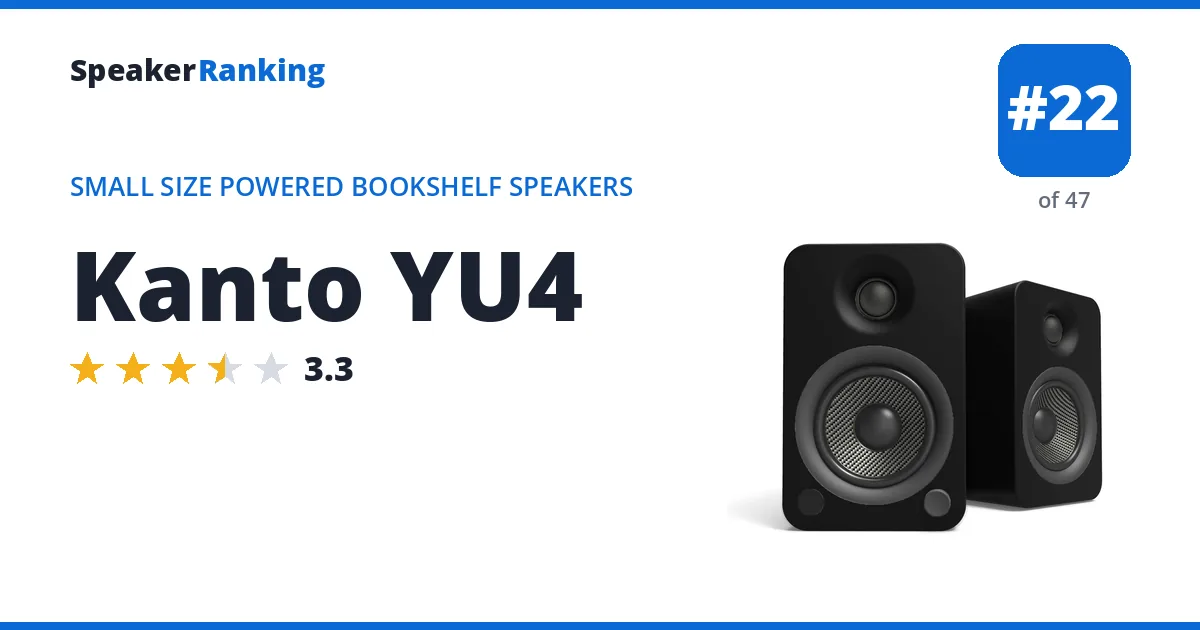
Newer model: the Kanto YU4 G2, estimated 3.6/5, released 2026. It adds AAC, but drops aptX. See every Kanto YU and Tuk generation.
Same family: the Kanto YU2 (smaller bookshelf, ranked higher, estimated 3.4/5) and the Kanto YU6 (larger bookshelf, rated 3.9/5).
Pros: Phono, optical and Bluetooth inputs, remote control and a subwoofer output make it convenient for a compact multi-source system. ASR’s measured horizontal coverage is broad enough for some freedom of seating position. The ideal-subwoofer preference score of 5.83 indicates that bass support would materially improve its usefulness.
Cons: Standalone preference is only 2.89, with a -3dB point around 86Hz and a 4.2dB midrange response span. Response irregularities remain even after bass extension is removed from the comparison, so a subwoofer alone will not make it neutral. Sensitivity measured at an arbitrary powered-speaker gain setting is not a reliable basis for judging efficiency or maximum volume. Discontinued.
Full Kanto YU4 review and specifications →
| Released | Jan 2017 (9 years ago) |
|---|---|
| AES Input | No |
| Amplifier Power | 70W RMS / 140W peak per pair |
| Aux Input | Yes |
| Bluetooth | Yes |
| Bluetooth Codecs | SBC, aptX |
| Bluetooth Version | 4.0 |
| Coaxial Input | No |
| Dimensions | 8.7H x 5.5W x 7.5D in |
| Drivers | 1” silk-dome tweeter, 4” Kevlar woofer |
| Enclosure | Powered 2-way, rear-ported |
| Frequency Response | 60Hz-20kHz |
| HDMI Input | No |
| Inputs | Bluetooth, optical, RCA/phono, 3.5mm |
| Optical Input | Yes |
| Outputs | Subwoofer |
| RCA Input | Yes |
| Spinorama Preference Score | 2.89 |
| Spinorama Preference Score with Perfect Sub | 5.83 |
| Subwoofer Output | Yes |
| TRS Input | No |
| USB Input | No |
| Weight | 6.8 lbs (3.1 kg) powered / 5.5 lbs (2.5 kg) passive |
| XLR Input | No |
- Links
- Reviews, Comparisons and Sound Samples
- Kanto YU4 Measurements (spinorama.org)
- Jasper Tech: Best Powered Bookshelf Speakers for Every Budget - 2025 More from Jasper Tech →
- Jasper Tech: Best Premium Computer Speakers: Kanto ORA4 Review & Comparison
- Jasper Tech: Best Desktop Computer Speakers for Every Budget
- Erin’s Audio Corner: 10 Great (and Terrible) Speakers Under $300! More from Erin’s Audio Corner →
- Head-to-Head Comparisons
 Ranked #44 of 47 in Small Size Powered Bookshelf Speakers - PreSonus Eris E3.5 2nd Gen: $99.99 per pair Amazon eBay
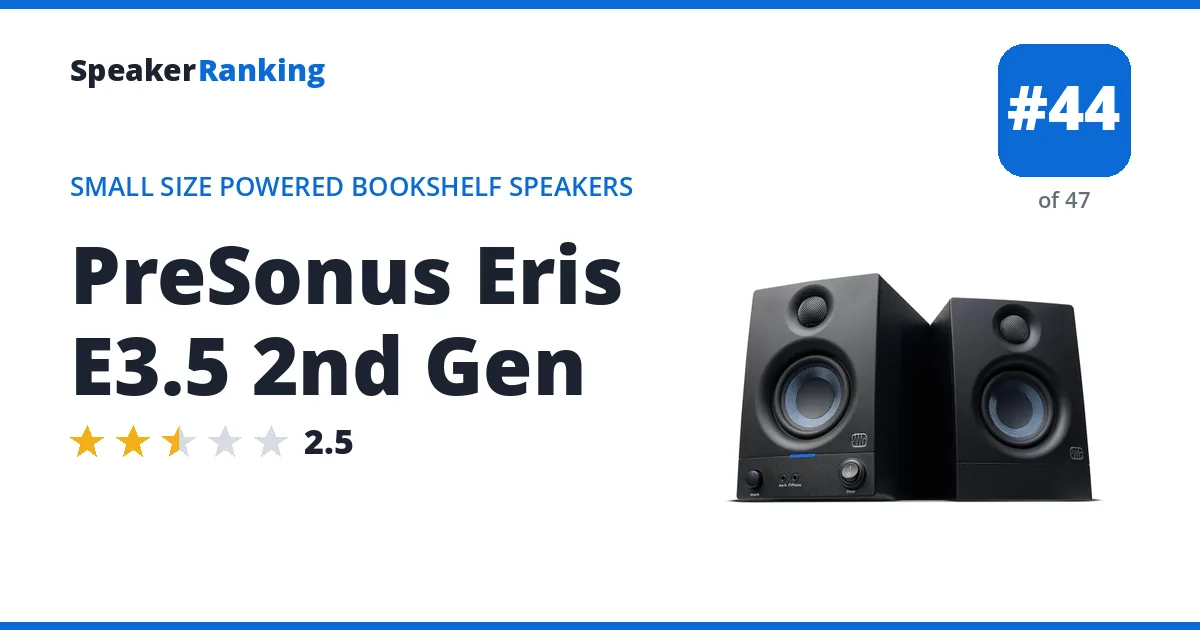
Older model: the PreSonus Eris E3.5 (ranked higher, rated 2.6/5). See every PreSonus Eris generation.
Same family: the PreSonus Eris Sub 8BT (subwoofer, rated 3.6/5).
Pros: Rear-panel bass and treble controls allow broad correction for desk and wall placement. Erin’s second-generation Klippel measurements give a -3dB point around 69Hz, so the speaker has useful upper-bass reach for its size. Its adjustable balance is more flexible than a fixed-response budget desktop pair. Measured bass extension of 80Hz (-3dB), with a measured sensitivity of 87.4dB.
Cons: The stock response spans 7.2dB from 300Hz to 5kHz and has a strong rising trend of about 1.27dB per octave, emphasizing treble over the midrange. Preference scores of 1.51 standalone and 4.17 with an ideal subwoofer indicate major tonal problems beyond bass extension. EQ may help, but a subwoofer alone will not make it neutral. Output and port-modification results from reviews of the original E3.5 should not be assumed to apply to this second-generation model.
Full PreSonus Eris E3.5 2nd Gen review and specifications →
| Released | Sep 2023 (3 years ago) |
|---|---|
| AES Input | No |
| Amplifier Power | 50W total (25W per speaker) |
| App | No |
| Aux Input | No |
| Bass Extension (-10dB) | 70Hz (measured, Erin’s Audio Corner) |
| Bass Extension (-3dB) | 80Hz (measured, Erin’s Audio Corner) |
| Bluetooth | No |
| Coaxial Input | No |
| Dimensions | 8.3”H x 6”W x 5.5”D (210.8 x 152.4 x 139.7 mm) |
| Drivers | 3.5” woofer, 1” silk dome tweeter |
| EQ | Yes (Acoustic space) |
| Frequency Response | 80 Hz-20 kHz (-3dB) (Manufacturer specified) |
| HDMI Input | No |
| Headphone Output | Yes |
| Inputs | RCA, 1/4” Balanced |
| Maximum SPL | 95dB @ 1m (manufacturer specified) |
| Optical Input | No |
| Outputs | 1/8” headphone jack |
| RCA Input | Yes |
| Sensitivity | 87.4dB (measured at 0.3V/1m, Erin’s Audio Corner) |
| Spinorama Preference Score | 1.51 |
| Spinorama Preference Score with Perfect Sub | 4.17 |
| TRS Input | No |
| USB Input | No |
| Weight | 8.6 lbs (3.9 kg) |
| XLR Input | No |
- Links
- Reviews, Comparisons and Sound Samples
- Erin’s Audio Corner Review Measurements More from Erin’s Audio Corner →
- Audio Science Review Measurements More from Audio Science Review →
- DSAUDIO.review: DSAUDIO.review Edifier MR4 vs Presonus Eris E3.5 sound.DEMO More from DSAUDIOreview →
- DSAUDIO.review: Presonus Eris E3.5 vs Edifier R1280T Sound Demo w/ Bass Test
- DSAUDIO.review: Presonus Eris E3.5 vs Mackie CR3 Sound Demo w/ Bass Test
- Erin’s Audio Corner: Mackie CR3-X vs PreSonus E3.5 Budget Monitor Showdown!
- Erin’s Audio Corner: 10 Great (and Terrible) Speakers Under $300!
- Erin’s Audio Corner Measurements (spinorama.org)
- Jasper Tech: Are the iLoud Micro Monitor Pro the Best Studio Monitor Speakers for your Home Studio? More from Jasper Tech →
- Jasper Tech: Best Desktop Computer Speakers for Every Budget
- Head-to-Head Comparisons
- PreSonus Eris E3.5 2nd Gen vs Logitech Z200
- PreSonus Eris E3.5 2nd Gen vs Midiplus MI3 II
- PreSonus Eris E3.5 2nd Gen vs PreSonus Eris E3.5
- PreSonus Eris E3.5 2nd Gen vs Monoprice DT-3
- PreSonus Eris E3.5 2nd Gen vs M-Audio BX3
- PreSonus Eris E3.5 2nd Gen vs Fiio SP3
- PreSonus Eris E3.5 2nd Gen vs Mackie CR3.5
- PreSonus Eris E3.5 2nd Gen vs Fluid Audio C35BT
- See all 19 comparisons
Medium Size Powered Bookshelf Speakers
 Ranked #17 of 105 in Medium Size Powered Bookshelf Speakers - Klipsch The Fives: $324.95 per pair Amazon eBay
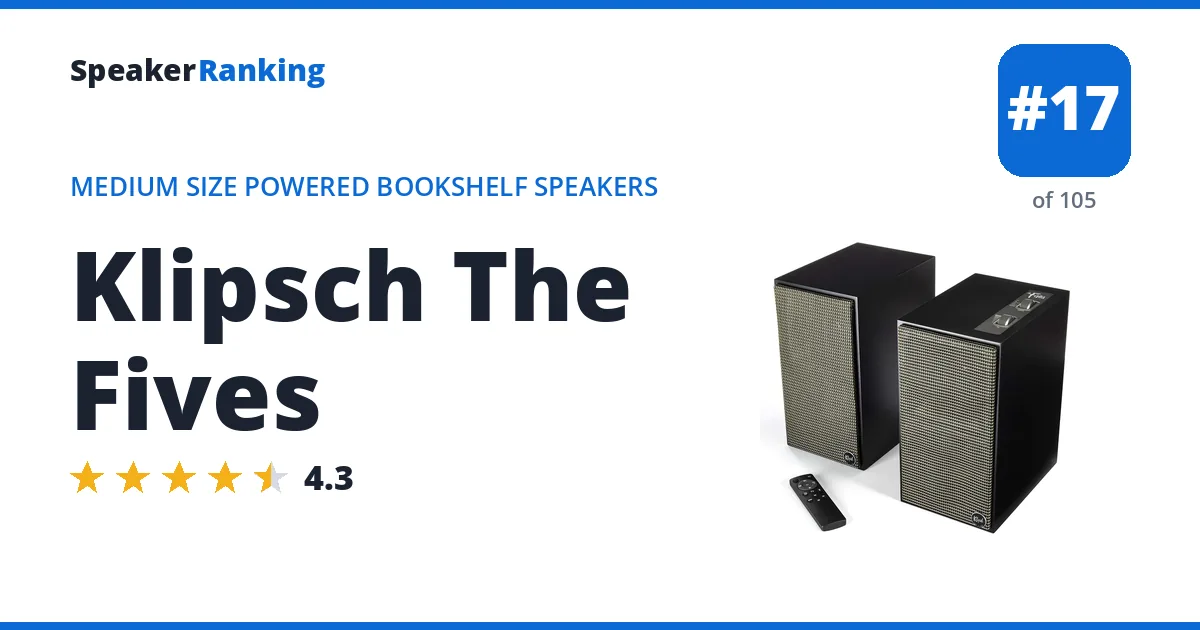
Newer model: the Klipsch The Fives II, ranked lower, estimated 4.3/5, released Jan 2026. See every Klipsch The Fives, Sevens and Nines generation.
Same family: the Klipsch The Sevens (larger bookshelf, rated 3.7/5) and the Klipsch The Nines (larger bookshelf, rated 4.2/5).
Pros: In the tested Bass Cut mode, Erin’s Klippel data gives preference scores of 5.52 standalone and 7.89 with an ideal subwoofer, with a 2.7dB midrange response span. That mode offers considerably better tonal balance than the bass-heavy default behavior. HDMI ARC, phono/line input, digital inputs and subwoofer output make it a versatile stereo alternative to a soundbar. Measured bass extension of 57Hz (-3dB).
Cons: The favorable score specifically requires Bass Cut mode; it does not describe every firmware or bass setting. Bass reaches -3dB around 59Hz in that configuration. The review reports increasing compression around 200Hz and below 80Hz as volume rises, reducing bass dynamics. Careful placement and a subwoofer remain useful, and the horn/woofer transition is not perfectly uniform off-axis.
Full Klipsch The Fives review and specifications →
| Released | May 2020 (6 years ago) |
|---|---|
| AES Input | No |
| Amplifier Power | 160W total system power (320W peak) |
| Aux Input | No |
| Bass Extension (-10dB) | 47.3Hz (measured, Erin’s Audio Corner) |
| Bass Extension (-3dB) | 57Hz (measured, Erin’s Audio Corner) |
| Bluetooth | Yes |
| Bluetooth Codecs | SBC, AAC, aptX, aptX HD |
| Bluetooth Version | 5.0 |
| Coaxial Input | No |
| DSP | Dynamic Bass, Flat and Bass Cut profiles |
| Dimensions | 12”H x 6.5”W x 9.2”D (304.8 x 165.1 x 234.95 mm) |
| Drivers | 1” horn-loaded tweeter; 4.5” woofer |
| Frequency Response | 50Hz - 25kHz (Manufacturer specified) |
| HDMI Input | Yes |
| Inputs | HDMI ARC, USB, optical, Bluetooth, phono/line RCA |
| Optical Input | Yes |
| Outputs | Subwoofer |
| RCA Input | Yes |
| Spinorama Preference Score | 5.52 |
| Spinorama Preference Score with Perfect Sub | 7.89 |
| Subwoofer Output | Yes |
| TRS Input | No |
| USB Input | Yes |
| Weight | Primary 11.8 lbs (5.35 kg), Secondary 10.7 lbs (4.85 kg) |
| XLR Input | No |
- Links
- Reviews, Comparisons and Sound Samples
- Erin’s Audio Corner: Klipsch The Fives Review More from Erin’s Audio Corner →
- Erin’s Audio Corner Website: Klipsch The Fives
- Erin’s Audio Corner Measurements (spinorama.org)
- Jasper Tech: Best Bookshelf Speakers For TV & Gaming - 2025 More from Jasper Tech →
- Jasper Tech: Best Powered Bookshelf Speakers for Every Budget - 2025
- Head-to-Head Comparisons
- Klipsch The Fives vs JBL 305P MKII
- Klipsch The Fives vs KEF LS50 Wireless II
- Klipsch The Fives vs Vanatoo Transparent One Encore Plus
- Klipsch The Fives vs Genelec 8020D
- Klipsch The Fives vs Topping MA4
- Klipsch The Fives vs Klipsch The Fives II
- Klipsch The Fives vs IK Multimedia iLoud MTM MKII
- Klipsch The Fives vs Devialet Phantom II 98 dB
- See all 59 comparisons
 Ranked #18 of 105 in Medium Size Powered Bookshelf Speakers - JBL 305P MKII: $289.00 per pair Amazon eBay
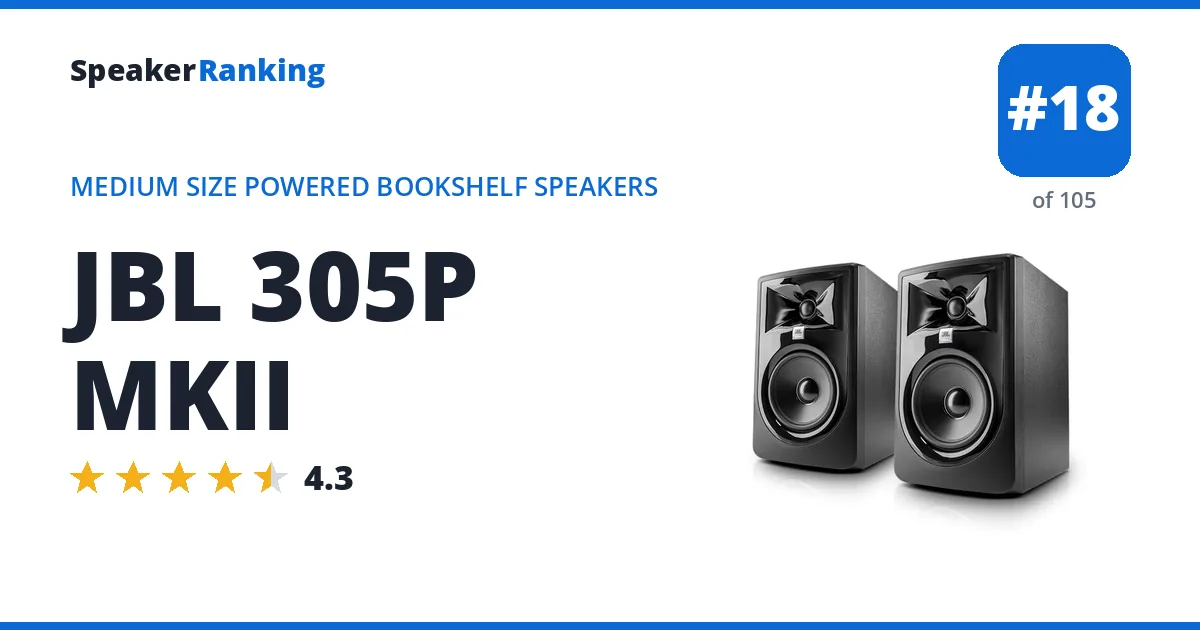
Older model: the JBL LSR305 (ranked lower, rated 4.2/5). See every JBL 3 Series generation.
Same family: the JBL 306P MKII (larger bookshelf, rated 4.1/5) and the JBL 308P MKII (larger bookshelf, rated 4.4/5).
Pros: Erin’s Klippel data gives 5.38 standalone and 7.52 with an ideal subwoofer, with bass reaching -3dB around 51Hz. Broad horizontal coverage and reasonably smooth reflected sound support stable imaging across a desk. The existing review reports effective limiting and little sustained thermal compression, making it a strong budget-monitor option rather than just a speaker with a promising frequency curve. Measured bass extension of 50Hz (-3dB), with a measured sensitivity of 91.1dB.
Cons: The 3.3dB midrange span and rising response show it is not perfectly neutral. A port-related feature around 1.6kHz and some excess treble can be audible; the review recommends the treble-trim switch. Vertical crossover interference makes ear height important. Amplifier hiss may matter in very quiet nearfield use, and rear-port placement needs room-boundary adjustment.
Full JBL 305P MKII review and specifications →
| Released | Jan 2018 (8 years ago) |
|---|---|
| AES Input | No |
| Amplifier Power | 81w Per Speaker |
| App | No |
| Aux Input | No |
| Bass Extension (-10dB) | 43Hz (measured, Erin’s Audio Corner) |
| Bass Extension (-3dB) | 50Hz (measured, Erin’s Audio Corner) |
| Bluetooth | No |
| Coaxial Input | No |
| Dimensions | 11.7”H x 7.3”W x 9.1”D (297.2 x 185.4 x 231.1 mm) |
| Drivers | 5” (127mm) woofer |
| EQ | Yes (Room adjustment) |
| Frequency Response | 49 Hz - 20 kHz (+-3 dB) (Manufacturer specified) |
| HDMI Input | No |
| Inputs | XLR, TRS |
| Optical Input | No |
| RCA Input | No |
| Sensitivity | 91.1dB (measured at 0.3V/1m, Erin’s Audio Corner) |
| Spinorama Preference Score | 5.38 |
| Spinorama Preference Score with Perfect Sub | 7.52 |
| TRS Input | Yes |
| USB Input | No |
| Weight | 10.4 lbs (4.7 kg) each |
| XLR Input | Yes |
- Links
- Reviews, Comparisons and Sound Samples
- Erin’s Audio Corner Review Measurements More from Erin’s Audio Corner →
- Audio Science Review Measurements More from Audio Science Review →
- Erin’s Audio Corner: LIVE! JBL 305P MkII Powered Studio Monitor Review
- DSAUDIO.review: DSAUDIO.review Focal Alpha 50 EVO vs JBL 305P MKII sound.DEMO More from DSAUDIOreview →
- DSAUDIO.review: JBL 305P MKII vs Yamaha HS5 6-Track Comparison
- DSAUDIO.review: DSAUDIO.review JBL 305P MKII vs KRK Classic 5 CL5G3 sound.DEMO
- DSAUDIO.review: JBL 305P MKII vs Adam Audio T5V 6-Track Comparison
- DSAUDIO.review: DSAUDIO.review Adam Audio A5X vs JBL 305P MKII sound.DEMO
- DSAUDIO.review: DSAUDIO.review Kali Audio LP-6 V2 (2nd Wave) vs JBL 305P MKII sound.DEMO
- DSAUDIO.review: DSAUDIO.review Edifier MR4 vs JBL 305P MKII sound.DEMO
- DSAUDIO.review: Kali Audio IN-5 vs JBL 305P MKII Sound & Frequency Response Comparison
- DSAUDIO.review: JBL 308P MKII vs JBL 305P MKII Sound & Frequency Response Comparison
- DSAUDIO.review: Neumann KH80 DSP vs JBL 305P MKII Sound & Frquency Response Comparison
- DSAUDIO.review: JBL 305P MKII vs PreSonus Eris E5 6-Track Comparison
- Erin’s Audio Corner Measurements (spinorama.org)
- Jasper Tech: Best Desktop Computer Speakers for Every Budget – 2026 More from Jasper Tech →
- Jasper Tech: Best Powered Bookshelf Speakers for Every Budget - 2025
- Jasper Tech: Are the iLoud Micro Monitor Pro the Best Studio Monitor Speakers for your Home Studio?
- Head-to-Head Comparisons
- JBL 305P MKII vs KEF LS50 Wireless II
- JBL 305P MKII vs Klipsch The Fives
- JBL 305P MKII vs Vanatoo Transparent One Encore Plus
- JBL 305P MKII vs Genelec 8020D
- JBL 305P MKII vs IK Multimedia iLoud MTM MKII
- JBL 305P MKII vs Topping MA4
- JBL 305P MKII vs Sigberg Audio SBS Gen 2
- JBL 305P MKII vs HEDD Type 05 A-CORE
- See all 71 comparisons
 Ranked #23 of 105 in Medium Size Powered Bookshelf Speakers - IK Multimedia iLoud MTM MKII: $699.99 per pair Amazon eBay
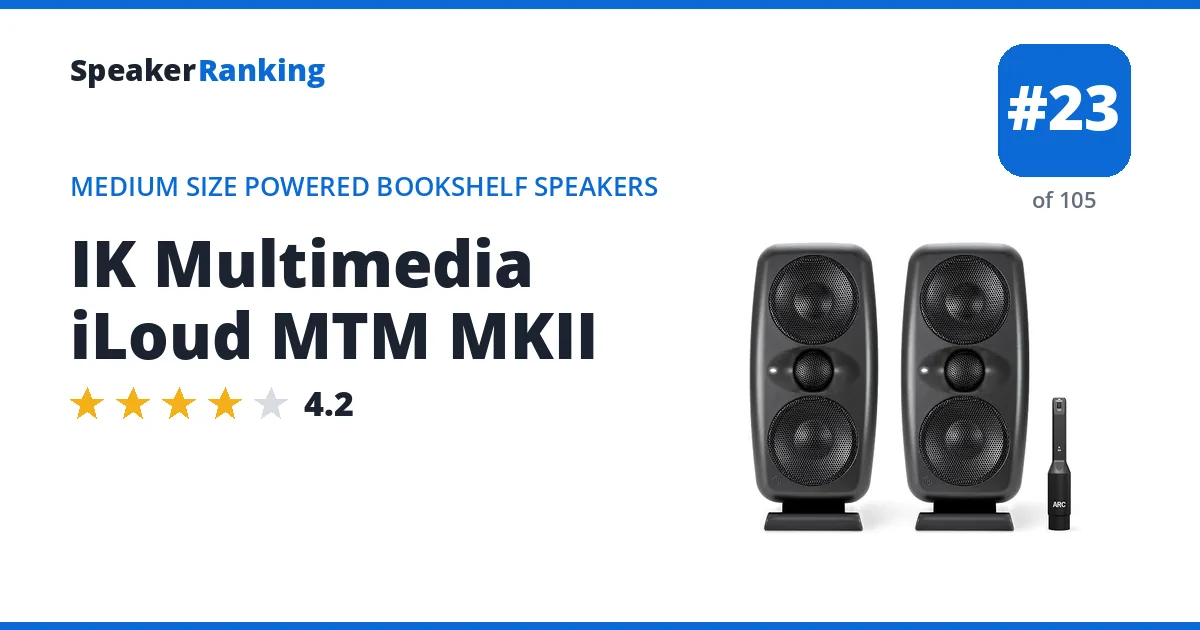
Older model: the IK Multimedia iLoud MTM (ranked lower, rated 4.1/5). See every IK Multimedia iLoud generation.
Same family: the IK Multimedia iLoud Micro Monitor Pro (smaller bookshelf, estimated 4.3/5).
Pros: Erin’s MKII measurements give a 2.2dB midrange span, a -3dB point around 53Hz, and preference scores of 5.22 standalone and 7.44 with an ideal subwoofer. The compact layout and included calibration microphone suit a close desktop setup. Existing tests show useful room-peak correction and good harmonic-distortion behavior at moderate levels. Measured bass extension of 52.7Hz (-3dB).
Cons: Some excess treble remains in the native tuning. The two-woofer MTM arrangement narrows the vertical listening window, so ear height and orientation matter. Multitone distortion rises strongly when pushed toward 96dB/1m; the review favors moderate listening levels, and a subwoofer does not eliminate all midrange output limits. These are MKII results, not measurements of the original MTM. Treble runs about 3dB hot on-axis; the rear -3dB treble switch overcorrects, and about -1.5dB of external EQ works better.
Full IK Multimedia iLoud MTM MKII review and specifications →
| Released | May 2024 (2 years ago) |
|---|---|
| AES Input | No |
| Amplifier Power | 100w Per Speaker |
| App | Yes (X-MONITOR speaker emulation) |
| Aux Input | No |
| Bass Extension (-10dB) | 46.3Hz (measured, Erin’s Audio Corner) |
| Bass Extension (-3dB) | 52.7Hz (measured, Erin’s Audio Corner) |
| Bluetooth | No |
| Coaxial Input | No |
| Dimensions | 10.4”H x 5.1”W x 6.3”D (264.2 x 129.5 x 160 mm) |
| Drivers | 2x 3.5” (89mm) woofers, 1” silk dome tweeter |
| EQ | Yes (Room adjustment) |
| Frequency Response | 48 Hz - 28 kHz (±2dB) (Manufacturer specified) |
| HDMI Input | No |
| Inputs | XLR |
| Maximum SPL | 112.5dB peak (manufacturer specified) |
| Optical Input | No |
| RCA Input | No |
| Spinorama Preference Score | 5.22 |
| Spinorama Preference Score with Perfect Sub | 7.44 |
| TRS Input | No |
| USB Input | No |
| Weight | 5.5 lbs (2.5 kg) each |
| XLR Input | Yes |
- Links
- Reviews, Comparisons and Sound Samples
- Head-to-Head Comparisons
- IK Multimedia iLoud MTM MKII vs Sigberg Audio SBS Gen 2
- IK Multimedia iLoud MTM MKII vs HEDD Type 05 A-CORE
- IK Multimedia iLoud MTM MKII vs Vanatoo Transparent One Encore Plus
- IK Multimedia iLoud MTM MKII vs Kali Audio SM-5
- IK Multimedia iLoud MTM MKII vs Kali Audio IN-5
- IK Multimedia iLoud MTM MKII vs KEF LS50 Wireless II
- IK Multimedia iLoud MTM MKII vs JBL 305P MKII
- IK Multimedia iLoud MTM MKII vs Klipsch The Fives
- See all 65 comparisons
 Ranked #36 of 105 in Medium Size Powered Bookshelf Speakers - KEF LSX II LT: $699.99 per pair Amazon eBay
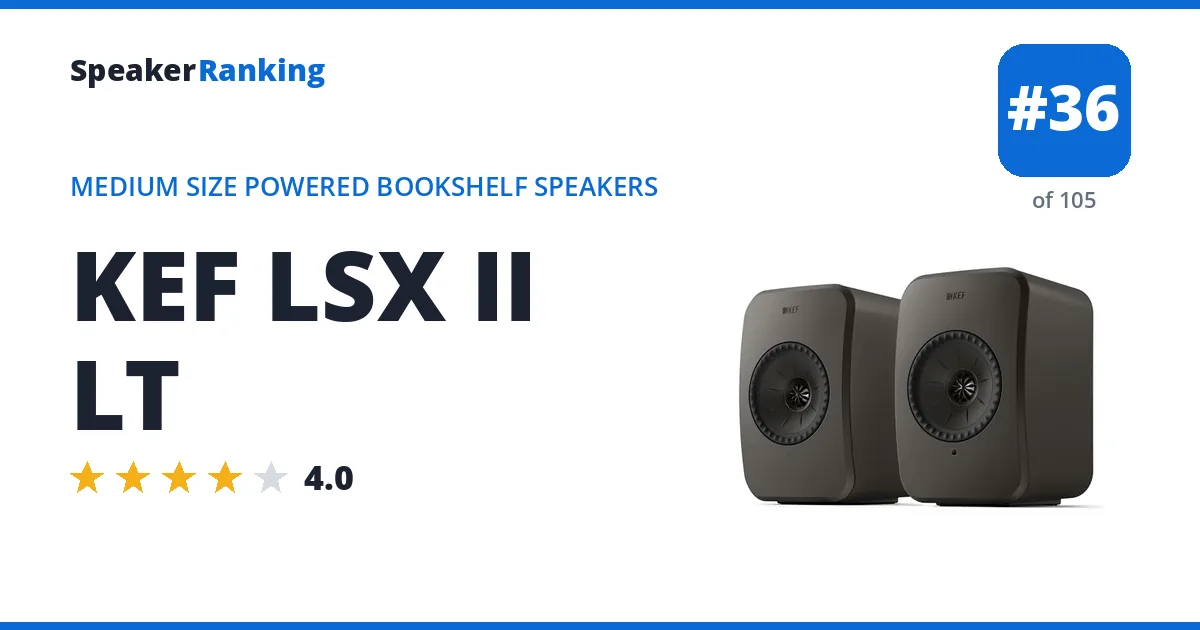
Same family: the KEF LSX II (larger bookshelf, estimated 4.1/5), the KEF LS50 Wireless II (larger bookshelf, ranked higher, rated 4.3/5) and the KEF LS60 (floorstanding, rated 4.8/5).
Pros: The coincident driver provides useful consistency across listening positions, and the app offers placement and subwoofer adjustments. Erin’s measurements give preference scores of 4.81 standalone and 7.03 with an ideal subwoofer, with -3dB bass around 56Hz. HDMI and USB connectivity make it convenient for a small TV or desktop system. Horizontal and vertical dispersion both reach about ±60°, giving a broad sweet spot for more than one seat. Measured bass extension of 55Hz (-3dB), with a measured sensitivity of 84dB.
Cons: The 3.4dB midrange response span and treble-region dips keep it below more neutral monitors. The existing review finds bass compression around 88-92dB/1m and rising distortion at higher levels, so the small drivers suit close listening rather than a large room. This LT version has no analog input; a turntable cannot plug straight into it.
Full KEF LSX II LT review and specifications →
| Released | Jan 2024 (2 years ago) |
|---|---|
| AES Input | No |
| Amplifier Power | 100w RMS Per Speaker |
| App | No |
| Aux Input | No |
| Bass Extension (-10dB) | 46Hz (measured, Erin’s Audio Corner) |
| Bass Extension (-3dB) | 55Hz (measured, Erin’s Audio Corner) |
| Bluetooth | Yes |
| Coaxial Input | No |
| Dimensions | 9.5”H x 6.1”W x 7.1”D (241.3 x 154.9 x 180.3 mm) |
| Drivers | 115mm (4.5in.) magnesium/aluminium alloy cone woofer, 19mm (0.75in.) aluminium dome tweeter |
| EQ | No |
| Frequency Response | 54Hz - 28kHz (±3dB) (Manufacturer specified) |
| HDMI Input | Yes |
| Inputs | Wifi, USB-C, HDMI, Optical, Bluetooth |
| Optical Input | Yes |
| Outputs | RCA Subwoofer |
| RCA Input | No |
| Sensitivity | 84dB (measured at 0.3V/1m, Erin’s Audio Corner) |
| Spinorama Preference Score | 4.81 |
| Spinorama Preference Score with Perfect Sub | 7.03 |
| Subwoofer Output | Yes |
| TRS Input | No |
| USB Input | Yes |
| Weight | 15 lbs (6.8 kg) |
| XLR Input | No |
- Links
- Reviews, Comparisons and Sound Samples
- Erin’s Audio Corner: Transform Your Sound System with the KEF LSX II LT Speaker More from Erin’s Audio Corner →
- Erin’s Audio Corner Website: KEF LSX II LT
- Erin’s Audio Corner Measurements (spinorama.org)
- Jasper Tech: Best Desktop Computer Speakers for Every Budget – 2026 More from Jasper Tech →
- Jasper Tech: Best Bookshelf Speakers For TV & Gaming - 2025
- Jasper Tech: Best Powered Bookshelf Speakers for Every Budget - 2025
- Head-to-Head Comparisons
 Ranked #37 of 105 in Medium Size Powered Bookshelf Speakers - Audioengine A5+ Classic: $399.00 per pair Amazon B&H Photo Video eBay
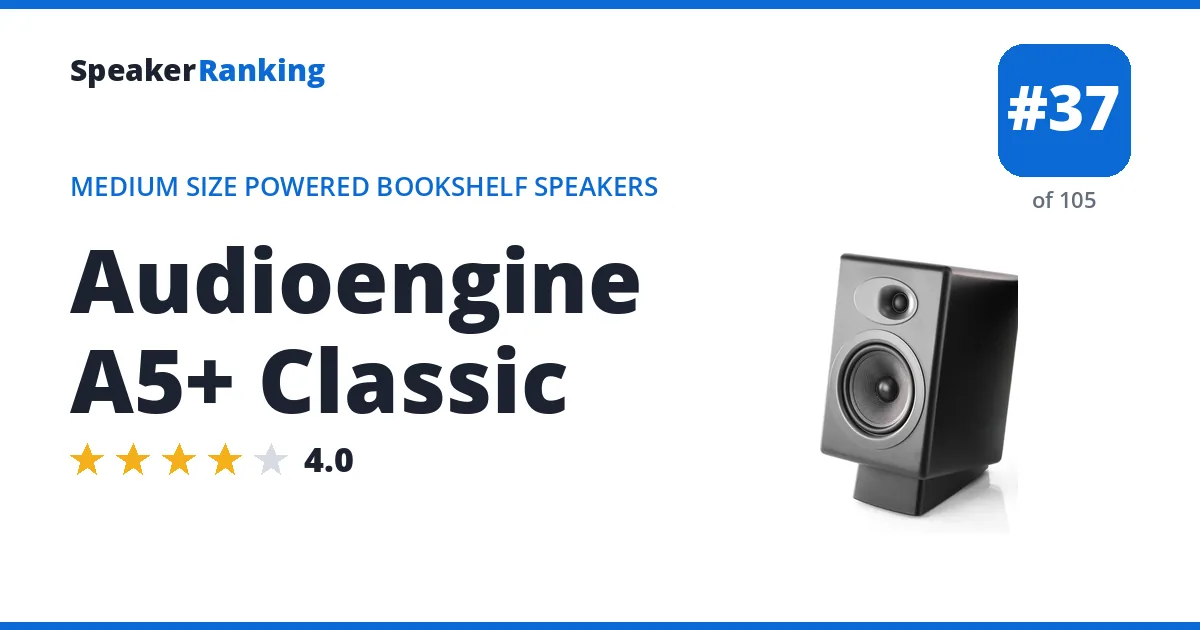
Same family: the Audioengine A2+ (smaller bookshelf, rated 3.4/5).
Pros: ASR’s A5+ Powered measurements give 4.59 standalone and 7.06 with an ideal subwoofer, with a 2.7dB midrange span. The analog powered pair is straightforward to use without an external amplifier. The measured result supports a more capable tonal balance than its former low position suggested. Measured bass extension of 68Hz (-3dB).
Cons: The measured -3dB point is around 69Hz, and the upper-bass recession can reduce body in voices and instruments. The existing review reports crossover-region directivity errors and a distortion feature around 800-900Hz. The score does not make it a reference monitor, and adding a subwoofer cannot correct those midrange and off-axis issues.
Full Audioengine A5+ Classic review and specifications →
| Released | Oct 2011 (15 years ago) |
|---|---|
| AES Input | No |
| Amplifier Power | 50W RMS / 75W peak |
| App | No |
| Aux Input | Yes |
| Bass Extension (-10dB) | 50Hz (measured, Audio Science Review) |
| Bass Extension (-3dB) | 68Hz (measured, Audio Science Review) |
| Bluetooth | No |
| Coaxial Input | No |
| DSP | No |
| Dimensions | 10.9”H x 7.2”W x 9.7”D (276.2 x 182.6 x 247.6 mm) |
| Drivers | 5” Kevlar woofer, 0.75” silk dome tweeter |
| EQ | No |
| Frequency Response | 50Hz - 22kHz (+/-1.5dB) (Manufacturer specified) |
| HDMI Input | No |
| Inputs | RCA, Aux |
| Optical Input | No |
| Outputs | RCA variable output (subwoofer) |
| RCA Input | Yes |
| Spinorama Preference Score | 4.59 |
| Spinorama Preference Score with Perfect Sub | 7.06 |
| Subwoofer Output | Yes |
| TRS Input | No |
| USB Input | No |
| Weight | 15.4 lbs (7 kg) (left/powered), 9.7 lbs (4.4 kg) (right) |
| XLR Input | No |
- Links
- Reviews, Comparisons and Sound Samples
- Head-to-Head Comparisons
- Audioengine A5+ Classic vs KEF LSX II LT
- Audioengine A5+ Classic vs ADAM Audio T5V
- Audioengine A5+ Classic vs Airpulse A100
- Audioengine A5+ Classic vs Pioneer DJ VM-50
- Audioengine A5+ Classic vs Kanto YU6
- Audioengine A5+ Classic vs Mackie MR524
- Audioengine A5+ Classic vs M-Audio BX5 D3
- Audioengine A5+ Classic vs IK Multimedia iLoud MTM
- See all 60 comparisons
 Ranked #38 of 105 in Medium Size Powered Bookshelf Speakers - ADAM Audio T5V: $464 per pair Amazon eBay
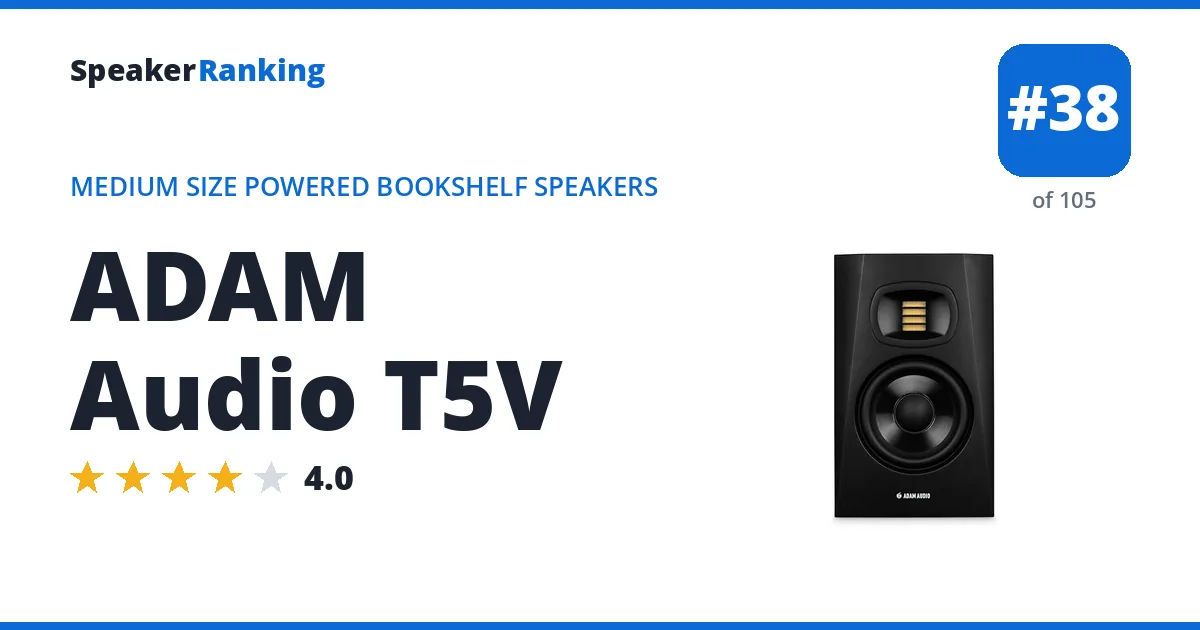
Same family: the ADAM Audio T7V (larger bookshelf, rated 3.9/5) and the ADAM Audio T8V (larger bookshelf, rated 3.9/5).
Pros: ASR’s data shows a small 2.0dB span from 300Hz to 5kHz, a -3dB point around 59Hz, and scores of 4.65 standalone and 7.02 with an ideal subwoofer. It offers useful bass and midrange performance for an affordable studio monitor. Rear tonal trims allow broad placement adjustment. Measured bass extension of 58.6Hz (-3dB).
Cons: The response rises toward the treble by about 0.56dB per octave, so the small midrange span should not be mistaken for flat full-band response. Upper-frequency unevenness remains, and a shelving control cannot precisely remove every peak. The existing review finds distortion reasonable for the price rather than reference-class; deeper bass and demanding levels still call for more capable hardware.
Full ADAM Audio T5V review and specifications →
| Released | 2018 (8 years ago) |
|---|---|
| AES Input | No |
| Amplifier Power | 70w Per Speaker |
| App | No |
| Aux Input | No |
| Bass Extension (-10dB) | 45.9Hz (derived, log-interpolated between spinorama.org -9dB/-12dB points) |
| Bass Extension (-3dB) | 58.6Hz (measured, Audio Science Review) |
| Bluetooth | No |
| Coaxial Input | No |
| Dimensions | 11.7”H x 7”W x 11.7”D (297.2 x 177.8 x 297.2 mm) |
| Drivers | 5” (127mm) woofer |
| EQ | Yes (Room adjustment) |
| Frequency Response | 58Hz - 24kHz (-3dB) (Manufacturer specified) |
| HDMI Input | No |
| Inputs | XLR, RCA |
| Optical Input | No |
| RCA Input | Yes |
| Spinorama Preference Score | 4.65 |
| Spinorama Preference Score with Perfect Sub | 7.02 |
| TRS Input | No |
| USB Input | No |
| Weight | 12.6 lbs (5.7 kg) each |
| XLR Input | Yes |
- Links
- Reviews, Comparisons and Sound Samples
- Audio Science Review Measurements More from Audio Science Review →
- DSAUDIO.review: JBL 305P MKII vs Adam Audio T5V 6-Track Comparison More from DSAUDIOreview →
- DSAUDIO.review: Kali LP-6 vs Adam Audio T5V Sound & Frequency Response Comparison
- DSAUDIO.review: Adam Audio T5V vs Yamaha HS5 5 Track Comparison
- DSAUDIO.review: DSAUDIO.review Adam Audio A5X vs Adam Audio T5V sound.DEMO
- DSAUDIO.review: DSAUDIO.review Focal Alpha 50 EVO vs Adam Audio T5V sound.DEMO
- DSAUDIO.review: Adam Audio T5V vs Presonus Eris E5 5 Track Comparison
- DSAUDIO.review: KRK Rokit 5 G4 RP5G4 vs Adam Audio T5V Sound & Frequency Response Comparison
- DSAUDIO.review: Bright and brighter. PreSonus E5 XT takes on Adam Audio T5V SOUND & FREQUENCY RESPONSE COMPARISON
- DSAUDIO.review: Adam Audio T5V vs Adam Audio T7V Sound & Frequency Response Comparison
- Audio Science Review Measurements (spinorama.org)
- Jasper Tech: Best Desktop Computer Speakers for Every Budget – 2026 More from Jasper Tech →
- Jasper Tech: Are the iLoud Micro Monitor Pro the Best Studio Monitor Speakers for your Home Studio?
- DSAUDIO.review: Genelec 8020D vs Adam Audo T5V Sound & Frequency Response Comparison
- Head-to-Head Comparisons
 Ranked #45 of 105 in Medium Size Powered Bookshelf Speakers - Kali Audio LP-UNF: $349.00 per pair Amazon eBay
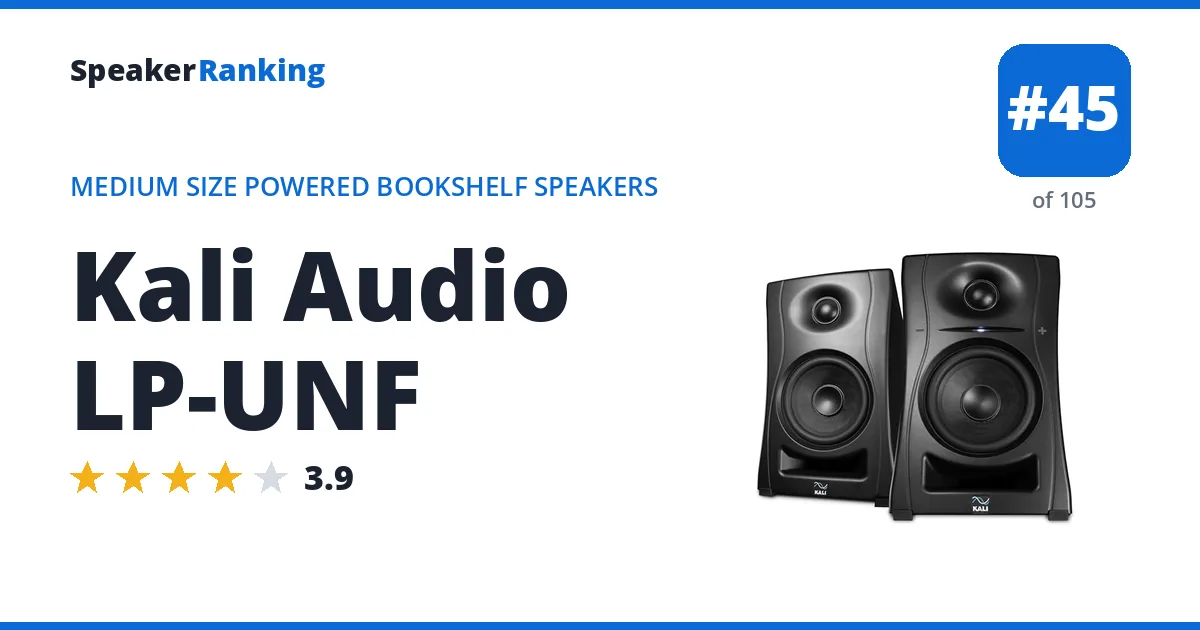
Same family: the Kali Audio LP-6 V2 (smaller bookshelf, rated 4.4/5) and the Kali Audio LP-8 V2 (smaller bookshelf, rated 4.1/5). See every Kali Audio LP generation.
Pros: A practical compact desktop system with USB-C, analog inputs and Bluetooth, plus extensive placement switches. Erin’s Klippel data gives -3dB bass around 54Hz and scores of 4.60 standalone and 6.67 with an ideal subwoofer. The low crossover and waveguide provide useful freedom of listening height for a two-way design, and moderate-level distortion is well controlled in the review. The 1.9kHz crossover gives vertical coverage of about ±30 to 40°, well beyond the typical ±10 to 15° of a two-way. Measured bass extension of 54Hz (-3dB), with a measured sensitivity of 88.1dB.
Cons: The 2.9dB midrange span masks local response ripples; listening-window narrow-band deviation of 0.467 is behind the best monitors. The review finds limiting around 91dB/1m per speaker. No dedicated subwoofer output means integration requires suitable external routing or bass management. Its strength is affordable close listening, not top-tier tonal accuracy or high-output room playback.
Full Kali Audio LP-UNF review and specifications →
| Released | Feb 2024 (2 years ago) |
|---|---|
| AES Input | No |
| Amplifier Power | 160W total (Class D, 2-channel bi-amped) |
| App | No |
| Aux Input | No |
| Bass Extension (-10dB) | 39Hz (measured, Erin’s Audio Corner) |
| Bass Extension (-3dB) | 54Hz (measured, Erin’s Audio Corner) |
| Bluetooth | Yes |
| Coaxial Input | No |
| Dimensions | 10”H x 6.5”W x 7.4”D (254 x 165 x 188 mm) |
| Drivers | 4.5” woofer, 1” Textile Dome tweeter |
| EQ | No |
| Frequency Response | 39Hz - 25kHz (-10dB) (Manufacturer specified) |
| HDMI Input | No |
| Inputs | Bluetooth, USB-C (digital), RCA, TRS |
| Optical Input | No |
| RCA Input | Yes |
| Sensitivity | 88.1dB (measured at 0.3V/1m, Erin’s Audio Corner) |
| Spinorama Preference Score | 4.60 |
| Spinorama Preference Score with Perfect Sub | 6.67 |
| TRS Input | Yes |
| USB Input | Yes |
| Weight | 17.2 lbs (7.8 kg) |
| XLR Input | No |
- Links
- Reviews, Comparisons and Sound Samples
- Erin’s Audio Corner Review Measurements More from Erin’s Audio Corner →
- Erin’s Audio Corner: The Perfect Desktop Speaker? Kali LP-UNF.
- Erin’s Audio Corner: The Best Budget Desktop Speakers, Tested & Rated
- Erin’s Audio Corner: My Absolute Favorite Products of 2024 Revealed
- Erin’s Audio Corner: 10 Great (and Terrible) Speakers Under $300!
- Erin’s Audio Corner Measurements (spinorama.org)
- Jasper Tech: Best Desktop Computer Speakers for Every Budget – 2026 More from Jasper Tech →
- Jasper Tech: Are the iLoud Micro Monitor Pro the Best Studio Monitor Speakers for your Home Studio?
- Head-to-Head Comparisons
- Kali Audio LP-UNF vs Vanatoo Transparent Zero Plus
- Kali Audio LP-UNF vs Kanto Tuk G2
- Kali Audio LP-UNF vs JBL 705P
- Kali Audio LP-UNF vs M-Audio BX5 D3
- Kali Audio LP-UNF vs Kanto YU6
- Kali Audio LP-UNF vs Neumi BS5P-ARC
- Kali Audio LP-UNF vs Neumi BS5P
- Kali Audio LP-UNF vs Focal Alpha 50 EVO
- See all 71 comparisons
 Ranked #46 of 105 in Medium Size Powered Bookshelf Speakers - Vanatoo Transparent Zero Plus: $499.99 per pair Amazon eBay
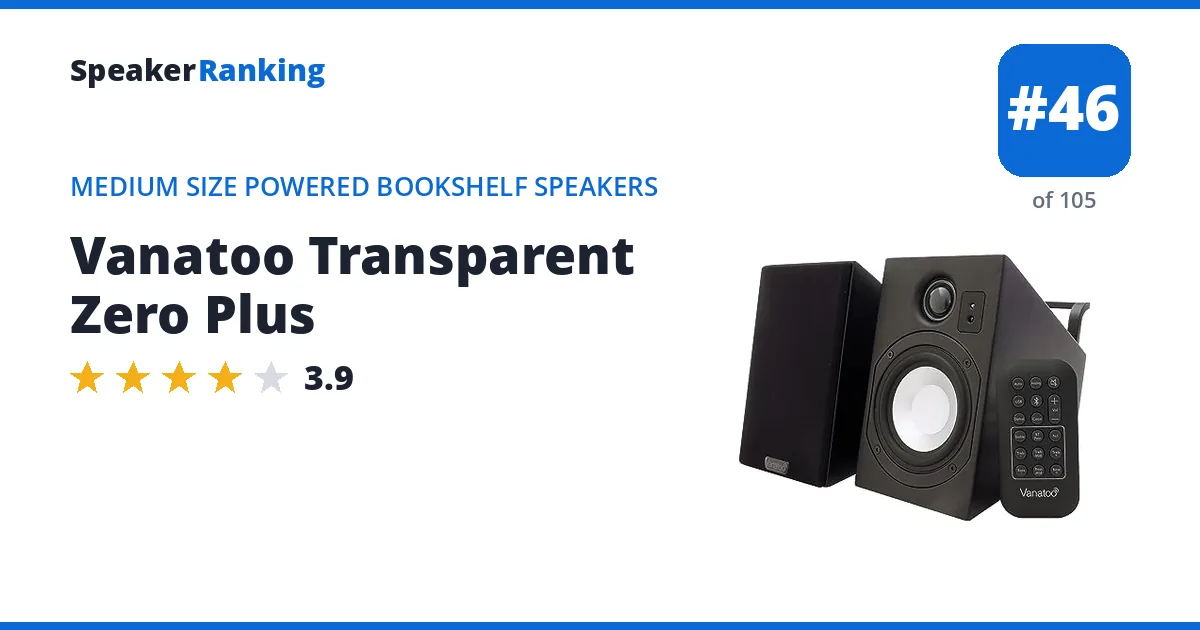
Older model: the Vanatoo Transparent Zero (ranked lower, rated 3.7/5). See every Vanatoo Transparent Zero generation.
Pros: Erin’s data shows a small 1.7dB span from 300Hz to 5kHz and a broadly level midrange trend. Scores of 4.07 standalone and 6.73 with an ideal subwoofer support it as a useful compact desktop option. Flexible cabinet orientation, multiple inputs and automatic subwoofer crossover behavior help with setup. Measured bass extension of 92Hz (-3dB), with a measured sensitivity of 88.5dB.
Cons: The measured -3dB point is around 95Hz, with a much lower F10 in the original review; this is not flat bass to the low-50Hz region. Vertical listening angle changes the upper-midrange response. The review finds cleaner results at moderate levels than near maximum output, where multitone distortion increases. A subwoofer is particularly valuable here. An 8th-order high-pass filter at 58Hz sharply cuts bass below that point, so kick drum fundamentals need a subwoofer.
Full Vanatoo Transparent Zero Plus review and specifications →
| Released | Jul 2023 (3 years ago) |
|---|---|
| AES Input | No |
| Amplifier Power | 120W total (Class D) |
| Aux Input | Yes |
| Bass Extension (-10dB) | 53Hz (measured, Erin’s Audio Corner) |
| Bass Extension (-3dB) | 92Hz (measured, Erin’s Audio Corner) |
| Bluetooth | Yes |
| Bluetooth Codecs | SBC, AAC, aptX, aptX HD |
| Coaxial Input | No |
| DSP | Yes (8th-order Butterworth high-pass at 58Hz) |
| Dimensions | 8.5”H x 5.5”W x 6”D |
| Drivers | 4” aluminum cone woofer, 4” long-throw passive radiator, 1” soft dome tweeter |
| Frequency Response | 56Hz - 20kHz (+/-3dB) (Manufacturer specified) |
| HDMI Input | No |
| Inputs | Bluetooth (aptX HD), USB (24-bit/96kHz), Toslink Optical (24-bit/96kHz), 3.5mm Analog |
| Optical Input | Yes |
| Outputs | RCA subwoofer |
| RCA Input | No |
| Sensitivity | 88.5dB (measured at 0.3V/1m, Erin’s Audio Corner) |
| Spinorama Preference Score | 4.07 |
| Spinorama Preference Score with Perfect Sub | 6.73 |
| Subwoofer Output | Yes |
| TRS Input | No |
| USB Input | Yes |
| Weight | 7.1 lbs (3.2 kg) each |
| XLR Input | No |
- Links
- Reviews, Comparisons and Sound Samples
- Erin’s Audio Corner: Vanatoo Transparent Zero Plus Review. More from Erin’s Audio Corner →
- Erin’s Audio Corner Website: Vanatoo Transparent Zero Plus
- Erin’s Audio Corner Measurements (spinorama.org)
- Jasper Tech: Best Desktop Computer Speakers for Every Budget – 2026 More from Jasper Tech →
- Jasper Tech: Are the D3V The Best Studio Monitors For The Money?
- Jasper Tech: Best Powered Bookshelf Speakers for Every Budget - 2025
- Jasper Tech: Best Premium Computer Speakers: Kanto ORA4 Review & Comparison
- Jasper Tech: Are the iLoud Micro Monitor Pro the Best Studio Monitor Speakers for your Home Studio?
- Jasper Tech: Best Desktop Computer Speakers for Every Budget
- Head-to-Head Comparisons
- Vanatoo Transparent Zero Plus vs Kali Audio LP-UNF
- Vanatoo Transparent Zero Plus vs Kanto Tuk G2
- Vanatoo Transparent Zero Plus vs JBL 705P
- Vanatoo Transparent Zero Plus vs M-Audio BX5 D3
- Vanatoo Transparent Zero Plus vs Neumi BS5P
- Vanatoo Transparent Zero Plus vs Kanto YU6
- Vanatoo Transparent Zero Plus vs Focal Alpha 50 EVO
- Vanatoo Transparent Zero Plus vs Dayton Audio M4
- See all 54 comparisons
 Ranked #50 of 105 in Medium Size Powered Bookshelf Speakers - Neumi BS5P-ARC: $219.99 per pair Amazon eBay
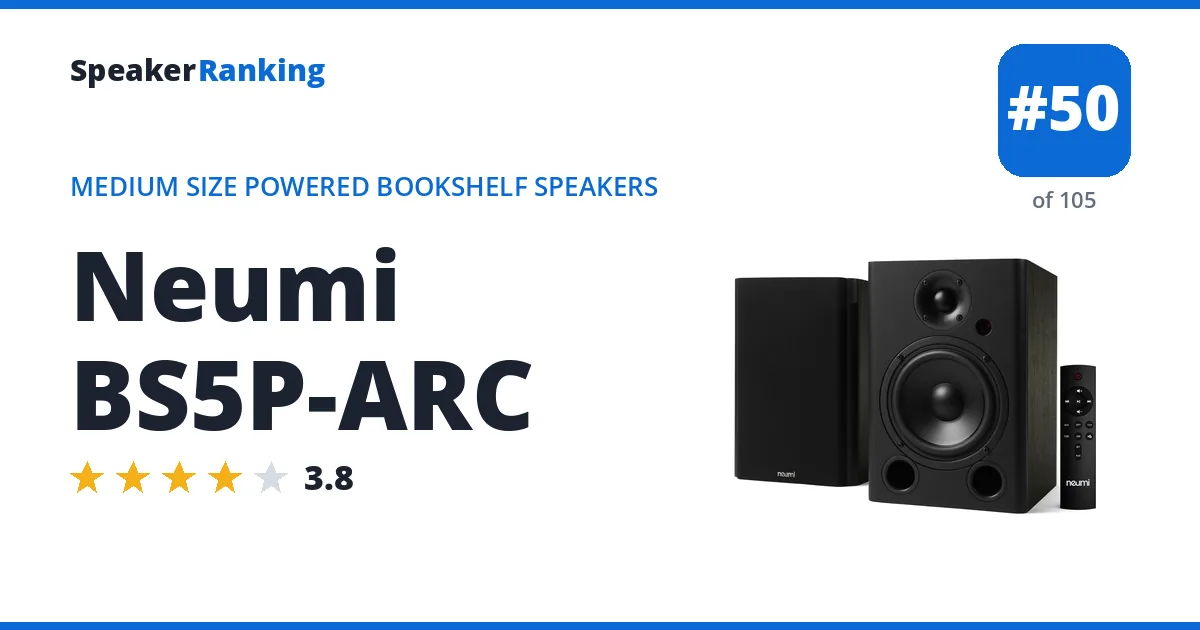
Older model: the Neumi BS5P (ranked lower, rated 3.8/5). See every Neumi BS5P generation.
Pros: Erin’s selected measurements give a 2.6dB midrange span and a 7.03 ideal-subwoofer preference score, indicating better tonal performance above the bass than its former near-bottom position suggested. HDMI ARC makes it a convenient low-cost TV stereo system.
Cons: The standalone score drops to 3.84. The published response reaches -3dB around 113Hz and -6dB around 83Hz, so bass balance is a significant limitation in that measured configuration. It is not the same model or dataset as the original Neumi BS5P. The score alone cannot establish clean output, and a subwoofer should not be assumed to solve crossover or room-integration issues automatically.
Full Neumi BS5P-ARC review and specifications →
| Released | 2022 (4 years ago) |
|---|---|
| AES Input | No |
| Amplifier Power | 75W total (37.5W per channel) |
| Aux Input | No |
| Bluetooth | Yes |
| Coaxial Input | Yes |
| Country | China |
| Dimensions | 10.6H x 7.2W x 8.5D in each |
| Drivers | 1” silk dome tweeter with integrated waveguide, 5” poly-cone woofer |
| Enclosure | 2-way active |
| Frequency Response | 50Hz - 20kHz (Typical In-Room) (Manufacturer specified) |
| HDMI Input | Yes |
| Inputs | HDMI ARC, Bluetooth, USB-C, optical, coaxial, RCA analog |
| Optical Input | Yes |
| RCA Input | Yes |
| Spinorama Preference Score | 3.84 |
| Spinorama Preference Score with Perfect Sub | 7.03 |
| TRS Input | No |
| USB Input | Yes |
| Weight | 24.9 lbs (11.3 kg) pair |
| XLR Input | No |
- Links
- Reviews, Comparisons and Sound Samples
- Head-to-Head Comparisons
 Ranked #60 of 105 in Medium Size Powered Bookshelf Speakers - Vanatoo Transparent Zero: $350 per pair Discontinued eBay
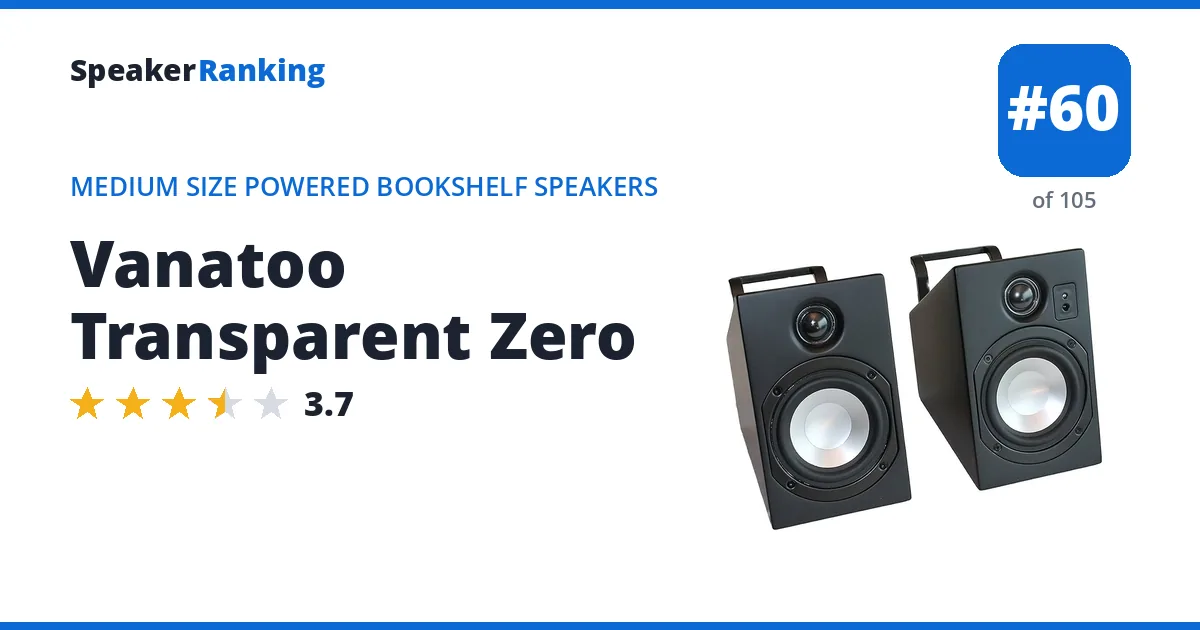
Newer model: the Vanatoo Transparent Zero Plus, ranked higher, rated 3.9/5, released Jul 2023. See every Vanatoo Transparent Zero generation.
Pros: Compact powered two-way pair with a 4 inch aluminum woofer and a dome tweeter, plus Bluetooth and a subwoofer output. Audio Science Review measured an even on-axis response (0.41 deviation) and listening window (0.42), with horizontal coverage of about ±60 degrees, for a preference score of 3.65 that rises to 6.40 with an ideal subwoofer. Measured bass extension of 54.2Hz (-10dB).
Cons: Bass is limited to 63.0Hz (-6dB) and about 54.2Hz (-10dB), so it needs a subwoofer for full range playback. The predicted in-room response is not very smooth (0.45). Replaced by the Vanatoo Transparent Zero Plus, which measures better. Discontinued.
Full Vanatoo Transparent Zero review and specifications →
| Released | Mar 2018 (8 years ago) |
|---|---|
| Amplifier Power | 192W (4 x 48W) |
| Bass Extension (-10dB) | 54.2Hz (derived, log-interpolated between spinorama.org -9dB/-12dB points) |
| Bluetooth | Yes |
| Country | United States |
| DIY Kit | No |
| Dimensions | 7.5”H x 4.8”W x 7.8”D (191 x 121 x 197 mm) |
| Drivers | 4” aluminum cone woofer, dome tweeter |
| Spinorama Preference Score | 3.65 |
| Spinorama Preference Score with Perfect Sub | 6.40 |
| Subwoofer Output | Yes |
| Weight | 4.4 lbs (2.0 kg) |
- Reviews, Comparisons and Sound Samples
 Ranked #71 of 105 in Medium Size Powered Bookshelf Speakers - Edifier MR4: $169.99 per pair Amazon eBay
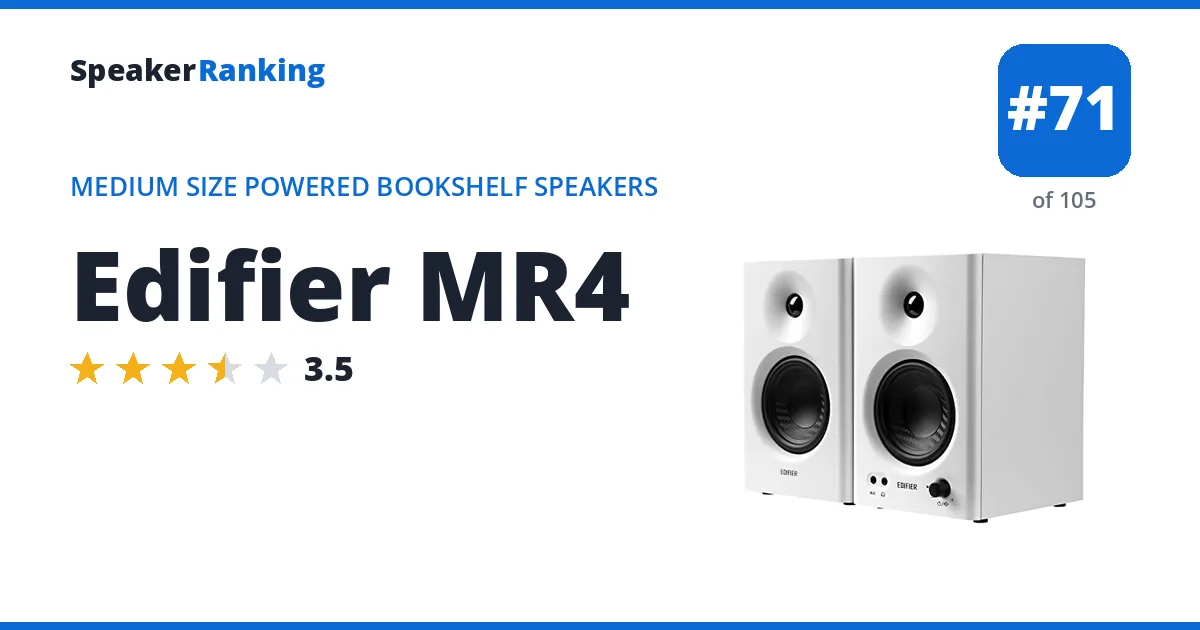
Same family: the Edifier MR3 (smaller bookshelf, rated 3.8/5), the Edifier MR4.5 (larger bookshelf, ranked higher, rated 3.6/5) and the Edifier MR5 (larger bookshelf, ranked lower, rated 3.3/5).
Pros: Erin’s data supports a useful budget desktop monitor: a 3.0dB midrange span, little overall on-axis tilt, and preference scores of 3.25 standalone and 6.00 with an ideal subwoofer. Balanced TRS inputs and tone controls are practical at its price, and its response is more balanced than the measured Edifier R1280T. Measured bass extension of 79Hz (-3dB), with a measured sensitivity of 78dB.
Cons: Bass reaches -3dB around 79Hz, so deep extension should not be inferred from the overall flat trend. Listening-window response still has local irregularities, including lower-treble unevenness. The existing review reports rapidly increasing distortion and audible distress when pushed well above moderate desktop levels. No Bluetooth, and adding a subwoofer does not cure every output or tonal limitation.
Full Edifier MR4 review and specifications →
| AES Input | No |
|---|---|
| Amplifier Power | 42W RMS total (21W per speaker) |
| App | No |
| Aux Input | Yes |
| Bass Extension (-10dB) | 59Hz (measured, Erin’s Audio Corner) |
| Bass Extension (-3dB) | 79Hz (measured, Erin’s Audio Corner) |
| Bluetooth | No |
| Coaxial Input | No |
| Dimensions | 9”H x 5.5”W x 7.6”D (228.6 x 139.7 x 193 mm) |
| Drivers | 4” (102mm) woofer, 1” silk dome tweeter |
| EQ | Yes (Monitor and Music modes) |
| Frequency Response | 60 Hz-20 kHz (-3dB) (Manufacturer specified) |
| HDMI Input | No |
| Headphone Output | Yes |
| Inputs | TRS Balanced, RCA, Aux |
| Optical Input | No |
| Outputs | Headphone |
| RCA Input | Yes |
| Sensitivity | 78dB (measured at 0.3V/1m, Erin’s Audio Corner) |
| Spinorama Preference Score | 3.25 |
| Spinorama Preference Score with Perfect Sub | 6.00 |
| TRS Input | Yes |
| USB Input | No |
| Weight | 9.9 lbs (4.5 kg) |
| XLR Input | No |
- Links
- Reviews, Comparisons and Sound Samples
- Erin’s Audio Corner Review Measurements More from Erin’s Audio Corner →
- Audio Science Review Measurements More from Audio Science Review →
- DSAUDIO.review: DSAUDIO.review Edifier MR4 vs Edifier R1280DBs sound.DEMO More from DSAUDIOreview →
- DSAUDIO.review: DSAUDIO.review Edifier MR4 vs Edifier R1700BT sound.DEMO
- DSAUDIO.review: DSAUDIO.review Edifier MR4 vs JBL 305P MKII sound.DEMO
- DSAUDIO.review: DSAUDIO.review Edifier MR4 vs Presonus Eris E3.5 sound.DEMO
- DSAUDIO.review: DSAUDIO.review Edifier MR4 vs iLoud Micro Monitor sound.DEMO
- DSAUDIO.review: DSAUDIO.review Edifier MR4 vs Presonus Eris E4.5 sound.DEMO
- DSAUDIO.review: DSAUDIO.review Edifier MR4 vs Mackie CR4-X sound.DEMO
- Erin’s Audio Corner Measurements (spinorama.org)
- Jasper Tech: Best Desktop Computer Speakers for Every Budget – 2026 More from Jasper Tech →
- Jasper Tech: Are the iLoud Micro Monitor Pro the Best Studio Monitor Speakers for your Home Studio?
- Erin’s Audio Corner: Edifier MR4 Powered Studio Monitors Review
- Head-to-Head Comparisons
 Ranked #93 of 105 in Medium Size Powered Bookshelf Speakers - Edifier R1280T: $119.99 per pair Amazon eBay
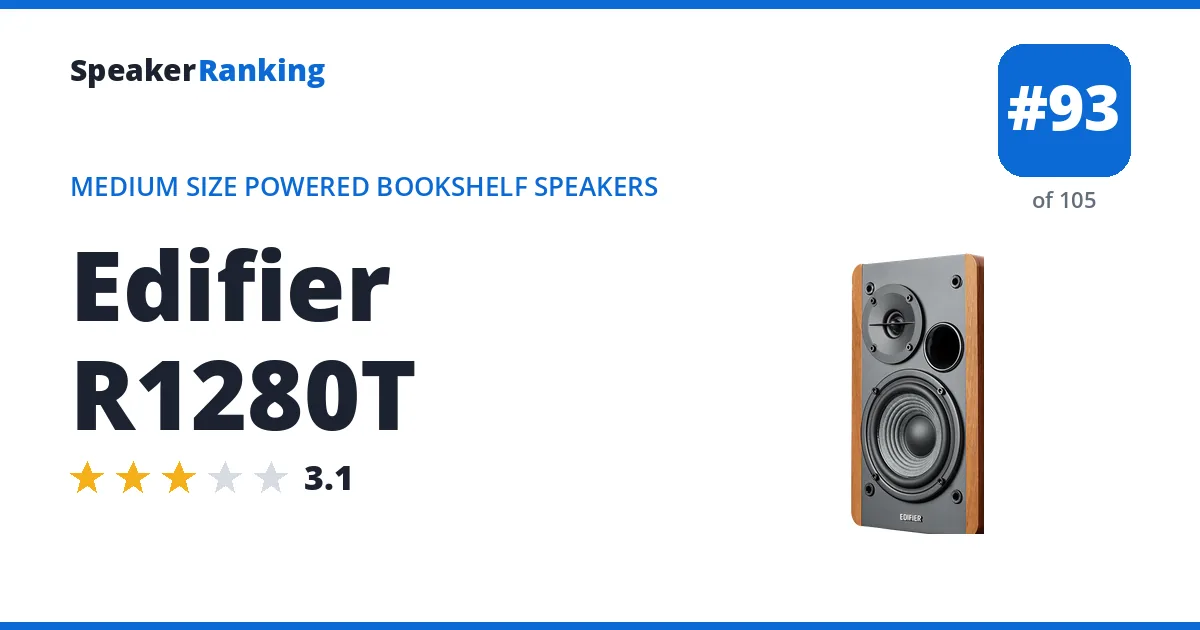
Pros: ASR’s review found useful moderate-level bass output from an inexpensive powered pair. Remote volume and bass/treble controls make it easy to use without separate amplification. Measured bass reaches -3dB around 63Hz. Measured bass extension of 63Hz (-3dB).
Cons: Preference scores of 2.41 standalone and 5.02 with an ideal subwoofer reflect substantial tonal limitations, not just missing bass. The response spans 5.5dB from 300Hz to 5kHz, and listening-window narrow-band deviation is 0.650. Resonances and treble unevenness affect reflected sound too. Listening height is important, and high-level compression changes the balance.
Full Edifier R1280T review and specifications →
| AES Input | No |
|---|---|
| Amplifier Power | 42w RMS Total |
| App | No |
| Aux Input | No |
| Bass Extension (-10dB) | 53.2Hz (derived, log-interpolated between spinorama.org -9dB/-12dB points) |
| Bass Extension (-3dB) | 63Hz (measured, Audio Science Review) |
| Bluetooth | No |
| Coaxial Input | No |
| Dimensions | 9.2”H x 7.7”W x 5.7”D (234 x 196 x 146 mm) |
| Drivers | 4” (102mm) woofer |
| EQ | No |
| Frequency Response | 52Hz - 20kHz (Manufacturer specified) |
| HDMI Input | No |
| Inputs | 2x RCA Input |
| Optical Input | No |
| Outputs | None |
| RCA Input | Yes |
| Spinorama Preference Score | 2.41 |
| Spinorama Preference Score with Perfect Sub | 5.02 |
| TRS Input | No |
| USB Input | No |
| Weight | 10.8 lbs (4.9 kg) |
| XLR Input | No |
- Links
- Reviews, Comparisons and Sound Samples
- Audio Science Review Measurements More from Audio Science Review →
- Audio Science Review Measurements (spinorama.org)
- Jasper Tech: Best Desktop Computer Speakers for Every Budget – 2026 More from Jasper Tech →
- Jasper Tech: Best Powered Bookshelf Speakers for Every Budget - 2025
- DSAUDIO.review: Presonus Eris E3.5 vs Edifier R1280T Sound Demo w/ Bass Test More from DSAUDIOreview →
- DSAUDIO.review: Mackie CR3-X vs Edifier R1280T Sound, Distortion & Frequency Response Comparison
- DSAUDIO.review: Edifier R1280T vs Edifier R2000DB Sound Demo
- Head-to-Head Comparisons
- Edifier R1280T vs Edifier R1280DB
- Edifier R1280T vs Midiplus MI5 II
- Edifier R1280T vs JBL One Series 104
- Edifier R1280T vs Edifier R1700BT
- Edifier R1280T vs Audioengine HD4
- Edifier R1280T vs Fluid Audio FX50 V2
- Edifier R1280T vs NHT Pro M-00
- Edifier R1280T vs Kali Audio IN-UNF
- See all 62 comparisons