Short answer: the Edifier R1280T, whose bass handling is at least measured directly. ASR’s Klippel-based tests found the woofer handled a demanding bass-heavy track without bottoming out or audible distortion, though the on-axis response is jagged, with a woofer resonance around 5kHz and a tweeter peak near 10kHz. The JBL One Series 104 relies on heavy internal EQ from the amplifier to compensate for poor raw driver measurements; measured alone, the passive drivers showed no bass, no low mids, and highly irregular highs.
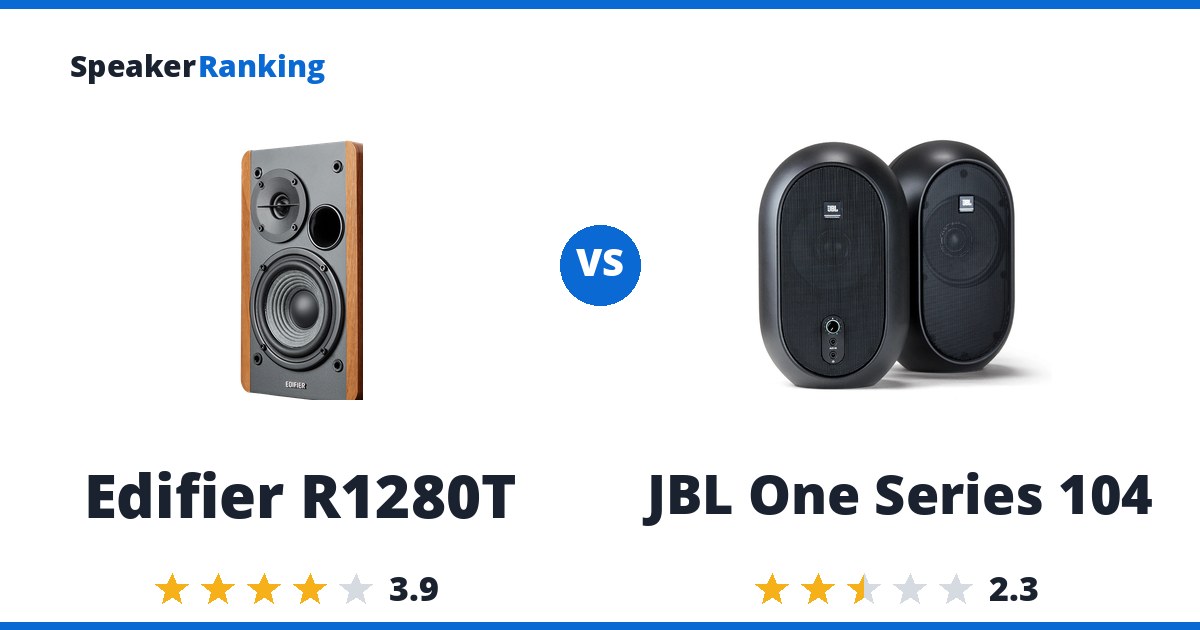
Buy the Edifier R1280T. It is rated higher for sound quality and still sold new, while the JBL One Series 104 is discontinued.
Still deciding? The full Powered Home rankings cover every ranked option.
Specifications Side By Side
| Edifier R1280T | JBL One Series 104 | |
|---|---|---|
| Price | $149.99 per pair | $129 per pair Discontinued |
| Ranked | #62 of 68 in Medium Size Powered Bookshelf Speakers | #64 of 68 in Medium Size Powered Bookshelf Speakers |
| Bass Extension (-3dB) | 63Hz (measured, Audio Science Review) | 45Hz with the amplifier’s DSP bass boost active (measured, Audio Science Review) |
| Bass Extension (-10dB) | 53.2Hz (derived, log-interpolated between spinorama.org -9dB/-12dB points) | 35Hz with the amplifier’s DSP bass boost active (measured, Audio Science Review) |
| Dimensions | 9.2”H x 7.7”W x 5.7”D (234 x 196 x 146 mm) | 9.7H x 6W x 4.9D in (per manufacturer, 104-BT) |
| Frequency Response | 52Hz - 20kHz (Manufacturer specified) | 60Hz - 20kHz (Manufacturer specified) |
| Inputs | 2x RCA Input | 1/4” TRS, RCA, 3.5mm Aux |
| Outputs | None | - |
| Weight | 10.8 lbs (4.9 kg) | 4.5 lbs (2.06 kg) (master), 3.8 lbs (1.73 kg) (slave) |
| Drivers | 4” (102mm) woofer | 4.5” coaxial low-frequency driver, 0.75” soft dome tweeter |
| App | No | No |
| Bluetooth | No | No |
| EQ | No | Yes (fixed, amplifier-applied) |
| Amplifier Power | 42w RMS Total | 60W total Class D (30W per speaker) |
| Spinorama Preference Score | 2.41 | - |
| Spinorama Preference Score with Perfect Sub | 5.02 | - |
| XLR Input | No | No |
| RCA Input | Yes | Yes |
| TRS Input | No | Yes |
| Optical Input | No | No |
| Coaxial Input | No | No |
| USB Input | No | No |
| HDMI Input | No | No |
| AES Input | No | No |
| Aux Input | No | Yes |
| DSP | - | Yes |
Related Speaker Comparisons
More worthwhile head-to-heads for Edifier R1280T:
- Edifier R1280T vs Genelec 8331A
- Edifier R1280T vs Neumann KH120 MKII
- Genelec 8030C vs Edifier R1280T
- Neumann KH80 DSP vs Edifier R1280T
- Edifier R1280T vs Dynaudio LYD 5
Prices on this page were last checked October 2, 2026 at 10:18 PM UTC. Product prices and availability are accurate as of that date/time and are subject to change; the price and availability shown on Amazon at the time of purchase will apply to the purchase of this product.
As an eBay Partner, we may be compensated if you make a purchase.
The Two Speakers In Full
 Edifier R1280T: $149.99 per pair Amazon eBay
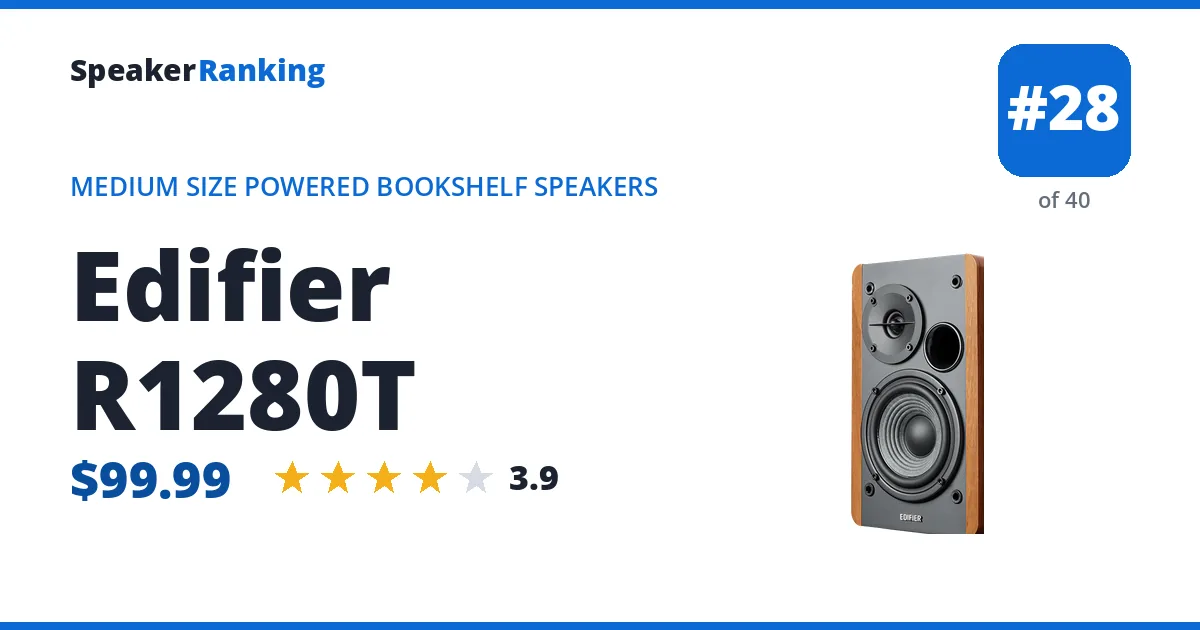
Pros: ASR’s review found useful moderate-level bass output from an inexpensive powered pair. Remote volume and bass/treble controls make it easy to use without separate amplification. Measured bass reaches -3dB around 63Hz. Measured bass extension of 63Hz (-3dB).
Cons: Preference scores of 2.41 standalone and 5.02 with an ideal subwoofer reflect substantial tonal limitations, not just missing bass. The response spans 5.5dB from 300Hz to 5kHz, and listening-window narrow-band deviation is 0.650. Resonances and treble unevenness affect reflected sound too. Listening height is important, and high-level compression changes the balance.
Full Edifier R1280T review and specifications →
| AES Input | No |
|---|---|
| Amplifier Power | 42w RMS Total |
| App | No |
| Aux Input | No |
| Bass Extension (-10dB) | 53.2Hz (derived, log-interpolated between spinorama.org -9dB/-12dB points) |
| Bass Extension (-3dB) | 63Hz (measured, Audio Science Review) |
| Bluetooth | No |
| Coaxial Input | No |
| Dimensions | 9.2”H x 7.7”W x 5.7”D (234 x 196 x 146 mm) |
| Drivers | 4” (102mm) woofer |
| EQ | No |
| Frequency Response | 52Hz - 20kHz (Manufacturer specified) |
| HDMI Input | No |
| Inputs | 2x RCA Input |
| Optical Input | No |
| Outputs | None |
| RCA Input | Yes |
| Spinorama Preference Score | 2.41 |
| Spinorama Preference Score with Perfect Sub | 5.02 |
| TRS Input | No |
| USB Input | No |
| Weight | 10.8 lbs (4.9 kg) |
| XLR Input | No |
- Links
- Reviews, Comparisons and Sound Samples
- Head-to-Head Comparisons
 JBL One Series 104: $129 per pair Discontinued eBay
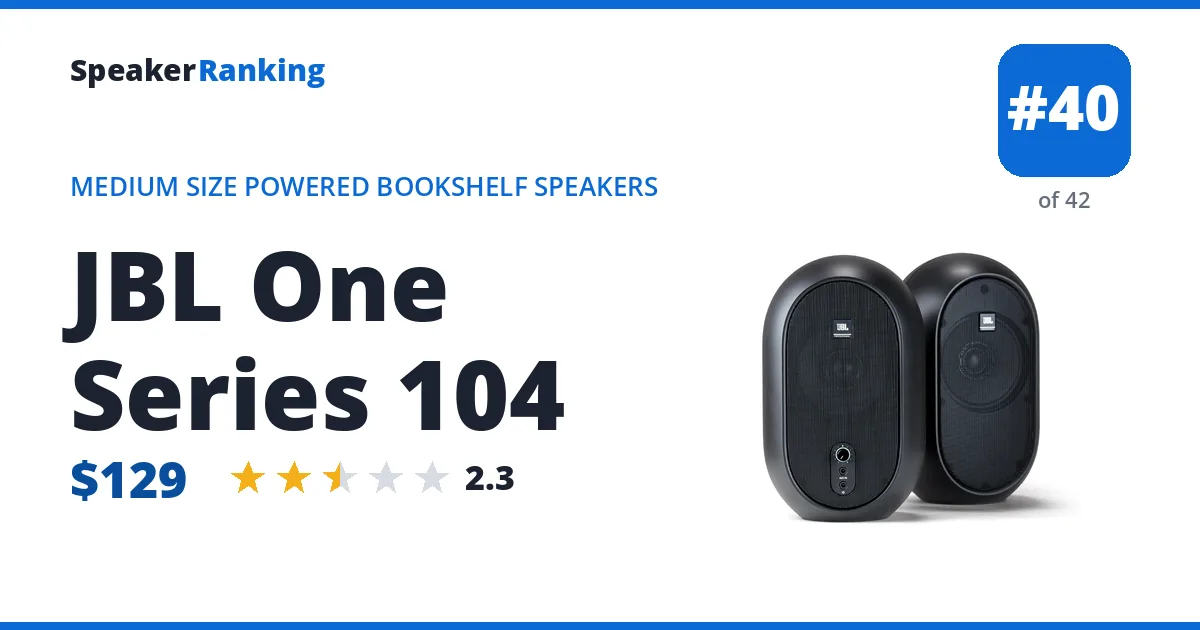
Pros: ASR’s powered-system measurement gives -3dB bass around 72Hz, and the compact coaxial layout is convenient for a small desk. Its internal equalization is part of the working speaker and should be included when assessing it, rather than judging the passive drivers with that correction bypassed. Measured bass extension of 45Hz (-3dB).
Cons: Even with the active system measured properly, scores are only 1.36 standalone and 4.08 with an ideal subwoofer. The 4.9dB midrange span and a high-frequency cancellation around 7.4kHz indicate significant unevenness; the review also found some vocals bright and irritating. These are results for the original 104, not a verification of the later 104-BT. Discontinued.
Full JBL One Series 104 review and specifications →
| AES Input | No |
|---|---|
| Amplifier Power | 60W total Class D (30W per speaker) |
| App | No |
| Aux Input | Yes |
| Bass Extension (-10dB) | 35Hz with the amplifier’s DSP bass boost active (measured, Audio Science Review) |
| Bass Extension (-3dB) | 45Hz with the amplifier’s DSP bass boost active (measured, Audio Science Review) |
| Bluetooth | No |
| Coaxial Input | No |
| DSP | Yes |
| Dimensions | 9.7H x 6W x 4.9D in (per manufacturer, 104-BT) |
| Drivers | 4.5” coaxial low-frequency driver, 0.75” soft dome tweeter |
| EQ | Yes (fixed, amplifier-applied) |
| Frequency Response | 60Hz - 20kHz (Manufacturer specified) |
| HDMI Input | No |
| Inputs | 1/4” TRS, RCA, 3.5mm Aux |
| Optical Input | No |
| RCA Input | Yes |
| TRS Input | Yes |
| USB Input | No |
| Weight | 4.5 lbs (2.06 kg) (master), 3.8 lbs (1.73 kg) (slave) |
| XLR Input | No |
- Links
- Reviews, Comparisons and Sound Samples
- Head-to-Head Comparisons
- JBL One Series 104 vs NHT Pro M-00
- JBL One Series 104 vs Edifier R1280DB
- JBL One Series 104 vs Edifier R1700BT
- JBL One Series 104 vs Audioengine HD4
- JBL One Series 104 vs Kali Audio IN-UNF
- JBL One Series 104 vs Edifier S1000MKII
- JBL One Series 104 vs Edifier S1000W
- JBL One Series 104 vs Edifier R2000DB
- See all 41 comparisons