Short answer: the KEF LSX II LT. It ranks #27 of 64 powered bookshelf speakers by sound quality at $469.99; the Sigberg Audio SBS.1 ranks #37 and costs $2500, so there is not much of a tradeoff to weigh.
What the KEF LSX II LT offers: Coaxial (Uni-Q-style) driver keeps the tweeter centered in the midrange, giving wide and consistent dispersion both horizontally and vertically (about ±60° each) - a wide sweet spot for multiple seats or positions. The KEF Connect app provides genuinely useful DSP control: desk/wall boundary compensation, adjustable bass contour (standard/less/extra), treble trim, and subwoofer integration, letting you tune the sound to wherever it’s placed. Distortion at a moderate 86dB looks good for the speaker’s compact size. Tonal profile stays consistent from 0° to 30° off-axis, so side-seat listeners hear essentially the same balance as someone centered. Extensive connectivity for its size: HDMI, USB, optical, sub output, plus Wi-Fi/Bluetooth. Clearly outperformed the reviewer’s soundbars, including ones bundled with their own subwoofers, as a TV audio replacement. Watch for: Small drivers mean it’s SPL-limited: bass compression kicks in around 88-92dB/1m per speaker, and multitone distortion crosses the reviewer’s 3% threshold around 96dB - not intended for loud or large-room duty. F3 of 55Hz and F10 of 46Hz mean it loses much of its bass by around 50Hz; a subwoofer (controllable through the same app) is needed for real low end. Diffraction dips appear around 4-5kHz and again near 8kHz, likely tied to the tweeter housing or surround, giving a mild reduction in treble attack and sibilance. A possible port or enclosure resonance shows up around 800Hz in the rear-radiation measurements, though the reviewer wasn’t certain of the exact cause or whether it’s audible. No analog input on this LT variant, so a turntable can’t be connected directly - only the pricier standard LSX II model includes one.
What the Sigberg Audio SBS.1 offers: Its 6.26 Spinorama preference score with a perfect subwoofer is the appropriate bass-normalized result because the SBS.1 is designed as a system with companion subwoofers, not for standalone use. That score exceeds the Manta’s 5.91, supported by better on-axis linearity and in-room smoothness above the subwoofer range. Distinctive 4-way coaxial design with dual 5.5” midbass drivers flanking a coincident 1” tweeter for time-aligned output. Active 3-channel Hypex nCore Class D amplification (350W per speaker) with a 9-band parametric EQ and factory presets. Watch for: Its 6.26 preference score with a perfect subwoofer trails the SBS Gen 2’s 6.74, and it has the widest listening-window deviation of the three Sigberg systems. Discontinued and sold out, replaced by the SBS Gen 2.
Buy the KEF LSX II LT. It ranks higher for sound quality than the Sigberg Audio SBS.1 and costs less, so there is no real case for the other one.
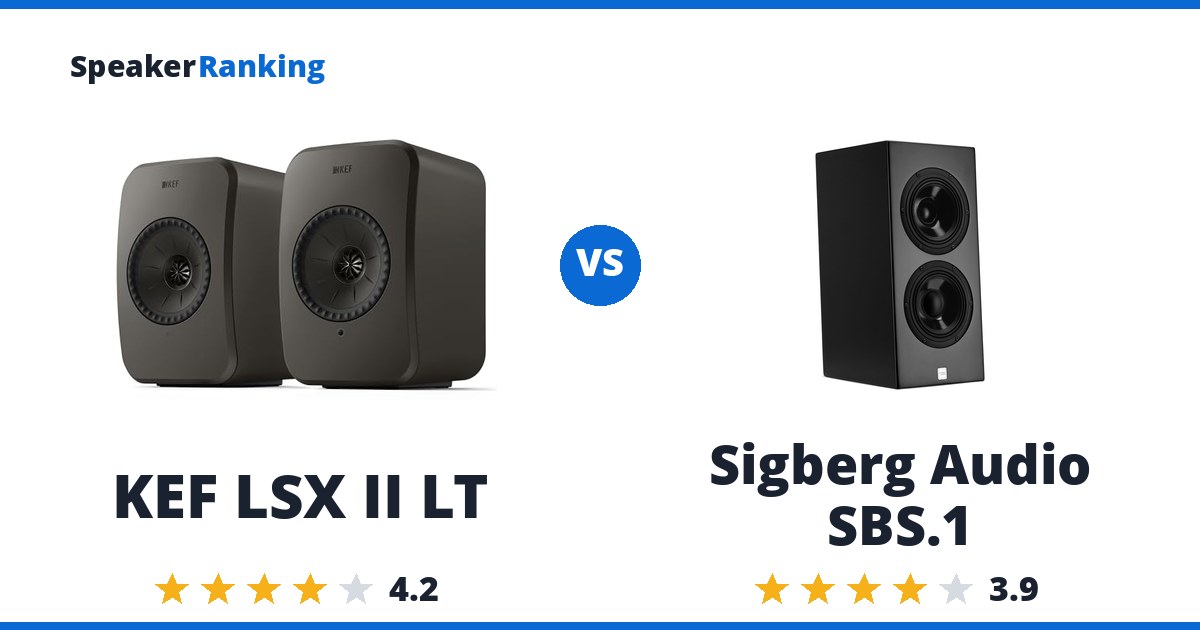
Specifications Side By Side
| KEF LSX II LT | Sigberg Audio SBS.1 | |
|---|---|---|
| Price | $469.99 | $2,500.00 2023 listing, per speaker; requires a separate subwoofer, Discontinued |
| Ranked | #27 of 64 in Medium Size Powered Bookshelf Speakers | #37 of 64 in Medium Size Powered Bookshelf Speakers |
| Dimensions | 9.5"H x 6.1"W x 7.1"D (241.3 x 154.9 x 180.3 mm) | 16.1"H x 7.5"W x 9.1"D (410 x 190 x 230 mm) |
| Inputs | Wifi, USB-C, HDMI, Optical, Bluetooth | XLR, RCA, Optical, Coaxial/SPDIF, AES |
| Outputs | RCA Subwoofer | - |
| Drivers | 115mm (4.5in.) magnesium/aluminium alloy cone woofer, 19mm (0.75in.) aluminium dome tweeter | 2x 5.5" midbass, 1" coaxial silk dome tweeter |
| Weight | 15 lbs / 6.8 kg | 20.9 lbs / 9.5 kg each |
| App | No | No |
| Bluetooth | No | No |
| EQ | No | Yes (9-band parametric, factory presets) |
| Output Power | 100w RMS Per Speaker | 350W per speaker |
| Bass Extension (-3dB) | 55Hz (measured, Erin’s Audio Corner) | 18Hz (manufacturer, with companion subwoofers) |
| Bass Extension (-10dB) | 46Hz (measured, Erin’s Audio Corner) | - |
| Sensitivity | 84dB (measured at 0.3V/1m, Erin’s Audio Corner) | - |
| Enclosure | - | sealed |
| Max SPL | - | 116dB |
| DSP | - | Yes |
| Country | - | Norway |
| Measurement Source | - | Manufacturer |
| Discontinued | - | Yes |
Related Speaker Comparisons
More useful head-to-heads from the same speaker class:
- Edifier R1280T vs KEF LS50 Wireless II
- Edifier R1280T vs Kali Audio SM-5
- Kali Audio SM-5 vs Dayton Audio M4
- Kali LP-UNF vs Sigberg Audio SBS.1
- Kali Audio IN-5 vs Sigberg Audio SBS.1
Prices on this page were last checked August 25, 2026 at 6:19 AM UTC. Product prices and availability are accurate as of that date/time and are subject to change; the price and availability shown on Amazon at the time of purchase will apply to the purchase of this product.
As an eBay Partner, we may be compensated if you make a purchase.
The Two Speakers In Full
 KEF LSX II LT: $469.99 Amazon eBay
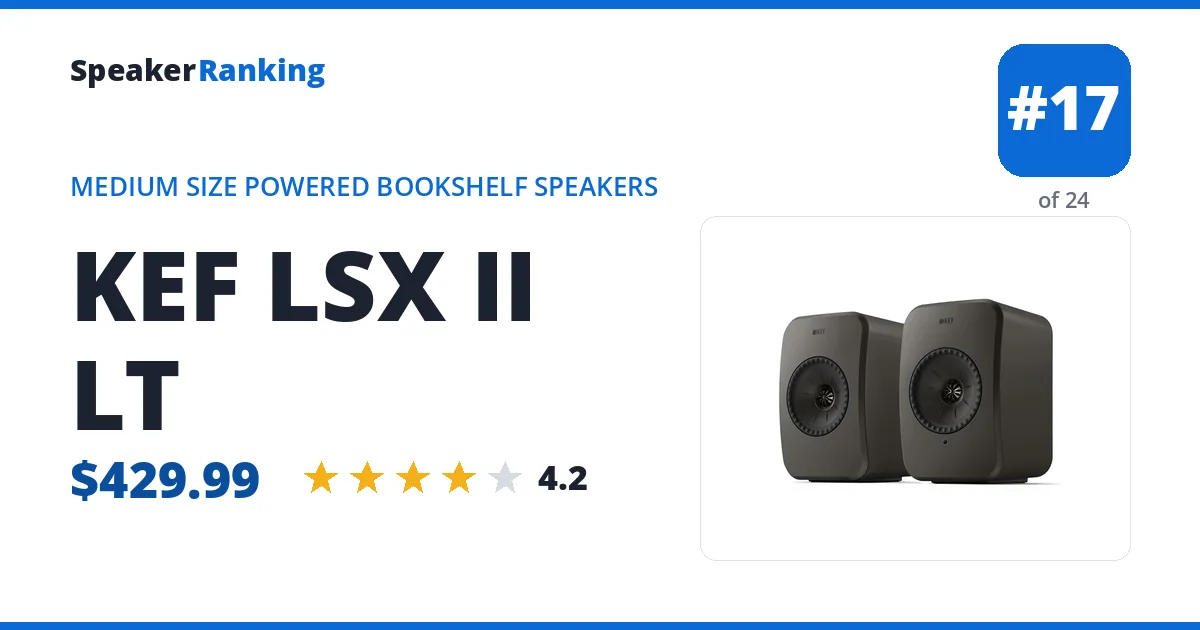
Pros: Coaxial (Uni-Q-style) driver keeps the tweeter centered in the midrange, giving wide and consistent dispersion both horizontally and vertically (about ±60° each) - a wide sweet spot for multiple seats or positions. The KEF Connect app provides genuinely useful DSP control: desk/wall boundary compensation, adjustable bass contour (standard/less/extra), treble trim, and subwoofer integration, letting you tune the sound to wherever it’s placed. Distortion at a moderate 86dB looks good for the speaker’s compact size. Tonal profile stays consistent from 0° to 30° off-axis, so side-seat listeners hear essentially the same balance as someone centered. Extensive connectivity for its size: HDMI, USB, optical, sub output, plus Wi-Fi/Bluetooth. Clearly outperformed the reviewer’s soundbars, including ones bundled with their own subwoofers, as a TV audio replacement.
Cons: Small drivers mean it’s SPL-limited: bass compression kicks in around 88-92dB/1m per speaker, and multitone distortion crosses the reviewer’s 3% threshold around 96dB - not intended for loud or large-room duty. F3 of 55Hz and F10 of 46Hz mean it loses much of its bass by around 50Hz; a subwoofer (controllable through the same app) is needed for real low end. Diffraction dips appear around 4-5kHz and again near 8kHz, likely tied to the tweeter housing or surround, giving a mild reduction in treble attack and sibilance. A possible port or enclosure resonance shows up around 800Hz in the rear-radiation measurements, though the reviewer wasn’t certain of the exact cause or whether it’s audible. No analog input on this LT variant, so a turntable can’t be connected directly - only the pricier standard LSX II model includes one.
Full KEF LSX II LT review and specifications →
| App | No |
|---|---|
| Bass Extension (-10dB) | 46Hz (measured, Erin's Audio Corner) |
| Bass Extension (-3dB) | 55Hz (measured, Erin's Audio Corner) |
| Bluetooth | No |
| Dimensions | 9.5"H x 6.1"W x 7.1"D (241.3 x 154.9 x 180.3 mm) |
| Drivers | 115mm (4.5in.) magnesium/aluminium alloy cone woofer, 19mm (0.75in.) aluminium dome tweeter |
| EQ | No |
| Inputs | Wifi, USB-C, HDMI, Optical, Bluetooth |
| Output Power | 100w RMS Per Speaker |
| Outputs | RCA Subwoofer |
| Sensitivity | 84dB (measured at 0.3V/1m, Erin's Audio Corner) |
| Weight | 15 lbs / 6.8 kg |
- Links
- Reviews, Comparisons and Sound Samples
- Head-to-Head Comparisons
- KEF LSX II LT vs Dayton Audio M4
- KEF LSX II LT vs Reflector Audio Square Two
- KEF LSX II LT vs Edifier S2000MKIII
- KEF LSX II LT vs Mackie MR524
- KEF LSX II LT vs KRK Classic 5
- KEF LSX II LT vs Sigberg Audio SBS Gen 2
- KEF LSX II LT vs Edifier MR4
- KEF LSX II LT vs HEDD Type 05 A-CORE
- See all 64 comparisons
 Sigberg Audio SBS.1: $2,500.00 2023 listing, per speaker; requires a separate subwoofer, Discontinued eBay
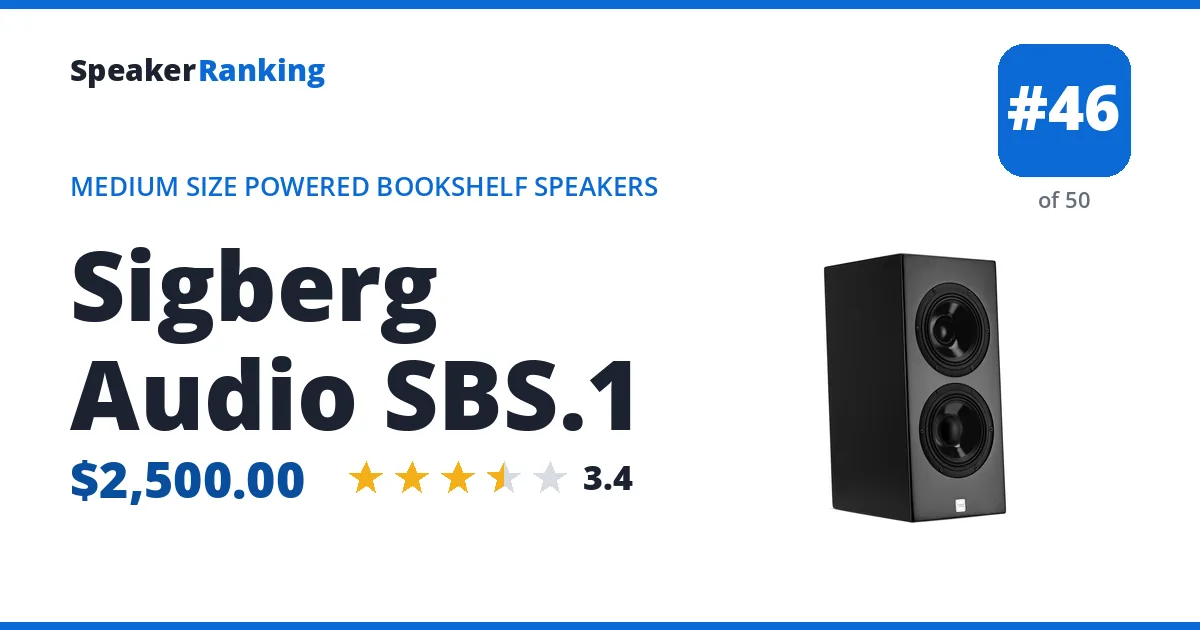
Pros: Its 6.26 Spinorama preference score with a perfect subwoofer is the appropriate bass-normalized result because the SBS.1 is designed as a system with companion subwoofers, not for standalone use. That score exceeds the Manta’s 5.91, supported by better on-axis linearity and in-room smoothness above the subwoofer range. Distinctive 4-way coaxial design with dual 5.5” midbass drivers flanking a coincident 1” tweeter for time-aligned output. Active 3-channel Hypex nCore Class D amplification (350W per speaker) with a 9-band parametric EQ and factory presets.
Cons: Its 6.26 preference score with a perfect subwoofer trails the SBS Gen 2’s 6.74, and it has the widest listening-window deviation of the three Sigberg systems. Discontinued and sold out, replaced by the SBS Gen 2. Discontinued.
Full Sigberg Audio SBS.1 review and specifications →
| App | No |
|---|---|
| Bass Extension (-3dB) | 18Hz (manufacturer, with companion subwoofers) |
| Bluetooth | No |
| Country | Norway |
| DSP | Yes |
| Dimensions | 16.1"H x 7.5"W x 9.1"D (410 x 190 x 230 mm) |
| Discontinued | Yes |
| Drivers | 2x 5.5" midbass, 1" coaxial silk dome tweeter |
| EQ | Yes (9-band parametric, factory presets) |
| Enclosure | sealed |
| Inputs | XLR, RCA, Optical, Coaxial/SPDIF, AES |
| Max SPL | 116dB |
| Measurement Source | Manufacturer |
| Output Power | 350W per speaker |
| Weight | 20.9 lbs / 9.5 kg each |
- Links
- Reviews, Comparisons and Sound Samples
- Head-to-Head Comparisons
- Sigberg Audio SBS.1 vs Edifier R1280DB
- Sigberg Audio SBS.1 vs KRK Classic 5
- Sigberg Audio SBS.1 vs Edifier S2000MKIII
- Sigberg Audio SBS.1 vs IK Multimedia iLoud MTM MKII
- Sigberg Audio SBS.1 vs Kali Audio IN-5
- Sigberg Audio SBS.1 vs Yamaha HS5
- Sigberg Audio SBS.1 vs Adam Audio T5V
- Sigberg Audio SBS.1 vs JBL 305P MKII
- See all 10 comparisons