Short answer: the Palmer STUDIMON 5 for better sound quality, the Edifier MR4 for the lower price. The Palmer STUDIMON 5 ranks #44 of 67 powered bookshelf speakers, rated 3.6/5, at $350. The Edifier MR4 ranks #48, rated 3.5/5, at $169.99, $180.01 cheaper.
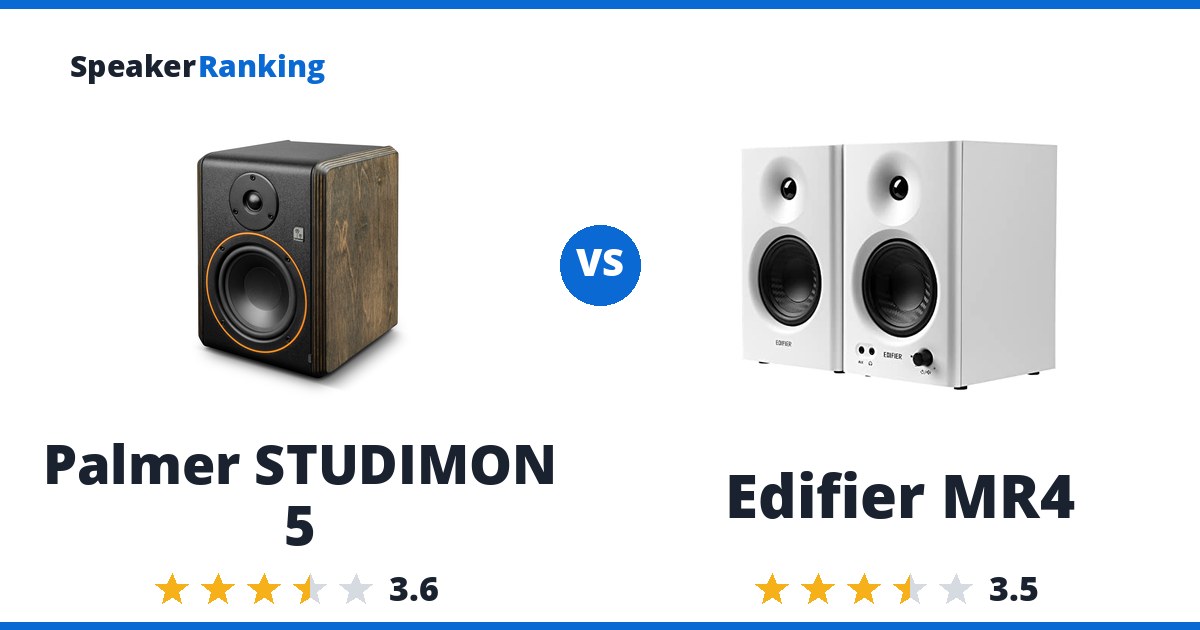
The case for the Palmer STUDIMON 5: The available third-party measurements predict 3.48 standalone and 6.37 with an ideal subwoofer. Watch for: The trace spans 4.0dB from 300Hz to 5kHz and estimates -3dB bass around 80Hz, with local irregularities despite the level overall trend.
What the Edifier MR4 does well: Erin’s data supports a useful budget desktop monitor: a 3.0dB midrange span, little overall on-axis tilt, and preference scores of 3.25 standalone and 6.00 with an ideal subwoofer. The catch: Bass reaches -3dB around 79Hz, so deep extension should not be inferred from the overall flat trend.
Buy the Palmer STUDIMON 5 when sound quality outweighs the price for you, and the Edifier MR4 when the price outweighs sound quality instead.
Want more options? Browse the full Powered Home rankings.
Specifications Side By Side
| Palmer STUDIMON 5 | Edifier MR4 | |
|---|---|---|
| Price | $350 per pair | $169.99 per pair |
| Ranked | #44 of 67 in Medium Size Powered Bookshelf Speakers | #48 of 67 in Medium Size Powered Bookshelf Speakers |
| Enclosure | 2-way active, rear-ported | - |
| Drivers | 0.75” soft-dome tweeter, 5” woofer | 4” (102mm) woofer, 1” silk dome tweeter |
| Dimensions | 10.6H x 7.5W x 8.5D in | 9”H x 5.5”W x 7.6”D (228.6 x 139.7 x 193 mm) |
| Weight | 8.6 lbs (3.9 kg) each | 9.9 lbs (4.5 kg) |
| Amplifier Power | 60W each (30W LF, 30W HF) | 42W RMS total (21W per speaker) |
| Inputs | Balanced XLR and 1/4” TRS | TRS Balanced, RCA, Aux |
| Country | Germany (design) | - |
| Spinorama Preference Score | 3.48 | 3.25 |
| Spinorama Preference Score with Perfect Sub | 6.37 | 6.00 |
| XLR Input | Yes | No |
| RCA Input | No | Yes |
| TRS Input | Yes | Yes |
| Optical Input | No | No |
| Coaxial Input | No | No |
| USB Input | No | No |
| HDMI Input | No | No |
| AES Input | No | No |
| Aux Input | No | Yes |
| Bluetooth | No | No |
| Frequency Response | 70Hz - 20kHz (-3dB) (Manufacturer specified) | 60 Hz-20 kHz (-3dB) (Manufacturer specified) |
| Outputs | - | Headphone |
| App | - | No |
| EQ | - | Yes (Monitor and Music modes) |
| Bass Extension (-3dB) | - | 79Hz (measured, Erin’s Audio Corner) |
| Bass Extension (-10dB) | - | 59Hz (measured, Erin’s Audio Corner) |
| Sensitivity | - | 78dB (measured at 0.3V/1m, Erin’s Audio Corner) |
| Headphone Output | - | Yes |
Related Speaker Comparisons
How Palmer STUDIMON 5 compares with other leading options:
- Neumann KH80 DSP vs Palmer STUDIMON 5
- JBL 305P MKII vs Palmer STUDIMON 5
- IK Multimedia iLoud MTM MKII vs Palmer STUDIMON 5
- Kali Audio IN-5 vs Palmer STUDIMON 5
- KEF LSX II LT vs Palmer STUDIMON 5
Prices on this page were last checked September 26, 2026 at 11:14 PM UTC. Product prices and availability are accurate as of that date/time and are subject to change; the price and availability shown on Amazon at the time of purchase will apply to the purchase of this product.
As an eBay Partner, we may be compensated if you make a purchase.
The Two Speakers In Full
 Palmer STUDIMON 5: $350 per pair Thomann eBay
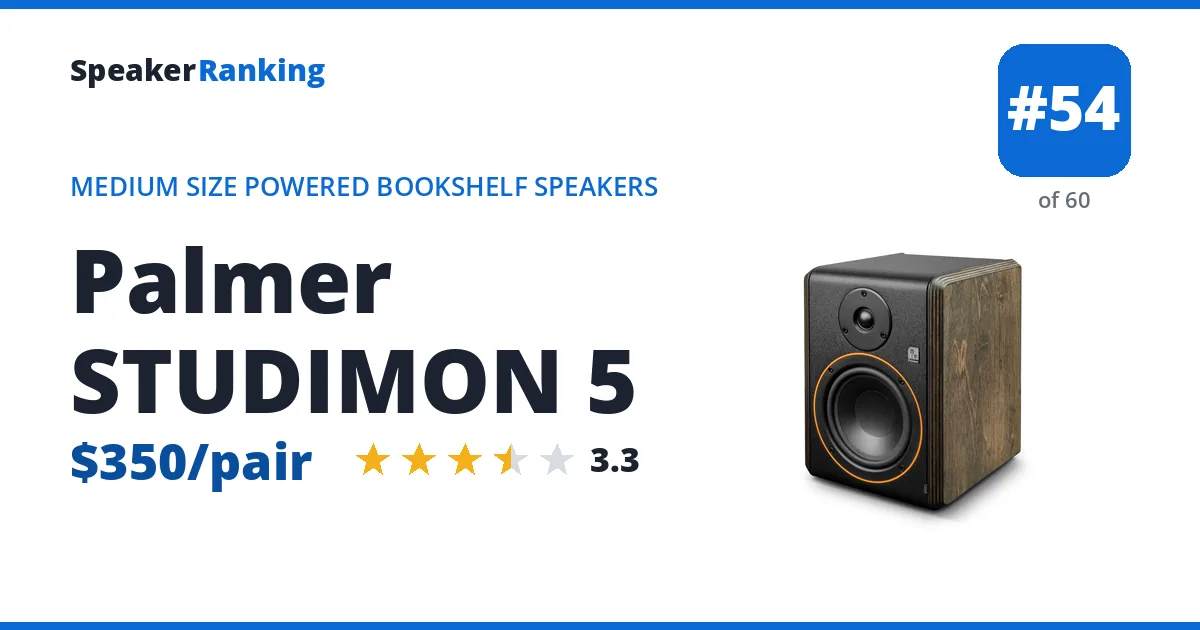
Pros: The available third-party measurements predict 3.48 standalone and 6.37 with an ideal subwoofer. Balanced inputs and a conventional compact monitor cabinet make it straightforward to use with studio equipment. The broad response trend is approximately level rather than strongly bright or dark.
Cons: The trace spans 4.0dB from 300Hz to 5kHz and estimates -3dB bass around 80Hz, with local irregularities despite the level overall trend. There are no room-EQ controls to address broad placement errors, and the available score does not establish clean output.
Full Palmer STUDIMON 5 review and specifications →
| AES Input | No |
|---|---|
| Amplifier Power | 60W each (30W LF, 30W HF) |
| Aux Input | No |
| Bluetooth | No |
| Coaxial Input | No |
| Country | Germany (design) |
| Dimensions | 10.6H x 7.5W x 8.5D in |
| Drivers | 0.75” soft-dome tweeter, 5” woofer |
| Enclosure | 2-way active, rear-ported |
| Frequency Response | 70Hz - 20kHz (-3dB) (Manufacturer specified) |
| HDMI Input | No |
| Inputs | Balanced XLR and 1/4” TRS |
| Optical Input | No |
| RCA Input | No |
| Spinorama Preference Score | 3.48 |
| Spinorama Preference Score with Perfect Sub | 6.37 |
| TRS Input | Yes |
| USB Input | No |
| Weight | 8.6 lbs (3.9 kg) each |
| XLR Input | Yes |
- Links
- Reviews, Comparisons and Sound Samples
- Head-to-Head Comparisons
- Palmer STUDIMON 5 vs Edifier MR4.5
- Palmer STUDIMON 5 vs Adam Audio A4V
- Palmer STUDIMON 5 vs Yamaha HS5
- Palmer STUDIMON 5 vs Presonus Eris E5 XT
- Palmer STUDIMON 5 vs Edifier S2000MKIII
- Palmer STUDIMON 5 vs Kanto YU
- Palmer STUDIMON 5 vs KRK Classic 5
- Palmer STUDIMON 5 vs Onkyo GX-30ARC
- See all 23 comparisons
 Edifier MR4: $169.99 per pair Amazon eBay
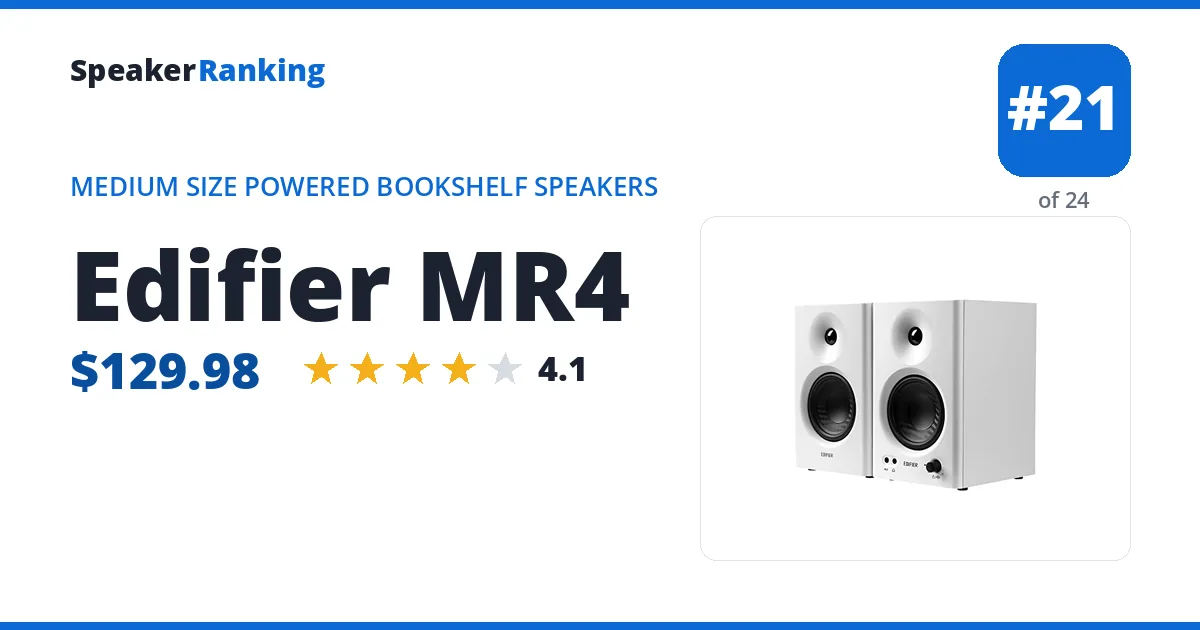
Pros: Erin’s data supports a useful budget desktop monitor: a 3.0dB midrange span, little overall on-axis tilt, and preference scores of 3.25 standalone and 6.00 with an ideal subwoofer. Balanced TRS inputs and tone controls are practical at its price, and its response is more balanced than the measured R1280T. Measured bass extension of 79Hz (-3dB), with a measured sensitivity of 78dB.
Cons: Bass reaches -3dB around 79Hz, so deep extension should not be inferred from the overall flat trend. Listening-window response still has local irregularities, including lower-treble unevenness. The existing review reports rapidly increasing distortion and audible distress when pushed well above moderate desktop levels. No Bluetooth, and adding a subwoofer does not cure every output or tonal limitation.
Full Edifier MR4 review and specifications →
| AES Input | No |
|---|---|
| Amplifier Power | 42W RMS total (21W per speaker) |
| App | No |
| Aux Input | Yes |
| Bass Extension (-10dB) | 59Hz (measured, Erin’s Audio Corner) |
| Bass Extension (-3dB) | 79Hz (measured, Erin’s Audio Corner) |
| Bluetooth | No |
| Coaxial Input | No |
| Dimensions | 9”H x 5.5”W x 7.6”D (228.6 x 139.7 x 193 mm) |
| Drivers | 4” (102mm) woofer, 1” silk dome tweeter |
| EQ | Yes (Monitor and Music modes) |
| Frequency Response | 60 Hz-20 kHz (-3dB) (Manufacturer specified) |
| HDMI Input | No |
| Headphone Output | Yes |
| Inputs | TRS Balanced, RCA, Aux |
| Optical Input | No |
| Outputs | Headphone |
| RCA Input | Yes |
| Sensitivity | 78dB (measured at 0.3V/1m, Erin’s Audio Corner) |
| Spinorama Preference Score | 3.25 |
| Spinorama Preference Score with Perfect Sub | 6.00 |
| TRS Input | Yes |
| USB Input | No |
| Weight | 9.9 lbs (4.5 kg) |
| XLR Input | No |
- Links
- Reviews, Comparisons and Sound Samples
- Erin’s Audio Corner Review Measurements More from Erin’s Audio Corner →
- Audio Science Review Measurements More from Audio Science Review →
- DSAUDIO.review: DSAUDIO.review Edifier MR4 vs Edifier R1280DBs sound.DEMO More from DSAUDIOreview →
- DSAUDIO.review: DSAUDIO.review Edifier MR4 vs Edifier R1700BT sound.DEMO
- DSAUDIO.review: DSAUDIO.review Edifier MR4 vs JBL 305P MKII sound.DEMO
- DSAUDIO.review: DSAUDIO.review Edifier MR4 vs Presonus Eris E3.5 sound.DEMO
- DSAUDIO.review: DSAUDIO.review Edifier MR4 vs iLoud Micro Monitor sound.DEMO
- DSAUDIO.review: DSAUDIO.review Edifier MR4 vs Presonus Eris E4.5 sound.DEMO
- DSAUDIO.review: DSAUDIO.review Edifier MR4 vs Mackie CR4-X sound.DEMO
- Erin’s Audio Corner Measurements (spinorama.org)
- Jasper Tech: Best Desktop Computer Speakers for Every Budget – 2026 More from Jasper Tech →
- Jasper Tech: Are the iLoud Micro Monitor Pro the Best Studio Monitor Speakers for your Home Studio?
- Head-to-Head Comparisons