Short answer: the PreSonus Eris E3.5 2nd Gen, though neither ranks well in its class. It ranks #45 of 48 powered bookshelf speakers by sound quality (rated 2.5/5) at $99.99 and is still sold new; the Midiplus MI3 II ranks #47 (rated 2.4/5) and is discontinued, so it is only an option used. The Midiplus MI3 II’s replacement, the Midiplus MI3 II V2, is rated 2.5/5 at $139. Both are rated below 3.0/5 among the 48 powered bookshelf speakers; for better sound, the Edifier MR3 ranks #11 at $109.99.
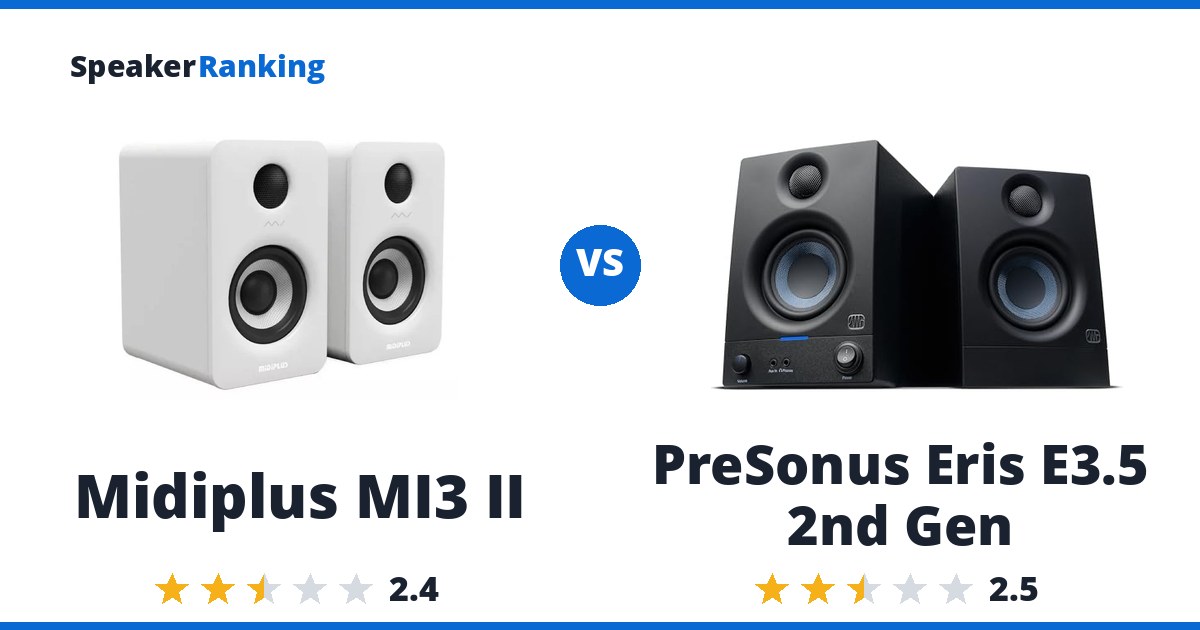
What the Midiplus MI3 II does well: Compact desktop speakers with Bluetooth, analog inputs and a treble adjustment for a basic computer setup. It keeps a wired aux input, which the PreSonus Eris E3.5 2nd Gen lacks. The catch: Preference scores of 0.99 standalone and 3.84 with an ideal subwoofer are poor.
The PreSonus Eris E3.5 2nd Gen is the more accurate pick. Small desktop monitors with bass and treble controls on the back to adjust for desk or wall placement. Its measured preference score, a predictor of how neutral it sounds, is 1.51 against 0.99 for the Midiplus MI3 II. Watch for: The stock response spans 7.2dB from 300Hz to 5kHz and has a strong rising trend of about 1.27dB per octave, emphasizing treble over the midrange.
Buy the PreSonus Eris E3.5 2nd Gen. It is rated higher for sound quality; the Midiplus MI3 II is no longer sold new.
Want more options? Browse the full Powered Home rankings.

Compact desktop speakers with Bluetooth, analog inputs and a treble adjustment for a basic computer setup.

Small desktop monitors with bass and treble controls on the back to adjust for desk or wall placement.
Prices on this page were last checked October 23, 2026 at 8:27 AM UTC. Product prices and availability are accurate as of that date/time and are subject to change; the price and availability shown on Amazon at the time of purchase will apply to the purchase of this product.
As an eBay Partner, we may be compensated if you make a purchase.
Specifications Side By Side
| Midiplus MI3 II | PreSonus Eris E3.5 2nd Gen | |
|---|---|---|
| Price | $139 per pair Discontinued | $99.99 per pair |
| Ranked | #47 of 48 in Small Size Powered Bookshelf Speakers | #45 of 48 in Small Size Powered Bookshelf Speakers |
| Weight | 3.9 lbs (1.77 kg) | 8.6 lbs (3.9 kg) |
| Enclosure | Powered 2-way | - |
| Drivers | 0.75-inch silk tweeter, 3-inch fiberglass woofer | 3.5” woofer, 1” silk dome tweeter |
| Frequency Response | 70Hz-25kHz | 80 Hz-20 kHz (-3dB) (Manufacturer specified) |
| Amplifier Power | 60W RMS per pair | 50W total (25W per speaker) |
| Maximum SPL | 98dB | 95dB @ 1m (manufacturer specified) |
| Inputs | RCA, 3.5mm, Bluetooth | RCA, 1/4” Balanced |
| Dimensions | 6.5H x 4.7W x 6D in | 8.3”H x 6”W x 5.5”D (210.8 x 152.4 x 139.7 mm) |
| Spinorama Preference Score | 0.99 | 1.51 |
| Spinorama Preference Score with Perfect Sub | 3.84 | 4.17 |
| XLR Input | No | No |
| RCA Input | Yes | Yes |
| TRS Input | No | No |
| Optical Input | No | No |
| Coaxial Input | No | No |
| USB Input | No | No |
| HDMI Input | No | No |
| AES Input | No | No |
| Aux Input | Yes | No |
| Bluetooth | Yes | No |
| Bluetooth Version | 5.0 | - |
| Outputs | - | 1/8” headphone jack |
| App | - | No |
| Bass Extension (-10dB) | - | 70Hz (measured, Erin’s Audio Corner) |
| Bass Extension (-3dB) | - | 80Hz (measured, Erin’s Audio Corner) |
| EQ | - | Yes (Acoustic space) |
| Sensitivity | - | 87.4dB (measured at 0.3V/1m, Erin’s Audio Corner) |
| Headphone Output | - | Yes |
Frequency Response Compared
Both speakers’ spinorama measurements, overlaid. A flatter line is more neutral: peaks sound forward or harsh, dips sound recessed. Each curve is shifted so its average from 300 Hz to 3 kHz sits at 0 dB, so loudness differences between the two are removed and only the shape is compared. The two were measured by different sources, so small differences, especially in the bass, can come from the measurement setup rather than the speakers.
Measurement data: Midiplus MI3 II (measured by an independent reviewer) and PreSonus Eris E3.5 2nd Gen (measured by Erin’s Audio Corner), via spinorama.org.
Related Speaker Comparisons
How PreSonus Eris E3.5 2nd Gen compares with other leading options: