Short answer: the Mackie CR3.5. It ranks #36 of 47 powered bookshelf speakers by sound quality, rated 3.0/5, at $99.99; the PreSonus Eris E3.5 2nd Gen ranks #44, rated 2.5/5, at $99.99. Close enough in price that the sound-quality gap is the deciding factor.
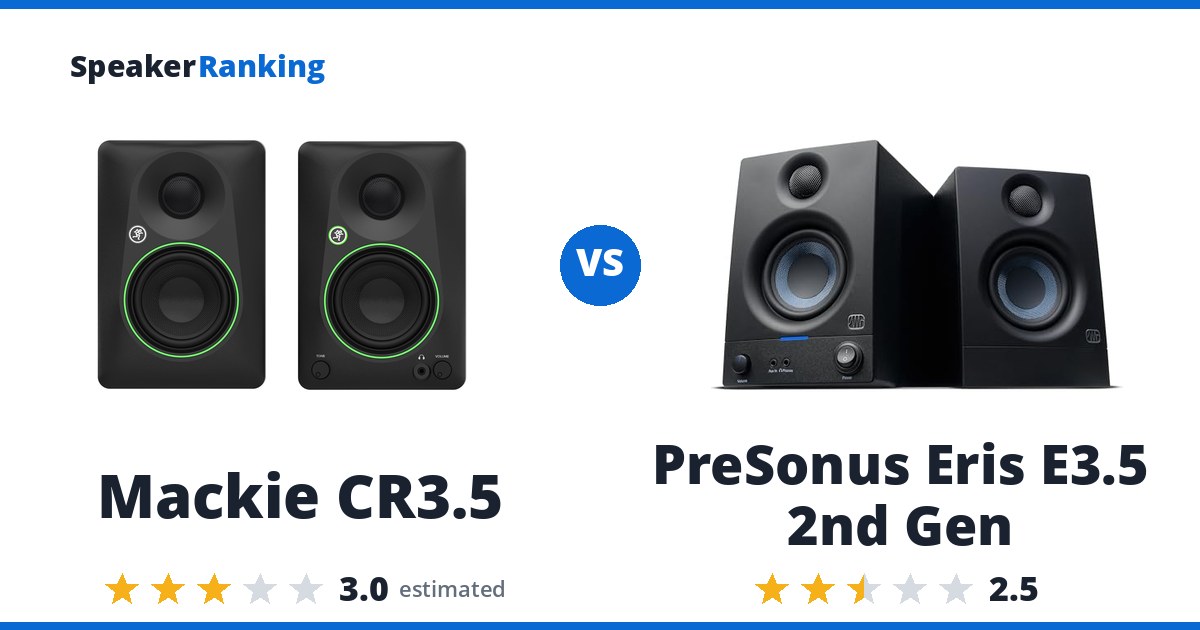
The Mackie CR3.5 is the better-sounding pick. The third generation of Mackie’s best-selling CR3 desktop monitors, replacing the Mackie CR3-X. It keeps a wired aux input, which the PreSonus Eris E3.5 2nd Gen lacks. The tradeoff: No independent measurements yet, so its tonal balance and directivity can’t be compared directly with measured speakers; the rating is estimated from the measured Mackie CR3-X it replaces, which measured with an uneven response and limited bass.
The case for the PreSonus Eris E3.5 2nd Gen: Rear-panel bass and treble controls allow broad correction for desk and wall placement. Watch for: The stock response spans 7.2dB from 300Hz to 5kHz and has a strong rising trend of about 1.27dB per octave, emphasizing treble over the midrange.
Buy the Mackie CR3.5. It is rated higher for sound quality than the PreSonus Eris E3.5 2nd Gen at the same price, so it is the default pick unless a specific strength of the other one matters more to you.
About the ratings: the Mackie CR3.5’s rating is estimated from measured siblings and predecessors rather than its own measurements, with a likely range of 2.6 to 3.4, so this verdict could change once it is measured.
Still deciding? The full Powered Home rankings cover every ranked option.
Specifications Side By Side
| Mackie CR3.5 | PreSonus Eris E3.5 2nd Gen | |
|---|---|---|
| Price | $99.99 per pair | $99.99 per pair |
| Ranked | #36 of 47 in Small Size Powered Bookshelf Speakers Estimated | #44 of 47 in Small Size Powered Bookshelf Speakers |
| XLR Input | No | No |
| RCA Input | Yes | Yes |
| TRS Input | Yes | No |
| Optical Input | No | No |
| Coaxial Input | No | No |
| USB Input | No | No |
| HDMI Input | No | No |
| AES Input | No | No |
| Aux Input | Yes | No |
| Drivers | 3.5” woven woofer, silk dome tweeter | 3.5” woofer, 1” silk dome tweeter |
| Amplifier Power | 50W RMS total (Class A/B) | 50W total (25W per speaker) |
| Headphone Output | Yes | Yes |
| Bluetooth | No | No |
| Dimensions | 8.1”H x 5.5”W x 7.1”D (206 x 140 x 180 mm) | 8.3”H x 6”W x 5.5”D (210.8 x 152.4 x 139.7 mm) |
| Weight | 8.2 lbs (3.7 kg) (pair) | 8.6 lbs (3.9 kg) |
| DIY Kit | No | - |
| Frequency Response | - | 80 Hz-20 kHz (-3dB) (Manufacturer specified) |
| Inputs | - | RCA, 1/4” Balanced |
| Outputs | - | 1/8” headphone jack |
| App | - | No |
| Bass Extension (-10dB) | - | 70Hz (measured, Erin’s Audio Corner) |
| Bass Extension (-3dB) | - | 80Hz (measured, Erin’s Audio Corner) |
| EQ | - | Yes (Acoustic space) |
| Sensitivity | - | 87.4dB (measured at 0.3V/1m, Erin’s Audio Corner) |
| Maximum SPL | - | 95dB @ 1m (manufacturer specified) |
| Spinorama Preference Score | - | 1.51 |
| Spinorama Preference Score with Perfect Sub | - | 4.17 |
Related Speaker Comparisons
More worthwhile head-to-heads for Mackie CR3.5:
- Mackie CR3.5 vs Mackie CR3-X
- Mackie CR3.5 vs M-Audio BX3
- PreSonus Eris E3.5 2nd Gen vs Mackie CR3-X
- Fluid Audio C35BT vs PreSonus Eris E3.5 2nd Gen
- M-Audio BX3 vs PreSonus Eris E3.5 2nd Gen
Prices on this page were last checked October 11, 2026 at 4:59 PM UTC. Product prices and availability are accurate as of that date/time and are subject to change; the price and availability shown on Amazon at the time of purchase will apply to the purchase of this product.
As an eBay Partner, we may be compensated if you make a purchase.
The Two Speakers In Full
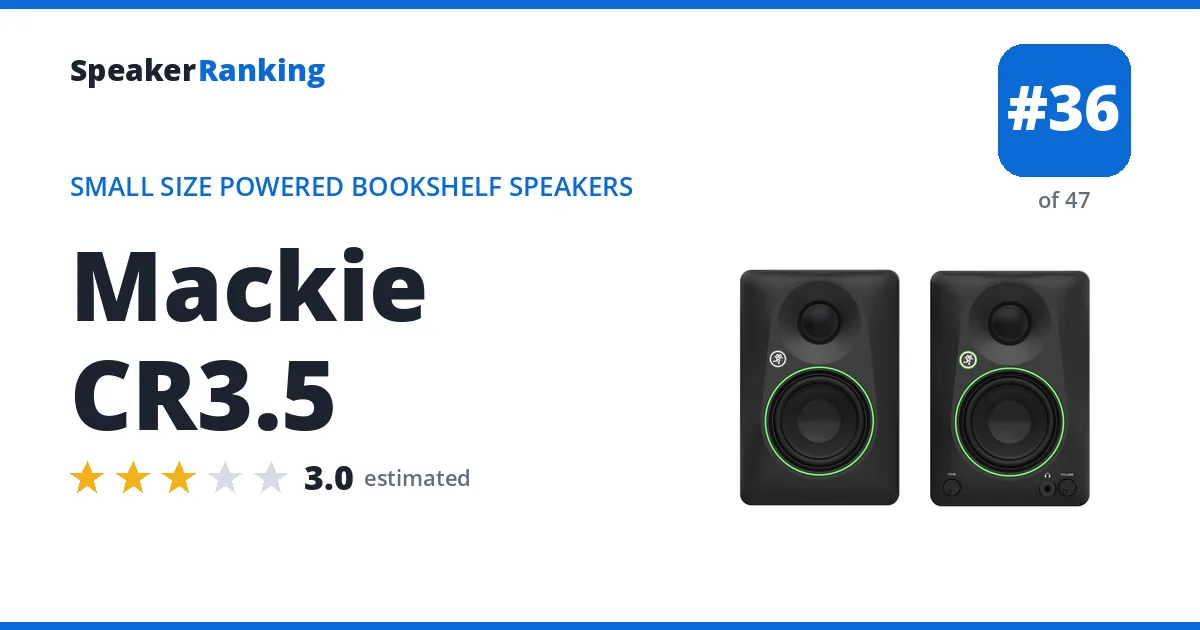
 Mackie CR3.5: $99.99 per pair Estimated Amazon Sweetwater eBay
Older model: the Mackie CR3-X (ranked higher, rated 3/5). See every Mackie CR generation.
Same family: the Mackie CR4.5 (larger bookshelf, ranked higher, estimated 3.3/5).
Pros: The third generation of Mackie’s best-selling CR3 desktop monitors, replacing the Mackie CR3-X. A 3.5” woven woofer and silk dome tweeter are bi-amplified with 50W RMS, and new features include a tone control for more bass or treble and a location switch that tunes the response for desktop or bookshelf placement. TRS, RCA and 3.5mm inputs plus a front headphone jack make it easy to set up.
Cons: No independent measurements yet, so its tonal balance and directivity can’t be compared directly with measured speakers; the rating is estimated from the measured Mackie CR3-X it replaces, which measured with an uneven response and limited bass. A 3.5” woofer limits bass and output, so a subwoofer helps for music.
Full Mackie CR3.5 review and specifications →
| Released | Oct 2024 (2 years ago) |
|---|---|
| AES Input | No |
| Amplifier Power | 50W RMS total (Class A/B) |
| Aux Input | Yes |
| Bluetooth | No |
| Coaxial Input | No |
| DIY Kit | No |
| Dimensions | 8.1”H x 5.5”W x 7.1”D (206 x 140 x 180 mm) |
| Drivers | 3.5” woven woofer, silk dome tweeter |
| HDMI Input | No |
| Headphone Output | Yes |
| Optical Input | No |
| RCA Input | Yes |
| TRS Input | Yes |
| USB Input | No |
| Weight | 8.2 lbs (3.7 kg) (pair) |
| XLR Input | No |
- Links
- Reviews, Comparisons and Sound Samples
- No independent measurement review is linked for this model; it is ranked from hands-on listening and comparison against similarly priced speakers.
- Head-to-Head Comparisons
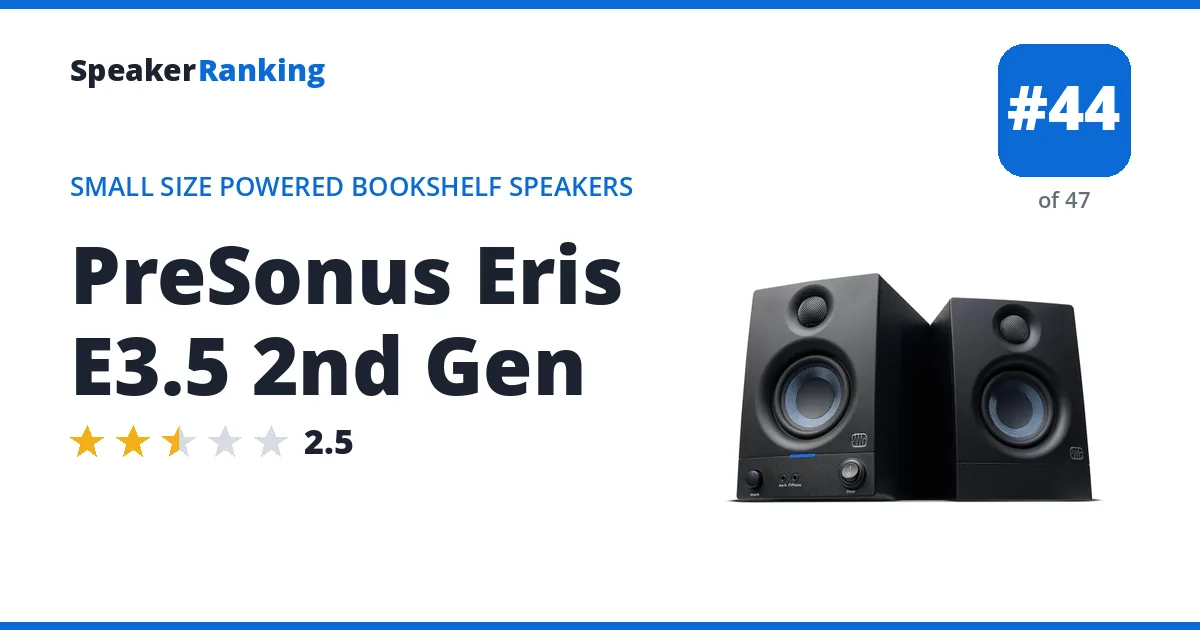
 PreSonus Eris E3.5 2nd Gen: $99.99 per pair Amazon eBay
Older model: the PreSonus Eris E3.5 (ranked higher, rated 2.6/5). See every PreSonus Eris generation.
Same family: the PreSonus Eris Sub 8BT (subwoofer, rated 3.6/5).
Pros: Rear-panel bass and treble controls allow broad correction for desk and wall placement. Erin’s second-generation Klippel measurements give a -3dB point around 69Hz, so the speaker has useful upper-bass reach for its size. Its adjustable balance is more flexible than a fixed-response budget desktop pair. Measured bass extension of 80Hz (-3dB), with a measured sensitivity of 87.4dB.
Cons: The stock response spans 7.2dB from 300Hz to 5kHz and has a strong rising trend of about 1.27dB per octave, emphasizing treble over the midrange. Preference scores of 1.51 standalone and 4.17 with an ideal subwoofer indicate major tonal problems beyond bass extension. EQ may help, but a subwoofer alone will not make it neutral. Output and port-modification results from reviews of the original E3.5 should not be assumed to apply to this second-generation model.
Full PreSonus Eris E3.5 2nd Gen review and specifications →
| Released | Sep 2023 (3 years ago) |
|---|---|
| AES Input | No |
| Amplifier Power | 50W total (25W per speaker) |
| App | No |
| Aux Input | No |
| Bass Extension (-10dB) | 70Hz (measured, Erin’s Audio Corner) |
| Bass Extension (-3dB) | 80Hz (measured, Erin’s Audio Corner) |
| Bluetooth | No |
| Coaxial Input | No |
| Dimensions | 8.3”H x 6”W x 5.5”D (210.8 x 152.4 x 139.7 mm) |
| Drivers | 3.5” woofer, 1” silk dome tweeter |
| EQ | Yes (Acoustic space) |
| Frequency Response | 80 Hz-20 kHz (-3dB) (Manufacturer specified) |
| HDMI Input | No |
| Headphone Output | Yes |
| Inputs | RCA, 1/4” Balanced |
| Maximum SPL | 95dB @ 1m (manufacturer specified) |
| Optical Input | No |
| Outputs | 1/8” headphone jack |
| RCA Input | Yes |
| Sensitivity | 87.4dB (measured at 0.3V/1m, Erin’s Audio Corner) |
| Spinorama Preference Score | 1.51 |
| Spinorama Preference Score with Perfect Sub | 4.17 |
| TRS Input | No |
| USB Input | No |
| Weight | 8.6 lbs (3.9 kg) |
| XLR Input | No |
- Links
- Reviews, Comparisons and Sound Samples
- Erin’s Audio Corner Review Measurements More from Erin’s Audio Corner →
- Audio Science Review Measurements More from Audio Science Review →
- DSAUDIO.review: DSAUDIO.review Edifier MR4 vs Presonus Eris E3.5 sound.DEMO More from DSAUDIOreview →
- DSAUDIO.review: Presonus Eris E3.5 vs Edifier R1280T Sound Demo w/ Bass Test
- DSAUDIO.review: Presonus Eris E3.5 vs Mackie CR3 Sound Demo w/ Bass Test
- Erin’s Audio Corner: Mackie CR3-X vs PreSonus E3.5 Budget Monitor Showdown!
- Erin’s Audio Corner: 10 Great (and Terrible) Speakers Under $300!
- Erin’s Audio Corner Measurements (spinorama.org)
- Jasper Tech: Are the iLoud Micro Monitor Pro the Best Studio Monitor Speakers for your Home Studio? More from Jasper Tech →
- Jasper Tech: Best Desktop Computer Speakers for Every Budget
- Head-to-Head Comparisons
- PreSonus Eris E3.5 2nd Gen vs Logitech Z200
- PreSonus Eris E3.5 2nd Gen vs Midiplus MI3 II
- PreSonus Eris E3.5 2nd Gen vs PreSonus Eris E3.5
- PreSonus Eris E3.5 2nd Gen vs Monoprice DT-3
- PreSonus Eris E3.5 2nd Gen vs M-Audio BX3
- PreSonus Eris E3.5 2nd Gen vs Fiio SP3
- PreSonus Eris E3.5 2nd Gen vs Fluid Audio C35BT
- PreSonus Eris E3.5 2nd Gen vs Mackie CR3-X
- See all 18 comparisons