Short answer: the Edifier M60. It ranks #9 of 48 powered bookshelf speakers by sound quality, rated 4.0/5, at $199.99. The HiVi Swan X3 ranks #10, rated 3.9/5, at $179, $20.99 cheaper, a saving that is not big enough to make up the sound-quality gap.
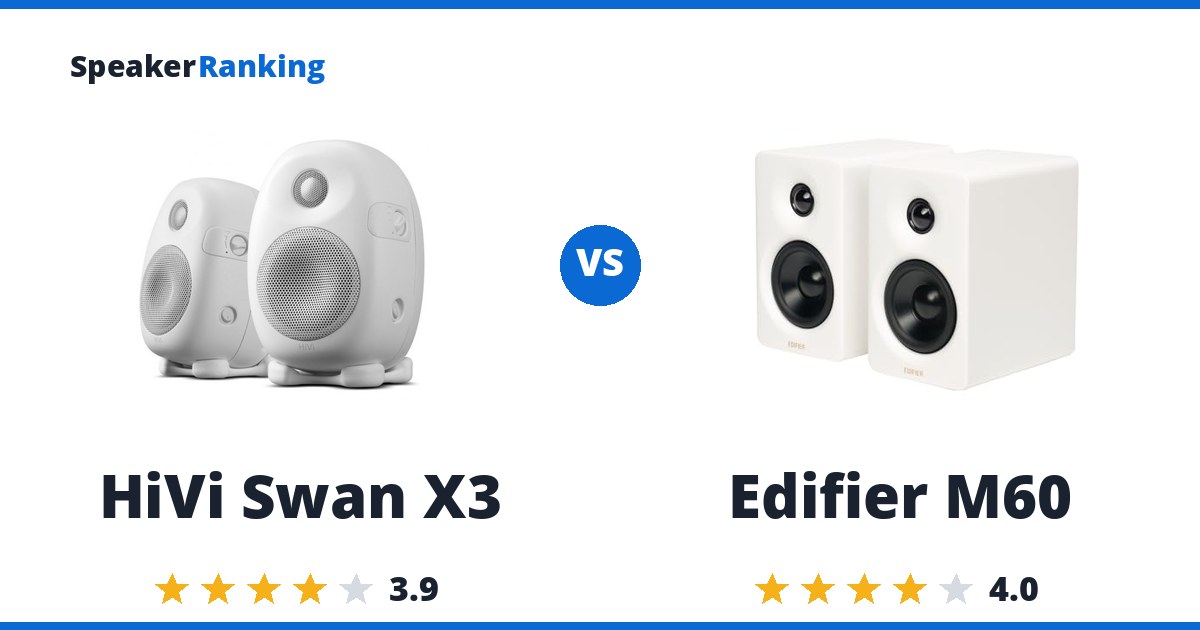
The case for the HiVi Swan X3: An affordable small coaxial desktop pair with fairly balanced sound for the money. The tradeoff: Not a flat reference monitor: the response spans 5.0dB from 300Hz to 5kHz and trends upward toward the treble.
The Edifier M60 is the more accurate pick. Small desktop speakers with even sound, USB, Bluetooth and included stands, easy to set up at a desk. Its measured preference score, a predictor of how neutral it sounds, is 4.60 against 4.04 for the HiVi Swan X3. It keeps a wired aux input, which the HiVi Swan X3 lacks. The catch: The on-axis response rises by about 0.57dB per octave, so the tonal balance becomes brighter toward the treble.
Buy the Edifier M60. It is rated higher for sound quality, and the $20.99 saving on the HiVi Swan X3 is not enough to make up the difference.
Still deciding? The full Powered Home rankings cover every ranked option.

An affordable small coaxial desktop pair with fairly balanced sound for the money.

Small desktop speakers with even sound, USB, Bluetooth and included stands, easy to set up at a desk.
Prices on this page were last checked October 23, 2026 at 8:27 AM UTC. Product prices and availability are accurate as of that date/time and are subject to change; the price and availability shown on Amazon at the time of purchase will apply to the purchase of this product.
As an eBay Partner, we may be compensated if you make a purchase.
Specifications Side By Side
| HiVi Swan X3 | Edifier M60 | |
|---|---|---|
| Price | $179.00 per pair | $199.99 per pair |
| Ranked | #10 of 48 in Small Size Powered Bookshelf Speakers | #9 of 48 in Small Size Powered Bookshelf Speakers |
| Enclosure | Active coaxial, rear-ported | - |
| Drivers | 3-inch coaxial woofer and tweeter | 3” woofer, 1” silk dome tweeter |
| Bass Extension (-6dB) | 71Hz (measured, Spinorama) | - |
| Inputs | RCA | Bluetooth, Aux, USB-C |
| Configuration | Powered desktop monitor | - |
| Spinorama Preference Score | 4.04 | 4.60 |
| Spinorama Preference Score with Perfect Sub | 7.03 | 7.33 |
| XLR Input | No | No |
| RCA Input | Yes | No |
| TRS Input | No | No |
| Optical Input | No | No |
| Coaxial Input | No | No |
| USB Input | No | Yes |
| HDMI Input | No | No |
| AES Input | No | No |
| Aux Input | No | Yes |
| Amplifier Power | 28W RMS Per Speaker | 66W total (33W per speaker) |
| Bluetooth | No | Yes |
| Dimensions | 5” x 4.8” x 7.1” (128 x 123 x 181 mm) (W x D x H) | 6.6”H x 3.9”W x 5.8”D (167.6 x 99.1 x 147.3 mm) |
| Frequency Response | 75Hz - 20kHz (±2.5dB) (Manufacturer specified) | 55Hz - 40kHz (Manufacturer specified) |
| Weight | 3.5 lbs (1.6 kg) each | 6.6 lbs (3 kg) |
| App | - | Yes |
| Bass Extension (-10dB) | - | 57Hz (measured, Erin’s Audio Corner) |
| Bass Extension (-3dB) | - | 67Hz (measured, Erin’s Audio Corner) |
| Bluetooth Codecs | - | SBC, LDAC |
| EQ | - | Yes |
| Bluetooth Version | - | 5.3 |
| Sensitivity | - | 87.5dB (measured at 0.3V/1m, Erin’s Audio Corner) |
| Maximum SPL | - | 96dB @ 1m (manufacturer specified) |
Frequency Response Compared
Both speakers’ spinorama measurements, overlaid. A flatter line is more neutral: peaks sound forward or harsh, dips sound recessed. Each curve is shifted so its average from 300 Hz to 3 kHz sits at 0 dB, so loudness differences between the two are removed and only the shape is compared. The two were measured by different sources, so small differences, especially in the bass, can come from the measurement setup rather than the speakers.
Measurement data: HiVi Swan X3 (measured by Audio Science Review) and Edifier M60 (measured by Erin’s Audio Corner), via spinorama.org.
Related Speaker Comparisons
More top alternatives to Edifier M60: