Short answer: the HiVi Swan X3. It ranks #7 of 24 powered bookshelf speakers by sound quality, rated 3.9/5, at $249; the Kanto YU4 ranks #14, rated 3.3/5, and costs $479.99, so there is not much of a tradeoff to weigh.
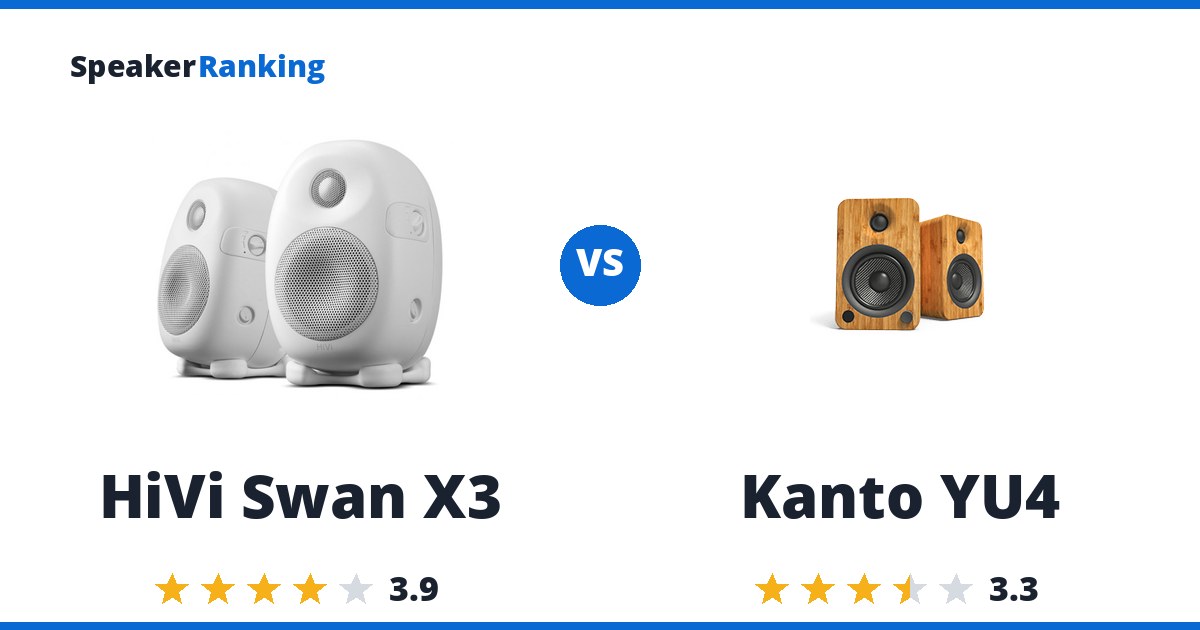
Why pick the HiVi Swan X3: ASR’s Spinorama data predicts 4.04 standalone and 7.03 with an ideal subwoofer, placing its bass-normalized tonal performance ahead of several similarly small budget monitors. The catch: Not a flat reference monitor: the response spans 5.0dB from 300Hz to 5kHz and trends upward toward the treble.
What the Kanto YU4 does well: Phono, optical and Bluetooth inputs, remote control and a subwoofer output make it convenient for a compact multi-source system. The catch: Standalone preference is only 2.89, with a -3dB point around 86Hz and a 4.2dB midrange response span.
Buy the HiVi Swan X3. It is rated higher for sound quality than the Kanto YU4 and costs less, which settles it without a real tradeoff to make.
Still deciding? The full Powered Home rankings cover every ranked option.
Specifications Side By Side
| HiVi Swan X3 | Kanto YU4 | |
|---|---|---|
| Price | $249 per pair | $479.99 per pair |
| Ranked | #7 of 24 in Small Size Powered Bookshelf Speakers | #14 of 24 in Small Size Powered Bookshelf Speakers |
| Enclosure | Active coaxial, rear-ported | Powered 2-way, rear-ported |
| Drivers | 3-inch coaxial woofer and tweeter | 1" silk-dome tweeter, 4" Kevlar woofer |
| Bass Extension (-6dB) | 71Hz (measured, Spinorama) | - |
| Inputs | RCA | Bluetooth, optical, RCA/phono, 3.5mm |
| Configuration | Powered desktop monitor | - |
| Spinorama Preference Score | 4.04 | 2.89 |
| Spinorama Preference Score with Perfect Sub | 7.03 | 5.83 |
| XLR Input | No | No |
| RCA Input | Yes | Yes |
| TRS Input | No | No |
| Optical Input | No | Yes |
| Coaxial Input | No | No |
| USB Input | No | No |
| HDMI Input | No | No |
| AES Input | No | No |
| Aux Input | No | Yes |
| Amplifier Power | 28W RMS Per Speaker | 70W RMS / 140W peak per pair |
| Bluetooth | No | Yes, 4.0 |
| Dimensions | 5" x 4.8" x 7.1" (128 x 123 x 181 mm) (W x D x H) | 8.7H x 5.5W x 7.5D in |
| Frequency Response | 75Hz - 20kHz (±2.5dB) (Manufacturer specified) | 60Hz-20kHz |
| Weight | 3.5 lbs (1.6 kg) each | 6.8 lbs (3.1 kg) powered / 5.5 lbs (2.5 kg) passive |
| Bluetooth Codecs | - | SBC, aptX |
| Outputs | - | Subwoofer |
| Subwoofer Output | - | Yes |
Related Speaker Comparisons
More top alternatives to HiVi Swan X3:
- Genelec 8010A vs HiVi Swan X3
- Adam Audio D3v vs HiVi Swan X3
- HiVi Swan X3 vs Cambridge Audio L/R S
- IK Multimedia iLoud Micro Monitor vs HiVi Swan X3
- HiVi Swan X3 vs Edifier M60
Prices on this page were last checked September 23, 2026 at 11:24 PM UTC. Product prices and availability are accurate as of that date/time and are subject to change; the price and availability shown on Amazon at the time of purchase will apply to the purchase of this product.
As an eBay Partner, we may be compensated if you make a purchase.
The Two Speakers In Full
 HiVi Swan X3: $249 per pair eBay
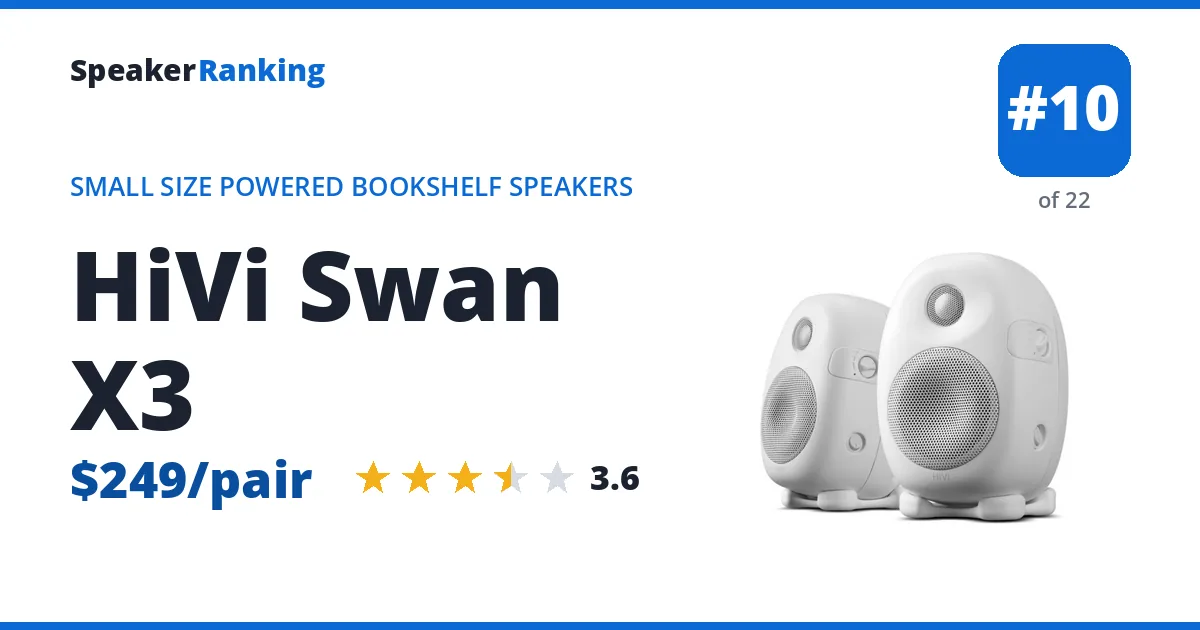
Pros: ASR’s Spinorama data predicts 4.04 standalone and 7.03 with an ideal subwoofer, placing its bass-normalized tonal performance ahead of several similarly small budget monitors. Listening-window narrow-band deviation is 0.420, lower than the MR3’s 0.538, indicating fewer local response irregularities by that measure. The compact coaxial layout is convenient for a small desktop system.
Cons: Not a flat reference monitor: the response spans 5.0dB from 300Hz to 5kHz and trends upward toward the treble. Bass reaches -3dB at about 79Hz, so a subwoofer remains important. Coaxial construction alone does not guarantee uniform dispersion, and the preference score does not establish distortion or maximum clean output.
Full HiVi Swan X3 review and specifications →
| AES Input | No |
|---|---|
| Amplifier Power | 28W RMS Per Speaker |
| Aux Input | No |
| Bass Extension (-6dB) | 71Hz (measured, Spinorama) |
| Bluetooth | No |
| Coaxial Input | No |
| Configuration | Powered desktop monitor |
| Dimensions | 5" x 4.8" x 7.1" (128 x 123 x 181 mm) (W x D x H) |
| Drivers | 3-inch coaxial woofer and tweeter |
| Enclosure | Active coaxial, rear-ported |
| Frequency Response | 75Hz - 20kHz (±2.5dB) (Manufacturer specified) |
| HDMI Input | No |
| Inputs | RCA |
| Optical Input | No |
| RCA Input | Yes |
| Spinorama Preference Score | 4.04 |
| Spinorama Preference Score with Perfect Sub | 7.03 |
| TRS Input | No |
| USB Input | No |
| Weight | 3.5 lbs (1.6 kg) each |
| XLR Input | No |
- Links
- Reviews, Comparisons and Sound Samples
- Head-to-Head Comparisons
- HiVi Swan X3 vs Edifier M60
- HiVi Swan X3 vs Edifier MR3
- HiVi Swan X3 vs IK Multimedia iLoud Micro Monitor
- HiVi Swan X3 vs Sovox MiniMax3
- HiVi Swan X3 vs Cambridge Audio L/R S
- HiVi Swan X3 vs Adam Audio D3v
- HiVi Swan X3 vs Bowers & Wilkins Formation Flex
- HiVi Swan X3 vs Genelec 8010A
- See all 16 comparisons
 Kanto YU4: $479.99 per pair Kanto eBay
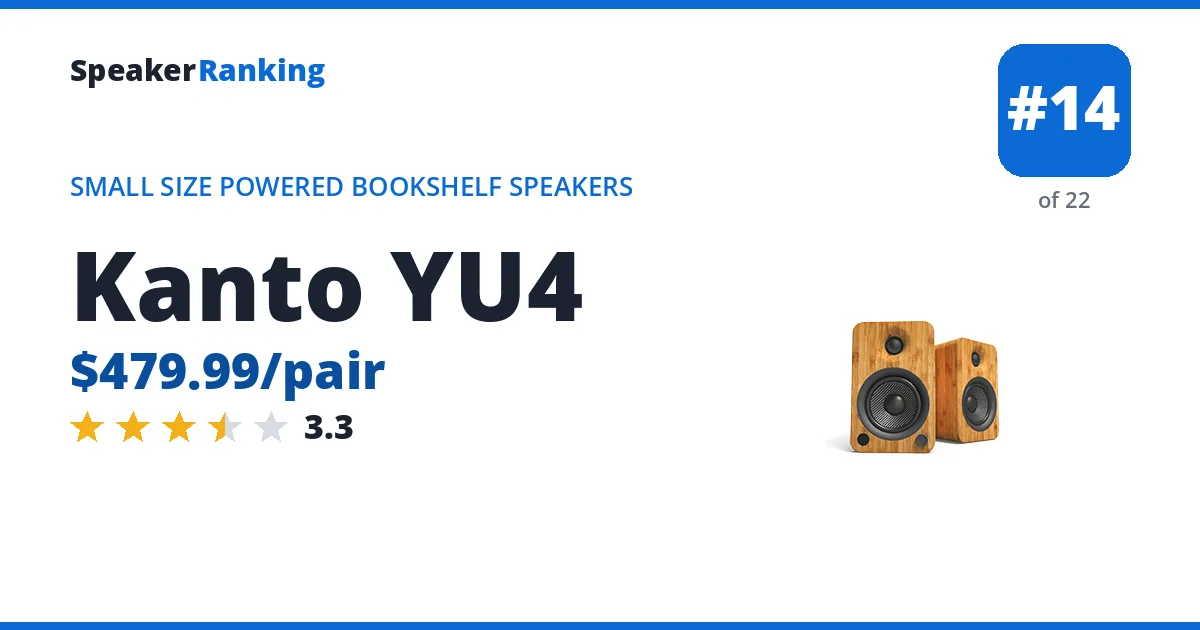
Pros: Phono, optical and Bluetooth inputs, remote control and a subwoofer output make it convenient for a compact multi-source system. ASR’s measured horizontal coverage is broad enough for some freedom of seating position. The ideal-subwoofer preference score of 5.83 indicates that bass support would materially improve its usefulness.
Cons: Standalone preference is only 2.89, with a -3dB point around 86Hz and a 4.2dB midrange response span. Response irregularities remain even after bass extension is removed from the comparison, so a subwoofer alone will not make it neutral. Sensitivity measured at an arbitrary powered-speaker gain setting is not a reliable basis for judging efficiency or maximum volume.
Full Kanto YU4 review and specifications →
| AES Input | No |
|---|---|
| Amplifier Power | 70W RMS / 140W peak per pair |
| Aux Input | Yes |
| Bluetooth | Yes, 4.0 |
| Bluetooth Codecs | SBC, aptX |
| Coaxial Input | No |
| Dimensions | 8.7H x 5.5W x 7.5D in |
| Drivers | 1" silk-dome tweeter, 4" Kevlar woofer |
| Enclosure | Powered 2-way, rear-ported |
| Frequency Response | 60Hz-20kHz |
| HDMI Input | No |
| Inputs | Bluetooth, optical, RCA/phono, 3.5mm |
| Optical Input | Yes |
| Outputs | Subwoofer |
| RCA Input | Yes |
| Spinorama Preference Score | 2.89 |
| Spinorama Preference Score with Perfect Sub | 5.83 |
| Subwoofer Output | Yes |
| TRS Input | No |
| USB Input | No |
| Weight | 6.8 lbs (3.1 kg) powered / 5.5 lbs (2.5 kg) passive |
| XLR Input | No |
- Links
- Reviews, Comparisons and Sound Samples
- Kanto YU4 Measurements (spinorama.org)
- Jasper Tech: Best Powered Bookshelf Speakers for Every Budget - 2025 More from Jasper Tech →
- Jasper Tech: Best Premium Computer Speakers: Kanto ORA4 Review & Comparison
- Jasper Tech: Best Desktop Computer Speakers for Every Budget
- Erin’s Audio Corner: 10 Great (and Terrible) Speakers Under $300! More from Erin’s Audio Corner →
- Head-to-Head Comparisons