Short answer: the ADAM Audio D3v. It ranks #3 of 47 powered bookshelf speakers by sound quality, rated 4.5/5, at $349.99; the Edifier MR5 ranks #78, rated 3.3/5, at $349.99. With prices this close, go by the sound-quality ranking rather than the cost.
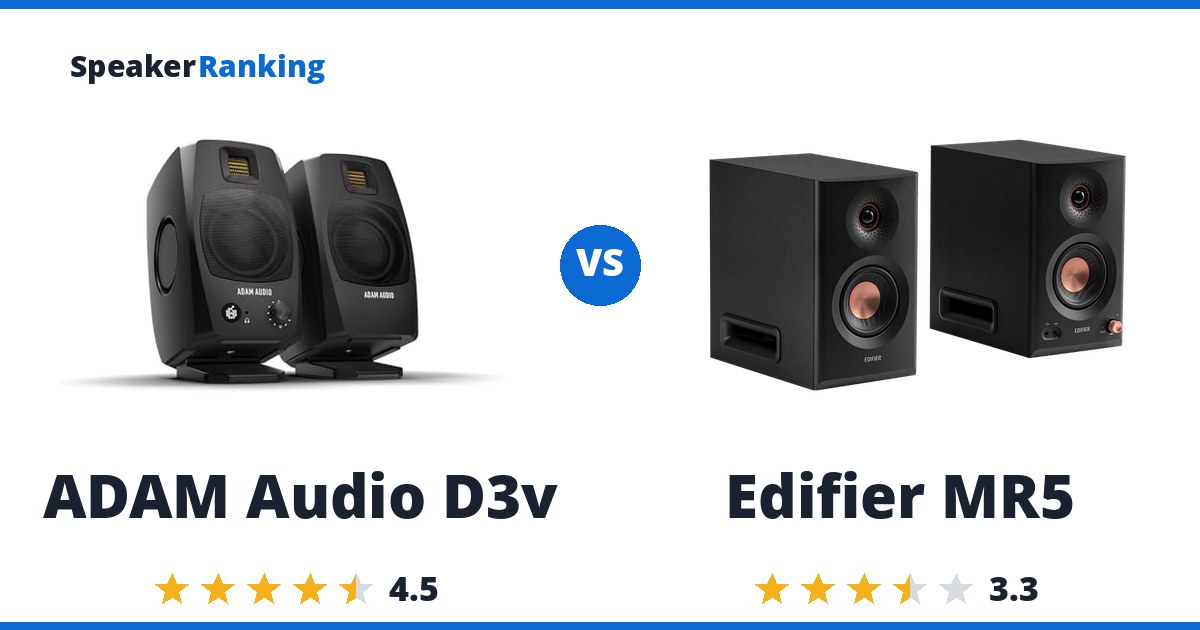
The case for the ADAM Audio D3v: Excellent midrange linearity for a tiny desktop speaker: Erin’s Klippel data spans just 1.7dB from 300Hz to 5kHz. The catch: A rising upper-frequency balance and vertical crossover interference keep it from being uniformly neutral at every angle; aim the tweeters toward ear height.
The case for the Edifier MR5: Erin’s Audio Corner measured useful bass for a compact 5-inch monitor, with F3 around 51Hz. It keeps a wired aux input, which the ADAM Audio D3v lacks. The tradeoff: Erin’s CTA-2034 data shows upper-midrange and treble irregularities, while off-axis response narrows more quickly than ideal above about 2-3kHz.
Buy the ADAM Audio D3v. It is rated higher for sound quality than the Edifier MR5 at the same price, which makes it the one to get unless you need something the other one does better.
Looking for alternatives? See the complete Powered Home rankings.
Specifications Side By Side
| ADAM Audio D3v | Edifier MR5 | |
|---|---|---|
| Price | $349.99 per pair | $349.99 per pair |
| Ranked | #3 of 47 in Small Size Powered Bookshelf Speakers | #78 of 108 in Medium Size Powered Bookshelf Speakers |
| Bass Extension (-10dB) | 45Hz (measured, Erin’s Audio Corner) | - |
| Bass Extension (-3dB) | 50Hz (measured, Erin’s Audio Corner) | 51Hz (measured, Erin’s Audio Corner) |
| App | No | Yes (Edifier ConneX) |
| Bluetooth | No | Yes |
| Dimensions | 200H (240H on included stand) x 115W x 150D mm | 6.3”W x 10.4”H x 11”D (159 x 264 x 280 mm) (active); 159W x 264H x 257D mm (passive) |
| EQ | Yes (Room adjustment filters) | Yes (app EQ and rear high/low controls) |
| Frequency Response | 48Hz - 22.6kHz (-3dB) (Manufacturer specified) | 46Hz-40kHz (Manufacturer specified) |
| Inputs | USB-C, balanced 1/4-inch TRS | Balanced XLR, balanced 6.35mm TRS, RCA, 3.5mm Aux |
| Sensitivity | 86.5dB (measured at 0.3V/1m, Erin’s Audio Corner) | 85dB (measured at 0.3V/1m, Erin’s Audio Corner) |
| Drivers | 3.5” aluminium woofer, D-ART folded ribbon tweeter, 2 x 3.5” passive radiators (each) | 5-inch woofer + 3.75-inch midrange + 1-inch silk-dome tweeter (each) |
| Weight | 7.9 lbs (3.58 kg) (pair) | 22.9 lbs (10.38 kg) |
| Amplifier Power | 100W RMS per speaker (70W woofer + 30W tweeter) (Manufacturer specified) | 110W RMS total (Manufacturer specified) |
| Maximum SPL | 98dB peak @ 1m (IEC-weighted noise, manufacturer specified) | 101dB (Manufacturer specified, 1m) |
| Spinorama Preference Score | 5.37 | - |
| Spinorama Preference Score with Perfect Sub | 7.59 | - |
| XLR Input | No | Yes |
| RCA Input | No | Yes |
| TRS Input | Yes | Yes |
| Optical Input | No | No |
| Coaxial Input | No | No |
| USB Input | Yes | No |
| HDMI Input | No | No |
| AES Input | No | No |
| Aux Input | No | Yes |
| Outputs | 3.5mm headphone | 3.5mm headphone |
| Headphone Output | Yes | Yes |
| Bluetooth Version | - | 6.0 |
| Bluetooth Codecs | - | LDAC, SBC |
| Measurement Source | - | Erin’s Audio Corner |
Watch Them Compared
Videos and reviews that test both speakers side by side.
Related Speaker Comparisons
How ADAM Audio D3v compares with other leading options:
- Audio Smile Little British Monitor vs ADAM Audio D3v
- ADAM Audio D3v vs Genelec 8010A
- ADAM Audio D3v vs Cambridge Audio L/R S
- ADAM Audio D3v vs IK Multimedia iLoud Micro Monitor
- ADAM Audio D3v vs IK Multimedia iLoud Micro Monitor Pro
Prices on this page were last checked October 11, 2026 at 4:59 PM UTC. Product prices and availability are accurate as of that date/time and are subject to change; the price and availability shown on Amazon at the time of purchase will apply to the purchase of this product.
As an eBay Partner, we may be compensated if you make a purchase.
The Two Speakers In Full
 ADAM Audio D3v: $349.99 per pair Amazon $349.99 eBay

Pros: Excellent midrange linearity for a tiny desktop speaker: Erin’s Klippel data spans just 1.7dB from 300Hz to 5kHz. Side passive radiators help bass reach -3dB at about 51Hz, substantially deeper than the Genelec 8010A or Audio Smile Little British Monitor. Predicted preference scores of 5.37 standalone and 7.59 with an ideal subwoofer support it as a particularly useful compact system without a sub. USB-C, analog inputs and placement filters simplify desk setup. Measured bass extension of 50Hz (-3dB), with a measured sensitivity of 86.5dB.
Cons: A rising upper-frequency balance and vertical crossover interference keep it from being uniformly neutral at every angle; aim the tweeters toward ear height. The limiter reduces bass and midrange output as volume rises, with the existing review’s compression tests putting usable maximum output around 89-90dB at 1m. Deep bass at moderate volume should not be confused with high output capability.
Full ADAM Audio D3v review and specifications →
| Released | Nov 2024 (1 year ago) |
|---|---|
| AES Input | No |
| Amplifier Power | 100W RMS per speaker (70W woofer + 30W tweeter) (Manufacturer specified) |
| App | No |
| Aux Input | No |
| Bass Extension (-10dB) | 45Hz (measured, Erin’s Audio Corner) |
| Bass Extension (-3dB) | 50Hz (measured, Erin’s Audio Corner) |
| Bluetooth | No |
| Coaxial Input | No |
| Dimensions | 200H (240H on included stand) x 115W x 150D mm |
| Drivers | 3.5” aluminium woofer, D-ART folded ribbon tweeter, 2 x 3.5” passive radiators (each) |
| EQ | Yes (Room adjustment filters) |
| Frequency Response | 48Hz - 22.6kHz (-3dB) (Manufacturer specified) |
| HDMI Input | No |
| Headphone Output | Yes |
| Inputs | USB-C, balanced 1/4-inch TRS |
| Maximum SPL | 98dB peak @ 1m (IEC-weighted noise, manufacturer specified) |
| Optical Input | No |
| Outputs | 3.5mm headphone |
| RCA Input | No |
| Sensitivity | 86.5dB (measured at 0.3V/1m, Erin’s Audio Corner) |
| Spinorama Preference Score | 5.37 |
| Spinorama Preference Score with Perfect Sub | 7.59 |
| TRS Input | Yes |
| USB Input | Yes |
| Weight | 7.9 lbs (3.58 kg) (pair) |
| XLR Input | No |
- Links
- Reviews, Comparisons and Sound Samples
- Erin’s Audio Corner: ADAM Audio D3V: Mighty Small But Mighty Awesome Desktop Speaker More from Erin’s Audio Corner →
- Erin’s Audio Review Adam Audio D3v
- Erin’s Audio Corner Measurements (spinorama.org)
- Jasper Tech: Best Desktop Computer Speakers for Every Budget – 2026 More from Jasper Tech →
- Jasper Tech: Are the D3V The Best Studio Monitors For The Money?
- Erin’s Audio Corner: The Best Budget Desktop Speakers, Tested & Rated
- Head-to-Head Comparisons
- ADAM Audio D3v vs Genelec 8010A
- ADAM Audio D3v vs Cambridge Audio L/R S
- ADAM Audio D3v vs Audio Smile Little British Monitor
- ADAM Audio D3v vs IK Multimedia iLoud Micro Monitor
- ADAM Audio D3v vs IK Multimedia iLoud Micro Monitor Pro
- ADAM Audio D3v vs Edifier M60
- ADAM Audio D3v vs HiVi Swan X3
- ADAM Audio D3v vs Edifier MR3
- See all 25 comparisons
 Edifier MR5: $349.99 per pair Amazon $349.99 B&H Photo Video $249.99 Lowest eBay
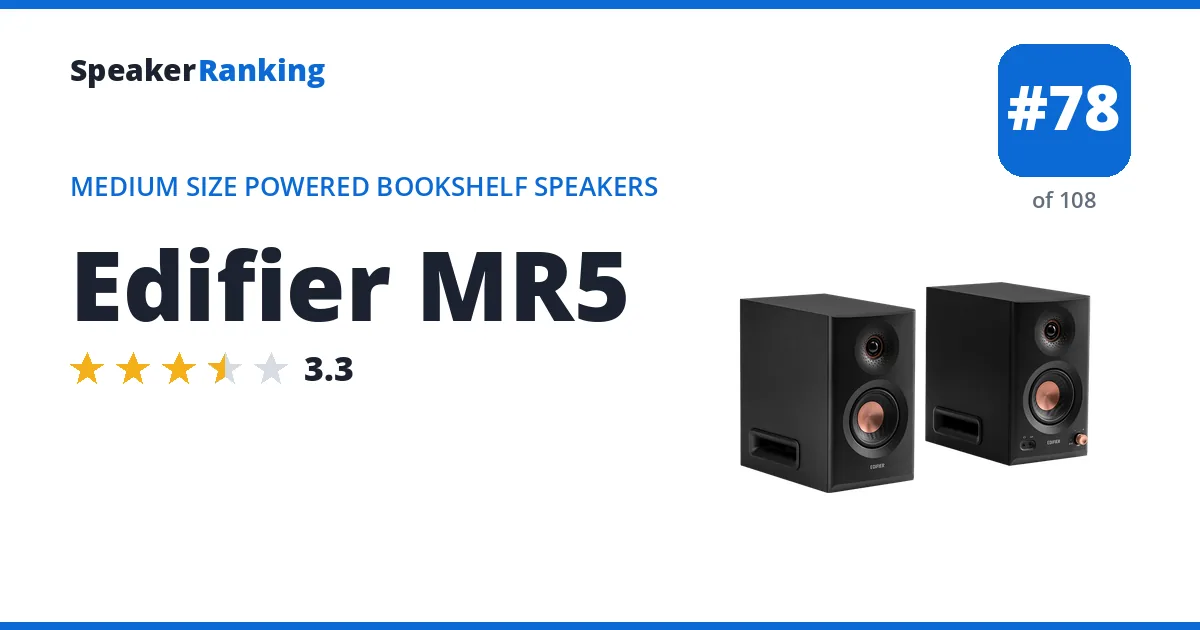
Same family: the Edifier MR3 (smaller bookshelf, rated 3.8/5), the Edifier MR4 (smaller bookshelf, ranked higher, rated 3.5/5) and the Edifier MR4.5 (smaller bookshelf, ranked higher, rated 3.6/5).
Pros: Erin’s Audio Corner measured useful bass for a compact 5-inch monitor, with F3 around 51Hz. The three-way active design adds a dedicated 3.75-inch midrange, and the 110W RMS system, app EQ, room-compensation controls, LDAC, balanced XLR/TRS inputs, and front headphone output make it unusually well equipped at $350 per pair. Measured bass extension of 51Hz (-3dB), with a measured sensitivity of 85dB.
Cons: Erin’s CTA-2034 data shows upper-midrange and treble irregularities, while off-axis response narrows more quickly than ideal above about 2-3kHz. Bass output is level-limited below about 70Hz and distortion/compression rise at higher levels, so it suits moderate nearfield use better than loud mid-field playback.
Full Edifier MR5 review and specifications →
| Released | Jun 2025 (1 year ago) |
|---|---|
| AES Input | No |
| Amplifier Power | 110W RMS total (Manufacturer specified) |
| App | Yes (Edifier ConneX) |
| Aux Input | Yes |
| Bass Extension (-3dB) | 51Hz (measured, Erin’s Audio Corner) |
| Bluetooth | Yes |
| Bluetooth Codecs | LDAC, SBC |
| Bluetooth Version | 6.0 |
| Coaxial Input | No |
| Dimensions | 6.3”W x 10.4”H x 11”D (159 x 264 x 280 mm) (active); 159W x 264H x 257D mm (passive) |
| Drivers | 5-inch woofer + 3.75-inch midrange + 1-inch silk-dome tweeter (each) |
| EQ | Yes (app EQ and rear high/low controls) |
| Frequency Response | 46Hz-40kHz (Manufacturer specified) |
| HDMI Input | No |
| Headphone Output | Yes |
| Inputs | Balanced XLR, balanced 6.35mm TRS, RCA, 3.5mm Aux |
| Maximum SPL | 101dB (Manufacturer specified, 1m) |
| Measurement Source | Erin’s Audio Corner |
| Optical Input | No |
| Outputs | 3.5mm headphone |
| RCA Input | Yes |
| Sensitivity | 85dB (measured at 0.3V/1m, Erin’s Audio Corner) |
| TRS Input | Yes |
| USB Input | No |
| Weight | 22.9 lbs (10.38 kg) |
| XLR Input | Yes |
- Links
- Reviews, Comparisons and Sound Samples
- Head-to-Head Comparisons