Short answer: the Bowers & Wilkins 802 D4. Both are rated 3.6/5 for sound quality (#171 and #175 of 226 floorstanding speakers), and the Bowers & Wilkins 802 D4 costs $30,000 against $35,000 for the Bowers & Wilkins 803 D5, so with nothing between them on sound quality, price settles it.
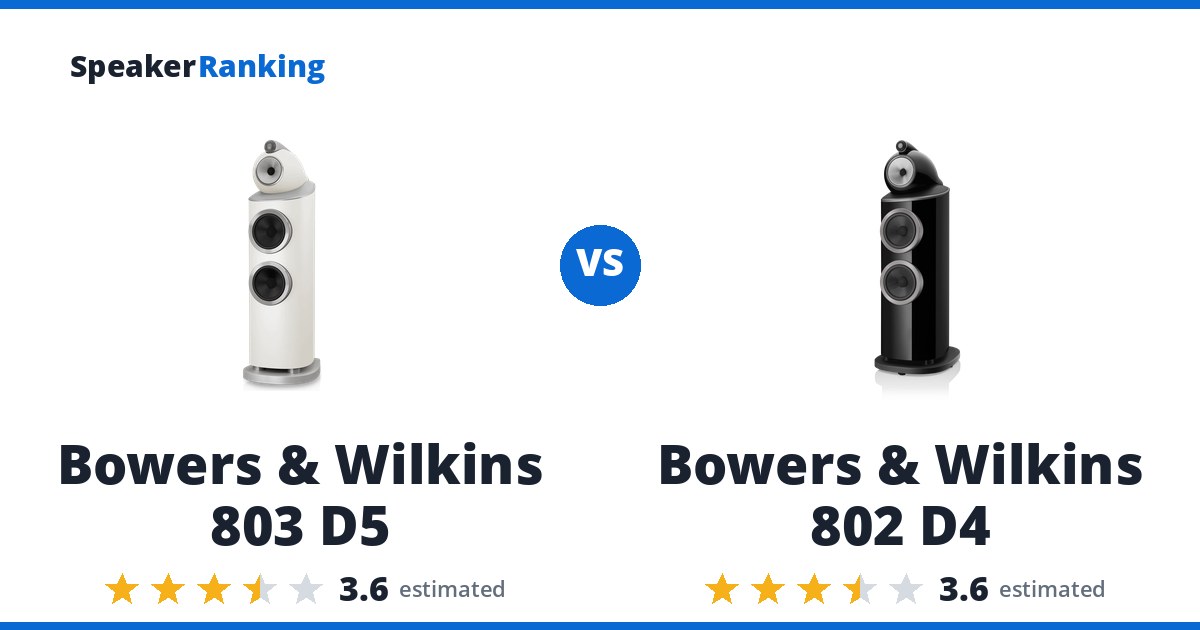
The case for the Bowers & Wilkins 803 D5: The first 800 D5 model with the separate turbine head midrange enclosure: a 1” diamond dome tweeter on top, a 5” Continuum FST midrange in its own head, and two 7” Aerofoil bass drivers. The catch: No independent measurements yet, so its tonal balance and directivity can’t be compared directly with measured speakers; the rating is estimated from the 800 D4 models it replaces.
The case for the Bowers & Wilkins 802 D4: Larger 6-inch Turbine Head midrange and dual 8-inch Aerofoil woofers yield effortless dynamic scale and authoritative low-frequency reach to 17Hz. Watch for: Non-flat frequency voicing with energetic top-end presence departs from neutral studio target curves.
Buy the Bowers & Wilkins 802 D4. Both are rated the same for sound quality, and it costs $5,000 less than the Bowers & Wilkins 803 D5.
About the ratings: neither speaker has been measured yet, so both ratings are estimated from measured siblings and predecessors (likely ranges: Bowers & Wilkins 803 D5 3.3 to 3.9; Bowers & Wilkins 802 D4 3.4 to 3.8). Treat this verdict as provisional.
Still deciding? The full Passive Home rankings cover every ranked option.
Specifications Side By Side
| Bowers & Wilkins 803 D5 | Bowers & Wilkins 802 D4 | |
|---|---|---|
| Price | $35,000 per pair | $30,000 per pair |
| Ranked | #175 of 226 in Large Size Floorstanding Speakers Estimated | #171 of 226 in Large Size Floorstanding Speakers Estimated |
| Bass Extension (-3dB) | 19Hz (manufacturer specified) | 17Hz (manufacturer specified) |
| Drivers | 1” (25mm) Diamond dome tweeter, 5” (130mm) Continuum cone FST midrange, 2 x 7” (180mm) Aerofoil bass | 1” (25mm) Diamond dome tweeter, 6” (150mm) Continuum cone FST midrange in Turbine Head, 2 x 8” (200mm) Aerofoil bass units |
| Frequency Response | 19Hz - 28kHz ±3dB (manufacturer specified) | 17Hz - 28kHz (+/- 3dB, manufacturer specified) |
| Sensitivity | 90dB (2.83V/1m, manufacturer specified) | 90dB (2.83V/1m, manufacturer specified) |
| Impedance | 8 ohms nominal, 3.0 ohms minimum (manufacturer specified) | 8 ohms nominal, 3.0 ohms minimum (manufacturer specified) |
| Woofer Cabinet | ported | ported, down-firing Flowport |
| Dimensions | 45.9”H x 11.9”W x 18.6”D (1165 x 301 x 473 mm) | 48”H x 16.3”W x 23.7”D (1218 x 413 x 602 mm) |
| Weight | 140.4 lbs (63.7 kg) each | 194.2 lbs (88.1 kg) each |
| DIY Kit | No | No |
Related Speaker Comparisons
How Bowers & Wilkins 802 D4 compares with other leading options:
- Bowers & Wilkins 801 D4 vs Bowers & Wilkins 802 D4
- Bowers & Wilkins 802 D4 vs Bowers & Wilkins 803 D4
- Bowers & Wilkins 802 D4 vs Bowers & Wilkins 804 D5
- Bowers & Wilkins 803 D5 vs Bowers & Wilkins 803 D4
- Bowers & Wilkins 803 D5 vs Bowers & Wilkins 804 D5
Prices on this page were last checked October 11, 2026 at 4:59 PM UTC. Product prices and availability are accurate as of that date/time and are subject to change; the price and availability shown on Amazon at the time of purchase will apply to the purchase of this product.
As an eBay Partner, we may be compensated if you make a purchase.
The Two Speakers In Full
 Bowers & Wilkins 803 D5: $35,000 per pair Estimated Bowers & Wilkins eBay

Older models: the Bowers & Wilkins 803 D4 (ranked lower, estimated 3.5/5) and the Bowers & Wilkins 803 D3 (ranked lower, estimated 3.4/5). See every Bowers & Wilkins 800 Series generation.
Same family: the Bowers & Wilkins 805 D5 (bookshelf, estimated 3.3/5), the Bowers & Wilkins 804 D5 (smaller floorstanding, ranked lower, estimated 3.5/5), the Bowers & Wilkins 802 D5 (larger floorstanding, ranked higher, estimated 3.7/5), the Bowers & Wilkins 801 D5 (larger floorstanding, ranked higher, estimated 3.8/5), the Bowers & Wilkins HTM82 D5 (smaller center, estimated 3.3/5) and the Bowers & Wilkins HTM81 D5 (larger center, estimated 3.4/5).
Pros: The first 800 D5 model with the separate turbine head midrange enclosure: a 1” diamond dome tweeter on top, a 5” Continuum FST midrange in its own head, and two 7” Aerofoil bass drivers. B&W rates it to 19Hz (±3dB) with 90dB sensitivity, so it plays loud from modest amplifier power.
Cons: No independent measurements yet, so its tonal balance and directivity can’t be compared directly with measured speakers; the rating is estimated from the 800 D4 models it replaces. Bowers & Wilkins’ house voicing, which the measured Bowers & Wilkins HTM81 D4 showed as a 4.9dB spread across the listening window, is likely to carry over, so expect a less neutral balance than similarly priced Revel or KEF models. The impedance dips to 3.0 ohms and each speaker weighs 63.7kg.
Full Bowers & Wilkins 803 D5 review and specifications →
| Released | Jul 2026 (3 months ago) |
|---|---|
| Bass Extension (-3dB) | 19Hz (manufacturer specified) |
| DIY Kit | No |
| Dimensions | 45.9”H x 11.9”W x 18.6”D (1165 x 301 x 473 mm) |
| Drivers | 1” (25mm) Diamond dome tweeter, 5” (130mm) Continuum cone FST midrange, 2 x 7” (180mm) Aerofoil bass |
| Frequency Response | 19Hz - 28kHz ±3dB (manufacturer specified) |
| Impedance | 8 ohms nominal, 3.0 ohms minimum (manufacturer specified) |
| Sensitivity | 90dB (2.83V/1m, manufacturer specified) |
| Weight | 140.4 lbs (63.7 kg) each |
| Woofer Cabinet | ported |
- Links
- Reviews, Comparisons and Sound Samples
- No independent measurement review is linked for this model; it is ranked from hands-on listening and comparison against similarly priced speakers.
- Head-to-Head Comparisons
 Bowers & Wilkins 802 D4: $30,000 per pair Estimated Bowers & Wilkins eBay

Newer model: the Bowers & Wilkins 802 D5, ranked higher, estimated 3.7/5, released Jun 2026.
Older models: the Bowers & Wilkins Nautilus 802 (ranked higher, rated 4/5) and the Bowers & Wilkins 802 Diamond (ranked higher, estimated 3.8/5). See every Bowers & Wilkins 800 Series generation.
Same family: the Bowers & Wilkins 805 D4 (bookshelf, estimated 3.2/5), the Bowers & Wilkins 804 D4 (smaller floorstanding, ranked lower, estimated 3.4/5), the Bowers & Wilkins 803 D4 (smaller floorstanding, ranked lower, estimated 3.5/5), the Bowers & Wilkins 801 D4 (larger floorstanding, ranked higher, estimated 3.7/5) and the Bowers & Wilkins HTM81 D4 (center, rated 3.3/5).
Pros: Larger 6-inch Turbine Head midrange and dual 8-inch Aerofoil woofers yield effortless dynamic scale and authoritative low-frequency reach to 17Hz. Benchmark industrial craftsmanship and acoustic isolation.
Cons: Non-flat frequency voicing with energetic top-end presence departs from neutral studio target curves. Enormous 194-lb weight and 3.0-ohm impedance dips require uncompromised amplification and spacious room placement.
Full Bowers & Wilkins 802 D4 review and specifications →
| Released | Aug 2021 (5 years ago) |
|---|---|
| Bass Extension (-3dB) | 17Hz (manufacturer specified) |
| DIY Kit | No |
| Dimensions | 48”H x 16.3”W x 23.7”D (1218 x 413 x 602 mm) |
| Drivers | 1” (25mm) Diamond dome tweeter, 6” (150mm) Continuum cone FST midrange in Turbine Head, 2 x 8” (200mm) Aerofoil bass units |
| Frequency Response | 17Hz - 28kHz (+/- 3dB, manufacturer specified) |
| Impedance | 8 ohms nominal, 3.0 ohms minimum (manufacturer specified) |
| Sensitivity | 90dB (2.83V/1m, manufacturer specified) |
| Weight | 194.2 lbs (88.1 kg) each |
| Woofer Cabinet | ported, down-firing Flowport |
- Links
- Reviews, Comparisons and Sound Samples
- No independent measurement review is linked for this model; it is ranked from hands-on listening and comparison against similarly priced speakers.
- Head-to-Head Comparisons