Short answer: the Polk Reserve R500. Both are rated 4.2/5 for sound quality (#85 and #92 of 226 floorstanding speakers), and the Polk Reserve R500 costs $1,118 against $1,198 for the ELAC Uni-Fi 2.0 UF52, so with nothing between them on sound quality, price settles it.

The case for the ELAC Uni-Fi 2.0 UF52: 3-way concentric floorstanding speaker incorporating a 4-inch aluminum midrange with integrated 1-inch wide-surround tweeter, combined with triple 5.25-inch aluminum woofers. The catch: Rating estimated based on Uni-Fi 2.0 series sibling testing.
Why pick the Polk Reserve R500: Dual 5.25” midwoofers paired with a ring radiator tweeter in a floorstanding tower design. The catch: A bump around 4-6kHz gives a “shouty,” mildly sibilant quality in the lower treble.
Buy the Polk Reserve R500. Both are rated the same for sound quality, and it costs $80 less than the ELAC Uni-Fi 2.0 UF52.
About the ratings: the ELAC Uni-Fi 2.0 UF52’s rating is estimated from measured siblings and predecessors rather than its own measurements, with a likely range of 4.0 to 4.4, so this verdict could change once it is measured.
Still deciding? The full Passive Home rankings cover every ranked option.
Specifications Side By Side
| ELAC Uni-Fi 2.0 UF52 | Polk Reserve R500 | |
|---|---|---|
| Price | $1,198 per pair | $1,118 per pair |
| Ranked | #92 of 226 in Large Size Floorstanding Speakers Estimated | #85 of 226 in Large Size Floorstanding Speakers |
| Drivers | Concentric 1” soft dome tweeter & 4” aluminum midrange, 3 x 5.25” aluminum woofers | Two 5.25” Turbine Cone woofer, 1” Pinnacle Ring Radiator tweeter |
| Frequency Response | 42Hz - 35kHz (manufacturer specified) | - |
| Sensitivity | 85dB (2.83V/1m, manufacturer specified) | 86.2dB (measured, Erin’s Audio Corner) |
| Impedance | 6 ohms nominal, 4.8 ohms minimum (manufacturer specified) | 4.1 ohms minimum above 80Hz (measured, Erin’s Audio Corner; 8 ohms nominal per manufacturer) |
| Bass Extension (-3dB) | 42Hz (manufacturer specified) | 51Hz (measured, Erin’s Audio Corner) |
| Dimensions | 38.6”H x 7.3”W x 10.8”D (980 x 185 x 275 mm) | 40.3”H x 6.8”W x 12.4”D (1023.6 x 172.7 x 315 mm) |
| Weight | 43.2 lbs (19.6 kg) each | 39.2 lbs (17.8 kg) each |
| DIY Kit | No | No |
| Bass Extension (-10dB) | - | 33Hz (measured, Erin’s Audio Corner) |
| Woofer Cabinet | - | ported, rear |
| Spinorama Preference Score | - | 5.86 |
| Spinorama Preference Score with Perfect Sub | - | 7.44 |
Related Speaker Comparisons
More worthwhile head-to-heads for Polk Reserve R500:
- Polk Reserve R500 vs Revel F328Be
- Polk Reserve R500 vs KEF R5 Meta
- Revel F226Be vs Polk Reserve R500
- KEF Reference 203 vs Polk Reserve R500
- JBL HDI-3800 vs Polk Reserve R500
Prices on this page were last checked October 11, 2026 at 4:59 PM UTC. Product prices and availability are accurate as of that date/time and are subject to change; the price and availability shown on Amazon at the time of purchase will apply to the purchase of this product.
As an eBay Partner, we may be compensated if you make a purchase.
The Two Speakers In Full
 ELAC Uni-Fi 2.0 UF52: $1,198 per pair Estimated Amazon eBay
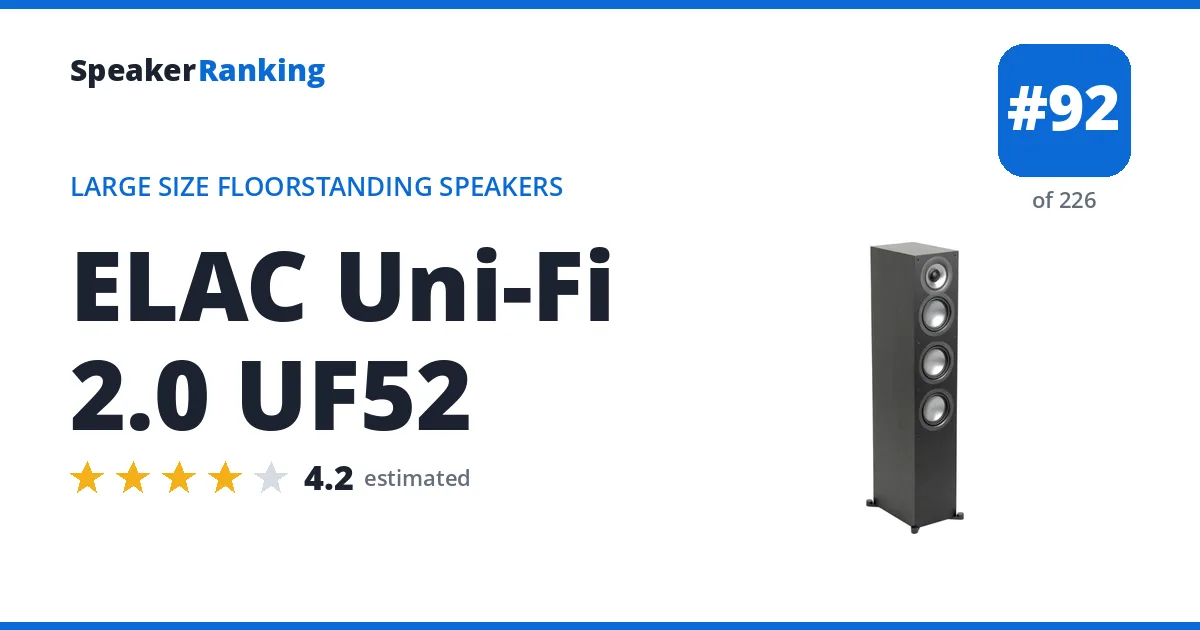
Same family: the ELAC Uni-Fi 2.0 UB52 (bookshelf, rated 2.4/5) and the ELAC Uni-Fi 2.0 UC52 (center, rated 3.9/5). See every ELAC Uni-Fi generation.
Pros: 3-way concentric floorstanding speaker incorporating a 4-inch aluminum midrange with integrated 1-inch wide-surround tweeter, combined with triple 5.25-inch aluminum woofers. True point-source acoustic coherence provides exceptionally uniform horizontal and vertical dispersion with extended bass down to 42Hz.
Cons: Rating estimated based on Uni-Fi 2.0 series sibling testing. 85dB sensitivity and low impedance dips demand high-current amplification to avoid receiver strain at high listening levels.
Full ELAC Uni-Fi 2.0 UF52 review and specifications →
| Released | Sep 2020 (6 years ago) |
|---|---|
| Bass Extension (-3dB) | 42Hz (manufacturer specified) |
| DIY Kit | No |
| Dimensions | 38.6”H x 7.3”W x 10.8”D (980 x 185 x 275 mm) |
| Drivers | Concentric 1” soft dome tweeter & 4” aluminum midrange, 3 x 5.25” aluminum woofers |
| Frequency Response | 42Hz - 35kHz (manufacturer specified) |
| Impedance | 6 ohms nominal, 4.8 ohms minimum (manufacturer specified) |
| Sensitivity | 85dB (2.83V/1m, manufacturer specified) |
| Weight | 43.2 lbs (19.6 kg) each |
- Links
- Reviews, Comparisons and Sound Samples
- No independent measurement review is linked for this model; it is ranked from hands-on listening and comparison against similarly priced speakers.
- Head-to-Head Comparisons
 Polk Reserve R500: $1,118 per pair Amazon eBay
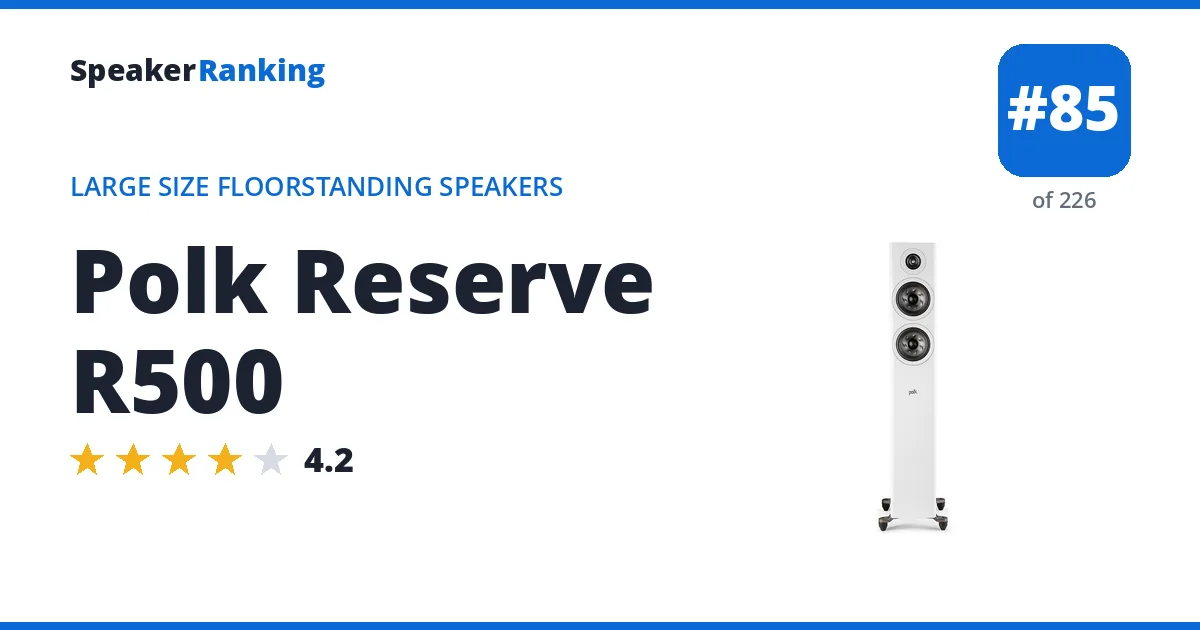
Same family: the Polk Reserve R100 (smaller bookshelf, rated 3.4/5), the Polk R200 (larger bookshelf, rated 3.2/5), the Polk Reserve R600 (larger floorstanding, ranked lower, estimated 4.2/5), the Polk Audio Reserve R700 (larger floorstanding, ranked higher, rated 4.3/5), the Polk Audio Reserve R300 (smallest center, estimated 3.6/5), the Polk Audio Reserve R350 (center, rated 3.7/5) and the Polk Audio Reserve R400 (largest center, estimated 3.8/5).
Pros: Dual 5.25” midwoofers paired with a ring radiator tweeter in a floorstanding tower design. Surprisingly neutral overall compared to Polk’s smaller bookshelf models: notably more even-handed than the brighter-sounding Polk R200 the reviewer tested previously. Good linearity on-axis, within about -3/+2dB. Sensitivity close to 86dB, easily driven to adequate levels in a small-to-medium room with a 100W-capable amplifier. Takes very well to EQ: a single band of correction (about a 2dB cut around 4-5kHz) resolves the main tonal issue and transforms the sound. Dynamic range and compression performance is solidly “medium,” holding up fine through about 20dB of level increase before higher-frequency and bass output start to taper at extreme volumes. Measured bass extension of 51Hz (-3dB), with a measured sensitivity of 86.2dB.
Cons: A bump around 4-6kHz gives a “shouty,” mildly sibilant quality in the lower treble. Counterintuitively, toeing the speaker out to reduce brightness makes this worse rather than better, since the ring-radiator tweeter’s directivity narrows rapidly above about 6-7kHz: pointed on-axis retains enough top-end air to balance the bump, but toed away that air drops off and the shoutiness stands out more. Bass is adequate for its 5.25” woofers but lacks real weight below about 40-50Hz; a subwoofer is still needed for movies and bass-heavy music. A cabinet resonance around 160-170Hz subtracts from rather than adds boom to the mid-bass region. Vertical listening window is fairly narrow: sitting more than about 10-20° above or below the tweeter axis causes a suckout in the 2-5kHz range, reducing clarity and attack. Multitone distortion ramps up noticeably around 1kHz, and crossing over to a subwoofer at 80Hz doesn’t meaningfully reduce it: likely a surround-related effect rather than excursion-related. Without applying corrective EQ, the reviewer says the 4-6kHz brightness would make it harder to live with day to day.
Full Polk Reserve R500 review and specifications →
| Released | 2021 (5 years ago) |
|---|---|
| Bass Extension (-10dB) | 33Hz (measured, Erin’s Audio Corner) |
| Bass Extension (-3dB) | 51Hz (measured, Erin’s Audio Corner) |
| DIY Kit | No |
| Dimensions | 40.3”H x 6.8”W x 12.4”D (1023.6 x 172.7 x 315 mm) |
| Drivers | Two 5.25” Turbine Cone woofer, 1” Pinnacle Ring Radiator tweeter |
| Impedance | 4.1 ohms minimum above 80Hz (measured, Erin’s Audio Corner; 8 ohms nominal per manufacturer) |
| Sensitivity | 86.2dB (measured, Erin’s Audio Corner) |
| Spinorama Preference Score | 5.86 |
| Spinorama Preference Score with Perfect Sub | 7.44 |
| Weight | 39.2 lbs (17.8 kg) each |
| Woofer Cabinet | ported, rear |
- Links
- Reviews, Comparisons and Sound Samples
- Erin’s Audio Corner: Polk R500 Tower Speaker Review. More from Erin’s Audio Corner →
- Erin’s Audio Review Website Polk Reserve R500
- Erin’s Audio Corner: My Personal Favorite Speakers Under $2500
- Erin’s Audio Corner Measurements (spinorama.org)
- Erin’s Audio Corner: Why the Emotiva XT2 Outperforms Other Speakers
- Head-to-Head Comparisons
- Polk Reserve R500 vs ELAC Debut 3.0 DF63
- Polk Reserve R500 vs Linkwitz Lab LXmini
- Polk Reserve R500 vs Emotiva Airmotiv T2+
- Polk Reserve R500 vs Infinity Primus 360
- Polk Reserve R500 vs Emotiva Airmotiv XT2
- Polk Reserve R500 vs ELAC Debut 3.0 DF53
- Polk Reserve R500 vs PSB Imagine T65
- Polk Reserve R500 vs Polk Audio Reserve R700
- See all 37 comparisons