Short answer: the Polk Reserve R500, if you are buying new. The JBL HDI-3800 ranks higher than it (#25 vs #74 of 188 floorstanding speakers, 4.5/5 vs 4.2/5) but is discontinued, so only consider it used; the Polk Reserve R500 is still sold new at $1,118.
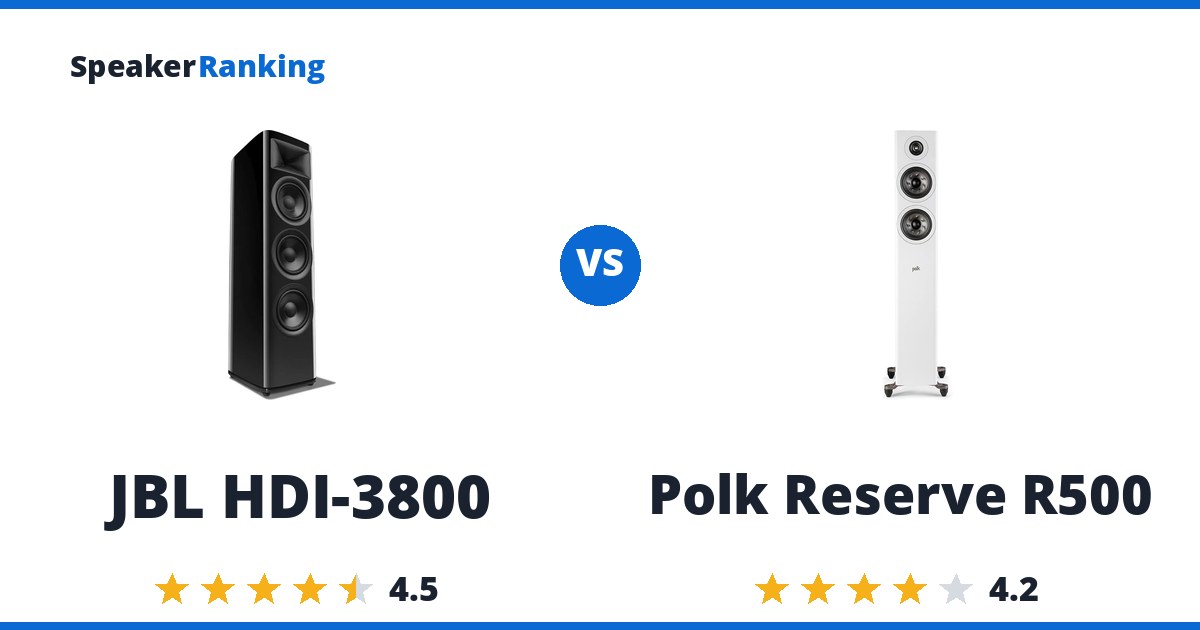
The JBL HDI-3800 is the deeper-bass option. 2410H-2 1” Teonex compression driver matched to a custom High-Definition Imaging (HDI) horn geometry achieves exceptional horizontal directivity control, high output capability, and effortless transient response. Its bass reaches about 37Hz before falling 3dB, against 51Hz for the Polk Reserve R500. The catch: On-axis frequency response features a narrow upper-frequency elevation around 8-10kHz, performing noticeably smoother when toed out 10-20° off-axis.
What the Polk Reserve R500 does well: Dual 5.25” midwoofers paired with a ring radiator tweeter in a floorstanding tower design. The tradeoff: A bump around 4-6kHz gives a “shouty,” mildly sibilant quality in the lower treble.
Buy the Polk Reserve R500, since the JBL HDI-3800 is discontinued and only worth hunting down used.
Want more options? Browse the full Passive Home rankings.
Specifications Side By Side
| JBL HDI-3800 | Polk Reserve R500 | |
|---|---|---|
| Price | $5,000 per pair Discontinued | $1,118 per pair |
| Ranked | #25 of 188 in Large Size Floorstanding Speakers | #74 of 188 in Large Size Floorstanding Speakers |
| Bass Extension (-10dB) | 28Hz (measured, Erin’s Audio Corner) | 33Hz (measured, Erin’s Audio Corner) |
| Bass Extension (-3dB) | 37Hz (measured, Erin’s Audio Corner) | 51Hz (measured, Erin’s Audio Corner) |
| Dimensions | 43.3”H x 11.8”W x 16.4”D (1100.5 x 300.0 x 417.8 mm) | 40.3”H x 6.8”W x 12.4”D (1023.6 x 172.7 x 315 mm) |
| Impedance | 4 ohms nominal (3.8 ohms minimum, measured by Erin’s Audio Corner) | 4.1 ohms minimum above 80Hz (measured, Erin’s Audio Corner; 8 ohms nominal per manufacturer) |
| Sensitivity | 92dB (measured average, Erin’s Audio Corner) | 86.2dB (measured, Erin’s Audio Corner) |
| Drivers | 1 in. 2410H-2 Teonex compression driver with HDI horn, triple 8 in. Advanced Aluminum Matrix cone woofers | Two 5.25” Turbine Cone woofer, 1” Pinnacle Ring Radiator tweeter |
| Weight | 83.8 lbs (38.0 kg) each | 39.2 lbs (17.8 kg) each |
| Woofer Cabinet | ported, rear | ported, rear |
| Spinorama Preference Score | 5.62 | 5.86 |
| Spinorama Preference Score with Perfect Sub | 7.03 | 7.44 |
| DIY Kit | No | No |
Related Speaker Comparisons
More top alternatives to JBL HDI-3800:
- KEF Blade Two Meta vs JBL HDI-3800
- JBL HDI-3800 vs MoFi SourcePoint V10 Master Edition
- MoFi SourcePoint 888 vs JBL HDI-3800
- JBL HDI-3800 vs Revel F328Be
- Ascend Acoustics ELX Ribbon Tower vs JBL HDI-3800
Prices on this page were last checked October 7, 2026 at 9:25 PM UTC. Product prices and availability are accurate as of that date/time and are subject to change; the price and availability shown on Amazon at the time of purchase will apply to the purchase of this product.
As an eBay Partner, we may be compensated if you make a purchase.
The Two Speakers In Full
 JBL HDI-3800: $5,000 per pair Discontinued eBay
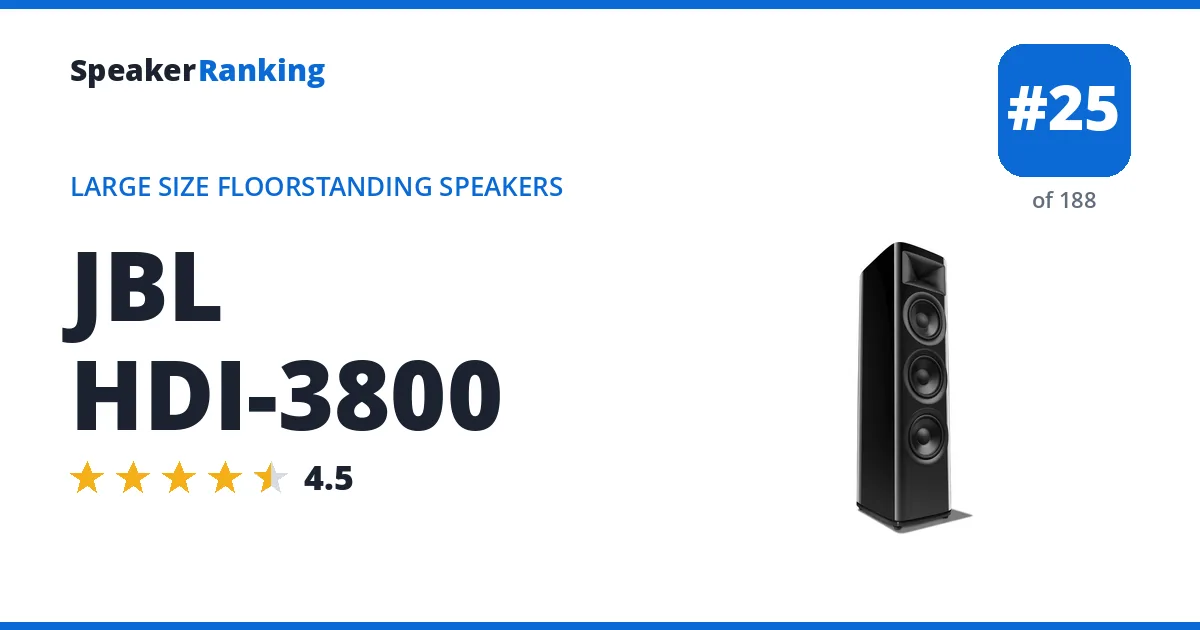
Same family: the JBL HDI-1600 (bookshelf, rated 4.2/5), the JBL HDI-3600 (smaller floorstanding, ranked lower, rated 4.3/5) and the JBL HDI-4500 (center, rated 3.7/5).
Pros: 2410H-2 1” Teonex compression driver matched to a custom High-Definition Imaging (HDI) horn geometry achieves exceptional horizontal directivity control, high output capability, and effortless transient response. Triple 8” Advanced Aluminum Matrix woofers deliver deep, authoritative bass extension down to an F3 of 37Hz and F10 of 28Hz with minimal low-frequency compression. Outstanding sensitivity (92dB SPL at 2.83V/1m) and ultra-low THD/multitone distortion allow extremely high undistorted SPL output in large home theater spaces. Measured bass extension of 37Hz (-3dB), with a measured sensitivity of 92dB.
Cons: On-axis frequency response features a narrow upper-frequency elevation around 8-10kHz, performing noticeably smoother when toed out 10-20° off-axis. Vertical directivity handoff across the triple woofer layout creates vertical soundstage height tilt depending on listening distance and ear height. Minimum impedance dips to 3.8 ohms, requiring high-current amplifier stability. Substantial cabinet dimensions and 38kg weight require significant room real estate. Discontinued.
Full JBL HDI-3800 review and specifications →
| Bass Extension (-10dB) | 28Hz (measured, Erin’s Audio Corner) |
|---|---|
| Bass Extension (-3dB) | 37Hz (measured, Erin’s Audio Corner) |
| DIY Kit | No |
| Dimensions | 43.3”H x 11.8”W x 16.4”D (1100.5 x 300.0 x 417.8 mm) |
| Drivers | 1 in. 2410H-2 Teonex compression driver with HDI horn, triple 8 in. Advanced Aluminum Matrix cone woofers |
| Impedance | 4 ohms nominal (3.8 ohms minimum, measured by Erin’s Audio Corner) |
| Sensitivity | 92dB (measured average, Erin’s Audio Corner) |
| Spinorama Preference Score | 5.62 |
| Spinorama Preference Score with Perfect Sub | 7.03 |
| Weight | 83.8 lbs (38.0 kg) each |
| Woofer Cabinet | ported, rear |
- Links
- Reviews, Comparisons and Sound Samples
- Head-to-Head Comparisons
 Polk Reserve R500: $1,118 per pair Amazon eBay
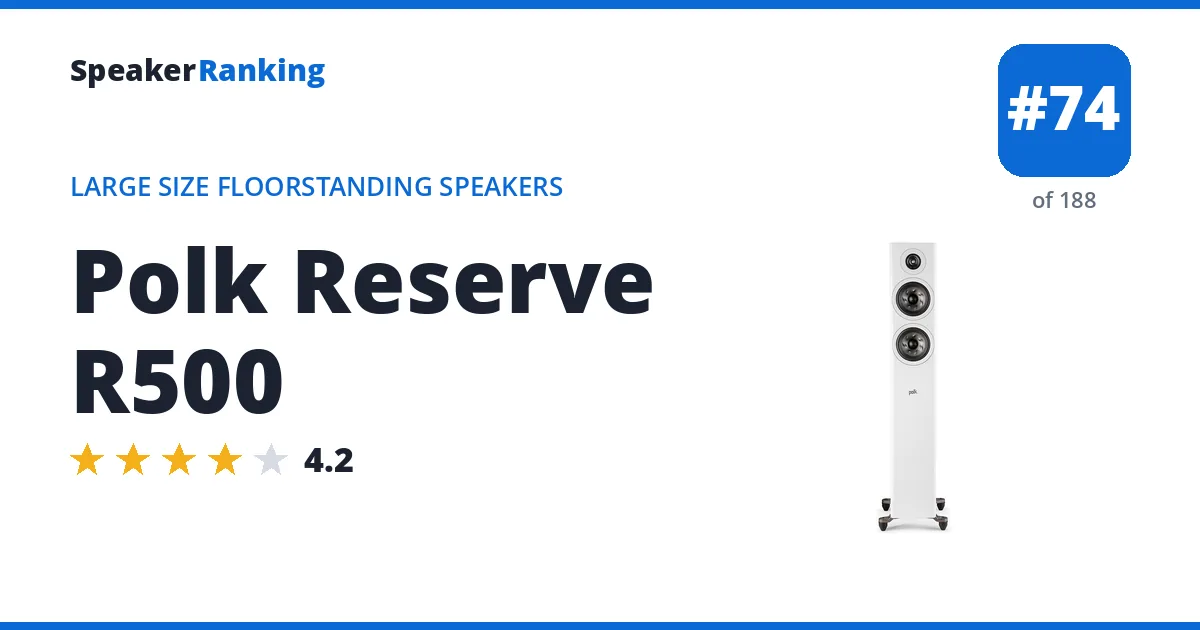
Same family: the Polk Reserve R100 (smaller bookshelf, rated 3.4/5), the Polk R200 (larger bookshelf, rated 3.2/5), the Polk Reserve R600 (larger floorstanding, ranked lower, estimated 4.2/5), the Polk Audio Reserve R700 (larger floorstanding, ranked higher, rated 4.3/5), the Polk Audio Reserve R300 (smallest center, estimated 3.6/5), the Polk Audio Reserve R350 (center, rated 3.7/5) and the Polk Audio Reserve R400 (largest center, estimated 3.8/5).
Pros: Dual 5.25” midwoofers paired with a ring radiator tweeter in a floorstanding tower design. Surprisingly neutral overall compared to Polk’s smaller bookshelf models: notably more even-handed than the brighter-sounding R200 the reviewer tested previously. Good linearity on-axis, within about -3/+2dB. Sensitivity close to 86dB, easily driven to adequate levels in a small-to-medium room with a 100W-capable amplifier. Takes very well to EQ: a single band of correction (about a 2dB cut around 4-5kHz) resolves the main tonal issue and transforms the sound. Dynamic range and compression performance is solidly “medium,” holding up fine through about 20dB of level increase before higher-frequency and bass output start to taper at extreme volumes. Measured bass extension of 51Hz (-3dB), with a measured sensitivity of 86.2dB.
Cons: A bump around 4-6kHz gives a “shouty,” mildly sibilant quality in the lower treble. Counterintuitively, toeing the speaker out to reduce brightness makes this worse rather than better, since the ring-radiator tweeter’s directivity narrows rapidly above about 6-7kHz: pointed on-axis retains enough top-end air to balance the bump, but toed away that air drops off and the shoutiness stands out more. Bass is adequate for its 5.25” woofers but lacks real weight below about 40-50Hz; a subwoofer is still needed for movies and bass-heavy music. A cabinet resonance around 160-170Hz subtracts from rather than adds boom to the mid-bass region. Vertical listening window is fairly narrow: sitting more than about 10-20° above or below the tweeter axis causes a suckout in the 2-5kHz range, reducing clarity and attack. Multitone distortion ramps up noticeably around 1kHz, and crossing over to a subwoofer at 80Hz doesn’t meaningfully reduce it: likely a surround-related effect rather than excursion-related. Without applying corrective EQ, the reviewer says the 4-6kHz brightness would make it harder to live with day to day.
Full Polk Reserve R500 review and specifications →
| Bass Extension (-10dB) | 33Hz (measured, Erin’s Audio Corner) |
|---|---|
| Bass Extension (-3dB) | 51Hz (measured, Erin’s Audio Corner) |
| DIY Kit | No |
| Dimensions | 40.3”H x 6.8”W x 12.4”D (1023.6 x 172.7 x 315 mm) |
| Drivers | Two 5.25” Turbine Cone woofer, 1” Pinnacle Ring Radiator tweeter |
| Impedance | 4.1 ohms minimum above 80Hz (measured, Erin’s Audio Corner; 8 ohms nominal per manufacturer) |
| Sensitivity | 86.2dB (measured, Erin’s Audio Corner) |
| Spinorama Preference Score | 5.86 |
| Spinorama Preference Score with Perfect Sub | 7.44 |
| Weight | 39.2 lbs (17.8 kg) each |
| Woofer Cabinet | ported, rear |
- Links
- Reviews, Comparisons and Sound Samples
- Head-to-Head Comparisons
- Polk Reserve R500 vs ELAC Debut 3.0 DF63
- Polk Reserve R500 vs Linkwitz Lab LXmini
- Polk Reserve R500 vs Emotiva Airmotiv T2+
- Polk Reserve R500 vs Infinity Primus 360
- Polk Reserve R500 vs PSB Imagine T65
- Polk Reserve R500 vs Polk Audio Reserve R700
- Polk Reserve R500 vs JBL HDI-3600
- Polk Reserve R500 vs JBL Studio 698
- See all 34 comparisons