Short answer: the Edifier MR5. It ranks #77 of 105 powered bookshelf speakers by sound quality, rated 3.3/5, at $349.99. The Yamaha HS4 ranks #32, rated 3.1/5, at $249.99, $100 cheaper, which does not close the gap in sound quality.
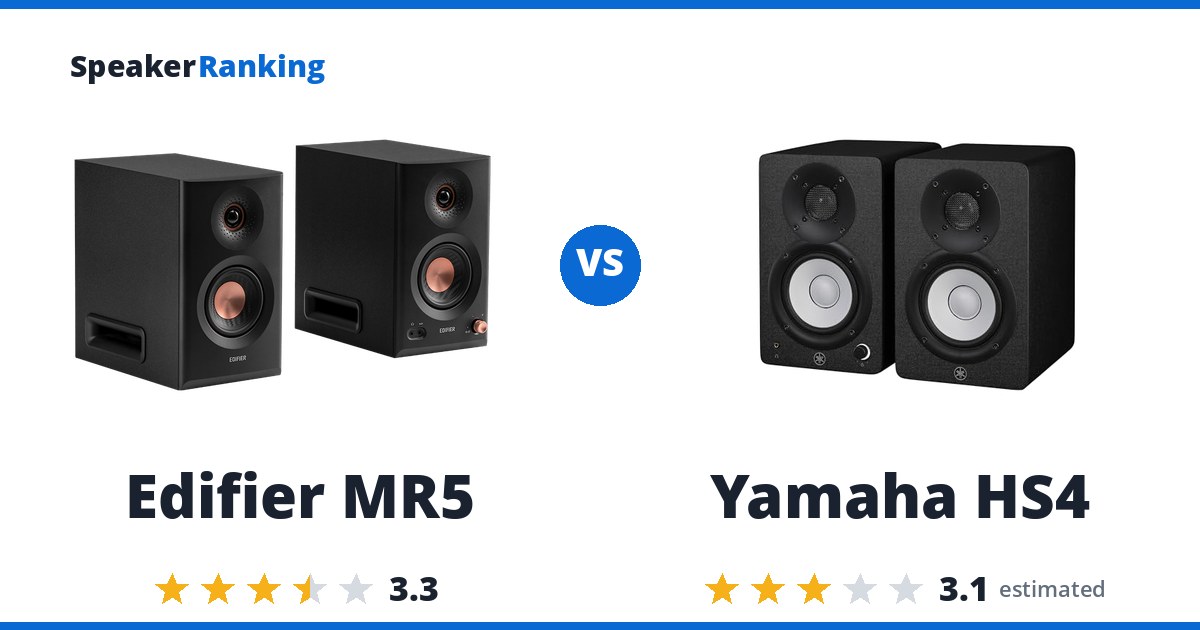
The case for the Edifier MR5: Erin’s Audio Corner measured useful bass for a compact 5-inch monitor, with F3 around 51Hz. The tradeoff: Erin’s CTA-2034 data shows upper-midrange and treble irregularities, while off-axis response narrows more quickly than ideal above about 2-3kHz.
The case for the Yamaha HS4: Active compact desktop monitor featuring a 4.5-inch white cone woofer and a 1-inch soft dome tweeter driven by a clean 26W + 26W Class-D amplifier. The tradeoff: Rating estimated from HS-series measured lineage.
Buy the Edifier MR5. It is rated higher for sound quality, and the $100 you would save on the Yamaha HS4 does not close the gap.
Worth knowing: the Yamaha HS4 has not been measured yet. Its rating is estimated from related models, with a likely range of 2.9 to 3.3, so treat this verdict as provisional.
Want more options? Browse the full Powered Home rankings.
Specifications Side By Side
| Edifier MR5 | Yamaha HS4 | |
|---|---|---|
| Price | $349.99 per pair | $249.99 per pair |
| Ranked | #77 of 105 in Medium Size Powered Bookshelf Speakers | #32 of 47 in Small Size Powered Bookshelf Speakers Estimated |
| Dimensions | 6.3”W x 10.4”H x 11”D (159 x 264 x 280 mm) (active); 159W x 264H x 257D mm (passive) | 9.4” x 5.9” x 8.4” (240 x 150 x 213 mm) |
| Frequency Response | 46Hz-40kHz (Manufacturer specified) | 60Hz - 22kHz (-10dB) |
| Inputs | Balanced XLR, balanced 6.35mm TRS, RCA, 3.5mm Aux | - |
| Outputs | 3.5mm headphone | - |
| Weight | 22.9 lbs (10.38 kg) | 8.2 lbs (3.7 kg) (pair total) |
| Drivers | 5-inch woofer + 3.75-inch midrange + 1-inch silk-dome tweeter (each) | 1” soft dome tweeter, 4.5” cone woofer |
| App | Yes (Edifier ConneX) | - |
| Bluetooth Version | 6.0 | - |
| Bluetooth Codecs | LDAC, SBC | - |
| EQ | Yes (app EQ and rear high/low controls) | - |
| Amplifier Power | 110W RMS total (Manufacturer specified) | 52W (26W + 26W dynamic) |
| Maximum SPL | 101dB (Manufacturer specified, 1m) | - |
| Bass Extension (-3dB) | 51Hz (measured, Erin’s Audio Corner) | - |
| Sensitivity | 85dB (measured at 0.3V/1m, Erin’s Audio Corner) | - |
| Measurement Source | Erin’s Audio Corner | - |
| Headphone Output | Yes | - |
| XLR Input | Yes | - |
| RCA Input | Yes | - |
| TRS Input | Yes | - |
| Optical Input | No | - |
| Coaxial Input | No | - |
| USB Input | No | - |
| HDMI Input | No | - |
| AES Input | No | - |
| Aux Input | Yes | - |
| Bluetooth | Yes | No |
| Crossover Frequency | - | 2.3kHz |
Related Speaker Comparisons
More top alternatives to Yamaha HS4:
- Monoprice Monolith MM-3 vs Yamaha HS4
- Bose Companion 2 Series III vs Yamaha HS4
- Yamaha HS4 vs Yamaha HS3
- Onkyo GX-30ARC vs Edifier MR5
- JBL 305P MKII vs Edifier MR5
Prices on this page were last checked October 11, 2026 at 4:59 PM UTC. Product prices and availability are accurate as of that date/time and are subject to change; the price and availability shown on Amazon at the time of purchase will apply to the purchase of this product.
As an eBay Partner, we may be compensated if you make a purchase.
The Two Speakers In Full
 Edifier MR5: $349.99 per pair Amazon B&H Photo Video eBay
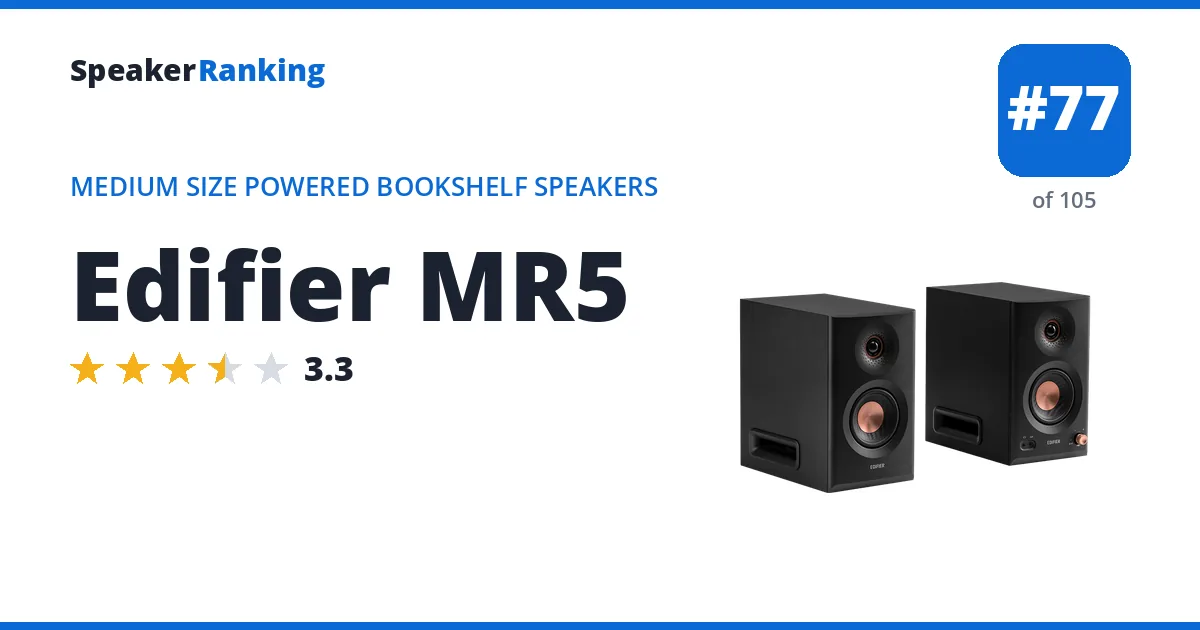
Same family: the Edifier MR3 (smaller bookshelf, rated 3.8/5), the Edifier MR4 (smaller bookshelf, ranked higher, rated 3.5/5) and the Edifier MR4.5 (smaller bookshelf, ranked higher, rated 3.6/5).
Pros: Erin’s Audio Corner measured useful bass for a compact 5-inch monitor, with F3 around 51Hz. The three-way active design adds a dedicated 3.75-inch midrange, and the 110W RMS system, app EQ, room-compensation controls, LDAC, balanced XLR/TRS inputs, and front headphone output make it unusually well equipped at $350 per pair. Measured bass extension of 51Hz (-3dB), with a measured sensitivity of 85dB.
Cons: Erin’s CTA-2034 data shows upper-midrange and treble irregularities, while off-axis response narrows more quickly than ideal above about 2-3kHz. Bass output is level-limited below about 70Hz and distortion/compression rise at higher levels, so it suits moderate nearfield use better than loud mid-field playback.
Full Edifier MR5 review and specifications →
| Released | Jun 2025 (1 year ago) |
|---|---|
| AES Input | No |
| Amplifier Power | 110W RMS total (Manufacturer specified) |
| App | Yes (Edifier ConneX) |
| Aux Input | Yes |
| Bass Extension (-3dB) | 51Hz (measured, Erin’s Audio Corner) |
| Bluetooth | Yes |
| Bluetooth Codecs | LDAC, SBC |
| Bluetooth Version | 6.0 |
| Coaxial Input | No |
| Dimensions | 6.3”W x 10.4”H x 11”D (159 x 264 x 280 mm) (active); 159W x 264H x 257D mm (passive) |
| Drivers | 5-inch woofer + 3.75-inch midrange + 1-inch silk-dome tweeter (each) |
| EQ | Yes (app EQ and rear high/low controls) |
| Frequency Response | 46Hz-40kHz (Manufacturer specified) |
| HDMI Input | No |
| Headphone Output | Yes |
| Inputs | Balanced XLR, balanced 6.35mm TRS, RCA, 3.5mm Aux |
| Maximum SPL | 101dB (Manufacturer specified, 1m) |
| Measurement Source | Erin’s Audio Corner |
| Optical Input | No |
| Outputs | 3.5mm headphone |
| RCA Input | Yes |
| Sensitivity | 85dB (measured at 0.3V/1m, Erin’s Audio Corner) |
| TRS Input | Yes |
| USB Input | No |
| Weight | 22.9 lbs (10.38 kg) |
| XLR Input | Yes |
- Links
- Reviews, Comparisons and Sound Samples
- Head-to-Head Comparisons
 Yamaha HS4: $249.99 per pair Estimated Amazon eBay

Same family: the Yamaha HS3 (smaller bookshelf, ranked lower, estimated 2.9/5), the Yamaha HS5 (larger bookshelf, rated 3.6/5), the Yamaha HS7 (larger bookshelf, rated 3.9/5), the Yamaha HS8 (larger bookshelf, rated 4.4/5) and the Yamaha HS8S (subwoofer, rated 3/5).
Pros: Active compact desktop monitor featuring a 4.5-inch white cone woofer and a 1-inch soft dome tweeter driven by a clean 26W + 26W Class-D amplifier. Delivers a more balanced low-end response (reaching down to 60Hz at -10dB) and smoother high-frequency dispersion than the Yamaha HS3, while including flexible XLR/TRS, RCA, and 3.5mm stereo inputs along with Room Control and High Trim boundary acoustic switches.
Cons: Rating estimated from HS-series measured lineage. Lower output capability and less bass extension than the dedicated bi-amplified Yamaha HS5; master/slave passive wire configuration for the second speaker.
Full Yamaha HS4 review and specifications →
| Released | Nov 2023 (2 years ago) |
|---|---|
| Amplifier Power | 52W (26W + 26W dynamic) |
| Bluetooth | No |
| Crossover Frequency | 2.3kHz |
| Dimensions | 9.4” x 5.9” x 8.4” (240 x 150 x 213 mm) |
| Drivers | 1” soft dome tweeter, 4.5” cone woofer |
| Frequency Response | 60Hz - 22kHz (-10dB) |
| Weight | 8.2 lbs (3.7 kg) (pair total) |
- Links
- Reviews, Comparisons and Sound Samples
- No independent measurement review is linked for this model; it is ranked from hands-on listening and comparison against similarly priced speakers.
- Head-to-Head Comparisons