Coverage note. Speaker Ranking currently covers 8 Fiio models across powered speakers and headphones. These are the products in our database, not a complete list of everything Fiio makes.
What this page covers. The Fiio models ranked here span powered speakers and headphones, including FiiO FT1 Pro, FiiO FH5s and FiiO FD5. Use each model’s category position to compare it with alternatives of the same size and use case.
This page lists all 8 Fiio speakers ranked on this site across powered speakers and headphones. Each model is shown in the category where it competes, with its current rank and the size of that ranking.
Use the category position rather than the brand name alone: speakers from the same manufacturer can perform very differently by size, price and product family.
Prices on this page were last checked October 10, 2026 at 5:37 PM UTC. Product prices and availability are accurate as of that date/time and are subject to change; the price and availability shown on Amazon at the time of purchase will apply to the purchase of this product.
As an eBay Partner, we may be compensated if you make a purchase.
Quick Navigation
Small Size Powered Bookshelf Speakers
 Ranked #37 of 47 in Small Size Powered Bookshelf Speakers - Fiio SP3: $299.99 per pair Amazon eBay
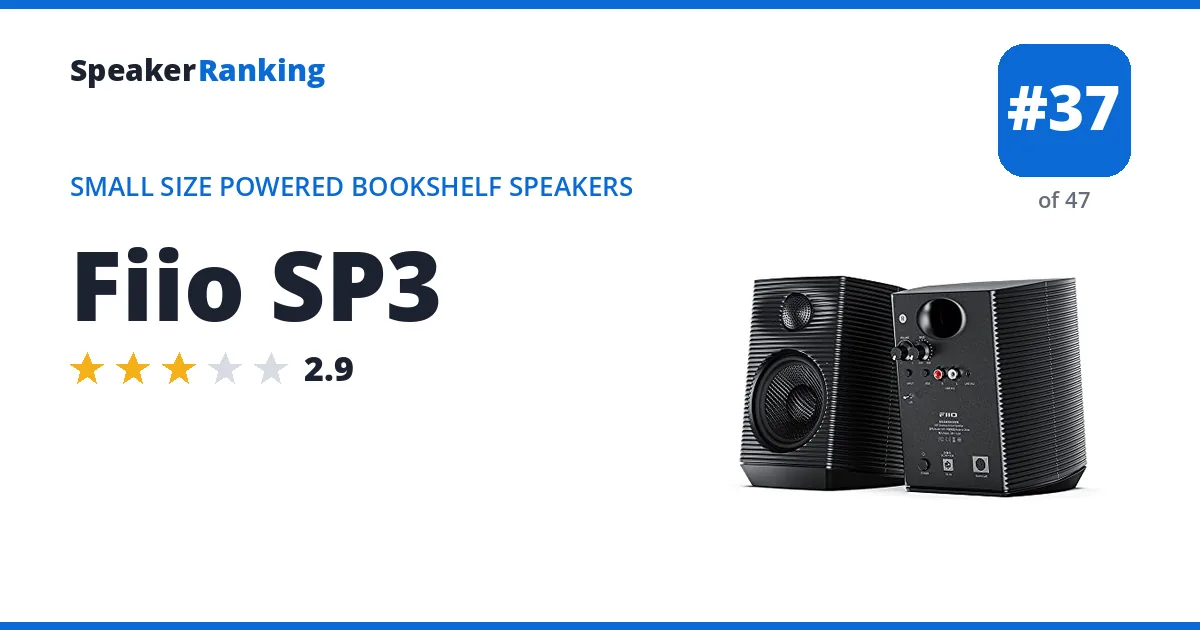
Pros: Compact cabinets and angled bases fit a small desk. The existing review found useful dynamic capability at higher frequencies, so lack of output is not the only issue. Erin’s Klippel data shows a measured -3dB bass point around 60Hz, deeper than several similarly sized alternatives. Measured bass extension of 59Hz (-3dB).
Cons: The response rises strongly toward the treble, about 1.13dB per octave, with a recessed midrange and problematic crossover behavior. Its 3.56 standalone and 6.17 ideal-subwoofer scores do not capture the full practical impact of the review’s boomy bass and off-axis tonal problems. Changing angle trades one coloration for another. Those audible limitations weigh against it more heavily than its numerical score or build quality.
Full Fiio SP3 review and specifications →
| Released | Jan 2023 (3 years ago) |
|---|---|
| AES Input | No |
| Amplifier Power | 40W total (30W midwoofer + 10W tweeter) |
| Aux Input | Yes |
| Bass Extension (-10dB) | 53Hz (measured, Erin’s Audio Corner) |
| Bass Extension (-3dB) | 59Hz (measured, Erin’s Audio Corner) |
| Bluetooth | No |
| Coaxial Input | No |
| Dimensions | 6.4”H x 4.7”W x 5.2”D (163 x 120 x 132 mm) |
| Drivers | 3.5” carbon fiber midwoofer, 1” silk dome tweeter |
| Frequency Response | 65Hz - 20kHz (±2dB) (Manufacturer specified) |
| HDMI Input | No |
| Inputs | AUX, RCA |
| Optical Input | No |
| RCA Input | Yes |
| Spinorama Preference Score | 3.56 |
| Spinorama Preference Score with Perfect Sub | 6.17 |
| TRS Input | No |
| USB Input | No |
| Weight | 4.3 lbs (1.95 kg) each |
| XLR Input | No |
- Links
- Reviews, Comparisons and Sound Samples
- Head-to-Head Comparisons
Over-Ear Headphones
 Ranked #26 of 134 in Over-Ear Headphones - FiiO FT1 Pro: $219.99 Amazon eBay
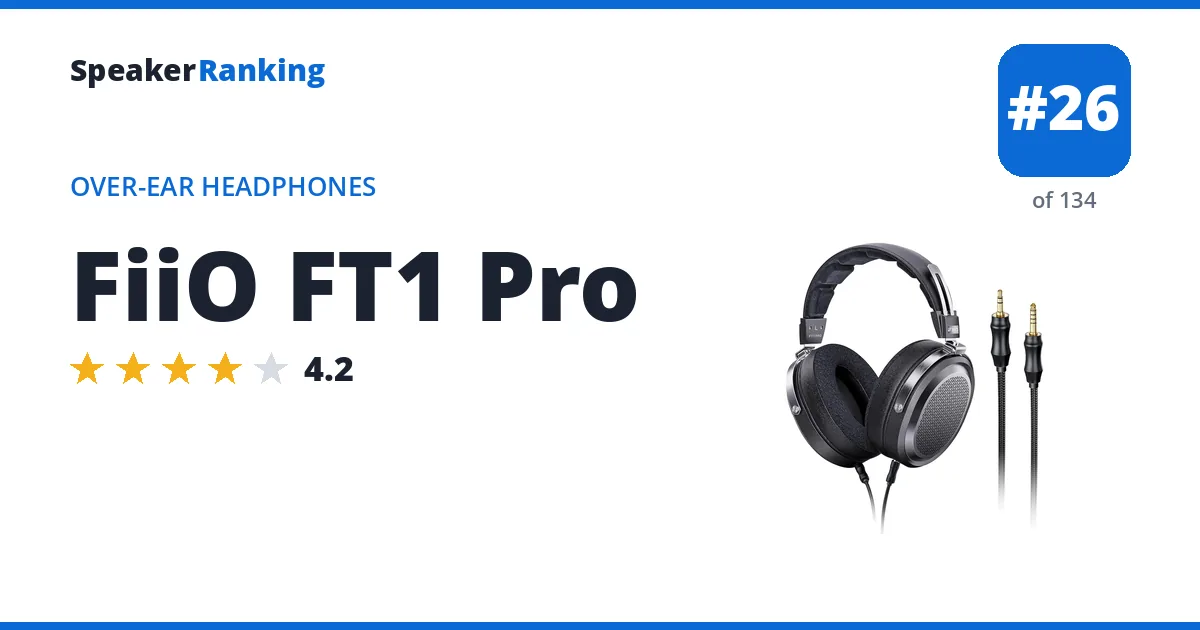
Pros: Planar magnetic drivers with a 20 ohm impedance and 95 dB per milliwatt sensitivity make it easy to drive from a dongle or phone while delivering a preference score of 86. Bass from 60 to 200 Hz is essentially on target and sub-bass is only about 2.5 dB light, giving clean, controlled low end. Its rating matches the Audio-Technica ATH-M70x and Beyerdynamic TYGR 300 R, with a lower price than the M70x.
Cons: A 10 dB dip near 9.6 kHz and treble about 1 dB low soften cymbals and the upper edge of vocals, while a 3.5 dB peak near 2.9 kHz can add some forwardness. Low mids run about 1.6 dB above target, which adds a touch of thickness. At 374 g it is fairly heavy, and the open back leaks sound.
Full FiiO FT1 Pro review and specifications →
| Released | Nov 2024 (1 year ago) |
|---|---|
| Back | Open |
| Connection | Wired |
| Deviation From Target | 2.16 dB standard deviation |
| Driver Type | Planar magnetic |
| Drivers | 1 x 95x86mm planar magnetic |
| Form Factor | Over-ear |
| Frequency Response | 7Hz - 40kHz (Manufacturer specified) |
| Harman Preference Score | 86 (measured by oratory1990, via AutoEQ) |
| Impedance | 20 ohms |
| Sensitivity | 95 dB/mW |
| Tonal Tilt | -0.07 (negative is warmer, positive brighter) |
| Weight | 0.8 lbs (374 g) |
EQ preset to match the Harman target
Set a preamp of -4.1 dB, then add these filters in any parametric equalizer (Wavelet, Equalizer APO, Peace, or a player with parametric EQ). Calculated by AutoEQ from its measured frequency response.
| Filter | Frequency | Gain | Q |
|---|---|---|---|
| Low shelf | 105 Hz | +4.2 dB | 0.70 |
| Peak | 162 Hz | -1.5 dB | 0.18 |
| Peak | 1,818 Hz | +4.7 dB | 2.03 |
| Peak | 2,815 Hz | -3.9 dB | 3.58 |
| Peak | 9,183 Hz | +1.7 dB | 2.62 |
| High shelf | 10,000 Hz | -1.4 dB | 0.70 |
| Peak | 5,731 Hz | -2.5 dB | 5.92 |
| Peak | 35 Hz | -0.6 dB | 2.36 |
| Peak | 100 Hz | +0.3 dB | 1.53 |
| Peak | 3,839 Hz | +1.7 dB | 6.00 |
- Reviews, Comparisons and Sound Samples
 Ranked #96 of 134 in Over-Ear Headphones - FiiO FT1: $164.99 Amazon eBay
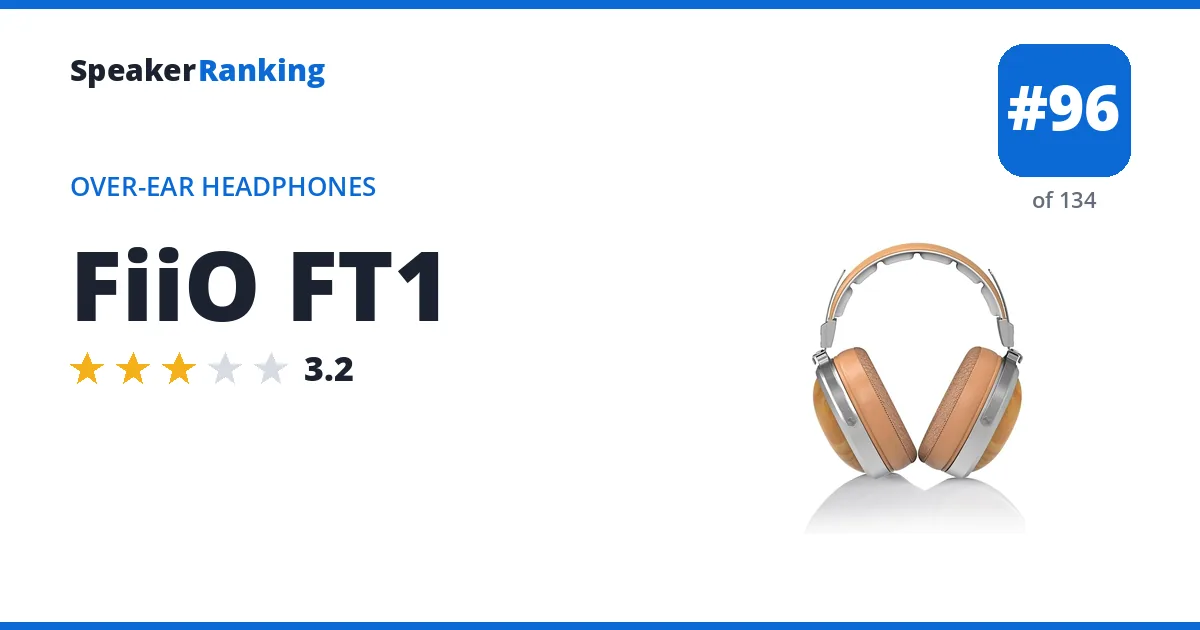
Pros: Sub-bass and bass both sit about 2.6 dB above target, so kick drums and bass lines have noticeable punch and rumble without bloating the midrange, which stays within a third of a dB of target. The 32 ohm, 98 dB/mW closed-back design runs directly from a phone or laptop, with a smoother response than most at 2.56 dB deviation.
Cons: Treble from 6 to 10 kHz is about 5 dB low with a 8.7 dB dip near 9.5 kHz, which dulls cymbals and takes the edge off sibilance. A 3.7 dB peak near 5.2 kHz and air about 3 dB high make the top end uneven. At 340 g it is on the heavier side.
Full FiiO FT1 review and specifications →
| Released | Sep 2024 (2 years ago) |
|---|---|
| Back | Closed |
| Connection | Wired |
| Deviation From Target | 2.56 dB standard deviation |
| Driver Type | Dynamic |
| Drivers | 1 x 60mm dynamic |
| Form Factor | Over-ear |
| Frequency Response | 10Hz - 40kHz (Manufacturer specified) |
| Harman Preference Score | 64 (measured by oratory1990, via AutoEQ) |
| Impedance | 32 ohms |
| Sensitivity | 98 dB/mW |
| Tonal Tilt | -1.20 (negative is warmer, positive brighter) |
| Weight | 0.7 lbs (340 g) |
EQ preset to match the Harman target
Set a preamp of -4.3 dB, then add these filters in any parametric equalizer (Wavelet, Equalizer APO, Peace, or a player with parametric EQ). Calculated by AutoEQ from its measured frequency response.
| Filter | Frequency | Gain | Q |
|---|---|---|---|
| Low shelf | 105 Hz | -2.7 dB | 0.70 |
| Peak | 155 Hz | -3.4 dB | 1.47 |
| Peak | 7,882 Hz | +4.5 dB | 1.99 |
| Peak | 3,835 Hz | +4.6 dB | 3.54 |
| Peak | 5,303 Hz | -5.6 dB | 4.56 |
| High shelf | 10,000 Hz | -3.1 dB | 0.70 |
| Peak | 1,735 Hz | -1.9 dB | 3.24 |
| Peak | 61 Hz | +0.9 dB | 2.22 |
| Peak | 579 Hz | +0.8 dB | 1.78 |
| Peak | 239 Hz | -0.5 dB | 2.59 |
- Reviews, Comparisons and Sound Samples
- Head-to-Head Comparisons
In-Ear Headphones
 Ranked #18 of 68 in In-Ear Headphones - FiiO FH5s: $254.99 Amazon eBay
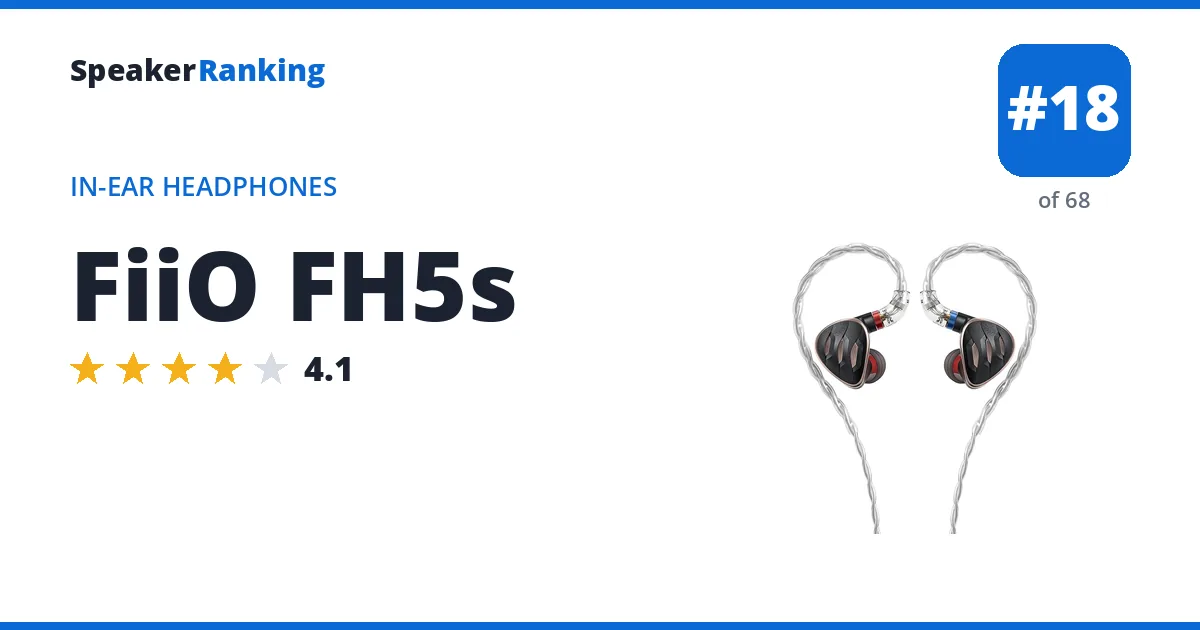
Pros: A preference score of 75 in crinacle’s measurement points to a response close to the Harman target, and it is rated above the Samsung Galaxy Buds2 and the Shuoer S12 Pro. The hybrid design pairs a 12 mm and a 6 mm dynamic driver with two balanced armature drivers. At 40 ohms and 106 dB sensitivity it is easy to drive from a phone, and each earbud weighs 8.8 g.
Cons: Its score and rating are about the same as the AUNE Jasper and the Beats Powerbeats Pro, so it does not stand out in its class. The tilt leans slightly bright, which may not suit listeners who prefer a warm sound. It is wired only, with no built in microphone.
Full FiiO FH5s review and specifications →
| Released | Apr 2021 (5 years ago) |
|---|---|
| Back | Closed |
| Built-in Microphone | No |
| Connection | Wired |
| Deviation From Target | 2.01 dB standard deviation |
| Driver Type | Hybrid (2 dynamic + 2 balanced armature) |
| Drivers | 2 x dynamic (12mm + 6mm) + 2 x balanced armature |
| Form Factor | In-ear |
| Frequency Response | 10Hz - 40kHz (Manufacturer specified) |
| Harman Preference Score | 75 (measured by crinacle, via AutoEQ) |
| Impedance | 40 ohms |
| Sensitivity | 106 dB/mW |
| Tonal Tilt | +0.34 (negative is warmer, positive brighter) |
| Weight | 0 lbs (8.8 g) per earbud |
EQ preset to match the Harman target
Set a preamp of -3.2 dB, then add these filters in any parametric equalizer (Wavelet, Equalizer APO, Peace, or a player with parametric EQ). Calculated by AutoEQ from its measured frequency response.
| Filter | Frequency | Gain | Q |
|---|---|---|---|
| Low shelf | 105 Hz | +2.3 dB | 0.70 |
| Peak | 883 Hz | +3.4 dB | 0.35 |
| Peak | 1,614 Hz | -7.4 dB | 1.64 |
| Peak | 196 Hz | -2.0 dB | 0.64 |
| Peak | 10,000 Hz | +1.7 dB | 0.65 |
| High shelf | 10,000 Hz | -2.6 dB | 0.70 |
| Peak | 6,307 Hz | +2.5 dB | 5.92 |
| Peak | 4,444 Hz | -1.6 dB | 5.97 |
| Peak | 3,652 Hz | +1.2 dB | 6.00 |
| Peak | 7,146 Hz | -1.1 dB | 6.00 |
- Reviews, Comparisons and Sound Samples
 Ranked #32 of 68 in In-Ear Headphones - FiiO FD5: $505.28 Amazon eBay
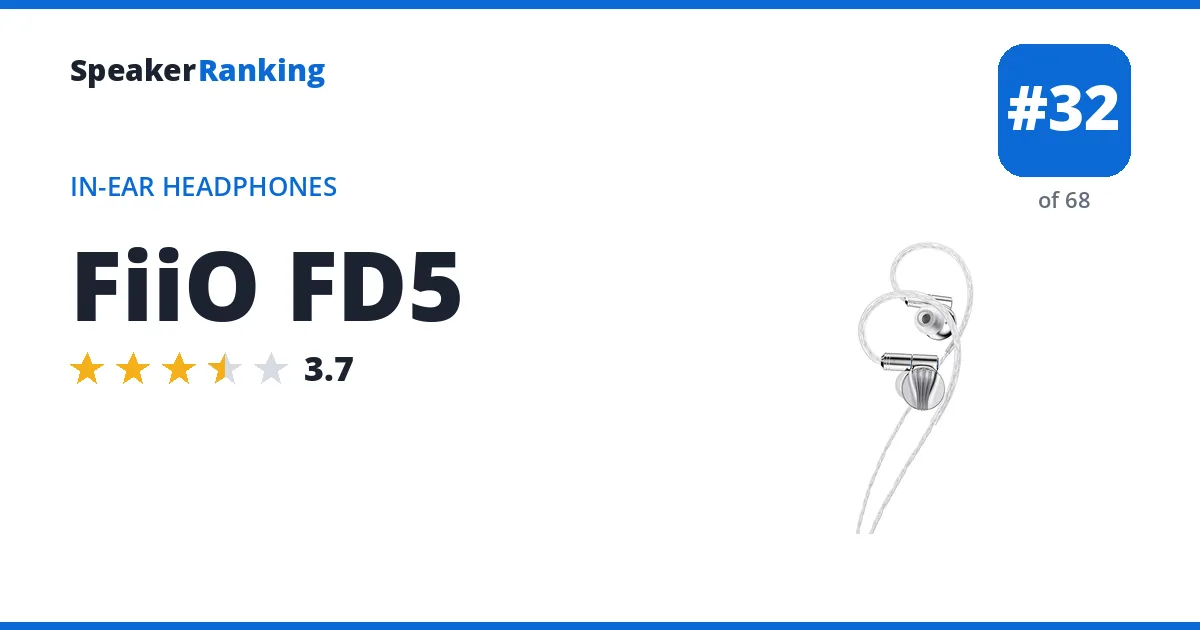
Pros: A preference score of 70 in crinacle’s measurement comes from a single large 12mm dynamic driver. At 32 ohms and 109 dB/mW it needs no dedicated amp, and the slightly warm tilt gives a full, smooth presentation. It also rates higher than the Audio-Technica ATH-CK2000Ti.
Cons: The 2.4 dB deviation from the target is no better than far cheaper sets in this class, which makes the high price hard to justify on tuning alone. The Moondrop Blessing 3 rates much higher for substantially less, and at 11 g per earbud it is on the heavier side for an in-ear.
Full FiiO FD5 review and specifications →
| Back | Closed |
|---|---|
| Connection | Wired |
| Deviation From Target | 2.40 dB standard deviation |
| Driver Type | Dynamic |
| Drivers | 1 x 12mm dynamic |
| Form Factor | In-ear |
| Frequency Response | 10Hz - 40kHz (Manufacturer specified) |
| Harman Preference Score | 70 (measured by crinacle, via AutoEQ) |
| Impedance | 32 ohms |
| Sensitivity | 109 dB/mW |
| Tonal Tilt | -0.45 (negative is warmer, positive brighter) |
| Weight | 0 lbs (11 g) per earbud |
EQ preset to match the Harman target
Set a preamp of -3.8 dB, then add these filters in any parametric equalizer (Wavelet, Equalizer APO, Peace, or a player with parametric EQ). Calculated by AutoEQ from its measured frequency response.
| Filter | Frequency | Gain | Q |
|---|---|---|---|
| Low shelf | 105 Hz | +1.2 dB | 0.70 |
| Peak | 155 Hz | -3.6 dB | 0.58 |
| Peak | 815 Hz | +2.7 dB | 1.04 |
| Peak | 3,920 Hz | +3.3 dB | 2.56 |
| Peak | 5,234 Hz | -3.2 dB | 5.78 |
| High shelf | 10,000 Hz | +0.4 dB | 0.70 |
| Peak | 10,000 Hz | +3.6 dB | 1.21 |
| Peak | 2,540 Hz | -1.4 dB | 4.19 |
| Peak | 40 Hz | -0.4 dB | 2.74 |
| Peak | 5,496 Hz | -1.7 dB | 6.00 |
- Reviews, Comparisons and Sound Samples
 Ranked #47 of 68 in In-Ear Headphones - FiiO FH3: $119.99 Amazon eBay
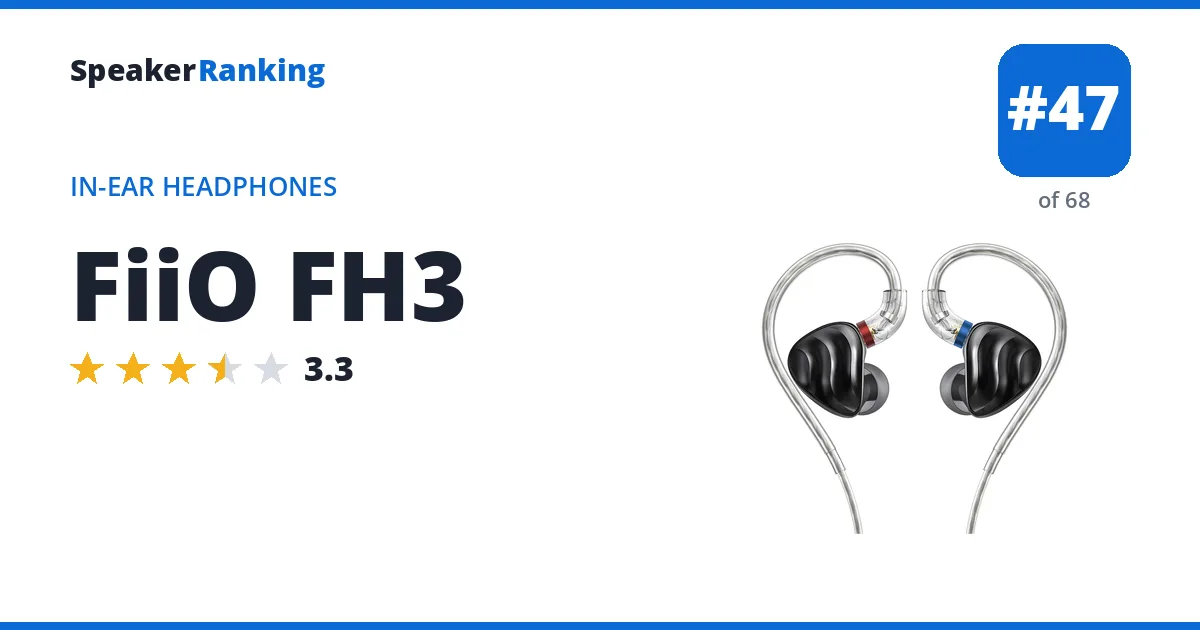
Pros: Bass and sub-bass sit within about 1 dB above the Harman target, giving kick drums and bass guitar a full, warm foundation without bloat. The hybrid design pairs a 10mm dynamic driver with two balanced armatures, and 114 dB/mW sensitivity at 24 ohms means a phone runs it easily. A preference score of 65 suits listeners who like a warm, bassy tilt.
Cons: The 3 to 6 kHz presence region sits about 5.7 dB below target, with a dip of 7.4 dB near 6.5 kHz, so vocals and cymbals lose bite and detail. Treble from 6 to 10 kHz is also about 2.2 dB low, which makes the sound dark and a little veiled. The KZ PR1 has a higher rating.
Full FiiO FH3 review and specifications →
| Back | Closed |
|---|---|
| Connection | Wired |
| Deviation From Target | 2.59 dB standard deviation |
| Driver Type | Hybrid (1 dynamic + 2 balanced armature) |
| Drivers | 1 x 10mm dynamic + 2 x balanced armature |
| Form Factor | In-ear |
| Frequency Response | 10Hz - 40kHz (Manufacturer specified) |
| Harman Preference Score | 65 (measured by HypetheSonics, via AutoEQ) |
| Impedance | 24 ohms |
| Sensitivity | 114 dB/mW |
| Tonal Tilt | -0.86 (negative is warmer, positive brighter) |
| Weight | 0 lbs (7.3 g) per earbud |
EQ preset to match the Harman target
Set a preamp of -4.3 dB, then add these filters in any parametric equalizer (Wavelet, Equalizer APO, Peace, or a player with parametric EQ). Calculated by AutoEQ from its measured frequency response.
| Filter | Frequency | Gain | Q |
|---|---|---|---|
| Low shelf | 105 Hz | -4.0 dB | 0.70 |
| Peak | 4,061 Hz | +4.3 dB | 1.02 |
| Peak | 178 Hz | -2.5 dB | 1.19 |
| Peak | 1,183 Hz | -3.9 dB | 2.64 |
| Peak | 60 Hz | +2.7 dB | 0.83 |
| High shelf | 10,000 Hz | -0.6 dB | 0.70 |
| Peak | 545 Hz | +1.1 dB | 2.57 |
| Peak | 2,365 Hz | -2.4 dB | 4.99 |
| Peak | 6,488 Hz | +2.3 dB | 6.00 |
| Peak | 2,972 Hz | +1.8 dB | 5.25 |
- Reviews, Comparisons and Sound Samples
- Head-to-Head Comparisons
 Ranked #49 of 68 in In-Ear Headphones - FiiO FH7S: $299.99 Amazon eBay
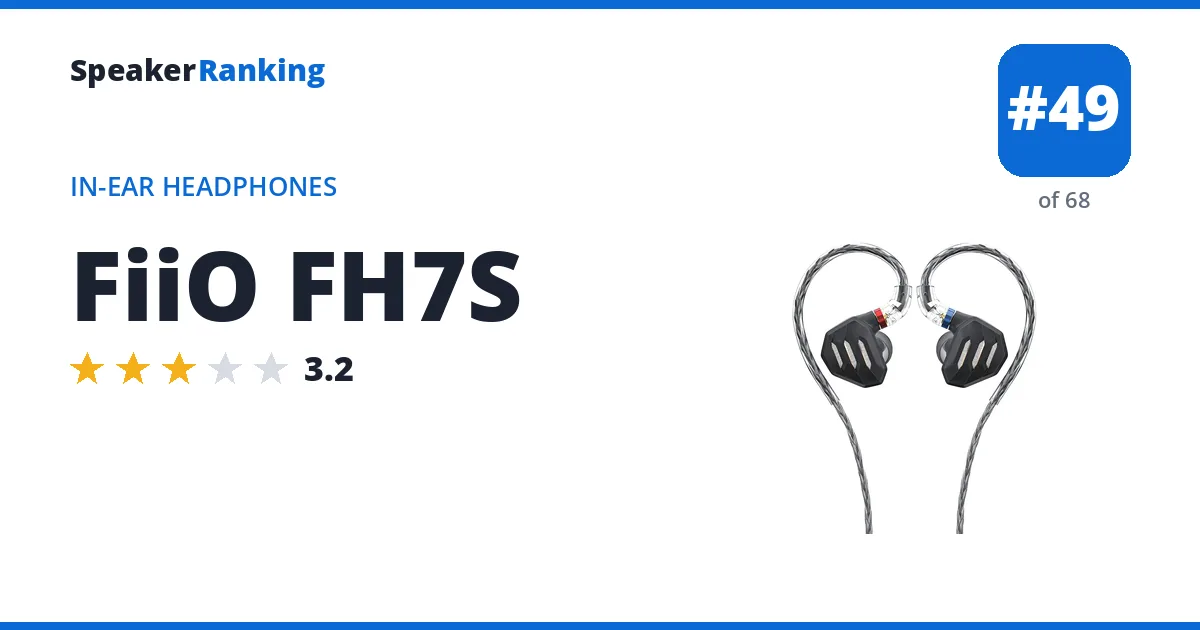
Pros: Oratory1990 measured bass about 4.6 dB above the Harman target, so kick drums and bass lines hit with real weight for a hybrid built around a 13.6mm dynamic driver and four balanced armatures. Treble is close to target, and an 18 ohm impedance makes it easy to drive from a phone despite the 104 dB/mW sensitivity. It suits warm, bassy tastes.
Cons: Low mids run 2.4 dB hot on top of the bass lift, which can make male vocals and bass instruments thick. A 6.1 dB peak near 8 kHz can make cymbals and sibilants sharp. The Tin HiFi P1 Max and FiiO FD5 both have higher ratings.
Full FiiO FH7S review and specifications →
| Back | Closed |
|---|---|
| Connection | Wired |
| Deviation From Target | 2.76 dB standard deviation |
| Driver Type | Hybrid (1 dynamic + 4 balanced armature) |
| Drivers | 1 x 13.6mm dynamic + 4 x balanced armature |
| Form Factor | In-ear |
| Frequency Response | 10Hz - 40kHz (Manufacturer specified) |
| Harman Preference Score | 64 (measured by oratory1990, via AutoEQ) |
| Impedance | 18 ohms |
| Sensitivity | 104 dB/mW |
| Tonal Tilt | -0.63 (negative is warmer, positive brighter) |
| Weight | 0 lbs (9 g) per earbud |
EQ preset to match the Harman target
Set a preamp of -5.4 dB, then add these filters in any parametric equalizer (Wavelet, Equalizer APO, Peace, or a player with parametric EQ). Calculated by AutoEQ from its measured frequency response.
| Filter | Frequency | Gain | Q |
|---|---|---|---|
| Low shelf | 105 Hz | +0.5 dB | 0.70 |
| Peak | 174 Hz | -4.7 dB | 0.67 |
| Peak | 5,596 Hz | +4.4 dB | 1.65 |
| Peak | 779 Hz | +3.3 dB | 1.24 |
| Peak | 2,065 Hz | +1.6 dB | 3.03 |
| High shelf | 10,000 Hz | -3.5 dB | 0.70 |
| Peak | 3,961 Hz | +1.5 dB | 3.23 |
| Peak | 3,138 Hz | -1.8 dB | 4.83 |
| Peak | 6,273 Hz | +2.3 dB | 5.99 |
| Peak | 5,471 Hz | -1.8 dB | 6.00 |
- Reviews, Comparisons and Sound Samples
- Head-to-Head Comparisons
 Ranked #55 of 68 in In-Ear Headphones - FiiO FH5: $1,127.26 Amazon eBay
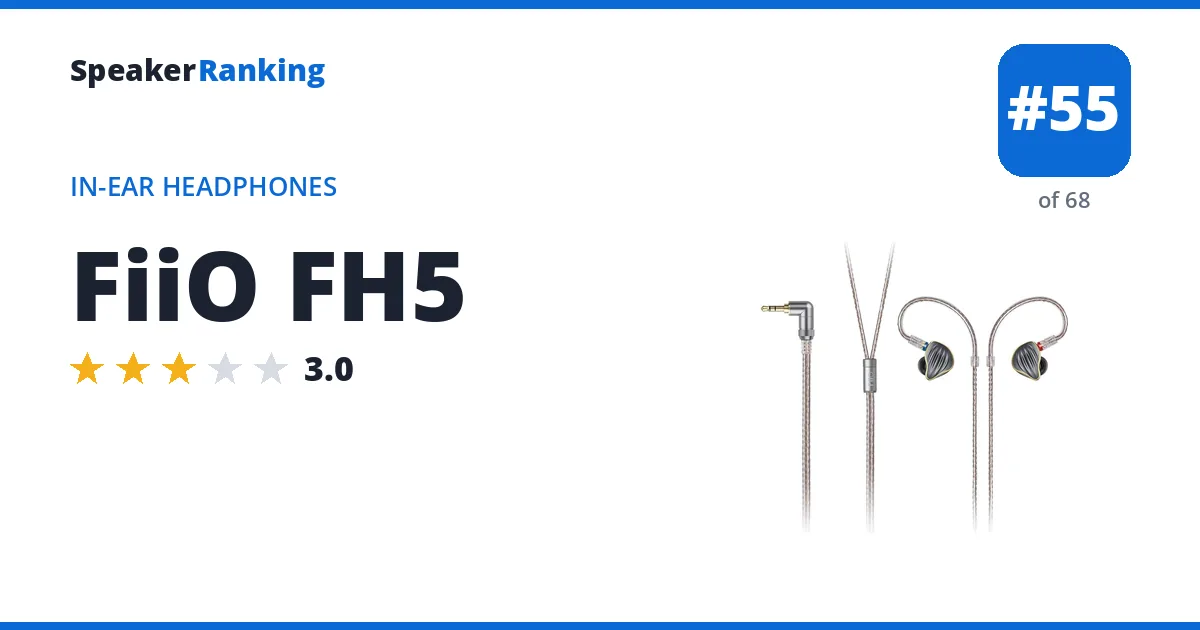
Pros: In oratory1990’s measurement the bass and low mids sit only 0.6 to 1.4 dB above the Harman target, so kick drums and bass guitar have a warm, full body without bloating. The hybrid design pairs a 10mm dynamic driver with 3 balanced armatures, and the 19 ohm impedance and 112 dB/mW sensitivity mean a phone or dongle drives it easily. Sub-bass is slightly lifted by 0.8 dB, which suits warm and bassy tastes.
Cons: Presence between 3 and 6 kHz runs about 7.3 dB under target, with a 9.6 dB dip near 4.7 kHz, so vocals, snare and guitar attack sound recessed and distant. Air above 10 kHz is down about 3.2 dB, which takes some sparkle off cymbals. A preference score of 61 and an uneven response with a 2.96 dB deviation leave it behind the HIFIMAN RE2000 for tonal accuracy.
Full FiiO FH5 review and specifications →
| Back | Closed |
|---|---|
| Connection | Wired |
| Deviation From Target | 2.96 dB standard deviation |
| Driver Type | Hybrid (1 dynamic + 3 balanced armature) |
| Drivers | 1 x 10mm dynamic + 3 x balanced armature |
| Form Factor | In-ear |
| Frequency Response | 15Hz - 40kHz (Manufacturer specified) |
| Harman Preference Score | 61 (measured by oratory1990, via AutoEQ) |
| Impedance | 19 ohms |
| Sensitivity | 112 dB/mW |
| Tonal Tilt | -1.08 (negative is warmer, positive brighter) |
| Weight | 0 lbs (8 g) per earbud |
EQ preset to match the Harman target
Set a preamp of -6.5 dB, then add these filters in any parametric equalizer (Wavelet, Equalizer APO, Peace, or a player with parametric EQ). Calculated by AutoEQ from its measured frequency response.
| Filter | Frequency | Gain | Q |
|---|---|---|---|
| Low shelf | 105 Hz | -2.4 dB | 0.70 |
| Peak | 3,870 Hz | +6.6 dB | 1.63 |
| Peak | 191 Hz | -2.7 dB | 1.11 |
| Peak | 1,347 Hz | -1.8 dB | 1.19 |
| Peak | 9,899 Hz | +2.5 dB | 2.75 |
| High shelf | 10,000 Hz | -1.8 dB | 0.70 |
| Peak | 69 Hz | +0.9 dB | 1.61 |
| Peak | 122 Hz | -0.6 dB | 2.38 |
| Peak | 6,634 Hz | -1.7 dB | 6.00 |
| Peak | 5,997 Hz | +1.5 dB | 6.00 |
- Reviews, Comparisons and Sound Samples