Short answer: the Fiio SP3, though neither ranks well in its class. It ranks #20 of 24 powered bookshelf speakers by sound quality, rated 2.9/5, at $299.99. The Midiplus MI3 II ranks #23, rated 2.4/5, at $139, $160.99 cheaper, not enough of a saving to outweigh the sound-quality gap. Both are rated below 3.0/5 among the 24 powered bookshelf speakers, and the Adam Audio D3v, ranked #3 at $344.99, is a better place to start if sound quality matters.
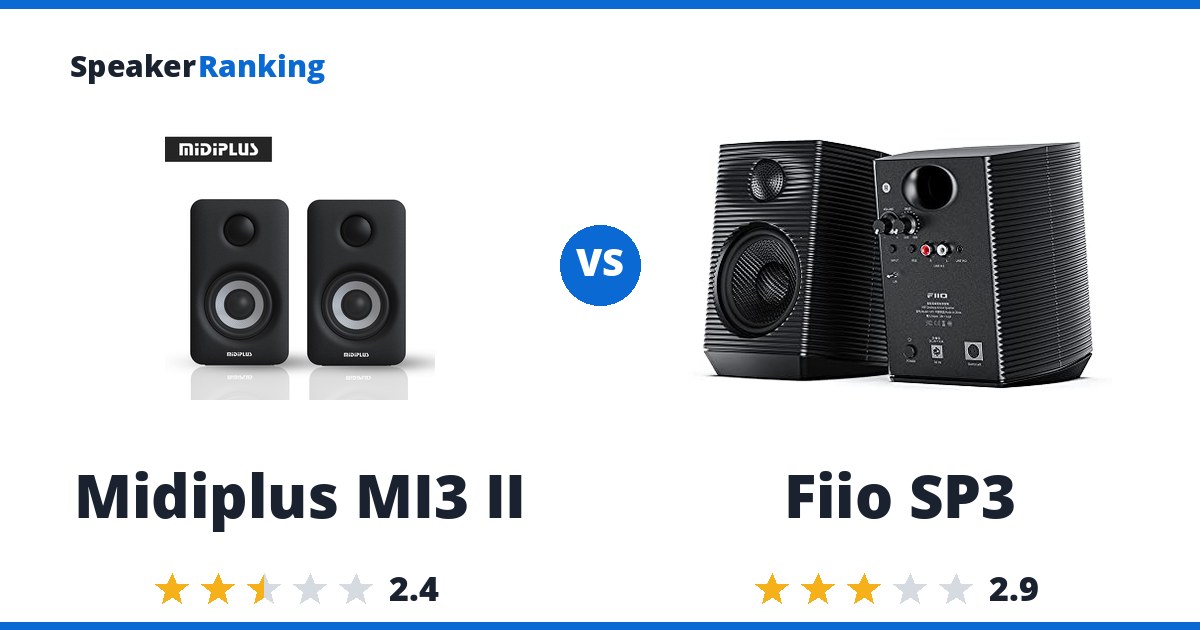
Why pick the Midiplus MI3 II: Compact cabinets, Bluetooth, analog inputs and high-frequency adjustment can suit a basic desktop system. The tradeoff: Preference scores of 0.99 standalone and 3.84 with an ideal subwoofer are poor.
Why pick the Fiio SP3: Compact cabinets and angled bases fit a small desk. The catch: The response rises strongly toward the treble, about 1.13dB per octave, with a recessed midrange and problematic crossover behavior.
Buy the Fiio SP3. It is rated higher for sound quality, and the $160.99 you would save on the Midiplus MI3 II does not close the gap.
Still deciding? The full Powered Home rankings cover every ranked option.
Specifications Side By Side
| Midiplus MI3 II | Fiio SP3 | |
|---|---|---|
| Price | $139 per pair | $299.99 per pair |
| Ranked | #23 of 24 in Small Size Powered Bookshelf Speakers | #20 of 24 in Small Size Powered Bookshelf Speakers |
| Enclosure | Powered 2-way | - |
| Drivers | 0.75-inch silk tweeter, 3-inch fiberglass woofer | 3.5" carbon fiber midwoofer, 1" silk dome tweeter |
| Frequency Response | 70Hz-25kHz | 65Hz - 20kHz (±2dB) (Manufacturer specified) |
| Amplifier Power | 60W RMS per pair | 40W total (30W midwoofer + 10W tweeter) |
| Maximum SPL | 98dB | - |
| Inputs | RCA, 3.5mm, Bluetooth | AUX, RCA |
| Dimensions | 6.5H x 4.7W x 6D in | 6.4"H x 4.7"W x 5.2"D (163 x 120 x 132 mm) |
| Spinorama Preference Score | 0.99 | 3.56 |
| Spinorama Preference Score with Perfect Sub | 3.84 | 6.17 |
| XLR Input | No | No |
| RCA Input | Yes | Yes |
| TRS Input | No | No |
| Optical Input | No | No |
| Coaxial Input | No | No |
| USB Input | No | No |
| HDMI Input | No | No |
| AES Input | No | No |
| Aux Input | Yes | Yes |
| Bluetooth | Yes, 5.0 | No |
| Weight | - | 4.3 lbs (1.95 kg) each |
| Bass Extension (-3dB) | - | 59Hz (measured, Erin's Audio Corner) |
| Bass Extension (-10dB) | - | 53Hz (measured, Erin's Audio Corner) |
Related Speaker Comparisons
More worthwhile head-to-heads for Fiio SP3:
- Genelec 8010A vs Fiio SP3
- Adam Audio D3v vs Fiio SP3
- Cambridge Audio L/R S vs Fiio SP3
- IK Multimedia iLoud Micro Monitor vs Fiio SP3
- Edifier M60 vs Fiio SP3
Prices on this page were last checked September 23, 2026 at 11:24 PM UTC. Product prices and availability are accurate as of that date/time and are subject to change; the price and availability shown on Amazon at the time of purchase will apply to the purchase of this product.
As an eBay Partner, we may be compensated if you make a purchase.
The Two Speakers In Full
 Midiplus MI3 II: $139 per pair eBay
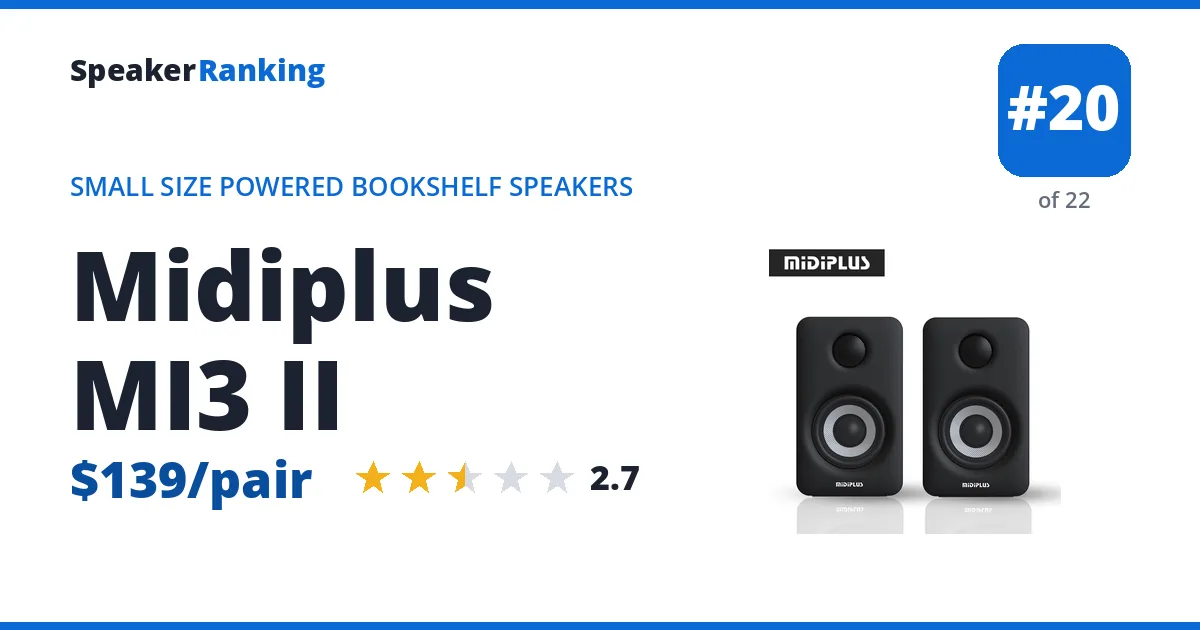
Pros: Compact cabinets, Bluetooth, analog inputs and high-frequency adjustment can suit a basic desktop system. The measured -3dB point is about 67Hz, so missing bass is not its only differentiator from other tiny speakers.
Cons: Preference scores of 0.99 standalone and 3.84 with an ideal subwoofer are poor. High narrow-band deviations on-axis (0.938) and across the listening window (0.852) indicate pronounced response irregularities that can color voices and instruments. The fairly flat overall trend does not mean the response itself is smooth. A subwoofer or simple treble adjustment cannot resolve all of these problems.
Full Midiplus MI3 II review and specifications →
| AES Input | No |
|---|---|
| Amplifier Power | 60W RMS per pair |
| Aux Input | Yes |
| Bluetooth | Yes, 5.0 |
| Coaxial Input | No |
| Dimensions | 6.5H x 4.7W x 6D in |
| Drivers | 0.75-inch silk tweeter, 3-inch fiberglass woofer |
| Enclosure | Powered 2-way |
| Frequency Response | 70Hz-25kHz |
| HDMI Input | No |
| Inputs | RCA, 3.5mm, Bluetooth |
| Maximum SPL | 98dB |
| Optical Input | No |
| RCA Input | Yes |
| Spinorama Preference Score | 0.99 |
| Spinorama Preference Score with Perfect Sub | 3.84 |
| TRS Input | No |
| USB Input | No |
| XLR Input | No |
- Links
- Reviews, Comparisons and Sound Samples
- Head-to-Head Comparisons
- Midiplus MI3 II vs Presonus Eris E3.5 2nd Gen
- Midiplus MI3 II vs Monoprice DT-3
- Midiplus MI3 II vs M-Audio BX3
- Midiplus MI3 II vs Fluid Audio C35BT
- Midiplus MI3 II vs Mackie CR3-X
- Midiplus MI3 II vs Audioengine HD3
- Midiplus MI3 II vs Klipsch ProMedia Lumina
- Midiplus MI3 II vs Audioengine A2+
- See all 9 comparisons
 Fiio SP3: $299.99 per pair Amazon eBay
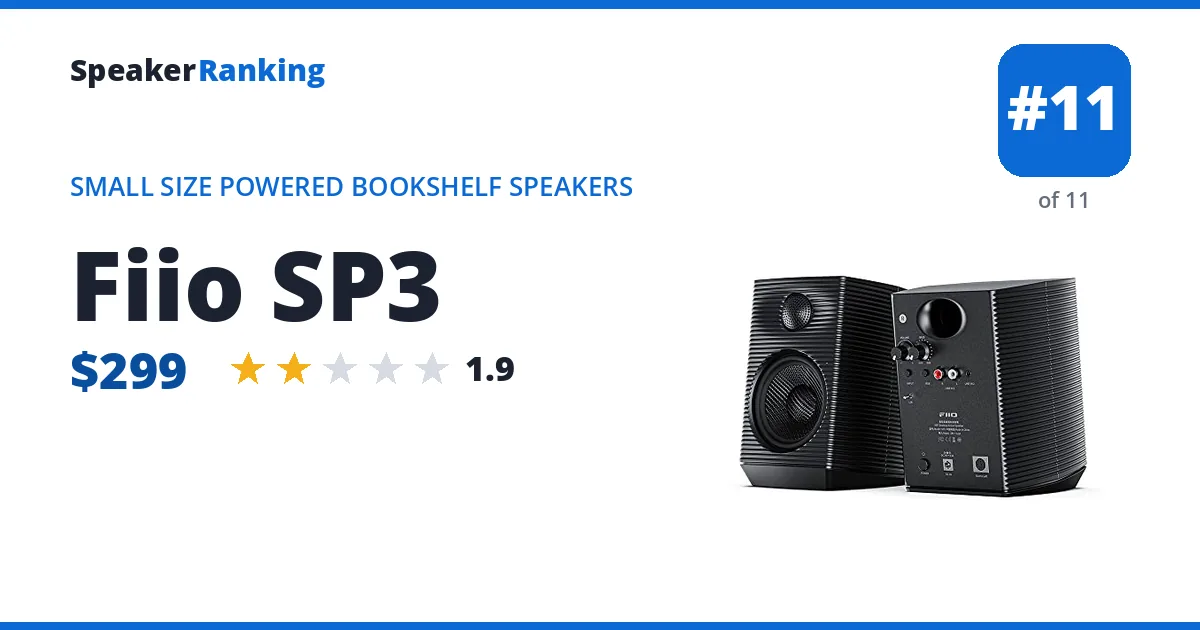
Pros: Compact cabinets and angled bases fit a small desk. The existing review found useful dynamic capability at higher frequencies, so lack of output is not the only issue. Erin’s Klippel data shows a measured -3dB bass point around 60Hz, deeper than several similarly sized alternatives. Measured bass extension of 59Hz (-3dB).
Cons: The response rises strongly toward the treble, about 1.13dB per octave, with a recessed midrange and problematic crossover behavior. Its 3.56 standalone and 6.17 ideal-subwoofer scores do not capture the full practical impact of the review’s boomy bass and off-axis tonal problems. Changing angle trades one coloration for another. Those audible limitations weigh against it more heavily than its numerical score or build quality.
Full Fiio SP3 review and specifications →
| AES Input | No |
|---|---|
| Amplifier Power | 40W total (30W midwoofer + 10W tweeter) |
| Aux Input | Yes |
| Bass Extension (-10dB) | 53Hz (measured, Erin's Audio Corner) |
| Bass Extension (-3dB) | 59Hz (measured, Erin's Audio Corner) |
| Bluetooth | No |
| Coaxial Input | No |
| Dimensions | 6.4"H x 4.7"W x 5.2"D (163 x 120 x 132 mm) |
| Drivers | 3.5" carbon fiber midwoofer, 1" silk dome tweeter |
| Frequency Response | 65Hz - 20kHz (±2dB) (Manufacturer specified) |
| HDMI Input | No |
| Inputs | AUX, RCA |
| Optical Input | No |
| RCA Input | Yes |
| Spinorama Preference Score | 3.56 |
| Spinorama Preference Score with Perfect Sub | 6.17 |
| TRS Input | No |
| USB Input | No |
| Weight | 4.3 lbs (1.95 kg) each |
| XLR Input | No |
- Links
- Reviews, Comparisons and Sound Samples
- Head-to-Head Comparisons