Short answer: the Monoprice Monolith MM-3. It ranks #16 of 24 powered bookshelf speakers by sound quality, rated 3.2/5, at $299.99; the Fiio SP3 ranks #20, rated 2.9/5, at $299.99. The price gap is small enough that the sound-quality ranking should decide it.
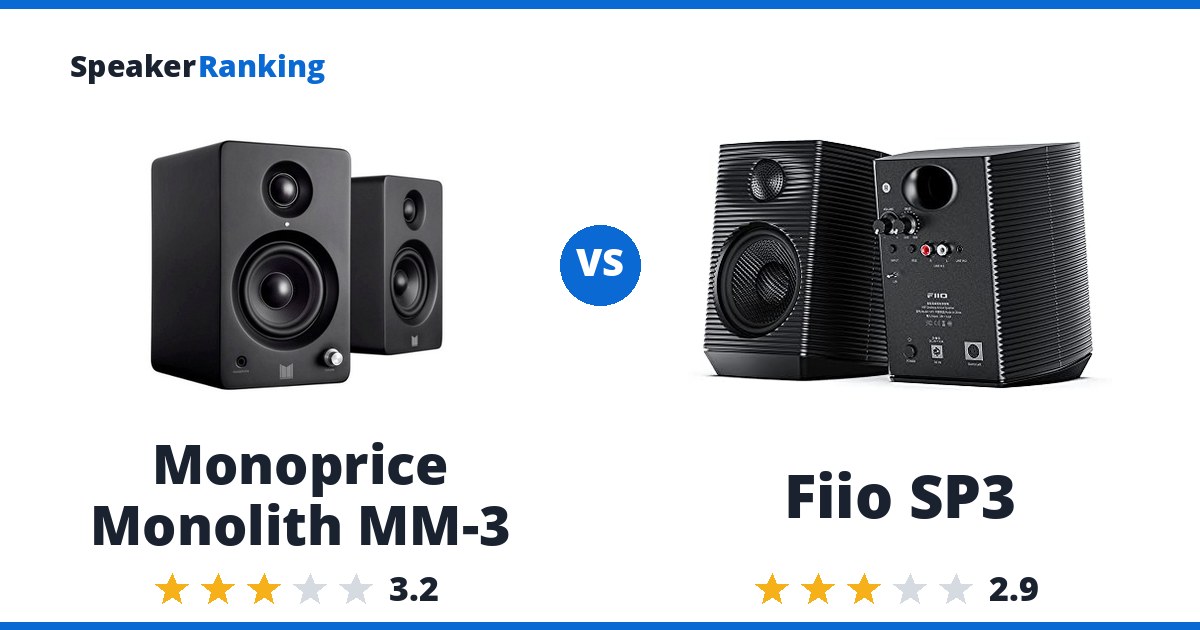
The case for the Monoprice Monolith MM-3: With the ports plugged, Erin’s Klippel data yields preference scores of 3.82 standalone and 6.24 with an ideal subwoofer, and a measured -3dB point around 62Hz. The tradeoff: These measurements describe modified, port-plugged speakers, not the stock product.
The case for the Fiio SP3: Compact cabinets and angled bases fit a small desk. The tradeoff: The response rises strongly toward the treble, about 1.13dB per octave, with a recessed midrange and problematic crossover behavior.
Buy the Monoprice Monolith MM-3. It is rated higher for sound quality than the Fiio SP3 at the same price, so the other one has nothing left to offer.
Still deciding? The full Powered Home rankings cover every ranked option.
Specifications Side By Side
| Monoprice Monolith MM-3 | Fiio SP3 | |
|---|---|---|
| Price | $299.99 per pair | $299.99 per pair |
| Ranked | #16 of 24 in Small Size Powered Bookshelf Speakers | #20 of 24 in Small Size Powered Bookshelf Speakers |
| Enclosure | 2-way active, rear slot port | - |
| Drivers | 0.75" silk-dome tweeter, 3" polypropylene woofer | 3.5" carbon fiber midwoofer, 1" silk dome tweeter |
| Dimensions | 8.3H x 5.5W x 6.3D in | 6.4"H x 4.7"W x 5.2"D (163 x 120 x 132 mm) |
| Weight | approx. 7.9 lbs (3.6 kg) each | 4.3 lbs (1.95 kg) each |
| Amplifier Power | 50W total, bi-amplified | 40W total (30W midwoofer + 10W tweeter) |
| Inputs | Bluetooth aptX, RCA, 3.5mm | AUX, RCA |
| Bluetooth Codecs | SBC, aptX | - |
| Country | United States (design) | - |
| Spinorama Preference Score | 3.82 | 3.56 |
| Spinorama Preference Score with Perfect Sub | 6.24 | 6.17 |
| XLR Input | No | No |
| RCA Input | Yes | Yes |
| TRS Input | No | No |
| Optical Input | No | No |
| Coaxial Input | No | No |
| USB Input | No | No |
| HDMI Input | No | No |
| AES Input | No | No |
| Aux Input | Yes | Yes |
| Bluetooth | Yes | No |
| Frequency Response | 50Hz - 22kHz (Manufacturer specified) | 65Hz - 20kHz (±2dB) (Manufacturer specified) |
| Bass Extension (-3dB) | - | 59Hz (measured, Erin's Audio Corner) |
| Bass Extension (-10dB) | - | 53Hz (measured, Erin's Audio Corner) |
Related Speaker Comparisons
More worthwhile head-to-heads for Monoprice Monolith MM-3:
- HiVi Swan X3 vs Monoprice Monolith MM-3
- Bowers & Wilkins Formation Flex vs Monoprice Monolith MM-3
- Monoprice Monolith MM-3 vs Audioengine A2+
- Monacor SOUND-4BT vs Monoprice Monolith MM-3
- Kanto YU4 vs Monoprice Monolith MM-3
Prices on this page were last checked September 23, 2026 at 11:24 PM UTC. Product prices and availability are accurate as of that date/time and are subject to change; the price and availability shown on Amazon at the time of purchase will apply to the purchase of this product.
As an eBay Partner, we may be compensated if you make a purchase.
The Two Speakers In Full
 Monoprice Monolith MM-3: $299.99 per pair Monoprice eBay
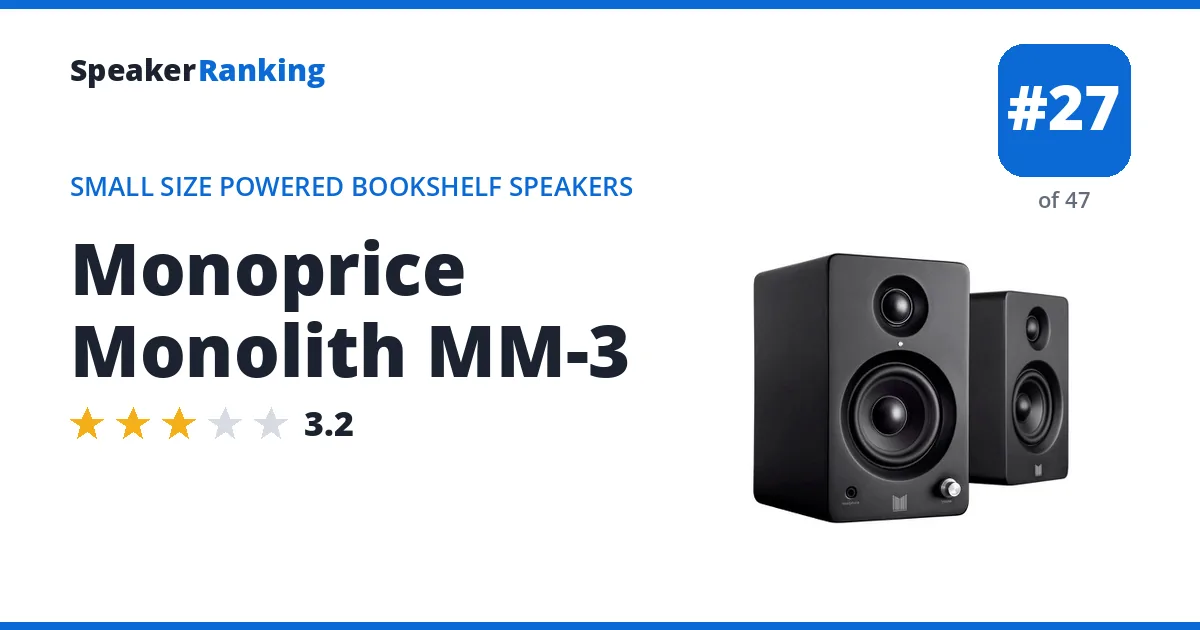
Pros: With the ports plugged, Erin’s Klippel data yields preference scores of 3.82 standalone and 6.24 with an ideal subwoofer, and a measured -3dB point around 62Hz. The reviewer found blocking the ports improved the bass peak and midrange resonances. Bluetooth, analog inputs, a headphone jack and angled stands provide a convenient compact desktop package.
Cons: These measurements describe modified, port-plugged speakers, not the stock product. Even in that configuration the review identifies substantial tonal problems and recommends off-axis placement to reduce excess treble. The score therefore does not justify ranking the stock MM-3 alongside better-balanced monitors. Small drivers limit its application, and the proprietary inter-speaker cable complicates replacement.
Full Monoprice Monolith MM-3 review and specifications →
| AES Input | No |
|---|---|
| Amplifier Power | 50W total, bi-amplified |
| Aux Input | Yes |
| Bluetooth | Yes |
| Bluetooth Codecs | SBC, aptX |
| Coaxial Input | No |
| Country | United States (design) |
| Dimensions | 8.3H x 5.5W x 6.3D in |
| Drivers | 0.75" silk-dome tweeter, 3" polypropylene woofer |
| Enclosure | 2-way active, rear slot port |
| Frequency Response | 50Hz - 22kHz (Manufacturer specified) |
| HDMI Input | No |
| Inputs | Bluetooth aptX, RCA, 3.5mm |
| Optical Input | No |
| RCA Input | Yes |
| Spinorama Preference Score | 3.82 |
| Spinorama Preference Score with Perfect Sub | 6.24 |
| TRS Input | No |
| USB Input | No |
| Weight | approx. 7.9 lbs (3.6 kg) each |
| XLR Input | No |
- Links
- Reviews, Comparisons and Sound Samples
- Head-to-Head Comparisons
- Monoprice Monolith MM-3 vs Klipsch ProMedia Lumina
- Monoprice Monolith MM-3 vs Audioengine HD3
- Monoprice Monolith MM-3 vs Kanto YU4
- Monoprice Monolith MM-3 vs Monacor SOUND-4BT
- Monoprice Monolith MM-3 vs Fluid Audio C35BT
- Monoprice Monolith MM-3 vs Audioengine A2+
- Monoprice Monolith MM-3 vs Bowers & Wilkins Formation Flex
- Monoprice Monolith MM-3 vs Monoprice DT-3
- See all 9 comparisons
 Fiio SP3: $299.99 per pair Amazon eBay
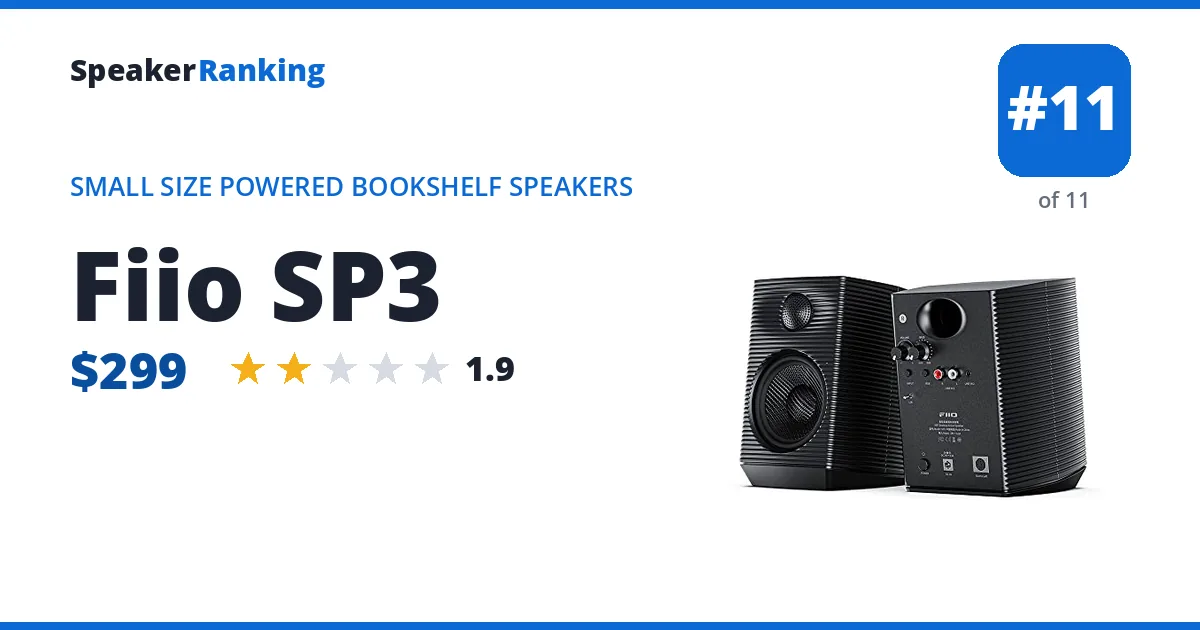
Pros: Compact cabinets and angled bases fit a small desk. The existing review found useful dynamic capability at higher frequencies, so lack of output is not the only issue. Erin’s Klippel data shows a measured -3dB bass point around 60Hz, deeper than several similarly sized alternatives. Measured bass extension of 59Hz (-3dB).
Cons: The response rises strongly toward the treble, about 1.13dB per octave, with a recessed midrange and problematic crossover behavior. Its 3.56 standalone and 6.17 ideal-subwoofer scores do not capture the full practical impact of the review’s boomy bass and off-axis tonal problems. Changing angle trades one coloration for another. Those audible limitations weigh against it more heavily than its numerical score or build quality.
Full Fiio SP3 review and specifications →
| AES Input | No |
|---|---|
| Amplifier Power | 40W total (30W midwoofer + 10W tweeter) |
| Aux Input | Yes |
| Bass Extension (-10dB) | 53Hz (measured, Erin's Audio Corner) |
| Bass Extension (-3dB) | 59Hz (measured, Erin's Audio Corner) |
| Bluetooth | No |
| Coaxial Input | No |
| Dimensions | 6.4"H x 4.7"W x 5.2"D (163 x 120 x 132 mm) |
| Drivers | 3.5" carbon fiber midwoofer, 1" silk dome tweeter |
| Frequency Response | 65Hz - 20kHz (±2dB) (Manufacturer specified) |
| HDMI Input | No |
| Inputs | AUX, RCA |
| Optical Input | No |
| RCA Input | Yes |
| Spinorama Preference Score | 3.56 |
| Spinorama Preference Score with Perfect Sub | 6.17 |
| TRS Input | No |
| USB Input | No |
| Weight | 4.3 lbs (1.95 kg) each |
| XLR Input | No |
- Links
- Reviews, Comparisons and Sound Samples
- Head-to-Head Comparisons