Short answer: the Linkwitz Lab LXmini. It ranks #86 of 226 floorstanding speakers by sound quality, rated 4.2/5, at $505; the Polk Signature Elite ES55 ranks #128, rated 4.0/5, and costs $898, so there is little reason to consider the other one.

The case for the Linkwitz Lab LXmini: Open-baffle/dipole upper driver and cylindrical woofer enclosure create a very large, open soundstage with unusually little cabinet signature. Watch for: This is not a conventional passive pair: it requires a construction-plan license, assembly, miniDSP, four matched amplifier channels and careful gain/setup work, so the apparent kit price is not the complete system cost.
The case for the Polk Signature Elite ES55: Mid-sized floorstanding tower in Polk’s Signature Elite range equipped with dual 6.5-inch Dynamic Balance woofers and a 1-inch Terylene dome tweeter. The tradeoff: Rating estimated based on sibling laboratory measurements across the Signature Elite line.
Buy the Linkwitz Lab LXmini. It is rated higher for sound quality than the Polk Signature Elite ES55 and costs less, which makes it the one to get unless you need something the other one does better.
Worth knowing: the Polk Signature Elite ES55 has not been measured yet. Its rating is estimated from related models, with a likely range of 3.8 to 4.2, so treat this verdict as provisional.
Looking for alternatives? See the complete Passive Home rankings.
Specifications Side By Side
| Linkwitz Lab LXmini | Polk Signature Elite ES55 | |
|---|---|---|
| Price | $505.00 per pair | $898 per pair Passive |
| Ranked | #86 of 226 in Large Size Floorstanding Speakers | #128 of 226 in Large Size Floorstanding Speakers Estimated |
| Bass Extension (-10dB) | 33Hz (measured, Erin’s Audio Corner) | - |
| Bass Extension (-3dB) | 50Hz (measured, Erin’s Audio Corner) | - |
| Sensitivity | 85dB upper driver / 87dB woofer @ 1W/1m (individual driver specifications; complete active-DSP system sensitivity is not directly specified) | 90dB (2.83V @ 1m) |
| Impedance | 4 ohms upper driver / 8 ohms woofer nominal (separate actively bi-amplified loads; manufacturer specified) | 8 ohms (4-8 ohm compatible) |
| Drivers | 6.5” SEAS woofer in sealed tube, 4” SEAS full-range dipole driver | 1” Terylene high-res dome tweeter, two 6.5” mica-reinforced polypropylene woofers |
| Crossover Frequency | 700Hz LR2, active DSP | 2.5kHz |
| Amplifier Power | Four channels, 50W/channel minimum with identical voltage gain | - |
| Woofer Cabinet | sealed cylindrical enclosure; open-baffle upper driver | - |
| Spinorama Preference Score | 3.89 (measured, spinorama.org) | - |
| Spinorama Preference Score with Perfect Sub | 5.77 (measured, spinorama.org) | - |
| DIY Kit | Yes | - |
| Dimensions | - | 41.7” x 11.7” x 12.5” (1059 x 297 x 318 mm) |
| Frequency Response | - | 40Hz - 40kHz |
| Passive | - | Yes |
| Weight | - | 44.1 lbs (20.0 kg) each |
Related Speaker Comparisons
More top alternatives to Linkwitz Lab LXmini:
- Revel Concerta2 F35 vs Linkwitz Lab LXmini
- ELAC Debut 3.0 DF63 vs Linkwitz Lab LXmini
- Polk Reserve R500 vs Linkwitz Lab LXmini
- Linkwitz Lab LXmini vs Infinity Primus 360
- ELAC Debut 3.0 DF53 vs Linkwitz Lab LXmini
Prices on this page were last checked October 11, 2026 at 4:59 PM UTC. Product prices and availability are accurate as of that date/time and are subject to change; the price and availability shown on Amazon at the time of purchase will apply to the purchase of this product.
As an eBay Partner, we may be compensated if you make a purchase.
The Two Speakers In Full
 Linkwitz Lab LXmini: $505.00 per pair Madisound LXmini Kit eBay
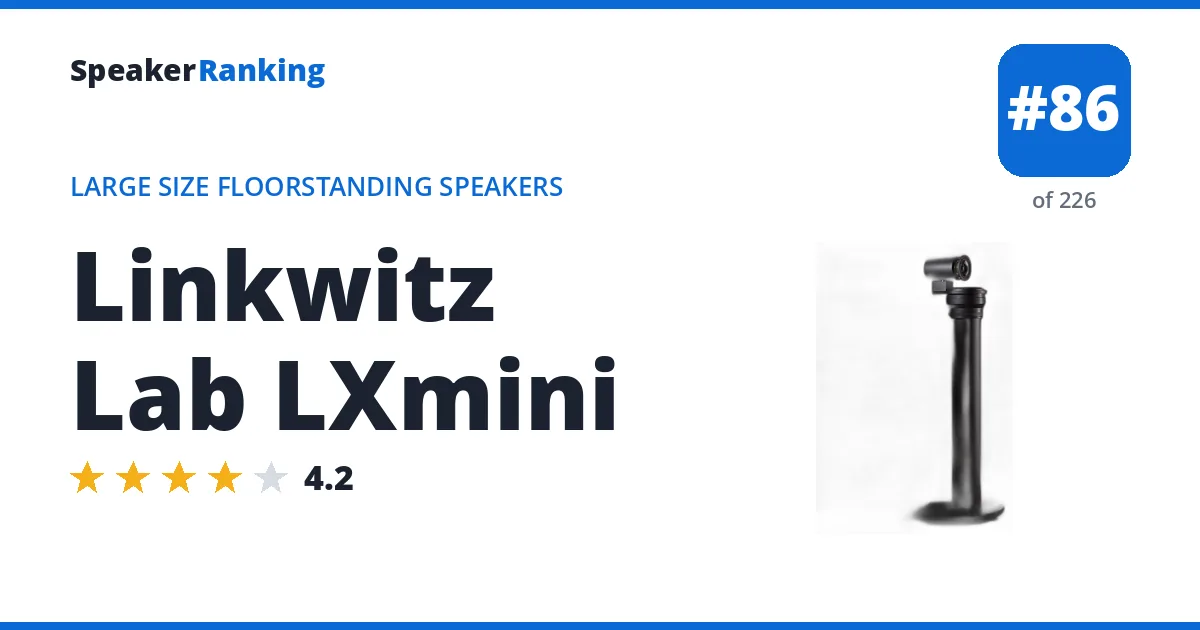
Pros: Open-baffle/dipole upper driver and cylindrical woofer enclosure create a very large, open soundstage with unusually little cabinet signature. Erin praised the stable, well-controlled directivity: despite using a nominal full-range upper driver, off-axis response retains composure beyond its beaming region and the directivity index is smooth enough for reliable DSP voicing. Imaging can be precisely adjusted through placement and toe angle. Erin measured F3 at 50Hz and F10 at 33Hz, impressive for the narrow footprint, and found the system satisfying for much music without a subwoofer. The supplied miniDSP configuration is readily editable; broad shelf correction near 550Hz and a handful of narrow filters can make the response substantially more linear. The kit is mechanically simple, highly customizable and based on well-documented Linkwitz engineering. Measured bass extension of 50Hz (-3dB).
Cons: This is not a conventional passive pair: it requires a construction-plan license, assembly, miniDSP, four matched amplifier channels and careful gain/setup work, so the apparent kit price is not the complete system cost. Output below about 50Hz lacks kick-drum weight and benefits from subwoofers. Erin found rising second-order distortion near 1.5kHz on both samples, accompanied by an impedance blip that may indicate an enclosure reflection or driver-compliance effect. At high output the system behaves as if electronically limited even with miniDSP limiting bypassed, reducing bass and subjective dynamics. Default voicing is less linear than expected, with irregularities above roughly 2kHz, though its controlled directivity makes these correctable. Dipole rear radiation demands meaningful distance from the front wall and makes placement less flexible than a box speaker.
Full Linkwitz Lab LXmini review and specifications →
| Amplifier Power | Four channels, 50W/channel minimum with identical voltage gain |
|---|---|
| Bass Extension (-10dB) | 33Hz (measured, Erin’s Audio Corner) |
| Bass Extension (-3dB) | 50Hz (measured, Erin’s Audio Corner) |
| Crossover Frequency | 700Hz LR2, active DSP |
| DIY Kit | Yes |
| Drivers | 6.5” SEAS woofer in sealed tube, 4” SEAS full-range dipole driver |
| Impedance | 4 ohms upper driver / 8 ohms woofer nominal (separate actively bi-amplified loads; manufacturer specified) |
| Sensitivity | 85dB upper driver / 87dB woofer @ 1W/1m (individual driver specifications; complete active-DSP system sensitivity is not directly specified) |
| Spinorama Preference Score | 3.89 (measured, spinorama.org) |
| Spinorama Preference Score with Perfect Sub | 5.77 (measured, spinorama.org) |
| Woofer Cabinet | sealed cylindrical enclosure; open-baffle upper driver |
- Links
- Reviews, Comparisons and Sound Samples
- Head-to-Head Comparisons
 Polk Signature Elite ES55: $898 per pair Passive Estimated Amazon eBay

Same family: the Polk Signature Elite ES10 (smallest bookshelf, estimated 3.1/5), the Polk Signature Elite ES15 (bookshelf, rated 3.5/5), the Polk Signature Elite ES20 (largest bookshelf, rated 3.7/5), the Polk Signature Elite ES50 (smaller floorstanding, ranked lower, estimated 3.8/5), the Polk Signature Elite ES60 (larger floorstanding, ranked lower, rated 3.4/5), the Polk Audio Signature Elite ES30 (smaller center, estimated 3.5/5), the Polk Audio Signature Elite ES35 (larger center, estimated 3.4/5), the Polk Audio Signature Elite ES8 Subwoofer (smallest subwoofer, estimated 3.2/5), the Polk Audio Signature Elite ES10 Subwoofer (subwoofer, estimated 3.7/5) and the Polk Audio Signature Elite ES12 Subwoofer (largest subwoofer, estimated 3.8/5). See every Polk Signature generation.
Pros: Mid-sized floorstanding tower in Polk’s Signature Elite range equipped with dual 6.5-inch Dynamic Balance woofers and a 1-inch Terylene dome tweeter. Offers higher sensitivity (90dB) and robust acoustic output capability with down-firing Power Port bass reflex tuning for clean extension down to 40Hz. Preserves the directivity matching and smooth off-axis tonal character validated by testing on the Polk Signature Elite ES20 and Polk Signature Elite ES60.
Cons: Rating estimated based on sibling laboratory measurements across the Signature Elite line. Substantial cabinet depth and footprint require generous boundary clearance from walls for optimum tonal balance.
Full Polk Signature Elite ES55 review and specifications →
| Released | Sep 2022 (4 years ago) |
|---|---|
| Crossover Frequency | 2.5kHz |
| Dimensions | 41.7” x 11.7” x 12.5” (1059 x 297 x 318 mm) |
| Drivers | 1” Terylene high-res dome tweeter, two 6.5” mica-reinforced polypropylene woofers |
| Frequency Response | 40Hz - 40kHz |
| Impedance | 8 ohms (4-8 ohm compatible) |
| Passive | Yes |
| Sensitivity | 90dB (2.83V @ 1m) |
| Weight | 44.1 lbs (20.0 kg) each |
- Links
- Reviews, Comparisons and Sound Samples
- Head-to-Head Comparisons