Short answer: the Linkwitz Lab LXmini, if you are buying new. The Infinity Primus 360 measures as well as it (#40 vs #38 of 73 floorstanding speakers, 4.2/5 vs 4.2/5) but is discontinued, so only consider it used; the Linkwitz Lab LXmini is still sold new at $505.
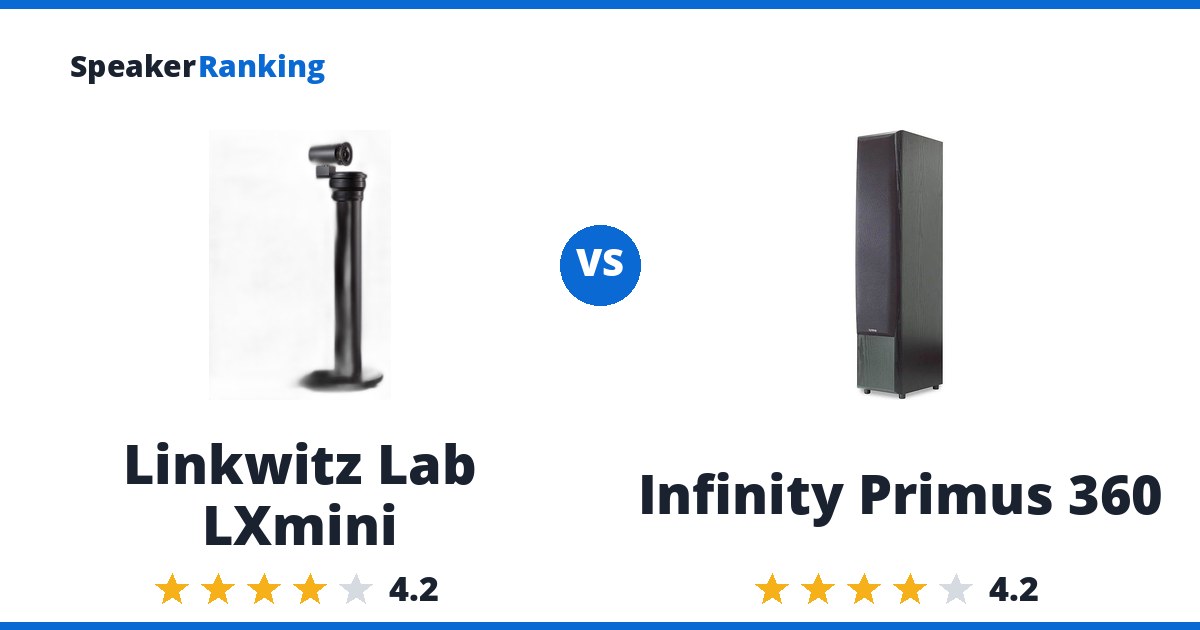
The case for the Linkwitz Lab LXmini: Open-baffle/dipole upper driver and cylindrical woofer enclosure create a very large, open soundstage with unusually little cabinet signature. The catch: This is not a conventional passive pair: it requires a construction-plan license, assembly, miniDSP, four matched amplifier channels and careful gain/setup work, so the apparent kit price is not the complete system cost.
What the Infinity Primus 360 does well: A three-way tower from 2005 (two 6.5” mid-woofers, a 4” mid-range, and a 0.75” dome tweeter, 8 ohms nominal) that holds up remarkably well by modern measurement standards: on-axis linearity is within about ±2dB, and the listening window stays consistent out to roughly ±30° horizontal and ±10° vertical off the mid-range axis. The tradeoff: Manufacturer-spec sensitivity of 93dB runs about 3-4dB optimistic versus the measured 89.4dB average.
Buy the Linkwitz Lab LXmini, since the Infinity Primus 360 is discontinued and only worth hunting down used.
Want more options? Browse the full Passive Home rankings.
Specifications Side By Side
| Linkwitz Lab LXmini | Infinity Primus 360 | |
|---|---|---|
| Price | $610.00 per pair | $650.00 per pair Discontinued |
| Ranked | #38 of 73 in Large Size Floorstanding Speakers | #40 of 73 in Large Size Floorstanding Speakers |
| Bass Extension (-10dB) | 33Hz (measured, Erin’s Audio Corner) | 37Hz (measured, Erin’s Audio Corner) |
| Bass Extension (-3dB) | 50Hz (measured, Erin’s Audio Corner) | 53Hz (measured, Erin’s Audio Corner) |
| Sensitivity | 85dB upper driver / 87dB woofer @ 1W/1m (individual driver specifications; complete active-DSP system sensitivity is not directly specified) | 89.4dB (measured, Erin’s Audio Corner; 93dB manufacturer specified) |
| Impedance | 4 ohms upper driver / 8 ohms woofer nominal (separate actively bi-amplified loads; manufacturer specified) | 8 ohms nominal, 3.5 ohms minimum (measured, Erin’s Audio Corner) |
| Drivers | 6.5” SEAS woofer in sealed tube, 4” SEAS full-range dipole driver | Two 6.5” mid-woofers, 4” mid-range, 0.75” dome tweeter |
| Crossover Frequency | 700Hz LR2, active DSP | 350Hz & 3.3kHz, 24dB/octave |
| Amplifier Power | Four channels, 50W/channel minimum with identical voltage gain | - |
| Woofer Cabinet | sealed cylindrical enclosure; open-baffle upper driver | - |
| Spinorama Preference Score | 3.89 (measured, spinorama.org) | 4.97 |
| Spinorama Preference Score with Perfect Sub | 5.77 (measured, spinorama.org) | 7.10 |
| DIY Kit | Yes | No |
| Dimensions | - | 39” x 8.2” x 13” (990 x 208 x 330 mm) |
| Weight | - | 48.5 lbs (22 kg) each |
| Frequency Response | - | 38Hz - 20kHz (±3dB, Manufacturer specified) |
| Recommended Power | - | 10-200W |
Related Speaker Comparisons
More worthwhile head-to-heads for Linkwitz Lab LXmini:
- Revel Concerta2 F35 vs Linkwitz Lab LXmini
- ELAC Debut 3.0 DF63 vs Linkwitz Lab LXmini
- Polk Reserve R500 vs Linkwitz Lab LXmini
- Definitive Technology BP-9020 vs Infinity Primus 360
- Polk T50 vs Infinity Primus 360
Prices on this page were last checked September 29, 2026 at 3:43 PM UTC. Product prices and availability are accurate as of that date/time and are subject to change; the price and availability shown on Amazon at the time of purchase will apply to the purchase of this product.
As an eBay Partner, we may be compensated if you make a purchase.
The Two Speakers In Full
 Linkwitz Lab LXmini: $610.00 per pair Madisound LXmini Kit eBay
Pros: Open-baffle/dipole upper driver and cylindrical woofer enclosure create a very large, open soundstage with unusually little cabinet signature. Erin praised the stable, well-controlled directivity: despite using a nominal full-range upper driver, off-axis response retains composure beyond its beaming region and the directivity index is smooth enough for reliable DSP voicing. Imaging can be precisely adjusted through placement and toe angle. Erin measured F3 at 50Hz and F10 at 33Hz, impressive for the narrow footprint, and found the system satisfying for much music without a subwoofer. The supplied miniDSP configuration is readily editable; broad shelf correction near 550Hz and a handful of narrow filters can make the response substantially more linear. The kit is mechanically simple, highly customizable and based on well-documented Linkwitz engineering. Measured bass extension of 50Hz (-3dB).
Cons: This is not a conventional passive pair: it requires a construction-plan license, assembly, miniDSP, four matched amplifier channels and careful gain/setup work, so the apparent kit price is not the complete system cost. Output below about 50Hz lacks kick-drum weight and benefits from subwoofers. Erin found rising second-order distortion near 1.5kHz on both samples, accompanied by an impedance blip that may indicate an enclosure reflection or driver-compliance effect. At high output the system behaves as if electronically limited even with miniDSP limiting bypassed, reducing bass and subjective dynamics. Default voicing is less linear than expected, with irregularities above roughly 2kHz, though its controlled directivity makes these correctable. Dipole rear radiation demands meaningful distance from the front wall and makes placement less flexible than a box speaker.
Full Linkwitz Lab LXmini review and specifications →
| Amplifier Power | Four channels, 50W/channel minimum with identical voltage gain |
|---|---|
| Bass Extension (-10dB) | 33Hz (measured, Erin’s Audio Corner) |
| Bass Extension (-3dB) | 50Hz (measured, Erin’s Audio Corner) |
| Crossover Frequency | 700Hz LR2, active DSP |
| DIY Kit | Yes |
| Drivers | 6.5” SEAS woofer in sealed tube, 4” SEAS full-range dipole driver |
| Impedance | 4 ohms upper driver / 8 ohms woofer nominal (separate actively bi-amplified loads; manufacturer specified) |
| Sensitivity | 85dB upper driver / 87dB woofer @ 1W/1m (individual driver specifications; complete active-DSP system sensitivity is not directly specified) |
| Spinorama Preference Score | 3.89 (measured, spinorama.org) |
| Spinorama Preference Score with Perfect Sub | 5.77 (measured, spinorama.org) |
| Woofer Cabinet | sealed cylindrical enclosure; open-baffle upper driver |
- Links
- Reviews, Comparisons and Sound Samples
- Head-to-Head Comparisons
 Infinity Primus 360: $650.00 per pair Discontinued eBay
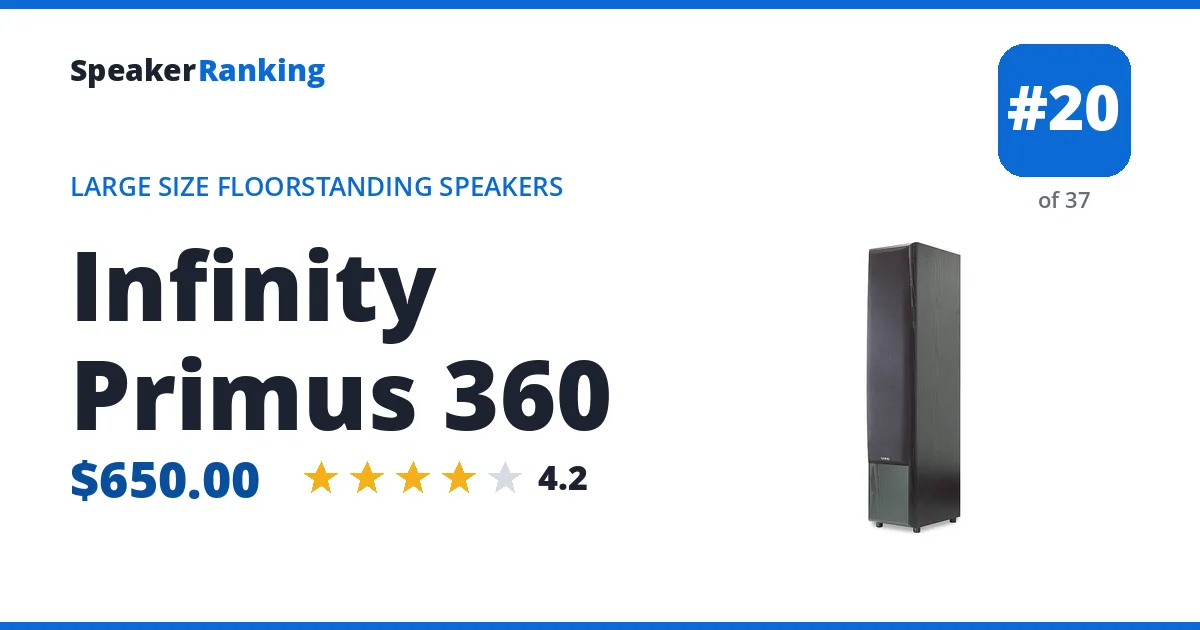
Pros: A three-way tower from 2005 (two 6.5” mid-woofers, a 4” mid-range, and a 0.75” dome tweeter, 8 ohms nominal) that holds up remarkably well by modern measurement standards: on-axis linearity is within about ±2dB, and the listening window stays consistent out to roughly ±30° horizontal and ±10° vertical off the mid-range axis. Horizontal directivity is well controlled out to about ±75° before tonality starts to drift, meaning the reflected sound in a room stays close in character to the direct sound: a speaker that takes EQ well without fighting itself. Harmonic distortion measures low at both 86dB and 96dB, and multitone distortion stays under the reviewer’s 3% threshold. Silky, smooth midrange with a rich lower-midrange/upper-bass character. No mechanical issues or surround degradation found in a 20-year-old pair, and a second unit measured within about 1-1.5dB of the first, suggesting good long-term consistency for the design. Measured bass extension of 53Hz (-3dB), with a measured sensitivity of 89.4dB.
Cons: Manufacturer-spec sensitivity of 93dB runs about 3-4dB optimistic versus the measured 89.4dB average. Bass output drops off fairly quickly below about 50Hz in-room (F3 53Hz, F10 37Hz), so a subwoofer is needed for real low-end extension. Resonances show up around 170Hz, 220Hz, and 350Hz. On-axis, the lower treble can sound a bit bright or sibilant when the speaker is aimed directly at the listener; toeing out about 10-15° (rather than the more extreme 30°) gave the best balance, and some sidewall acoustic absorption further tamed a 4-5kHz peak. Placed close to the rear wall, bass gets boomy: pulling the speakers out about a foot resolves most of it, with roughly 1.5 feet from the wall as a good compromise between bass character and typical room aesthetics. Straying beyond about 25° above or below the mid-range axis introduces audible suckout. No longer in production, so it’s a used/secondhand purchase only.
Full Infinity Primus 360 review and specifications →
| Bass Extension (-10dB) | 37Hz (measured, Erin’s Audio Corner) |
|---|---|
| Bass Extension (-3dB) | 53Hz (measured, Erin’s Audio Corner) |
| Crossover Frequency | 350Hz & 3.3kHz, 24dB/octave |
| DIY Kit | No |
| Dimensions | 39” x 8.2” x 13” (990 x 208 x 330 mm) |
| Drivers | Two 6.5” mid-woofers, 4” mid-range, 0.75” dome tweeter |
| Frequency Response | 38Hz - 20kHz (±3dB, Manufacturer specified) |
| Impedance | 8 ohms nominal, 3.5 ohms minimum (measured, Erin’s Audio Corner) |
| Recommended Power | 10-200W |
| Sensitivity | 89.4dB (measured, Erin’s Audio Corner; 93dB manufacturer specified) |
| Spinorama Preference Score | 4.97 |
| Spinorama Preference Score with Perfect Sub | 7.10 |
| Weight | 48.5 lbs (22 kg) each |
- Reviews, Comparisons and Sound Samples
- Head-to-Head Comparisons
- Infinity Primus 360 vs Q Acoustics 5040
- Infinity Primus 360 vs Klipsch Forte IV
- Infinity Primus 360 vs Polk Reserve R500
- Infinity Primus 360 vs ELAC Debut 3.0 DF63
- Infinity Primus 360 vs KEF Q11 Meta
- Infinity Primus 360 vs Emotiva Airmotiv T2+
- Infinity Primus 360 vs Klipsch RP-5000F II
- Infinity Primus 360 vs PSB Imagine T65
- See all 30 comparisons