Short answer: the Beyerdynamic DT 880. It ranks #23 of 216 over-ear headphones by sound quality, rated 4.3/5, at $159.95; the Audio-Technica ATH-R50x ranks #52, rated 4.1/5, and costs $169, so there is little reason to consider the other one.

Why pick the Beyerdynamic DT 880: A preference score of 88 and a neutral tilt show a well balanced tuning, with bass from 60 to 200 Hz within 1 dB of target and upper mids within half a dB. The catch: A 6 dB peak near 5.8 kHz can make hi-hats, snare and sibilant vocals sound sharp, and the treble from 6 to 10 kHz runs about 2 dB hot.
The case for the Audio-Technica ATH-R50x: A preference score of 83 and the smoothest deviation in this group at 1.67 dB make for a very even response, with bass from 60 to 200 Hz and low mids within 0.6 dB of target. Watch for: Sub-bass is about 6 dB low under 60 Hz, so deep rumble is lacking.
Buy the Beyerdynamic DT 880. It is rated higher for sound quality than the Audio-Technica ATH-R50x and costs less, so only choose the other one for a particular feature it does better.
Looking for alternatives? See the complete Headphones rankings.
Specifications Side By Side
| Beyerdynamic DT 880 | Audio-Technica ATH-R50x | |
|---|---|---|
| Price | $159.95 | $169.00 |
| Ranked | #23 of 216 in Over-Ear Headphones | #52 of 216 in Over-Ear Headphones |
| Form Factor | Over-ear | Over-ear |
| Harman Preference Score | 88 (measured by oratory1990, via AutoEQ) | 83 (measured by oratory1990, via AutoEQ) |
| Deviation From Target | 2.05 dB standard deviation | 1.67 dB standard deviation |
| Tonal Tilt | +0.02 (negative is warmer, positive brighter) | +0.64 (negative is warmer, positive brighter) |
| Sub-bass Extension | Falls 6 dB below target at 30 Hz (-6.2 dB at 30 Hz) | Falls 6 dB below target at 30 Hz (-6.4 dB at 30 Hz) |
| Connection | Wired | Wired |
| Back | Semi-open | Open |
| Driver Type | Dynamic | Dynamic |
| Frequency Response | 5Hz - 35kHz (Manufacturer specified) | 5Hz - 40kHz (Manufacturer specified) |
| Drivers | - | 1 x 45mm dynamic |
| Impedance | - | 50 ohms |
| Sensitivity | - | 93.3 dB/mW |
| Weight | - | 0.5 lbs (207 g) |
Related Headphone Comparisons
More worthwhile head-to-heads for Beyerdynamic DT 880:
- Beyerdynamic DT 880 vs Sennheiser HD 505
- Beyerdynamic DT 880 vs Beyerdynamic TYGR 300 R
- Beyerdynamic DT 1350 vs Beyerdynamic DT 880
- Beyerdynamic TYGR 300 R vs Audio-Technica ATH-R50x
- Audio-Technica ATH-R50x vs Beyerdynamic DT 770 Pro
Prices on this page were last checked October 11, 2026 at 4:59 PM UTC. Product prices and availability are accurate as of that date/time and are subject to change; the price and availability shown on Amazon at the time of purchase will apply to the purchase of this product.
As an eBay Partner, we may be compensated if you make a purchase.
The Two Headphones In Full
 Beyerdynamic DT 880: $159.95 Amazon eBay
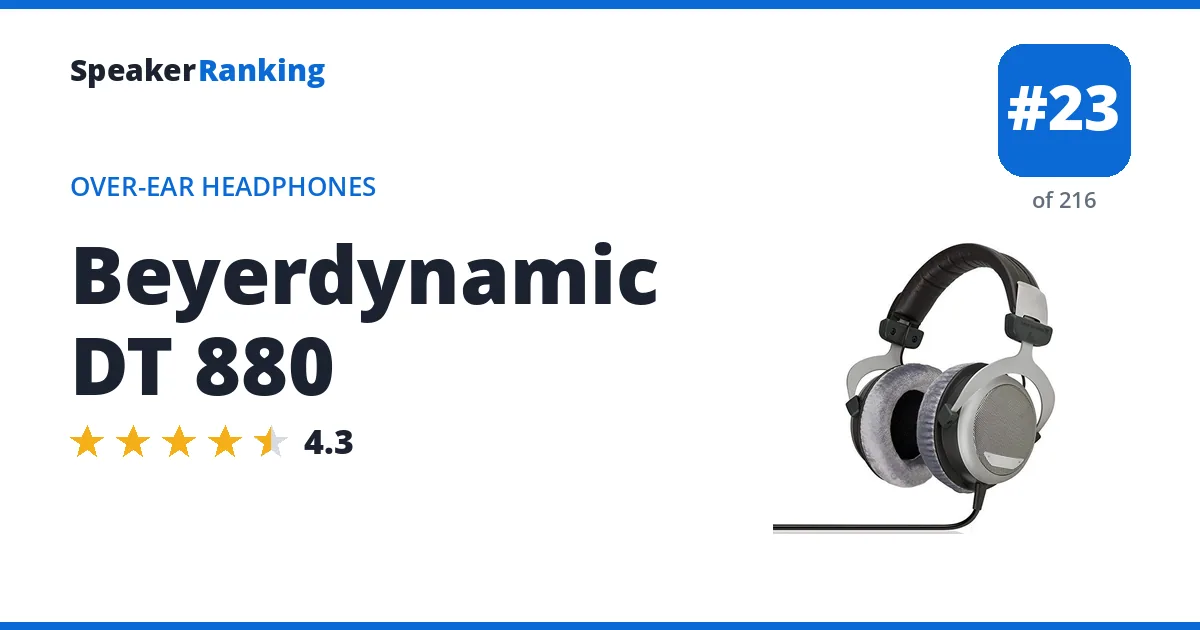
Pros: A preference score of 88 and a neutral tilt show a well balanced tuning, with bass from 60 to 200 Hz within 1 dB of target and upper mids within half a dB. The semi-open design offers a more spacious feel than a closed back. It has the same rating as the HIFIMAN Ananda Stealth and Sennheiser HD 505 while costing less than both.
Cons: A 6 dB peak near 5.8 kHz can make hi-hats, snare and sibilant vocals sound sharp, and the treble from 6 to 10 kHz runs about 2 dB hot. The low mids are lifted by about 2 dB and sub-bass is about 4 dB light under 60 Hz, giving a slightly boxy, bass-shy balance. The semi-open back leaks some sound and gives limited isolation.
Full Beyerdynamic DT 880 review and specifications →
| Back | Semi-open |
|---|---|
| Connection | Wired |
| Deviation From Target | 2.05 dB standard deviation |
| Driver Type | Dynamic |
| Form Factor | Over-ear |
| Frequency Response | 5Hz - 35kHz (Manufacturer specified) |
| Harman Preference Score | 88 (measured by oratory1990, via AutoEQ) |
| Sub-bass Extension | Falls 6 dB below target at 30 Hz (-6.2 dB at 30 Hz) |
| Tonal Tilt | +0.02 (negative is warmer, positive brighter) |
EQ preset to match the Harman target
Set a preamp of -6.4 dB, then add these filters in any parametric equalizer (Wavelet, Equalizer APO, Peace, or a player with parametric EQ). Calculated by AutoEQ from its measured frequency response.
| Filter | Frequency | Gain | Q |
|---|---|---|---|
| Low shelf | 105 Hz | +7.4 dB | 0.70 |
| Peak | 112 Hz | -3.4 dB | 0.30 |
| Peak | 1,320 Hz | +2.1 dB | 0.54 |
| Peak | 5,760 Hz | -6.1 dB | 4.97 |
| Peak | 4,480 Hz | +3.9 dB | 4.24 |
| High shelf | 10,000 Hz | -3.1 dB | 0.70 |
| Peak | 480 Hz | +0.5 dB | 2.40 |
| Peak | 234 Hz | -0.4 dB | 2.41 |
| Peak | 940 Hz | -0.6 dB | 4.04 |
| Peak | 2,939 Hz | -0.5 dB | 4.92 |
- Reviews, Comparisons and Sound Samples
- Head-to-Head Comparisons
 Audio-Technica ATH-R50x: $169.00 Amazon eBay
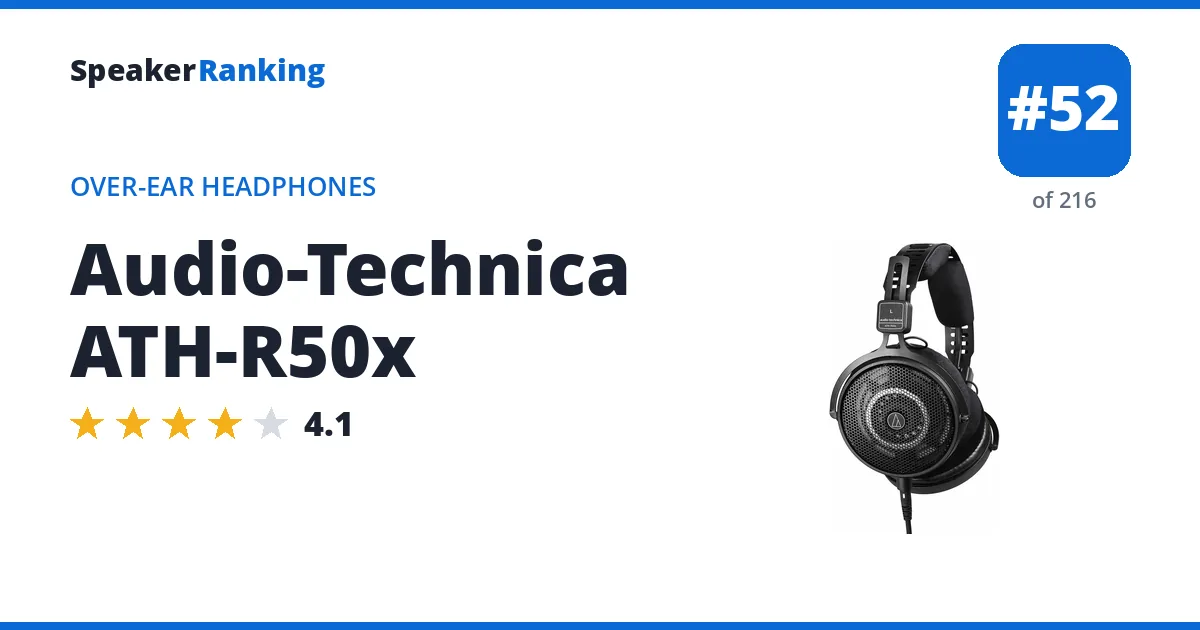
Pros: A preference score of 83 and the smoothest deviation in this group at 1.67 dB make for a very even response, with bass from 60 to 200 Hz and low mids within 0.6 dB of target. At 50 ohms and 93.3 dB/mW sensitivity it can be driven by most portable sources, and at 207 g it is light. It costs less than the AKG K701 and AKG K702 while holding the same rating.
Cons: Sub-bass is about 6 dB low under 60 Hz, so deep rumble is lacking. Treble is slightly forward, with presence about 2 dB high, 6 to 10 kHz about 2.6 dB high and a 4.8 dB peak near 6.3 kHz, which can make vocals and cymbals bright. Its tilt of 0.64 leans bright, and the open back leaks sound.
Full Audio-Technica ATH-R50x review and specifications →
| Released | Jan 2025 (1 year ago) |
|---|---|
| Back | Open |
| Connection | Wired |
| Deviation From Target | 1.67 dB standard deviation |
| Driver Type | Dynamic |
| Drivers | 1 x 45mm dynamic |
| Form Factor | Over-ear |
| Frequency Response | 5Hz - 40kHz (Manufacturer specified) |
| Harman Preference Score | 83 (measured by oratory1990, via AutoEQ) |
| Impedance | 50 ohms |
| Sensitivity | 93.3 dB/mW |
| Sub-bass Extension | Falls 6 dB below target at 30 Hz (-6.4 dB at 30 Hz) |
| Tonal Tilt | +0.64 (negative is warmer, positive brighter) |
| Weight | 0.5 lbs (207 g) |
EQ preset to match the Harman target
Set a preamp of -6.2 dB, then add these filters in any parametric equalizer (Wavelet, Equalizer APO, Peace, or a player with parametric EQ). Calculated by AutoEQ from its measured frequency response.
| Filter | Frequency | Gain | Q |
|---|---|---|---|
| Low shelf | 105 Hz | +7.2 dB | 0.70 |
| Peak | 482 Hz | +2.4 dB | 0.92 |
| Peak | 60 Hz | -4.8 dB | 0.60 |
| Peak | 6,204 Hz | -3.3 dB | 1.70 |
| Peak | 38 Hz | +2.3 dB | 1.60 |
| High shelf | 10,000 Hz | -2.1 dB | 0.70 |
| Peak | 1,497 Hz | -1.4 dB | 3.40 |
| Peak | 851 Hz | +0.5 dB | 2.04 |
| Peak | 4,628 Hz | +1.6 dB | 4.12 |
| Peak | 3,874 Hz | -2.5 dB | 6.00 |
- Reviews, Comparisons and Sound Samples
- Head-to-Head Comparisons