Short answer: the Beyerdynamic DT 880. It ranks #23 of 216 over-ear headphones by sound quality, rated 4.3/5, at $159.95; the Beyerdynamic TYGR 300 R ranks #35, rated 4.2/5, and costs $159.99, so there is not much of a tradeoff to weigh.
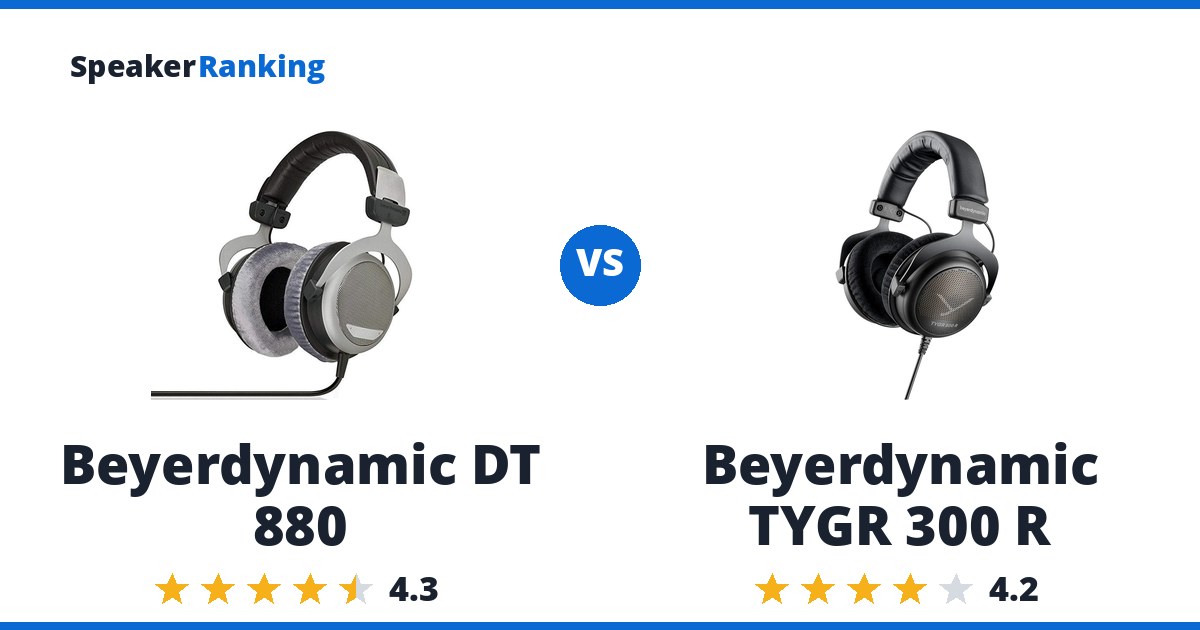
Why pick the Beyerdynamic DT 880: A preference score of 88 and a neutral tilt show a well balanced tuning, with bass from 60 to 200 Hz within 1 dB of target and upper mids within half a dB. The catch: A 6 dB peak near 5.8 kHz can make hi-hats, snare and sibilant vocals sound sharp, and the treble from 6 to 10 kHz runs about 2 dB hot.
Why pick the Beyerdynamic TYGR 300 R: A preference score of 86 in crinacle’s measurement shows it tracks the Harman target closely, with a smoothness of 1.9 dB. Watch for: Only the overall score is available, so there is no band by band breakdown of where it deviates from target.
Buy the Beyerdynamic DT 880. It is rated higher for sound quality than the Beyerdynamic TYGR 300 R and costs less, so it is the default pick unless a specific strength of the other one matters more to you.
Still deciding? The full Headphones rankings cover every ranked option.
Specifications Side By Side
| Beyerdynamic DT 880 | Beyerdynamic TYGR 300 R | |
|---|---|---|
| Price | $159.95 | $159.99 |
| Ranked | #23 of 216 in Over-Ear Headphones | #35 of 216 in Over-Ear Headphones |
| Form Factor | Over-ear | Over-ear |
| Harman Preference Score | 88 (measured by oratory1990, via AutoEQ) | 86 (measured by crinacle, via AutoEQ) |
| Deviation From Target | 2.05 dB standard deviation | 1.90 dB standard deviation |
| Tonal Tilt | +0.02 (negative is warmer, positive brighter) | -0.30 (negative is warmer, positive brighter) |
| Sub-bass Extension | Falls 6 dB below target at 30 Hz (-6.2 dB at 30 Hz) | - |
| Connection | Wired | Wired |
| Back | Semi-open | Open |
| Driver Type | Dynamic | - |
| Frequency Response | 5Hz - 35kHz (Manufacturer specified) | 5Hz - 35kHz (Manufacturer specified) |
| Impedance | - | 32 ohms |
| Sensitivity | - | 96 dB SPL |
| Weight | - | 0.6 lbs (290 g) |
| Built-in Microphone | - | No |
Related Headphone Comparisons
More worthwhile head-to-heads for Beyerdynamic DT 880:
- Beyerdynamic DT 880 vs Sennheiser HD 505
- Beyerdynamic DT 880 vs Audio-Technica ATH-R50x
- Beyerdynamic DT 1350 vs Beyerdynamic DT 880
- Beyerdynamic TYGR 300 R vs Audio-Technica ATH-R50x
- Beyerdynamic TYGR 300 R vs AKG K371
Prices on this page were last checked October 11, 2026 at 4:59 PM UTC. Product prices and availability are accurate as of that date/time and are subject to change; the price and availability shown on Amazon at the time of purchase will apply to the purchase of this product.
As an eBay Partner, we may be compensated if you make a purchase.
The Two Headphones In Full
 Beyerdynamic DT 880: $159.95 Amazon eBay
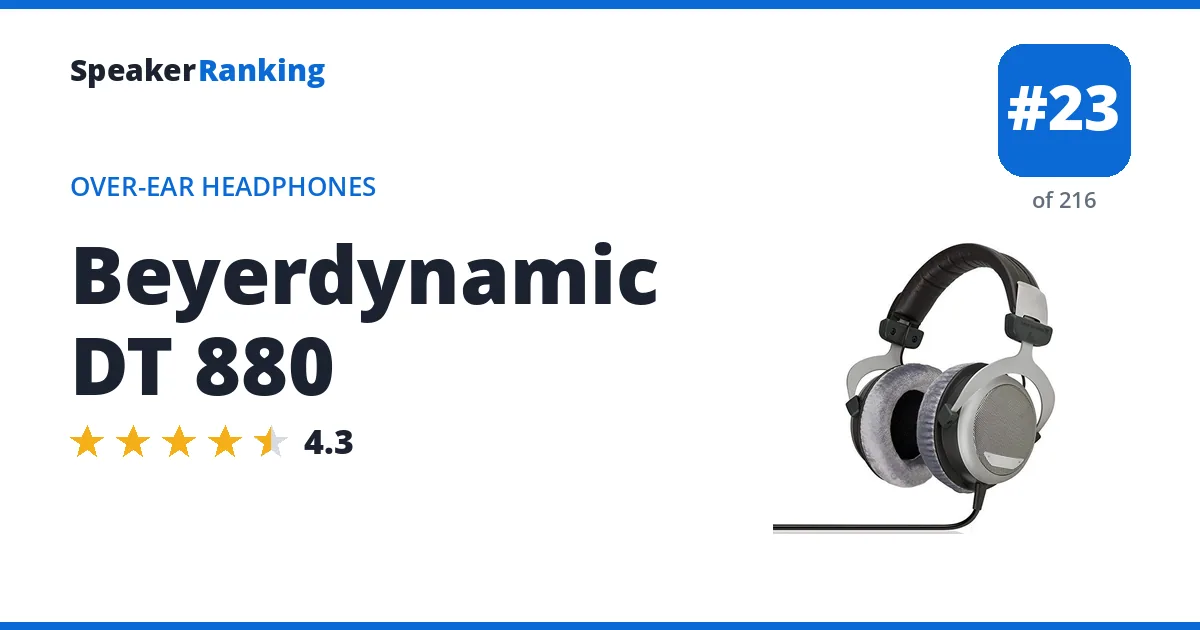
Pros: A preference score of 88 and a neutral tilt show a well balanced tuning, with bass from 60 to 200 Hz within 1 dB of target and upper mids within half a dB. The semi-open design offers a more spacious feel than a closed back. It has the same rating as the HIFIMAN Ananda Stealth and Sennheiser HD 505 while costing less than both.
Cons: A 6 dB peak near 5.8 kHz can make hi-hats, snare and sibilant vocals sound sharp, and the treble from 6 to 10 kHz runs about 2 dB hot. The low mids are lifted by about 2 dB and sub-bass is about 4 dB light under 60 Hz, giving a slightly boxy, bass-shy balance. The semi-open back leaks some sound and gives limited isolation.
Full Beyerdynamic DT 880 review and specifications →
| Back | Semi-open |
|---|---|
| Connection | Wired |
| Deviation From Target | 2.05 dB standard deviation |
| Driver Type | Dynamic |
| Form Factor | Over-ear |
| Frequency Response | 5Hz - 35kHz (Manufacturer specified) |
| Harman Preference Score | 88 (measured by oratory1990, via AutoEQ) |
| Sub-bass Extension | Falls 6 dB below target at 30 Hz (-6.2 dB at 30 Hz) |
| Tonal Tilt | +0.02 (negative is warmer, positive brighter) |
EQ preset to match the Harman target
Set a preamp of -6.4 dB, then add these filters in any parametric equalizer (Wavelet, Equalizer APO, Peace, or a player with parametric EQ). Calculated by AutoEQ from its measured frequency response.
| Filter | Frequency | Gain | Q |
|---|---|---|---|
| Low shelf | 105 Hz | +7.4 dB | 0.70 |
| Peak | 112 Hz | -3.4 dB | 0.30 |
| Peak | 1,320 Hz | +2.1 dB | 0.54 |
| Peak | 5,760 Hz | -6.1 dB | 4.97 |
| Peak | 4,480 Hz | +3.9 dB | 4.24 |
| High shelf | 10,000 Hz | -3.1 dB | 0.70 |
| Peak | 480 Hz | +0.5 dB | 2.40 |
| Peak | 234 Hz | -0.4 dB | 2.41 |
| Peak | 940 Hz | -0.6 dB | 4.04 |
| Peak | 2,939 Hz | -0.5 dB | 4.92 |
- Reviews, Comparisons and Sound Samples
- Head-to-Head Comparisons
 Beyerdynamic TYGR 300 R: $159.99 Amazon eBay

Pros: A preference score of 86 in crinacle’s measurement shows it tracks the Harman target closely, with a smoothness of 1.9 dB. The 32 ohm impedance and 96 dB sensitivity mean it runs fine from a phone or laptop, and 290 g is manageable for an open-back design. It shares its rating with the FiiO FT1 Pro at a lower price.
Cons: Only the overall score is available, so there is no band by band breakdown of where it deviates from target. The open back leaks sound and offers no isolation, and there is no built-in microphone, so it suits quiet listening and desk use rather than commuting or calls.
Full Beyerdynamic TYGR 300 R review and specifications →
| Released | 2019 (7 years ago) |
|---|---|
| Back | Open |
| Built-in Microphone | No |
| Connection | Wired |
| Deviation From Target | 1.90 dB standard deviation |
| Form Factor | Over-ear |
| Frequency Response | 5Hz - 35kHz (Manufacturer specified) |
| Harman Preference Score | 86 (measured by crinacle, via AutoEQ) |
| Impedance | 32 ohms |
| Sensitivity | 96 dB SPL |
| Tonal Tilt | -0.30 (negative is warmer, positive brighter) |
| Weight | 0.6 lbs (290 g) |
EQ preset to match the Harman target
Set a preamp of -5.9 dB, then add these filters in any parametric equalizer (Wavelet, Equalizer APO, Peace, or a player with parametric EQ). Calculated by AutoEQ from its measured frequency response.
| Filter | Frequency | Gain | Q |
|---|---|---|---|
| Low shelf | 105 Hz | +16.5 dB | 0.70 |
| Peak | 43 Hz | -14.1 dB | 0.32 |
| Peak | 2,772 Hz | +2.4 dB | 1.07 |
| Peak | 626 Hz | +2.7 dB | 1.03 |
| Peak | 5,621 Hz | -6.0 dB | 5.22 |
| High shelf | 10,000 Hz | -6.3 dB | 0.70 |
| Peak | 4,679 Hz | +1.3 dB | 6.00 |
| Peak | 23 Hz | -0.5 dB | 4.16 |
| Peak | 30 Hz | +0.3 dB | 2.29 |
| Peak | 6,882 Hz | +1.3 dB | 5.99 |
- Reviews, Comparisons and Sound Samples
- Head-to-Head Comparisons