Short answer: the Beyerdynamic TYGR 300 R. It ranks #35 of 216 over-ear headphones by sound quality, rated 4.2/5, at $159.99; the AKG K371 ranks #39, rated 4.1/5, and costs $179, so there is little reason to consider the other one.
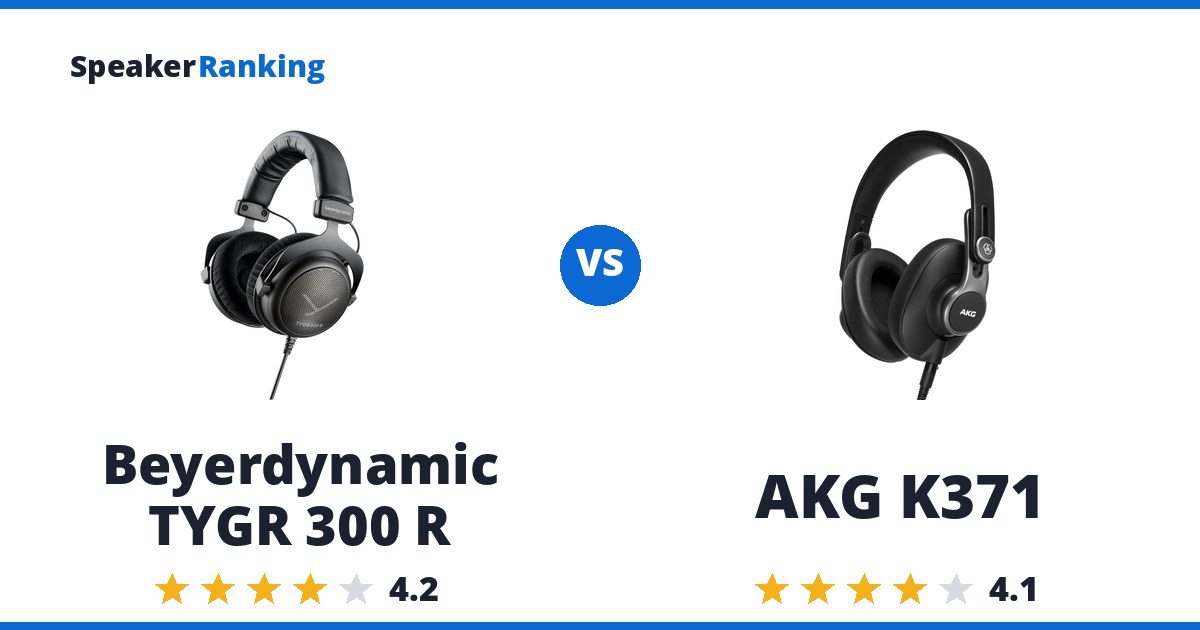
The case for the Beyerdynamic TYGR 300 R: A preference score of 86 in crinacle’s measurement shows it tracks the Harman target closely, with a smoothness of 1.9 dB. The tradeoff: Only the overall score is available, so there is no band by band breakdown of where it deviates from target.
What the AKG K371 does well: A preference score of 85 with only 1.66 dB of deviation makes it one of the smoother closed-back models, and sub-bass runs about 1.6 dB above target for a full, extended low end. The tradeoff: A 7 dB dip near 3.9 kHz and presence about 2.6 dB low push vocals and instrument detail back, while air above 10 kHz is roughly 3.5 dB low, so the sound is dark and lacks sparkle.
Buy the Beyerdynamic TYGR 300 R. It is rated higher for sound quality than the AKG K371 and costs less, so only choose the other one for a particular feature it does better.
Looking for alternatives? See the complete Headphones rankings.
Specifications Side By Side
| Beyerdynamic TYGR 300 R | AKG K371 | |
|---|---|---|
| Price | $159.99 | $179.00 |
| Ranked | #35 of 216 in Over-Ear Headphones | #39 of 216 in Over-Ear Headphones |
| Form Factor | Over-ear | Over-ear |
| Harman Preference Score | 86 (measured by crinacle, via AutoEQ) | 85 (measured by oratory1990, via AutoEQ) |
| Deviation From Target | 1.90 dB standard deviation | 1.66 dB standard deviation |
| Tonal Tilt | -0.30 (negative is warmer, positive brighter) | -0.57 (negative is warmer, positive brighter) |
| Connection | Wired | Wired |
| Back | Open | Closed |
| Impedance | 32 ohms | 32 ohms |
| Sensitivity | 96 dB SPL | 114 dB SPL/V |
| Weight | 0.6 lbs (290 g) | 0.6 lbs (255 g) |
| Frequency Response | 5Hz - 35kHz (Manufacturer specified) | 5Hz - 40kHz (Manufacturer specified) |
| Built-in Microphone | No | - |
| Sub-bass Extension | - | Within 6 dB of target down to 20 Hz (+2.1 dB at 30 Hz) |
| Driver Type | - | Dynamic |
| Drivers | - | 1 x 50mm dynamic |
Related Headphone Comparisons
More worthwhile head-to-heads for Beyerdynamic TYGR 300 R:
- Beyerdynamic DT 880 vs Beyerdynamic TYGR 300 R
- Beyerdynamic TYGR 300 R vs FiiO JT7
- Beyerdynamic TYGR 300 R vs Audio-Technica ATH-R50x
- AKG K371 vs Audio-Technica ATH-R50x
- AKG K371 vs HIFIMAN Sundara
Prices on this page were last checked October 11, 2026 at 4:59 PM UTC. Product prices and availability are accurate as of that date/time and are subject to change; the price and availability shown on Amazon at the time of purchase will apply to the purchase of this product.
As an eBay Partner, we may be compensated if you make a purchase.
The Two Headphones In Full
 Beyerdynamic TYGR 300 R: $159.99 Amazon eBay

Pros: A preference score of 86 in crinacle’s measurement shows it tracks the Harman target closely, with a smoothness of 1.9 dB. The 32 ohm impedance and 96 dB sensitivity mean it runs fine from a phone or laptop, and 290 g is manageable for an open-back design. It shares its rating with the FiiO FT1 Pro at a lower price.
Cons: Only the overall score is available, so there is no band by band breakdown of where it deviates from target. The open back leaks sound and offers no isolation, and there is no built-in microphone, so it suits quiet listening and desk use rather than commuting or calls.
Full Beyerdynamic TYGR 300 R review and specifications →
| Released | 2019 (7 years ago) |
|---|---|
| Back | Open |
| Built-in Microphone | No |
| Connection | Wired |
| Deviation From Target | 1.90 dB standard deviation |
| Form Factor | Over-ear |
| Frequency Response | 5Hz - 35kHz (Manufacturer specified) |
| Harman Preference Score | 86 (measured by crinacle, via AutoEQ) |
| Impedance | 32 ohms |
| Sensitivity | 96 dB SPL |
| Tonal Tilt | -0.30 (negative is warmer, positive brighter) |
| Weight | 0.6 lbs (290 g) |
EQ preset to match the Harman target
Set a preamp of -5.9 dB, then add these filters in any parametric equalizer (Wavelet, Equalizer APO, Peace, or a player with parametric EQ). Calculated by AutoEQ from its measured frequency response.
| Filter | Frequency | Gain | Q |
|---|---|---|---|
| Low shelf | 105 Hz | +16.5 dB | 0.70 |
| Peak | 43 Hz | -14.1 dB | 0.32 |
| Peak | 2,772 Hz | +2.4 dB | 1.07 |
| Peak | 626 Hz | +2.7 dB | 1.03 |
| Peak | 5,621 Hz | -6.0 dB | 5.22 |
| High shelf | 10,000 Hz | -6.3 dB | 0.70 |
| Peak | 4,679 Hz | +1.3 dB | 6.00 |
| Peak | 23 Hz | -0.5 dB | 4.16 |
| Peak | 30 Hz | +0.3 dB | 2.29 |
| Peak | 6,882 Hz | +1.3 dB | 5.99 |
- Reviews, Comparisons and Sound Samples
- Head-to-Head Comparisons
 AKG K371: $179.00 Amazon eBay
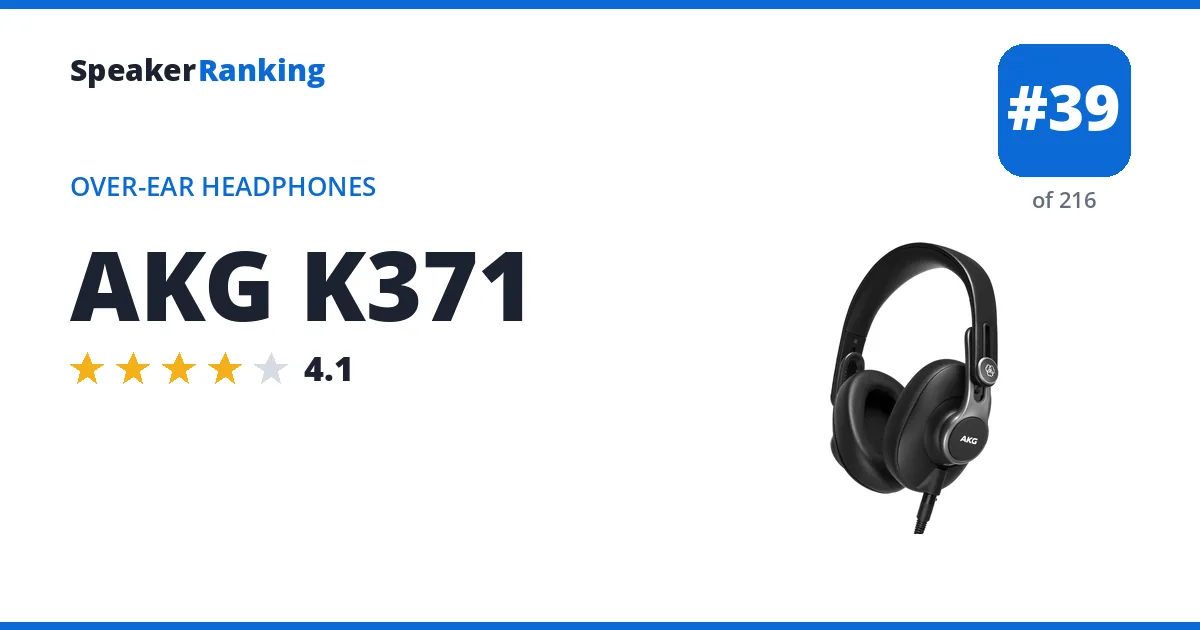
Pros: A preference score of 85 with only 1.66 dB of deviation makes it one of the smoother closed-back models, and sub-bass runs about 1.6 dB above target for a full, extended low end. At 32 ohms and 114 dB per volt it is easy to drive from a phone, and the closed design isolates reasonably well. The warm tilt suits listeners who want bass without harshness.
Cons: A 7 dB dip near 3.9 kHz and presence about 2.6 dB low push vocals and instrument detail back, while air above 10 kHz is roughly 3.5 dB low, so the sound is dark and lacks sparkle. Fans of a bright or highly detailed presentation will find it veiled.
Full AKG K371 review and specifications →
| Released | Aug 2019 (7 years ago) |
|---|---|
| Back | Closed |
| Connection | Wired |
| Deviation From Target | 1.66 dB standard deviation |
| Driver Type | Dynamic |
| Drivers | 1 x 50mm dynamic |
| Form Factor | Over-ear |
| Frequency Response | 5Hz - 40kHz (Manufacturer specified) |
| Harman Preference Score | 85 (measured by oratory1990, via AutoEQ) |
| Impedance | 32 ohms |
| Sensitivity | 114 dB SPL/V |
| Sub-bass Extension | Within 6 dB of target down to 20 Hz (+2.1 dB at 30 Hz) |
| Tonal Tilt | -0.57 (negative is warmer, positive brighter) |
| Weight | 0.6 lbs (255 g) |
EQ preset to match the Harman target
Set a preamp of -5.6 dB, then add these filters in any parametric equalizer (Wavelet, Equalizer APO, Peace, or a player with parametric EQ). Calculated by AutoEQ from its measured frequency response.
| Filter | Frequency | Gain | Q |
|---|---|---|---|
| Low shelf | 105 Hz | -2.7 dB | 0.70 |
| Peak | 182 Hz | -2.3 dB | 1.23 |
| Peak | 4,038 Hz | +5.0 dB | 3.60 |
| Peak | 67 Hz | +3.1 dB | 1.41 |
| Peak | 1,066 Hz | -0.8 dB | 2.57 |
| High shelf | 10,000 Hz | +2.4 dB | 0.70 |
| Peak | 5,564 Hz | -1.6 dB | 3.89 |
| Peak | 4,232 Hz | +0.9 dB | 5.03 |
| Peak | 524 Hz | +0.3 dB | 1.66 |
| Peak | 2,048 Hz | +0.5 dB | 4.67 |
- Reviews, Comparisons and Sound Samples
- Head-to-Head Comparisons