Short answer: the Audio-Technica ATH-R50x. Both are rated 4.1/5 for sound quality (#52 and #39 of 216 over-ear headphones), and the Audio-Technica ATH-R50x costs $169 against $179 for the AKG K371, with sound quality a draw, the lower price decides it.

What the AKG K371 does well: A preference score of 85 with only 1.66 dB of deviation makes it one of the smoother closed-back models, and sub-bass runs about 1.6 dB above target for a full, extended low end. The catch: A 7 dB dip near 3.9 kHz and presence about 2.6 dB low push vocals and instrument detail back, while air above 10 kHz is roughly 3.5 dB low, so the sound is dark and lacks sparkle.
The case for the Audio-Technica ATH-R50x: A preference score of 83 and the smoothest deviation in this group at 1.67 dB make for a very even response, with bass from 60 to 200 Hz and low mids within 0.6 dB of target. Watch for: Sub-bass is about 6 dB low under 60 Hz, so deep rumble is lacking.
Buy the Audio-Technica ATH-R50x. Both are rated the same for sound quality, and it costs $10 less than the AKG K371.
Still deciding? The full Headphones rankings cover every ranked option.
Specifications Side By Side
| AKG K371 | Audio-Technica ATH-R50x | |
|---|---|---|
| Price | $179.00 | $169.00 |
| Ranked | #39 of 216 in Over-Ear Headphones | #52 of 216 in Over-Ear Headphones |
| Form Factor | Over-ear | Over-ear |
| Harman Preference Score | 85 (measured by oratory1990, via AutoEQ) | 83 (measured by oratory1990, via AutoEQ) |
| Deviation From Target | 1.66 dB standard deviation | 1.67 dB standard deviation |
| Tonal Tilt | -0.57 (negative is warmer, positive brighter) | +0.64 (negative is warmer, positive brighter) |
| Sub-bass Extension | Within 6 dB of target down to 20 Hz (+2.1 dB at 30 Hz) | Falls 6 dB below target at 30 Hz (-6.4 dB at 30 Hz) |
| Connection | Wired | Wired |
| Back | Closed | Open |
| Driver Type | Dynamic | Dynamic |
| Drivers | 1 x 50mm dynamic | 1 x 45mm dynamic |
| Impedance | 32 ohms | 50 ohms |
| Sensitivity | 114 dB SPL/V | 93.3 dB/mW |
| Weight | 0.6 lbs (255 g) | 0.5 lbs (207 g) |
| Frequency Response | 5Hz - 40kHz (Manufacturer specified) | 5Hz - 40kHz (Manufacturer specified) |
Related Headphone Comparisons
More worthwhile head-to-heads for AKG K371:
- Beyerdynamic TYGR 300 R vs AKG K371
- AKG K371 vs Sennheiser HD 25 Plus
- AKG K371 vs HIFIMAN Sundara
- Audio-Technica ATH-R50x vs HIFIMAN Sundara
- Beyerdynamic TYGR 300 R vs Audio-Technica ATH-R50x
Prices on this page were last checked October 11, 2026 at 4:59 PM UTC. Product prices and availability are accurate as of that date/time and are subject to change; the price and availability shown on Amazon at the time of purchase will apply to the purchase of this product.
As an eBay Partner, we may be compensated if you make a purchase.
The Two Headphones In Full
 AKG K371: $179.00 Amazon eBay
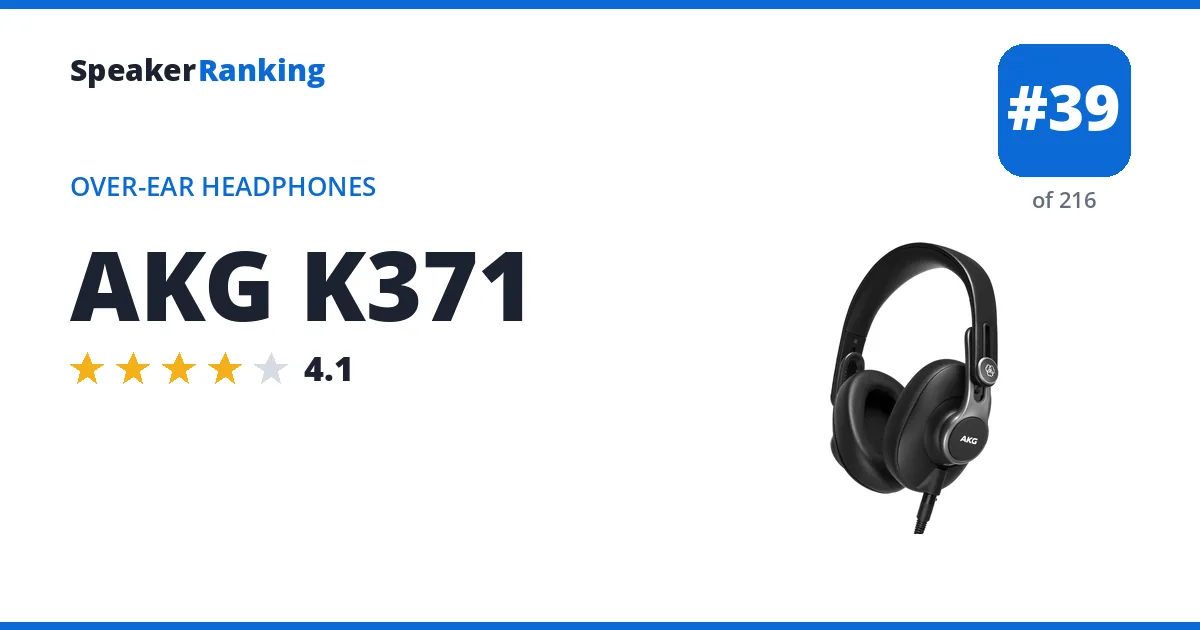
Pros: A preference score of 85 with only 1.66 dB of deviation makes it one of the smoother closed-back models, and sub-bass runs about 1.6 dB above target for a full, extended low end. At 32 ohms and 114 dB per volt it is easy to drive from a phone, and the closed design isolates reasonably well. The warm tilt suits listeners who want bass without harshness.
Cons: A 7 dB dip near 3.9 kHz and presence about 2.6 dB low push vocals and instrument detail back, while air above 10 kHz is roughly 3.5 dB low, so the sound is dark and lacks sparkle. Fans of a bright or highly detailed presentation will find it veiled.
Full AKG K371 review and specifications →
| Released | Aug 2019 (7 years ago) |
|---|---|
| Back | Closed |
| Connection | Wired |
| Deviation From Target | 1.66 dB standard deviation |
| Driver Type | Dynamic |
| Drivers | 1 x 50mm dynamic |
| Form Factor | Over-ear |
| Frequency Response | 5Hz - 40kHz (Manufacturer specified) |
| Harman Preference Score | 85 (measured by oratory1990, via AutoEQ) |
| Impedance | 32 ohms |
| Sensitivity | 114 dB SPL/V |
| Sub-bass Extension | Within 6 dB of target down to 20 Hz (+2.1 dB at 30 Hz) |
| Tonal Tilt | -0.57 (negative is warmer, positive brighter) |
| Weight | 0.6 lbs (255 g) |
EQ preset to match the Harman target
Set a preamp of -5.6 dB, then add these filters in any parametric equalizer (Wavelet, Equalizer APO, Peace, or a player with parametric EQ). Calculated by AutoEQ from its measured frequency response.
| Filter | Frequency | Gain | Q |
|---|---|---|---|
| Low shelf | 105 Hz | -2.7 dB | 0.70 |
| Peak | 182 Hz | -2.3 dB | 1.23 |
| Peak | 4,038 Hz | +5.0 dB | 3.60 |
| Peak | 67 Hz | +3.1 dB | 1.41 |
| Peak | 1,066 Hz | -0.8 dB | 2.57 |
| High shelf | 10,000 Hz | +2.4 dB | 0.70 |
| Peak | 5,564 Hz | -1.6 dB | 3.89 |
| Peak | 4,232 Hz | +0.9 dB | 5.03 |
| Peak | 524 Hz | +0.3 dB | 1.66 |
| Peak | 2,048 Hz | +0.5 dB | 4.67 |
- Reviews, Comparisons and Sound Samples
- Head-to-Head Comparisons
 Audio-Technica ATH-R50x: $169.00 Amazon eBay
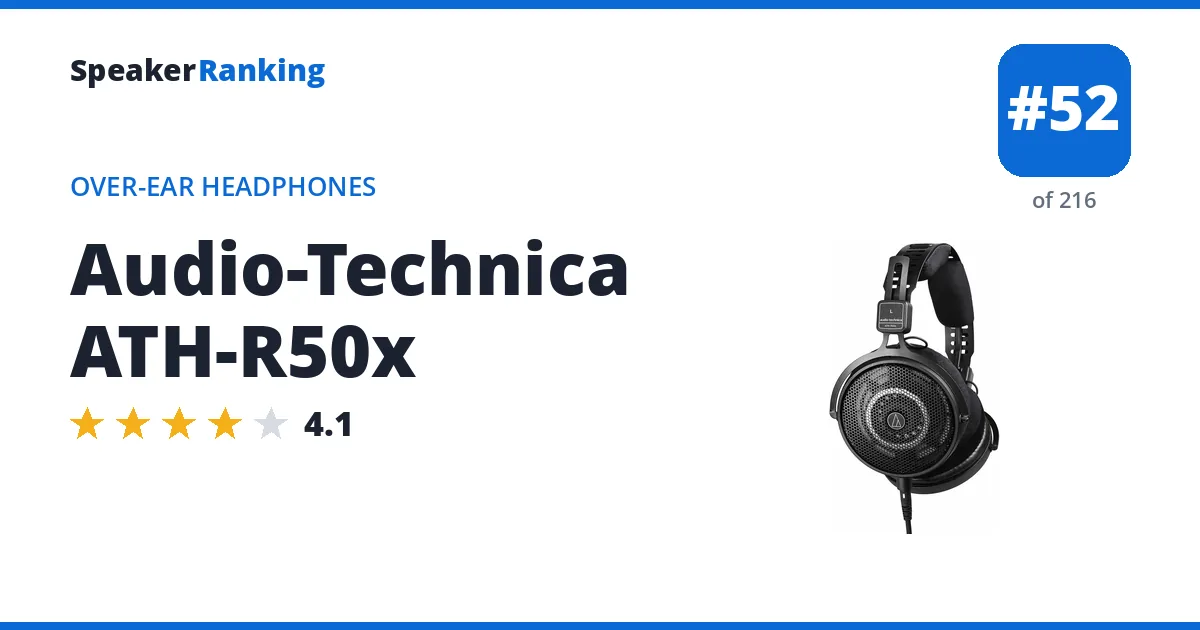
Pros: A preference score of 83 and the smoothest deviation in this group at 1.67 dB make for a very even response, with bass from 60 to 200 Hz and low mids within 0.6 dB of target. At 50 ohms and 93.3 dB/mW sensitivity it can be driven by most portable sources, and at 207 g it is light. It costs less than the AKG K701 and AKG K702 while holding the same rating.
Cons: Sub-bass is about 6 dB low under 60 Hz, so deep rumble is lacking. Treble is slightly forward, with presence about 2 dB high, 6 to 10 kHz about 2.6 dB high and a 4.8 dB peak near 6.3 kHz, which can make vocals and cymbals bright. Its tilt of 0.64 leans bright, and the open back leaks sound.
Full Audio-Technica ATH-R50x review and specifications →
| Released | Jan 2025 (1 year ago) |
|---|---|
| Back | Open |
| Connection | Wired |
| Deviation From Target | 1.67 dB standard deviation |
| Driver Type | Dynamic |
| Drivers | 1 x 45mm dynamic |
| Form Factor | Over-ear |
| Frequency Response | 5Hz - 40kHz (Manufacturer specified) |
| Harman Preference Score | 83 (measured by oratory1990, via AutoEQ) |
| Impedance | 50 ohms |
| Sensitivity | 93.3 dB/mW |
| Sub-bass Extension | Falls 6 dB below target at 30 Hz (-6.4 dB at 30 Hz) |
| Tonal Tilt | +0.64 (negative is warmer, positive brighter) |
| Weight | 0.5 lbs (207 g) |
EQ preset to match the Harman target
Set a preamp of -6.2 dB, then add these filters in any parametric equalizer (Wavelet, Equalizer APO, Peace, or a player with parametric EQ). Calculated by AutoEQ from its measured frequency response.
| Filter | Frequency | Gain | Q |
|---|---|---|---|
| Low shelf | 105 Hz | +7.2 dB | 0.70 |
| Peak | 482 Hz | +2.4 dB | 0.92 |
| Peak | 60 Hz | -4.8 dB | 0.60 |
| Peak | 6,204 Hz | -3.3 dB | 1.70 |
| Peak | 38 Hz | +2.3 dB | 1.60 |
| High shelf | 10,000 Hz | -2.1 dB | 0.70 |
| Peak | 1,497 Hz | -1.4 dB | 3.40 |
| Peak | 851 Hz | +0.5 dB | 2.04 |
| Peak | 4,628 Hz | +1.6 dB | 4.12 |
| Peak | 3,874 Hz | -2.5 dB | 6.00 |
- Reviews, Comparisons and Sound Samples
- Head-to-Head Comparisons