99 powered speakers in our rankings have a balanced XLR input, the standard connector for studio monitors, audio interfaces and mixing consoles. A balanced connection rejects cable-induced noise over longer runs, which matters most once cables cross a desk or a room.
A speaker’s rank here reflects its measured audio performance, not the presence of this input. If you want XLR specifically weighed against sound quality rather than just listed, see our curated best powered speakers with an XLR input picks instead. For background on this and other connector types, see powered speaker inputs explained.
This is every match, grouped by size and sorted by measured sound quality.
The Speakers
Prices on this page were last checked September 17, 2026 at 12:43 AM UTC. Product prices and availability are accurate as of that date/time and are subject to change; the price and availability shown on Amazon at the time of purchase will apply to the purchase of this product.
As an eBay Partner, we may be compensated if you make a purchase.
Quick Navigation
- Small Size Powered Bookshelf Speakers
- Medium Size Powered Bookshelf Speakers
- Large Size Powered Bookshelf Speakers
- Large Size Powered Floorstanding Speakers
| Select to compare | |||||||
|---|---|---|---|---|---|---|---|
| 2 | Genelec 8010A | $900 per pair | 50W | 67 Hz-25 kHz | No | 3.3 lbs | |
| 1 | Genelec 8331A | $4,500 per pair | 72W LF + 36W MF + 36W… | - | - | 14.8 lbs | |
| 2 | Neumann KH120 MKII | $2000 per pair | 245W | 44Hz - 21kHz | No | 14.6 lbs | |
| 3 | Genelec 8030C | $1,750 per pair | 100W | 54Hz - 20kHz | No | 11 lbs | |
| 4 | Neumann KH80 DSP | $598.98 per pair | 140W | 57 Hz - 25 kHz | No | 9 lbs | |
| 5 | Reflector Audio Square Two | $6,499 per pair | 250W to woofers, 100W… | 40Hz-26kHz | - | 42.8 lbs | |
| 6 | Dynaudio LYD 5 | $1000 per pair | 100W total | 50Hz - 21kHz | - | 11.9 lbs | |
| 7 | Genelec 8330A | $2,250 per pair | 100W total | 45Hz-23kHz -6dB | - | 11.2 lbs | |
| 8 | Genelec 8320A | $1,700 per pair | 100W total | 55Hz-23kHz -6dB | - | 7.1 lbs | |
| 10 | Topping MA4 | $400 per pair | 75W total | 49Hz-20kHz +/-3dB | - | 8.3 lbs | |
| 11 | Genelec 8020D | $1,390 per pair | 100W | 56 Hz - 25 kHz | No | 7.1 lbs | |
| 13 | JBL 305P MKII | $319.00 per pair | 81w Per Speaker | 49 Hz - 20 kHz | No | 10.4 lbs | |
| 16 | IK Multimedia iLoud MTM MKII | $799.99 per pair | 100w Per Speaker | 48 Hz - 28 kHz | No | 5.5 lbs | |
| 17 | Sigberg Audio SBS Gen 2 | $18,043.20 | 350W per speaker | - | No | 20.9 lbs | |
| 18 | HEDD Type 05 A-CORE | $714 per pair | 200W total, bi-amped | 43Hz - 50kHz | No | 13.7 lbs | |
| 19 | Kali Audio SM-5 | $3400 per pair | 150W total | 39Hz - 35kHz ±10dB | No | 20.9 lbs | |
| 20 | Kali Audio IN-5 | $698 per pair | 80W LF + 40W mid + 40… | - | - | - | |
| 21 | IK Multimedia iLoud MTM | $800 per pair | 100w Per Speaker | 50 Hz - 24 kHz | No | 5.5 lbs | |
| 22 | Sigberg Audio SBS.1 | - | 350W per speaker | - | No | 20.9 lbs | |
| 23 | Mackie MR524 | $379.98 per pair | 50W bi-amplified per… | 45Hz-20kHz | - | - | |
| 24 | Pioneer DJ VM-50 | $338 per pair | 30W LF + 30W HF; Clas… | - | - | - | |
| 28 | Adam Audio T5V | $464 per pair | 70w Per Speaker | 58Hz - 24kHz | No | 12.6 lbs | |
| 30 | M-Audio BX5 D3 | $299 per pair | 100W each | 52Hz-35kHz | - | 12.3 lbs | |
| 31 | JBL 705P | $1998 per pair | 500W total | 39Hz - 36kHz | - | 12.6 lbs | |
| 36 | Focal Alpha 50 EVO | $658 per pair | 60w Per Speaker | 45 Hz - 22 kHz | No | 13.2 lbs | |
| 40 | KRK Rokit 5 G4 | $337 per pair | 55w Per Speaker | 58Hz - 24kHz | No | 10.8 lbs | |
| 41 | Yamaha HS5 | $298.98 per pair | 45w Per Speaker | 58Hz - 24kHz | No | 12.1 lbs | |
| 42 | Adam Audio A4V | $1,199.98 per pair | 130W RMS each | - | - | 12.8 lbs | |
| 43 | Palmer STUDIMON 5 | $350 per pair | 60W each | - | - | 8.6 lbs | |
| 44 | Presonus Eris E5 XT | $239.98 per pair | 80w Per Speaker | 53Hz - 22kHz | No | 10.1 lbs | |
| 47 | KRK Classic 5 | $319.99 per pair | 50w RMS Per Speaker | 56Hz-30KHz | No | 12.9 lbs | |
| 49 | Presonus Eris E5 | $219.98 per pair | 80w Per Speaker | 53Hz - 22kHz | No | 10.1 lbs | |
| 50 | Edifier MR5 | $349.99 per pair | 110W RMS total | 46Hz-40kHz | - | 22.9 lbs | |
| 62 | Fluid Audio FX50 V2 | $298 per pair | 90W each | 49Hz-22kHz +/-2dB | - | 8.4 lbs | |
| 64 | NHT Pro M-00 | $498 per pair | 75W RMS continuous, 1… | - | No | 14 lbs | |
| 65 | Avantone Pro Active MixCube | $518 per pair | 60W RMS Class AB | 90Hz-17kHz | - | 7.1 lbs | |
| 1 | AsciLab C8C | $6,200 per pair | 600W total | - | - | 60.6 lbs | |
| 2 | Mesanovic CDM65 | $5,300 per pair | 600W total | 40Hz-20kHz +/-1.0dB | - | 32 lbs | |
| 3 | Kii THREE | $14,000 per pair | 1,500W total per spea… | - | - | 42.1 lbs | |
| 4 | Genelec 8351B | $9150 per pair | 550w Per Speaker | 32Hz - 40kHz | No | 31.1 lbs | |
| 5 | Neumann KH420 | $10500 per pair | 555w Per Speaker | 31Hz - 21kHz | No | 77.2 lbs | |
| 6 | Genelec 8361A | $10900 per pair | 1000w Per Speaker | 30Hz - 43kHz | No | 70.3 lbs | |
| 7 | Genelec 8341A | $6590 per pair | 550W total | 338Hz - 37kHz | - | - | |
| 8 | Neumann KH 150 | $3,398 per pair | 245W total | 39Hz-20.4kHz +/-3dB | - | 17.6 lbs | |
| 9 | Dutch & Dutch 8C | $13000 per pair | 1000W | 20Hz - 20kHz | No | 57.3 lbs | |
| 10 | Aalto Speakers Aalto 3 Active Pro | $5,930 per pair | 4x 245W | 31-23,500Hz | - | 19.8 lbs | |
| 11 | Buchardt A10 | $4300 per pair | 200w Per Speaker | - | No | 15 lbs | |
| 12 | Pitt & Giblin Flare | $8,300 per pair | 250W per speaker, bi-… | 36Hz-25kHz +/-1.5dB | - | 37.5 lbs | |
| 13 | Adam Audio S2V | $3500 per pair | 350W total | 35Hz - 50kHz | - | - | |
| 14 | LOGProfessional Alpha | €11,560 per pair | 2x 70W Class A/B | - | - | 15.4 lbs | |
| 15 | Buchardt A500 | $4,150 per pair | 3 x 150W per speaker | - | - | 55.1 lbs | |
| 16 | GGNTKT M1 | £7,500 per pair | 560W total | 36Hz-20kHz -3dB | - | 24.3 lbs | |
| 17 | Neumann KH 310 A | $4,998 per pair | 290W total | 34Hz - 21kHz | - | - | |
| 18 | HEDD Type 20 MK2 | $4800 per pair | 900W | 32Hz - 40kHz | No | 34 lbs | |
| 19 | PSI Audio A21-M | $7,440 per pair | 335W total | 38Hz-23kHz -6dB | - | 28.2 lbs | |
| 20 | Genelec S360 | $9,550 per pair | 350W total | 36Hz-22kHz -6dB | - | 66.1 lbs | |
| 21 | SHIVAUDYO Point Zero | €6,500 per pair | 600W total | 30Hz - 20kHz ±1dB | - | 36.4 lbs | |
| 22 | JBL 308P MKII | $498 per pair | 112W total | 45Hz - 20kHz | - | - | |
| 23 | O.S. Acoustics DBS8 | $5,600 per pair | 500W LF + 150W HF per… | - | - | 34.8 lbs | |
| 24 | Yamaha HS8 | $797.98 per pair | 120w Per Speaker | 47Hz - 24kHz | No | 22.5 lbs | |
| 25 | Kali Audio LP-6 V2 | $398 per pair | 40W LF + 40W HF per s… | - | - | - | |
| 26 | Kali Audio IN-8 V2 | $998 per pair | 140w Per Speaker | - | No | 22.9 lbs | |
| 27 | Genelec 8050B | $3800 per pair | 270w Per Speaker | 32Hz - 25kHz | No | 31.7 lbs | |
| 28 | JBL 4305P | $2,200 per pair | 300W system: 125W LF… | - | - | - | |
| 29 | Focal Solo6 ST6 | $2,998 per pair | 130W total | - | - | - | |
| 30 | Thomann Swissonic A306 | $250 per pair | 100W bi-amplified tot… | 43Hz - 20kHz | - | 13.6 lbs | |
| 31 | Kali Audio LP-6 | $298 per pair | 80W total | 47Hz - 21kHz | - | 16.1 lbs | |
| 32 | Genelec 8040B | $2,790 per pair | 180w Per Speaker | 41Hz - 25kHz | No | 20.7 lbs | |
| 33 | APS Klasik 2020 | $1,800 per pair | 100w Per Speaker | 39Hz - 25kHz | No | 22 lbs | |
| 35 | Palmer Orbit 11 | $1,532 per pair | 1000W peak / 400W RMS… | - | - | 30.6 lbs | |
| 36 | Focal Trio6 ST6 | $6,998 per pair | 250W total | - | - | 55.1 lbs | |
| 37 | Meyer Sound Amie | $8,200 per pair | 2-channel Class D, on… | - | - | 24.9 lbs | |
| 38 | JBL 708P | $4000 per pair | 500W total | 41Hz - 25kHz | - | 25.1 lbs | |
| 40 | JBL 306P MKII | $398 per pair | 112W total | 39Hz - 24kHz | - | 13.4 lbs | |
| 41 | Sigberg Audio Manta | $32,220.00 | 600W per speaker | - | No | 55.1 lbs | |
| 42 | Fluid Audio Image 2 | $3,798 per pair | 675W each | 40Hz-27kHz +/-2.2dB | - | 28.4 lbs | |
| 43 | Barefoot Footprint 01 | $3,199 per pair | 650W total per speaker | 36Hz-45kHz | - | 35.1 lbs | |
| 45 | Kali Audio LP-8 V2 | $299.00 per pair | 100W total, bi-amped | - | - | 19.8 lbs | |
| 46 | Dynaudio Core 47 | $5,250 per pair | 1,150W each | - | - | 33.3 lbs | |
| 48 | Emotiva Airmotiv 6s | $800 per pair | 210W total | 42Hz - 25kHz | - | 24.9 lbs | |
| 49 | M-Audio BX8 D3 | $258 per pair | 150W each | - | - | 23.1 lbs | |
| 50 | Focal Alpha 65 EVO | $998 per pair | 85w Per Speaker | 40Hz - 22kHz | No | 16.8 lbs | |
| 51 | Adam Audio A7V | $1,879.98 per pair | 130W RMS each | - | - | 19.2 lbs | |
| 52 | Yamaha HS7 | $699.98 per pair | 95W each | - | - | 18.1 lbs | |
| 53 | Adam Audio T8V | $699.98 per pair | 90w Per Speaker | 33Hz - 25kHz | No | 21.6 lbs | |
| 54 | Adam Audio T7V | $579.98 per pair | 70w Per Speaker | 39Hz - 25kHz | No | 15.7 lbs | |
| 55 | Kali Audio LP-8 | $598 per pair | 100w Per Speaker | 45Hz - 21kHz | No | 19.8 lbs | |
| 56 | KRK Rokit 8 G4 | $1,000 per pair | 100w Per Speaker | - | No | 23.1 lbs | |
| 57 | KRK Rokit 7 G4 | $668 per pair | - | - | No | 16.8 lbs | |
| 58 | Presonus Eris Studio 8 | $924 per pair | 140w Per Speaker | 35Hz - 20kHz | No | 22.3 lbs | |
| 59 | Edifier S3000Pro | $900 per pair | 78w RMS Per Speaker | 38Hz-20KHz | Yes, 5.0 | 29.8 lbs | |
| 61 | Focal Twin6 Be | $4,400 per pair | 150W LF + 100W LF/MF… | - | - | - | |
| 63 | Focal Alpha Twin Evo | $1,318 per pair | 210W each | - | - | 26.5 lbs | |
| 65 | EVE Audio SC305 | $2,599.98 per pair | 150W each | 50Hz-21kHz | - | 18.7 lbs | |
| 66 | PMC result6 | $3,300 per pair | 100W LF + 65W HF each | 45Hz-22kHz | - | 17.6 lbs | |
| 67 | Ocean Way Audio HR5 | $5,598 per pair | 215W total | 45Hz - 20kHz | - | 37.9 lbs | |
| 2 | GGNTKT M3 | $32,350 per pair | approx. 1000W total | 29Hz-20kHz | - | approx. 154.3 lbs | |
| 3 | Pitt & Giblin Superwax | $16,500 per pair | 950W total | 27Hz-18kHz +/-1.5dB | - | 202.8 lbs | |
| 4 | Pitt & Giblin Superwax Mini | $9,800 per pair | 350W total | -3dB at 30.9Hz, -6dB… | - | 88.2 lbs |
Small Size Powered Bookshelf Speakers
 Ranked #2 of 23 in Small Size Powered Bookshelf Speakers - Genelec 8010A: $900 per pair B&H Photo Video eBay
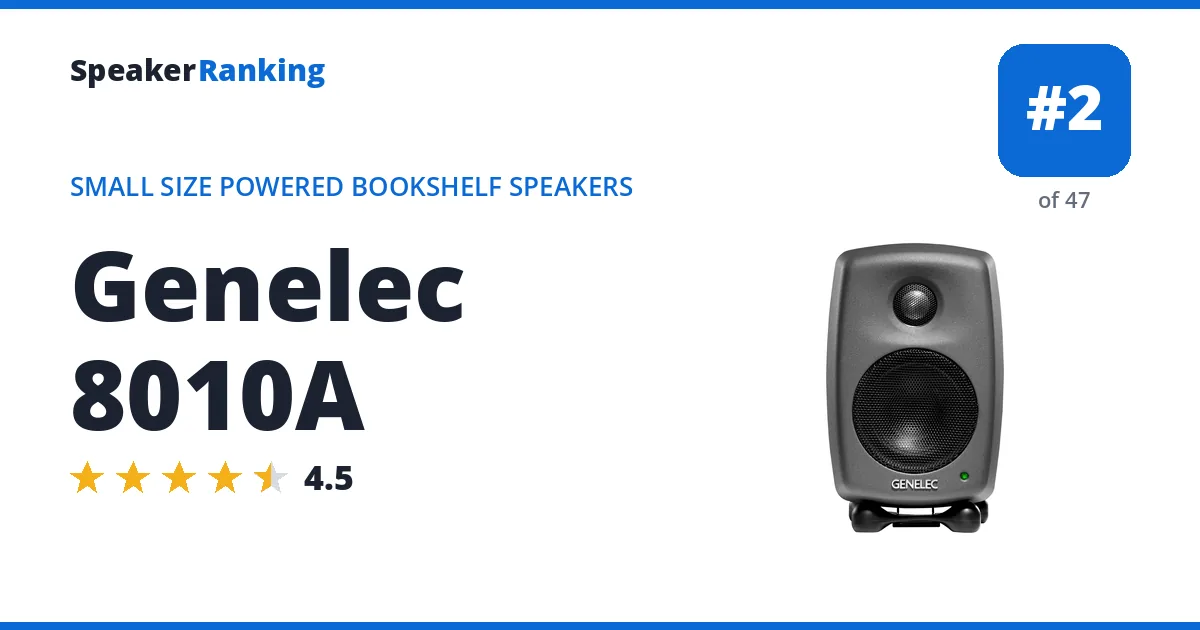
Pros: ASR’s Klippel measurements support a neutral compact monitor: the response spans 2.5dB from 300Hz to 5kHz, with lower narrow-band variation in the listening window than directly on-axis. Spinorama predicts 4.10 standalone and 7.01 with an ideal subwoofer, making it a strong choice when bass is handled separately. Its measured balance provides firmer evidence for critical listening than a recorded sound demonstration alone. Measured bass extension of 74Hz (-3dB).
Cons: The measured -3dB point is about 78Hz, so deep bass is missing without a subwoofer. The small enclosure and woofer are better suited to close listening than room-filling levels; the preference score does not measure headroom. The D3V offers substantially deeper measured bass in a similarly compact format, while the Genelec’s premium price is harder to justify for casual desktop use.
Full Genelec 8010A review and specifications →
| AES Input | No |
|---|---|
| Amplifier Power | 50W (25W woofer + 25W tweeter) |
| App | No |
| Aux Input | No |
| Bass Extension (-10dB) | 67Hz (measured, Audio Science Review) |
| Bass Extension (-3dB) | 74Hz (measured, Audio Science Review) |
| Bluetooth | No |
| Coaxial Input | No |
| Dimensions | 7.7"H x 4.8"W x 4.5"D (195.6 x 121.9 x 114.3 mm) |
| Drivers | 3" woofer, 0.75" metal dome tweeter |
| EQ | Yes (Bass tilt, Desk proximity) |
| Frequency Response | 67 Hz-25 kHz (-6dB) (Manufacturer specified) |
| HDMI Input | No |
| Inputs | XLR |
| Maximum SPL | 96dB @ 1m (manufacturer specified) |
| Optical Input | No |
| RCA Input | No |
| TRS Input | No |
| USB Input | No |
| Weight | 3.3 lbs (1.5 kg) |
| XLR Input | Yes |
- Links
- Reviews, Comparisons and Sound Samples
- Audio Science Review Measurements More from Audio Science Review →
- DSAUDIO.review: Genelec 8010A (Genelec G One) vs iLoud Micro Monitor Sound Demo w/ Bass Test More from DSAUDIOreview →
- DSAUDIO.review: Genelec 8010A (Genelec G One) vs Presonus Eris E4.5 Sound Demo w/ Bass Test
- DSAUDIO.review: Genelec 8010A (G One) vs JBL LSR305 Sound Demo w/ Bass Test
- DSAUDIO.review: Genelec 8010A (Genelec G One) vs Audioengine A2+ Sound Demo w/ Bass Test
- DSAUDIO.review: Genelec 8010A (Genelec G One) vs Yamaha HS5 Sound Demo w/ Bass Test
- Audio Science Review Measurements (spinorama.org)
- Head-to-Head Comparisons
- Genelec 8010A vs Adam Audio D3v
- Genelec 8010A vs Cambridge Audio L/R S
- Genelec 8010A vs IK Multimedia iLoud Micro Monitor
- Genelec 8010A vs Edifier M60
- Genelec 8010A vs HiVi Swan X3
- Genelec 8010A vs Edifier MR3
- Genelec 8010A vs Audioengine A2+
- Genelec 8010A vs Klipsch ProMedia Lumina
- See all 13 comparisons
Medium Size Powered Bookshelf Speakers
 Ranked #1 of 65 in Medium Size Powered Bookshelf Speakers - Genelec 8331A: $4,500 per pair B&H Photo Video eBay
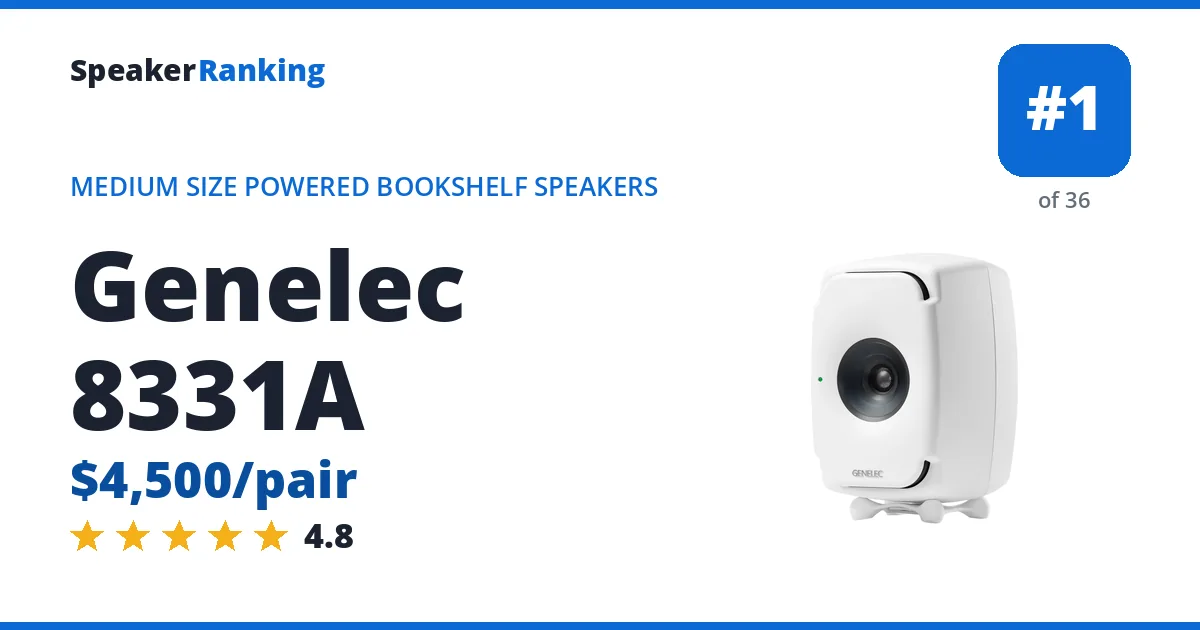
Pros: Erin’s Klippel measurements support its reference-monitor credentials: a 1.4dB response span from 300Hz to 5kHz, low listening-window and predicted-room irregularity, and preference scores of 5.91 standalone and 7.85 with an ideal subwoofer. The coaxial mid/tweeter and concealed woofers maintain coherent radiation as listening position changes. Bass reaches -3dB around 48Hz, and GLM adds level, delay and room-response calibration. Measured bass extension of 49Hz (-3dB).
Cons: Expensive, with studio-oriented XLR connectivity rather than consumer streaming. The compact woofers still limit deep-bass output, and the review reports protection muting when pushed beyond its operating range. GLM calibration hardware is an additional purchase. Its excellent tonal score does not remove the need for a subwoofer or larger monitor at demanding levels.
Full Genelec 8331A review and specifications →
| AES Input | Yes |
|---|---|
| Amplifier Power | 72W LF + 36W MF + 36W HF |
| Aux Input | No |
| Bass Extension (-10dB) | 39Hz (measured, Erin's Audio Corner) |
| Bass Extension (-3dB) | 49Hz (measured, Erin's Audio Corner) |
| Coaxial Input | No |
| Dimensions | 12"H x 7.4"W x 8.3"D (305 x 189 x 212 mm) |
| Drivers | Dual 130x65mm woofers; 90mm coaxial mid; 19mm tweeter |
| HDMI Input | No |
| Inputs | XLR, AES/EBU |
| Maximum SPL | 100dB at 3m before protection (measured, Erin's Audio Corner) |
| Optical Input | No |
| RCA Input | No |
| Sensitivity | Not applicable (active DSP loudspeaker) |
| Spinorama Preference Score | 5.91 |
| Spinorama Preference Score with Perfect Sub | 7.85 |
| TRS Input | No |
| USB Input | No |
| Weight | 14.8 lbs (6.7kg) each |
| XLR Input | Yes |
- Links
- Reviews, Comparisons and Sound Samples
- Head-to-Head Comparisons
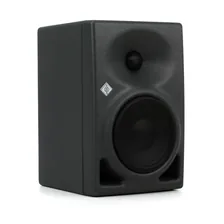 Ranked #2 of 65 in Medium Size Powered Bookshelf Speakers - Neumann KH120 MKII: $2000 per pair B&H Photo Video eBay
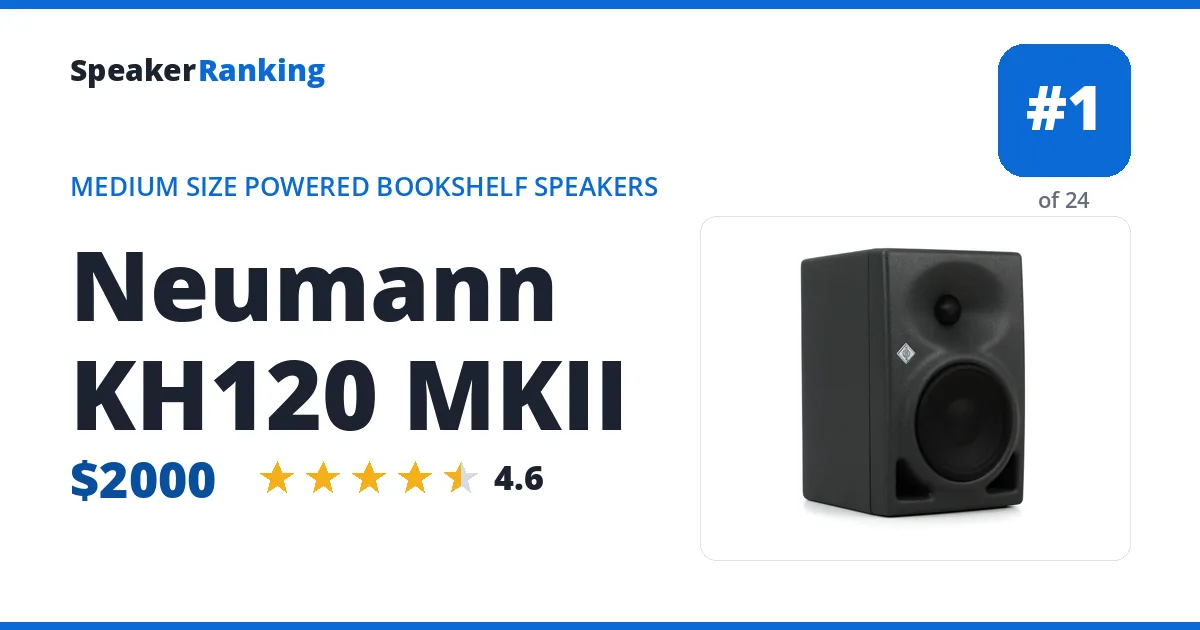
Pros: ASR’s Klippel data shows exceptional neutrality: only a 1.5dB span from 300Hz to 5kHz and low listening-window narrow-band deviation of 0.208. Scores of 5.75 standalone and 7.70 with an ideal subwoofer place it among the strongest measured options here. Bass reaches -3dB around 45Hz. The review reports very low distortion at 86dB/1m and clean performance outside deep bass at 96dB. Measured bass extension of 46Hz (-3dB).
Cons: Vertical crossover interference makes listening height important even though horizontal dispersion is well controlled. A small directivity irregularity remains around 2kHz. Distortion increases below about 50Hz at high output; a subwoofer can extend the system and reduce low-frequency demands. High price, and a flat anechoic response still needs suitable placement in the room.
Full Neumann KH120 MKII review and specifications →
| AES Input | No |
|---|---|
| Amplifier Power | 245W (145W woofer + 100W tweeter) |
| App | Yes (MA 1 alignment) |
| Aux Input | No |
| Bass Extension (-10dB) | 36Hz (measured, Audio Science Review) |
| Bass Extension (-3dB) | 46Hz (measured, Audio Science Review) |
| Bluetooth | No |
| Coaxial Input | No |
| DSP | Yes |
| Dimensions | 11.3"H x 7.2"W x 8.9"D (287 x 182.9 x 226.1 mm) |
| Drivers | 5.25" woofer, 1" titanium fabric dome tweeter |
| EQ | Yes (via DSP) |
| Frequency Response | 44Hz - 21kHz (±3dB) (Manufacturer specified) |
| HDMI Input | No |
| Inputs | XLR |
| Maximum SPL | 116.8dB @ 1m (manufacturer specified) |
| Optical Input | No |
| RCA Input | No |
| Spinorama Preference Score | 5.75 |
| Spinorama Preference Score with Perfect Sub | 7.70 |
| TRS Input | No |
| USB Input | No |
| Weight | 14.6 lbs (6.6 kg) each |
| XLR Input | Yes |
- Links
- Reviews, Comparisons and Sound Samples
- Head-to-Head Comparisons
- Neumann KH120 MKII vs Genelec 8030C
- Neumann KH120 MKII vs Genelec 8331A
- Neumann KH120 MKII vs Neumann KH80 DSP
- Neumann KH120 MKII vs Dynaudio LYD 5
- Neumann KH120 MKII vs Genelec 8330A
- Neumann KH120 MKII vs Genelec 8320A
- Neumann KH120 MKII vs Devialet Phantom II 98 dB
- Neumann KH120 MKII vs Topping MA4
- See all 51 comparisons
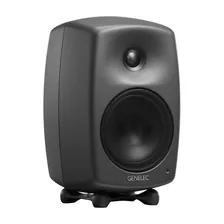 Ranked #3 of 65 in Medium Size Powered Bookshelf Speakers - Genelec 8030C: $1,750 per pair B&H Photo Video eBay
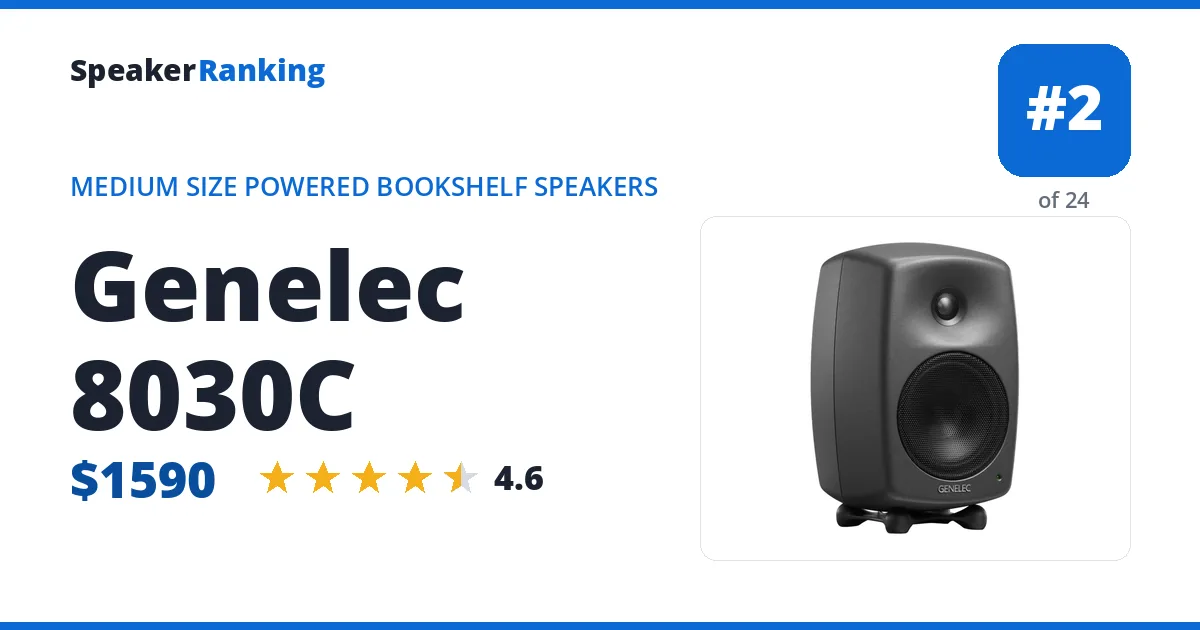
Pros: ASR’s Klippel measurements show a 1.9dB response span from 300Hz to 5kHz and smooth listening-window behavior. Predicted preference scores of 5.35 standalone and 7.60 with an ideal subwoofer support its high position for tonal accuracy. Broad, controlled horizontal radiation makes the balance relatively stable across a desk, and bass reaches -3dB around 56Hz. Measured bass extension of 59Hz (-3dB).
Cons: A dip around 2-3kHz remains, and vertical placement is less forgiving than the horizontal coverage suggests. Deep-bass headroom is limited; isolated high-output measurements at higher frequencies do not describe full-band loudness. The review found demanding bass material could cause audible distress beyond moderate levels. A subwoofer is useful for full-range monitoring.
Full Genelec 8030C review and specifications →
| AES Input | No |
|---|---|
| Amplifier Power | 100W (50W woofer + 50W tweeter) |
| App | No |
| Aux Input | No |
| Bass Extension (-10dB) | 47Hz (measured, Audio Science Review) |
| Bass Extension (-3dB) | 59Hz (measured, Audio Science Review) |
| Bluetooth | No |
| Coaxial Input | No |
| Dimensions | 11.7"H x 7.4"W x 7"D (297.2 x 188 x 177.8 mm) |
| Drivers | 5.1" woofer, 0.75" metal dome tweeter |
| EQ | Yes (Bass tilt, treble tilt, room response) |
| Frequency Response | 54Hz - 20kHz (±2.5dB) (Manufacturer specified) |
| HDMI Input | No |
| Inputs | XLR |
| Maximum SPL | 110dB @ 1m (manufacturer specified) |
| Optical Input | No |
| RCA Input | No |
| TRS Input | No |
| USB Input | No |
| Weight | 11 lbs (5 kg) each |
| XLR Input | Yes |
- Links
- Reviews, Comparisons and Sound Samples
- Head-to-Head Comparisons
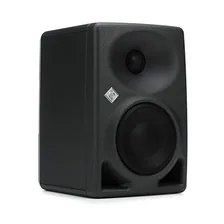 Ranked #4 of 65 in Medium Size Powered Bookshelf Speakers - Neumann KH80 DSP: $598.98 per pair Amazon B&H Photo Video eBay
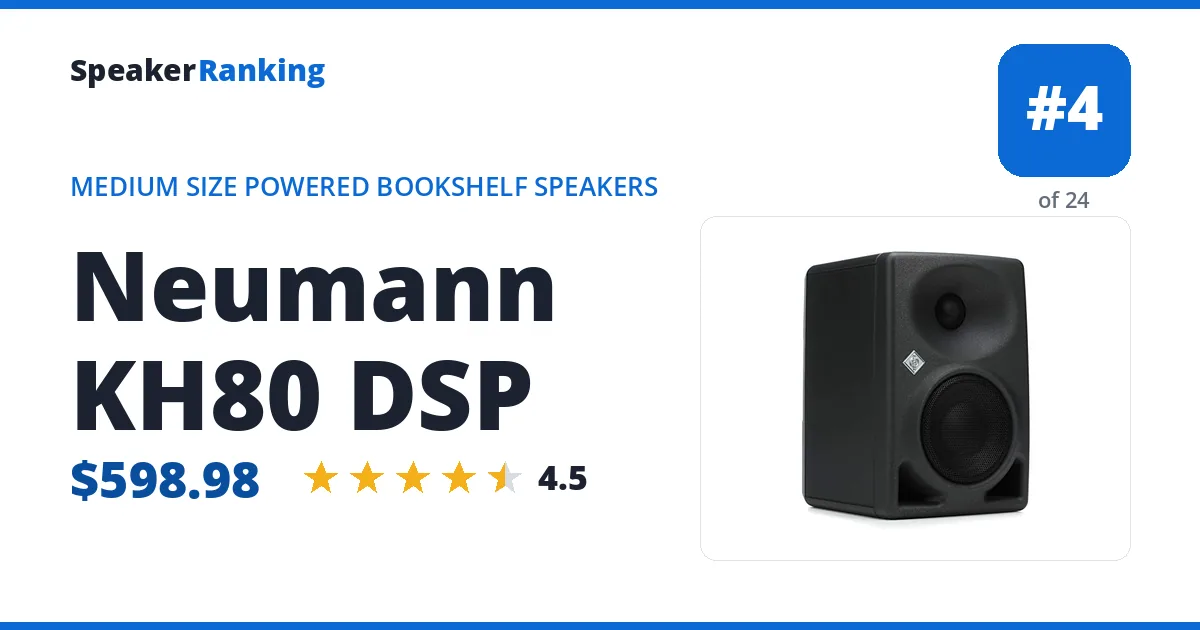
Pros: ASR’s selected Klippel measurement has a 1.4dB midrange response span and virtually no overall on-axis tilt. Scores of 5.03 standalone and 7.39 with an ideal subwoofer indicate excellent tonal accuracy in a compact monitor. The waveguide and steep crossover provide useful control of reflected sound, while placement filters help compensate for a desk or nearby boundaries. Existing multitone testing supports good moderate-level clarity. Measured bass extension of 57Hz (-3dB), with a measured sensitivity of 91.9dB.
Cons: Bass reaches -3dB around 59Hz in this measurement, less deep than the KH120 II. Output protection and increasing multitone distortion limit loud listening, especially in the bass. Room reflections and listening distance can alter perceived treble balance despite its flat direct response. Calibration equipment adds to the cost; the preference score is not a measurement of maximum clean output.
Full Neumann KH80 DSP review and specifications →
| AES Input | No |
|---|---|
| Amplifier Power | 140W (90W woofer + 50W tweeter) |
| App | Yes (MA 1 alignment) |
| Aux Input | No |
| Bass Extension (-10dB) | 51Hz (measured, Erin's Audio Corner) |
| Bass Extension (-3dB) | 57Hz (measured, Erin's Audio Corner) |
| Bluetooth | No |
| Coaxial Input | No |
| DSP | Yes |
| Dimensions | 13.6"H x 10.8"W x 9.6"D (345.4 x 274.3 x 243.8 mm) |
| Drivers | 4.1" woofer, 1" fabric dome tweeter |
| EQ | Yes (via DSP) |
| Frequency Response | 57 Hz - 25 kHz (+-3 dB) (Manufacturer specified) |
| HDMI Input | No |
| Inputs | XLR |
| Maximum SPL | 110.7dB @ 1m (manufacturer specified) |
| Optical Input | No |
| RCA Input | No |
| Sensitivity | 91.9dB (measured at 0.3V/1m, Erin's Audio Corner) |
| Spinorama Preference Score | 5.03 |
| Spinorama Preference Score with Perfect Sub | 7.39 |
| TRS Input | No |
| USB Input | No |
| Weight | 9 lbs (4.1 kg) each |
| XLR Input | Yes |
- Links
- Reviews, Comparisons and Sound Samples
- Erin’s Audio Corner: Neumann KH 80 Studio Monitor Review. Excellent Performance. Small Size. More from Erin’s Audio Corner →
- Erin’s Audio Corner Review Measurements
- Audio Science Review Measurements More from Audio Science Review →
- DSAUDIO.review: Neumann KH80 DSP vs Genelec 8020D Sound & Frequency Response Comparison More from DSAUDIOreview →
- DSAUDIO.review: Neumann KH80 DSP vs Yamaha HS8 Sound & Frequency Response Comparison
- DSAUDIO.review: Neumann KH80 DSP vs Focal Shape 40 Sound & Frequency Response Comparison
- DSAUDIO.review: Neumann KH80 DSP vs IK Multimedia iLoud MTM Sound & Frequency Response Comparison
- DSAUDIO.review: Neumann KH80 DSP vs JBL 305P MKII Sound & Frquency Response Comparison
- DSAUDIO.review: KEF LSX vs Neumann KH80 DSP Sound & Frequency Response Comparison
- DSAUDIO.review: Adam Audio A3X vs Neumann KH80 DSP Sound & Frequency Response Comparison
- DSAUDIO.review: Neumann KH80 DSP vs KRK Rokit 5 G4 RP5G4 Sound & Frequency Response Comparison
- Joy & Oluv’Sone: 🎃🔥 UBoom X - Halloween Rock Special 🎸🤘 More from Oluv’Sone →
- Audio Science Review Measurements (spinorama.org)
- Head-to-Head Comparisons
- Neumann KH80 DSP vs Genelec 8030C
- Neumann KH80 DSP vs Reflector Audio Square Two
- Neumann KH80 DSP vs Neumann KH120 MKII
- Neumann KH80 DSP vs Dynaudio LYD 5
- Neumann KH80 DSP vs Genelec 8331A
- Neumann KH80 DSP vs Genelec 8330A
- Neumann KH80 DSP vs Genelec 8320A
- Neumann KH80 DSP vs Devialet Phantom II 98 dB
- See all 64 comparisons
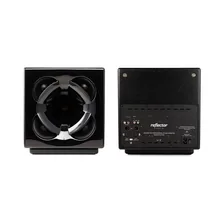 Ranked #5 of 65 in Medium Size Powered Bookshelf Speakers - Reflector Audio Square Two: $6,499 per pair Monheim Microphones eBay
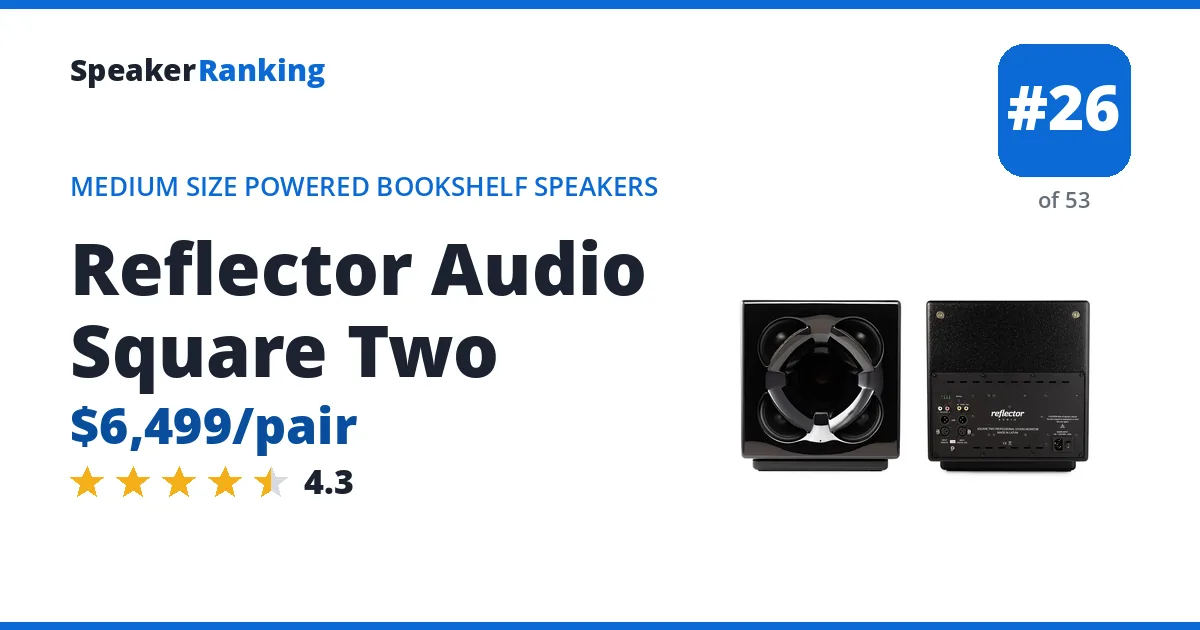
Pros: The manufacturer-supplied data shows a very small 1.1dB span from 300Hz to 5kHz and preference scores of 5.73 standalone and 7.54 with an ideal subwoofer. Its horn-centered layout and four surrounding woofers offer a compact, controlled-radiation monitor, with a measured -3dB point around 49Hz. The linked Sound on Sound review also supports its use for detailed monitoring.
Cons: The nominal 60-by-60-degree pattern calls for careful aiming and gives less freedom to move than wide-dispersion monitors.
Full Reflector Audio Square Two review and specifications →
| AES Input | Yes |
|---|---|
| Amplifier Power | 250W to woofers, 100W to compression driver (Hypex Class-D) |
| Aux Input | No |
| Coaxial Input | Yes |
| Country | Made in Latvia |
| Dimensions | 12.6"W x 13.6"H x 12.8"D (320 x 345 x 325 mm) |
| Drivers | 4x 5" woofers, 1x horn-loaded compression driver (ring diaphragm) |
| Enclosure | 2-way active coaxial horn monitor, bass-reflex (convertible to sealed) |
| Frequency Response | 40Hz-26kHz (-6dB) |
| HDMI Input | No |
| Inputs | Analogue XLR/RCA, AES digital XLR, S/PDIF, TOSLINK optical |
| Maximum SPL | 118dB @ 1m (EIA-426B, single monitor) (manufacturer specified) |
| Optical Input | Yes |
| RCA Input | Yes |
| Spinorama Preference Score | 5.73 |
| Spinorama Preference Score with Perfect Sub | 7.54 |
| TRS Input | No |
| USB Input | No |
| Weight | 42.8 lbs (19.4 kg) each |
| XLR Input | Yes |
- Links
- Reviews, Comparisons and Sound Samples
- Head-to-Head Comparisons
- Reflector Audio Square Two vs Neumann KH80 DSP
- Reflector Audio Square Two vs JBL 305P MKII
- Reflector Audio Square Two vs IK Multimedia iLoud MTM MKII
- Reflector Audio Square Two vs Kali Audio IN-5
- Reflector Audio Square Two vs KEF LSX II LT
- Reflector Audio Square Two vs Adam Audio T5V
- Reflector Audio Square Two vs Kali LP-UNF
- Reflector Audio Square Two vs Yamaha HS5
- See all 11 comparisons
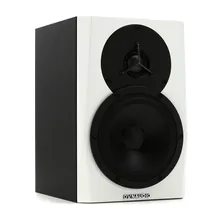 Ranked #6 of 65 in Medium Size Powered Bookshelf Speakers - Dynaudio LYD 5: $1000 per pair B&H Photo Video eBay
Pros: ASR’s Klippel data is substantially stronger than a low ranking suggests: 4.72 standalone and 7.38 with an ideal subwoofer, with a 1.9dB span from 300Hz to 5kHz. Low listening-window narrow-band deviation of 0.242 supports relatively uncolored midrange reproduction. It is particularly competitive when used with a subwoofer rather than judged only by bass reach. Measured bass extension of 68Hz (-3dB).
Cons: Bass reaches -3dB around 72Hz, so it gives up low-frequency weight to deeper-reaching monitors. The existing review identifies a dip near 1.6kHz, upper-bass emphasis and uneven crossover-region dispersion. These issues and limited deep-bass capability keep it below the leading all-rounders despite its strong bass-normalized score. A subwoofer does not correct upper-frequency directivity errors.
Full Dynaudio LYD 5 review and specifications →
| AES Input | No |
|---|---|
| Amplifier Power | 100W total (50W LF, 50W HF) |
| App | No |
| Aux Input | No |
| Bass Extension (-10dB) | 50Hz (measured, Audio Science Review) |
| Bass Extension (-3dB) | 68Hz (measured, Audio Science Review) |
| Coaxial Input | No |
| DSP | No |
| Dimensions | 10.2"H x 6.7"W x 8.3"D (260 x 170 x 211 mm) |
| Drivers | 5" woofer, 28mm soft dome tweeter |
| EQ | No |
| Frequency Response | 50Hz - 21kHz (Manufacturer specified) |
| HDMI Input | No |
| Inputs | XLR, RCA |
| Optical Input | No |
| RCA Input | Yes |
| TRS Input | No |
| USB Input | No |
| Weight | 11.9 lbs (5.4 kg) each |
| XLR Input | Yes |
- Links
- Reviews, Comparisons and Sound Samples
- Head-to-Head Comparisons
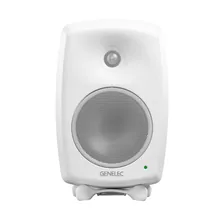 Ranked #7 of 65 in Medium Size Powered Bookshelf Speakers - Genelec 8330A: $2,250 per pair B&H Photo Video eBay
Pros: ASR’s measurements give a 2.3dB midrange response span and a -3dB point around 56Hz. Scores of 4.78 standalone and 7.03 with an ideal subwoofer indicate solid tonal accuracy, while deeper bass than the 8320A helps without a sub. GLM calibration, the waveguide and rounded aluminum enclosure make it a practical compact studio system. Measured bass extension of 55.7Hz (-3dB).
Cons: The listening-window response has more local variation than the 8030C or KH80 in the selected measurements, so DSP capability should not be mistaken for superior native neutrality. GLM calibration hardware costs extra. Small-driver bass headroom remains finite, and neither the modeled ideal-subwoofer score nor the fitted bass Q establishes maximum output or freedom from resonances.
Full Genelec 8330A review and specifications →
| AES Input | Yes |
|---|---|
| Amplifier Power | 100W total (50W woofer, 50W tweeter, Class D) |
| Aux Input | No |
| Bass Extension (-10dB) | 44.9Hz (measured, Audio Science Review) |
| Bass Extension (-3dB) | 55.7Hz (measured, Audio Science Review) |
| Coaxial Input | No |
| Country | Finland |
| Dimensions | 11.8"H x 7.4"W x 7"D (299 x 189 x 178 mm) |
| Drivers | 0.75" metal dome tweeter, 5.1" cone woofer |
| Enclosure | ported |
| Frequency Response | 45Hz-23kHz -6dB |
| HDMI Input | No |
| Inputs | XLR, AES/EBU |
| Maximum SPL | 104dB (manufacturer specified) |
| Optical Input | No |
| RCA Input | No |
| Spinorama Preference Score | 4.78 |
| Spinorama Preference Score with Perfect Sub | 7.03 |
| TRS Input | No |
| USB Input | No |
| Warranty | 2 years (5 with product registration) |
| Weight | 11.2 lbs (5.1 kg) each |
| XLR Input | Yes |
- Links
- Reviews, Comparisons and Sound Samples
- Head-to-Head Comparisons
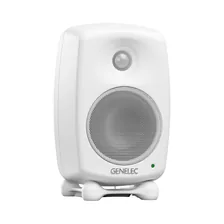 Ranked #8 of 65 in Medium Size Powered Bookshelf Speakers - Genelec 8320A: $1,700 per pair B&H Photo Video eBay
Pros: A measured 1.6dB span from 300Hz to 5kHz and preference scores of 4.70 standalone and 7.22 with an ideal subwoofer support accurate close-range monitoring. The waveguide helps control the balance between direct and reflected sound. GLM room calibration is useful for matching levels and placement in a compact setup. Measured bass extension of 67.4Hz (-3dB).
Cons: The -3dB point is about 67Hz, making a subwoofer important for lower bass and giving the larger 8330A a practical advantage without one. Calibration hardware is sold separately. The small woofer limits its intended listening distance and bass output; a favorable response-fit parameter is not evidence that it has uniquely well-damped bass or unusually high headroom.
Full Genelec 8320A review and specifications →
| AES Input | No |
|---|---|
| Amplifier Power | 100W total (50W woofer, 50W tweeter, Class D) |
| Aux Input | No |
| Bass Extension (-10dB) | 53.2Hz (measured, Audio Science Review) |
| Bass Extension (-3dB) | 67.4Hz (measured, Audio Science Review) |
| Coaxial Input | No |
| Country | Finland |
| Dimensions | 9.5"H x 5.9"W x 5.6"D (242 x 151 x 142 mm) |
| Drivers | 0.75" metal dome tweeter, 4.1" cone woofer |
| Enclosure | ported |
| Frequency Response | 55Hz-23kHz -6dB |
| HDMI Input | No |
| Inputs | XLR |
| Maximum SPL | Peak 107dB (manufacturer specified) |
| Optical Input | No |
| RCA Input | No |
| Spinorama Preference Score | 4.70 |
| Spinorama Preference Score with Perfect Sub | 7.22 |
| TRS Input | No |
| USB Input | No |
| Warranty | 2 years (5 with product registration) |
| Weight | 7.1 lbs (3.2 kg) each |
| XLR Input | Yes |
- Links
- Reviews, Comparisons and Sound Samples
- Head-to-Head Comparisons
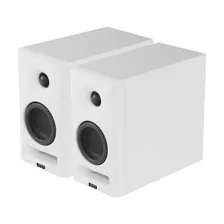 Ranked #10 of 65 in Medium Size Powered Bookshelf Speakers - Topping MA4: $400 per pair Audiophonics eBay
Pros: The selected manufacturer-supplied Klippel data shows a 1.6dB span from 300Hz to 5kHz, bass reaching -3dB around 50Hz, and preference scores of 4.78 standalone and 6.98 with an ideal subwoofer. That is strong measured tonal performance for a compact monitor. Its analog crossover and balanced XLR connection suit an existing audio interface. Measured bass extension of 49.8Hz (-3dB).
Cons: The native listening-window response is not as smooth as the leading Genelec and Neumann measurements. No USB, Bluetooth or built-in room-correction DSP: source control and correction need external equipment. Bass extension alone does not establish clean output capability.
Full Topping MA4 review and specifications →
| AES Input | No |
|---|---|
| Amplifier Power | 75W total (50W woofer, 25W tweeter, Class D) |
| Aux Input | No |
| Bass Extension (-10dB) | 42.9Hz (measured, spinorama.org vendor data) |
| Bass Extension (-3dB) | 49.8Hz (measured, spinorama.org vendor data) |
| Coaxial Input | No |
| Country | China |
| Crossover Frequency | 1.3kHz |
| Dimensions | 10"H x 5.5"W x 11.3"D (255 x 140 x 288 mm) |
| Drivers | 1" soft dome tweeter with waveguide, 4" paper cone woofer |
| Enclosure | ported |
| Frequency Response | 49Hz-20kHz +/-3dB |
| HDMI Input | No |
| Inputs | XLR (balanced analog) |
| Maximum SPL | 105dB @ 1m (manufacturer specified) |
| Optical Input | No |
| RCA Input | No |
| Sensitivity | 92dB |
| Spinorama Preference Score | 4.78 |
| Spinorama Preference Score with Perfect Sub | 6.98 |
| TRS Input | No |
| USB Input | No |
| Warranty | 1-2 years (varies by region) |
| Weight | 8.3 lbs (3.78 kg) each |
| XLR Input | Yes |
- Links
- Reviews, Comparisons and Sound Samples
- Head-to-Head Comparisons
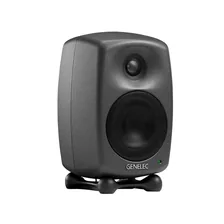 Ranked #11 of 65 in Medium Size Powered Bookshelf Speakers - Genelec 8020D: $1,390 per pair B&H Photo Video eBay
Pros: A compact waveguided monitor with balanced XLR input and placement filters, well suited to a small studio desk. Measured bass extension of 56Hz (-3dB).
Cons: Small size limits deep-bass reach and headroom. It lacks the GLM calibration of the SAM models, and the price is substantial for a compact analog-input monitor.
Full Genelec 8020D review and specifications →
| AES Input | No |
|---|---|
| Amplifier Power | 100W (50W woofer + 50W tweeter) |
| App | No |
| Aux Input | No |
| Bass Extension (-10dB) | 50Hz (measured, Audio Science Review) |
| Bass Extension (-3dB) | 56Hz (measured, Audio Science Review) |
| Bluetooth | No |
| Coaxial Input | No |
| Dimensions | 9.5"H x 5.8"W x 5.6"D (241.3 x 147.3 x 142.2 mm) |
| Drivers | 4.1" woofer, 0.75" metal dome tweeter |
| EQ | Yes (Bass tilt, desk proximity) |
| Frequency Response | 56 Hz - 25 kHz (-6 dB) (Manufacturer specified) |
| HDMI Input | No |
| Inputs | XLR |
| Maximum SPL | 103dB @ 1m (manufacturer specified) |
| Optical Input | No |
| RCA Input | No |
| TRS Input | No |
| USB Input | No |
| Weight | 7.1 lbs (3.2 kg) each |
| XLR Input | Yes |
- Links
- Reviews, Comparisons and Sound Samples
- Audio Science Review Measurements More from Audio Science Review →
- DSAUDIO.review: Genelec 8020D vs Yamaha HS5 Soun & Frequency Response Comparison More from DSAUDIOreview →
- DSAUDIO.review: Genelec 8020D vs Yamaha HS8 Sound & Frequency Response Comparison
- DSAUDIO.review: Neumann KH80 DSP vs Genelec 8020D Sound & Frequency Response Comparison
- DSAUDIO.review: IK Multimedia iLoud MTM vs Genelec 8020D Sound & Frequency Response Comparison
- DSAUDIO.review: KEF LSX vs Genelec 8020D Sound & Frequency Response Comparison
- DSAUDIO.review: Genelec 8020D vs Adam Audo T5V Sound & Frequency Response Comparison
- DSAUDIO.review: Genelec 8020D & KRK Rokit 5 G4 PR5G4 - Same, same, but different Sound & Response Comparison
- Head-to-Head Comparisons
- Genelec 8020D vs Klipsch The Fives
- Genelec 8020D vs Topping MA4
- Genelec 8020D vs JBL 305P MKII
- Genelec 8020D vs Devialet Phantom II 98 dB
- Genelec 8020D vs Genelec 8320A
- Genelec 8020D vs KEF LS50 Wireless II
- Genelec 8020D vs Genelec 8330A
- Genelec 8020D vs Vanatoo Transparent One Encore Plus
- See all 52 comparisons
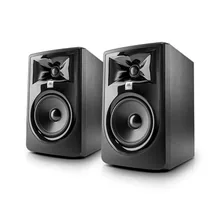 Ranked #13 of 65 in Medium Size Powered Bookshelf Speakers - JBL 305P MKII: $319.00 per pair Amazon eBay
Pros: Erin’s Klippel data gives 4.47 standalone and 6.61 with an ideal subwoofer, with bass reaching -3dB around 51Hz. Broad horizontal coverage and reasonably smooth reflected sound support stable imaging across a desk. The existing review reports effective limiting and little sustained thermal compression, making it a strong budget-monitor option rather than just a speaker with a promising frequency curve. Measured bass extension of 50Hz (-3dB), with a measured sensitivity of 91.1dB.
Cons: The 3.3dB midrange span and rising response show it is not perfectly neutral. A port-related feature around 1.6kHz and some excess treble can be audible; the review recommends the treble-trim switch. Vertical crossover interference makes ear height important. Amplifier hiss may matter in very quiet nearfield use, and rear-port placement needs room-boundary adjustment.
Full JBL 305P MKII review and specifications →
| AES Input | No |
|---|---|
| Amplifier Power | 81w Per Speaker |
| App | No |
| Aux Input | No |
| Bass Extension (-10dB) | 43Hz (measured, Erin's Audio Corner) |
| Bass Extension (-3dB) | 50Hz (measured, Erin's Audio Corner) |
| Bluetooth | No |
| Coaxial Input | No |
| Dimensions | 11.7"H x 7.3"W x 9.1"D (297.2 x 185.4 x 231.1 mm) |
| Drivers | 5" (127mm) woofer |
| EQ | Yes (Room adjustment) |
| Frequency Response | 49 Hz - 20 kHz (+-3 dB) (Manufacturer specified) |
| HDMI Input | No |
| Inputs | XLR, TRS |
| Optical Input | No |
| RCA Input | No |
| Sensitivity | 91.1dB (measured at 0.3V/1m, Erin's Audio Corner) |
| Spinorama Preference Score | 4.47 |
| Spinorama Preference Score with Perfect Sub | 6.61 |
| TRS Input | Yes |
| USB Input | No |
| Weight | 10.4 lbs (4.7 kg) each |
| XLR Input | Yes |
- Links
- Reviews, Comparisons and Sound Samples
- Erin’s Audio Corner Review Measurements More from Erin’s Audio Corner →
- Audio Science Review Measurements More from Audio Science Review →
- Erin’s Audio Corner: LIVE! JBL 305P MkII Powered Studio Monitor Review
- DSAUDIO.review: DSAUDIO.review Focal Alpha 50 EVO vs JBL 305P MKII sound.DEMO More from DSAUDIOreview →
- DSAUDIO.review: JBL 305P MKII vs Yamaha HS5 6-Track Comparison
- DSAUDIO.review: DSAUDIO.review JBL 305P MKII vs KRK Classic 5 CL5G3 sound.DEMO
- DSAUDIO.review: JBL 305P MKII vs Adam Audio T5V 6-Track Comparison
- DSAUDIO.review: DSAUDIO.review Adam Audio A5X vs JBL 305P MKII sound.DEMO
- DSAUDIO.review: DSAUDIO.review Kali Audio LP-6 V2 (2nd Wave) vs JBL 305P MKII sound.DEMO
- DSAUDIO.review: DSAUDIO.review Edifier MR4 vs JBL 305P MKII sound.DEMO
- DSAUDIO.review: Kali Audio IN-5 vs JBL 305P MKII Sound & Frequency Response Comparison
- DSAUDIO.review: JBL 308P MKII vs JBL 305P MKII Sound & Frequency Response Comparison
- DSAUDIO.review: Neumann KH80 DSP vs JBL 305P MKII Sound & Frquency Response Comparison
- DSAUDIO.review: JBL 305P MKII vs PreSonus Eris E5 6-Track Comparison
- Erin’s Audio Corner Measurements (spinorama.org)
- Jasper Tech: Best Desktop Computer Speakers for Every Budget – 2026 More from Jasper Tech →
- Jasper Tech: Best Powered Bookshelf Speakers for Every Budget - 2025
- Jasper Tech: Are the iLoud Micro Monitor Pro the Best Studio Monitor Speakers for your Home Studio?
- Head-to-Head Comparisons
- JBL 305P MKII vs KEF LS50 Wireless II
- JBL 305P MKII vs Klipsch The Fives
- JBL 305P MKII vs Genelec 8020D
- JBL 305P MKII vs Vanatoo Transparent One Encore Plus
- JBL 305P MKII vs IK Multimedia iLoud MTM MKII
- JBL 305P MKII vs Topping MA4
- JBL 305P MKII vs Devialet Phantom II 98 dB
- JBL 305P MKII vs Sigberg Audio SBS Gen 2
- See all 65 comparisons
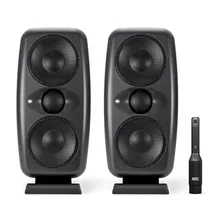 Ranked #16 of 65 in Medium Size Powered Bookshelf Speakers - IK Multimedia iLoud MTM MKII: $799.99 per pair Amazon eBay
Pros: Erin’s MKII measurements give a 2.2dB midrange span, a -3dB point around 53Hz, and preference scores of 4.30 standalone and 6.53 with an ideal subwoofer. The compact layout and included calibration microphone suit a close desktop setup. Existing tests show useful room-peak correction and good harmonic-distortion behavior at moderate levels. Measured bass extension of 52.7Hz (-3dB).
Cons: Some excess treble remains in the native tuning. The two-woofer MTM arrangement narrows the vertical listening window, so ear height and orientation matter. Multitone distortion rises strongly when pushed toward 96dB/1m; the review favors moderate listening levels, and a subwoofer does not eliminate all midrange output limits. These are MKII results, not measurements of the original MTM.
Full IK Multimedia iLoud MTM MKII review and specifications →
| AES Input | No |
|---|---|
| Amplifier Power | 100w Per Speaker |
| App | Yes (X-MONITOR speaker emulation) |
| Aux Input | No |
| Bass Extension (-10dB) | 46.3Hz (measured, Erin's Audio Corner) |
| Bass Extension (-3dB) | 52.7Hz (measured, Erin's Audio Corner) |
| Bluetooth | No |
| Coaxial Input | No |
| Dimensions | 10.4"H x 5.1"W x 6.3"D (264.2 x 129.5 x 160 mm) |
| Drivers | 2x 3.5" (89mm) woofers, 1" silk dome tweeter |
| EQ | Yes (Room adjustment) |
| Frequency Response | 48 Hz - 28 kHz (±2dB) (Manufacturer specified) |
| HDMI Input | No |
| Inputs | XLR |
| Maximum SPL | 112.5dB peak (manufacturer specified) |
| Optical Input | No |
| RCA Input | No |
| Spinorama Preference Score | 4.30 |
| Spinorama Preference Score with Perfect Sub | 6.53 |
| TRS Input | No |
| USB Input | No |
| Weight | 5.5 lbs (2.5 kg) each |
| XLR Input | Yes |
- Links
- Reviews, Comparisons and Sound Samples
- Head-to-Head Comparisons
- IK Multimedia iLoud MTM MKII vs Vanatoo Transparent One Encore Plus
- IK Multimedia iLoud MTM MKII vs Sigberg Audio SBS Gen 2
- IK Multimedia iLoud MTM MKII vs KEF LS50 Wireless II
- IK Multimedia iLoud MTM MKII vs HEDD Type 05 A-CORE
- IK Multimedia iLoud MTM MKII vs JBL 305P MKII
- IK Multimedia iLoud MTM MKII vs Kali Audio SM-5
- IK Multimedia iLoud MTM MKII vs Kali Audio IN-5
- IK Multimedia iLoud MTM MKII vs Klipsch The Fives
- See all 63 comparisons
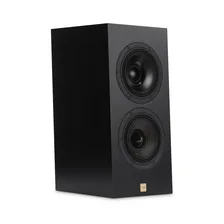 Ranked #17 of 65 in Medium Size Powered Bookshelf Speakers - Sigberg Audio SBS Gen 2: $18,043.20 for the full system (2 speakers + 2 dedicated subwoofers, built to order) Sigberg Audio eBay
Pros: The measured speaker-and-subwoofer system has a 1.7dB midrange response span and a 6.74 ideal-subwoofer preference score, supporting useful tonal accuracy above the bass region. The measured system reaches -3dB around 34Hz. Onboard parametric EQ and dedicated amplification provide flexible integration for a complete high-performance setup. Measured bass extension of 24Hz (-3dB).
Cons: The measured system explicitly includes a subwoofer: its 5.78 full-system score and bass extension must not be attributed to the bookshelf speaker alone. It is not directly equivalent to the standalone-monitor tests around it. The complete system is expensive and occupies more space than the main speakers suggest; the score alone does not prove superior output or room performance.
Full Sigberg Audio SBS Gen 2 review and specifications →
| AES Input | Yes |
|---|---|
| Amplifier Power | 350W per speaker |
| App | No |
| Aux Input | No |
| Bass Extension (-3dB) | 24Hz (measured, spinorama.org, with companion subwoofer) |
| Bluetooth | No |
| Coaxial Input | Yes |
| Country | Norway |
| DSP | Yes |
| Dimensions | 16.1"H x 7.5"W x 9.1"D (410 x 190 x 230 mm) |
| Drivers | 5.5" midbass, 5.5" coaxial mid/tweeter with 1" silk dome |
| EQ | Yes (9-band parametric, factory presets) |
| Enclosure | sealed |
| HDMI Input | No |
| Inputs | XLR, RCA, Optical, Coaxial/SPDIF, AES |
| Maximum SPL | 116dB (manufacturer specified) |
| Measurement Source | Manufacturer |
| Optical Input | Yes |
| RCA Input | Yes |
| Spinorama Preference Score | 5.78 |
| Spinorama Preference Score with Perfect Sub | 6.74 |
| TRS Input | No |
| USB Input | No |
| Weight | 20.9 lbs (9.5 kg) each |
| XLR Input | Yes |
- Links
- Reviews, Comparisons and Sound Samples
- Head-to-Head Comparisons
- Sigberg Audio SBS Gen 2 vs IK Multimedia iLoud MTM MKII
- Sigberg Audio SBS Gen 2 vs Kali Audio IN-5
- Sigberg Audio SBS Gen 2 vs JBL 305P MKII
- Sigberg Audio SBS Gen 2 vs KEF LSX II LT
- Sigberg Audio SBS Gen 2 vs Adam Audio T5V
- Sigberg Audio SBS Gen 2 vs Neumann KH80 DSP
- Sigberg Audio SBS Gen 2 vs Kali LP-UNF
- Sigberg Audio SBS Gen 2 vs Yamaha HS5
- See all 11 comparisons
 Ranked #18 of 65 in Medium Size Powered Bookshelf Speakers - HEDD Type 05 A-CORE: $714 per pair B&H Photo Video eBay
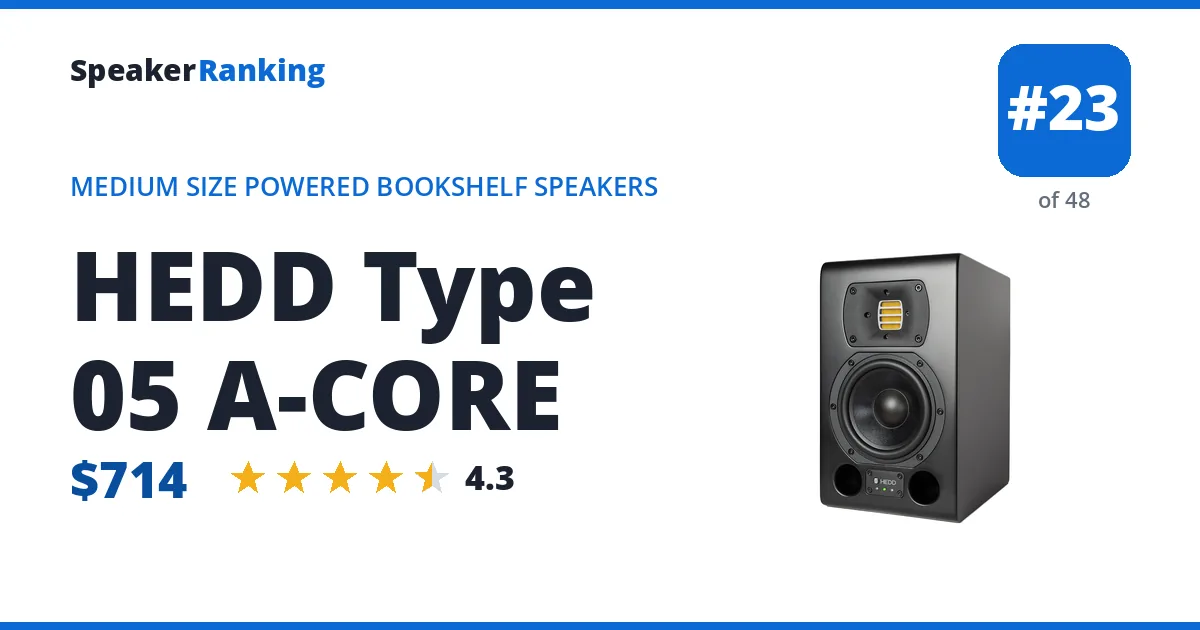
Pros: ASR’s Klippel data shows useful bass reach for this size, with -3dB around 44Hz. Preference scores of 4.47 standalone and 6.35 with an ideal subwoofer support it as a balanced all-round option. The AMT tweeter and analog signal path appeal to users who want a studio monitor without digital conversion or firmware dependence. Measured bass extension of 43.9Hz (-3dB).
Cons: The 2.7dB midrange span and listening-window narrow-band deviation of 0.404 trail the most linear monitors here. The response rises modestly toward the treble. The analog-only design does not provide built-in room correction or digital inputs, and published amplification power should not be read as a measured clean-output rating.
Full HEDD Type 05 A-CORE review and specifications →
| AES Input | No |
|---|---|
| Amplifier Power | 200W total, bi-amped (2x100W ICEpower Class D) |
| App | None (analog-only, no DSP) |
| Aux Input | No |
| Bass Extension (-10dB) | 37.1Hz (measured, spinorama.org) |
| Bass Extension (-3dB) | 43.9Hz (measured, spinorama.org) |
| Bluetooth | No |
| Coaxial Input | No |
| Dimensions | 12.1" x 7.1" x 9.6" (308 x 180 x 245 mm) each |
| Drivers | AMT (Air Motion Transformer) tweeter, 5" Honeycomb-compound woofer |
| EQ | Yes, analog High/Low shelving, ±6dB continuous |
| Frequency Response | 43Hz - 50kHz |
| HDMI Input | No |
| Inputs | RCA unbalanced, XLR/TRS combo balanced |
| Maximum SPL | 112dB per pair at 1m (manufacturer specified) |
| Optical Input | No |
| RCA Input | Yes |
| Spinorama Preference Score | 4.47 |
| Spinorama Preference Score with Perfect Sub | 6.35 |
| TRS Input | Yes |
| USB Input | No |
| Weight | 13.7 lbs (6.2 kg) each |
| XLR Input | Yes |
- Links
- Reviews, Comparisons and Sound Samples
- Head-to-Head Comparisons
- HEDD Type 05 A-CORE vs IK Multimedia iLoud MTM MKII
- HEDD Type 05 A-CORE vs Kali Audio IN-5
- HEDD Type 05 A-CORE vs IK Multimedia iLoud MTM
- HEDD Type 05 A-CORE vs JBL 305P MKII
- HEDD Type 05 A-CORE vs KEF LSX II LT
- HEDD Type 05 A-CORE vs Adam Audio T5V
- HEDD Type 05 A-CORE vs JBL 705P
- HEDD Type 05 A-CORE vs Kali LP-UNF
- See all 16 comparisons
 Ranked #19 of 65 in Medium Size Powered Bookshelf Speakers - Kali Audio SM-5: $3400 per pair B&H Photo Video eBay
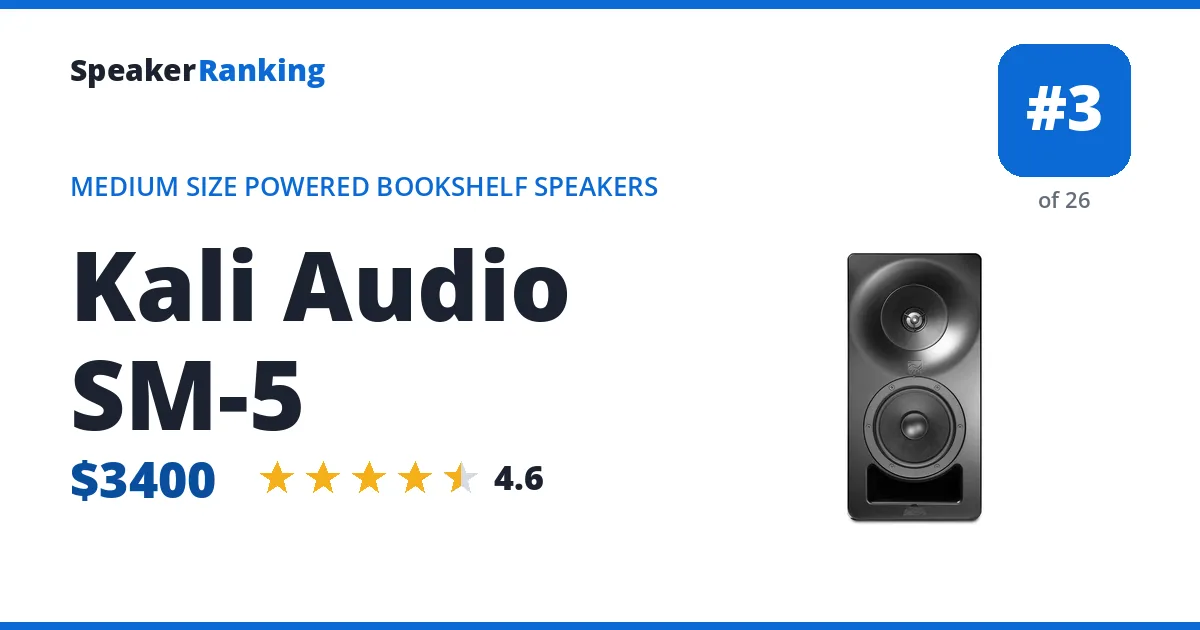
Pros: Erin’s measurements show bass reaching -3dB around 43Hz and a 2.8dB midrange response span. The coaxial mid/tweeter and large waveguide give useful consistency horizontally and vertically, reducing sensitivity to listening height. Built-in per-speaker DSP and mounting options make placement flexible. Existing testing reports low midrange distortion at 96dB. Measured bass extension of 45Hz (-3dB).
Cons: Scores of 4.29 standalone and 6.23 with an ideal subwoofer are good but below the leading reference monitors, so its advanced driver layout does not justify a near-top ranking by itself. A small upper-midrange irregularity remains. The five-inch woofer and limiter constrain loud bass; the review places compression onset roughly in the 96-102dB/1m region.
Full Kali Audio SM-5 review and specifications →
| AES Input | Yes |
|---|---|
| Amplifier Power | 150W total |
| App | Kali Audio DSP software (free download) |
| Aux Input | No |
| Bass Extension (-10dB) | 39Hz (measured, Erin's Audio Corner) |
| Bass Extension (-3dB) | 45Hz (measured, Erin's Audio Corner) |
| Bluetooth | No |
| Coaxial Input | No |
| Dimensions | 15.7"H x 7.9"W x 9.8"D (400 x 200 x 250 mm) |
| Drivers | 1" coaxial tweeter, 4" coaxial midrange, 5" mid-bass woofer |
| EQ | Yes, per-speaker DSP |
| Frequency Response | 39Hz - 35kHz ±10dB (47Hz - 21kHz ±3dB, Manufacturer specified) |
| HDMI Input | No |
| Inputs | XLR/TRS, AES/EBU (BNC), RJ45 network control |
| Maximum SPL | 117dB (manufacturer specified) |
| Optical Input | No |
| RCA Input | No |
| Spinorama Preference Score | 4.29 |
| Spinorama Preference Score with Perfect Sub | 6.23 |
| TRS Input | Yes |
| USB Input | No |
| Weight | 20.9 lbs (9.5 kg) each |
| XLR Input | Yes |
- Links
- Reviews, Comparisons and Sound Samples
- Head-to-Head Comparisons
- Kali Audio SM-5 vs Kali Audio IN-5
- Kali Audio SM-5 vs IK Multimedia iLoud MTM
- Kali Audio SM-5 vs IK Multimedia iLoud MTM MKII
- Kali Audio SM-5 vs Vanatoo Transparent One Encore Plus
- Kali Audio SM-5 vs Pioneer DJ VM-50
- Kali Audio SM-5 vs KEF LS50 Wireless II
- Kali Audio SM-5 vs JBL 305P MKII
- Kali Audio SM-5 vs Airpulse A100
- See all 50 comparisons
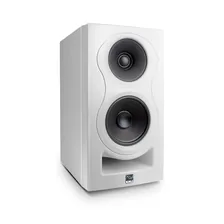 Ranked #20 of 65 in Medium Size Powered Bookshelf Speakers - Kali Audio IN-5: $698 per pair Amazon eBay
Pros: The active three-way layout separates bass duties from the coaxial mid/tweeter, giving flexible listening geometry. Erin’s data shows a 1.8dB midrange response span and -3dB bass around 45Hz, with scores of 4.21 standalone and 6.22 with an ideal subwoofer. Placement switches and balanced inputs help integrate it into a studio; moderate-level distortion is well controlled in the existing review. Measured bass extension of 45Hz (-3dB).
Cons: Local listening-window irregularities remain despite the small overall midrange span. The review reports midrange distortion rising above 3% at 96dB and a brighter perceived balance at closer distances. Limiting makes it unsuitable for demanding farfield playback. Coaxial construction improves geometry but does not remove response errors or guarantee unlimited output.
Full Kali Audio IN-5 review and specifications →
| AES Input | No |
|---|---|
| Amplifier Power | 80W LF + 40W mid + 40W HF |
| Aux Input | No |
| Bass Extension (-10dB) | 40.0Hz (measured, Erin's Audio Corner) |
| Bass Extension (-3dB) | Approximately 45Hz (measured, Erin's Audio Corner) |
| Coaxial Input | No |
| Drivers | 1" tweeter coaxial with 4" midrange; 5" woofer |
| HDMI Input | No |
| Inputs | XLR, TRS, RCA |
| Optical Input | No |
| RCA Input | Yes |
| Sensitivity | Not applicable (active three-way monitor) |
| Spinorama Preference Score | 4.21 |
| Spinorama Preference Score with Perfect Sub | 6.22 |
| TRS Input | Yes |
| USB Input | No |
| Woofer Cabinet | ported, front |
| XLR Input | Yes |
- Links
- Reviews, Comparisons and Sound Samples
- Head-to-Head Comparisons
- Kali Audio IN-5 vs IK Multimedia iLoud MTM
- Kali Audio IN-5 vs Kali Audio SM-5
- Kali Audio IN-5 vs HEDD Type 05 A-CORE
- Kali Audio IN-5 vs Sigberg Audio SBS.1
- Kali Audio IN-5 vs Sigberg Audio SBS Gen 2
- Kali Audio IN-5 vs Mackie MR524
- Kali Audio IN-5 vs IK Multimedia iLoud MTM MKII
- Kali Audio IN-5 vs Pioneer DJ VM-50
- See all 60 comparisons
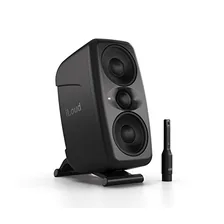 Ranked #21 of 65 in Medium Size Powered Bookshelf Speakers - IK Multimedia iLoud MTM: $800 per pair Discontinued Amazon eBay
Pros: ASR’s measurements of the original MTM give scores of 4.07 standalone and 6.26 with an ideal subwoofer, a 2.4dB midrange response span and a -3dB point around 53Hz. The small cabinet, balanced input and calibration capability make it useful for close listening where larger monitors would be impractical. Measured bass extension of 50Hz (-3dB).
Cons: The MTM arrangement makes listening height and orientation important, while bass below the low-50Hz region still needs support. The native response is not as smooth as the best compact reference monitors. Exact compression ceilings and correction examples from the MKII review should not be assigned to this original version; its score describes tonal response, not maximum clean volume. Discontinued.
Full IK Multimedia iLoud MTM review and specifications →
| AES Input | No |
|---|---|
| Amplifier Power | 100w Per Speaker |
| App | No |
| Aux Input | No |
| Bass Extension (-10dB) | 40Hz (measured, Audio Science Review) |
| Bass Extension (-3dB) | 50Hz (measured, Audio Science Review) |
| Bluetooth | No |
| Coaxial Input | No |
| Dimensions | 10.4"H x 5.1"W x 6.3"D (264.2 x 129.5 x 160 mm) |
| Discontinued | Yes |
| Drivers | 2x 3.5" (89mm) woofers |
| EQ | Yes (Room adjustment) |
| Frequency Response | 50 Hz - 24 kHz (-3dB) (Manufacturer specified) |
| HDMI Input | No |
| Inputs | XLR |
| Optical Input | No |
| RCA Input | No |
| TRS Input | No |
| USB Input | No |
| Weight | 5.5 lbs (2.5 kg) |
| XLR Input | Yes |
- Links
- Reviews, Comparisons and Sound Samples
- Audio Science Review Measurements More from Audio Science Review →
- DSAUDIO.review: IK Multimedia iLoud MTM vs Genelec 8020D Sound & Frequency Response Comparison More from DSAUDIOreview →
- DSAUDIOreview: IK Multimedia iLoud MTM vs iLoud Micro Sound & Frequency Response Comparison
- DSAUDIO.review: IK Multimedia iLoud MTM vs KRK Rokit 5 G4 Sound & Frequency Response Comparison
- DSAUDIO.review: IK Multimedia iLoud MTM vs Edifier S3000 Pro Sound & Frequency Response Comparison
- DSAUDIO.review: Neumann KH80 DSP vs IK Multimedia iLoud MTM Sound & Frequency Response Comparison
- DSAUDIO.review: Adam Audio A3X vs IK Multimedia iLoud MTM Sound & Frequency Response Comparison
- DSAUDIO.review: Yamaha HS8 vs IK Multimedia iLoud MTM Sound & Frequency Response Comparison
- Audio Science Review Measurements (spinorama.org)
- Head-to-Head Comparisons
- IK Multimedia iLoud MTM vs Kali Audio IN-5
- IK Multimedia iLoud MTM vs Kali Audio SM-5
- IK Multimedia iLoud MTM vs Pioneer DJ VM-50
- IK Multimedia iLoud MTM vs HEDD Type 05 A-CORE
- IK Multimedia iLoud MTM vs Airpulse A100
- IK Multimedia iLoud MTM vs IK Multimedia iLoud MTM MKII
- IK Multimedia iLoud MTM vs KEF LSX II LT
- IK Multimedia iLoud MTM vs Vanatoo Transparent One Encore Plus
- See all 48 comparisons
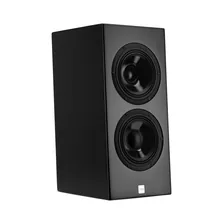 Ranked #22 of 65 in Medium Size Powered Bookshelf Speakers - Sigberg Audio SBS.1: Discontinued eBay
Pros: The 6.26 preference score with an ideal subwoofer is the relevant tonal comparison for this subwoofer-dependent design. Manufacturer-supplied data shows a 2.0dB midrange response span, and onboard parametric EQ offers substantial system-tuning flexibility. It is intended as a main speaker in a complete system rather than a conventional full-range desktop pair.
Cons: The measured -3dB point is around 97Hz and the standalone score is 2.97, reflecting the requirement for a companion subwoofer rather than an unexpectedly weak full-range design. It is discontinued, so condition and system compatibility matter when buying used. Discontinued.
Full Sigberg Audio SBS.1 review and specifications →
| AES Input | Yes |
|---|---|
| Amplifier Power | 350W per speaker |
| App | No |
| Aux Input | No |
| Bass Extension (-3dB) | 18Hz (manufacturer, with companion subwoofers) |
| Bluetooth | No |
| Coaxial Input | Yes |
| Country | Norway |
| DSP | Yes |
| Dimensions | 16.1"H x 7.5"W x 9.1"D (410 x 190 x 230 mm) |
| Discontinued | Yes |
| Drivers | 2x 5.5" midbass, 1" coaxial silk dome tweeter |
| EQ | Yes (9-band parametric, factory presets) |
| Enclosure | sealed |
| HDMI Input | No |
| Inputs | XLR, RCA, Optical, Coaxial/SPDIF, AES |
| Maximum SPL | 116dB (manufacturer specified) |
| Measurement Source | Manufacturer |
| Optical Input | Yes |
| RCA Input | Yes |
| Spinorama Preference Score | 2.97 |
| Spinorama Preference Score with Perfect Sub | 6.26 |
| TRS Input | No |
| USB Input | No |
| Weight | 20.9 lbs (9.5 kg) each |
| XLR Input | Yes |
- Links
- Reviews, Comparisons and Sound Samples
- Head-to-Head Comparisons
- Sigberg Audio SBS.1 vs Kali Audio IN-5
- Sigberg Audio SBS.1 vs KEF LSX II LT
- Sigberg Audio SBS.1 vs Adam Audio T5V
- Sigberg Audio SBS.1 vs IK Multimedia iLoud MTM MKII
- Sigberg Audio SBS.1 vs JBL 305P MKII
- Sigberg Audio SBS.1 vs Kali LP-UNF
- Sigberg Audio SBS.1 vs Neumann KH80 DSP
- Sigberg Audio SBS.1 vs Yamaha HS5
- See all 11 comparisons
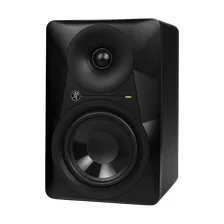 Ranked #23 of 65 in Medium Size Powered Bookshelf Speakers - Mackie MR524: $379.98 per pair B&H Photo Video eBay
Pros: The available third-party data suggests a useful combination of bass reach and midrange balance: -3dB around 46Hz, a 2.0dB midrange span, and preference estimates of 4.30 standalone and 6.25 with an ideal subwoofer. Balanced inputs, boundary compensation and treble trim are practical studio features. Measured bass extension of 46.2Hz (-3dB).
Cons: The measured response trends upward toward the treble by about 0.47dB per octave, which can lend a brighter balance. Boundary compensation and treble trim help with setup but are less flexible than parametric correction.
Full Mackie MR524 review and specifications →
| AES Input | No |
|---|---|
| Amplifier Power | 50W bi-amplified per speaker |
| Aux Input | No |
| Bass Extension (-10dB) | approximately 38Hz (measured, spinorama.org) |
| Bass Extension (-3dB) | 46.2Hz (measured, spinorama.org) |
| Coaxial Input | No |
| Drivers | 5-inch polypropylene woofer; 1-inch silk-dome tweeter |
| Frequency Response | 45Hz-20kHz |
| HDMI Input | No |
| Inputs | Balanced XLR, balanced TRS, RCA |
| Optical Input | No |
| RCA Input | Yes |
| Spinorama Preference Score | 4.30 |
| Spinorama Preference Score with Perfect Sub | 6.25 |
| TRS Input | Yes |
| USB Input | No |
| XLR Input | Yes |
- Links
- Reviews, Comparisons and Sound Samples
- Head-to-Head Comparisons
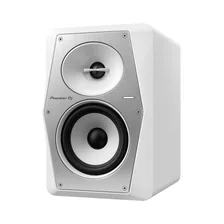 Ranked #24 of 65 in Medium Size Powered Bookshelf Speakers - Pioneer DJ VM-50: $338 per pair Amazon eBay
Pros: Erin’s Klippel measurements give scores of 3.79 standalone and 6.15 with an ideal subwoofer, with a -3dB point around 60Hz. The existing review reports low distortion and little sustained compression, supporting practical clean playback beyond what the tonal score alone captures. Separate bass and treble voicings and balanced inputs make adjustment straightforward. Measured bass extension of 61Hz (-3dB).
Cons: The default response spans 3.5dB from 300Hz to 5kHz, and the upper-midrange/treble balance varies with angle. EQ-switch selection and aiming therefore matter. Bass below about 50Hz is reduced, so it is not a full-range substitute for a monitor-and-subwoofer system. Its output evidence supports nearfield use, not unrestricted home-theater levels.
Full Pioneer DJ VM-50 review and specifications →
| AES Input | No |
|---|---|
| Amplifier Power | 30W LF + 30W HF; Class D |
| Aux Input | No |
| Bass Extension (-10dB) | 47.3Hz (measured, Erin's Audio Corner) |
| Bass Extension (-3dB) | 61Hz (measured, Erin's Audio Corner) |
| Coaxial Input | No |
| DSP | Four LF and four HF EQ settings |
| Drivers | 1" tweeter in horn; 5.25" aramid-fiber woofer |
| HDMI Input | No |
| Inputs | XLR/TRS combo and RCA |
| Optical Input | No |
| RCA Input | Yes |
| Sensitivity | Not applicable (active DSP monitor) |
| Spinorama Preference Score | 3.79 |
| Spinorama Preference Score with Perfect Sub | 6.15 |
| TRS Input | Yes |
| USB Input | No |
| XLR Input | Yes |
- Links
- Reviews, Comparisons and Sound Samples
- Head-to-Head Comparisons
- Pioneer DJ VM-50 vs Airpulse A100
- Pioneer DJ VM-50 vs KEF LSX II LT
- Pioneer DJ VM-50 vs Audioengine A5+ Classic
- Pioneer DJ VM-50 vs IK Multimedia iLoud MTM
- Pioneer DJ VM-50 vs Kali Audio IN-5
- Pioneer DJ VM-50 vs Adam Audio T5V
- Pioneer DJ VM-50 vs Kali Audio SM-5
- Pioneer DJ VM-50 vs Kanto YU6
- See all 51 comparisons
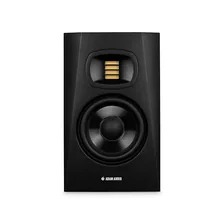 Ranked #28 of 65 in Medium Size Powered Bookshelf Speakers - Adam Audio T5V: $464 per pair Amazon eBay
Pros: ASR’s data shows a small 2.0dB span from 300Hz to 5kHz, a -3dB point around 59Hz, and scores of 3.74 standalone and 6.11 with an ideal subwoofer. It offers useful bass and midrange performance for an affordable studio monitor. Rear tonal trims allow broad placement adjustment. Measured bass extension of 78Hz (-3dB).
Cons: The response rises toward the treble by about 0.56dB per octave, so the small midrange span should not be mistaken for flat full-band response. Upper-frequency unevenness remains, and a shelving control cannot precisely remove every peak. The existing review finds distortion reasonable for the price rather than reference-class; deeper bass and demanding levels still call for more capable hardware.
Full Adam Audio T5V review and specifications →
| AES Input | No |
|---|---|
| Amplifier Power | 70w Per Speaker |
| App | No |
| Aux Input | No |
| Bass Extension (-10dB) | 60Hz (measured, Audio Science Review) |
| Bass Extension (-3dB) | 78Hz (measured, Audio Science Review) |
| Bluetooth | No |
| Coaxial Input | No |
| Dimensions | 11.7"H x 7"W x 11.7"D (297.2 x 177.8 x 297.2 mm) |
| Drivers | 5" (127mm) woofer |
| EQ | Yes (Room adjustment) |
| Frequency Response | 58Hz - 24kHz (-3dB) (Manufacturer specified) |
| HDMI Input | No |
| Inputs | XLR, RCA |
| Optical Input | No |
| RCA Input | Yes |
| Spinorama Preference Score | 3.74 |
| Spinorama Preference Score with Perfect Sub | 6.11 |
| TRS Input | No |
| USB Input | No |
| Weight | 12.6 lbs (5.7 kg) each |
| XLR Input | Yes |
- Links
- Reviews, Comparisons and Sound Samples
- Audio Science Review Measurements More from Audio Science Review →
- DSAUDIO.review: JBL 305P MKII vs Adam Audio T5V 6-Track Comparison More from DSAUDIOreview →
- DSAUDIO.review: Kali LP-6 vs Adam Audio T5V Sound & Frequency Response Comparison
- DSAUDIO.review: Adam Audio T5V vs Yamaha HS5 5 Track Comparison
- DSAUDIO.review: DSAUDIO.review Adam Audio A5X vs Adam Audio T5V sound.DEMO
- DSAUDIO.review: DSAUDIO.review Focal Alpha 50 EVO vs Adam Audio T5V sound.DEMO
- DSAUDIO.review: Adam Audio T5V vs Presonus Eris E5 5 Track Comparison
- DSAUDIO.review: KRK Rokit 5 G4 RP5G4 vs Adam Audio T5V Sound & Frequency Response Comparison
- DSAUDIO.review: Bright and brighter. PreSonus E5 XT takes on Adam Audio T5V SOUND & FREQUENCY RESPONSE COMPARISON
- DSAUDIO.review: Adam Audio T5V vs Adam Audio T7V Sound & Frequency Response Comparison
- Audio Science Review Measurements (spinorama.org)
- Jasper Tech: Best Desktop Computer Speakers for Every Budget – 2026 More from Jasper Tech →
- Jasper Tech: Are the iLoud Micro Monitor Pro the Best Studio Monitor Speakers for your Home Studio?
- Head-to-Head Comparisons
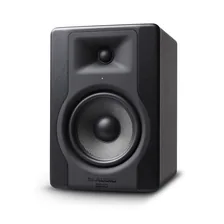 Ranked #30 of 65 in Medium Size Powered Bookshelf Speakers - M-Audio BX5 D3: $299 per pair Amazon eBay
Pros: The third-party measurements suggest scores of 3.34 standalone and 5.94 with an ideal subwoofer, with a 2.4dB midrange span. Balanced inputs and acoustic-space adjustment are useful for a basic studio setup. The measured -3dB estimate is about 64Hz.
Cons: The response slopes downward by about 0.65dB per octave, potentially softening treble relative to the midrange. There is no digital input or automatic calibration, and the preference estimate does not verify distortion or output headroom.
Full M-Audio BX5 D3 review and specifications →
| AES Input | No |
|---|---|
| Amplifier Power | 100W each |
| Aux Input | No |
| Coaxial Input | No |
| Dimensions | 10H x 6.9W x 7.8D in |
| Drivers | 1-inch silk tweeter, 5-inch Kevlar woofer |
| Enclosure | Active 2-way, rear-ported |
| Frequency Response | 52Hz-35kHz |
| HDMI Input | No |
| Inputs | XLR and TRS |
| Maximum SPL | 110dB |
| Optical Input | No |
| RCA Input | No |
| Spinorama Preference Score | 3.34 |
| Spinorama Preference Score with Perfect Sub | 5.94 |
| TRS Input | Yes |
| USB Input | No |
| Weight | 12.3 lbs (5.6 kg) each |
| XLR Input | Yes |
- Links
- Reviews, Comparisons and Sound Samples
- Head-to-Head Comparisons
- M-Audio BX5 D3 vs Kanto YU6
- M-Audio BX5 D3 vs Kali LP-UNF
- M-Audio BX5 D3 vs Adam Audio T5V
- M-Audio BX5 D3 vs Audioengine A5+ Classic
- M-Audio BX5 D3 vs Vanatoo Transparent Zero Plus
- M-Audio BX5 D3 vs KEF LSX II LT
- M-Audio BX5 D3 vs Airpulse A100
- M-Audio BX5 D3 vs Focal Alpha 50 EVO
- See all 38 comparisons
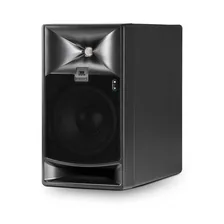 Ranked #31 of 65 in Medium Size Powered Bookshelf Speakers - JBL 705P: $1998 per pair B&H Photo Video eBay
Pros: ASR’s data gives bass reaching -3dB around 48Hz and a 5.80 ideal-subwoofer preference score. Its waveguided compression driver and dedicated amplification are suited to studio use, and the broad response trend is close to level. It has useful low-frequency reach for a five-inch monitor. Measured bass extension of 80Hz (-3dB).
Cons: The standalone score is 3.79, and a localized cancellation near 750Hz contributes to the large 7.8dB midrange response span. A crossover-region rise also prevents reference-flat reproduction. An average flat trend does not erase these features, and amplifier wattage is not a measured clean-SPL rating. The data does not support calling it uniformly flat simply because it shares technology with larger JBL models.
Full JBL 705P review and specifications →
| AES Input | Yes |
|---|---|
| Amplifier Power | 500W total (250W woofer, 250W tweeter) |
| App | No |
| Aux Input | No |
| Bass Extension (-10dB) | 62Hz (measured, Audio Science Review) |
| Bass Extension (-3dB) | 80Hz (measured, Audio Science Review) |
| Coaxial Input | No |
| DSP | No |
| Dimensions | 10.6"H x 5.9"W x 10.8"D (268 x 151 x 274 mm) |
| Drivers | 5" woofer, 2409H 1" compression driver |
| EQ | No |
| Frequency Response | 39Hz - 36kHz (Manufacturer specified) |
| HDMI Input | No |
| Inputs | XLR/TRS combo (analog), XLR AES3 (digital) |
| Optical Input | No |
| RCA Input | No |
| Spinorama Preference Score | 3.79 |
| Spinorama Preference Score with Perfect Sub | 5.80 |
| TRS Input | Yes |
| USB Input | No |
| Weight | 12.6 lbs (5.7 kg) each |
| XLR Input | Yes |
- Links
- Reviews, Comparisons and Sound Samples
- Head-to-Head Comparisons
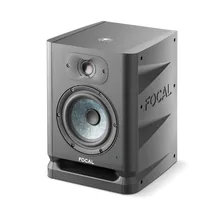 Ranked #36 of 65 in Medium Size Powered Bookshelf Speakers - Focal Alpha 50 EVO: $658 per pair Amazon eBay
Pros: Rear shelving controls and a conventional studio-monitor layout provide practical placement adjustment.
Cons: Basic shelving controls are less flexible than parametric room correction. Careful placement is still important, especially near walls or on a desk.
Full Focal Alpha 50 EVO review and specifications →
| AES Input | No |
|---|---|
| Amplifier Power | 60w Per Speaker |
| App | No |
| Aux Input | No |
| Bluetooth | No |
| Coaxial Input | No |
| Dimensions | 12.2"H x 9"W x 9.4"D (309.9 x 228.6 x 238.8 mm) |
| Drivers | 5" (127mm) woofer |
| EQ | Yes (Room adjustment) |
| Frequency Response | 45 Hz - 22 kHz (+-3 dB) (Manufacturer specified) |
| HDMI Input | No |
| Inputs | XLR, TRS, RCA |
| Optical Input | No |
| RCA Input | Yes |
| Spinorama Preference Score | 0.40 |
| Spinorama Preference Score with Perfect Sub | 5.05 |
| TRS Input | Yes |
| USB Input | No |
| Weight | 13.2 lbs (6.0 kg) each |
| XLR Input | Yes |
- Links
- Reviews, Comparisons and Sound Samples
- Independent Measurements (spinorama.org)
- DSAUDIO.review: DSAUDIO.review Focal Alpha 50 EVO vs Adam Audio T5V sound.DEMO More from DSAUDIOreview →
- DSAUDIO.review: DSAUDIO.review APS Klasik 2020 vs Focal Alpha 50 EVO sound.DEMO
- DSAUDIO.review: DSAUDIO.review Focal Alpha 50 EVO vs Focal Alpha 65 EVO sound.DEMO
- DSAUDIO.review: DSAUDIO.review Focal Alpha 50 EVO vs KRK Rokit 5 G4 RP5G4 sound.DEMO
- DSAUDIO.review: DSAUDIO.review Focal Alpha 50 EVO vs JBL 305P MKII sound.DEMO
- DSAUDIO.review: DSAUDIO.review Adam Audio A5X vs Focal Alpha 50 EVO sound.DEMO
- DSAUDIO.review: DSAUDIO.review Focal Alpha 50 EVO vs Eve Audio SC205 sound.DEMO
- DSAUDIO.review: DSAUDIO.review Kali Audio LP-6 V2 (2nd Wave) vs Focal Alpha 50 EVO sound.DEMO
- DSAUDIO.review: DSAUDIO.review Focal Alpha 50 EVO vs KRK Classic 5 CL5G3 sound.DEMO
- DSAUDIO.review: DSAUDIO.review Focal Alpha 50 EVO vs Yamaha HS5 sound.DEMO
- Head-to-Head Comparisons
- Focal Alpha 50 EVO vs Dayton Audio M4
- Focal Alpha 50 EVO vs Neumi BS5P
- Focal Alpha 50 EVO vs Vanatoo Transparent Zero Plus
- Focal Alpha 50 EVO vs Kanto YU
- Focal Alpha 50 EVO vs KRK Rokit 5 G4
- Focal Alpha 50 EVO vs Kali LP-UNF
- Focal Alpha 50 EVO vs Yamaha HS5
- Focal Alpha 50 EVO vs JBL 705P
- See all 56 comparisons
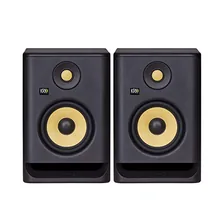 Ranked #40 of 65 in Medium Size Powered Bookshelf Speakers - KRK Rokit 5 G4: $337 per pair Discontinued eBay
Pros: ASR’s data gives -3dB bass around 56Hz and scores of 3.06 standalone and 5.42 with an ideal subwoofer. The waveguide provides useful horizontal directivity control, while onboard adjustments help tailor broad balance. The existing review reports low distortion at 86dB and low audible hiss. Measured bass extension of 78Hz (-3dB).
Cons: The 3.6dB midrange span and listening-window narrow-band deviation of 0.502 show that native response is not reference-flat. A port-region resonance and other tonal irregularities remain. Its deeper bass does not establish greater detail or mixing accuracy than another monitor. EQ can help, but the unequalized measurements determine the starting recommendation. Discontinued.
Full KRK Rokit 5 G4 review and specifications →
| AES Input | No |
|---|---|
| Amplifier Power | 55w Per Speaker |
| App | No |
| Aux Input | No |
| Bass Extension (-10dB) | 60Hz (measured, Audio Science Review) |
| Bass Extension (-3dB) | 78Hz (measured, Audio Science Review) |
| Bluetooth | No |
| Coaxial Input | No |
| Dimensions | 11.2"H x 7.5"W x 9.5"D (284.5 x 190.5 x 241.3 mm) |
| Discontinued | Yes |
| Drivers | 5" (127mm) woofer |
| EQ | Yes (Room adjustment) |
| Frequency Response | 58Hz - 24kHz (-3dB) (Manufacturer specified) |
| HDMI Input | No |
| Inputs | TRS/XLR |
| Optical Input | No |
| RCA Input | No |
| Spinorama Preference Score | 3.06 |
| Spinorama Preference Score with Perfect Sub | 5.42 |
| TRS Input | Yes |
| USB Input | No |
| Weight | 10.8 lbs (4.9 kg) each |
| XLR Input | Yes |
- Links
- Reviews, Comparisons and Sound Samples
- Audio Science Review Measurements More from Audio Science Review →
- DSAUDIO.review: DSAUDIO.review Focal Alpha 50 EVO vs KRK Rokit 5 G4 RP5G4 sound.DEMO More from DSAUDIOreview →
- DSAUDIO.review: KRK Rokit 5 G4 RP5G4 vs Adam Audio T5V Sound & Frequency Response Comparison
- DSAUDIO.review: DSAUDIO.review KRK Classic 5 CL5G3 vs KRK Rokit 5 RP5G4 sound.DEMO
- DSAUDIO.review: KRK Rokit 5 G4 RP5G4 vs Yamaha HS5 Sound & Frequency Response Comparison
- DSAUDIO.review: KRK Rokit 5 G4 RP5G4 vs Presonus Eris E5 Sound & Frequency Response Comparison
- DSAUDIO.review: PreSonus E5 XT vs KRK Rokit 5 G4 Sound & Frequency Response Comparison
- DSAUDIO.review: Genelec 8020D & KRK Rokit 5 G4 PR5G4 - Same, same, but different Sound & Response Comparison
- DSAUDIO.review: Neumann KH80 DSP vs KRK Rokit 5 G4 RP5G4 Sound & Frequency Response Comparison
- DSAUDIO.review: Tannoy Gold 5 vs KRK Rokit 5 G4 RP5G4 Sound & Frequency Response Comparison
- DSAUDIO.review: IK Multimedia iLoud MTM vs KRK Rokit 5 G4 Sound & Frequency Response Comparison
- Audio Science Review Measurements (spinorama.org)
- Head-to-Head Comparisons
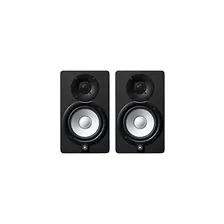 Ranked #41 of 65 in Medium Size Powered Bookshelf Speakers - Yamaha HS5: $298.98 per pair Amazon eBay
Pros: ASR found reasonably smooth early-reflection directivity, which makes broad EQ correction more promising than on speakers whose off-axis response changes abruptly. Balanced inputs and placement controls suit studio use. The measured preference scores are 2.91 standalone and 5.52 with an ideal subwoofer. Measured bass extension of 88Hz (-3dB).
Cons: The measurements do not support describing it as very neutral: excess midrange and reduced lower-midrange/upper-bass weight produce a bass-light balance. The 300Hz-5kHz span is 4.3dB. Its automated -3dB crossing is affected by response shape, so it should not be treated as a simple bass-cutoff specification. A subwoofer adds low bass but does not fix the elevated midrange.
Full Yamaha HS5 review and specifications →
| AES Input | No |
|---|---|
| Amplifier Power | 45w Per Speaker |
| App | No |
| Aux Input | No |
| Bass Extension (-10dB) | 68Hz (measured, Audio Science Review) |
| Bass Extension (-3dB) | 88Hz (measured, Audio Science Review) |
| Bluetooth | No |
| Coaxial Input | No |
| Dimensions | 11.2"H x 6.7"W x 8.7"D (284.5 x 170.2 x 221 mm) |
| Drivers | 5" (127mm) woofer |
| EQ | Yes (Room adjustment) |
| Frequency Response | 58Hz - 24kHz (-3dB) (Manufacturer specified) |
| HDMI Input | No |
| Inputs | XLR |
| Optical Input | No |
| RCA Input | No |
| Spinorama Preference Score | 2.91 |
| Spinorama Preference Score with Perfect Sub | 5.52 |
| TRS Input | No |
| USB Input | No |
| Weight | 12.1 lbs (5.5 kg) each |
| XLR Input | Yes |
- Links
- Reviews, Comparisons and Sound Samples
- Audio Science Review Measurements More from Audio Science Review →
- DSAUDIO.review: DSAUDIO.review KRK Classic 5 CL5G3 vs Yamaha HS5 sound.DEMO More from DSAUDIOreview →
- DSAUDIO.review: DSAUDIO.review Focal Alpha 50 EVO vs Yamaha HS5 sound.DEMO
- DSAUDIO.review: Genelec 8020D vs Yamaha HS5 Soun & Frequency Response Comparison
- DSAUDIO.review: JBL 305P MKII vs Yamaha HS5 6-Track Comparison
- DSAUDIO.review: Adam Audio T5V vs Yamaha HS5 5 Track Comparison
- DSAUDIO.review: Yamaha HS5 vs Presonus Eris E5 Sound Demo
- DSAUDIO.review: KRK Rokit 5 G4 RP5G4 vs Yamaha HS5 Sound & Frequency Response Comparison
- DSAUDIO.review: New PreSonus E5 XT and Yamaha HS5 could not sound any more different! SOUND AND RESPONSE COMPARISON
- DSAUDIO.review: Yamaha HS8 vs Yamaha HS5 Sound & Frequency Response Comparison
- DSAUDIO.review: Genelec 8010A (Genelec G One) vs Yamaha HS5 Sound Demo w/ Bass Test
- Audio Science Review Measurements (spinorama.org)
- Head-to-Head Comparisons
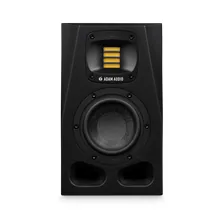 Ranked #42 of 65 in Medium Size Powered Bookshelf Speakers - Adam Audio A4V: $1,199.98 per pair B&H Photo Video eBay
Pros: Compact monitor with onboard DSP, placement controls and room-correction integration. ASR’s Klippel data gives a -3dB point around 59Hz and preference scores of 3.02 standalone and 5.43 with an ideal subwoofer. Its adjustment facilities are useful when placement or tonal correction is needed.
Cons: A small average-deviation figure hides a major localized response irregularity: the selected measurement spans 10.8dB from 300Hz to 5kHz, and listening-window narrow-band deviation is 0.547. The native response should therefore not be called smoothly neutral. Correction potential is not the same as stock performance, and analog audio inputs mean a separate interface is needed for USB sources.
Full Adam Audio A4V review and specifications →
| AES Input | No |
|---|---|
| Amplifier Power | 130W RMS each |
| Aux Input | No |
| Coaxial Input | No |
| Dimensions | 10.6H x 6.2W x 8.7D in |
| Drivers | X-ART folded-ribbon tweeter, 4" MLM woofer |
| Enclosure | 2-way active, dual front ports |
| HDMI Input | No |
| Inputs | XLR and RCA; Ethernet for control |
| Optical Input | No |
| RCA Input | Yes |
| Spinorama Preference Score | 3.02 |
| Spinorama Preference Score with Perfect Sub | 5.43 |
| TRS Input | No |
| USB Input | No |
| Weight | 12.8 lbs (5.8 kg) each |
| XLR Input | Yes |
- Links
- Reviews, Comparisons and Sound Samples
- Head-to-Head Comparisons
- Adam Audio A4V vs Yamaha HS5
- Adam Audio A4V vs Presonus Eris E5 XT
- Adam Audio A4V vs Edifier S2000MKIII
- Adam Audio A4V vs Kanto YU
- Adam Audio A4V vs Edifier MR4
- Adam Audio A4V vs KRK Classic 5
- Adam Audio A4V vs Focal Alpha 50 EVO
- Adam Audio A4V vs Vanatoo Transparent Zero Plus
- See all 38 comparisons
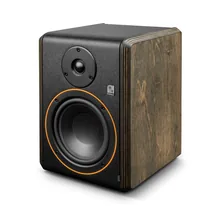 Ranked #43 of 65 in Medium Size Powered Bookshelf Speakers - Palmer STUDIMON 5: $350 per pair Thomann eBay
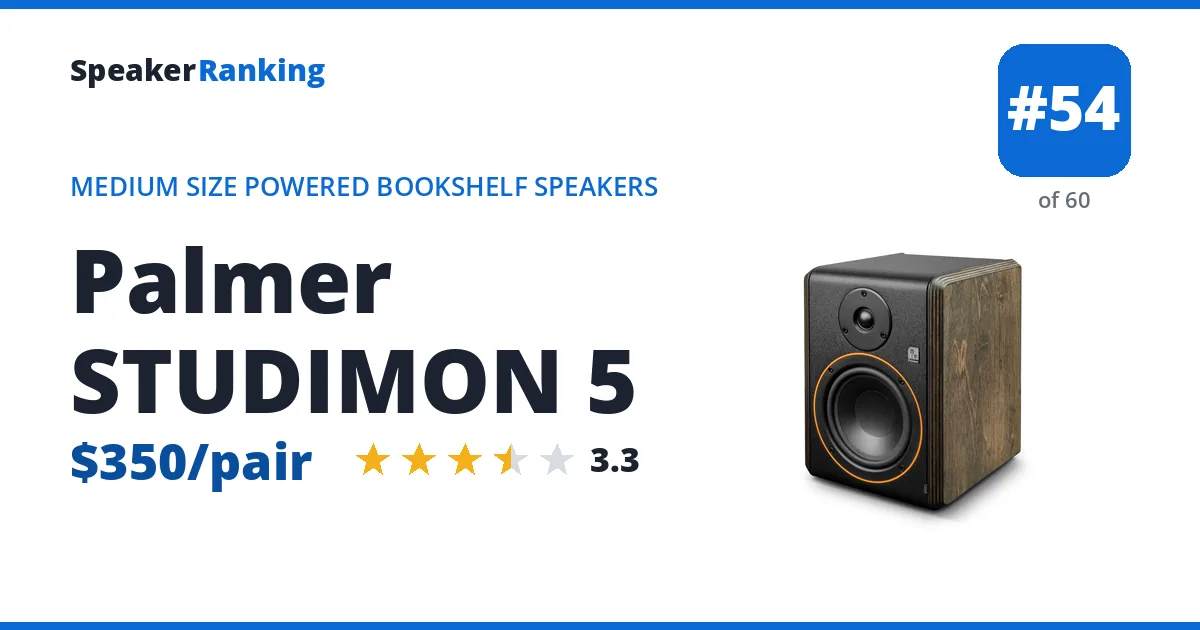
Pros: The available third-party measurements predict 2.69 standalone and 5.58 with an ideal subwoofer. Balanced inputs and a conventional compact monitor cabinet make it straightforward to use with studio equipment. The broad response trend is approximately level rather than strongly bright or dark.
Cons: The trace spans 4.0dB from 300Hz to 5kHz and estimates -3dB bass around 80Hz, with local irregularities despite the level overall trend. There are no room-EQ controls to address broad placement errors, and the available score does not establish clean output.
Full Palmer STUDIMON 5 review and specifications →
| AES Input | No |
|---|---|
| Amplifier Power | 60W each (30W LF, 30W HF) |
| Aux Input | No |
| Coaxial Input | No |
| Country | Germany (design) |
| Dimensions | 10.6H x 7.5W x 8.5D in |
| Drivers | 0.75" soft-dome tweeter, 5" woofer |
| Enclosure | 2-way active, rear-ported |
| HDMI Input | No |
| Inputs | Balanced XLR and 1/4" TRS |
| Optical Input | No |
| RCA Input | No |
| Spinorama Preference Score | 2.69 |
| Spinorama Preference Score with Perfect Sub | 5.58 |
| TRS Input | Yes |
| USB Input | No |
| Weight | 8.6 lbs (3.9 kg) each |
| XLR Input | Yes |
- Links
- Reviews, Comparisons and Sound Samples
- Head-to-Head Comparisons
- Palmer STUDIMON 5 vs Yamaha HS5
- Palmer STUDIMON 5 vs Edifier S2000MKIII
- Palmer STUDIMON 5 vs KRK Classic 5
- Palmer STUDIMON 5 vs Kali LP-UNF
- Palmer STUDIMON 5 vs Edifier R1280DB
- Palmer STUDIMON 5 vs Adam Audio T5V
- Palmer STUDIMON 5 vs KEF LSX II LT
- Palmer STUDIMON 5 vs Kali Audio IN-5
- See all 11 comparisons
 Ranked #44 of 65 in Medium Size Powered Bookshelf Speakers - Presonus Eris E5 XT: $239.98 per pair Amazon eBay
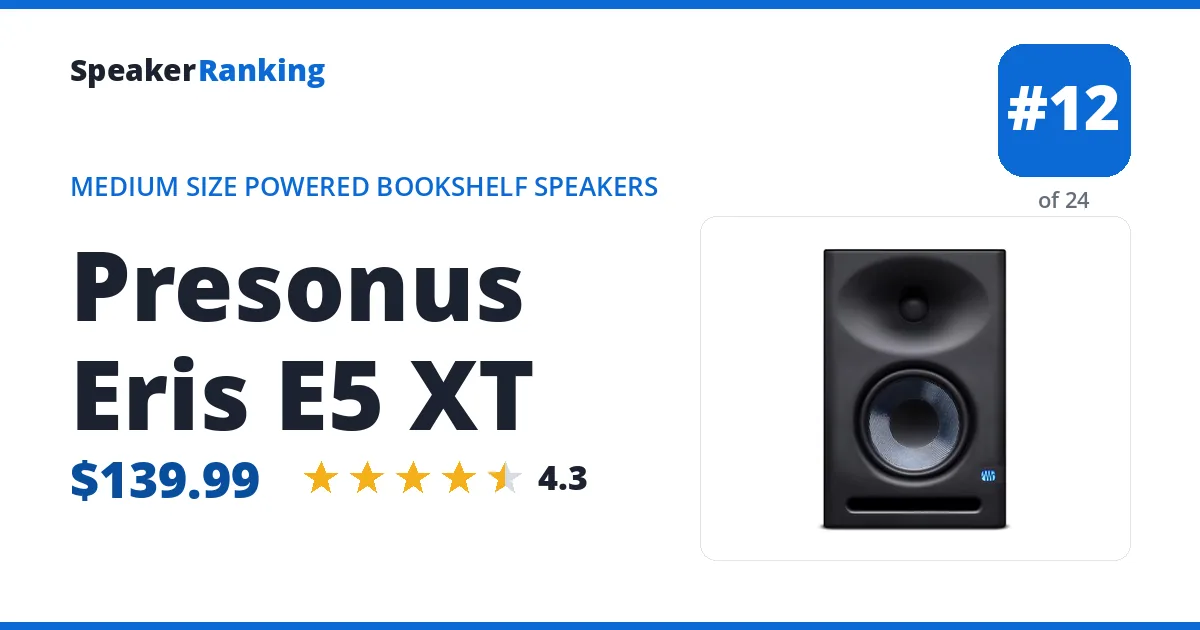
Pros: ASR’s measurements show reasonably consistent directivity through the crossover, so EQ changes are more likely to benefit both direct and reflected sound. Bass reaches -3dB around 56Hz. A standalone preference score of 2.88 rises to 5.30 with an ideal subwoofer, indicating useful bass reach but only moderate native tonal performance. Measured bass extension of 85Hz (-3dB).
Cons: The response has bass and treble emphasis with a recessed crossover region; smooth directivity carries that imbalance into room reflections rather than fixing it. Existing distortion testing shows problems across a broad range when pushed to 96dB. Tone correction and moderate levels help, but it is not a reference-flat monitor out of the box.
Full Presonus Eris E5 XT review and specifications →
| AES Input | No |
|---|---|
| Amplifier Power | 80w Per Speaker |
| App | No |
| Aux Input | No |
| Bass Extension (-10dB) | 65Hz (measured, Audio Science Review) |
| Bass Extension (-3dB) | 85Hz (measured, Audio Science Review) |
| Bluetooth | No |
| Coaxial Input | No |
| Dimensions | 10.2"H x 7"W x 7.7"D (259.1 x 177.8 x 195.6 mm) |
| Drivers | 5" (127mm) woofer |
| EQ | Yes (Room adjustment) |
| Frequency Response | 53Hz - 22kHz (Manufacturer specified) |
| HDMI Input | No |
| Inputs | TRS, XLR, RCA |
| Optical Input | No |
| RCA Input | Yes |
| Spinorama Preference Score | 2.88 |
| Spinorama Preference Score with Perfect Sub | 5.30 |
| TRS Input | Yes |
| USB Input | No |
| Weight | 10.1 lbs (4.6 kg) each |
| XLR Input | Yes |
- Links
- Reviews, Comparisons and Sound Samples
- DSAUDIO.review: New PreSonus E5 XT and Yamaha HS5 could not sound any more different! SOUND AND RESPONSE COMPARISON More from DSAUDIOreview →
- DSAUDIO.review: Bright and brighter. PreSonus E5 XT takes on Adam Audio T5V SOUND & FREQUENCY RESPONSE COMPARISON
- DSAUDIO.review: PreSonus Eris E5 XT vs PreSonus Eris E5 (new vs old) Sound & Frequency Response Comparison
- DSAUDIO.review: PreSonus E7 XT vs PreSonus E5 XT Sound & Frequency Response Comparison
- DSAUDIO.review: PreSonus Eris E8 XT vs PreSonus Eris E5 XT Sound & Frequency Response Comparison
- DSAUDIO.review: PreSonus E5 XT vs KRK Rokit 5 G4 Sound & Frequency Response Comparison
- Audio Science Review Measurements More from Audio Science Review →
- Audio Science Review Measurements (spinorama.org)
- Head-to-Head Comparisons
- Presonus Eris E5 XT vs Edifier S2000MKIII
- Presonus Eris E5 XT vs Edifier MR4
- Presonus Eris E5 XT vs Adam Audio A4V
- Presonus Eris E5 XT vs KRK Classic 5
- Presonus Eris E5 XT vs Yamaha HS5
- Presonus Eris E5 XT vs KRK Rokit 5 G4
- Presonus Eris E5 XT vs Presonus Eris E5
- Presonus Eris E5 XT vs Kanto YU
- See all 52 comparisons
 Ranked #47 of 65 in Medium Size Powered Bookshelf Speakers - KRK Classic 5: $319.99 per pair Amazon eBay
Pros: ASR’s Klippel data gives -3dB bass around 60Hz and a 5.18 preference score with an ideal subwoofer. Broad tonal correction can improve it, so it may be useful to someone willing to measure and EQ a basic studio setup. Measured bass extension of 60.1Hz (-3dB).
Cons: The native standalone score is 2.66 and the midrange span is a large 6.5dB. Excess treble and crossover/directivity errors keep it from being neutral out of the box, while low-bass distortion limits loud playback. Modeled EQ scores are not stock performance and do not demonstrate corrected distortion or dispersion.
Full KRK Classic 5 review and specifications →
| AES Input | No |
|---|---|
| Amplifier Power | 50w RMS Per Speaker |
| App | No |
| Aux Input | No |
| Bass Extension (-3dB) | 60.1Hz (Spinorama/Audio Science Review) |
| Bass Extension (-6dB) | 54.2Hz (Spinorama/Audio Science Review) |
| Bluetooth | No |
| Coaxial Input | No |
| Dimensions | 9.7"H x 7.4"W x 11.2"D (246.4 x 188 x 284.5 mm) |
| Drivers | 5" (127mm) woofer |
| EQ | Yes (Room adjustment) |
| Frequency Response | 56Hz-30KHz (+-3dB) (Manufacturer specified) |
| HDMI Input | No |
| Inputs | RCA, TRS, XLR |
| Optical Input | No |
| RCA Input | Yes |
| Spinorama Preference Score | 2.71 |
| Spinorama Preference Score with Perfect Sub | 5.22 |
| TRS Input | Yes |
| USB Input | No |
| Weight | 12.9 lbs (5.87 kg) |
| XLR Input | Yes |
- Links
- Reviews, Comparisons and Sound Samples
- Audio Science Review Measurements More from Audio Science Review →
- DSAUDIO.review: DSAUDIO.review Edifier S1000MKII vs Edifier S2000MKIII sound.DEMO More from DSAUDIOreview →
- DSAUDIO.review: Edifier S2000MKIII vs Edifier S3000PRO Sound & Frequency Response Comparison
- DSAUDIO.review: DSAUDIO.review Focal Alpha 50 EVO vs KRK Classic 5 CL5G3 sound.DEMO
- DSAUDIO.review: DSAUDIO.review JBL 305P MKII vs KRK Classic 5 CL5G3 sound.DEMO
- DSAUDIO.review: DSAUDIO.review KRK Classic 5 CL5G3 vs Yamaha HS5 sound.DEMO
- DSAUDIO.review: DSAUDIO.review KRK Classic 5 CL5G3 vs KRK Rokit 5 RP5G4 sound.DEMO
- Audio Science Review Measurements (spinorama.org)
- Head-to-Head Comparisons
 Ranked #49 of 65 in Medium Size Powered Bookshelf Speakers - Presonus Eris E5: $219.98 per pair Amazon eBay
Pros: Balanced XLR/TRS and RCA inputs plus placement adjustment make the original Eris E5 easy to connect to studio or consumer sources. Existing listening notes describe a fuller low end than some small, bass-light monitors, which may suit casual nearfield listening.
Cons: A fuller bass balance is not necessarily neutral. Placement adjustment is useful, but it does not replace a properly integrated subwoofer for deep-bass monitoring.
Full Presonus Eris E5 review and specifications →
| AES Input | No |
|---|---|
| Amplifier Power | 80w Per Speaker |
| App | No |
| Aux Input | No |
| Bluetooth | No |
| Coaxial Input | No |
| Dimensions | 10.2"H x 7"W x 7.7"D (259.1 x 177.8 x 195.6 mm) |
| Drivers | 5" (127mm) woofer |
| EQ | Yes (Room adjustment) |
| Frequency Response | 53Hz - 22kHz (Manufacturer specified) |
| HDMI Input | No |
| Inputs | TRS, XLR, RCA |
| Optical Input | No |
| RCA Input | Yes |
| TRS Input | Yes |
| USB Input | No |
| Weight | 10.1 lbs (4.6 kg) each |
| XLR Input | Yes |
- Links
- Reviews, Comparisons and Sound Samples
- DSAUDIO.review: Adam Audio T5V vs Presonus Eris E5 5 Track Comparison More from DSAUDIOreview →
- DSAUDIO.review: Yamaha HS5 vs Presonus Eris E5 Sound Demo
- DSAUDIO.review: Fluid Audio F5 vs Presonus Eris E5 Sound & Frequency Response Comparison
- DSAUDIO.review: M-Audio BX5 D3 vs Presonus Eris E5 5 Track Comparison
- DSAUDIO.review: PreSonus Eris E5 XT vs PreSonus Eris E5 (new vs old) Sound & Frequency Response Comparison
- DSAUDIO.review: JBL 305P MKII vs PreSonus Eris E5 6-Track Comparison
- DSAUDIO.review: Mackie CR5 BT vs Presonus Eris E5 Sound Demo w/ Bass Test
- DSAUDIO.review: KRK Rokit 5 RP5G3 vs Presonus E5 Sound Demo w/ Bass Test
- DSAUDIO.review: JBL LSR305 vs Presonus Eris E5 Sound Demo
- DSAUDIO.review: KRK Rokit 5 G4 RP5G4 vs Presonus Eris E5 Sound & Frequency Response Comparison
- Head-to-Head Comparisons
- Presonus Eris E5 vs KRK Classic 5
- Presonus Eris E5 vs Audioengine HD6
- Presonus Eris E5 vs Edifier MR4
- Presonus Eris E5 vs Edifier R2000DB
- Presonus Eris E5 vs Edifier S1000W
- Presonus Eris E5 vs Edifier S2000MKIII
- Presonus Eris E5 vs Presonus Eris E5 XT
- Presonus Eris E5 vs Edifier S1000MKII
- See all 46 comparisons
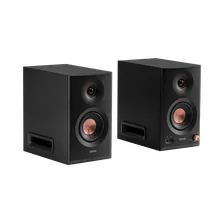 Ranked #50 of 65 in Medium Size Powered Bookshelf Speakers - Edifier MR5: $349.99 per pair Amazon eBay
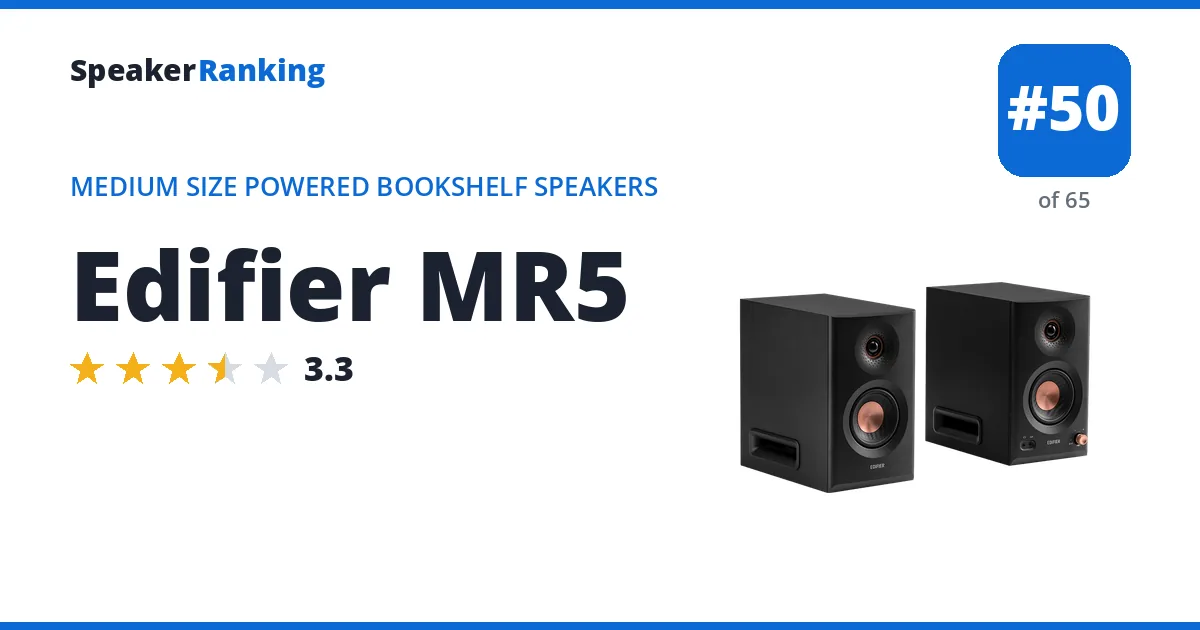
Pros: Erin’s Audio Corner measured useful bass for a compact 5-inch monitor, with F3 around 51Hz. The three-way active design adds a dedicated 3.75-inch midrange, and the 110W RMS system, app EQ, room-compensation controls, LDAC, balanced XLR/TRS inputs, and front headphone output make it unusually well equipped at $350 per pair. Measured bass extension of 51Hz (-3dB), with a measured sensitivity of 85dB.
Cons: Erin’s CTA-2034 data shows upper-midrange and treble irregularities, while off-axis response narrows more quickly than ideal above about 2–3kHz. Bass output is level-limited below about 70Hz and distortion/compression rise at higher levels, so it suits moderate nearfield use better than loud mid-field playback.
Full Edifier MR5 review and specifications →
| AES Input | No |
|---|---|
| Amplifier Power | 110W RMS total (Manufacturer specified) |
| App | Yes (Edifier ConneX) |
| Aux Input | Yes |
| Bass Extension (-3dB) | 51Hz (measured, Erin's Audio Corner) |
| Bluetooth Codecs | LDAC, SBC |
| Bluetooth Version | 5.4 |
| Coaxial Input | No |
| Dimensions | 6.3"W x 10.4"H x 11"D (159 x 264 x 280 mm) (active); 159W x 264H x 257D mm (passive) |
| Drivers | 5-inch woofer + 3.75-inch midrange + 1-inch silk-dome tweeter (each) |
| EQ | Yes (app EQ and rear high/low controls) |
| Frequency Response | 46Hz-40kHz (Manufacturer specified) |
| HDMI Input | No |
| Headphone Output | Yes |
| Inputs | Balanced XLR, balanced 6.35mm TRS, RCA, 3.5mm Aux |
| Maximum SPL | 101dB (Manufacturer specified, 1m) |
| Measurement Source | Erin's Audio Corner |
| Optical Input | No |
| Outputs | 3.5mm headphone |
| RCA Input | Yes |
| Sensitivity | 85dB (measured at 0.3V/1m, Erin's Audio Corner) |
| TRS Input | Yes |
| USB Input | No |
| Weight | 22.9 lbs (10.38 kg) |
| XLR Input | Yes |
- Links
- Reviews, Comparisons and Sound Samples
 Ranked #62 of 65 in Medium Size Powered Bookshelf Speakers - Fluid Audio FX50 V2: $298 per pair Fluid Audio eBay
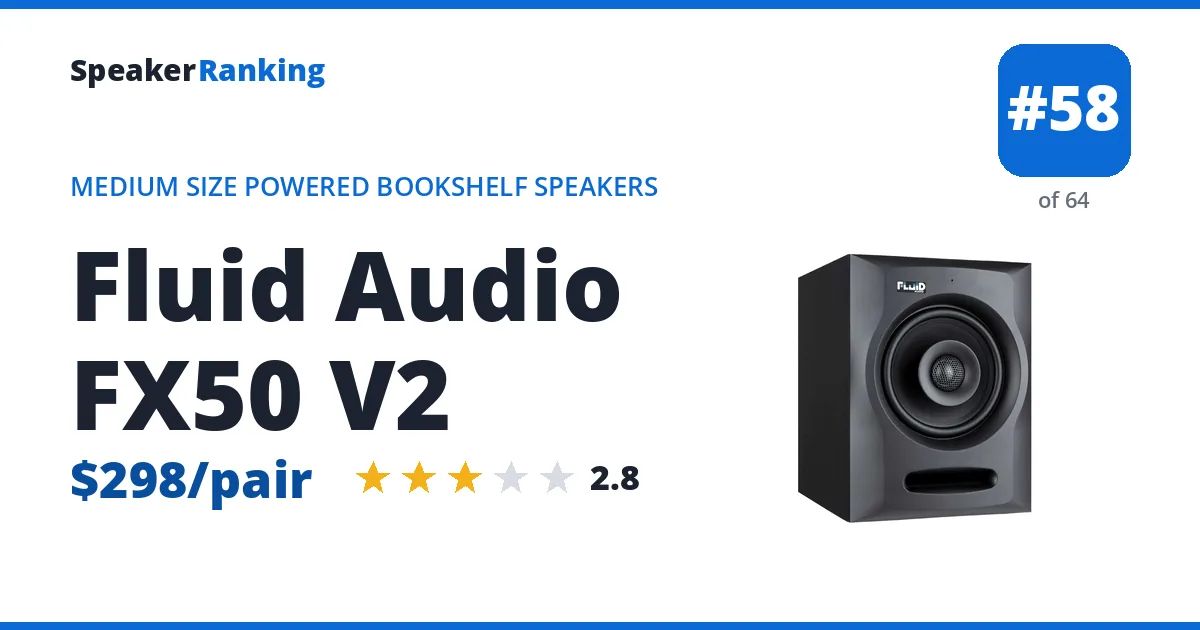
Pros: The coaxial geometry and mounting provisions allow flexible physical orientation, while balanced inputs and boundary controls suit a compact studio installation. Bass reaches -3dB around 67Hz in ASR’s selected measurement.
Cons: Scores of 0.92 standalone and 3.53 with an ideal subwoofer indicate poor native tonal accuracy. Listening-window and predicted-room narrow-band deviations are both around 0.80, showing irregular sound for both the listener and room reflections. Coaxial construction does not guarantee smooth dispersion or neutral reproduction, and correction features should not be credited as a proven fix.
Full Fluid Audio FX50 V2 review and specifications →
| AES Input | No |
|---|---|
| Amplifier Power | 90W each |
| Aux Input | No |
| Coaxial Input | No |
| Dimensions | 9.2H x 6.9W x 9.1D in |
| Drivers | 1-inch silk tweeter coaxially mounted in 5-inch paper woofer |
| Enclosure | Active coaxial, front-ported |
| Frequency Response | 49Hz-22kHz +/-2dB |
| HDMI Input | No |
| Inputs | XLR/TRS and RCA |
| Maximum SPL | 110dB |
| Optical Input | No |
| RCA Input | Yes |
| Spinorama Preference Score | 0.92 |
| Spinorama Preference Score with Perfect Sub | 3.53 |
| TRS Input | Yes |
| USB Input | No |
| Weight | 8.4 lbs (3.8 kg) each |
| XLR Input | Yes |
- Links
- Reviews, Comparisons and Sound Samples
- Head-to-Head Comparisons
- Fluid Audio FX50 V2 vs Edifier R1280DB
- Fluid Audio FX50 V2 vs KRK Classic 5
- Fluid Audio FX50 V2 vs Edifier S2000MKIII
- Fluid Audio FX50 V2 vs Yamaha HS5
- Fluid Audio FX50 V2 vs Kali LP-UNF
- Fluid Audio FX50 V2 vs Adam Audio T5V
- Fluid Audio FX50 V2 vs KEF LSX II LT
- Fluid Audio FX50 V2 vs IK Multimedia iLoud MTM MKII
- See all 10 comparisons
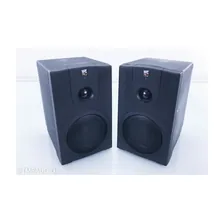 Ranked #64 of 65 in Medium Size Powered Bookshelf Speakers - NHT Pro M-00: $498 per pair (used market; originally $249 each), Discontinued eBay
Pros: A sturdy metal enclosure, analog studio/consumer connections and selectable nearfield/farfield voicing give it practical features as an older powered monitor. Measured bass extension of 83.3Hz (-3dB).
Cons: The review identifies a pronounced upper-bass cancellation, treble peaks and problematic vertical response, and strongly prefers the JBL 305P MKII in direct listening. Discontinued.
Full NHT Pro M-00 review and specifications →
| AES Input | No |
|---|---|
| Amplifier Power | 75W RMS continuous, 150W peak (per speaker) |
| App | No |
| Aux Input | No |
| Bass Extension (-10dB) | 59.7Hz (measured, Audio Science Review) |
| Bass Extension (-3dB) | 83.3Hz (measured, Audio Science Review) |
| Bluetooth | No |
| Coaxial Input | No |
| DSP | No |
| Dimensions | 9H x 5.7W x 7.3D in |
| Discontinued | Yes |
| Drivers | 1" ferrofluid-cooled fabric dome tweeter, 4.5" treated paper-cone woofer |
| HDMI Input | No |
| Inputs | RCA, XLR/TRS |
| Optical Input | No |
| RCA Input | Yes |
| TRS Input | Yes |
| USB Input | No |
| Weight | 14 lbs (6.35 kg) each |
| XLR Input | Yes |
- Reviews, Comparisons and Sound Samples
- Head-to-Head Comparisons
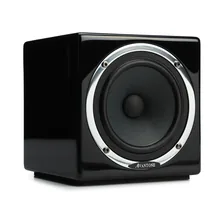 Ranked #65 of 65 in Medium Size Powered Bookshelf Speakers - Avantone Pro Active MixCube: $518 per pair B&H Photo Video eBay
Pros: A deliberately bandwidth-limited single-driver monitor for checking midrange balance and mix translation. The powered, sealed format, isolation pad and stand mounting make it useful as a secondary studio reference.
Cons: It is not a full-range music speaker. The measured -3dB point is around 297Hz, and scores of -3.74 standalone and 1.00 with an ideal subwoofer reflect severe bandwidth and response limitations for general listening. A subwoofer cannot restore the missing high-frequency coverage. This low general-purpose rank does not measure its usefulness for the specialist task of checking a mix.
Full Avantone Pro Active MixCube review and specifications →
| AES Input | No |
|---|---|
| Amplifier Power | 60W RMS Class AB |
| Aux Input | No |
| Coaxial Input | No |
| Dimensions | 6.5H x 6.5W x 6.5D in |
| Drivers | 5.25-inch paper-cone driver; 5.25-inch paper-cone driver; 5.25-inch paper-cone driver; 5.25-inch paper-cone driver |
| Enclosure | Powered sealed full-range monitor |
| Frequency Response | 90Hz-17kHz |
| HDMI Input | No |
| Inputs | Balanced XLR/TRS combo |
| Maximum SPL | 104dB at 1m |
| Optical Input | No |
| RCA Input | No |
| Spinorama Preference Score | -3.74 |
| Spinorama Preference Score with Perfect Sub | 1.00 |
| TRS Input | Yes |
| USB Input | No |
| Weight | 7.1 lbs (3.2 kg) each |
| XLR Input | Yes |
- Links
- Reviews, Comparisons and Sound Samples
- Head-to-Head Comparisons
- Avantone Pro Active MixCube vs Edifier R1280DB
- Avantone Pro Active MixCube vs KRK Classic 5
- Avantone Pro Active MixCube vs Edifier S2000MKIII
- Avantone Pro Active MixCube vs Yamaha HS5
- Avantone Pro Active MixCube vs Kali LP-UNF
- Avantone Pro Active MixCube vs Adam Audio T5V
- Avantone Pro Active MixCube vs KEF LSX II LT
- Avantone Pro Active MixCube vs IK Multimedia iLoud MTM MKII
- See all 10 comparisons
Large Size Powered Bookshelf Speakers
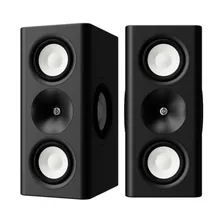 Ranked #1 of 67 in Large Size Powered Bookshelf Speakers - AsciLab C8C: $6,200 per pair Audiophonics eBay
Pros: ASR’s revised measurement combines an 8.02 ideal-subwoofer preference score with a 1.7dB response span from 300Hz to 5kHz, supporting highly even vocal and instrumental balance. Bass reaches 30.8Hz at -3dB and 23.4Hz at -6dB, giving substantial low-end reach without an added subwoofer. Measured bass extension of 30.8Hz (-3dB).
Cons: The result applies to the revised measured configuration; confirm that the speaker’s tuning matches it. Each cabinet weighs about 27.5kg and needs a substantial stand. Deep extension and excellent tonality do not guarantee unlimited bass output or eliminate the need to adjust placement.
Full AsciLab C8C review and specifications →
| AES Input | Yes |
|---|---|
| Amplifier Power | 600W total (100W tweeter, 250W midrange, 250W subwoofer) |
| Aux Input | No |
| Bass Extension (-10dB) | 20.5Hz (measured, Audio Science Review) |
| Bass Extension (-3dB) | 30.8Hz (measured, Audio Science Review) |
| Bass Extension (-6dB) | 23.4Hz (measured, Audio Science Review) |
| Coaxial Input | Yes |
| Country | South Korea |
| Crossover Frequency | 150Hz, 1.2kHz |
| Dimensions | 22"H x 10"W x 13.8"D (560 x 254 x 350 mm) |
| Drivers | 1" alumina ceramic dome tweeter with waveguide, 2x 6" alumina ceramic midrange/woofers, 2x 8" side mounted opposed cardioid subwoofers |
| Enclosure | sealed |
| HDMI Input | No |
| Inputs | XLR, RCA, AES/EBU, Coaxial, Optical |
| Optical Input | Yes |
| RCA Input | Yes |
| Spinorama Preference Score | 7.25 |
| Spinorama Preference Score with Perfect Sub | 8.02 |
| TRS Input | No |
| USB Input | No |
| Warranty | 2 years |
| Weight | 60.6 lbs (27.5 kg) each |
| XLR Input | Yes |
- Links
- Reviews, Comparisons and Sound Samples
- Head-to-Head Comparisons
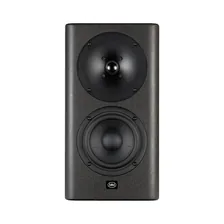 Ranked #2 of 67 in Large Size Powered Bookshelf Speakers - Mesanovic CDM65: $5,300 per pair Front End Audio eBay
Pros: Erin’s measurements show a very even 1.1dB span from 300Hz to 5kHz and an 8.08 ideal-subwoofer preference score, strong evidence for natural tonal balance. Measured -3dB bass extension is 36.6Hz. Switchable cardioid operation offers useful control of rearward radiation; an optional WiSA hub adds wireless system integration. Measured bass extension of 36.6Hz (-3dB).
Cons: Cardioid operation and bass tuning affect placement and output, so use the appropriate mode for the room. A subwoofer is still useful for deep bass at high levels. These are substantial, roughly 14.5kg cabinets, and the optional hub adds cost rather than being necessary for wired playback.
Full Mesanovic CDM65 review and specifications →
| AES Input | No |
|---|---|
| Amplifier Power | 600W total (150W tweeter, 150W midrange, 300W subwoofers combined) |
| Aux Input | No |
| Bass Extension (-10dB) | 29.8Hz (measured, Erin's Audio Corner) |
| Bass Extension (-3dB) | 36.6Hz (measured, Erin's Audio Corner) |
| Coaxial Input | No |
| Country | United States |
| Crossover Frequency | 150Hz, 2,300Hz |
| Dimensions | 15"H x 8"W x 14"D (381 x 203 x 356 mm) |
| Drivers | 1" aluminum dome waveguide tweeter, 5" aluminum cone midrange, 2x 6.5" paper Kevlar side mounted subwoofers |
| Enclosure | sealed |
| Frequency Response | 40Hz-20kHz +/-1.0dB |
| HDMI Input | No |
| Inputs | XLR (balanced analog), WiSA wireless |
| Maximum SPL | 103dB @ 1m (manufacturer specified) |
| Optical Input | No |
| RCA Input | No |
| Spinorama Preference Score | 6.58 |
| Spinorama Preference Score with Perfect Sub | 8.08 |
| TRS Input | No |
| USB Input | No |
| Warranty | 2 years |
| Weight | 32 lbs (14.5 kg) each |
| XLR Input | Yes |
- Links
- Reviews, Comparisons and Sound Samples
- Head-to-Head Comparisons
 Ranked #3 of 67 in Large Size Powered Bookshelf Speakers - Kii THREE: $14,000 per pair Vintage King eBay
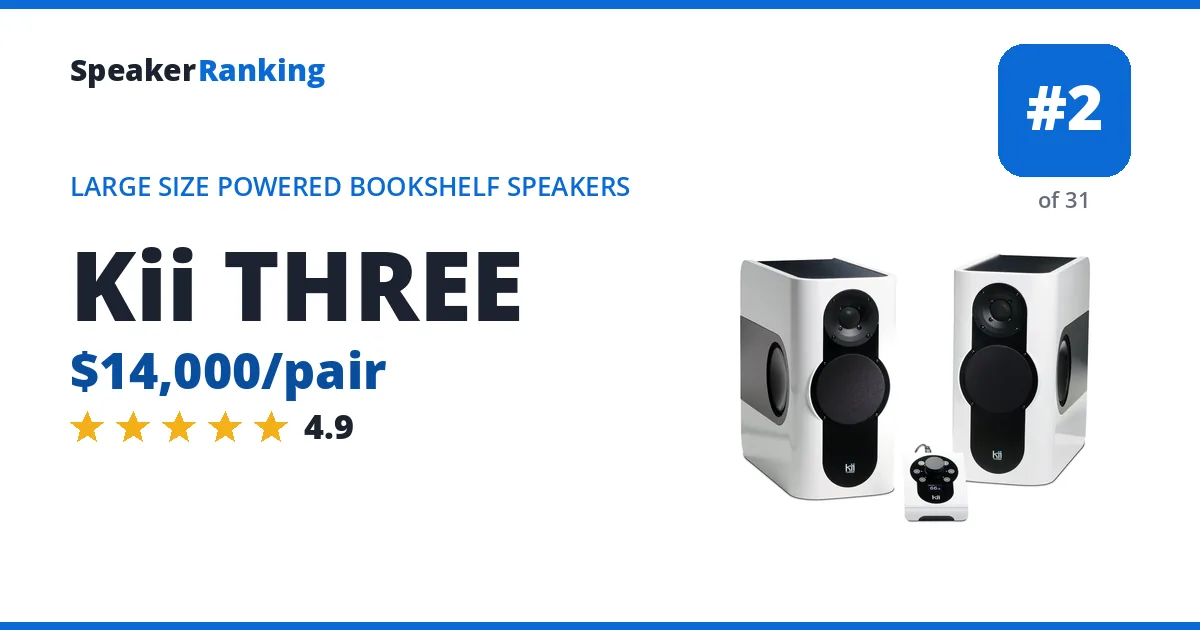
Pros: Exceptionally even measured balance: the 300Hz-5kHz response spans only 1.2dB, with preference scores of 7.06 standalone and 7.71 with an ideal subwoofer. Cardioid control reduces rearward low-midrange energy, while measured -3dB extension of 29.3Hz provides convincing full-range bass in a compact system. Measured bass extension of 28Hz (-3dB).
Cons: Deep-bass output has limits: demanding low-frequency material at high levels can trigger compression or audible distress. The reviewer preferred a small treble reduction, so the high score is not a promise of ideal tonal balance for every listener. Linear-phase operation adds latency, and the system is expensive.
Full Kii THREE review and specifications →
| AES Input | Yes |
|---|---|
| Amplifier Power | 1,500W total per speaker; Six Ncore channels |
| Aux Input | No |
| Bass Extension (-10dB) | 20.5Hz (measured, Erin's Audio Corner) |
| Bass Extension (-3dB) | 28Hz (measured, Erin's Audio Corner) |
| Coaxial Input | No |
| Coverage | DSP-controlled cardioid above approximately 70-90Hz |
| DSP | Yes; boundary, contour, phase-exact and low-latency modes |
| Dimensions | 15.7"H x 7.9"W x 15.7"D |
| Drivers | Four 6.5" woofers; 5" midrange; 1" waveguided tweeter |
| HDMI Input | No |
| Inputs | XLR (analog), XLR AES/EBU (digital), proprietary KiiLink digital multi-pin |
| Optical Input | No |
| RCA Input | No |
| Sensitivity | Not applicable (active DSP loudspeaker) |
| Spinorama Preference Score | 7.06 |
| Spinorama Preference Score with Perfect Sub | 7.71 |
| TRS Input | No |
| USB Input | No |
| Weight | 42.1 lbs (19.1 kg) each |
| XLR Input | Yes |
- Links
- Reviews, Comparisons and Sound Samples
- Head-to-Head Comparisons
 Ranked #4 of 67 in Large Size Powered Bookshelf Speakers - Genelec 8351B: $9150 per pair B&H Photo Video eBay
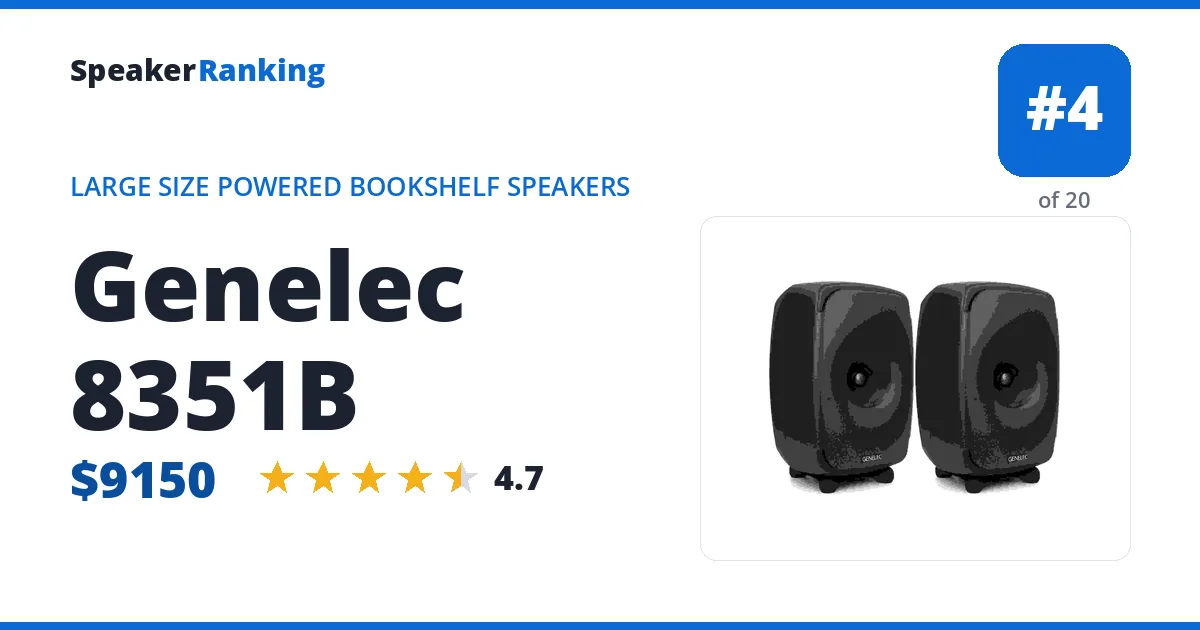
Pros: The vertical ASR measurement scores 7.75 with an ideal subwoofer and reaches 35.2Hz at -3dB. Coaxial midrange and treble help maintain consistent sound as the listening angle changes. Low measured distortion at ordinary listening levels and GLM calibration make it a strong precision-monitoring choice. Measured bass extension of 33Hz (-3dB).
Cons: Bass distortion increases at higher playback levels, so a subwoofer remains useful for demanding material. Upper-treble distortion in the test also cautions against assuming unlimited output. Calibration hardware adds to an already expensive system, and the quoted result is for the measured vertical orientation.
Full Genelec 8351B review and specifications →
| AES Input | No |
|---|---|
| Amplifier Power | 550w Per Speaker |
| App | Yes (GLM) |
| Aux Input | No |
| Bass Extension (-10dB) | 28Hz (measured, Audio Science Review) |
| Bass Extension (-3dB) | 33Hz (measured, Audio Science Review) |
| Bluetooth | No |
| Coaxial Input | No |
| DSP | Yes |
| Dimensions | 17"H x 11.3"W x 10.9"D (431.8 x 287 x 276.9 mm) |
| Drivers | 8.6" woofer, 5" coaxial with tweeter midrange, 0.75" (19mm) coaxial tweeter |
| EQ | Yes (via GLM software) |
| Frequency Response | 32Hz - 40kHz (±1.5dB) (Manufacturer specified) |
| HDMI Input | No |
| Inputs | XLR |
| Maximum SPL | 113dB @ 1m (manufacturer specified) |
| Optical Input | No |
| RCA Input | No |
| TRS Input | No |
| USB Input | No |
| Weight | 31.1 lbs (14.1 kg) each |
| XLR Input | Yes |
- Links
- Reviews, Comparisons and Sound Samples
- Head-to-Head Comparisons
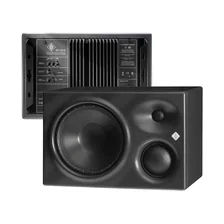 Ranked #5 of 67 in Large Size Powered Bookshelf Speakers - Neumann KH420: $10500 per pair B&H Photo Video eBay
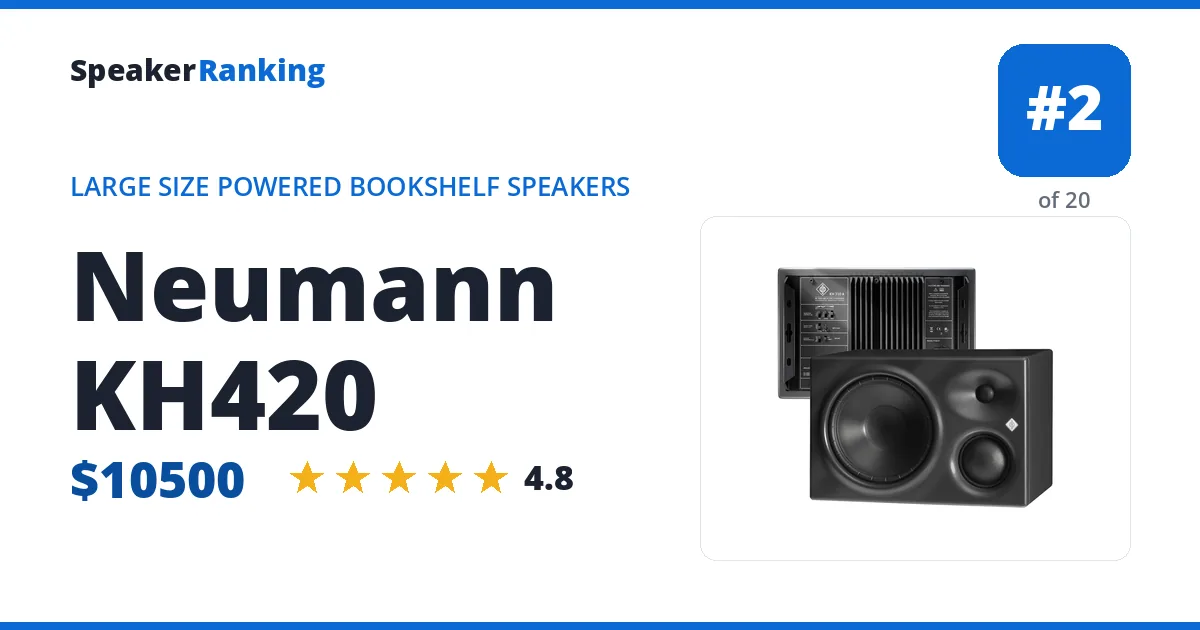
Pros: A 1.2dB response span from 300Hz to 5kHz, 7.51 ideal-subwoofer score and 27.8Hz measured -3dB extension combine accurate mids with genuinely deep bass. Its three-way design and low distortion at normal levels make it particularly attractive for larger listening distances and dynamic material. Measured bass extension of 32Hz (-3dB).
Cons: It is a large, heavy studio monitor rather than an easy desktop speaker. Vertical alignment matters around the crossover regions. Bass distortion rises as playback levels increase, and the measured high-level limits still apply despite the substantial drivers and amplifiers.
Full Neumann KH420 review and specifications →
| AES Input | No |
|---|---|
| Amplifier Power | 555w Per Speaker |
| App | Yes (MA 1 alignment) |
| Aux Input | No |
| Bass Extension (-10dB) | 24Hz (measured, Audio Science Review) |
| Bass Extension (-3dB) | 32Hz (measured, Audio Science Review) |
| Bluetooth | No |
| Coaxial Input | No |
| DSP | No |
| Dimensions | 25.4"H x 13"W x 17.5"D (645.2 x 330.2 x 444.5 mm) |
| Drivers | 10" woofer, 4" dome midrange, 1" fabric dome tweeter |
| EQ | Yes (Room response controls) |
| Frequency Response | 31Hz - 21kHz (±3dB) (Manufacturer specified) |
| HDMI Input | No |
| Inputs | XLR |
| Maximum SPL | 124dB @ 1m (manufacturer specified) |
| Optical Input | No |
| RCA Input | No |
| Spinorama Preference Score | 6.39 |
| Spinorama Preference Score with Perfect Sub | 7.51 |
| TRS Input | No |
| USB Input | No |
| Weight | 77.2 lbs (35 kg) each |
| XLR Input | Yes |
- Links
- Reviews, Comparisons and Sound Samples
- Head-to-Head Comparisons
 Ranked #6 of 67 in Large Size Powered Bookshelf Speakers - Genelec 8361A: $10900 per pair B&H Photo Video eBay
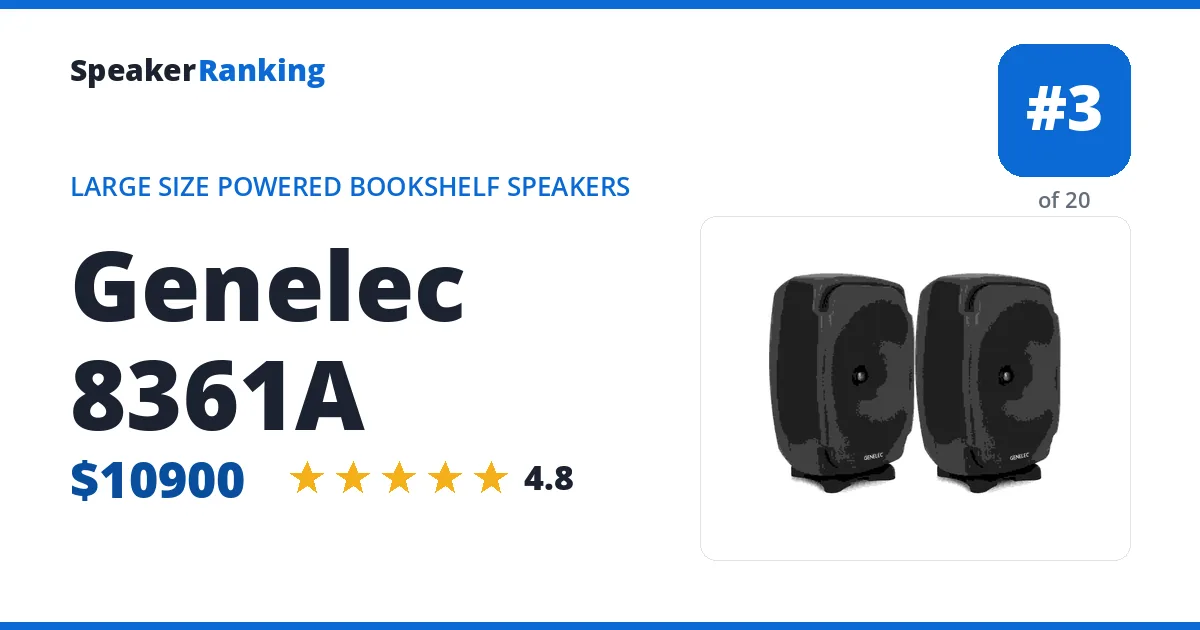
Pros: The coaxial design combines consistent imaging with substantial output capability. ASR measured a 1.8dB response span from 300Hz to 5kHz, 33.7Hz -3dB extension and a 7.35 ideal-subwoofer score. Low distortion and restrained compression support its use at greater distances than smaller nearfield monitors. Measured bass extension of 34Hz (-3dB).
Cons: Its larger size buys headroom, not uniformly better tonality than the smaller Ones models. Some lower-midrange unevenness remains, and listening angle can affect perceived treble balance. The cabinets are very heavy and expensive; GLM setup and suitable stands need to be budgeted separately.
Full Genelec 8361A review and specifications →
| AES Input | No |
|---|---|
| Amplifier Power | 1000w Per Speaker |
| App | Yes (GLM) |
| Aux Input | No |
| Bass Extension (-10dB) | 29Hz (measured, Erin's Audio Corner) |
| Bass Extension (-3dB) | 34Hz (measured, Erin's Audio Corner) |
| Bluetooth | No |
| Coaxial Input | No |
| DSP | Yes |
| Dimensions | 22.5"H x 14"W x 13.6"D (571.5 x 355.6 x 345.4 mm) |
| Drivers | Dual 263 x 137 mm woofers, 5.1" coaxial with tweeter midrange, 1" (25mm) coaxial tweeter |
| EQ | Yes (via GLM software) |
| Frequency Response | 30Hz - 43kHz (±2dB) (Manufacturer specified) |
| HDMI Input | No |
| Inputs | XLR |
| Maximum SPL | 118dB @ 1m (manufacturer specified) |
| Optical Input | No |
| RCA Input | No |
| Spinorama Preference Score | 6.04 |
| Spinorama Preference Score with Perfect Sub | 7.35 |
| TRS Input | No |
| USB Input | No |
| Weight | 70.3 lbs (31.9 kg) each |
| XLR Input | Yes |
- Links
- Reviews, Comparisons and Sound Samples
- Head-to-Head Comparisons
 Ranked #7 of 67 in Large Size Powered Bookshelf Speakers - Genelec 8341A: $6590 per pair B&H Photo Video eBay
Pros: An 8.09 ideal-subwoofer preference score and 1.2dB response span from 300Hz to 5kHz place the measured vertical configuration among the strongest tonal performers here. Coaxial radiation and GLM support precise nearfield imaging and room integration. Measured bass extension of 58Hz (-3dB).
Cons: Measured -3dB extension is 47.6Hz, so the larger 8351B and 8361A provide more useful low-end reach and headroom. The review found bass-output limitations at demanding levels. Its excellent ideal-subwoofer score should not be read as equivalent full-range output to those larger models.
Full Genelec 8341A review and specifications →
| AES Input | Yes |
|---|---|
| Amplifier Power | 550W total (250W bass, 150W mid, 150W treble) |
| App | No |
| Aux Input | No |
| Bass Extension (-10dB) | 40Hz (measured, Audio Science Review) |
| Bass Extension (-3dB) | 58Hz (measured, Audio Science Review) |
| Coaxial Input | No |
| DSP | No |
| Dimensions | not published by manufacturer |
| Drivers | 2x 6.5" woofers, 3.5" midrange, 0.75" tweeter (coaxial mid/tweeter) |
| EQ | Yes (Room adjustment) |
| Frequency Response | 338Hz - 37kHz (-6dB) (Manufacturer specified) |
| HDMI Input | No |
| Inputs | XLR, AES/EBU |
| Optical Input | No |
| RCA Input | No |
| Spinorama Preference Score | 6.32 |
| Spinorama Preference Score with Perfect Sub | 8.09 |
| TRS Input | No |
| USB Input | No |
| Weight | not published by manufacturer |
| XLR Input | Yes |
- Links
- Reviews, Comparisons and Sound Samples
- Head-to-Head Comparisons
 Ranked #8 of 67 in Large Size Powered Bookshelf Speakers - Neumann KH 150: $3,398 per pair B&H Photo Video eBay
Pros: An exceptionally tight 1.0dB response span from 300Hz to 5kHz supports neutral vocals and instruments. The measured ideal-subwoofer score is 7.58, with -3dB bass extension to 39.6Hz. DSP and optional MA 1 alignment offer useful control over room-related response errors. Measured bass extension of 39.6Hz (-3dB).
Cons: A two-way nearfield monitor cannot match the largest three-way systems for deep-bass output at distance. Keep the tweeter near ear height to avoid crossover-related changes off the vertical axis. MA 1 calibration requires additional equipment, and studio connections are less convenient than a consumer streaming system.
Full Neumann KH 150 review and specifications →
| AES Input | No |
|---|---|
| Amplifier Power | 245W total (145W woofer, 100W tweeter, 10% THD+N) |
| Aux Input | No |
| Bass Extension (-10dB) | 34.2Hz (measured, Audio Science Review) |
| Bass Extension (-3dB) | 39.6Hz (measured, Audio Science Review) |
| Coaxial Input | Yes |
| Country | Germany |
| Crossover Frequency | 1.7kHz |
| Dimensions | 13.6"H x 8.9"W x 10.7"D (345 x 225 x 273 mm) |
| Drivers | 1" tweeter, 6.5" woofer |
| Enclosure | ported |
| Frequency Response | 39Hz-20.4kHz +/-3dB |
| HDMI Input | No |
| Inputs | XLR (balanced analog), RCA S/PDIF (digital) |
| Maximum SPL | 118.7dB @ 1m half space (manufacturer specified) |
| Optical Input | No |
| RCA Input | Yes |
| Spinorama Preference Score | 5.84 |
| Spinorama Preference Score with Perfect Sub | 7.58 |
| TRS Input | No |
| USB Input | No |
| Warranty | 2 years |
| Weight | 17.6 lbs (8.0 kg) each |
| XLR Input | Yes |
- Links
- Reviews, Comparisons and Sound Samples
- Head-to-Head Comparisons
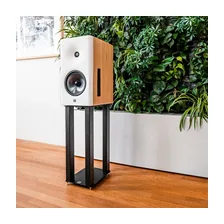 Ranked #9 of 67 in Large Size Powered Bookshelf Speakers - Dutch & Dutch 8C: $13000 per pair Tidepoolaudio eBay
Pros: Very deep measured bass reaches 23.4Hz at -3dB, while the 1.8dB response span from 300Hz to 5kHz supports even mids. The 6.51 standalone score reflects that full-range strength. Cardioid midrange radiation and boundary-aware bass adjustment help integrate the system with nearby walls. Measured bass extension of 23Hz (-3dB), with a measured sensitivity of 106dB.
Cons: Cardioid operation reduces some reflections; it does not make the speaker independent of the room. Rear-woofer placement and setup remain important. Its 7.16 ideal-subwoofer score trails the strongest tonal performers here, although its deep native bass is a meaningful advantage for listening without a sub.
Full Dutch & Dutch 8C review and specifications →
| AES Input | No |
|---|---|
| Amplifier Power | 1000W (250W tweeter + 250W mid + 500W dual woofers) |
| App | Yes (Ascend) |
| Aux Input | No |
| Bass Extension (-10dB) | <20Hz (measured, Erin's Audio Corner) |
| Bass Extension (-3dB) | 23Hz (measured, Erin's Audio Corner) |
| Bluetooth | No |
| Coaxial Input | No |
| DSP | Yes |
| Dimensions | 19"H x 10.5"W x 15"D (482.6 x 266.7 x 381 mm) |
| Drivers | 2x 8" Aluminium Cone woofers, 8" Aluminium Cone midrange, 1" Aluminium/Magnesium dome tweeter |
| EQ | Yes (24-band parametric) |
| Frequency Response | 20Hz - 20kHz (Manufacturer specified) |
| HDMI Input | No |
| Inputs | XLR |
| Maximum SPL | 106dB @ 1m continuous (manufacturer specified) |
| Optical Input | No |
| RCA Input | No |
| Sensitivity | ~106dB (measured at 0.30V/1m, Erin's Audio Corner) |
| Streaming Services | Yes (network streaming) |
| TRS Input | No |
| USB Input | No |
| Weight | 57.3 lbs (26 kg) each |
| Wi-Fi | Yes (Ethernet) |
| XLR Input | Yes |
- Links
- Reviews, Comparisons and Sound Samples
- Head-to-Head Comparisons
- Dutch & Dutch 8C vs Aalto Speakers Aalto 3 Active Pro
- Dutch & Dutch 8C vs Genelec 8361A
- Dutch & Dutch 8C vs Neumann KH420
- Dutch & Dutch 8C vs Kii THREE
- Dutch & Dutch 8C vs Yamaha HS8
- Dutch & Dutch 8C vs Kali Audio LP-6 V2
- Dutch & Dutch 8C vs Kali Audio IN-8 V2
- Dutch & Dutch 8C vs JBL M2 Master Reference Monitor
- See all 13 comparisons
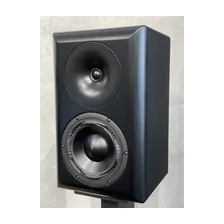 Ranked #10 of 67 in Large Size Powered Bookshelf Speakers - Aalto Speakers Aalto 3 Active Pro: $5,930 per pair Aalto Speakers eBay
Pros: The manufacturer dataset reports a remarkably even 0.7dB response span from 300Hz to 5kHz, 34.6Hz -3dB extension and an 8.55 ideal-subwoofer preference score. If representative of the delivered system, this promises exceptionally neutral balance with useful bass reach.
Cons: External amplification and system setup make this less straightforward than a self-contained desktop pair.
Full Aalto Speakers Aalto 3 Active Pro review and specifications →
| AES Input | Yes |
|---|---|
| Amplifier Power | 4x 245W (external amplifier module, Speakon connection) |
| Aux Input | No |
| Coaxial Input | No |
| Country | Finland |
| DSP | FourAudio System Software (Windows/macOS) |
| Dimensions | 9.4"W x 15.7"H x 9.8"D (240 x 400 x 250 mm) |
| Drivers | 26mm aluminum dome tweeter, 6.5" long-stroke bass-midrange, 8" passive radiator |
| Enclosure | 2-way active, passive-radiator loaded, MDF |
| Frequency Response | 31-23,500Hz (-6dB) |
| HDMI Input | No |
| Inputs | Analogue XLR, AES/EBU XLR, USB Type B |
| Optical Input | No |
| RCA Input | No |
| Spinorama Preference Score | 7.14 |
| Spinorama Preference Score with Perfect Sub | 8.55 |
| TRS Input | No |
| USB Input | Yes |
| Weight | 19.8 lbs (9 kg) each |
| XLR Input | Yes |
- Links
- Reviews, Comparisons and Sound Samples
- Head-to-Head Comparisons
 Ranked #11 of 67 in Large Size Powered Bookshelf Speakers - Buchardt A10: $4300 per pair Buchardtaudio eBay
Pros: The measured tuning combines 31.5Hz -3dB bass extension with preference scores of 6.49 standalone and 7.20 with an ideal subwoofer. A 1.9dB response span from 300Hz to 5kHz supports broadly even mids, and selectable DSP tunings offer useful flexibility. Measured bass extension of 30Hz (-3dB).
Cons: The rising treble balance can sound brighter on axis; toe-out or a different tuning may suit some rooms. Deep-bass demands cause compression before the largest monitors reach their limits. A subwoofer with appropriate high-pass filtering can improve headroom; alternate presets should not be assumed to share the quoted scores.
Full Buchardt A10 review and specifications →
| AES Input | No |
|---|---|
| Amplifier Power | 200w Per Speaker |
| App | No |
| Aux Input | No |
| Bass Extension (-10dB) | 21Hz (measured, Erin's Audio Corner) |
| Bass Extension (-3dB) | 30Hz (measured, Erin's Audio Corner) |
| Bluetooth | No |
| Coaxial Input | No |
| DSP | No |
| Dimensions | 14.6"H x 7"W x 9.6"D (370.8 x 177.8 x 243.8 mm) |
| Drivers | 6.5" PURIFI Extended Stroke Driver with Ultra Low Distortion, Custom made with triple Voice Coil woofer, 19 mm / 0.74" Resonance Free Aluminum dome with CDC aluminum waveguide tweeter |
| EQ | Yes (Room adjustment) |
| HDMI Input | No |
| Inputs | XLR |
| Optical Input | No |
| RCA Input | No |
| Spinorama Preference Score | 6.49 |
| Spinorama Preference Score with Perfect Sub | 7.20 |
| TRS Input | No |
| USB Input | No |
| Weight | 15 lbs (6.8 kg) each |
| Woofer Cabinet | sealed |
| XLR Input | Yes |
- Links
- Reviews, Comparisons and Sound Samples
- Head-to-Head Comparisons
 Ranked #12 of 67 in Large Size Powered Bookshelf Speakers - Pitt & Giblin Flare: $8,300 per pair Pitt & Giblin eBay
Pros: Manufacturer measurements indicate a tight 1.1dB response span from 300Hz to 5kHz and a 7.71 ideal-subwoofer score, promising natural vocal balance. Measured -3dB extension of 37Hz suggests useful standalone bass from this active system.
Cons: This is a substantial specialist system rather than an uncomplicated desktop purchase. Allow room for suitable placement and the complete active system.
Full Pitt & Giblin Flare review and specifications →
| AES Input | No |
|---|---|
| Amplifier Power | 250W per speaker, bi-amplified (Pascal Class-D) |
| Aux Input | No |
| Coaxial Input | Yes |
| Country | Hand-built in Hobart, Tasmania, Australia |
| Dimensions | 11.6"W x 17.3"H x 11.4"D (295 x 440 x 290 mm) (cabinet); waveguide adds 110mm to total height |
| Drivers | 8" (200mm) paper-cone mid-bass driver, 25mm polymer compression driver on a cast-bronze circular waveguide |
| Enclosure | 2-way active, rear-ported reflex |
| Frequency Response | 36Hz-25kHz +/-1.5dB |
| HDMI Input | No |
| Inputs | Analogue XLR/RCA, S/PDIF coaxial digital |
| Optical Input | No |
| RCA Input | Yes |
| Spinorama Preference Score | 6.32 |
| Spinorama Preference Score with Perfect Sub | 7.71 |
| TRS Input | No |
| USB Input | No |
| Weight | 37.5 lbs (17 kg) each |
| XLR Input | Yes |
- Links
- Reviews, Comparisons and Sound Samples
- Head-to-Head Comparisons
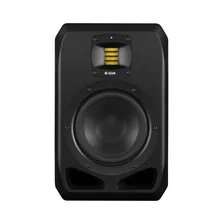 Ranked #13 of 67 in Large Size Powered Bookshelf Speakers - Adam Audio S2V: $3500 per pair B&H Photo Video eBay
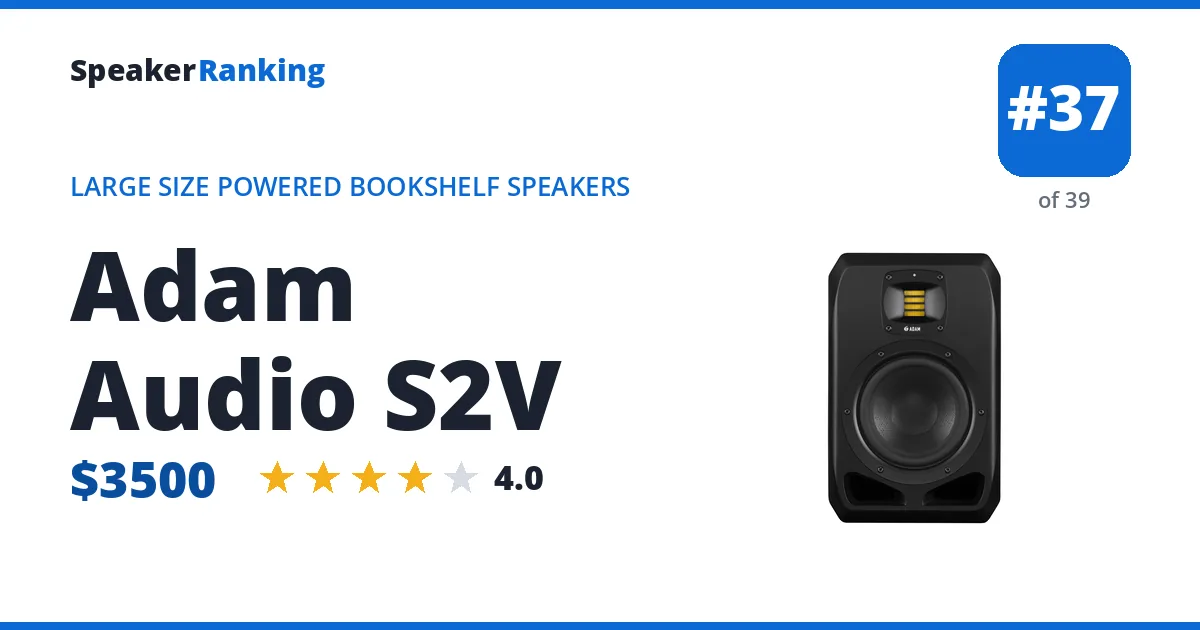
Pros: A 7.22 ideal-subwoofer score and relatively even listening-window response support a strong role as a subwoofer-assisted studio monitor. The review’s low-distortion findings add useful evidence beyond amplifier ratings, and onboard DSP permits tailored adjustment. Measured bass extension of 85Hz (-3dB).
Cons: Measured -3dB extension is 52.7Hz, so the large cabinet does not automatically deliver the deepest bass here. The native balance rises toward the treble, with some lower-midrange unevenness. DSP can improve that balance, but an EQ-optimized result is not its unadjusted performance.
Full Adam Audio S2V review and specifications →
| AES Input | Yes |
|---|---|
| Amplifier Power | 350W total (300W woofer Class D, 50W tweeter Class A/B) |
| App | Yes |
| Aux Input | No |
| Bass Extension (-10dB) | 62Hz (measured, Audio Science Review) |
| Bass Extension (-3dB) | 85Hz (measured, Audio Science Review) |
| Coaxial Input | No |
| DSP | Yes |
| Dimensions | not published by manufacturer |
| Drivers | 7" woofer, S-ART AMT tweeter |
| EQ | No |
| Frequency Response | 35Hz - 50kHz (Manufacturer specified) |
| HDMI Input | No |
| Inputs | XLR, AES/EBU |
| Optical Input | No |
| RCA Input | No |
| Spinorama Preference Score | 5.08 |
| Spinorama Preference Score with Perfect Sub | 7.22 |
| TRS Input | No |
| USB Input | No |
| Weight | not published by manufacturer |
| XLR Input | Yes |
- Links
- Reviews, Comparisons and Sound Samples
- Head-to-Head Comparisons
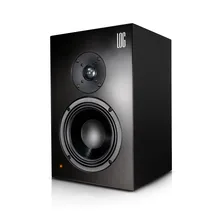 Ranked #14 of 67 in Large Size Powered Bookshelf Speakers - LOGProfessional Alpha: €11,560 per pair LOGProfessional eBay
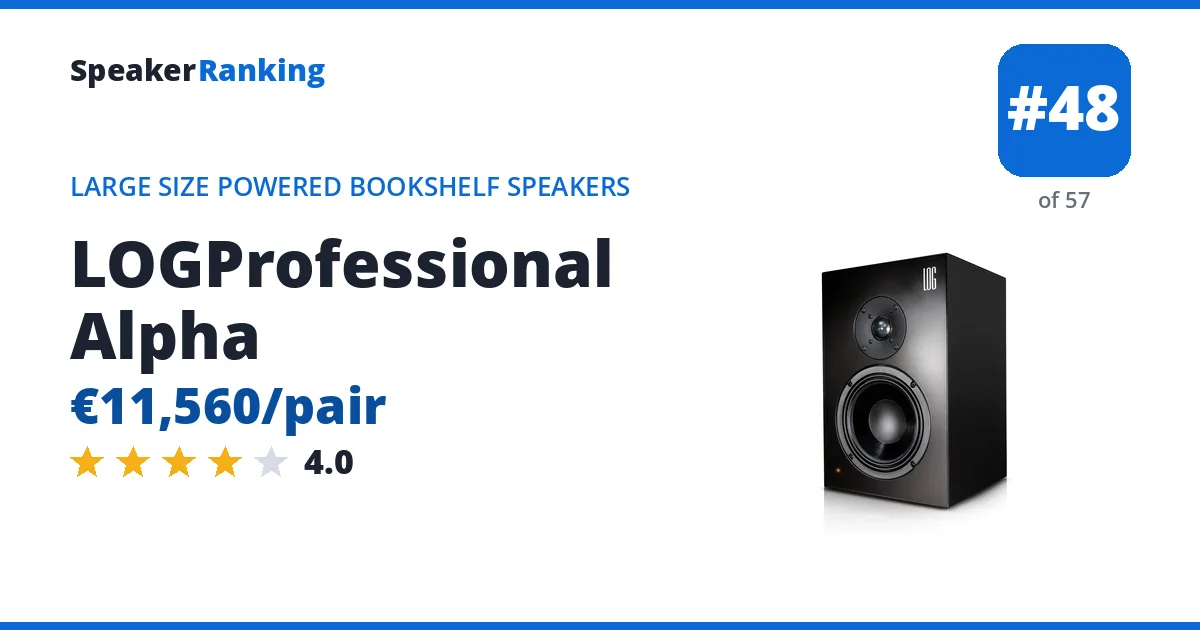
Pros: Sound & Recording’s measurements show a 1.2dB response span from 300Hz to 5kHz and a 7.36 ideal-subwoofer score. This supports a particularly even midrange and makes the Alpha a promising choice for a system with properly integrated bass support.
Cons: The measured -3dB point is 67.1Hz, making a subwoofer important for full-range listening. A smooth midrange is not proof of high clean output or uniformly controlled dispersion.
Full LOGProfessional Alpha review and specifications →
| AES Input | No |
|---|---|
| Amplifier Power | 2x 70W Class A/B |
| Aux Input | No |
| Coaxial Input | No |
| Country | Graz, Austria |
| Dimensions | 13.4"W x 8.7"H x 8.7"D (340 x 220 x 220 mm) |
| Drivers | 1" dome tweeter, 6.5" bass-midrange woofer |
| Enclosure | 2-way active, bass-reflex, low-vibration housing |
| HDMI Input | No |
| Inputs | Digital and analog XLR, 192kHz/24-bit DSP |
| Maximum SPL | 112dB (manufacturer specified) |
| Optical Input | No |
| RCA Input | No |
| Spinorama Preference Score | 5.02 |
| Spinorama Preference Score with Perfect Sub | 7.36 |
| TRS Input | No |
| USB Input | No |
| Weight | 15.4 lbs (7 kg) each |
| XLR Input | Yes |
- Links
- Reviews, Comparisons and Sound Samples
- Head-to-Head Comparisons
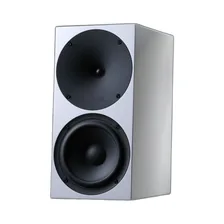 Ranked #15 of 67 in Large Size Powered Bookshelf Speakers - Buchardt A500: $4,150 per pair Buchardt Audio eBay
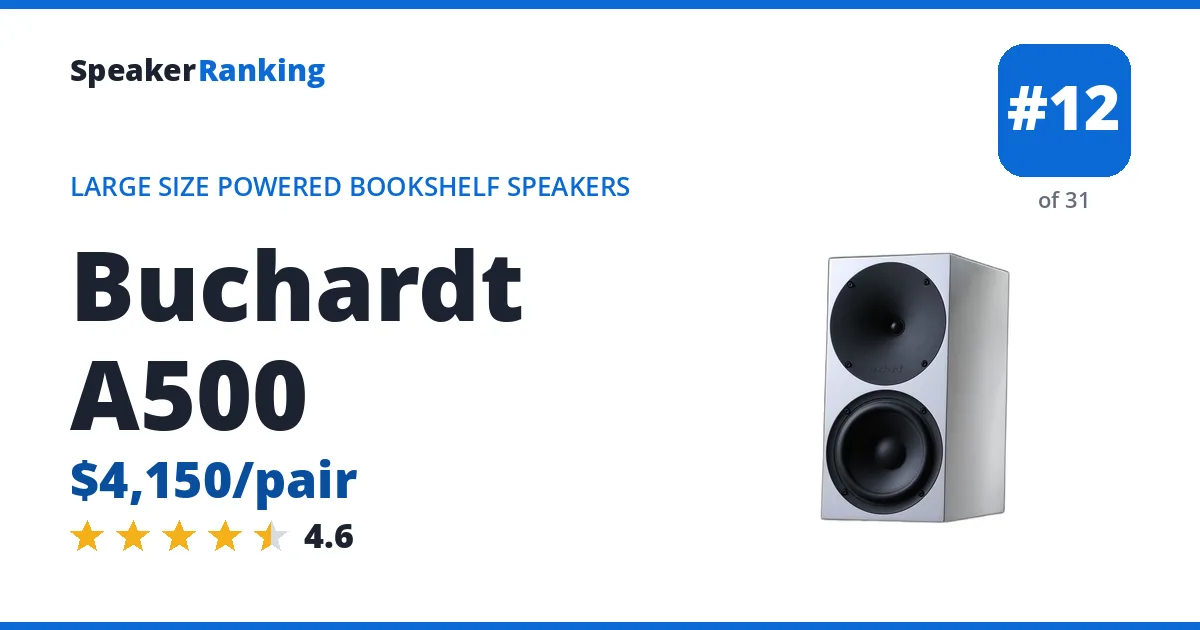
Pros: Erin measured unusually deep bass for the cabinet size: 24.9Hz at -3dB. A 1.8dB response span from 300Hz to 5kHz and 6.12 standalone preference score support balanced, full-range listening. Master Tunings and optional wireless integration provide practical flexibility. Measured bass extension of 24.9Hz (-3dB).
Cons: Bass extension depends on the selected tuning and comes with output tradeoffs at high levels. The 7.01 ideal-subwoofer score is good but not class-leading. A rear-facing woofer does not by itself establish cardioid radiation, and alternate Master Tunings should not inherit the measured configuration’s score.
Full Buchardt A500 review and specifications →
| AES Input | No |
|---|---|
| Amplifier Power | 3 x 150W per speaker |
| Aux Input | No |
| Bass Extension | Master-tuning dependent; approximately 25–40Hz |
| Bass Extension (-10dB) | 23.4Hz (measured, Erin's Audio Corner) |
| Bass Extension (-3dB) | 24.9Hz (measured, Erin's Audio Corner) |
| Coaxial Input | No |
| Dimensions | 14.4H x 7W x 11D inches |
| Drivers | 0.74-inch dome; front and rear 6-inch long-throw woofers |
| HDMI Input | No |
| Inputs | XLR, WiSA |
| Optical Input | No |
| RCA Input | No |
| Sensitivity | Not applicable (active DSP loudspeaker) |
| Spinorama Preference Score | 6.12 |
| Spinorama Preference Score with Perfect Sub | 7.01 |
| TRS Input | No |
| USB Input | No |
| Weight | 55.1 lbs (25kg)/pair |
| XLR Input | Yes |
- Links
- Reviews, Comparisons and Sound Samples
- Head-to-Head Comparisons
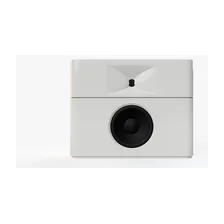 Ranked #16 of 67 in Large Size Powered Bookshelf Speakers - GGNTKT M1: £7,500 per pair Purite Audio (UK) eBay
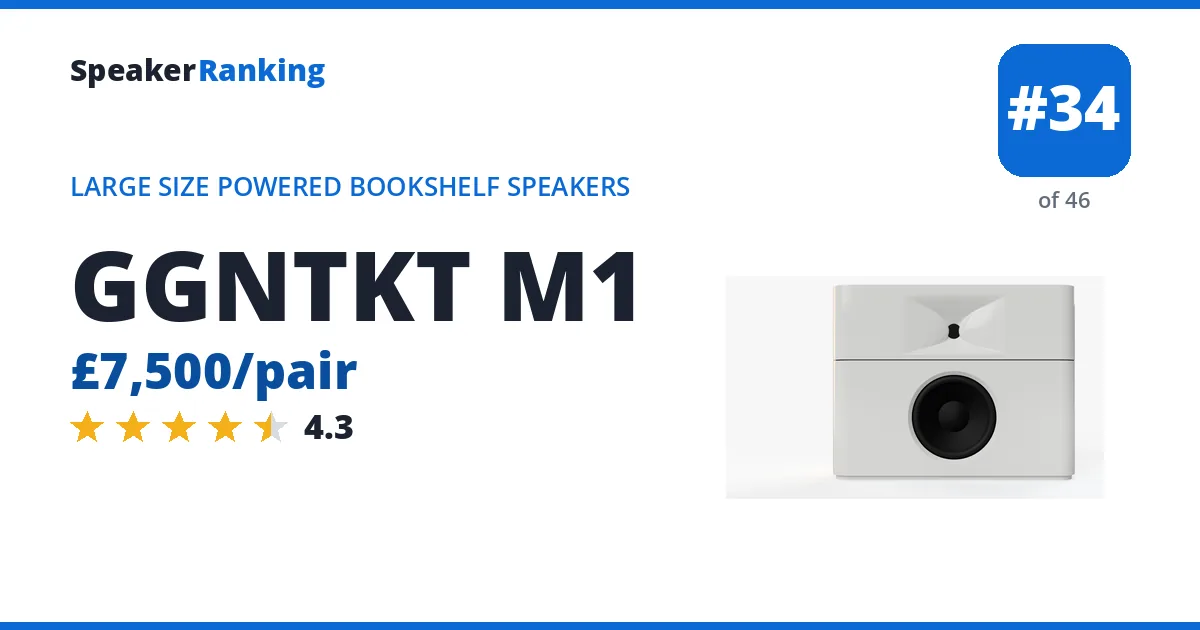
Pros: The manufacturer-supplied monopole measurement shows a 1.6dB response span from 300Hz to 5kHz, 33.8Hz -3dB extension and a 7.03 ideal-subwoofer score. Those results support even midrange balance and useful bass from a relatively shallow cabinet. Measured bass extension of 33.8Hz (-3dB).
Cons: The cited measurement is specifically monopole, so it cannot substantiate claims about cardioid-mode performance. Outboard electronics add cabling and installation complexity; confirm the complete system configuration before purchase.
Full GGNTKT M1 review and specifications →
| AES Input | Yes |
|---|---|
| Amplifier Power | 560W total (70W tweeter, 210W woofers per channel, Class D) |
| Aux Input | No |
| Bass Extension (-10dB) | 28.2Hz (measured, spinorama.org vendor data) |
| Bass Extension (-3dB) | 33.8Hz (measured, spinorama.org vendor data) |
| Coaxial Input | No |
| Country | Germany |
| Dimensions | 12.6"H x 15.9"W x 5.5"D (319 x 405 x 140 mm) |
| Drivers | 1.75" titanium ring diaphragm compression tweeter with waveguide, 3x 6.5" aluminum cone woofers (1 front, 2 rear firing, cardioid) |
| Enclosure | sealed |
| Frequency Response | 36Hz-20kHz -3dB |
| HDMI Input | No |
| Inputs | XLR (balanced analog), XLR AES/EBU (digital), USB (calibration/control only, not an audio input) |
| Maximum SPL | 112.8dB @ 1m (manufacturer specified) |
| Optical Input | No |
| RCA Input | No |
| TRS Input | No |
| USB Input | No |
| Warranty | 3 years (with registration) |
| Weight | 24.3 lbs (11.0 kg) each |
| XLR Input | Yes |
- Links
- Reviews, Comparisons and Sound Samples
- Head-to-Head Comparisons
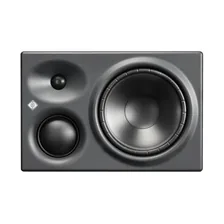 Ranked #17 of 67 in Large Size Powered Bookshelf Speakers - Neumann KH 310 A: $4,998 per pair B&H Photo Video eBay
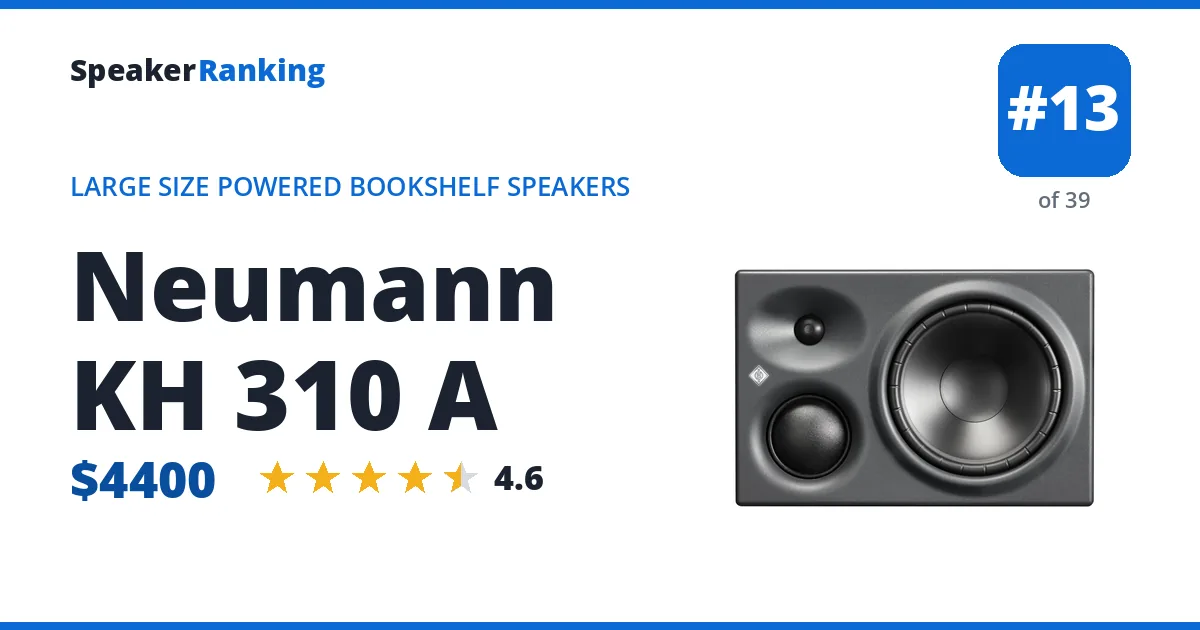
Pros: The sealed three-way design combines 35.2Hz measured -3dB extension with low distortion in the review’s demanding playback tests. Its 2.2dB response span from 300Hz to 5kHz and 6.86 ideal-subwoofer score support balanced monitoring with useful full-range capability. Measured bass extension of 70Hz (-3dB).
Cons: Its measured tonal balance is not as even as the KH 150 or the best coaxial alternatives. Correct orientation and listening height matter for the separated drivers. The analog system lacks the integrated calibration workflow of newer DSP models, so room correction requires additional equipment.
Full Neumann KH 310 A review and specifications →
| AES Input | No |
|---|---|
| Amplifier Power | 290W total (150W woofer, 70W mid, 70W tweeter) |
| App | No |
| Aux Input | No |
| Bass Extension (-10dB) | 42Hz (measured, Audio Science Review) |
| Bass Extension (-3dB) | 70Hz (measured, Audio Science Review) |
| Coaxial Input | No |
| DSP | No |
| Dimensions | not published by manufacturer |
| Drivers | 8.25" woofer, 3" midrange, 1" tweeter |
| EQ | No |
| Frequency Response | 34Hz - 21kHz (+/-3dB) (Manufacturer specified) |
| HDMI Input | No |
| Inputs | XLR (balanced analog) |
| Optical Input | No |
| RCA Input | No |
| Spinorama Preference Score | 5.36 |
| Spinorama Preference Score with Perfect Sub | 6.86 |
| TRS Input | No |
| USB Input | No |
| Weight | not published by manufacturer |
| XLR Input | Yes |
- Links
- Reviews, Comparisons and Sound Samples
- Head-to-Head Comparisons
- Neumann KH 310 A vs HEDD Type 20 MK2
- Neumann KH 310 A vs Genelec S360
- Neumann KH 310 A vs Adam Audio S2V
- Neumann KH 310 A vs JBL 308P MKII
- Neumann KH 310 A vs Buchardt A10
- Neumann KH 310 A vs Yamaha HS8
- Neumann KH 310 A vs Kali Audio LP-6 V2
- Neumann KH 310 A vs Kali Audio IN-8 V2
- See all 35 comparisons
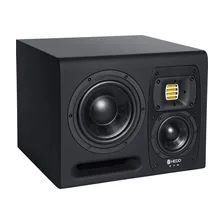 Ranked #18 of 67 in Large Size Powered Bookshelf Speakers - HEDD Type 20 MK2: $4800 per pair B&H Photo Video eBay
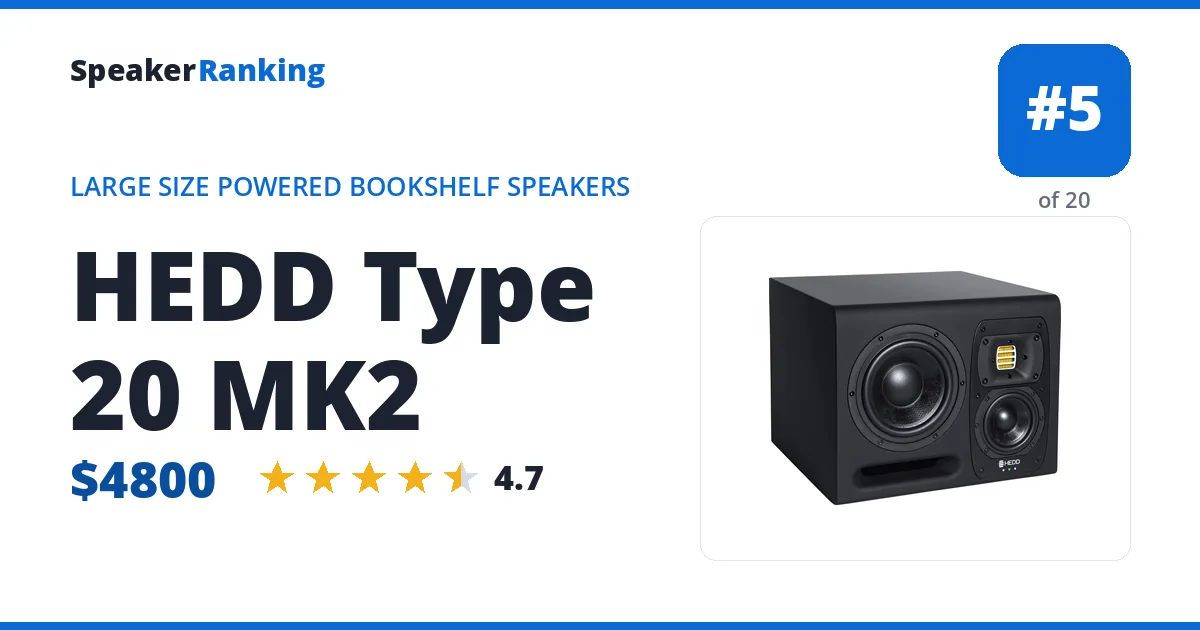
Pros: The measured ported configuration reaches 35.2Hz at -3dB and scores 6.92 with an ideal subwoofer. A 2.4dB response span from 300Hz to 5kHz supports broadly balanced mids, while ported operation reduces deep-bass strain compared with the sealed setting in the review. Measured bass extension of 32Hz (-3dB).
Cons: These results are for ported operation, not every bass or phase setting. Horizontal asymmetry and vertical crossover behavior make orientation and listening position important. Distortion rises at higher output, and linear-phase processing can add latency for live monitoring.
Full HEDD Type 20 MK2 review and specifications →
| AES Input | Yes |
|---|---|
| Amplifier Power | 900W (3x300W) |
| App | Yes (HEDD CTRL) |
| Aux Input | No |
| Bass Extension (-10dB) | 26Hz (measured, Audio Science Review) |
| Bass Extension (-3dB) | 32Hz (measured, Audio Science Review) |
| Bluetooth | No |
| Coaxial Input | No |
| DSP | Yes (96kHz/32-bit) |
| Dimensions | 14.1"H x 11"W x 13.3"D (358.1 x 279.4 x 337.8 mm) |
| Drivers | 7" honeycomb composite woofer, 4" honeycomb composite midrange, HEDD AMT (Air Motion Transformer) tweeter |
| EQ | Yes (Desk filter, shelf filters) |
| Frequency Response | 32Hz - 40kHz (Manufacturer specified) |
| HDMI Input | No |
| Inputs | XLR (Analog/AES) |
| Maximum SPL | 120dB @ 1m (per pair) (manufacturer specified) |
| Optical Input | No |
| Outputs | XLR (AES pass-through) |
| RCA Input | No |
| Spinorama Preference Score | 5.34 |
| Spinorama Preference Score with Perfect Sub | 6.92 |
| TRS Input | No |
| USB Input | No |
| Weight | 34 lbs (15.4 kg) each |
| XLR Input | Yes |
- Links
- Reviews, Comparisons and Sound Samples
- Head-to-Head Comparisons
- HEDD Type 20 MK2 vs Neumann KH 310 A
- HEDD Type 20 MK2 vs Buchardt A500
- HEDD Type 20 MK2 vs JBL 308P MKII
- HEDD Type 20 MK2 vs Yamaha HS8
- HEDD Type 20 MK2 vs Buchardt A10
- HEDD Type 20 MK2 vs Kali Audio LP-6 V2
- HEDD Type 20 MK2 vs Kali Audio IN-8 V2
- HEDD Type 20 MK2 vs Genelec 8050B
- See all 25 comparisons
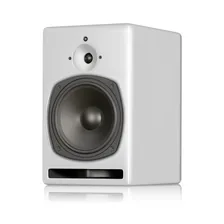 Ranked #19 of 67 in Large Size Powered Bookshelf Speakers - PSI Audio A21-M: $7,440 per pair B&H Photo Video eBay
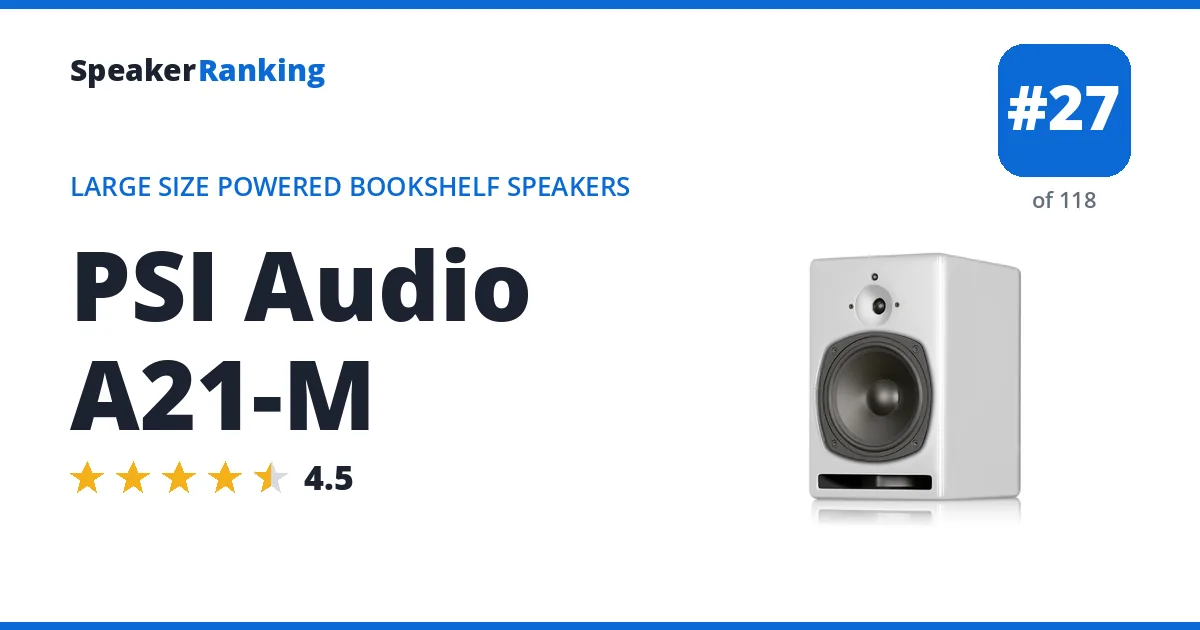
Pros: ASR measured 39.6Hz -3dB extension and a 2.2dB response span from 300Hz to 5kHz, giving useful bass and broadly even mids. Its 6.87 ideal-subwoofer score supports serious monitoring, with analog phase compensation offering an alternative to DSP-based systems. Measured bass extension of 39.6Hz (-3dB).
Cons: The measured tonal result is good rather than a clear advance over less costly competitors. There is no built-in automatic room-calibration system, so placement or external correction still matters. The premium construction and analog circuitry should not be mistaken for proof of better audible performance.
Full PSI Audio A21-M review and specifications →
| AES Input | No |
|---|---|
| Amplifier Power | 335W total (280W woofer, 55W tweeter, Class A/B) |
| Aux Input | No |
| Bass Extension (-10dB) | 33.2Hz (measured, Audio Science Review) |
| Bass Extension (-3dB) | 39.6Hz (measured, Audio Science Review) |
| Coaxial Input | No |
| Country | Switzerland |
| Crossover Frequency | 2.4kHz |
| Dimensions | 9.8"H x 15.7"W x 11.8"D (250 x 400 x 300 mm) |
| Drivers | 27mm handmade dome tweeter, 172mm cone woofer |
| Enclosure | ported |
| Frequency Response | 38Hz-23kHz -6dB |
| HDMI Input | No |
| Inputs | XLR (balanced analog) |
| Maximum SPL | 110dB short term, 121dB peak (manufacturer specified) |
| Optical Input | No |
| RCA Input | No |
| Spinorama Preference Score | 5.21 |
| Spinorama Preference Score with Perfect Sub | 6.87 |
| TRS Input | No |
| USB Input | No |
| Warranty | 5+1 years |
| Weight | 28.2 lbs (12.8 kg) each |
| XLR Input | Yes |
- Links
- Reviews, Comparisons and Sound Samples
- Head-to-Head Comparisons
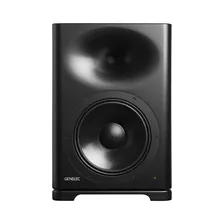 Ranked #20 of 67 in Large Size Powered Bookshelf Speakers - Genelec S360: $9,550 per pair B&H Photo Video eBay
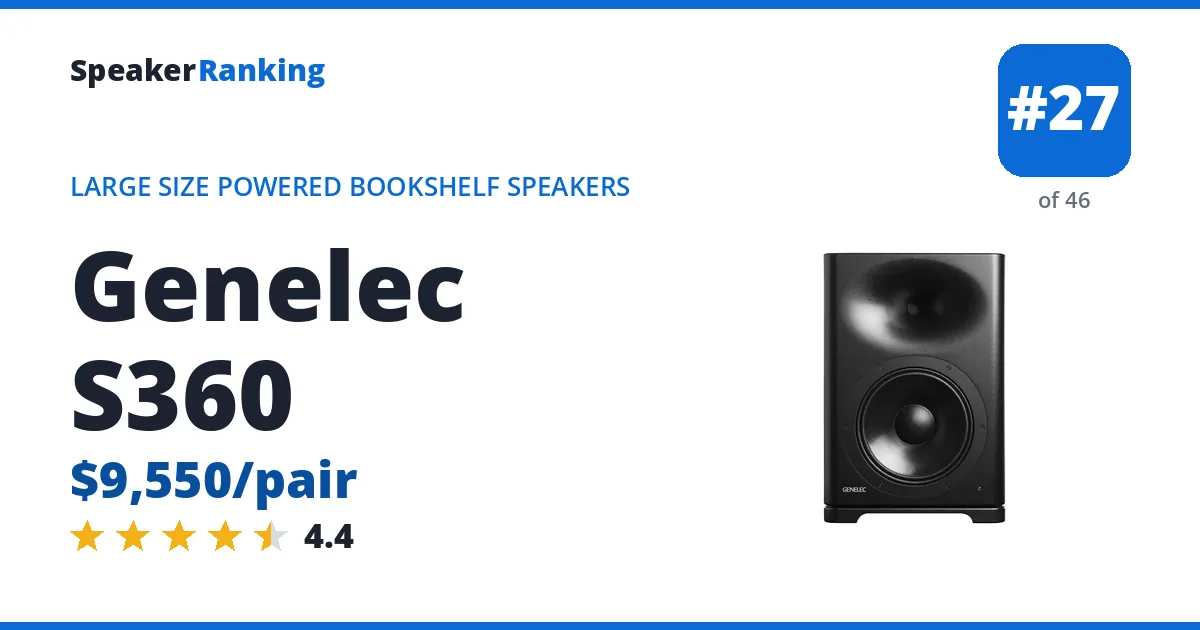
Pros: A strong choice when professional output capability and listening distance matter. The measured 2.0dB response span from 300Hz to 5kHz, 39.6Hz -3dB extension and 6.81 ideal-subwoofer score support balanced sound, while GLM provides room-integration tools. Measured bass extension of 39.6Hz (-3dB).
Cons: The substantial enclosure and installation requirements make it excessive for many desks. Its tonal measurements do not surpass the best smaller monitors simply because it can play louder. Deep-bass reproduction still benefits from a subwoofer, especially in high-output systems.
Full Genelec S360 review and specifications →
| AES Input | Yes |
|---|---|
| Amplifier Power | 350W total (250W woofer, 100W tweeter, Class D) |
| Aux Input | No |
| Bass Extension (-10dB) | 35.6Hz (measured, Audio Science Review) |
| Bass Extension (-3dB) | 39.6Hz (measured, Audio Science Review) |
| Coaxial Input | No |
| Country | Finland |
| Dimensions | 20.9"H x 14.2"W x 14.2"D (530 x 360 x 360 mm) |
| Drivers | 1" titanium compression tweeter, 10" cone woofer |
| Enclosure | ported |
| Frequency Response | 36Hz-22kHz -6dB |
| HDMI Input | No |
| Inputs | XLR (analog), XLR AES/EBU (digital) |
| Maximum SPL | Peak 128dB (manufacturer specified) |
| Optical Input | No |
| RCA Input | No |
| Spinorama Preference Score | 5.08 |
| Spinorama Preference Score with Perfect Sub | 6.81 |
| TRS Input | No |
| USB Input | No |
| Warranty | 2 years (5 with product registration) |
| Weight | 66.1 lbs (30 kg) each |
| XLR Input | Yes |
- Links
- Reviews, Comparisons and Sound Samples
- Head-to-Head Comparisons
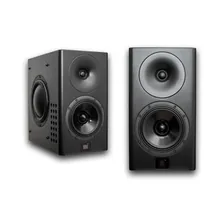 Ranked #21 of 67 in Large Size Powered Bookshelf Speakers - SHIVAUDYO Point Zero: €6,500 per pair Shivaudyo eBay
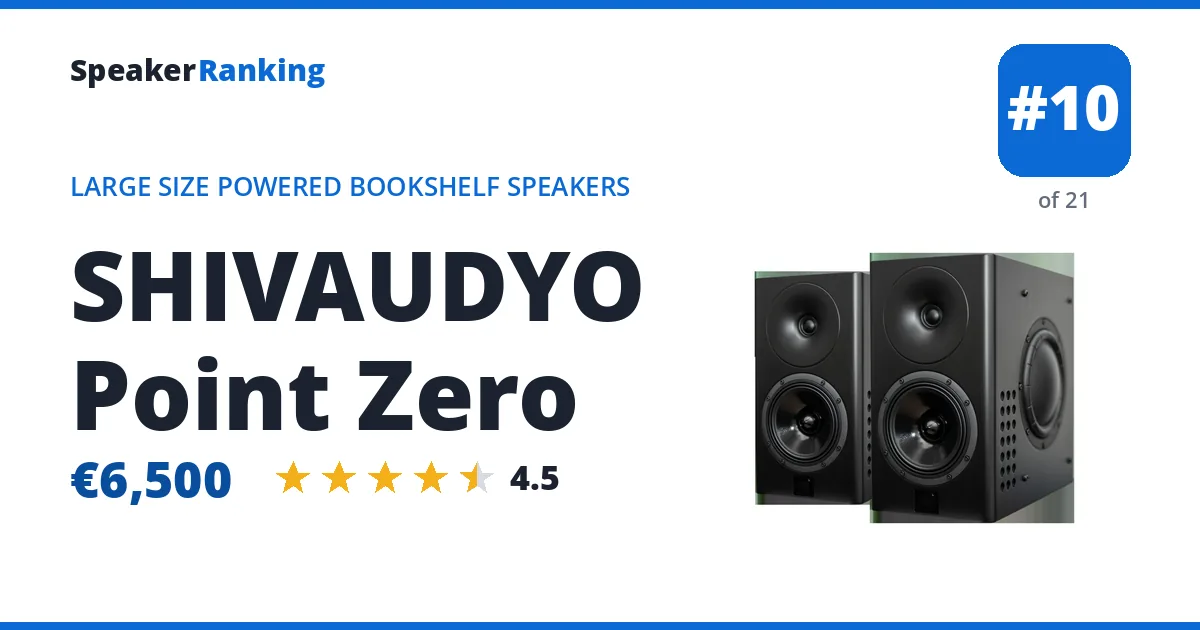
Pros: Measured -3dB extension of 31.5Hz and a 6.78 ideal-subwoofer score combine useful bass with broadly balanced sound. Cardioid control through the low midrange reduces some rearward energy, and selectable bass presets let the listener trade extension for headroom. Measured bass extension of 31Hz (-3dB), with a measured sensitivity of 92.9dB.
Cons: Cardioid control begins around 200Hz rather than extending through all deep bass. Listening height can change vocal weight, and the measured 2.0dB midband span does not capture every directional variation. The deepest bass preset sacrifices output, so its nominal cutoff is not a clean-SPL guarantee.
Full SHIVAUDYO Point Zero review and specifications →
| AES Input | Yes |
|---|---|
| Amplifier Power | 600W total (300W subs + 200W mid-woofer + 100W tweeter, Hypex NCore) |
| App | No |
| Aux Input | No |
| Bass Extension (-10dB) | 22Hz (measured on-axis, Erin's Audio Corner) |
| Bass Extension (-3dB) | 31Hz (measured on-axis, Erin's Audio Corner) |
| Coaxial Input | Yes |
| Crossover Frequency | 120Hz / 1600Hz, 4th-order Linkwitz-Riley |
| DSP | Yes (Hypex, downloadable software, 3 bass presets) |
| Dimensions | 15.7"H x 8.7"W x 15.4"D (400 x 220 x 390 mm) |
| Drivers | 6.5" mid-woofer, 1" waveguide dome tweeter, 2x 8" side-firing subwoofers (opposed, vibration-cancelling) |
| Frequency Response | 30Hz - 20kHz ±1dB (anechoic, Preset 1) |
| HDMI Input | No |
| Inputs | XLR, RCA, AES-EBU, S/PDIF, Toslink |
| Maximum SPL | 110dB long-term, 116dB short-term, 120dB peak (manufacturer specified) |
| Optical Input | Yes |
| RCA Input | Yes |
| Sensitivity | 92.9dB (measured at 0.3V/1m, Erin's Audio Corner; Erin notes this figure is scaled rather than directly comparable to passive-speaker sensitivity) |
| Spinorama Preference Score | 5.72 |
| Spinorama Preference Score with Perfect Sub | 6.78 |
| TRS Input | No |
| USB Input | No |
| Weight | 36.4 lbs (16.5 kg) each |
| XLR Input | Yes |
- Links
- Reviews, Comparisons and Sound Samples
- Head-to-Head Comparisons
- SHIVAUDYO Point Zero vs Yamaha HS8
- SHIVAUDYO Point Zero vs Kali Audio LP-6 V2
- SHIVAUDYO Point Zero vs Thomann Swissonic A306
- SHIVAUDYO Point Zero vs JBL M2 Master Reference Monitor
- SHIVAUDYO Point Zero vs Genelec 8351B
- SHIVAUDYO Point Zero vs Kii THREE
- SHIVAUDYO Point Zero vs Klipsch The Nines
- SHIVAUDYO Point Zero vs JBL 4329P
- See all 12 comparisons
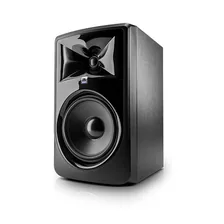 Ranked #22 of 67 in Large Size Powered Bookshelf Speakers - JBL 308P MKII: $498 per pair B&H Photo Video eBay
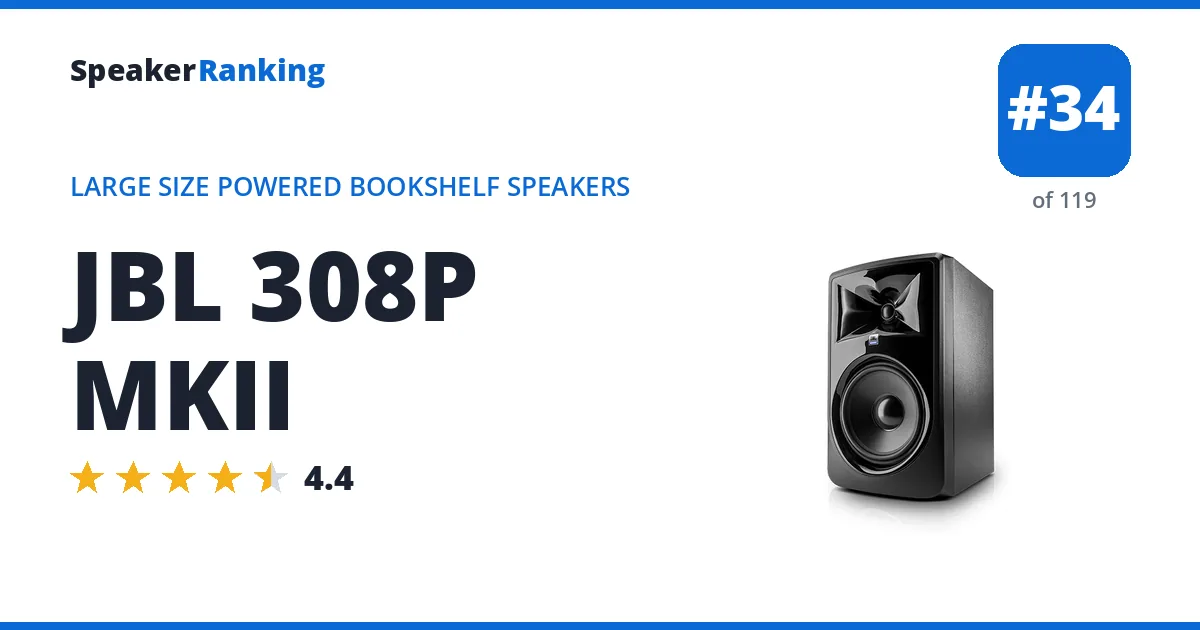
Pros: A 1.8dB response span from 300Hz to 5kHz and 6.89 ideal-subwoofer score support unusually good tonal balance for an accessible studio monitor. Measured -3dB extension of 42.5Hz supplies useful musical bass, and the waveguide helps maintain consistent horizontal coverage. Measured bass extension of 82Hz (-3dB).
Cons: Amplifier hiss may be noticeable in quiet, close-range use. Bass distortion and output limits matter when playing loudly, despite the 8-inch woofer. Keep the tweeter near ear height; vertical crossover behavior is less forgiving than the best coaxial designs.
Full JBL 308P MKII review and specifications →
| AES Input | No |
|---|---|
| Amplifier Power | 112W total |
| App | No |
| Aux Input | No |
| Bass Extension (-10dB) | 60Hz (measured, Audio Science Review) |
| Bass Extension (-3dB) | 82Hz (measured, Audio Science Review) |
| Coaxial Input | No |
| DSP | No |
| Dimensions | 16.5"H x 10"W x 12.1"D (419.1 x 254 x 307.3 mm) |
| Drivers | 8" woofer, 1" neodymium tweeter |
| EQ | No |
| Frequency Response | 45Hz - 20kHz (+/-3dB) (Manufacturer specified) |
| HDMI Input | No |
| Inputs | XLR, 1/4" TRS |
| Optical Input | No |
| RCA Input | No |
| Spinorama Preference Score | 5.08 |
| Spinorama Preference Score with Perfect Sub | 6.89 |
| TRS Input | Yes |
| USB Input | No |
| Weight | not published by manufacturer |
| XLR Input | Yes |
- Links
- Reviews, Comparisons and Sound Samples
- Head-to-Head Comparisons
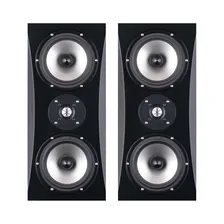 Ranked #23 of 67 in Large Size Powered Bookshelf Speakers - O.S. Acoustics DBS8: $5,600 per pair O.S. Acoustics Dealers eBay
Pros: The available Sound & Recording data gives a 6.97 ideal-subwoofer score and a 2.6dB response span from 300Hz to 5kHz, supporting balanced monitoring with bass support. DSP settings provide useful adjustment for installation. Measured bass extension of 48.5Hz (-3dB).
Cons: The measured -3dB point is 48.5Hz, not especially deep for a large monitor. Driver layout and listening height require care; a scalar directivity statistic alone cannot establish a wide sweet spot.
Full O.S. Acoustics DBS8 review and specifications →
| AES Input | No |
|---|---|
| Amplifier Power | 500W LF + 150W HF per speaker |
| Aux Input | No |
| Bass Extension (-10dB) | approximately 35Hz (measured, spinorama.org) |
| Bass Extension (-3dB) | 48.5Hz (measured, spinorama.org) |
| Coaxial Input | No |
| Dimensions | 19.8" x 8.7" x 17.2" (502 x 222 x 437 mm) each |
| Drivers | Two 6.5-inch aluminum woofers; 1.1-inch ceramic-coated magnesium tweeter |
| Enclosure | Sealed MTM |
| HDMI Input | No |
| Inputs | Balanced XLR |
| Maximum SPL | 105dB (manufacturer specified) |
| Optical Input | No |
| RCA Input | No |
| Spinorama Preference Score | 5.00 |
| Spinorama Preference Score with Perfect Sub | 6.97 |
| TRS Input | No |
| USB Input | No |
| Weight | 34.8 lbs (15.8kg) each |
| XLR Input | Yes |
- Links
- Reviews, Comparisons and Sound Samples
- Head-to-Head Comparisons
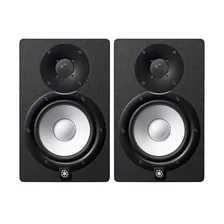 Ranked #24 of 67 in Large Size Powered Bookshelf Speakers - Yamaha HS8: $797.98 per pair Amazon eBay
Pros: ASR measurements support broadly neutral sound: a 2.3dB response span from 300Hz to 5kHz and 6.68 ideal-subwoofer score. Measured -3dB bass extension of 43.9Hz gives useful weight for music, with straightforward analog connections and room-adjustment controls. Measured bass extension of 43.9Hz (-3dB).
Cons: Its response and off-axis behavior are not as refined as the leading monitors. Vertical positioning around the crossover matters, and a subwoofer remains useful for deep bass. Basic rear-panel controls do not replace measured room correction.
Full Yamaha HS8 review and specifications →
| AES Input | No |
|---|---|
| Amplifier Power | 120w Per Speaker |
| App | No |
| Aux Input | No |
| Bass Extension (-10dB) | 34.7Hz (measured, Audio Science Review) |
| Bass Extension (-3dB) | 43.9Hz (measured, Audio Science Review) |
| Bluetooth | No |
| Coaxial Input | No |
| DSP | No |
| Dimensions | 15.4"H x 9.8"W x 13.1"D (391.2 x 248.9 x 332.7 mm) |
| Drivers | 8" woofer, 1" dome tweeter |
| EQ | Yes (Room adjustment) |
| Frequency Response | 47Hz - 24kHz (-3dB) (Manufacturer specified) |
| HDMI Input | No |
| Inputs | XLR |
| Optical Input | No |
| RCA Input | No |
| Spinorama Preference Score | 4.95 |
| Spinorama Preference Score with Perfect Sub | 6.68 |
| TRS Input | No |
| USB Input | No |
| Weight | 22.5 lbs (10.2 kg) |
| XLR Input | Yes |
- Links
- Reviews, Comparisons and Sound Samples
- Audio Science Review: Yamaha HS8 Studio Monitor Review More from Audio Science Review →
- Sercan Solmaz: Adam Audio T8V vs Yamaha HS8 vs KRK Rokit 8 (STUDIO SPEAKER SOUND TEST)
- DSAUDIO.review: DSAUDIO.review Edifier R2850DB vs Yamaha HS8 sound.DEMO More from DSAUDIOreview →
- DSAUDIO.review: DSAUDIO.review Adam Audio A7X vs Yamaha HS8 sound.DEMO
- DSAUDIO.review: Yamaha HS7 vs Yamaha HS8 Sound & Frequency Response Comparison
- DSAUDIO.review: Yamaha HS8 vs Yamaha HS5 Sound & Frequency Response Comparison
- DSAUDIO.review: Genelec 8020D vs Yamaha HS8 Sound & Frequency Response Comparison
- DSAUDIO.review: DSAUDIO.review APS Klasik 2020 vs Yamaha HS8 sound.DEMO
- DSAUDIO.review: DSAUDIO.review Focal Alpha 65 EVO vs Yamaha HS8 sound.DEMO
- DSAUDIO.review: Yamaha HS8 vs PreSonus Eris E8 XT Sound & Frequency Response Comparison
- DSAUDIO.review: Yamaha HS8 vs Kali Audio LP-8 Sound & Frequency Response Comparison
- DSAUDIO.review: KRK Rokit 8 G4 RP8G4 vs Yamaha HS8 Sound & Frequency Response Comparison
- DSAUDIO.review: Neumann KH80 DSP vs Yamaha HS8 Sound & Frequency Response Comparison
- DSAUDIO.review: Yamaha HS8 vs IK Multimedia iLoud MTM Sound & Frequency Response Comparison
- Audio Science Review Measurements (spinorama.org)
- Head-to-Head Comparisons
 Ranked #25 of 67 in Large Size Powered Bookshelf Speakers - Kali Audio LP-6 V2: $398 per pair Amazon B&H Photo Video eBay
Pros: Erin’s measurements give a 6.62 ideal-subwoofer score and 42.5Hz -3dB bass extension, a strong combination for an affordable nearfield monitor. The waveguide and placement switches help with practical setup, and the second generation improves close-range noise behavior. Measured bass extension of 42Hz (-3dB).
Cons: The 2.5dB response span from 300Hz to 5kHz leaves some tonal unevenness. Vertical crossover behavior makes ear-height placement important, and compression limits loud bass playback. Its good tonal score is not evidence of the output capability of a much larger monitor.
Full Kali Audio LP-6 V2 review and specifications →
| AES Input | No |
|---|---|
| Amplifier Power | 40W LF + 40W HF per speaker; Bi-amplified Class D |
| Aux Input | No |
| Bass Extension (-10dB) | 39.1Hz (measured, Erin's Audio Corner) |
| Bass Extension (-3dB) | 42Hz (measured, Erin's Audio Corner) |
| Coaxial Input | No |
| DSP | Yes; boundary presets and LF/HF trims |
| Dimensions | 14.1"H x 8.8"W x 10.2"D |
| Drivers | 1" soft-dome tweeter; 6.5" woofer |
| HDMI Input | No |
| Inputs | XLR, balanced TRS and RCA |
| Maximum SPL | Approximately 102dB per pair with good measured linearity (Erin's Audio Corner) (manufacturer specified) |
| Optical Input | No |
| RCA Input | Yes |
| Sensitivity | Not applicable (active DSP loudspeaker) |
| Spinorama Preference Score | 4.67 |
| Spinorama Preference Score with Perfect Sub | 6.62 |
| TRS Input | Yes |
| USB Input | No |
| XLR Input | Yes |
- Links
- Reviews, Comparisons and Sound Samples
- Head-to-Head Comparisons
- Kali Audio LP-6 V2 vs Kali Audio IN-8 V2
- Kali Audio LP-6 V2 vs Yamaha HS8
- Kali Audio LP-6 V2 vs Genelec 8050B
- Kali Audio LP-6 V2 vs JBL 4305P
- Kali Audio LP-6 V2 vs JBL 308P MKII
- Kali Audio LP-6 V2 vs SHIVAUDYO Point Zero
- Kali Audio LP-6 V2 vs Focal Solo6 ST6
- Kali Audio LP-6 V2 vs Thomann Swissonic A306
- See all 45 comparisons
 Ranked #26 of 67 in Large Size Powered Bookshelf Speakers - Kali Audio IN-8 V2: $998 per pair Amazon eBay
Pros: The IN-8 V2’s coaxial midrange/tweeter supports coherent imaging, and low distortion at ordinary levels complements its 6.54 ideal-subwoofer score. Measured -3dB extension of 45.4Hz provides useful bass; boundary settings assist placement. Measured bass extension of 44Hz (-3dB), with a measured sensitivity of 89dB.
Cons: The measured 3.0dB response span from 300Hz to 5kHz includes unevenness that can make some vocals sound forward. Bass and limiter behavior constrain high-level playback. These measurements apply to the V2, not the first-generation IN-8.
Full Kali Audio IN-8 V2 review and specifications →
| AES Input | No |
|---|---|
| Amplifier Power | 140w Per Speaker |
| App | No |
| Aux Input | No |
| Bass Extension (-10dB) | 36Hz (measured, Erin's Audio Corner) |
| Bass Extension (-3dB) | 44Hz (measured, Erin's Audio Corner) |
| Bluetooth | No |
| Coaxial Input | No |
| DSP | No |
| Dimensions | 17.8"H x 10"W x 11.3"D (452.1 x 254 x 287 mm) |
| Drivers | 8" (203mm) woofer |
| EQ | Yes (Room adjustment) |
| HDMI Input | No |
| Inputs | XLR, RCA |
| Optical Input | No |
| RCA Input | Yes |
| Sensitivity | 89dB (measured at 0.3V/1m, Erin's Audio Corner) |
| Spinorama Preference Score | 3.53 |
| Spinorama Preference Score with Perfect Sub | 5.40 |
| TRS Input | No |
| USB Input | No |
| Weight | 22.9 lbs (10.4 kg) each |
| XLR Input | Yes |
- Links
- Reviews, Comparisons and Sound Samples
- Head-to-Head Comparisons
- Kali Audio IN-8 V2 vs Genelec 8050B
- Kali Audio IN-8 V2 vs Kali Audio LP-6 V2
- Kali Audio IN-8 V2 vs Yamaha HS8
- Kali Audio IN-8 V2 vs JBL 4305P
- Kali Audio IN-8 V2 vs Focal Solo6 ST6
- Kali Audio IN-8 V2 vs JBL 308P MKII
- Kali Audio IN-8 V2 vs Kali Audio LP-6
- Kali Audio IN-8 V2 vs Genelec 8040B
- See all 38 comparisons
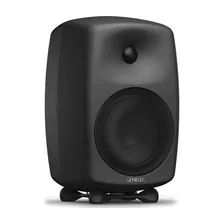 Ranked #27 of 67 in Large Size Powered Bookshelf Speakers - Genelec 8050B: $3800 per pair B&H Photo Video eBay
Pros: Measured -3dB extension of 35.2Hz gives the 8050B deeper native bass than many similarly ranked monitors. The 6.49 ideal-subwoofer score supports broadly balanced listening, with a waveguide and analog boundary controls for practical studio placement. Measured bass extension of 68Hz (-3dB).
Cons: A 2.7dB response span from 300Hz to 5kHz and a dip around 2kHz keep it below the strongest tonal performers. Port-related response features and high-level distortion also warrant attention. Unlike the SAM models, it does not provide GLM room calibration.
Full Genelec 8050B review and specifications →
| AES Input | No |
|---|---|
| Amplifier Power | 270w Per Speaker |
| App | No |
| Aux Input | No |
| Bass Extension (-10dB) | 50Hz (measured, Audio Science Review) |
| Bass Extension (-3dB) | 68Hz (measured, Audio Science Review) |
| Bluetooth | No |
| Coaxial Input | No |
| DSP | No |
| Dimensions | 17.8"H x 11.3"W x 10.9"D (452.1 x 287 x 276.9 mm) |
| Drivers | 8" (203mm) woofer |
| EQ | Yes (Room adjustment) |
| Frequency Response | 32Hz - 25kHz (-6dB) (Manufacturer specified) |
| HDMI Input | No |
| Inputs | XLR |
| Optical Input | No |
| RCA Input | No |
| TRS Input | No |
| USB Input | No |
| Weight | 31.7 lbs (14.4 kg) each |
| XLR Input | Yes |
- Links
- Reviews, Comparisons and Sound Samples
- Head-to-Head Comparisons
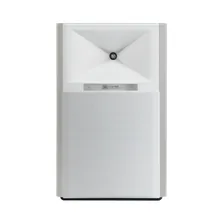 Ranked #28 of 67 in Large Size Powered Bookshelf Speakers - JBL 4305P: $2,200 per pair Amazon JBL eBay
Pros: The measured 1.5dB response span from 300Hz to 5kHz supports even mids, with a 6.54 ideal-subwoofer score and 45.4Hz -3dB bass extension. Integrated consumer connectivity makes this a more convenient living-room system than many studio monitors. Measured bass extension of 45Hz (-3dB).
Cons: Crossover-region directivity changes mean the narrow on-axis span does not describe every listening angle. Limiting becomes relevant at high output, particularly with bass-heavy music. It suits near- to midfield listening better than the largest high-output systems here.
Full JBL 4305P review and specifications →
| AES Input | No |
|---|---|
| Amplifier Power | 300W system: 125W LF + 25W HF per speaker |
| Aux Input | Yes |
| Bass Extension (-10dB) | 40.5Hz (measured, Erin's Audio Corner) |
| Bass Extension (-3dB) | 45Hz (measured, Erin's Audio Corner) |
| Coaxial Input | No |
| Dimensions | 13.2H x 8.3W x 8.8D inches |
| Drivers | 5.25-inch pulp woofer; 1-inch annular compression driver |
| HDMI Input | No |
| Inputs | XLR/TRS combo, 3.5mm Aux, Optical, USB-B, Ethernet |
| Maximum SPL | ~93dB at 2m in-room before limiting (measured, Erin's Audio Corner) |
| Optical Input | Yes |
| RCA Input | No |
| Sensitivity | Not applicable (active DSP loudspeaker) |
| Spinorama Preference Score | 4.53 |
| Spinorama Preference Score with Perfect Sub | 6.54 |
| TRS Input | Yes |
| USB Input | Yes |
| XLR Input | Yes |
- Links
- Reviews, Comparisons and Sound Samples
- Head-to-Head Comparisons
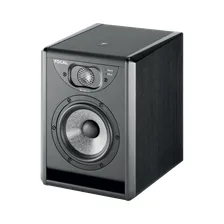 Ranked #29 of 67 in Large Size Powered Bookshelf Speakers - Focal Solo6 ST6: $2,998 per pair B&H Photo Video eBay
Pros: ASR measured a tight 1.6dB response span from 300Hz to 5kHz and a 6.44 ideal-subwoofer score, supporting accurate midrange monitoring. The beryllium tweeter and Focus mode offer a useful professional workflow, with Focus serving as an alternate mix-check presentation. Measured bass extension of 46.9Hz (-3dB).
Cons: The measured -3dB point is 46.9Hz, so deep-bass work benefits from a subwoofer. The standard-mode score does not apply to Focus mode. There is no automatic room-calibration system, and premium driver materials alone do not establish superior sound.
Full Focal Solo6 ST6 review and specifications →
| AES Input | No |
|---|---|
| Amplifier Power | 130W total (80W LF + 50W HF); Bi-amped (Class G LF + Class AB HF) |
| Aux Input | No |
| Bass Extension (-10dB) | 38.1Hz (measured, spinorama.org) |
| Bass Extension (-3dB) | 46.9Hz (measured, spinorama.org) |
| Coaxial Input | No |
| Dimensions | 24.6 x 33.4 x 29.5cm (9.7 x 13.1 x 11.6 in) each, 13kg (28.6 lb) each |
| Drivers | 1" Beryllium inverted-dome tweeter, 6.5" "W" composite sandwich-cone woofer |
| HDMI Input | No |
| Inputs | XLR |
| Maximum SPL | 110dB peak at 1m |
| Optical Input | No |
| RCA Input | No |
| Spinorama Preference Score | 4.04 |
| Spinorama Preference Score with Perfect Sub | 6.18 |
| TRS Input | No |
| USB Input | No |
| XLR Input | Yes |
- Links
- Reviews, Comparisons and Sound Samples
- Head-to-Head Comparisons
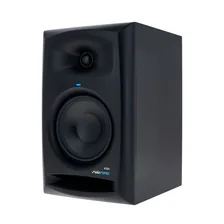 Ranked #30 of 67 in Large Size Powered Bookshelf Speakers - Thomann Swissonic A306: $250 per pair Thomann eBay
Pros: With the treble control set to -2dB, Erin measured a 6.40 ideal-subwoofer score and 43.9Hz -3dB bass extension. This is a useful affordable monitoring option when carefully set up, with onboard controls for basic tonal adjustment. Measured bass extension of 43Hz (-3dB), with a measured sensitivity of 89.9dB.
Cons: The published result is not the flat-control setting: it specifically uses -2dB treble. Even then, the response spans 2.8dB from 300Hz to 5kHz, so balance is not as even as the leaders. Bass output and vertical listening position remain practical limitations.
Full Thomann Swissonic A306 review and specifications →
| AES Input | No |
|---|---|
| Amplifier Power | 100W bi-amplified total (50W + 50W, Class D) |
| Aux Input | No |
| Bass Extension (-10dB) | 34Hz (measured, Erin's Audio Corner) |
| Bass Extension (-3dB) | 43Hz (measured, Erin's Audio Corner) |
| Coaxial Input | No |
| Crossover Frequency | 2600Hz |
| DSP | Yes (rear-panel treble/bass trim, wall/near-wall placement switches) |
| Dimensions | 8.8"W x 14.2"H x 11.1"D (224 x 361 x 282 mm) |
| Drivers | 6.5" woofer, 1" silk dome tweeter with waveguide |
| Frequency Response | 43Hz - 20kHz (manufacturer specified) |
| HDMI Input | No |
| Inputs | XLR (balanced), RCA (unbalanced) |
| Optical Input | No |
| RCA Input | Yes |
| Sensitivity | 89.9dB (measured at 0.3V/1m, Erin's Audio Corner) |
| Spinorama Preference Score | 4.53 |
| Spinorama Preference Score with Perfect Sub | 6.40 |
| TRS Input | No |
| USB Input | No |
| Weight | 13.6 lbs (6.17 kg) each |
| XLR Input | Yes |
- Links
- Reviews, Comparisons and Sound Samples
- Head-to-Head Comparisons
- Thomann Swissonic A306 vs Kali Audio LP-6 V2
- Thomann Swissonic A306 vs Yamaha HS8
- Thomann Swissonic A306 vs SHIVAUDYO Point Zero
- Thomann Swissonic A306 vs JBL 4329P
- Thomann Swissonic A306 vs Focal Alpha 65 EVO
- Thomann Swissonic A306 vs Adam Audio T8V
- Thomann Swissonic A306 vs Kali Audio LP-8
- Thomann Swissonic A306 vs KRK Rokit 8 G4
- See all 10 comparisons
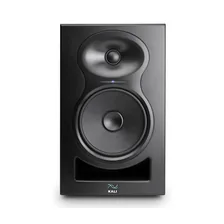 Ranked #31 of 67 in Large Size Powered Bookshelf Speakers - Kali Audio LP-6: $298 per pair Discontinued B&H Photo Video eBay
Pros: The original LP-6 measures 43.9Hz at -3dB and scores 6.33 with an ideal subwoofer. Its waveguide and placement controls make it a credible budget studio monitor, with useful bass for ordinary music listening. Measured bass extension of 55Hz (-3dB).
Cons: The measured 2.9dB response span from 300Hz to 5kHz is less even than the newer LP-6 V2. First-generation amplifier hiss can be distracting at short distances. Do not assume the V2’s noise improvements or measurements apply to this model. Discontinued.
Full Kali Audio LP-6 review and specifications →
| AES Input | No |
|---|---|
| Amplifier Power | 80W total (40W LF, 40W HF) |
| App | No |
| Aux Input | No |
| Bass Extension (-10dB) | 42Hz (measured, Audio Science Review) |
| Bass Extension (-3dB) | 55Hz (measured, Audio Science Review) |
| Coaxial Input | No |
| DSP | No |
| Dimensions | 14.1"H x 8.8"W x 10.3"D (358.8 x 222.3 x 260.4 mm) |
| Discontinued | Yes |
| Drivers | 6.5" woofer, 1" textile dome tweeter |
| EQ | No |
| Frequency Response | 47Hz - 21kHz (-3dB) (Manufacturer specified) |
| HDMI Input | No |
| Inputs | XLR, TRS, RCA |
| Optical Input | No |
| RCA Input | Yes |
| TRS Input | Yes |
| USB Input | No |
| Weight | 16.1 lbs (7.3 kg) each |
| XLR Input | Yes |
- Links
- Reviews, Comparisons and Sound Samples
- Head-to-Head Comparisons
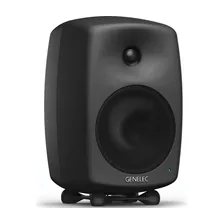 Ranked #32 of 67 in Large Size Powered Bookshelf Speakers - Genelec 8040B: $2,790 per pair B&H Photo Video eBay
Pros: A compact professional monitor with balanced XLR input and analog room-adjustment controls. The manufacturer’s 41Hz limit is specified at -6dB, offering a useful reference for system planning without confusing it with a measured -3dB point.
Cons: It lacks GLM calibration and consumer streaming inputs. The balanced XLR connection may require an interface or controller for a typical desktop source.
Full Genelec 8040B review and specifications →
| AES Input | No |
|---|---|
| Amplifier Power | 180w Per Speaker |
| App | No |
| Aux Input | No |
| Bluetooth | No |
| Coaxial Input | No |
| DSP | No |
| Dimensions | 14.4"H x 9.3"W x 8.8"D (365.8 x 236.2 x 223.5 mm) |
| Drivers | 6.5" (165mm) woofer |
| EQ | Yes (Room adjustment) |
| Frequency Response | 41Hz - 25kHz (-6dB) (Manufacturer specified) |
| HDMI Input | No |
| Inputs | XLR |
| Optical Input | No |
| RCA Input | No |
| TRS Input | No |
| USB Input | No |
| Weight | 20.7 lbs (9.4 kg) each |
| XLR Input | Yes |
- Links
- Reviews, Comparisons and Sound Samples
- No independent measurement review is linked for this model; it is ranked from hands-on listening and comparison against similarly priced speakers.
- Head-to-Head Comparisons
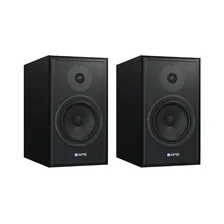 Ranked #33 of 67 in Large Size Powered Bookshelf Speakers - APS Klasik 2020: $1,800 per pair Aps-company eBay
Pros: A remarkably capable analogue nearfield monitor with 100W amplification per speaker, balanced XLR and RCA inputs, and three low-frequency adjustment options. Independent review finds its response exceptionally even through the vocal range, with precise, tuneful bass, natural voices, pin-sharp imaging and unusually strong mix detail for the class.
Cons: Its all-analogue design means no streaming, Bluetooth, DSP or automatic room correction. The most extended bass setting loses some precision as volume rises, while the top end is competent rather than the system’s standout feature. It is built for a serious nearfield setup, not all-in-one convenience.
Full APS Klasik 2020 review and specifications →
| AES Input | No |
|---|---|
| Amplifier Power | 100w Per Speaker |
| App | No |
| Aux Input | No |
| Bluetooth | No |
| Coaxial Input | No |
| DSP | No |
| Dimensions | 14.2"H x 8.3"W x 12.6"D (360.7 x 210.8 x 320 mm) |
| Drivers | 7" (178mm) woofer |
| EQ | Yes (Room adjustment) |
| Frequency Response | 39Hz - 25kHz (-3dB) (Manufacturer specified) |
| HDMI Input | No |
| Inputs | XLR, RCA |
| Optical Input | No |
| RCA Input | Yes |
| TRS Input | No |
| USB Input | No |
| Weight | 22 lbs (10.0 kg) each |
| XLR Input | Yes |
- Links
- Reviews, Comparisons and Sound Samples
- Head-to-Head Comparisons
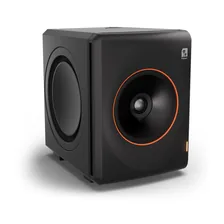 Ranked #35 of 67 in Large Size Powered Bookshelf Speakers - Palmer Orbit 11: $1,532 per pair Thomann eBay
Pros: A 27.8Hz measured -3dB point provides genuinely deep standalone bass. The 1.8dB response span from 300Hz to 5kHz supports even mids, and the coaxial arrangement offers a compact acoustic source for nearfield listening. Measured bass extension of 27.8Hz (-3dB).
Cons: Its 6.20 ideal-subwoofer score is more modest than the narrow midrange span alone suggests; response outside that band and off-axis behavior also matter. Deep-bass extension does not prove high-level headroom. Studio-oriented connections and setup are less convenient than an all-in-one consumer pair.
Full Palmer Orbit 11 review and specifications →
| AES Input | Yes |
|---|---|
| Amplifier Power | 1000W peak / 400W RMS total; Tri-amped Class D |
| Aux Input | No |
| Bass Extension (-10dB) | 21.5Hz (measured, spinorama.org) |
| Bass Extension (-3dB) | 27.8Hz (measured, spinorama.org) |
| Coaxial Input | No |
| Dimensions | 8.5" x 11.5" x 11.5" (217 x 293 x 292 mm) each |
| Drivers | 1" tweeter + 6.5" midrange (coaxial), 2x 8" woofers |
| HDMI Input | No |
| Inputs | XLR (balanced analog), AES3 (digital, via XLR) |
| Maximum SPL | 116dB peak at 1m |
| Optical Input | No |
| RCA Input | No |
| Spinorama Preference Score | 5.30 |
| Spinorama Preference Score with Perfect Sub | 6.20 |
| TRS Input | No |
| USB Input | No |
| Weight | 30.6 lbs (13.9 kg) each |
| XLR Input | Yes |
- Links
- Reviews, Comparisons and Sound Samples
- Head-to-Head Comparisons
- Palmer Orbit 11 vs Focal Trio6 ST6
- Palmer Orbit 11 vs Kali Audio IN-8 V2
- Palmer Orbit 11 vs Kali Audio LP-6 V2
- Palmer Orbit 11 vs Yamaha HS8
- Palmer Orbit 11 vs Cambridge Audio L/R X
- Palmer Orbit 11 vs JBL 308P MKII
- Palmer Orbit 11 vs Focal Alpha 65 EVO
- Palmer Orbit 11 vs HEDD Type 20 MK2
- See all 19 comparisons
 Ranked #36 of 67 in Large Size Powered Bookshelf Speakers - Focal Trio6 ST6: $6,998 per pair Amazon eBay
Pros: Sound & Recording’s measurements indicate 37.8Hz -3dB bass extension and a 6.22 ideal-subwoofer score. The three-way format and alternate Focus monitoring modes offer useful flexibility for professional work.
Cons: The measured balance tilts downward through the treble, with a 2.6dB response span from 300Hz to 5kHz. Heavy cabinets and a premium price do not by themselves establish better neutrality, and alternate modes change the result.
Full Focal Trio6 ST6 review and specifications →
| AES Input | No |
|---|---|
| Amplifier Power | 250W total (2x 100W Class-G bass/mid, 50W Class-AB tweeter) |
| Aux Input | No |
| Coaxial Input | No |
| Country | France |
| Dimensions | 21.1"H x 11.5"W x 14.4"D (537 x 292 x 367 mm) |
| Drivers | 1.5" beryllium inverted-dome tweeter, 5" W-composite midrange, 8" W-composite woofer |
| Enclosure | 3-way active, sealed/ported |
| HDMI Input | No |
| Inputs | XLR |
| Optical Input | No |
| RCA Input | No |
| Spinorama Preference Score | 4.55 |
| Spinorama Preference Score with Perfect Sub | 6.22 |
| TRS Input | No |
| USB Input | No |
| Weight | 55.1 lbs (25 kg) each |
| XLR Input | Yes |
- Links
- Reviews, Comparisons and Sound Samples
- Head-to-Head Comparisons
 Ranked #37 of 67 in Large Size Powered Bookshelf Speakers - Meyer Sound Amie: $8,200 per pair RSPE Audio Solutions eBay
Pros: ASR measured a 2.1dB response span from 300Hz to 5kHz and a 6.11 ideal-subwoofer score, supporting reasonably even midrange balance. Its professional nearfield design is suited to a deliberately configured monitoring system.
Cons: Measured -3dB extension is 48.3Hz, so full-range monitoring benefits from bass support. The broader response and off-axis measurements are less even than the strongest competitors despite the narrow midband span. Professional installation features add cost without guaranteeing a tonal advantage.
Full Meyer Sound Amie review and specifications →
| AES Input | No |
|---|---|
| Amplifier Power | 2-channel Class D, one channel per driver |
| Aux Input | No |
| Coaxial Input | No |
| Country | United States |
| Dimensions | 15.3H x 9W x 13.24D in |
| Drivers | 1" silk dome tweeter (constant-directivity waveguide), 6.5" long-excursion cone woofer |
| Enclosure | 2-way active, sealed, multi-ply birch cabinet |
| HDMI Input | No |
| Inputs | XLR (balanced analog) |
| Maximum SPL | 117.5-120.5dB (manufacturer specified) |
| Optical Input | No |
| RCA Input | No |
| Spinorama Preference Score | 3.98 |
| Spinorama Preference Score with Perfect Sub | 6.11 |
| TRS Input | No |
| USB Input | No |
| Weight | 24.9 lbs (11.3 kg) each |
| XLR Input | Yes |
- Links
- Reviews, Comparisons and Sound Samples
- Head-to-Head Comparisons
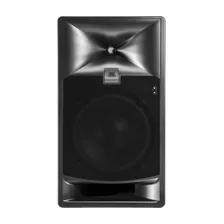 Ranked #38 of 67 in Large Size Powered Bookshelf Speakers - JBL 708P: $4000 per pair B&H Photo Video eBay
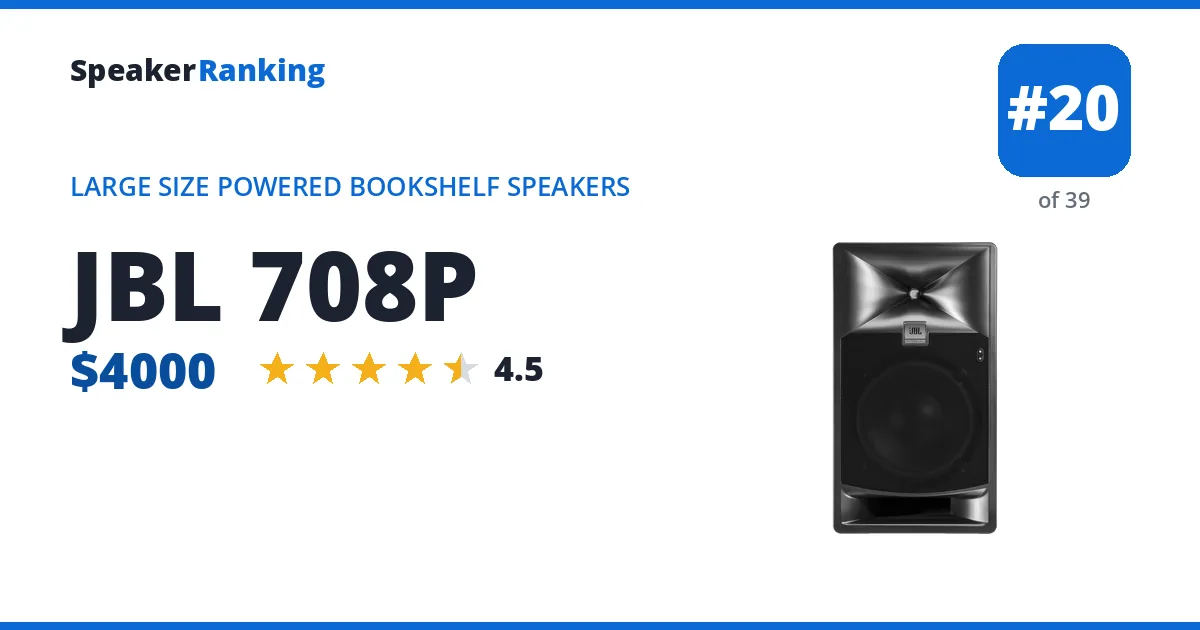
Pros: Erin’s measurements give 43.9Hz -3dB extension and a 6.02 ideal-subwoofer score, with useful bass from a professional active monitor. The waveguide and onboard processing make it a practical choice for a carefully installed studio system. Measured bass extension of 82Hz (-3dB).
Cons: The 2.6dB response span from 300Hz to 5kHz includes audible-relevance irregularities, with port-region features and vertical crossover sensitivity. High-level distortion remains a constraint. Its professional positioning and amplifier power do not make it automatically more neutral than the cheaper 308P MKII.
Full JBL 708P review and specifications →
| AES Input | Yes |
|---|---|
| Amplifier Power | 500W total (250W woofer, 250W tweeter) |
| App | No |
| Aux Input | No |
| Bass Extension (-10dB) | 62Hz (measured, Audio Science Review) |
| Bass Extension (-3dB) | 82Hz (measured, Audio Science Review) |
| Coaxial Input | No |
| DSP | No |
| Dimensions | 17.2"H x 9.8"W x 11.5"D (438 x 248 x 292 mm) |
| Drivers | 8" woofer, 2409H 1" compression driver |
| EQ | No |
| Frequency Response | 41Hz - 25kHz (+/-3dB) (Manufacturer specified) |
| HDMI Input | No |
| Inputs | XLR/TRS combo (analog), XLR AES3 (digital) |
| Optical Input | No |
| RCA Input | No |
| Spinorama Preference Score | 4.14 |
| Spinorama Preference Score with Perfect Sub | 6.02 |
| TRS Input | Yes |
| USB Input | No |
| Weight | 25.1 lbs (11.4 kg) each |
| XLR Input | Yes |
- Links
- Reviews, Comparisons and Sound Samples
- Head-to-Head Comparisons
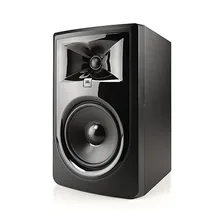 Ranked #40 of 67 in Large Size Powered Bookshelf Speakers - JBL 306P MKII: $398 per pair B&H Photo Video eBay
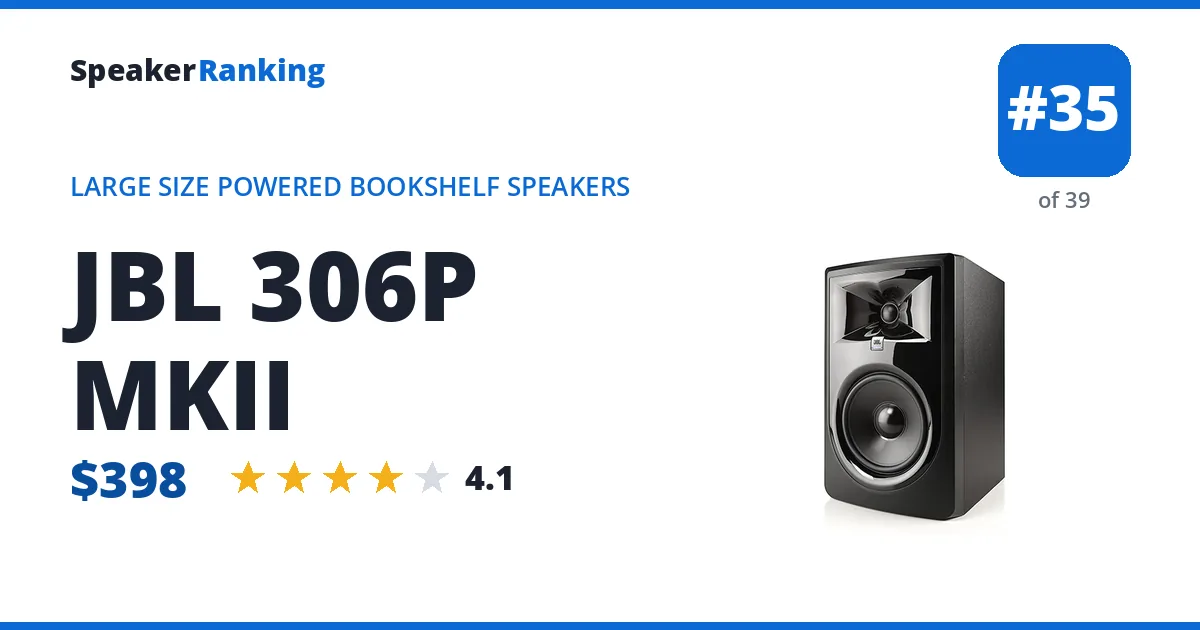
Pros: A 6.02 ideal-subwoofer score and 46.9Hz measured -3dB extension make this a useful affordable nearfield monitor. The waveguide supports broad horizontal listening coverage, and basic boundary controls help with setup. Measured bass extension of 78Hz (-3dB).
Cons: The 3.4dB response span from 300Hz to 5kHz is less even than the 308P MKII’s, with midrange resonances affecting neutrality. Hiss can matter at a quiet desk, while bass distortion limits demanding playback. A subwoofer improves bandwidth but does not remove the midrange irregularities.
Full JBL 306P MKII review and specifications →
| AES Input | No |
|---|---|
| Amplifier Power | 112W total |
| App | No |
| Aux Input | No |
| Bass Extension (-10dB) | 60Hz (measured, Audio Science Review) |
| Bass Extension (-3dB) | 78Hz (measured, Audio Science Review) |
| Coaxial Input | No |
| DSP | No |
| Dimensions | 16.1"H x 11.2"W x 12.9"D (408 x 285 x 328 mm) |
| Drivers | 6.5" woofer, 1" neodymium tweeter |
| EQ | No |
| Frequency Response | 39Hz - 24kHz (-10dB) (Manufacturer specified) |
| HDMI Input | No |
| Inputs | XLR, 1/4" TRS |
| Optical Input | No |
| RCA Input | No |
| Spinorama Preference Score | 4.15 |
| Spinorama Preference Score with Perfect Sub | 6.02 |
| TRS Input | Yes |
| USB Input | No |
| Weight | 13.4 lbs (6.1 kg) each |
| XLR Input | Yes |
- Links
- Reviews, Comparisons and Sound Samples
- Head-to-Head Comparisons
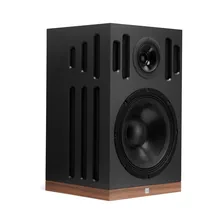 Ranked #41 of 67 in Large Size Powered Bookshelf Speakers - Sigberg Audio Manta: $32,220.00 for the full system (2 speakers + 2 dedicated subwoofers, built to order) Sigberg Audio eBay
Pros: Designed for use with separate subwoofers, the Manta is a main speaker for a complete system rather than a conventional full-range desktop pair.
Cons: Separate subwoofers and system setup add cost and occupy more space than the main speakers alone. Correct crossover integration and placement are essential.
Full Sigberg Audio Manta review and specifications →
| AES Input | Yes |
|---|---|
| Amplifier Power | 600W per speaker |
| App | No |
| Aux Input | No |
| Bass Extension (-3dB) | 18Hz (manufacturer, with companion subwoofers) |
| Bluetooth | No |
| Coaxial Input | Yes |
| Country | Norway |
| DSP | Yes |
| Dimensions | 23.6"H x 14.2"W x 13.8"D (600 x 360 x 350 mm) |
| Drivers | 12" midbass, 5.5" coaxial mid/tweeter with 1" silk dome |
| EQ | Yes (9-band parametric, factory presets) |
| Enclosure | sealed |
| HDMI Input | No |
| Inputs | XLR, RCA, Optical, Coaxial/SPDIF, AES |
| Maximum SPL | 122dB (manufacturer specified) |
| Measurement Source | Manufacturer |
| Optical Input | Yes |
| RCA Input | Yes |
| Spinorama Preference Score | 2.48 |
| Spinorama Preference Score with Perfect Sub | 5.91 |
| TRS Input | No |
| USB Input | No |
| Weight | 55.1 lbs (25.0 kg) each |
| XLR Input | Yes |
- Links
- Reviews, Comparisons and Sound Samples
- Head-to-Head Comparisons
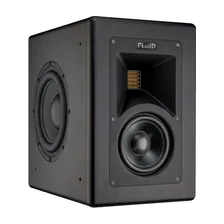 Ranked #42 of 67 in Large Size Powered Bookshelf Speakers - Fluid Audio Image 2: $3,798 per pair Fluid Audio eBay
Pros: Measured -3dB extension of 38.1Hz gives useful bass reach, while a 2.5dB response span from 300Hz to 5kHz supports broadly balanced mids. The active multiway design and DSP tools offer flexibility for a studio installation.
Cons: The 5.89 ideal-subwoofer score places its measured native tonality below the leading monitors. DSP flexibility should not be confused with verified accuracy before adjustment. Full-range headroom, room integration and cabinet placement still need attention in a demanding monitoring system.
Full Fluid Audio Image 2 review and specifications →
| AES Input | Yes |
|---|---|
| Amplifier Power | 675W each |
| Aux Input | No |
| Coaxial Input | Yes |
| Dimensions | 14.3H x 9.5W x 13.8D in |
| Drivers | AMT tweeter, 5-inch midrange, dual opposed 8-inch woofers |
| Enclosure | Active sealed 3-way |
| Frequency Response | 40Hz-27kHz +/-2.2dB |
| HDMI Input | No |
| Inputs | XLR/TRS, AES/EBU, SPDIF |
| Maximum SPL | 112dB each |
| Optical Input | No |
| RCA Input | No |
| Spinorama Preference Score | 4.31 |
| Spinorama Preference Score with Perfect Sub | 5.89 |
| TRS Input | Yes |
| USB Input | No |
| Weight | 28.4 lbs (12.9 kg) each |
| XLR Input | Yes |
- Links
- Reviews, Comparisons and Sound Samples
- Head-to-Head Comparisons
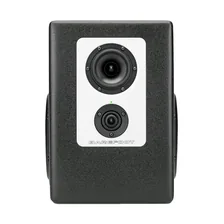 Ranked #43 of 67 in Large Size Powered Bookshelf Speakers - Barefoot Footprint 01: $3,199 per pair B&H Photo Video eBay
Pros: Measured bass reaches 35.2Hz at -3dB, giving substantial low-end weight. Its active multiway format and opposed bass drivers offer a compact professional system, with a 4.64 standalone preference score reflecting useful full-range capability.
Cons: The 5.86 ideal-subwoofer score and 2.9dB response span from 300Hz to 5kHz indicate tonal unevenness relative to the strongest monitors. Driver count and opposed-woofer construction do not guarantee neutral room sound. Careful placement and correction remain worthwhile.
Full Barefoot Footprint 01 review and specifications →
| AES Input | No |
|---|---|
| Amplifier Power | 650W total per speaker (500W LF, 150W HF), bi-amped |
| Aux Input | No |
| Coaxial Input | No |
| Country | United States |
| Dimensions | 14.0H x 9.5W x 13.0D in |
| Drivers | 1" ring-radiator tweeter, 4" aluminum-cone midrange, 2x 8" paper-composite woofers (Dual-Force opposed) |
| Enclosure | 3-way active, sealed woofer/midrange chambers, machined aluminum baffle |
| Frequency Response | 36Hz-45kHz (+/-3dB) |
| HDMI Input | No |
| Inputs | XLR |
| Optical Input | No |
| RCA Input | No |
| Spinorama Preference Score | 4.64 |
| Spinorama Preference Score with Perfect Sub | 5.86 |
| TRS Input | No |
| USB Input | No |
| Weight | 35.1 lbs (15.9 kg) each |
| XLR Input | Yes |
- Links
- Reviews, Comparisons and Sound Samples
- Head-to-Head Comparisons
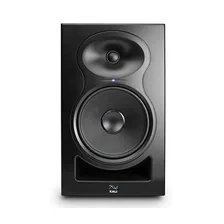 Ranked #45 of 67 in Large Size Powered Bookshelf Speakers - Kali Audio LP-8 V2: $299.00 per pair Amazon eBay
Pros: Erin measured 39.6Hz -3dB extension, useful for music without a subwoofer. Placement switches and the waveguide assist nearfield setup, with second-generation noise improvements making it more practical at a desk.
Cons: The 3.8dB response span from 300Hz to 5kHz and 5.83 ideal-subwoofer score show less even tonality than the smaller LP-6 V2. A larger woofer brings bandwidth and output tradeoffs, not automatically greater accuracy. Vertical placement and bass demands still matter.
Full Kali Audio LP-8 V2 review and specifications →
| AES Input | No |
|---|---|
| Amplifier Power | 100W total, bi-amped (60W LF, 40W HF) |
| Aux Input | No |
| Coaxial Input | No |
| Country | United States (design) |
| Dimensions | 16.5"W x 10"H x 11.3"D (419 x 254 x 286 mm) |
| Drivers | 1" soft dome tweeter, 8" woofer |
| Enclosure | 2-way active, ported |
| HDMI Input | No |
| Inputs | XLR, TRS, RCA |
| Optical Input | No |
| RCA Input | Yes |
| Spinorama Preference Score | 4.10 |
| Spinorama Preference Score with Perfect Sub | 5.83 |
| TRS Input | Yes |
| USB Input | No |
| Weight | 19.8 lbs (9 kg) each |
| XLR Input | Yes |
- Links
- Reviews, Comparisons and Sound Samples
- Head-to-Head Comparisons
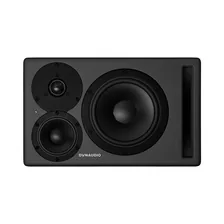 Ranked #46 of 67 in Large Size Powered Bookshelf Speakers - Dynaudio Core 47: $5,250 per pair B&H Photo Video eBay
Pros: A professional three-way monitor with 42.5Hz measured -3dB extension and flexible installation controls. Its 5.73 ideal-subwoofer score supports a usable studio foundation when paired with appropriate room setup.
Cons: The measured 3.1dB response span from 300Hz to 5kHz and listening-window unevenness keep it below the leading accuracy choices. A nearly flat overall response slope does not mean the individual frequencies are equally balanced. Premium construction and amplifier power do not resolve those response variations.
Full Dynaudio Core 47 review and specifications →
| AES Input | No |
|---|---|
| Amplifier Power | 1,150W each (150W HF, 500W MF, 500W LF) |
| Aux Input | No |
| Coaxial Input | No |
| Country | Denmark |
| Dimensions | 9.4H x 15.4W x 14D in |
| Drivers | 1" Esotar Pro tweeter, 4" MSP midrange, 7" MSP woofer |
| Enclosure | 3-way active, bass-reflex |
| HDMI Input | No |
| Inputs | Analog XLR, AES3 digital XLR, word clock |
| Optical Input | No |
| RCA Input | No |
| Spinorama Preference Score | 4.08 |
| Spinorama Preference Score with Perfect Sub | 5.73 |
| TRS Input | No |
| USB Input | No |
| Weight | 33.3 lbs (15.1 kg) each |
| XLR Input | Yes |
- Links
- Reviews, Comparisons and Sound Samples
- Head-to-Head Comparisons
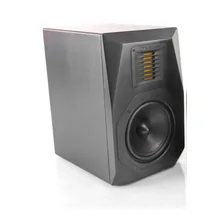 Ranked #48 of 67 in Large Size Powered Bookshelf Speakers - Emotiva Airmotiv 6s: $800 per pair Discontinued eBay
Pros: ASR measured 49.1Hz -3dB bass extension and a 5.75 ideal-subwoofer score. The review found useful output capability, making it a credible option for ordinary nearfield playback with additional bass support when needed. Measured bass extension of 72Hz (-3dB).
Cons: The 3.0dB response span from 300Hz to 5kHz includes lower-midrange unevenness that can change vocal weight. Treble peaks also prevent a fully neutral balance. Equalization may help, but the substantially higher EQ-optimized score is not its native performance. Discontinued.
Full Emotiva Airmotiv 6s review and specifications →
| AES Input | No |
|---|---|
| Amplifier Power | 210W total (100W tweeter, 110W woofer) |
| App | No |
| Aux Input | No |
| Bass Extension (-10dB) | 55Hz (measured, Audio Science Review) |
| Bass Extension (-3dB) | 72Hz (measured, Audio Science Review) |
| Coaxial Input | No |
| DSP | No |
| Discontinued | Yes |
| Drivers | 6.5" AirMotiv low-frequency transducer, 60x32mm AirMotiv tweeter |
| EQ | Yes (built-in presets) |
| Frequency Response | 42Hz - 25kHz (+0/-3dB) (Manufacturer specified) |
| HDMI Input | No |
| Inputs | XLR, RCA |
| Optical Input | No |
| RCA Input | Yes |
| TRS Input | No |
| USB Input | No |
| Weight | 24.9 lbs (11.3 kg) each |
| XLR Input | Yes |
- Reviews, Comparisons and Sound Samples
- Head-to-Head Comparisons
- Emotiva Airmotiv 6s vs M-Audio BX8 D3
- Emotiva Airmotiv 6s vs Focal Alpha 65 EVO
- Emotiva Airmotiv 6s vs JBL 4329P
- Emotiva Airmotiv 6s vs Adam Audio T8V
- Emotiva Airmotiv 6s vs Adam Audio T7V
- Emotiva Airmotiv 6s vs Kali Audio LP-8
- Emotiva Airmotiv 6s vs JBL 306P MKII
- Emotiva Airmotiv 6s vs Klipsch The Nines
- See all 21 comparisons
 Ranked #49 of 67 in Large Size Powered Bookshelf Speakers - M-Audio BX8 D3: $258 per pair B&H Photo Video eBay
Pros: Measured -3dB extension of 48.3Hz provides useful musical bass, with a 5.76 ideal-subwoofer score. The large woofer and analog connections suit a straightforward studio setup without requiring a streaming ecosystem.
Cons: A 3.9dB response span from 300Hz to 5kHz and downward tonal tilt suggest a darker, less even presentation than the leaders. The 8-inch driver and amplifier rating are not proof of deeper or cleaner bass than smaller competitors. Room controls cannot fully correct frequency-dependent directivity.
Full M-Audio BX8 D3 review and specifications →
| AES Input | No |
|---|---|
| Amplifier Power | 150W each (80W LF, 70W HF) |
| Aux Input | No |
| Coaxial Input | No |
| Country | United States (design) |
| Dimensions | 15.1H x 9.8W x 11.9D in |
| Drivers | 1.25" silk-dome tweeter, 8" Kevlar woofer |
| Enclosure | 2-way active, rear-ported MDF |
| HDMI Input | No |
| Inputs | Balanced XLR and 1/4" TRS |
| Optical Input | No |
| RCA Input | No |
| Spinorama Preference Score | 3.75 |
| Spinorama Preference Score with Perfect Sub | 5.76 |
| TRS Input | Yes |
| USB Input | No |
| Weight | 23.1 lbs (10.5 kg) each |
| XLR Input | Yes |
- Links
- Reviews, Comparisons and Sound Samples
- Head-to-Head Comparisons
 Ranked #50 of 67 in Large Size Powered Bookshelf Speakers - Focal Alpha 65 EVO: $998 per pair Amazon eBay
Pros: ASR measured 42.5Hz -3dB extension, providing useful low-end reach for music. Analog input options and tonal controls make it straightforward to integrate into a studio, with a 5.71 ideal-subwoofer score indicating respectable but not leading tonality. Measured bass extension of 45Hz (-3dB).
Cons: The measured 2.7dB response span from 300Hz to 5kHz and listening-window variation do not support a claim of reference-level neutrality. Placement and external correction may help. An anomalous distortion result from an individual sample should not be treated as a proven defect in every unit.
Full Focal Alpha 65 EVO review and specifications →
| AES Input | No |
|---|---|
| Amplifier Power | 85w Per Speaker |
| App | No |
| Aux Input | No |
| Bass Extension (-10dB) | 36Hz (measured, Audio Science Review) |
| Bass Extension (-3dB) | 45Hz (measured, Audio Science Review) |
| Bluetooth | No |
| Coaxial Input | No |
| DSP | No |
| Dimensions | 13.4"H x 10.3"W x 11.4"D (340.4 x 261.6 x 289.6 mm) |
| Drivers | 6.5" (165mm) woofer |
| EQ | Yes (Room adjustment) |
| Frequency Response | 40Hz - 22kHz (+-3dB) (Manufacturer specified) |
| HDMI Input | No |
| Inputs | TRS, XLR, RCA |
| Optical Input | No |
| RCA Input | Yes |
| Spinorama Preference Score | 3.83 |
| Spinorama Preference Score with Perfect Sub | 5.71 |
| TRS Input | Yes |
| USB Input | No |
| Weight | 16.8 lbs (7.6 kg) each |
| XLR Input | Yes |
- Links
- Reviews, Comparisons and Sound Samples
- Audio Science Review Measurements More from Audio Science Review →
- DSAUDIO.review: DSAUDIO.review Focal Alpha 65 EVO vs Yamaha HS8 sound.DEMO More from DSAUDIOreview →
- DSAUDIO.review: DSAUDIO.review Focal Alpha 65 EVO vs Focal Alpha 65 sound.DEMO
- DSAUDIO.review: DSAUDIO.review Focal Alpha 65 EVO vs Kali Audio IN-5 sound.DEMO
- DSAUDIO.review: DSAUDIO.review Focal Alpha 50 EVO vs Focal Alpha 65 EVO sound.DEMO
- DSAUDIO.review: DSAUDIO.review Focal Alpha 65 EVO vs Adam Audio A7X sound.DEMO
- DSAUDIO.review: DSAUDIO.review Focal Alpha 65 EVO vs Adam Audio T7V sound.DEMO
- Audio Science Review Measurements (spinorama.org)
- Head-to-Head Comparisons
- Focal Alpha 65 EVO vs Adam Audio A7V
- Focal Alpha 65 EVO vs Emotiva Airmotiv 6s
- Focal Alpha 65 EVO vs Adam Audio T8V
- Focal Alpha 65 EVO vs Cambridge Audio L/R X
- Focal Alpha 65 EVO vs Adam Audio T7V
- Focal Alpha 65 EVO vs Kali Audio LP-8
- Focal Alpha 65 EVO vs KRK Rokit 8 G4
- Focal Alpha 65 EVO vs JBL 4329P
- See all 47 comparisons
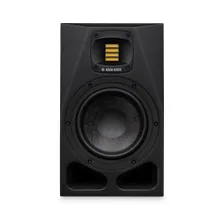 Ranked #51 of 67 in Large Size Powered Bookshelf Speakers - Adam Audio A7V: $1,879.98 per pair B&H Photo Video eBay
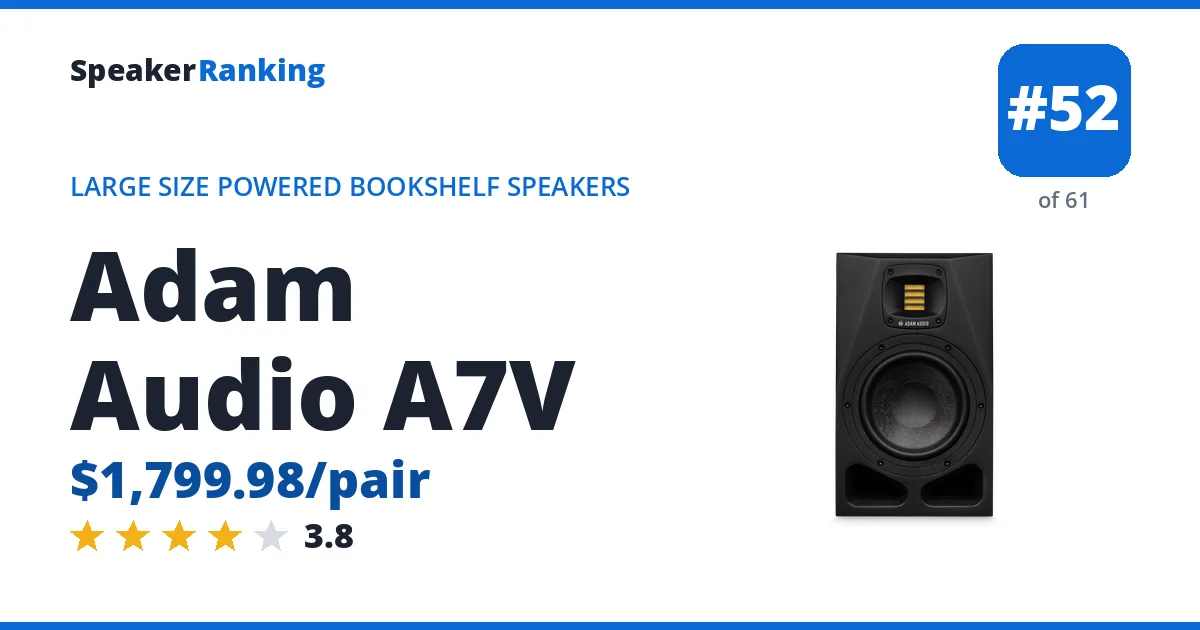
Pros: Onboard DSP and correction integration offer useful ways to tailor the speaker to a room. The Sound & Recording dataset gives a 5.70 ideal-subwoofer score and 50.9Hz measured -3dB extension, supporting use with bass assistance.
Cons: The measured configuration spans 6.3dB from 300Hz to 5kHz, so its native response is appreciably less even than the leading monitors. Performance is configuration-specific; alternate voicings or correction can change the result. Software features should not be credited as already-corrected acoustic performance.
Full Adam Audio A7V review and specifications →
| AES Input | No |
|---|---|
| Amplifier Power | 130W RMS each |
| Aux Input | No |
| Coaxial Input | No |
| Country | Germany (design) |
| Dimensions | 13.3H x 7.9W x 11D in |
| Drivers | X-ART folded-ribbon tweeter, 7" Multi-Layer Mineral woofer |
| Enclosure | 2-way active, twin front ports |
| HDMI Input | No |
| Inputs | XLR and RCA; Ethernet for control |
| Optical Input | No |
| RCA Input | Yes |
| Spinorama Preference Score | 3.52 |
| Spinorama Preference Score with Perfect Sub | 5.70 |
| TRS Input | No |
| USB Input | No |
| Weight | 19.2 lbs (8.7 kg) each |
| XLR Input | Yes |
- Links
- Reviews, Comparisons and Sound Samples
- Head-to-Head Comparisons
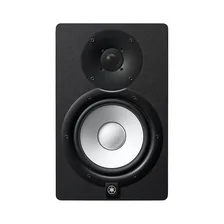 Ranked #52 of 67 in Large Size Powered Bookshelf Speakers - Yamaha HS7: $699.98 per pair Amazon eBay
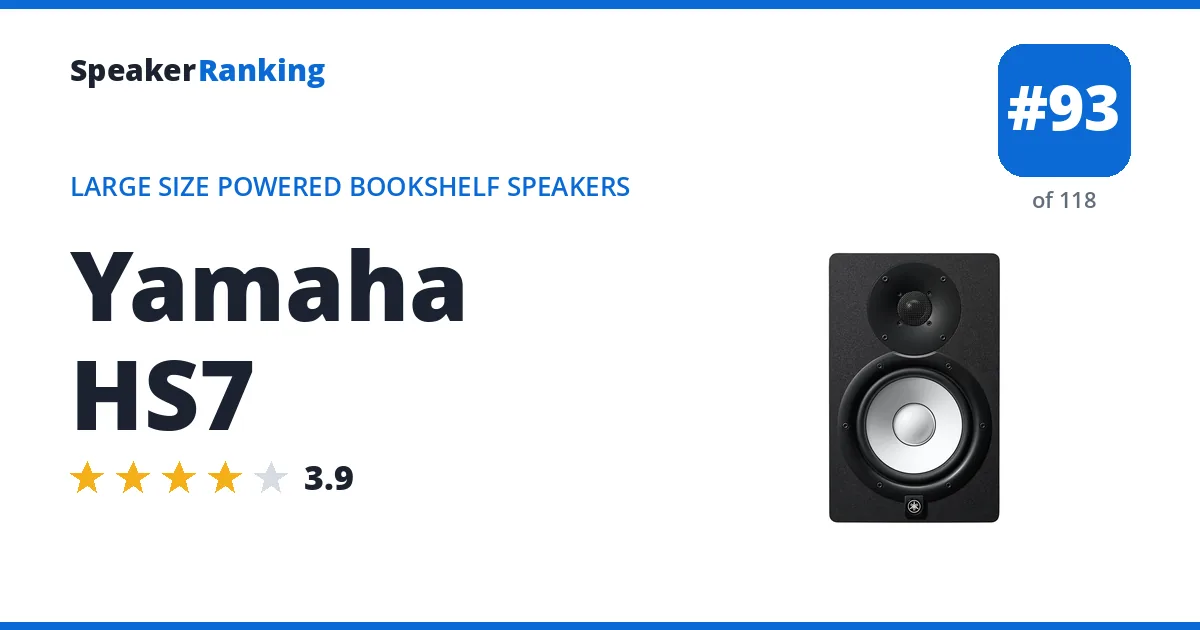
Pros: A straightforward analog monitor with boundary and treble controls. The measured -6dB point is 43.9Hz, so there is useful bass below the upper-bass region; the ideal-subwoofer score is 5.60.
Cons: Its uneven bass response crosses -3dB around 87.9Hz in the normalized measurement, so quoting the 41Hz low-frequency score input as flat bass extension is misleading. A 2.8dB response span from 300Hz to 5kHz and crossover-related variation also limit neutrality. Bass support does not fix all midrange and treble irregularities.
Full Yamaha HS7 review and specifications →
| AES Input | No |
|---|---|
| Amplifier Power | 95W each (60W LF, 35W HF) |
| Aux Input | No |
| Coaxial Input | No |
| Country | Japan (design) |
| Dimensions | 13.1H x 8.3W x 11.2D in |
| Drivers | 1" dome tweeter, 6.5" cone woofer |
| Enclosure | 2-way active, rear-ported |
| HDMI Input | No |
| Inputs | Balanced XLR and 1/4" TRS |
| Optical Input | No |
| RCA Input | No |
| Spinorama Preference Score | 3.66 |
| Spinorama Preference Score with Perfect Sub | 5.60 |
| TRS Input | Yes |
| USB Input | No |
| Weight | 18.1 lbs (8.2 kg) each |
| XLR Input | Yes |
- Links
- Reviews, Comparisons and Sound Samples
- Head-to-Head Comparisons
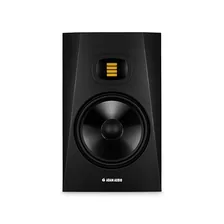 Ranked #53 of 67 in Large Size Powered Bookshelf Speakers - Adam Audio T8V: $699.98 per pair Amazon eBay
Pros: Measured -3dB extension of 39.6Hz gives useful bass depth for an affordable large monitor. Analog inputs and basic shelf controls offer uncomplicated studio integration. Measured bass extension of 45Hz (-3dB).
Cons: The 5.42 ideal-subwoofer score and 3.0dB response span from 300Hz to 5kHz show less even tonal balance than stronger budget alternatives. Treble emphasis and crossover-region vertical cancellation make listening height important. Deep bass and an AMT tweeter do not by themselves imply accurate sound.
Full Adam Audio T8V review and specifications →
| AES Input | No |
|---|---|
| Amplifier Power | 90w Per Speaker |
| App | No |
| Aux Input | No |
| Bass Extension (-10dB) | 35Hz (measured, Audio Science Review) |
| Bass Extension (-3dB) | 45Hz (measured, Audio Science Review) |
| Bluetooth | No |
| Coaxial Input | No |
| DSP | No |
| Dimensions | 15.8"H x 9.8"W x 13.2"D (401.3 x 248.9 x 335.3 mm) |
| Drivers | 8" (203mm) woofer |
| EQ | Yes (Room adjustment) |
| Frequency Response | 33Hz - 25kHz (-6dB) (Manufacturer specified) |
| HDMI Input | No |
| Inputs | XLR, RCA |
| Optical Input | No |
| RCA Input | Yes |
| Spinorama Preference Score | 3.77 |
| Spinorama Preference Score with Perfect Sub | 5.42 |
| TRS Input | No |
| USB Input | No |
| Weight | 21.6 lbs (9.8 kg) |
| XLR Input | Yes |
- Links
- Reviews, Comparisons and Sound Samples
- Audio Science Review Measurements More from Audio Science Review →
- Sercan Solmaz: Adam Audio T8V vs Yamaha HS8 vs KRK Rokit 8 (STUDIO SPEAKER SOUND TEST)
- DSAUDIO.review: Adam Audio T8V vs KRK Rokit 8 G4 Sound & Frequency Response Comparison More from DSAUDIOreview →
- Audio Science Review Measurements (spinorama.org)
- Head-to-Head Comparisons
- Adam Audio T8V vs Adam Audio T7V
- Adam Audio T8V vs Kali Audio LP-8
- Adam Audio T8V vs KRK Rokit 8 G4
- Adam Audio T8V vs Focal Alpha 65 EVO
- Adam Audio T8V vs KRK Rokit 7 G4
- Adam Audio T8V vs Emotiva Airmotiv 6s
- Adam Audio T8V vs Presonus Eris Studio 8
- Adam Audio T8V vs Edifier S3000Pro
- See all 46 comparisons
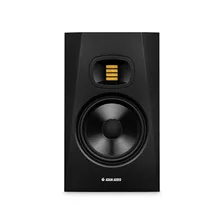 Ranked #54 of 67 in Large Size Powered Bookshelf Speakers - Adam Audio T7V: $579.98 per pair Amazon eBay
Pros: Audioholics’ measurements provide useful evidence about the midrange and treble, with a digitized 2.4dB response span from 300Hz to 5kHz. Basic tonal controls and analog connections suit a straightforward nearfield system. Measured bass extension of 65Hz (-3dB).
Cons: Correct listening height is important for the two-way crossover. Basic shelf controls offer less adjustment flexibility than parametric room correction.
Full Adam Audio T7V review and specifications →
| AES Input | No |
|---|---|
| Amplifier Power | 70w Per Speaker |
| App | No |
| Aux Input | No |
| Bass Extension (-10dB) | approx. 45Hz, extrapolated from the reviewer's directly-computed -6dB point of 45.4Hz (measured, Audio Science Review) |
| Bass Extension (-3dB) | approx. 65Hz, extrapolated from the reviewer's directly-computed -6dB point of 45.4Hz (measured, Audio Science Review) |
| Bluetooth | No |
| Coaxial Input | No |
| DSP | No |
| Dimensions | 13.7"H x 8.3"W x 11.5"D (348 x 210.8 x 292.1 mm) |
| Drivers | 7" (178mm) woofer |
| EQ | Yes (Room adjustment) |
| Frequency Response | 39Hz - 25kHz (-6dB) (Manufacturer specified) |
| HDMI Input | No |
| Inputs | XLR, RCA |
| Optical Input | No |
| RCA Input | Yes |
| TRS Input | No |
| USB Input | No |
| Weight | 15.7 lbs (7.1 kg) |
| XLR Input | Yes |
- Links
- Reviews, Comparisons and Sound Samples
- Audio Science Review Measurements More from Audio Science Review →
- Audioholics Review Measurements
- DSAUDIO.review: Adam Audio T7V vs Yamaha HS7 Sound & Frequency Response Comparison More from DSAUDIOreview →
- DSAUDIO.review: DSAUDIO.review Adam Audio A7X vs Adam Audio T7V sound.DEMO
- DSAUDIO.review: Adam Audio T7V vs Yamaha HS7 Sound & Frequency Response Comparison
- DSAUDIO.review: DSAUDIO.review Focal Alpha 65 EVO vs Adam Audio T7V sound.DEMO
- DSAUDIO.review: DSAUDIO.review Adam Audio T7V vs Adam Audio A5X sound.DEMO
- DSAUDIO.review: DSAUDIO.review Tannoy Gold 7 vs Adam Audio T7V sound.DEMO
- DSAUDIO.review: Adam Audio T5V vs Adam Audio T7V Sound & Frequency Response Comparison
- DSAUDIO.review: Kali LP-6 vs Adam Audio T7V Sound & Frequency Response Comparison
- DSAUDIO.review: KRK Rokit 7 G4 RP7G4 vs Adam Audio T7V Sound & Frequency Response Comparison
- DSAUDIO.review: Adam Audio T7V vs JBL 306P MKII Sound & Frequency Response Comparison
- Audioholics Measurements (spinorama.org)
- Head-to-Head Comparisons
- Adam Audio T7V vs Kali Audio LP-8
- Adam Audio T7V vs Adam Audio T8V
- Adam Audio T7V vs KRK Rokit 7 G4
- Adam Audio T7V vs Focal Alpha 65 EVO
- Adam Audio T7V vs Presonus Eris Studio 8
- Adam Audio T7V vs Edifier R2850DB
- Adam Audio T7V vs Emotiva Airmotiv 6s
- Adam Audio T7V vs Focal Twin6 Be
- See all 39 comparisons
 Ranked #55 of 67 in Large Size Powered Bookshelf Speakers - Kali Audio LP-8: $598 per pair Discontinued eBay
Pros: The original LP-8 offers a large woofer, a waveguide and placement switches for affordable nearfield monitoring.
Cons: First-generation amplifier noise can be distracting at a quiet desk. The large cabinets need substantial space, and placement switches do not replace full room correction. Discontinued.
Full Kali Audio LP-8 review and specifications →
| AES Input | No |
|---|---|
| Amplifier Power | 100w Per Speaker |
| App | No |
| Aux Input | No |
| Bluetooth | No |
| Coaxial Input | No |
| DSP | No |
| Dimensions | 16.5"H x 10"W x 11.3"D (419.1 x 254 x 287 mm) |
| Discontinued | Yes |
| Drivers | 8" woofer, 1" soft dome tweeter |
| EQ | Yes (Room adjustment) |
| Frequency Response | 45Hz - 21kHz (+-3dB) (Manufacturer specified) |
| HDMI Input | No |
| Inputs | TRS, XLR, RCA |
| Optical Input | No |
| RCA Input | Yes |
| TRS Input | Yes |
| USB Input | No |
| Weight | 19.8 lbs (9.0 kg) each |
| XLR Input | Yes |
- Links
- Reviews, Comparisons and Sound Samples
- DSAUDIO.review: Tannoy Gold 8 vs Kali Audio LP-8 Sound & Frequency Response Comparison More from DSAUDIOreview →
- DSAUDIO.review: Focal Alpha 80 vs Kali Audio LP-8 Sound & Frequency Response Comparison
- DSAUDIO.review: Yamaha HS8 vs Kali Audio LP-8 Sound & Frequency Response Comparison
- DSAUDIO.review: Kali Audio LP-8 vs Presonus Eris E8 XT Sound & Frequency Response Comparison
- DSAUDIO.review: Kali Audio LP-8 vs JBL 306P MKII Sound & Frequency Response Comparison
- Audioholics Measurements (spinorama.org)
- Head-to-Head Comparisons
- Kali Audio LP-8 vs Adam Audio T7V
- Kali Audio LP-8 vs KRK Rokit 8 G4
- Kali Audio LP-8 vs Adam Audio T8V
- Kali Audio LP-8 vs KRK Rokit 7 G4
- Kali Audio LP-8 vs Presonus Eris Studio 8
- Kali Audio LP-8 vs Edifier S3000Pro
- Kali Audio LP-8 vs Edifier R2850DB
- Kali Audio LP-8 vs Focal Alpha 65 EVO
- See all 44 comparisons
 Ranked #56 of 67 in Large Size Powered Bookshelf Speakers - KRK Rokit 8 G4: $1,000 per pair Discontinued Amazon eBay
Pros: An 8-inch active monitor with balanced studio connections and room-adjustment controls, offering a practical basis for a desktop or small studio system. The larger format may suit listeners who want more scale than a compact monitor.
Cons: The large cabinet requires substantial desk or stand space. Its balanced studio inputs need a suitable source connection rather than offering built-in consumer streaming. Discontinued.
Full KRK Rokit 8 G4 review and specifications →
| AES Input | No |
|---|---|
| Amplifier Power | 100w Per Speaker |
| App | No |
| Aux Input | No |
| Bluetooth | No |
| Coaxial Input | No |
| DSP | No |
| Dimensions | 15.7"H x 10.5"W x 12.2"D (400 x 266.7 x 309.9 mm) |
| Discontinued | Yes |
| Drivers | 8" (203mm) woofer |
| EQ | Yes (Room adjustment) |
| HDMI Input | No |
| Inputs | TRS, XLR |
| Optical Input | No |
| RCA Input | No |
| TRS Input | Yes |
| USB Input | No |
| Weight | 23.1 lbs (10.5 kg) |
| XLR Input | Yes |
- Links
- Reviews, Comparisons and Sound Samples
- Head-to-Head Comparisons
- KRK Rokit 8 G4 vs KRK Rokit 7 G4
- KRK Rokit 8 G4 vs Kali Audio LP-8
- KRK Rokit 8 G4 vs Presonus Eris Studio 8
- KRK Rokit 8 G4 vs Adam Audio T8V
- KRK Rokit 8 G4 vs Edifier S3000Pro
- KRK Rokit 8 G4 vs Focal Alpha 65 EVO
- KRK Rokit 8 G4 vs JBL 4329P
- KRK Rokit 8 G4 vs Thomann Swissonic A306
- See all 10 comparisons
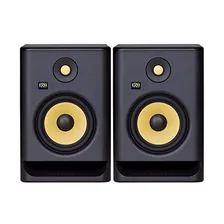 Ranked #57 of 67 in Large Size Powered Bookshelf Speakers - KRK Rokit 7 G4: $668 per pair Amazon eBay
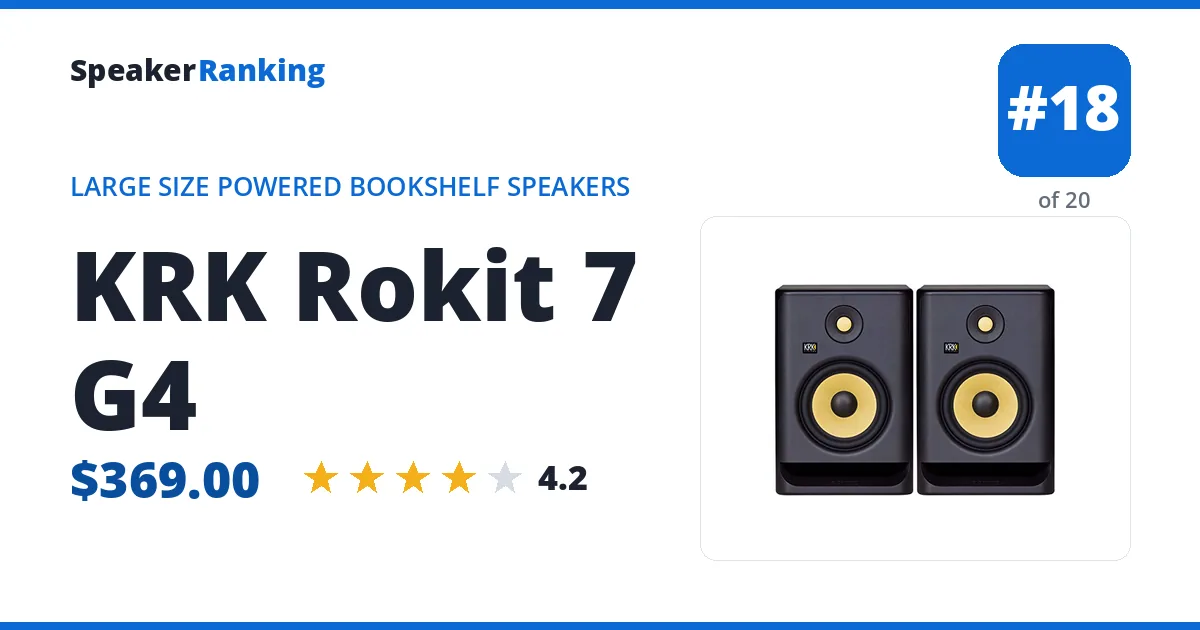
Pros: The 7-inch format offers a middle ground between compact monitors and larger 8-inch cabinets. Balanced inputs and room-adjustment controls make it practical for a simple studio installation.
Cons: Its balanced studio inputs need a suitable source connection rather than offering built-in consumer streaming. The cabinet still occupies appreciably more desk space than a compact monitor.
Full KRK Rokit 7 G4 review and specifications →
| AES Input | No |
|---|---|
| App | No |
| Aux Input | No |
| Bluetooth | No |
| Coaxial Input | No |
| DSP | No |
| Dimensions | 13.4"H x 8.9"W x 11.2"D (340.4 x 226.1 x 284.5 mm) |
| Drivers | 7" (178mm) woofer |
| EQ | Yes (Room adjustment) |
| HDMI Input | No |
| Inputs | TRS, XLR |
| Optical Input | No |
| RCA Input | No |
| TRS Input | Yes |
| USB Input | No |
| Weight | 16.8 lbs (7.6 kg) |
| XLR Input | Yes |
- Links
- Reviews, Comparisons and Sound Samples
- DSAUDIO.review: KRK Rokit 7 G4 RP7G4 vs Adam Audio T7V Sound & Frequency Response Comparison More from DSAUDIOreview →
- DSAUDIO.review: KRK Rokit 7 G4 RP7G4 vs Yamaha HS7 Sound & Frequency Response Comparison
- DSAUDIO.review: KRK Rokit 5 RP5G4 vs KRK Rokit 7 RP7G4 Sound & Frequency Comparison
- DSAUDIO.review: KRK Rokit 7 RP7G4 vs JBL 306P MKII Sound & Frequency Response Comparison
- Head-to-Head Comparisons
 Ranked #58 of 67 in Large Size Powered Bookshelf Speakers - Presonus Eris Studio 8: $924 per pair Amazon eBay
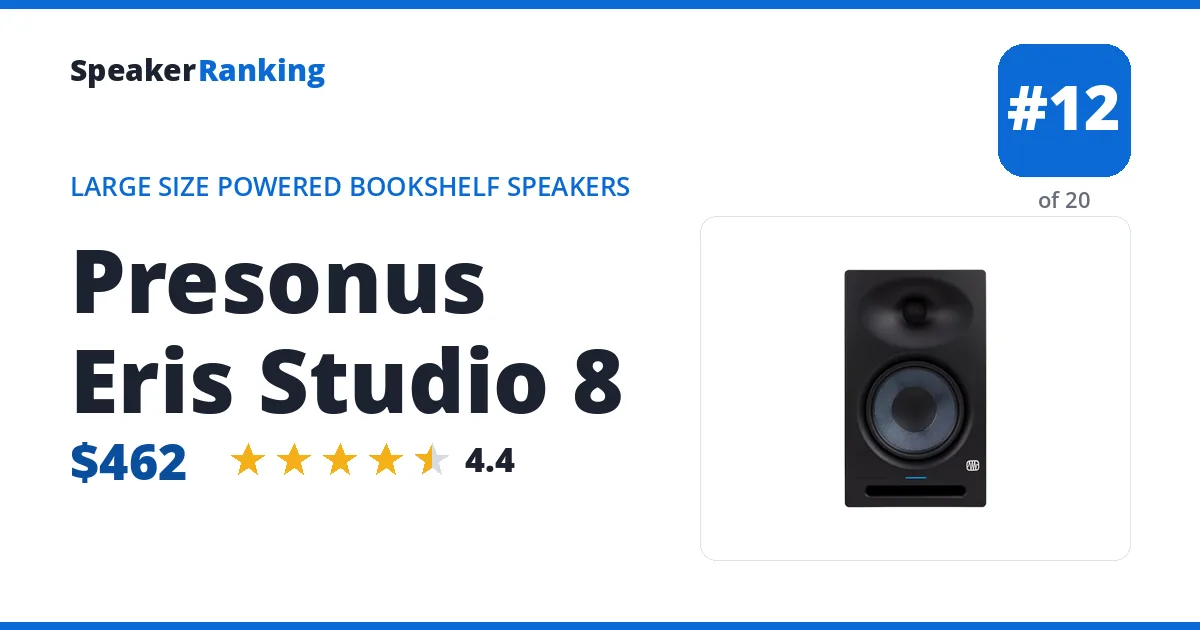
Pros: An 8-inch active monitor with XLR, TRS and RCA inputs and room-adjustment controls, providing flexible analog integration. Its cabinet and connection options suit a conventional studio setup.
Cons: The large cabinet requires substantial desk or stand space. Analog room-adjustment controls offer less flexibility than automatic calibration or parametric correction.
Full Presonus Eris Studio 8 review and specifications →
| AES Input | No |
|---|---|
| Amplifier Power | 140w Per Speaker |
| App | No |
| Aux Input | No |
| Bluetooth | No |
| Coaxial Input | No |
| DSP | No |
| Dimensions | 16.5"H x 9.8"W x 11.7"D (419.1 x 248.9 x 297.2 mm) |
| Drivers | 8" (203mm) woofer |
| EQ | Yes (Room adjustment) |
| Frequency Response | 35Hz - 20kHz (Manufacturer specified) |
| HDMI Input | No |
| Inputs | TRS, XLR, RCA |
| Optical Input | No |
| RCA Input | Yes |
| TRS Input | Yes |
| USB Input | No |
| Weight | 22.3 lbs (10.1 kg) each |
| XLR Input | Yes |
- Links
- Reviews, Comparisons and Sound Samples
- DSAUDIO.review: PreSonus Eris E8 XT vs PreSonus Eris E5 XT Sound & Frequency Response Comparison More from DSAUDIOreview →
- DSAUDIO.review: Yamaha HS8 vs PreSonus Eris E8 XT Sound & Frequency Response Comparison
- DSAUDIO.review: Kali Audio LP-8 vs Presonus Eris E8 XT Sound & Frequency Response Comparison
- DSAUDIO.review: Tannoy Gold 8 vs PreSonus Eris E8 XT Sound & Frequency Response Comparison
- DSAUDIO.review: Focal Alpha 80 vs PreSonus Eris E8 XT Sound & Frequency Response Comparison
- Head-to-Head Comparisons
- Presonus Eris Studio 8 vs KRK Rokit 8 G4
- Presonus Eris Studio 8 vs Edifier R2850DB
- Presonus Eris Studio 8 vs Kali Audio LP-8
- Presonus Eris Studio 8 vs Adam Audio T7V
- Presonus Eris Studio 8 vs Adam Audio T8V
- Presonus Eris Studio 8 vs Klipsch The Sevens
- Presonus Eris Studio 8 vs Focal Alpha 65 EVO
- Presonus Eris Studio 8 vs Cambridge Audio L/R X
- See all 24 comparisons
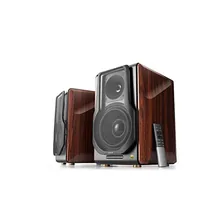 Ranked #59 of 67 in Large Size Powered Bookshelf Speakers - Edifier S3000Pro: $900 per pair Discontinued eBay
Pros: A convenient home-listening system with digital and analog input options, avoiding the need for a separate power amplifier. Its large cabinets and tone adjustments offer flexibility for a music-focused setup.
Cons: The substantial cabinet size requires more space than a typical desktop pair. High-resolution digital input support does not itself guarantee better sound. Discontinued.
Full Edifier S3000Pro review and specifications →
| AES Input | No |
|---|---|
| Amplifier Power | 78w RMS Per Speaker |
| App | No |
| Aux Input | No |
| Bluetooth | Yes, 5.0 |
| Bluetooth Codecs | SBC, aptX HD |
| Coaxial Input | Yes |
| DSP | No |
| Dimensions | 14.5"H x 9.1"W x 14"D (368.3 x 231.1 x 355.6 mm) |
| Discontinued | Yes |
| Drivers | 6.5" (165mm) woofer |
| EQ | Yes (Room adjustment) |
| Frequency Response | 38Hz-20KHz (-3dB) (Manufacturer specified) |
| HDMI Input | No |
| Inputs | Bluetooth, XLR, RCA Input, Digital Optical, Digital Coax, USB |
| Optical Input | Yes |
| Outputs | None |
| RCA Input | Yes |
| TRS Input | No |
| USB Input | Yes |
| Weight | 29.8 lbs (13.5 kg) |
| XLR Input | Yes |
- Links
- Reviews, Comparisons and Sound Samples
- Head-to-Head Comparisons
- Edifier S3000Pro vs KRK Rokit 7 G4
- Edifier S3000Pro vs KRK Rokit 8 G4
- Edifier S3000Pro vs Kali Audio LP-8
- Edifier S3000Pro vs Klipsch The Sevens
- Edifier S3000Pro vs Adam Audio T8V
- Edifier S3000Pro vs Focal Alpha 65 EVO
- Edifier S3000Pro vs JBL 4329P
- Edifier S3000Pro vs Thomann Swissonic A306
- See all 11 comparisons
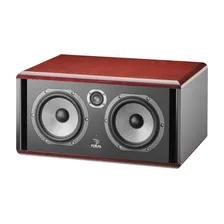 Ranked #61 of 67 in Large Size Powered Bookshelf Speakers - Focal Twin6 Be: $4,400 per pair Amazon eBay
Pros: The dual-woofer arrangement offers useful output capability for studio work, with a 48.3Hz measured -3dB point in the horizontal test. Its professional controls and format can suit a dedicated monitoring installation. Measured bass extension of 48.3Hz (-3dB).
Cons: The horizontal measurement scores 5.33 with an ideal subwoofer and spans 2.9dB from 300Hz to 5kHz. Off-axis variation limits tonal consistency across listening positions. Orientation matters, and neither the beryllium tweeter nor the additional woofer makes its measured balance class-leading.
Full Focal Twin6 Be review and specifications →
| AES Input | No |
|---|---|
| Amplifier Power | 150W LF + 100W LF/MF + 100W HF |
| Aux Input | No |
| Bass Extension | 40Hz manufacturer specified; Erin measured strong low-frequency linearity |
| Bass Extension (-10dB) | 39.1Hz (measured, Erin's Audio Corner) |
| Bass Extension (-3dB) | 48.3Hz (measured, Erin's Audio Corner) |
| Coaxial Input | No |
| Drivers | 1" inverted beryllium tweeter; dual 6.5" W-cone drivers |
| HDMI Input | No |
| Inputs | Balanced XLR with +4dBu/-10dBV sensitivity |
| Optical Input | No |
| RCA Input | No |
| Sensitivity | Not applicable (active studio monitor) |
| Spinorama Preference Score | 3.32 |
| Spinorama Preference Score with Perfect Sub | 5.33 |
| TRS Input | No |
| USB Input | No |
| XLR Input | Yes |
- Links
- Reviews, Comparisons and Sound Samples
- Head-to-Head Comparisons
- Focal Twin6 Be vs Edifier R2850DB
- Focal Twin6 Be vs Ex Machina Pulsar MKII
- Focal Twin6 Be vs Klipsch The Sevens
- Focal Twin6 Be vs Kali Audio LP-8
- Focal Twin6 Be vs Adam Audio T7V
- Focal Twin6 Be vs Adam Audio T8V
- Focal Twin6 Be vs Focal Alpha 65 EVO
- Focal Twin6 Be vs Emotiva Airmotiv 6s
- See all 33 comparisons
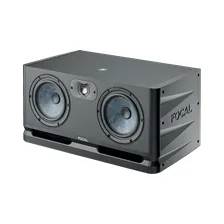 Ranked #63 of 67 in Large Size Powered Bookshelf Speakers - Focal Alpha Twin Evo: $1,318 per pair B&H Photo Video eBay
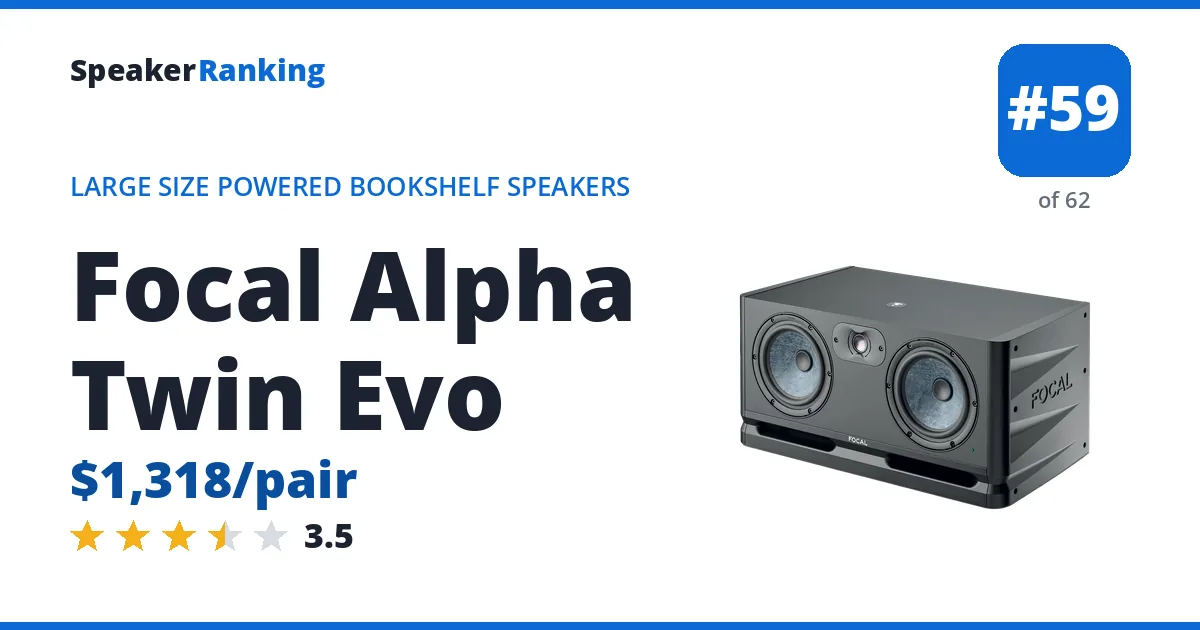
Pros: The available Sound & Recording data indicates deep bass, reaching 28.7Hz at -3dB. Dual bass/midrange drivers and analog adjustment controls provide a flexible format for studio playback.
Cons: The measurements give a 5.17 ideal-subwoofer score and 3.5dB response span from 300Hz to 5kHz, suggesting appreciable tonal unevenness. Driver orientation and off-axis behavior also matter. Deep extension does not establish low distortion at high levels, and the bass-fit statistic alone is not evidence of boominess.
Full Focal Alpha Twin Evo review and specifications →
| AES Input | No |
|---|---|
| Amplifier Power | 210W each |
| Aux Input | No |
| Coaxial Input | No |
| Dimensions | 10.2H x 21.7W x 11.4D in |
| Drivers | 1" inverted-dome tweeter, dual 6.5" Slatefiber woofers |
| Enclosure | 2.5-way active, dual front ports |
| HDMI Input | No |
| Inputs | XLR, TRS and RCA |
| Optical Input | No |
| RCA Input | Yes |
| Spinorama Preference Score | 4.01 |
| Spinorama Preference Score with Perfect Sub | 5.17 |
| TRS Input | Yes |
| USB Input | No |
| Weight | 26.5 lbs (12 kg) each |
| XLR Input | Yes |
- Links
- Reviews, Comparisons and Sound Samples
- Head-to-Head Comparisons
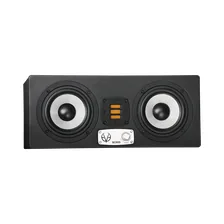 Ranked #65 of 67 in Large Size Powered Bookshelf Speakers - EVE Audio SC305: $2,599.98 per pair B&H Photo Video eBay
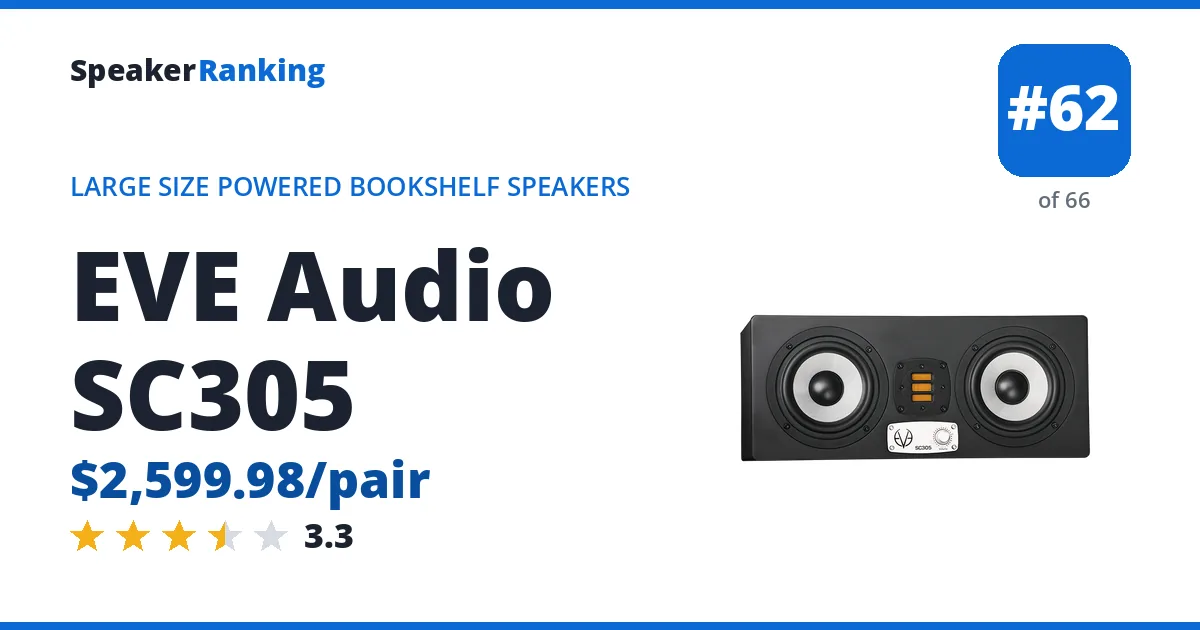
Pros: A compact horizontal three-way with an AMT tweeter, analog inputs and onboard tonal adjustment. ASR measured 58.6Hz -3dB extension, making bass support useful for full-range monitoring.
Cons: The 2.76 standalone and 5.12 ideal-subwoofer scores, together with a 3.9dB response span from 300Hz to 5kHz, indicate significant native tonal unevenness. DSP controls do not make it flat without adjustment. The wide horizontal cabinet also requires care with orientation and listening position.
Full EVE Audio SC305 review and specifications →
| AES Input | No |
|---|---|
| Amplifier Power | 150W each |
| Aux Input | No |
| Coaxial Input | No |
| Dimensions | 16.7W x 7.1H x 9.8D in |
| Drivers | AMT tweeter, 5" midwoofer, 5" woofer |
| Enclosure | Active 3-way, rear-ported |
| Frequency Response | 50Hz-21kHz |
| HDMI Input | No |
| Inputs | XLR and RCA |
| Maximum SPL | 108dB per pair |
| Optical Input | No |
| RCA Input | Yes |
| Spinorama Preference Score | 2.76 |
| Spinorama Preference Score with Perfect Sub | 5.12 |
| TRS Input | No |
| USB Input | No |
| Weight | 18.7 lbs (8.5 kg) each |
| XLR Input | Yes |
- Links
- Reviews, Comparisons and Sound Samples
- Head-to-Head Comparisons
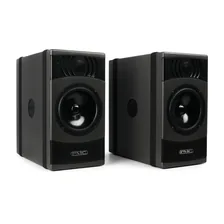 Ranked #66 of 67 in Large Size Powered Bookshelf Speakers - PMC result6: $3,300 per pair Sweetwater eBay
Pros: A self-powered professional monitor with straightforward analog connectivity. A subwoofer can extend its bandwidth, with the measured -6dB point at 55.7Hz providing a useful system-planning reference.
Cons: The measured -3dB point is 67.4Hz, and preference scores of 2.17 standalone and 4.69 with an ideal subwoofer reveal limited native tonal accuracy. Broad response and listening-window irregularities remain even when bass is accounted for. Its transmission-line construction does not overcome these measured limitations, and correction requires external equipment.
Full PMC result6 review and specifications →
| AES Input | No |
|---|---|
| Amplifier Power | 100W LF + 65W HF each |
| Aux Input | No |
| Coaxial Input | No |
| Drivers | 1-inch tweeter, 6.5-inch woofer |
| Enclosure | Active 2-way Advanced Transmission Line |
| Frequency Response | 45Hz-22kHz |
| HDMI Input | No |
| Inputs | Balanced XLR |
| Maximum SPL | 112dB |
| Optical Input | No |
| RCA Input | No |
| Spinorama Preference Score | 2.17 |
| Spinorama Preference Score with Perfect Sub | 4.69 |
| TRS Input | No |
| USB Input | No |
| Weight | 17.6 lbs (8 kg) each |
| XLR Input | Yes |
- Links
- Reviews, Comparisons and Sound Samples
- Head-to-Head Comparisons
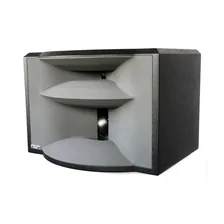 Ranked #67 of 67 in Large Size Powered Bookshelf Speakers - Ocean Way Audio HR5: $5,598 per pair Sweetwater eBay
Pros: The active format and substantial drivers can supply useful scale in a studio system. Measured -3dB extension is 52.7Hz, so separate bass support would be appropriate for full-range work. Measured bass extension of 80Hz (-3dB).
Cons: Scores of 1.05 standalone and 3.12 with an ideal subwoofer reflect substantial response unevenness, including severe upper-treble irregularities. Narrowing high-frequency coverage further changes the balance across listening positions. Bass support cannot repair those midrange and treble problems, making this difficult to recommend for neutral monitoring.
Full Ocean Way Audio HR5 review and specifications →
| AES Input | Yes |
|---|---|
| Amplifier Power | 215W total (125W LF, 90W HF) |
| App | No |
| Aux Input | No |
| Bass Extension (-10dB) | 60Hz (measured, Audio Science Review) |
| Bass Extension (-3dB) | 80Hz (measured, Audio Science Review) |
| Coaxial Input | No |
| DSP | No |
| Dimensions | 12H x 17.5W x 14.5D in |
| Drivers | 7" low-frequency driver, 1" high-frequency driver (horn/waveguide) |
| EQ | No |
| Frequency Response | 45Hz - 20kHz (Manufacturer specified) |
| HDMI Input | No |
| Inputs | XLR (analog), XLR AES3 (digital) |
| Optical Input | No |
| RCA Input | No |
| Spinorama Preference Score | 1.05 |
| Spinorama Preference Score with Perfect Sub | 3.12 |
| TRS Input | No |
| USB Input | No |
| Weight | 37.9 lbs (17.2 kg) each |
| XLR Input | Yes |
- Links
- Reviews, Comparisons and Sound Samples
- Head-to-Head Comparisons
Large Size Powered Floorstanding Speakers
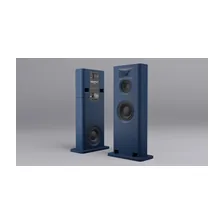 Ranked #2 of 6 in Large Size Powered Floorstanding Speakers - GGNTKT M3: $32,350 per pair GGNTKT eBay
Pros: The manufacturer measurement shows a very tight 0.5dB response span from 300Hz to 5kHz and a 7.84 ideal-subwoofer preference score, supporting exceptionally even midrange balance. Cardioid radiation reduces rearward bass and low-midrange energy, helping with near-wall placement. A dedicated midrange, wide waveguide and DSP-controlled four-way architecture suit a large listening area without relying on a narrow on-axis sweet spot.
Cons: Measured -3dB extension of 35.5Hz is useful but does not match the deepest-reaching towers here. Cardioid operation reduces some boundary interaction rather than eliminating room modes. The broad, heavy cabinets and professional system setup demand space and planning; maximum-output claims should not be confused with equally low distortion at every frequency.
Full GGNTKT M3 review and specifications →
| AES Input | Yes |
|---|---|
| Amplifier Power | approx. 1000W total (PASCAL Class-D UMAC modules) |
| Aux Input | No |
| Coaxial Input | No |
| Country | Germany |
| Coverage | 140 deg horizontal x 100 deg vertical (constant directivity waveguide) |
| Dimensions | 50.6"H x 19.6"W x 7.8"D (1286 x 499 x 199 mm) |
| Drivers | 56mm ring-diaphragm compression tweeter, 210mm (8") paper-fiber midrange, 2x 260mm (10") long-throw subwoofers |
| Enclosure | 4-way bass reflex, cardioid-loaded bass (opposed front/rear woofers) |
| Frequency Response | 29Hz-20kHz (-3dB), 24Hz-22kHz (-6dB) |
| HDMI Input | No |
| Inputs | XLR (balanced analog), XLR AES/EBU (digital), USB (calibration/control only, not an audio input) |
| Optical Input | No |
| RCA Input | No |
| Spinorama Preference Score | 5.87 |
| Spinorama Preference Score with Perfect Sub | 7.84 |
| TRS Input | No |
| USB Input | No |
| Warranty | 2 years, extendable to 3 with product registration |
| Weight | approx. 154.3 lbs (70 kg) each |
| XLR Input | Yes |
- Links
- Reviews, Comparisons and Sound Samples
- Head-to-Head Comparisons
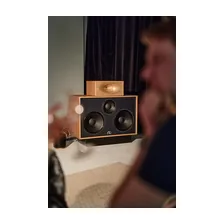 Ranked #3 of 6 in Large Size Powered Floorstanding Speakers - Pitt & Giblin Superwax: $16,500 per pair Pitt & Giblin eBay
Pros: The published DSP-adjusted manufacturer measurement combines 26.2Hz -3dB extension with an 8.19 ideal-subwoofer preference score and a smooth predicted room-response trend. Dual 15-inch woofers and a separate 10-inch midrange provide a substantial full-range architecture. Digital and analog inputs, remote volume control and three voicing profiles make the active system flexible despite its size.
Cons: The measured 2.3dB response span from 300Hz to 5kHz leaves more local midrange variation than the Superwax Mini; a level overall slope is not a perfectly flat response. Results apply to the measured DSP tuning, not every profile. At about 92kg and one metre wide per speaker, installation and room space are major considerations.
Full Pitt & Giblin Superwax review and specifications →
| AES Input | Yes |
|---|---|
| Amplifier Power | 950W total (Hypex nCore, discrete per driver) |
| Aux Input | No |
| Bass Extension | 24Hz at -3dB, 20Hz at -10dB (half space) |
| Coaxial Input | Yes |
| Country | Hand-built in Hobart, Tasmania, Australia |
| DSP | Profiles: Natural, Live, Clean (remote selectable) |
| Dimensions | 39.4"H x 39.4"W x 21.7"D (1000 x 1000 x 550 mm) (with stand) |
| Drivers | 1" compression driver on bronze waveguide, 10" sealed midrange, 2x 15" ported woofers |
| Enclosure | 3-way active, Birch plywood with separate HF waveguide and MF/LF cabinet, hardwood plinth |
| Frequency Response | 27Hz-18kHz +/-1.5dB |
| HDMI Input | No |
| Inputs | Analogue XLR/RCA, S/PDIF, AES, TOSLINK |
| Optical Input | Yes |
| RCA Input | Yes |
| Spinorama Preference Score | 7.35 |
| Spinorama Preference Score with Perfect Sub | 8.19 |
| TRS Input | No |
| USB Input | No |
| Weight | 202.8 lbs (92 kg) each |
| XLR Input | Yes |
- Links
- Reviews, Comparisons and Sound Samples
- Head-to-Head Comparisons
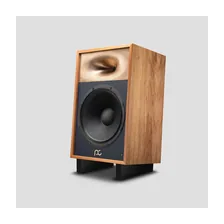 Ranked #4 of 6 in Large Size Powered Floorstanding Speakers - Pitt & Giblin Superwax Mini: $9,800 per pair Pitt & Giblin eBay
Pros: The published DSP-adjusted manufacturer measurement shows a 1.2dB response span from 300Hz to 5kHz and a 7.98 ideal-subwoofer preference score, supporting natural vocal balance. Bass reaches 30.9Hz at -3dB. The 15-inch woofer, bronze waveguide and built-in amplification provide a substantial two-way system with both digital and analog connections.
Cons: The Mini gives up some deep-bass reach compared with the full Superwax. Its low cabinet height makes the supplied tilt feet and listening position important. At 40kg per speaker and 460mm wide, it is still a large installation. The quoted response describes the measured DSP tuning; alternate voicing profiles change the balance.
Full Pitt & Giblin Superwax Mini review and specifications →
| AES Input | No |
|---|---|
| Amplifier Power | 350W total (Hypex nCore/FusionAmp Class-D) |
| Aux Input | No |
| Coaxial Input | Yes |
| Country | Hand-built in Hobart, Tasmania, Australia |
| DSP | Profiles: Natural, Live, Clean (remote selectable) |
| Dimensions | 28.1"H x 18.1"W x 15"D (715 x 460 x 380 mm) |
| Drivers | 15" cast-frame neodymium mid-bass woofer, 1" titanium compression driver on a hand-cast solid bronze waveguide |
| Enclosure | 2-way active, solid Birch plywood, hand-finished veneer |
| Frequency Response | -3dB at 30.9Hz, -6dB at 27.1Hz (measured, spinorama.org vendor data) |
| HDMI Input | No |
| Inputs | Analogue RCA/XLR, TOSLINK, S/PDIF coax, AES3 digital XLR, built-in DAC |
| Optical Input | Yes |
| RCA Input | Yes |
| Spinorama Preference Score | 6.97 |
| Spinorama Preference Score with Perfect Sub | 7.98 |
| TRS Input | No |
| USB Input | No |
| Weight | 88.2 lbs (40 kg) each |
| XLR Input | Yes |
- Links
- Reviews, Comparisons and Sound Samples
- Head-to-Head Comparisons