Short answer: both are discontinued, and they are rated the same for sound quality, though neither ranks well in its class. (#865 and #907 of 909 in-ear headphones). Either one is only an option used, so choose on condition and price. Both are rated below 3.0/5 among the 909 in-ear headphones; for better sound, the ThieAudio Monarch MKIII ranks #1 at $999.
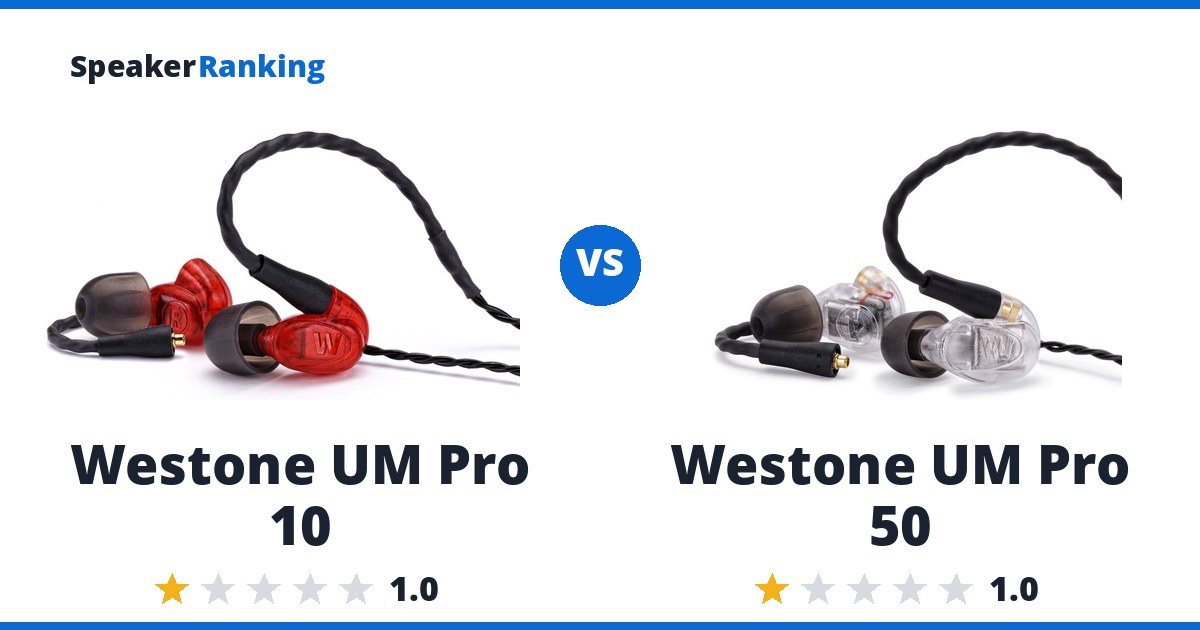
Why pick the Westone UM Pro 10: It uses 1 x balanced armature with an easy 25 ohm load. Watch for: Discontinued, so it is mainly found used.
What the Westone UM Pro 50 does well: It uses 5 x balanced armature. Watch for: Discontinued, so it is mainly found used.
Buy the Westone UM Pro 10 or the Westone UM Pro 50, whichever you find used in better condition; both are discontinued. For a new speaker, start with the ThieAudio Monarch MKIII instead.
Want more options? Browse the full Headphones rankings.
Specifications Side By Side
| Westone UM Pro 10 | Westone UM Pro 50 | |
|---|---|---|
| Price | Discontinued | Discontinued |
| Ranked | #865 of 909 in In-Ear Headphones | #907 of 909 in In-Ear Headphones |
| Form Factor | In-ear | In-ear |
| Connection | Wired | Wired |
| Driver Type | Balanced armature | Balanced armature |
| Drivers | 1 x balanced armature | 5 x balanced armature |
| Impedance | 25 ohms | 45 ohms |
| Sensitivity | 114 dB/mW | 115 dB/mW |
| Frequency Response | 20Hz - 16kHz | 20Hz - 20kHz |
| Harman Preference Score | 36 (measured by crinacle, via AutoEQ) | 9 (measured by crinacle, via AutoEQ) |
| Deviation From Target | 4.79 dB standard deviation | 6.52 dB standard deviation |
| Tonal Tilt | -0.86 (negative is warmer, positive brighter) | -2.26 (negative is warmer, positive brighter) |
| Weight | - | 0 lbs (12.7 g) |
Related Headphone Comparisons
More worthwhile head-to-heads for Westone UM Pro 10:
- Westone UM Pro 10 vs Westone UM Pro 30
- Westone UM Pro 10 vs Westone UM Pro 20
- Westone UM Pro 30 vs Westone UM Pro 50
- Westone UM Pro 20 vs Westone UM Pro 50
- Campfire Audio Dorado 2020 vs Westone Pro X50
Prices on this page were last checked October 13, 2026 at 3:17 PM UTC. Product prices and availability are accurate as of that date/time and are subject to change; the price and availability shown on Amazon at the time of purchase will apply to the purchase of this product.
As an eBay Partner, we may be compensated if you make a purchase.
The Two Headphones In Full
 Westone UM Pro 10 Discontinued eBay
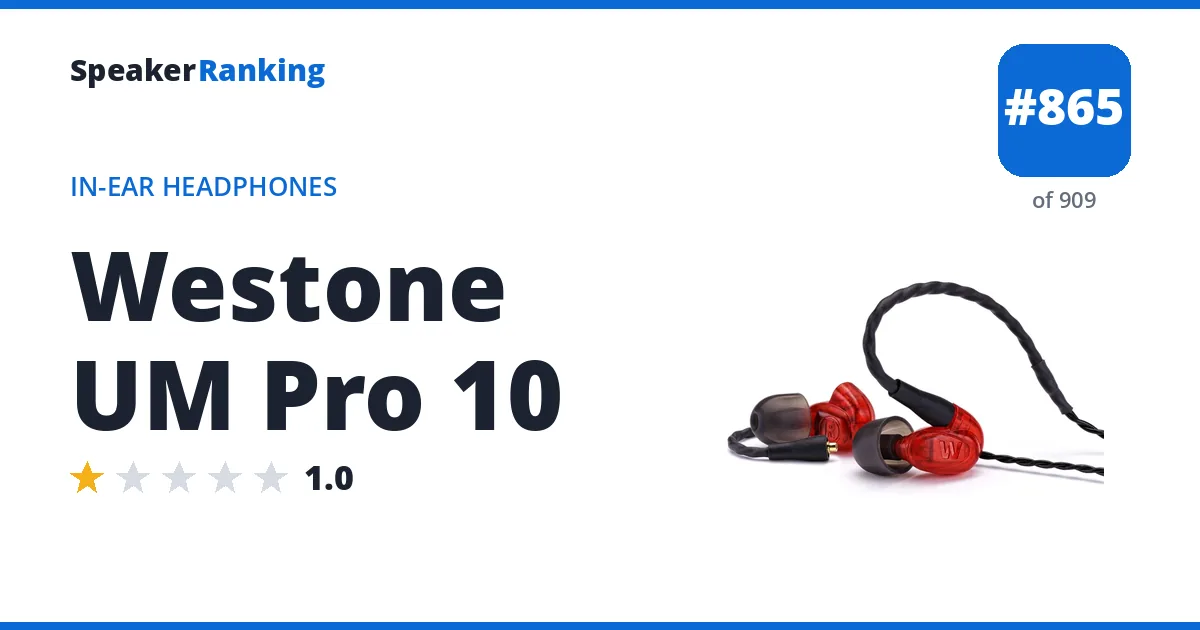
Pros: It uses 1 x balanced armature with an easy 25 ohm load.
Cons: Discontinued, so it is mainly found used. Its 4.79 dB spread from the target means a noticeably uneven response. A Harman score of 36 places it in the lower part of the in-ear rankings.
Full Westone UM Pro 10 review and specifications →
| Released | 2013 (13 years ago) |
|---|---|
| Connection | Wired |
| Deviation From Target | 4.79 dB standard deviation |
| Driver Type | Balanced armature |
| Drivers | 1 x balanced armature |
| Form Factor | In-ear |
| Frequency Response | 20Hz - 16kHz |
| Harman Preference Score | 36 (measured by crinacle, via AutoEQ) |
| Impedance | 25 ohms |
| Sensitivity | 114 dB/mW |
| Tonal Tilt | -0.86 (negative is warmer, positive brighter) |
EQ preset to match the Harman target
Set a preamp of -6.3 dB, then add these filters in any parametric equalizer (Wavelet, Equalizer APO, Peace, or a player with parametric EQ). Calculated by AutoEQ from its measured frequency response.
| Filter | Frequency | Gain | Q |
|---|---|---|---|
| Low shelf | 105 Hz | +3.4 dB | 0.70 |
| Peak | 278 Hz | -4.9 dB | 0.39 |
| Peak | 6,389 Hz | +6.3 dB | 0.22 |
| Peak | 1,445 Hz | -4.6 dB | 1.36 |
| Peak | 157 Hz | -0.4 dB | 2.24 |
| High shelf | 10,000 Hz | +1.7 dB | 0.70 |
| Peak | 8,987 Hz | -0.6 dB | 1.59 |
| Peak | 67 Hz | +0.2 dB | 3.31 |
| Peak | 4,585 Hz | +0.4 dB | 6.00 |
| Peak | 3,968 Hz | -0.3 dB | 5.52 |
- Reviews, Comparisons and Sound Samples
- Head-to-Head Comparisons
 Westone UM Pro 50 Discontinued eBay
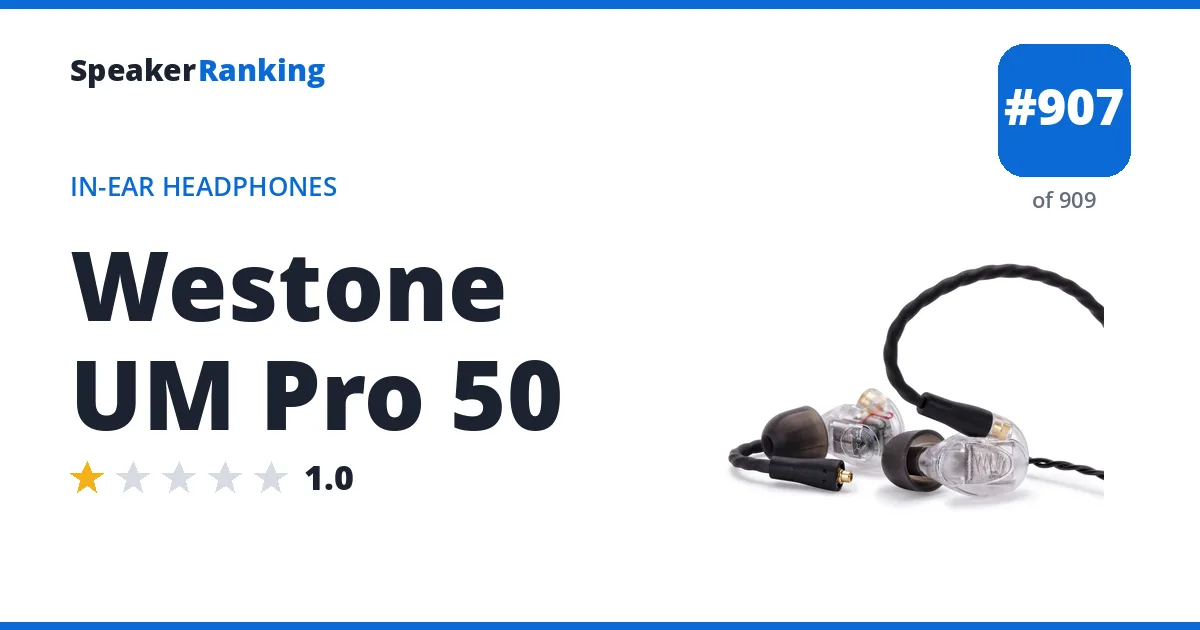
Pros: It uses 5 x balanced armature.
Cons: Discontinued, so it is mainly found used. A tonal tilt of -2.26 makes it sound dark, with bass well ahead of the treble. Its 6.52 dB spread from the target means a noticeably uneven response. A Harman score of 9 places it in the lower part of the in-ear rankings.
Full Westone UM Pro 50 review and specifications →
| Released | 2014 (12 years ago) |
|---|---|
| Connection | Wired |
| Deviation From Target | 6.52 dB standard deviation |
| Driver Type | Balanced armature |
| Drivers | 5 x balanced armature |
| Form Factor | In-ear |
| Frequency Response | 20Hz - 20kHz |
| Harman Preference Score | 9 (measured by crinacle, via AutoEQ) |
| Impedance | 45 ohms |
| Sensitivity | 115 dB/mW |
| Tonal Tilt | -2.26 (negative is warmer, positive brighter) |
| Weight | 0 lbs (12.7 g) |
EQ preset to match the Harman target
Set a preamp of -6.4 dB, then add these filters in any parametric equalizer (Wavelet, Equalizer APO, Peace, or a player with parametric EQ). Calculated by AutoEQ from its measured frequency response.
| Filter | Frequency | Gain | Q |
|---|---|---|---|
| Low shelf | 105 Hz | -0.6 dB | 0.70 |
| Peak | 211 Hz | -7.9 dB | 0.52 |
| Peak | 4,189 Hz | +6.7 dB | 0.20 |
| Peak | 1,570 Hz | -7.8 dB | 1.84 |
| Peak | 523 Hz | -2.0 dB | 0.92 |
| High shelf | 10,000 Hz | -0.4 dB | 0.70 |
| Peak | 2,457 Hz | +2.0 dB | 5.31 |
| Peak | 1,977 Hz | -1.3 dB | 4.94 |
| Peak | 61 Hz | +0.4 dB | 1.77 |
| Peak | 34 Hz | -0.3 dB | 1.95 |
- Reviews, Comparisons and Sound Samples
- Head-to-Head Comparisons