Short answer: the Shure SRH840A. It ranks #127 of 216 over-ear headphones by sound quality, rated 3.5/5, at $169; the FiiO FT1 ranks #152, rated 3.2/5, at $164.99. With prices this close, go by the sound-quality ranking rather than the cost.

Why pick the Shure SRH840A: Bass is big, with sub-bass about 3.9 dB and bass about 5.3 dB above target, which suits hip hop, EDM and pop where weight matters. The tradeoff: The bass boost of 5.3 dB can bleed into the low mids and cloud vocals and bass guitar.
What the FiiO FT1 does well: Sub-bass and bass both sit about 2.6 dB above target, so kick drums and bass lines have noticeable punch and rumble without bloating the midrange, which stays within a third of a dB of target. The tradeoff: Treble from 6 to 10 kHz is about 5 dB low with a 8.7 dB dip near 9.5 kHz, which dulls cymbals and takes the edge off sibilance.
Buy the Shure SRH840A. It is rated higher for sound quality, and the $4.01 you would save on the FiiO FT1 does not close the gap.
Want more options? Browse the full Headphones rankings.
Specifications Side By Side
| Shure SRH840A | FiiO FT1 | |
|---|---|---|
| Price | $169.00 | $164.99 |
| Ranked | #127 of 216 in Over-Ear Headphones | #152 of 216 in Over-Ear Headphones |
| Form Factor | Over-ear | Over-ear |
| Harman Preference Score | 71 (measured by oratory1990, via AutoEQ) | 64 (measured by oratory1990, via AutoEQ) |
| Deviation From Target | 2.25 dB standard deviation | 2.56 dB standard deviation |
| Tonal Tilt | -0.99 (negative is warmer, positive brighter) | -1.20 (negative is warmer, positive brighter) |
| Sub-bass Extension | Within 6 dB of target down to 20 Hz (+2.6 dB at 30 Hz) | Within 6 dB of target down to 20 Hz (+3.4 dB at 30 Hz) |
| Connection | Wired | Wired |
| Back | Closed | Closed |
| Driver Type | Dynamic | Dynamic |
| Drivers | 1 x 40mm dynamic | 1 x 60mm dynamic |
| Impedance | 44 ohms | 32 ohms |
| Sensitivity | 102 dB/mW | 98 dB/mW |
| Weight | 0.6 lbs (273 g) | 0.7 lbs (340 g) |
| Frequency Response | 5Hz - 25kHz (Manufacturer specified) | 10Hz - 40kHz (Manufacturer specified) |
Related Headphone Comparisons
More top alternatives to Shure SRH840A:
- Cooler Master MH752 vs Shure SRH840A
- Shure SRH840A vs Sony MDR-CD900ST
- 1MORE Triple Driver Over Ear vs FiiO FT1
- FiiO FT1 vs Yamaha HPH-200
- Audio-Technica ATH-AD700X vs FiiO FT1
Prices on this page were last checked October 11, 2026 at 4:59 PM UTC. Product prices and availability are accurate as of that date/time and are subject to change; the price and availability shown on Amazon at the time of purchase will apply to the purchase of this product.
As an eBay Partner, we may be compensated if you make a purchase.
The Two Headphones In Full
 Shure SRH840A: $169.00 Amazon eBay

Older model: the Shure SRH840 (ranked higher, rated 4.3/5). See every Shure SRH840 generation.
Pros: Bass is big, with sub-bass about 3.9 dB and bass about 5.3 dB above target, which suits hip hop, EDM and pop where weight matters. Treble and air are lifted too, about 2 dB and 4.5 dB over target, adding sparkle and a sense of detail. At 44 ohms and 102 dB/mW sensitivity it runs well from a phone, and the closed 273 g design isolates.
Cons: The bass boost of 5.3 dB can bleed into the low mids and cloud vocals and bass guitar. A 4 dB peak near 11.9 kHz can make cymbals and sibilance a little splashy. Overall tilt is warm, so listeners who want an accurate, neutral balance will find it colored.
Full Shure SRH840A review and specifications →
| Back | Closed |
|---|---|
| Connection | Wired |
| Deviation From Target | 2.25 dB standard deviation |
| Driver Type | Dynamic |
| Drivers | 1 x 40mm dynamic |
| Form Factor | Over-ear |
| Frequency Response | 5Hz - 25kHz (Manufacturer specified) |
| Harman Preference Score | 71 (measured by oratory1990, via AutoEQ) |
| Impedance | 44 ohms |
| Sensitivity | 102 dB/mW |
| Sub-bass Extension | Within 6 dB of target down to 20 Hz (+2.6 dB at 30 Hz) |
| Tonal Tilt | -0.99 (negative is warmer, positive brighter) |
| Weight | 0.6 lbs (273 g) |
EQ preset to match the Harman target
Set a preamp of -3.3 dB, then add these filters in any parametric equalizer (Wavelet, Equalizer APO, Peace, or a player with parametric EQ). Calculated by AutoEQ from its measured frequency response.
| Filter | Frequency | Gain | Q |
|---|---|---|---|
| Low shelf | 105 Hz | -1.4 dB | 0.70 |
| Peak | 1,254 Hz | +2.3 dB | 0.60 |
| Peak | 121 Hz | -3.6 dB | 0.71 |
| Peak | 5,403 Hz | -3.1 dB | 2.76 |
| Peak | 4,270 Hz | +3.9 dB | 4.65 |
| High shelf | 10,000 Hz | -4.6 dB | 0.70 |
| Peak | 46 Hz | -0.4 dB | 1.73 |
| Peak | 251 Hz | +1.2 dB | 3.63 |
| Peak | 170 Hz | -0.7 dB | 3.14 |
| Peak | 418 Hz | -0.6 dB | 2.84 |
- Reviews, Comparisons and Sound Samples
- Head-to-Head Comparisons
 FiiO FT1: $164.99 Amazon AliExpress eBay
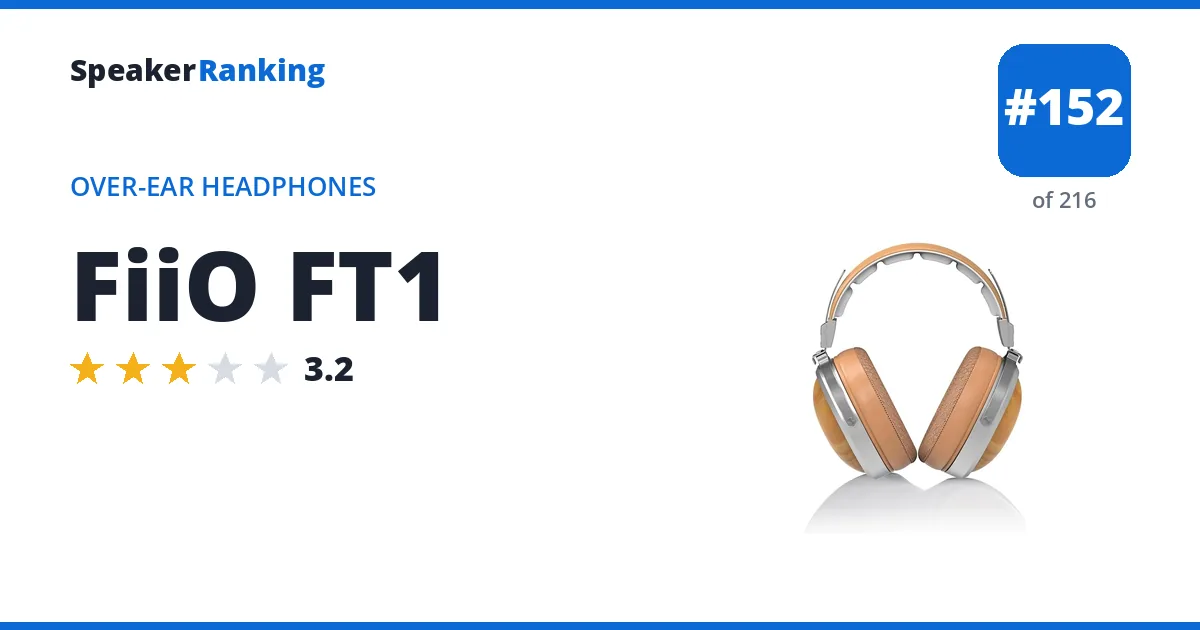
Pros: Sub-bass and bass both sit about 2.6 dB above target, so kick drums and bass lines have noticeable punch and rumble without bloating the midrange, which stays within a third of a dB of target. The 32 ohm, 98 dB/mW closed-back design runs directly from a phone or laptop, with a smoother response than most at 2.56 dB deviation.
Cons: Treble from 6 to 10 kHz is about 5 dB low with a 8.7 dB dip near 9.5 kHz, which dulls cymbals and takes the edge off sibilance. A 3.7 dB peak near 5.2 kHz and air about 3 dB high make the top end uneven. At 340 g it is on the heavier side.
Full FiiO FT1 review and specifications →
| Released | Sep 2024 (2 years ago) |
|---|---|
| Back | Closed |
| Connection | Wired |
| Deviation From Target | 2.56 dB standard deviation |
| Driver Type | Dynamic |
| Drivers | 1 x 60mm dynamic |
| Form Factor | Over-ear |
| Frequency Response | 10Hz - 40kHz (Manufacturer specified) |
| Harman Preference Score | 64 (measured by oratory1990, via AutoEQ) |
| Impedance | 32 ohms |
| Sensitivity | 98 dB/mW |
| Sub-bass Extension | Within 6 dB of target down to 20 Hz (+3.4 dB at 30 Hz) |
| Tonal Tilt | -1.20 (negative is warmer, positive brighter) |
| Weight | 0.7 lbs (340 g) |
EQ preset to match the Harman target
Set a preamp of -4.3 dB, then add these filters in any parametric equalizer (Wavelet, Equalizer APO, Peace, or a player with parametric EQ). Calculated by AutoEQ from its measured frequency response.
| Filter | Frequency | Gain | Q |
|---|---|---|---|
| Low shelf | 105 Hz | -2.7 dB | 0.70 |
| Peak | 155 Hz | -3.4 dB | 1.47 |
| Peak | 7,882 Hz | +4.5 dB | 1.99 |
| Peak | 3,835 Hz | +4.6 dB | 3.54 |
| Peak | 5,303 Hz | -5.6 dB | 4.56 |
| High shelf | 10,000 Hz | -3.1 dB | 0.70 |
| Peak | 1,735 Hz | -1.9 dB | 3.24 |
| Peak | 61 Hz | +0.9 dB | 2.22 |
| Peak | 579 Hz | +0.8 dB | 1.78 |
| Peak | 239 Hz | -0.5 dB | 2.59 |
- Reviews, Comparisons and Sound Samples
- Head-to-Head Comparisons