Different classes, so treat this as a step-up-or-not question rather than a head-to-head. The Shure Aonic 3 ranks #681 of 865 in-ear headphones by sound quality; the Shure Aonic 50 ranks #133 of 417 over-ear headphones by sound quality.
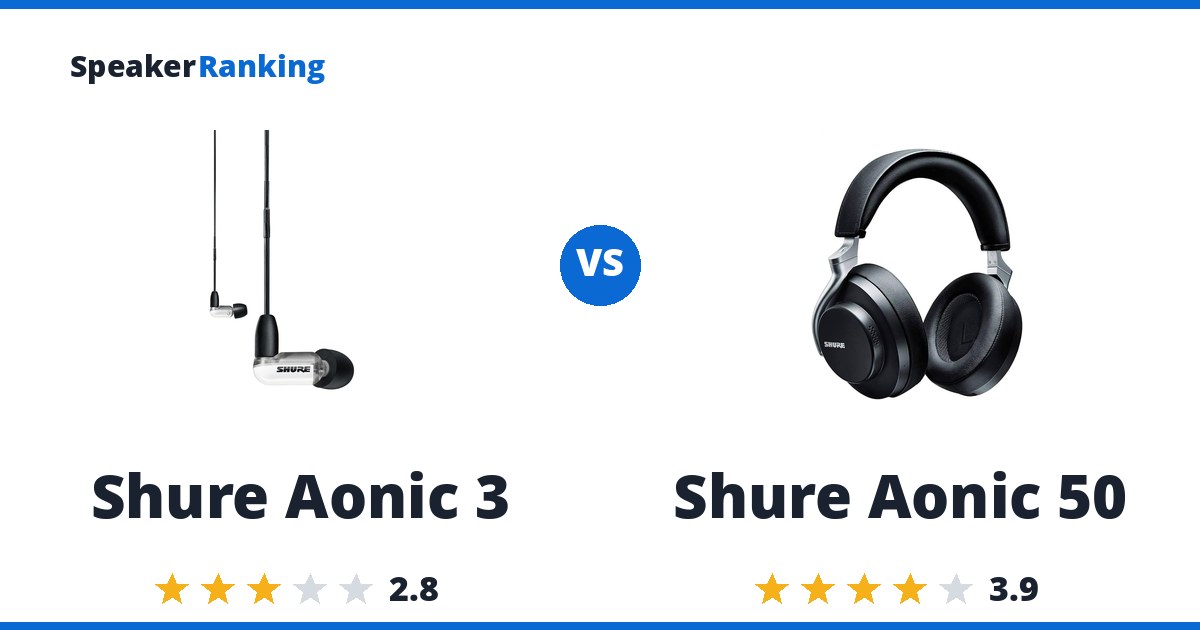
The case for the Shure Aonic 3: Its tonal tilt of +0.37 sits close to the target, so the overall balance is neither dark nor bright. Watch for: A Harman score of 59 places it in the lower part of the in-ear rankings.
The case for the Shure Aonic 50: Measured response gives it a very good Harman preference score of 79 with a 2.57 dB spread. Watch for: Discontinued, so it is mainly found used.
One note: the Shure Aonic 50 is no longer sold new, but at #133 of 417 over-ear headphones by sound quality it still outranks most current models, so used is worth considering.
Buy the Shure Aonic 3 for a in-ear headphones; the Shure Aonic 50 suits a over-ear headphones instead.
Still deciding? The full Headphones rankings cover every ranked option.
Specifications Side By Side
| Shure Aonic 3 | Shure Aonic 50 | |
|---|---|---|
| Price | - | Discontinued |
| Ranked | #681 of 865 in In-Ear Headphones | #133 of 417 in Over-Ear Headphones |
| Form Factor | In-ear | Over-ear |
| Connection | Wired | Bluetooth |
| Driver Type | Balanced armature | Dynamic |
| Drivers | 1 x balanced armature | 1 x 50mm dynamic |
| Impedance | 28 ohms | 39 ohms |
| Sensitivity | 108 dB SPL/mW | 97.5 dB/mW |
| Frequency Response | 22Hz - 19kHz | 20Hz - 22kHz |
| Harman Preference Score | 59 (measured by crinacle, via AutoEQ) | 79 (measured by oratory1990, via AutoEQ) |
| Deviation From Target | 3.31 dB standard deviation | 2.57 dB standard deviation |
| Tonal Tilt | +0.37 (negative is warmer, positive brighter) | +0.17 (negative is warmer, positive brighter) |
| Back | - | Closed |
| Weight | - | 0.7 lbs (334 g) |
| Sub-bass Extension | - | Within 6 dB of target down to 20 Hz (-2.2 dB at 30 Hz) |
Related Headphone Comparisons
How Shure Aonic 50 compares with other leading options:
- Shure Aonic 4 vs Shure Aonic 50
- Shure Aonic 3 vs Shure Aonic 4
- HIFIMAN Arya Stealth Magnet Version vs Fosi Audio i5
- HIFIMAN Arya Stealth vs Fosi Audio i5
- Fosi Audio i5 vs Stax SR-X1
Prices on this page were last checked October 13, 2026 at 3:17 PM UTC. Product prices and availability are accurate as of that date/time and are subject to change; the price and availability shown on Amazon at the time of purchase will apply to the purchase of this product.
As an eBay Partner, we may be compensated if you make a purchase.
The Two Headphones In Full
 Shure Aonic 3 eBay
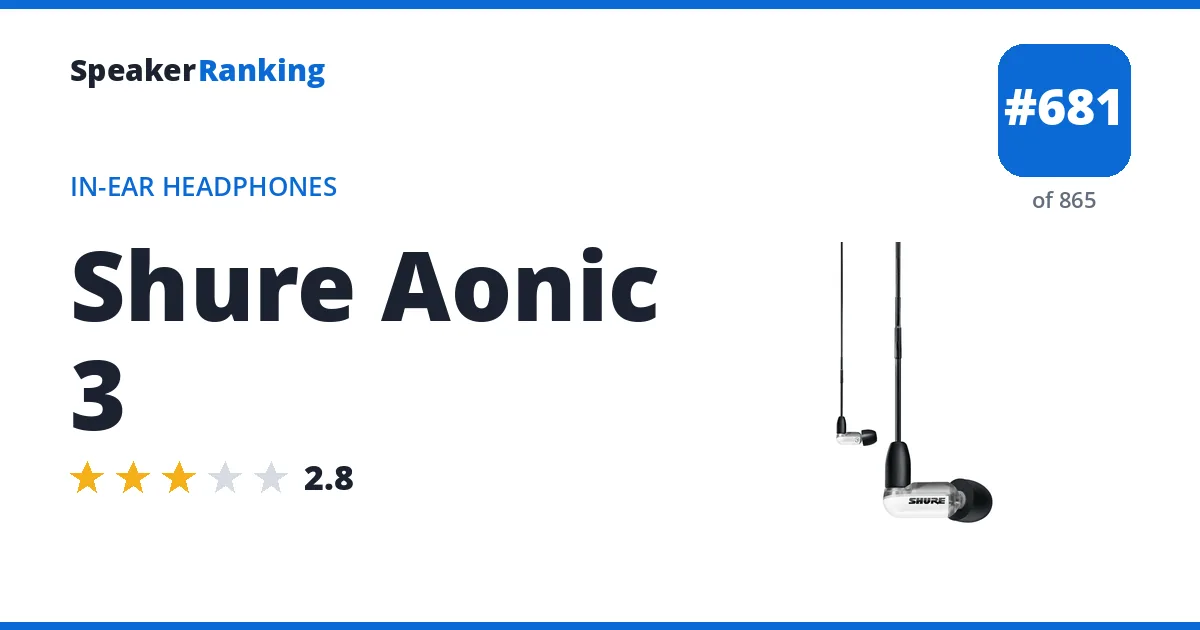
Pros: Its tonal tilt of +0.37 sits close to the target, so the overall balance is neither dark nor bright. It uses 1 x balanced armature with an easy 28 ohm load.
Cons: A Harman score of 59 places it in the lower part of the in-ear rankings.
Full Shure Aonic 3 review and specifications →
| Released | 2020 (6 years ago) |
|---|---|
| Connection | Wired |
| Deviation From Target | 3.31 dB standard deviation |
| Driver Type | Balanced armature |
| Drivers | 1 x balanced armature |
| Form Factor | In-ear |
| Frequency Response | 22Hz - 19kHz |
| Harman Preference Score | 59 (measured by crinacle, via AutoEQ) |
| Impedance | 28 ohms |
| Sensitivity | 108 dB SPL/mW |
| Tonal Tilt | +0.37 (negative is warmer, positive brighter) |
EQ preset to match the Harman target
Set a preamp of -6.6 dB, then add these filters in any parametric equalizer (Wavelet, Equalizer APO, Peace, or a player with parametric EQ). Calculated by AutoEQ from its measured frequency response.
| Filter | Frequency | Gain | Q |
|---|---|---|---|
| Low shelf | 105 Hz | +8.8 dB | 0.70 |
| Peak | 70 Hz | -4.6 dB | 0.25 |
| Peak | 5,692 Hz | +5.0 dB | 1.38 |
| Peak | 2,508 Hz | +2.8 dB | 2.23 |
| Peak | 7,366 Hz | -3.6 dB | 5.18 |
| High shelf | 10,000 Hz | +6.6 dB | 0.70 |
| Peak | 897 Hz | +1.3 dB | 1.75 |
| Peak | 9,052 Hz | -2.5 dB | 1.98 |
| Peak | 1,346 Hz | -1.4 dB | 3.28 |
| Peak | 357 Hz | -0.6 dB | 2.24 |
- Reviews, Comparisons and Sound Samples
- Head-to-Head Comparisons
 Shure Aonic 50 Discontinued eBay
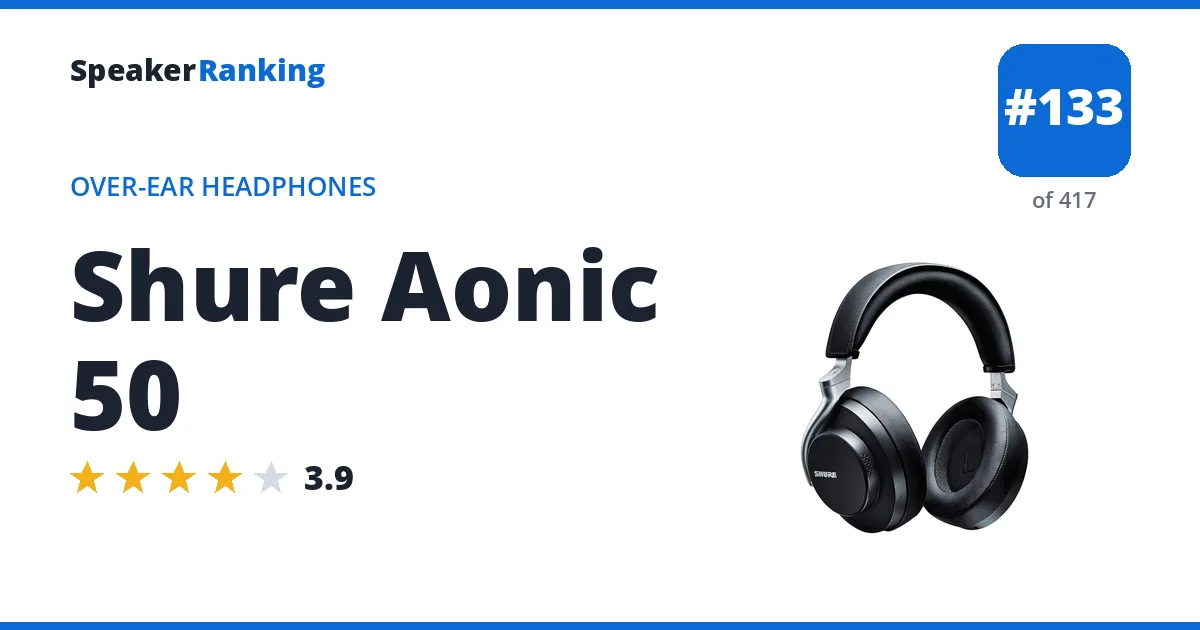
Pros: Measured response gives it a very good Harman preference score of 79 with a 2.57 dB spread. It uses 1 x 50mm dynamic.
Cons: Discontinued, so it is mainly found used. An 8.3 dB peak near 11.9 kHz can make cymbals and sibilance sound sharp. The 4.6 dB bass lift can sound boomy and mask midrange detail.
Full Shure Aonic 50 review and specifications →
| Released | Apr 2020 (6 years ago) |
|---|---|
| Back | Closed |
| Connection | Bluetooth |
| Deviation From Target | 2.57 dB standard deviation |
| Driver Type | Dynamic |
| Drivers | 1 x 50mm dynamic |
| Form Factor | Over-ear |
| Frequency Response | 20Hz - 22kHz |
| Harman Preference Score | 79 (measured by oratory1990, via AutoEQ) |
| Impedance | 39 ohms |
| Sensitivity | 97.5 dB/mW |
| Sub-bass Extension | Within 6 dB of target down to 20 Hz (-2.2 dB at 30 Hz) |
| Tonal Tilt | +0.17 (negative is warmer, positive brighter) |
| Weight | 0.7 lbs (334 g) |
EQ preset to match the Harman target
Set a preamp of -5.4 dB, then add these filters in any parametric equalizer (Wavelet, Equalizer APO, Peace, or a player with parametric EQ). Calculated by AutoEQ from its measured frequency response.
| Filter | Frequency | Gain | Q |
|---|---|---|---|
| Low shelf | 105 Hz | +5.8 dB | 0.70 |
| Peak | 471 Hz | +5.1 dB | 0.74 |
| Peak | 129 Hz | -6.0 dB | 0.68 |
| Peak | 5,309 Hz | -4.3 dB | 2.71 |
| Peak | 2,908 Hz | -3.6 dB | 5.04 |
| High shelf | 10,000 Hz | -1.6 dB | 0.70 |
| Peak | 1,894 Hz | -1.5 dB | 3.19 |
| Peak | 51 Hz | -1.3 dB | 2.33 |
| Peak | 78 Hz | +1.1 dB | 2.48 |
| Peak | 3,742 Hz | +2.0 dB | 6.00 |
- Reviews, Comparisons and Sound Samples
- Head-to-Head Comparisons