Short answer: a tie on sound quality. Both are rated 4.4/5 (#109 and #90 of 450 in-ear headphones) at nearly the same price ($129 vs $129.95), so choose on features and fit.
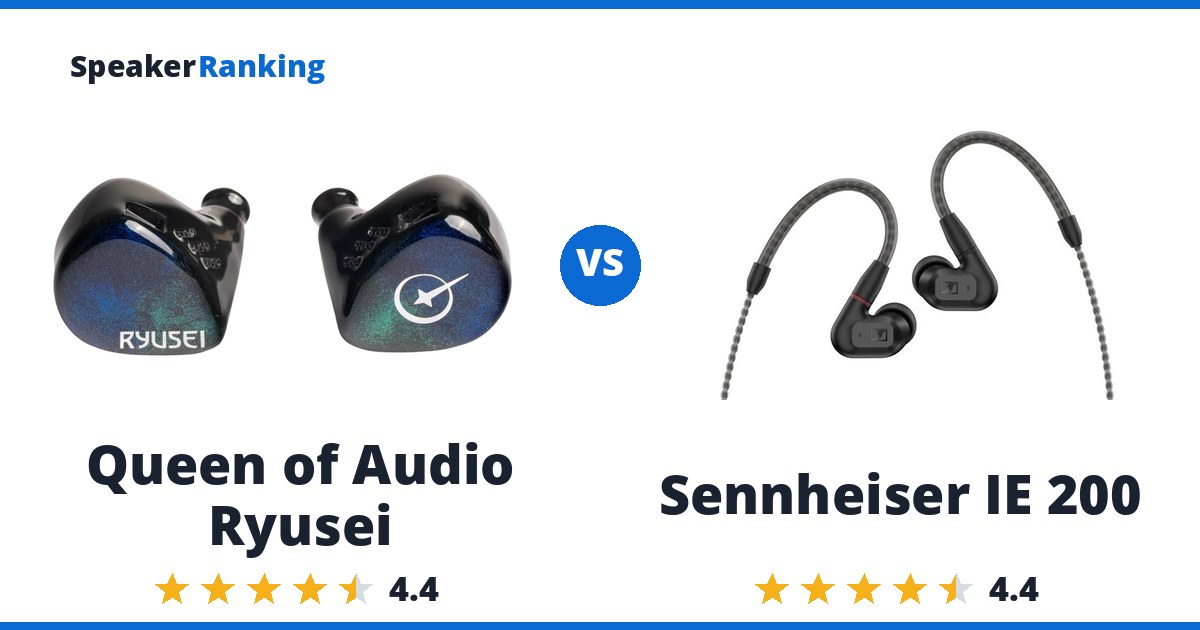
The case for the Queen of Audio Ryusei: Its single dynamic driver earns a preference score of 78.8 and a smooth 1.37 dB spread in the median of 4 squig.link measurements. The catch: Presence drops about 4.1 dB below target, softening vocal edge and snare attack.
The case for the Sennheiser IE 200: Bass and midrange land almost exactly on the Harman target in oratory1990’s measurement, within about 0.5 dB from 60 Hz to 3 kHz, which gives a natural tonal balance and a preference score of 79. The tradeoff: The presence region from 3 to 6 kHz sits about 5 dB under target, with a 5.7 dB dip near 4.4 kHz, so vocals and snare attacks sound a little recessed.
Buy the Queen of Audio Ryusei or the Sennheiser IE 200 on features: they are rated the same for sound quality at close to the same price.
Still deciding? The full Headphones rankings cover every ranked option.
Specifications Side By Side
| Queen of Audio Ryusei | Sennheiser IE 200 | |
|---|---|---|
| Price | $129.00 | $129.95 |
| Ranked | #109 of 450 in In-Ear Headphones | #90 of 450 in In-Ear Headphones |
| Form Factor | In-ear | In-ear |
| Back | Closed | Closed |
| Harman Preference Score | 79 (median of 4 squig.link measurements, calibrated to AutoEQ) | 79 (measured by oratory1990, via AutoEQ) |
| Deviation From Target | 1.37 dB standard deviation | 1.86 dB standard deviation |
| Tonal Tilt | -0.46 (negative is warmer, positive brighter) | -0.02 (negative is warmer, positive brighter) |
| Sub-bass Extension | Within 6 dB of target down to 20 Hz (+1.8 dB at 30 Hz) | Within 6 dB of target down to 20 Hz (-1.8 dB at 30 Hz) |
| Connection | Wired | Wired |
| Driver Type | Dynamic | Dynamic |
| Drivers | 1 x dynamic | 1 x 7mm dynamic |
| Impedance | - | 16 ohms |
| Sensitivity | - | 119 dB SPL/V |
| Weight | - | 0 lbs (4 g) per earphone |
| Frequency Response | - | 6Hz - 20kHz (Manufacturer specified) |
Related Headphone Comparisons
More worthwhile head-to-heads for Sennheiser IE 200:
- Sennheiser IE 200 vs Truthear x Crinacle Zero
- Moondrop Variations vs Sennheiser IE 200
- Kefine Quatio vs Sennheiser IE 200
- Moondrop Starfield 2 vs Sennheiser IE 200
- Sennheiser IE 200 vs Sony WF-1000XM5
Prices on this page were last checked October 11, 2026 at 4:59 PM UTC. Product prices and availability are accurate as of that date/time and are subject to change; the price and availability shown on Amazon at the time of purchase will apply to the purchase of this product.
As an eBay Partner, we may be compensated if you make a purchase.
The Two Headphones In Full
 Queen of Audio Ryusei: $129.00 Bloom Audio eBay

Pros: Its single dynamic driver earns a preference score of 78.8 and a smooth 1.37 dB spread in the median of 4 squig.link measurements. Bass rises about 3.3 dB above target between 60 and 200 Hz, giving rich, punchy low end and warmth that suits bassy and warm tastes. Upper mids stay on target, so vocals keep their natural tone.
Cons: Presence drops about 4.1 dB below target, softening vocal edge and snare attack. Treble is uneven, with a 6.5 dB peak near 8.4 kHz that can sharpen sibilance and a 5.5 dB dip near 11 kHz that trims air, and the low mids run 1.3 dB hot, adding some thickness.
Full Queen of Audio Ryusei review and specifications →
| Released | 2026 (this year) |
|---|---|
| Back | Closed |
| Connection | Wired |
| Deviation From Target | 1.37 dB standard deviation |
| Driver Type | Dynamic |
| Drivers | 1 x dynamic |
| Form Factor | In-ear |
| Harman Preference Score | 79 (median of 4 squig.link measurements, calibrated to AutoEQ) |
| Sub-bass Extension | Within 6 dB of target down to 20 Hz (+1.8 dB at 30 Hz) |
| Tonal Tilt | -0.46 (negative is warmer, positive brighter) |
- Reviews, Comparisons and Sound Samples
- Head-to-Head Comparisons
 Sennheiser IE 200: $129.95 Amazon eBay
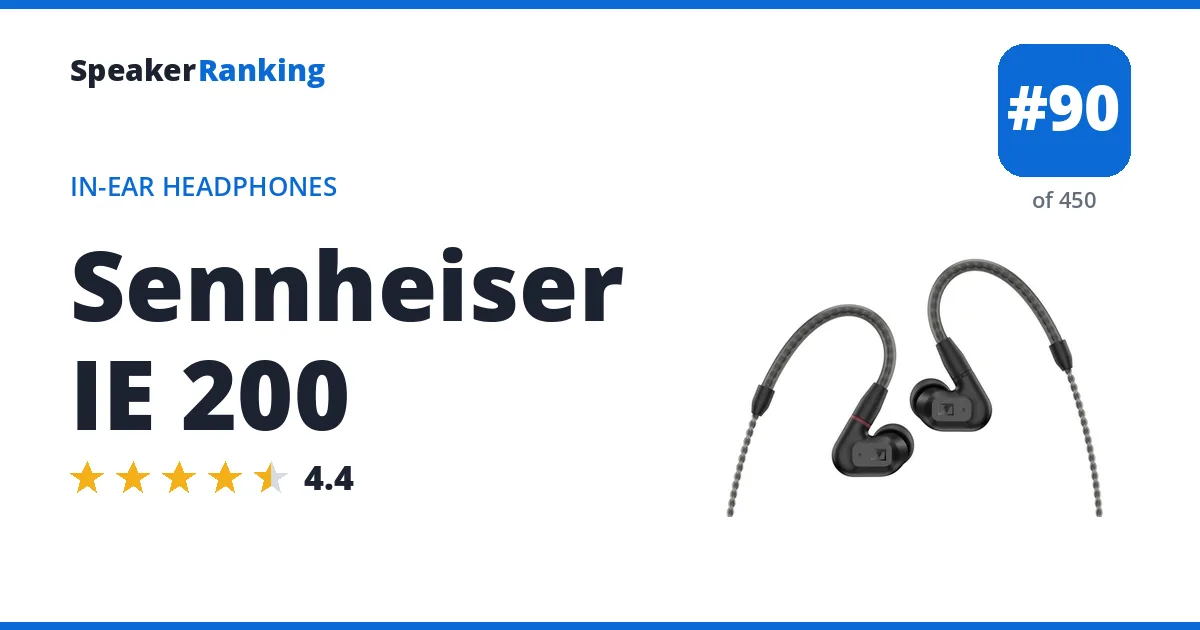
Pros: Bass and midrange land almost exactly on the Harman target in oratory1990’s measurement, within about 0.5 dB from 60 Hz to 3 kHz, which gives a natural tonal balance and a preference score of 79. At 16 ohms and 119 dB SPL/V sensitivity it plays loud straight from a phone with no amp. Each earpiece weighs only 4 g, and the single 7mm dynamic driver is a simple, wired design with no battery to charge.
Cons: The presence region from 3 to 6 kHz sits about 5 dB under target, with a 5.7 dB dip near 4.4 kHz, so vocals and snare attacks sound a little recessed. The top octave runs about 5.8 dB hot, which adds sparkle that can read as thin or bright on some recordings. The Final Audio A4000 and Shuoer S12 carry higher ratings at lower prices.
Full Sennheiser IE 200 review and specifications →
| Back | Closed |
|---|---|
| Connection | Wired |
| Deviation From Target | 1.86 dB standard deviation |
| Driver Type | Dynamic |
| Drivers | 1 x 7mm dynamic |
| Form Factor | In-ear |
| Frequency Response | 6Hz - 20kHz (Manufacturer specified) |
| Harman Preference Score | 79 (measured by oratory1990, via AutoEQ) |
| Impedance | 16 ohms |
| Sensitivity | 119 dB SPL/V |
| Sub-bass Extension | Within 6 dB of target down to 20 Hz (-1.8 dB at 30 Hz) |
| Tonal Tilt | -0.02 (negative is warmer, positive brighter) |
| Weight | 0 lbs (4 g) per earphone |
EQ preset to match the Harman target
Set a preamp of -4.3 dB, then add these filters in any parametric equalizer (Wavelet, Equalizer APO, Peace, or a player with parametric EQ). Calculated by AutoEQ from its measured frequency response.
| Filter | Frequency | Gain | Q |
|---|---|---|---|
| Low shelf | 105 Hz | +0.3 dB | 0.70 |
| Peak | 4,135 Hz | +4.3 dB | 1.83 |
| Peak | 1,520 Hz | -1.9 dB | 1.99 |
| Peak | 180 Hz | -1.2 dB | 1.14 |
| Peak | 67 Hz | +1.0 dB | 1.34 |
| High shelf | 10,000 Hz | -6.1 dB | 0.70 |
| Peak | 727 Hz | +0.8 dB | 1.79 |
| Peak | 5,480 Hz | +1.2 dB | 3.96 |
| Peak | 1,154 Hz | -0.6 dB | 3.44 |
| Peak | 2,978 Hz | +0.4 dB | 3.96 |
- Reviews, Comparisons and Sound Samples
- Head-to-Head Comparisons
- Sennheiser IE 200 vs Truthear x Crinacle Zero
- Sennheiser IE 200 vs Moondrop Variations
- Sennheiser IE 200 vs Kefine Quatio
- Sennheiser IE 200 vs Moondrop Starfield 2
- Sennheiser IE 200 vs Sony WF-1000XM5
- Sennheiser IE 200 vs Tanchjim Fission
- Sennheiser IE 200 vs Sennheiser IE 600
- Sennheiser IE 200 vs Sennheiser IE 900
- See all 9 comparisons