Short answer: the Q Acoustics 3030c, if you are buying new. The Q Acoustics 3030i ranks higher than the Q Acoustics 5020 (#84 vs #146 of 168 bookshelf speakers) but is discontinued; its replacement, the Q Acoustics 3030c, is rated 3.8/5 at $819 and is still sold new.
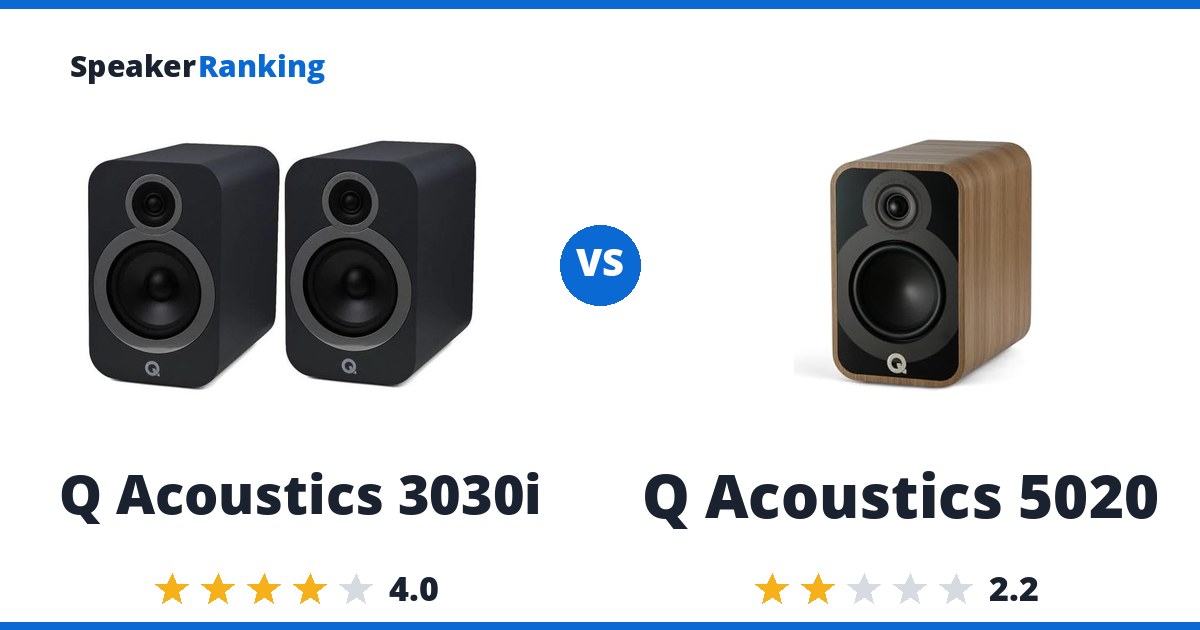
The Q Acoustics 3030i is the more accurate, deeper-bass pick. A two-way standmount with a 6.5” woofer and 0.9” tweeter in a braced cabinet, rated at 88dB. Its measured preference score, a predictor of how neutral it sounds, is 4.97 against 3.63 for the Q Acoustics 5020. Its bass reaches about 69Hz before falling 3dB, against 103Hz for the Q Acoustics 5020. Watch for: That measurement is low quality, so the details are less certain than a full Klippel or anechoic test.
What the Q Acoustics 5020 does well: Attractively finished compact standmount with a 5-inch Continuous Curved Cone woofer and carefully engineered cabinet details. The tradeoff: Erin found the tonal balance distinctly too crisp, forward and treble-heavy: the top end is roughly 3-5dB elevated while the 1-3kHz region is recessed, so vocals change level unnaturally as they move through their range.
Buy the Q Acoustics 3030c, the replacement for the discontinued Q Acoustics 3030i; it is rated higher for sound quality than the Q Acoustics 5020.
Looking for alternatives? See the complete Passive Home rankings.
Specifications Side By Side
| Q Acoustics 3030i | Q Acoustics 5020 | |
|---|---|---|
| Price | $549 per pair Discontinued | $1,199.00 per pair |
| Ranked | #84 of 216 in Large Size Bookshelf Speakers | #146 of 168 in Medium Size Bookshelf Speakers |
| Drivers | 0.9” (22mm) tweeter, 6.5” (165mm) mid/bass driver | 5” (125mm) C3 mid/bass driver, 1” (25mm) tweeter |
| Frequency Response | 46Hz-30kHz (manufacturer specified) | 53Hz - 30kHz (-6dB, manufacturer specified) |
| Sensitivity | 88dB (manufacturer specified) | 87.1dB (2.83V/1m, measured, Erin’s Audio Corner; 87.9dB manufacturer specified) |
| Impedance | 6 ohms nominal, 4 ohms minimum (manufacturer specified) | 6 ohms nominal, 3.3 ohms minimum (manufacturer specified) |
| Woofer Cabinet | ported | rear-ported |
| Dimensions | 12.8”H x 7.9”W x 13”D (325 x 200 x 329 mm) | 11.2”H x 7.1”W x 11.5”D |
| Weight | 14.1 lbs (6.4 kg) each | 15.4 lbs (7.0 kg) each |
| Bass Extension (-3dB) | 69.0Hz (measured, third-party data via spinorama.org) | 103Hz (measured, Erin’s Audio Corner) |
| Bass Extension (-10dB) | about 41.1Hz (measured, third-party data via spinorama.org) | 48Hz (measured, Erin’s Audio Corner) |
| Spinorama Preference Score | 4.97 | 3.63 |
| Spinorama Preference Score with Perfect Sub | 7.28 | 6.55 |
| DIY Kit | No | No |
| Crossover Frequency | - | 2.5kHz (manufacturer specified) |
| Recommended Power | - | 25W - 100W (manufacturer specified) |
Frequency Response Compared
Both speakers’ spinorama measurements, overlaid. A flatter line is more neutral: peaks sound forward or harsh, dips sound recessed. Each curve is shifted so its average from 300 Hz to 3 kHz sits at 0 dB, so loudness differences between the two are removed and only the shape is compared. The two were measured by different sources, so small differences, especially in the bass, can come from the measurement setup rather than the speakers.
Measurement data: Q Acoustics 3030i (measured by an independent reviewer) and Q Acoustics 5020 (measured by Erin’s Audio Corner), via spinorama.org.
Related Speaker Comparisons
More top alternatives to Q Acoustics 3030i:
- KEF Q100 vs Q Acoustics 5020
- Wharfedale Diamond 12.1 vs Q Acoustics 5020
- ELAC Uni-Fi 2.0 UB52 vs Q Acoustics 5020
- Paradigm Monitor SE Atom vs Q Acoustics 5020
- JBL Studio 530 vs Q Acoustics 5020
Prices on this page were last checked October 11, 2026 at 4:59 PM UTC. Product prices and availability are accurate as of that date/time and are subject to change; the price and availability shown on Amazon at the time of purchase will apply to the purchase of this product.
As an eBay Partner, we may be compensated if you make a purchase.
The Two Speakers In Full
 Q Acoustics 3030i: $549 per pair Discontinued eBay
Newer model: the Q Acoustics 3030c, estimated 3.8/5, released Jan 2025. See every Q Acoustics 3000 Series generation.
Same family: the Q Acoustics 3020i (smaller bookshelf, rated 2.4/5) and the Q Acoustics 3060S (subwoofer, rated 3.3/5).
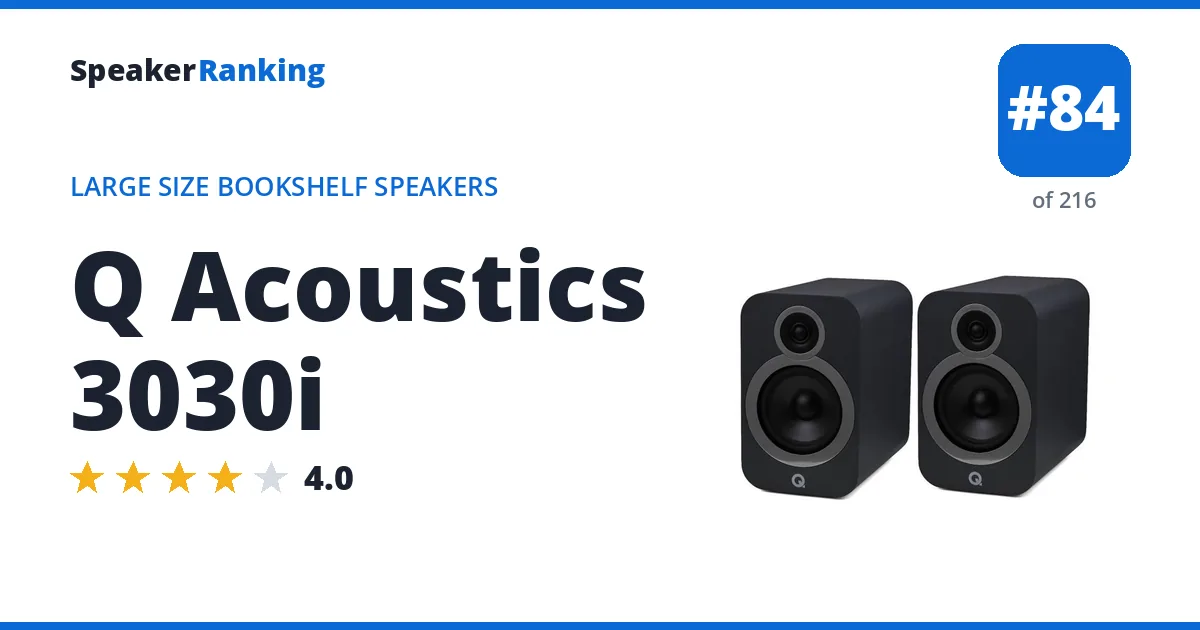
Pros: A two-way standmount with a 6.5” woofer and 0.9” tweeter in a braced cabinet, rated at 88dB. The only Spinorama data, digitized from a third-party chart, shows a listening window within 2.3dB from 300Hz to 5kHz and low on-axis deviation (0.44), with bass to 69.0Hz (-3dB) and about 41Hz (-10dB). Preference score 4.97, rising to 7.28 with an ideal subwoofer. Measured bass extension of 69.0Hz (-3dB).
Cons: That measurement is low quality, so the details are less certain than a full Klippel or anechoic test. Directivity is only average (3.29dB directivity index deviation). Replaced by the Q Acoustics 3030c. Discontinued.
Full Q Acoustics 3030i review and specifications →
| Released | Mar 2020 (6 years ago) |
|---|---|
| Bass Extension (-10dB) | about 41.1Hz (measured, third-party data via spinorama.org) |
| Bass Extension (-3dB) | 69.0Hz (measured, third-party data via spinorama.org) |
| DIY Kit | No |
| Dimensions | 12.8”H x 7.9”W x 13”D (325 x 200 x 329 mm) |
| Drivers | 0.9” (22mm) tweeter, 6.5” (165mm) mid/bass driver |
| Frequency Response | 46Hz-30kHz (manufacturer specified) |
| Impedance | 6 ohms nominal, 4 ohms minimum (manufacturer specified) |
| Sensitivity | 88dB (manufacturer specified) |
| Spinorama Preference Score | 4.97 |
| Spinorama Preference Score with Perfect Sub | 7.28 |
| Weight | 14.1 lbs (6.4 kg) each |
| Woofer Cabinet | ported |
- Reviews, Comparisons and Sound Samples
 Q Acoustics 5020: $1,199.00 per pair Amazon $1,199.00 eBay
Same family: the Q Acoustics 5010 (smaller bookshelf, ranked higher, estimated 3.5/5), the Q Acoustics 5040 (smaller floorstanding, rated 4.1/5), the Q Acoustics 5050 (larger floorstanding, estimated 4.3/5) and the Q Acoustics 5090 (center, estimated 3.7/5).
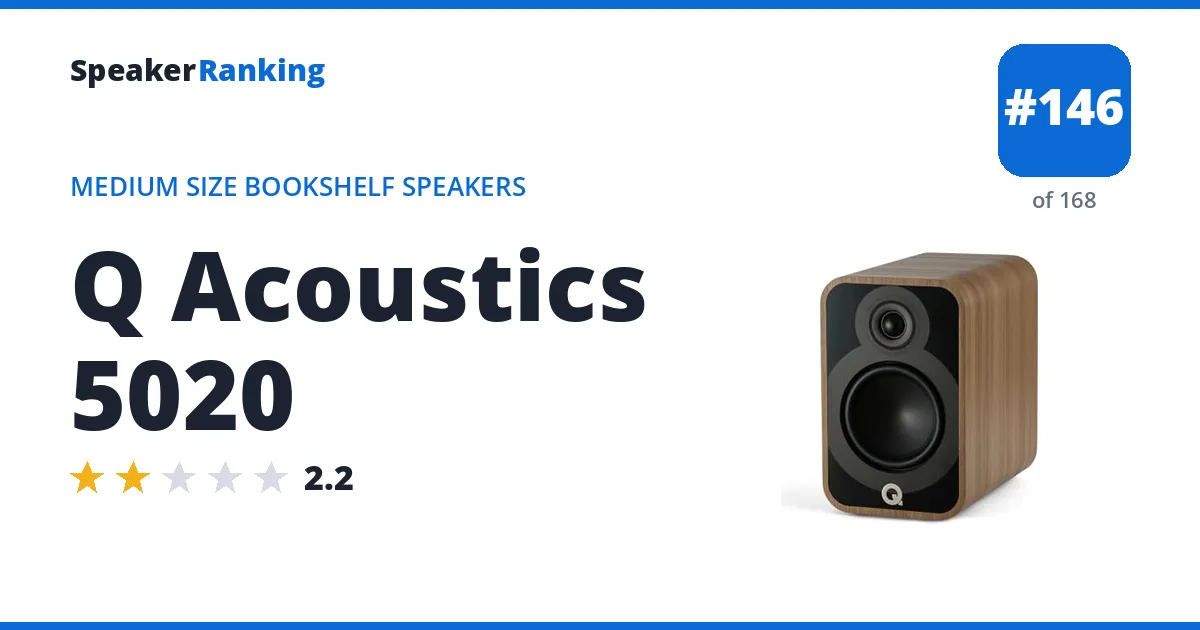
Pros: Attractively finished compact standmount with a 5-inch Continuous Curved Cone woofer and carefully engineered cabinet details. Erin found distortion well controlled at normal levels: below 1% down to about 50Hz at 86dB/1m. Its 87dB measured sensitivity is unremarkable rather than hard to drive, and it maintains acceptable output for typical 80-85dB listening. The rear port can be plugged for placement flexibility. Measured bass extension of 103Hz (-3dB), with a measured sensitivity of 87.1dB.
Cons: Erin found the tonal balance distinctly too crisp, forward and treble-heavy: the top end is roughly 3-5dB elevated while the 1-3kHz region is recessed, so vocals change level unnaturally as they move through their range. The shallow woofer crossover and steeper tweeter slope contribute to the off-axis discontinuity, while the port has a strong 1kHz resonance. Bass is limited: Erin measured F3 103Hz and F10 48Hz; at 96dB distortion reaches about 3% by 100Hz, and he bottomed the woofer when pushed hard. He preferred the less-expensive Q Acoustics 3020i’s linearity and did not recommend the 5020 for neutral listening without EQ.
Full Q Acoustics 5020 review and specifications →
| Released | Apr 2023 (3 years ago) |
|---|---|
| Bass Extension (-10dB) | 48Hz (measured, Erin’s Audio Corner) |
| Bass Extension (-3dB) | 103Hz (measured, Erin’s Audio Corner) |
| Crossover Frequency | 2.5kHz (manufacturer specified) |
| DIY Kit | No |
| Dimensions | 11.2”H x 7.1”W x 11.5”D |
| Drivers | 5” (125mm) C3 mid/bass driver, 1” (25mm) tweeter |
| Frequency Response | 53Hz - 30kHz (-6dB, manufacturer specified) |
| Impedance | 6 ohms nominal, 3.3 ohms minimum (manufacturer specified) |
| Recommended Power | 25W - 100W (manufacturer specified) |
| Sensitivity | 87.1dB (2.83V/1m, measured, Erin’s Audio Corner; 87.9dB manufacturer specified) |
| Spinorama Preference Score | 3.63 |
| Spinorama Preference Score with Perfect Sub | 6.55 |
| Weight | 15.4 lbs (7.0 kg) each |
| Woofer Cabinet | rear-ported |
- Links
- Reviews, Comparisons and Sound Samples
- Head-to-Head Comparisons
- Q Acoustics 5020 vs Verdant Audio Bambusa AL-1
- Q Acoustics 5020 vs Micca RB42
- Q Acoustics 5020 vs JBL Stage A130
- Q Acoustics 5020 vs Fluance Signature HFS
- Q Acoustics 5020 vs JBL Control 1 Pro
- Q Acoustics 5020 vs Polk T15
- Q Acoustics 5020 vs Q Acoustics 3020i
- Q Acoustics 5020 vs Definitive Technology ProMonitor 1000
- See all 47 comparisons