Short answer: the KEF Q100 for even-handed imaging; the Q Acoustics 5020 is the brighter, more forward option, though neither ranks well in its class. The 5020 is an attractively finished compact standmount with a 5-inch Continuous Curved Cone woofer, but Erin found it too crisp: the top end runs roughly 3-5dB elevated while 1-3kHz is recessed, so vocals change level unnaturally. The Q100’s Uni-Q shows a 700Hz-1.5kHz lift and a notch around 1.4kHz. Both are rated below 3.0/5 among the 90 bookshelf speakers, and the Philharmonic Ceramic Mini, ranked #2 at $900, is a better place to start if sound quality matters.
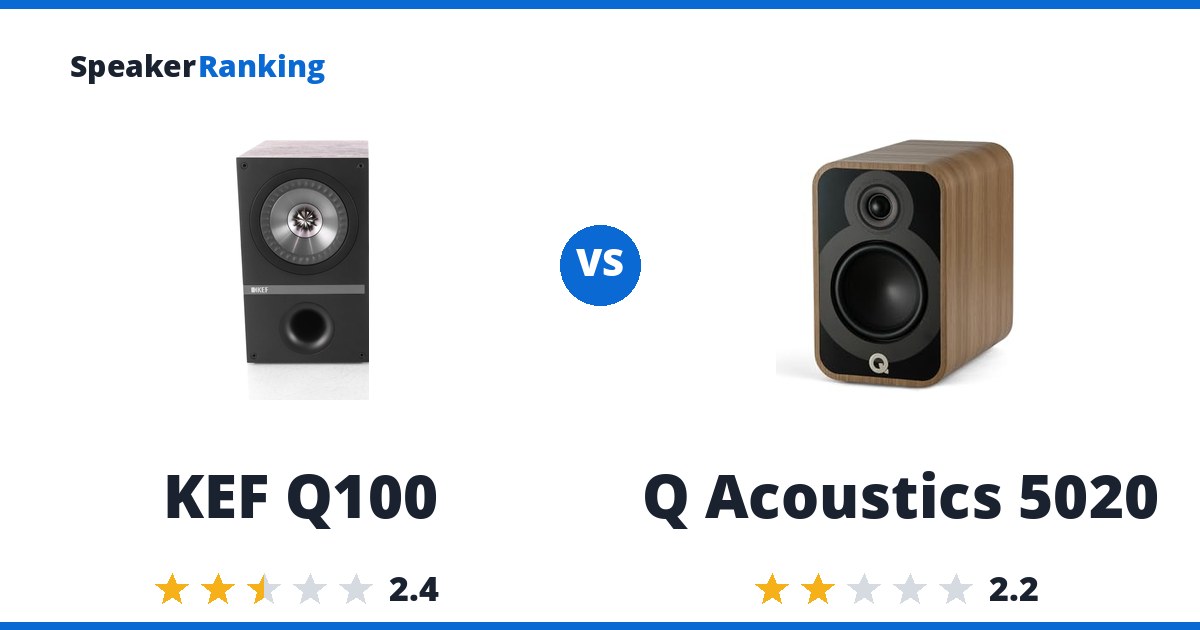
Buy the Q Acoustics 5020 if you want one new; the KEF Q100 is discontinued, so only look for it used.
Want more options? Browse the full Passive Home rankings.
Specifications Side By Side
| KEF Q100 | Q Acoustics 5020 | |
|---|---|---|
| Price | $550 per pair Discontinued | $1,199.00 per pair |
| Ranked | #71 of 90 in Medium Size Bookshelf Speakers | #76 of 90 in Medium Size Bookshelf Speakers |
| Bass Extension (-3dB) | 85Hz (measured, Audio Science Review) | 103Hz (measured, Erin’s Audio Corner) |
| Bass Extension (-10dB) | 65Hz (measured, Audio Science Review) | 48Hz (measured, Erin’s Audio Corner) |
| Sensitivity | 85dB (2.83V/1m, measured, Audio Science Review) | 87.1dB (2.83V/1m, measured, Erin’s Audio Corner; 87.9dB manufacturer specified) |
| Impedance | 8 ohms nominal | 6 ohms nominal, 3.3 ohms minimum (manufacturer specified) |
| Frequency Response | 49Hz - 40kHz (+/-3dB) (Manufacturer specified) | 53Hz - 30kHz (-6dB, manufacturer specified) |
| Drivers | 5.25” Uni-Q aluminum coaxial driver, 1” aluminum dome tweeter | 5” (125mm) C3 mid/bass driver, 1” (25mm) tweeter |
| Weight | 13 lbs (5.9 kg) each | 15.4 lbs (7.0 kg) each |
| Dimensions | 11.8”H x 7.1”W x 10.7”D (300 x 180 x 272 mm) | 11.2”H x 7.1”W x 11.5”D |
| Woofer Cabinet | ported, rear | rear-ported |
| Spinorama Preference Score | 4.96 (spinorama.org) | 3.63 |
| Spinorama Preference Score with Perfect Sub | 7.24 (spinorama.org) | 6.55 |
| DIY Kit | No | No |
| Crossover Frequency | - | 2.5kHz (manufacturer specified) |
| Recommended Power | - | 25W - 100W (manufacturer specified) |
Related Speaker Comparisons
How KEF Q100 compares with other leading options:
- KEF Q100 vs Ascend Sierra 1 v2
- KEF LS50 Meta vs KEF Q100
- KEF Q100 vs Arendal 1961 Monitor
- KEF Q100 vs Revel M105
- KEF Q100 vs Klipsch RP-500M II
Prices on this page were last checked October 2, 2026 at 10:18 PM UTC. Product prices and availability are accurate as of that date/time and are subject to change; the price and availability shown on Amazon at the time of purchase will apply to the purchase of this product.
As an eBay Partner, we may be compensated if you make a purchase.
The Two Speakers In Full
 KEF Q100: $550 per pair Discontinued eBay
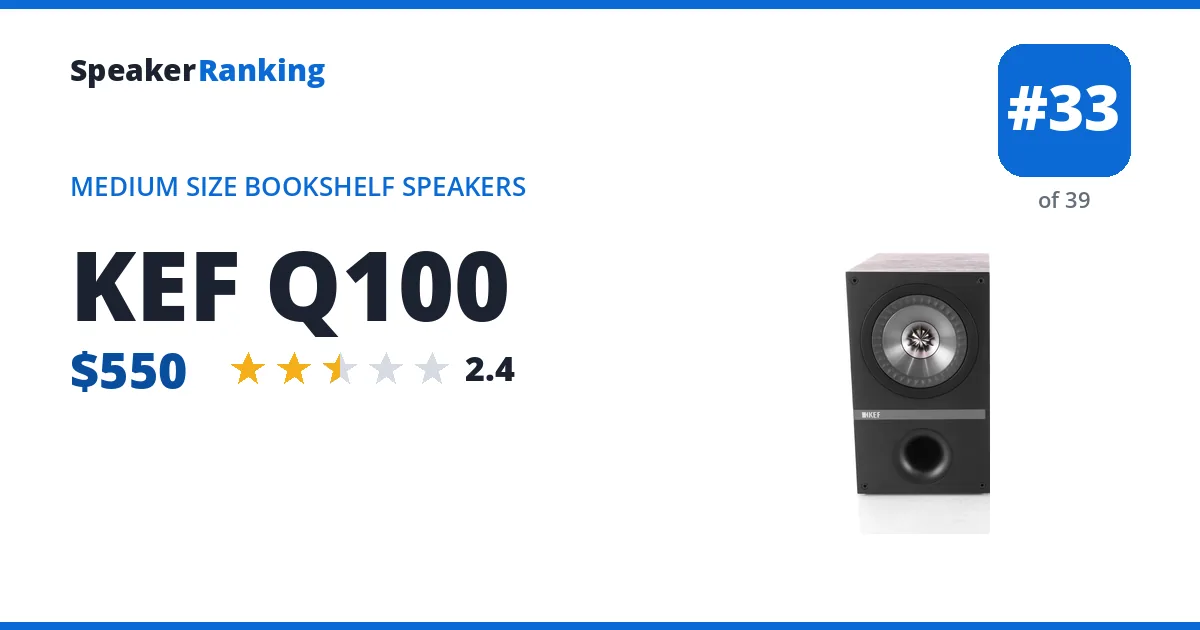
Newer model: the KEF Q1 Meta, ranked higher, rated 3.6/5.
Pros: 5.25” Uni-Q coaxial driver keeps the tweeter and woofer point-source aligned for consistent imaging. 86dB sensitivity is reasonably easy to drive. Measured bass extension of 85Hz (-3dB), with a measured sensitivity of 85dB.
Cons: CEA2034 spinorama shows broad, audible deviations from flat rather than narrow peaks: a lift from 700Hz-1.5kHz and again from 5kHz up, plus a cancellation notch around 1.4kHz from port/cabinet interaction. Bass sensitivity drops to about 80dB and impedance falls below 4 ohms in the bass, demanding a capable amplifier. The reviewer heard boomy, buzzing bass that improved somewhat with the port plugged, and could not recommend it, calling the famous reputation more about looks than sound. Discontinued.
Full KEF Q100 review and specifications →
| Bass Extension (-10dB) | 65Hz (measured, Audio Science Review) |
|---|---|
| Bass Extension (-3dB) | 85Hz (measured, Audio Science Review) |
| DIY Kit | No |
| Dimensions | 11.8”H x 7.1”W x 10.7”D (300 x 180 x 272 mm) |
| Drivers | 5.25” Uni-Q aluminum coaxial driver, 1” aluminum dome tweeter |
| Frequency Response | 49Hz - 40kHz (+/-3dB) (Manufacturer specified) |
| Impedance | 8 ohms nominal |
| Sensitivity | 85dB (2.83V/1m, measured, Audio Science Review) |
| Spinorama Preference Score | 4.96 (spinorama.org) |
| Spinorama Preference Score with Perfect Sub | 7.24 (spinorama.org) |
| Weight | 13 lbs (5.9 kg) each |
| Woofer Cabinet | ported, rear |
- Reviews, Comparisons and Sound Samples
- Head-to-Head Comparisons
 Q Acoustics 5020: $1,199.00 per pair Amazon eBay
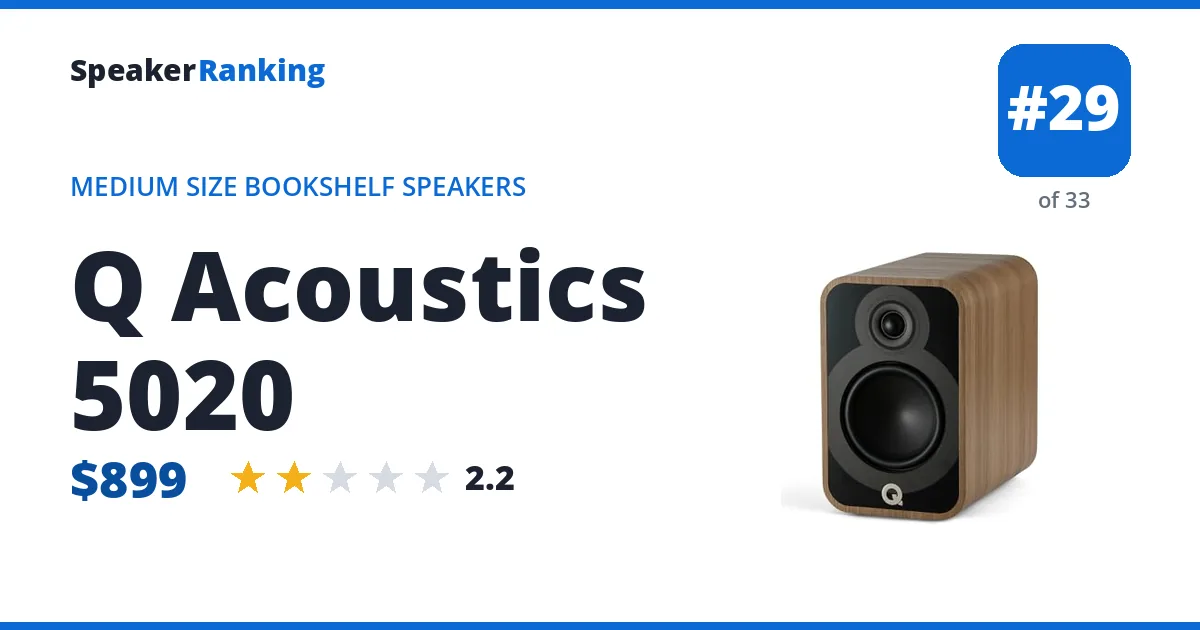
Pros: Attractively finished compact standmount with a 5-inch Continuous Curved Cone woofer and carefully engineered cabinet details. Erin found distortion well controlled at normal levels: below 1% down to about 50Hz at 86dB/1m. Its 87dB measured sensitivity is unremarkable rather than hard to drive, and it maintains acceptable output for typical 80-85dB listening. The rear port can be plugged for placement flexibility. Measured bass extension of 103Hz (-3dB), with a measured sensitivity of 87.1dB.
Cons: Erin found the tonal balance distinctly too crisp, forward and treble-heavy: the top end is roughly 3-5dB elevated while the 1-3kHz region is recessed, so vocals change level unnaturally as they move through their range. The shallow woofer crossover and steeper tweeter slope contribute to the off-axis discontinuity, while the port has a strong 1kHz resonance. Bass is limited: Erin measured F3 103Hz and F10 48Hz; at 96dB distortion reaches about 3% by 100Hz, and he bottomed the woofer when pushed hard. He preferred the less-expensive 3020i’s linearity and did not recommend the 5020 for neutral listening without EQ.
Full Q Acoustics 5020 review and specifications →
| Bass Extension (-10dB) | 48Hz (measured, Erin’s Audio Corner) |
|---|---|
| Bass Extension (-3dB) | 103Hz (measured, Erin’s Audio Corner) |
| Crossover Frequency | 2.5kHz (manufacturer specified) |
| DIY Kit | No |
| Dimensions | 11.2”H x 7.1”W x 11.5”D |
| Drivers | 5” (125mm) C3 mid/bass driver, 1” (25mm) tweeter |
| Frequency Response | 53Hz - 30kHz (-6dB, manufacturer specified) |
| Impedance | 6 ohms nominal, 3.3 ohms minimum (manufacturer specified) |
| Recommended Power | 25W - 100W (manufacturer specified) |
| Sensitivity | 87.1dB (2.83V/1m, measured, Erin’s Audio Corner; 87.9dB manufacturer specified) |
| Spinorama Preference Score | 3.63 |
| Spinorama Preference Score with Perfect Sub | 6.55 |
| Weight | 15.4 lbs (7.0 kg) each |
| Woofer Cabinet | rear-ported |
- Links
- Reviews, Comparisons and Sound Samples
- Head-to-Head Comparisons
- Q Acoustics 5020 vs Micca RB42
- Q Acoustics 5020 vs Verdant Audio Bambusa AL-1
- Q Acoustics 5020 vs JBL Stage A130
- Q Acoustics 5020 vs Fluance Signature HFS
- Q Acoustics 5020 vs Q Acoustics 3020i
- Q Acoustics 5020 vs JBL Control 1 Pro
- Q Acoustics 5020 vs Polk T15
- Q Acoustics 5020 vs ELAC Uni-Fi 2.0 UB52
- See all 42 comparisons