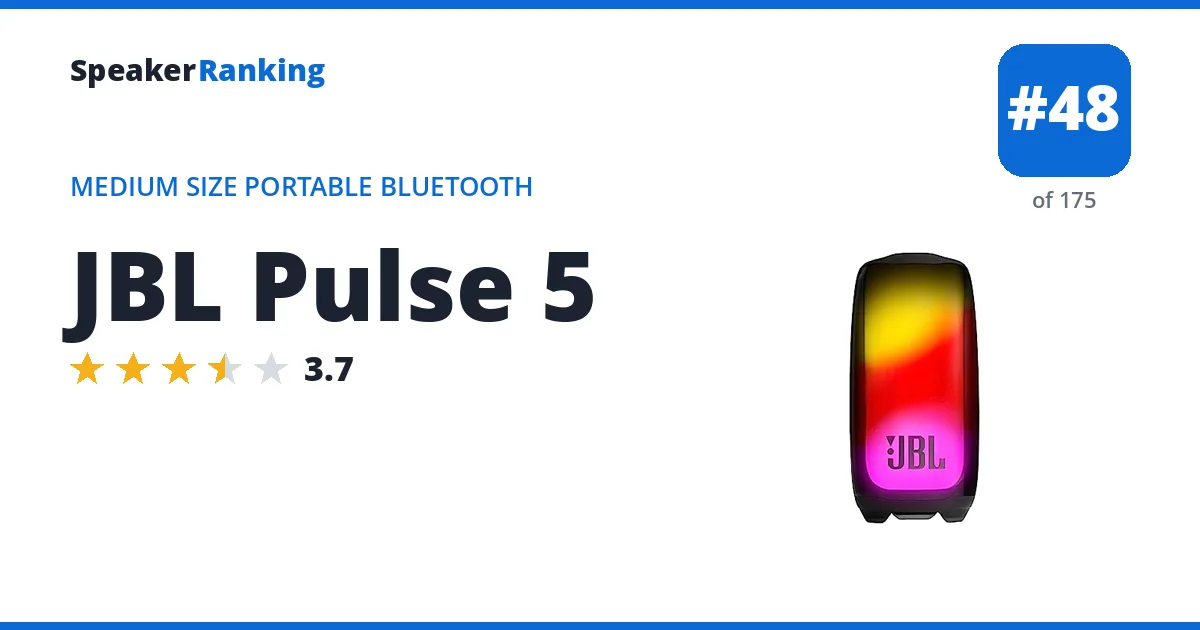
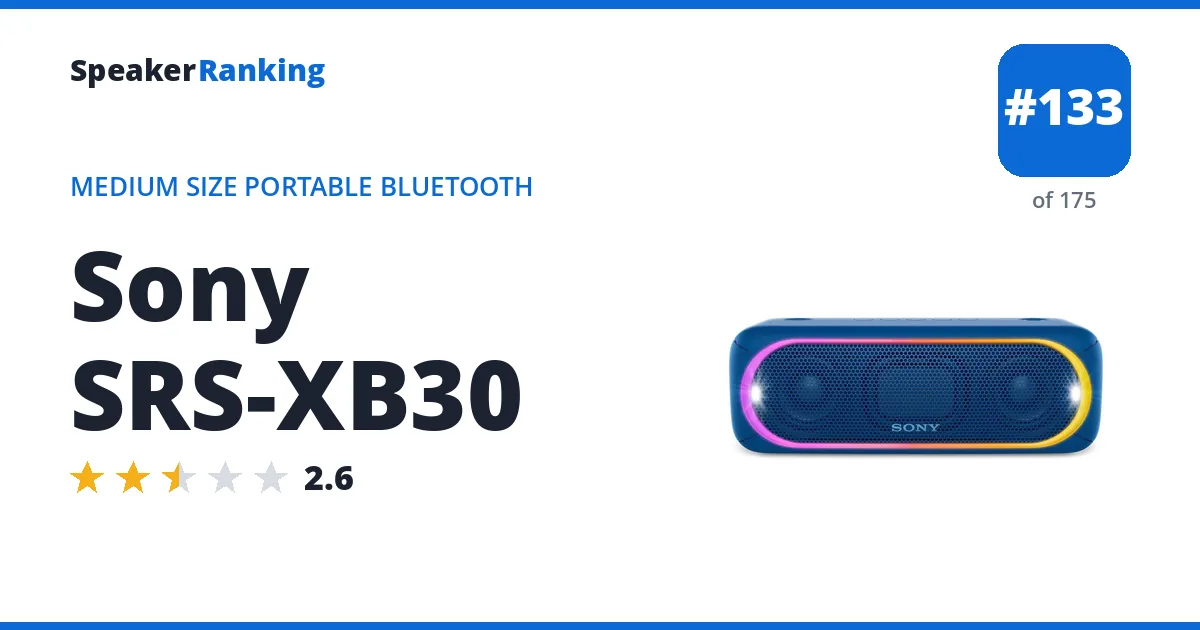
Short answer: the JBL Pulse 5. It ranks #48 of 175 medium speakers by sound quality (rated 3.7/5) at $219.99 and is still sold new; the Sony SRS-XB30 ranks #133 (rated 2.6/5) and is discontinued, so it is only an option used. The Sony SRS-XB30’s replacement, the Sony ULT Field 3, is rated 3.4/5 at $208.
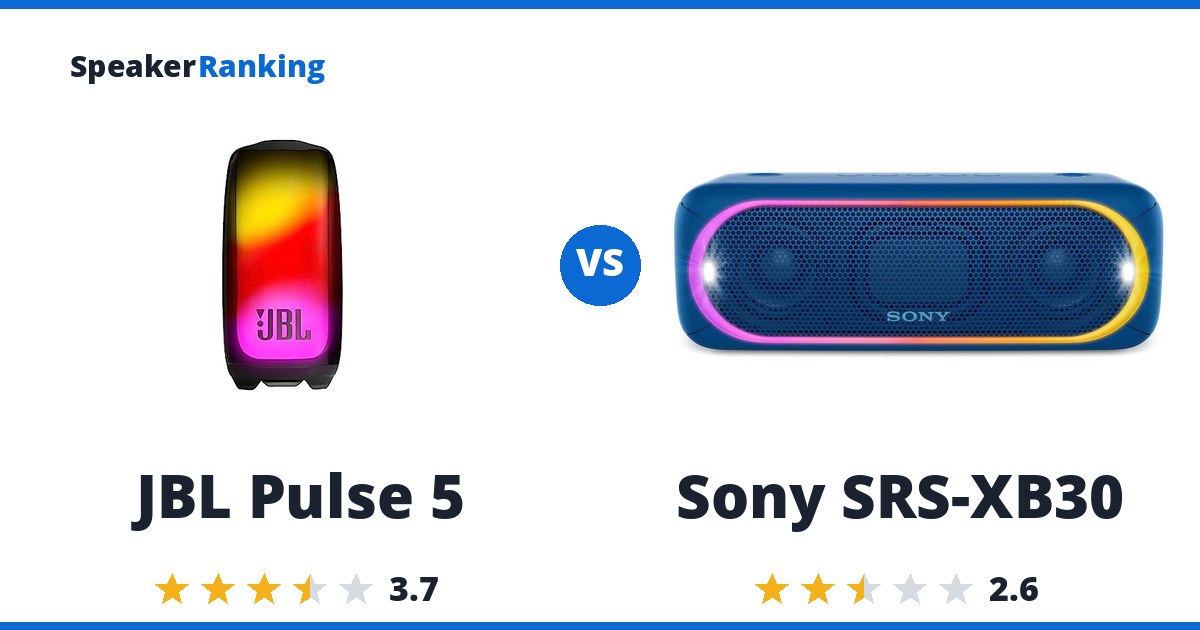
The JBL Pulse 5 is the better-sounding, tougher option. A cool light show, though it is not synced to the music like the Pulse 2. It is rated IP67 against IPX5 for the Sony SRS-XB30. It charges over USB-C rather than Micro USB. The tradeoff: Bass does not reach as deep as others, and the plastic scratches easily.
The Sony SRS-XB30 is the longer-running, lighter pick. A compact 2.2 lbs (1 kg) portable with IPX5 splash protection, aux input, LDAC/AAC support, Sony’s app, speakerphone capability, power-bank output, stereo pairing and Party Chain linking. It is rated for 24 hours of battery against 12 for the JBL Pulse 5. At 2.2 lbs (1 kg) it weighs noticeably less than the JBL Pulse 5 at 3.3 lbs (1.5 kg). It supports LDAC Bluetooth, which the JBL Pulse 5 lacks. Watch for: Independent lab listening rates music fidelity only fair: bass has impact but is boomy and lacks the deepest notes, while the midrange can sound hazy, muffled and grainy.
Buy the JBL Pulse 5. It is rated higher for sound quality and still sold new, while the Sony SRS-XB30 is discontinued.
Still deciding? The full Portable Bluetooth rankings cover every ranked option.
Specifications Side By Side
| JBL Pulse 5 | Sony SRS-XB30 | |
|---|---|---|
| Price | $219.99 | $199 Discontinued |
| Ranked | #48 of 175 in Medium Size Portable Bluetooth Speakers | #133 of 175 in Medium Size Portable Bluetooth Speakers |
| App | Yes | Yes (Sony Music Center) |
| Bass Extension (-10dB) | ~58Hz | 55Hz |
| Battery Life | 12 hours (Manufacturer specified) | 24 hours (Manufacturer specified) |
| EQ | Yes | Yes |
| IP Rating | IP67 | IPX5 |
| Party Mode | Yes (PartyBoost up to 100 speakers) | Yes (Partychain up to 100 speakers) |
| Stereo | No | Yes |
| Omnidirectional | Pointing up | No |
| Weight | 3.3 lbs (1500 g) | 2.2 lbs (1000 g) |
| Bluetooth | Yes | Yes |
| Bluetooth Codecs | SBC | SBC, AAC, LDAC |
| Bluetooth Version | 5.3 | 4.2 |
| Dimensions | 4.2” x 8.4” x 5.2” (107 x 214 x 131 mm) | 9” x 3.2” x 3.4” (228 x 82 x 86 mm) |
| Drivers | 64mm woofer, 16mm tweeter | 2x 48mm full-range drivers + 2x passive radiators |
| Frequency Response | 58Hz - 20kHz (Manufacturer specified) | - |
| Power Input | USB-C | Micro USB |
| Amplifier Power | 40W | 20W |
| Digital Aux Input | No | No |
| Lights | Yes | - |
| Aux Input | No | Yes |
| TWS | Yes | Yes |
| Strap | No | - |
| Built-in Microphone | - | Yes |
| Maximum SPL | - | 95dB (Manufacturer specified) |
Related Speaker Comparisons
How JBL Pulse 5 compares with other leading options:
- EarFun Uboom L vs JBL Pulse 5
- Soundcore Motion 300 vs JBL Pulse 5
- Soundcore Motion+ vs JBL Pulse 5
- Soundcore Boost “upgraded” 2021 vs JBL Pulse 5
- Minirig 4 vs JBL Pulse 5
Prices on this page were last checked October 12, 2026 at 4:13 PM UTC. Product prices and availability are accurate as of that date/time and are subject to change; the price and availability shown on Amazon at the time of purchase will apply to the purchase of this product.
As an eBay Partner, we may be compensated if you make a purchase.
The Two Speakers In Full
 JBL Pulse 5: $219.99 Amazon $219.99 eBay
Newer model: the JBL Pulse 6, ranked lower, estimated 3.7/5, released 2026. It adds USB audio input, AAC and LC3. Water resistance goes from IP67 to IP68. See every JBL Pulse generation.
Pros: JBL Pulse 5 uses 64mm woofer, 16mm tweeter. Its 1500 g, claimed 12 hours (Manufacturer specified) battery life, IP67 protection and mono playback make it a practical option for its intended room or portable use. A cool light show, though it is not synced to the music like the Pulse 2. Measured bass extension of ~58Hz (-10dB).
Cons: Bass is limited by its ~58Hz specification. Bass does not reach as deep as others, and the plastic scratches easily.
Full JBL Pulse 5 review and specifications →
| Released | 2023 (3 years ago) |
|---|---|
| Amplifier Power | 40W |
| App | Yes |
| Aux Input | No |
| Bass Extension (-10dB) | ~58Hz |
| Battery Life | 12 hours (Manufacturer specified) |
| Bluetooth | Yes |
| Bluetooth Codecs | SBC |
| Bluetooth Version | 5.3 |
| Digital Aux Input | No |
| Dimensions | 4.2” x 8.4” x 5.2” (107 x 214 x 131 mm) |
| Drivers | 64mm woofer, 16mm tweeter |
| EQ | Yes |
| Frequency Response | 58Hz - 20kHz (Manufacturer specified) |
| IP Rating | IP67 |
| Lights | Yes |
| Omnidirectional | Pointing up |
| Party Mode | Yes (PartyBoost up to 100 speakers) |
| Power Input | USB-C |
| Stereo | No |
| Strap | No |
| TWS | Yes |
| Weight | 3.3 lbs (1500 g) |
- Links
- Reviews, Comparisons and Sound Samples
- M1MTechChannel: Welche JBL Partybox ist die BESTE ? Alle Partyboxen im Vergleich | 2026 More from M1MTechChannel →
- Techder Audios: JBL PULSE 5 VS JBL CHARGE 5 "LIGHTS VS BASS?!" More from techderaudios →
- Jay’s Straight Up Reviews & More: Bass Check 💣 Treblab HD-360, Ultimate Ears EpicBoom, Marshall Middleton & JBL Pulse 5. Boom or Bust? More from JaysStraightUpReviews →
- Head-to-Head Comparisons
 Sony SRS-XB30: $199 Discontinued eBay
Newer model: the Sony ULT Field 3, ranked higher, rated 3.4/5, released Apr 2025. See every Sony XB and ULT generation.
Pros: A compact 1kg portable with IPX5 splash protection, aux input, LDAC/AAC support, Sony’s app, speakerphone capability, power-bank output, stereo pairing and Party Chain linking. It reaches a useful 95dB maximum level and has a claimed 24-hour battery life at moderate volume, making it a convenient older outdoor option. Measured bass extension of 55Hz (-10dB).
Cons: Independent lab listening rates music fidelity only fair: bass has impact but is boomy and lacks the deepest notes, while the midrange can sound hazy, muffled and grainy. Its micro-USB charging and older Bluetooth 4.2 platform now feel dated, so it is best considered for features and used-market value rather than sound quality. Discontinued.
Full Sony SRS-XB30 review and specifications →
| Released | Mar 2017 (9 years ago) |
|---|---|
| Amplifier Power | 20W |
| App | Yes (Sony Music Center) |
| Aux Input | Yes |
| Bass Extension (-10dB) | 55Hz |
| Battery Life | 24 hours (Manufacturer specified) |
| Bluetooth | Yes |
| Bluetooth Codecs | SBC, AAC, LDAC |
| Bluetooth Version | 4.2 |
| Built-in Microphone | Yes |
| Digital Aux Input | No |
| Dimensions | 9” x 3.2” x 3.4” (228 x 82 x 86 mm) |
| Drivers | 2x 48mm full-range drivers + 2x passive radiators |
| EQ | Yes |
| IP Rating | IPX5 |
| Maximum SPL | 95dB (Manufacturer specified) |
| Omnidirectional | No |
| Party Mode | Yes (Partychain up to 100 speakers) |
| Power Input | Micro USB |
| Stereo | Yes |
| TWS | Yes |
| Weight | 2.2 lbs (1000 g) |
- Links
- Reviews, Comparisons and Sound Samples
- Head-to-Head Comparisons
- Sony SRS-XB30 vs Soundcore Flare 2
- Sony SRS-XB30 vs Teufel Rockster Go
- Sony SRS-XB30 vs W-King D8 Mini
- Sony SRS-XB30 vs Marshall Emberton II
- Sony SRS-XB30 vs Marshall Emberton III
- Sony SRS-XB30 vs B&O Beosound Explore
- Sony SRS-XB30 vs Bose SoundLink Color II
- Sony SRS-XB30 vs Tribit Stormbox Mini+
- See all 90 comparisons