Short answer: the Final Audio E3000, though neither ranks well in its class. Both are rated 2.6/5 for sound quality (#413 and #415 of 450 in-ear headphones), and the Final Audio E3000 costs $46.60 against $55 for the Tin HiFi T2 Evo, and with sound quality even, the cheaper one is the better buy. Both are rated below 3.0/5 among the 450 in-ear headphones, and the Intuaura Reference 2019, ranked #5 at $34.99, is a better place to start if sound quality matters.

What the Final Audio E3000 does well: Bass at 60 to 200 Hz sits about 5.5 dB above the Harman target in oratory1990’s measurement, and the low mids are lifted about 3.2 dB, giving a warm, full and weighty sound. The catch: The strong bass and low mid lift can muddy vocals, and presence from 3 to 6 kHz is down about 3 dB with a 3.7 dB dip near 4.5 kHz, so voices lack clarity.
Why pick the Tin HiFi T2 Evo: Listeners who want a neutral or bright presentation are the best match, with presence and treble lifted 2 to 3 dB for clear, crisp detail. The tradeoff: Sub-bass sits about 4 dB below target in hobbyist measurements on squig.link, so kick drums and synth bass lack depth.
Buy the Final Audio E3000. Both are rated the same for sound quality, and it costs $8.40 less than the Tin HiFi T2 Evo.
Looking for alternatives? See the complete Headphones rankings.
Specifications Side By Side
| Final Audio E3000 | Tin HiFi T2 Evo | |
|---|---|---|
| Price | $46.60 | $55.00 |
| Ranked | #413 of 450 in In-Ear Headphones | #415 of 450 in In-Ear Headphones |
| Form Factor | In-ear | In-ear |
| Harman Preference Score | 57 (measured by oratory1990, via AutoEQ) | 57 (measured by crinacle, via AutoEQ) |
| Deviation From Target | 3.40 dB standard deviation | 3.20 dB standard deviation |
| Tonal Tilt | -0.57 (negative is warmer, positive brighter) | +1.31 (negative is warmer, positive brighter) |
| Sub-bass Extension | Within 6 dB of target down to 20 Hz (-3.8 dB at 30 Hz) | Within 6 dB of target down to 20 Hz (-5.1 dB at 30 Hz) |
| Connection | Wired | Wired |
| Driver Type | Dynamic | Dynamic |
| Drivers | 1 x 6.4mm dynamic | 1 x 10mm dynamic |
| Impedance | 16 ohms | 32 ohms |
| Sensitivity | 100 dB/mW | 93 dB @ 1kHz (0.126V) |
| Back | Closed | Closed |
| Frequency Response | - | 10Hz - 20kHz (Manufacturer specified) |
Related Headphone Comparisons
How Final Audio E3000 compares with other leading options:
- KZ AS10 vs Final Audio E3000
- 1MORE Triple Driver vs Final Audio E3000
- Final Audio E3000 vs SoundMAGIC E11
- Final Audio E3000 vs Tin HiFi T2
- Tin HiFi T2 Evo vs Tin HiFi T2
Prices on this page were last checked October 11, 2026 at 4:59 PM UTC. Product prices and availability are accurate as of that date/time and are subject to change; the price and availability shown on Amazon at the time of purchase will apply to the purchase of this product.
As an eBay Partner, we may be compensated if you make a purchase.
The Two Headphones In Full
 Final Audio E3000: $46.60 Amazon eBay
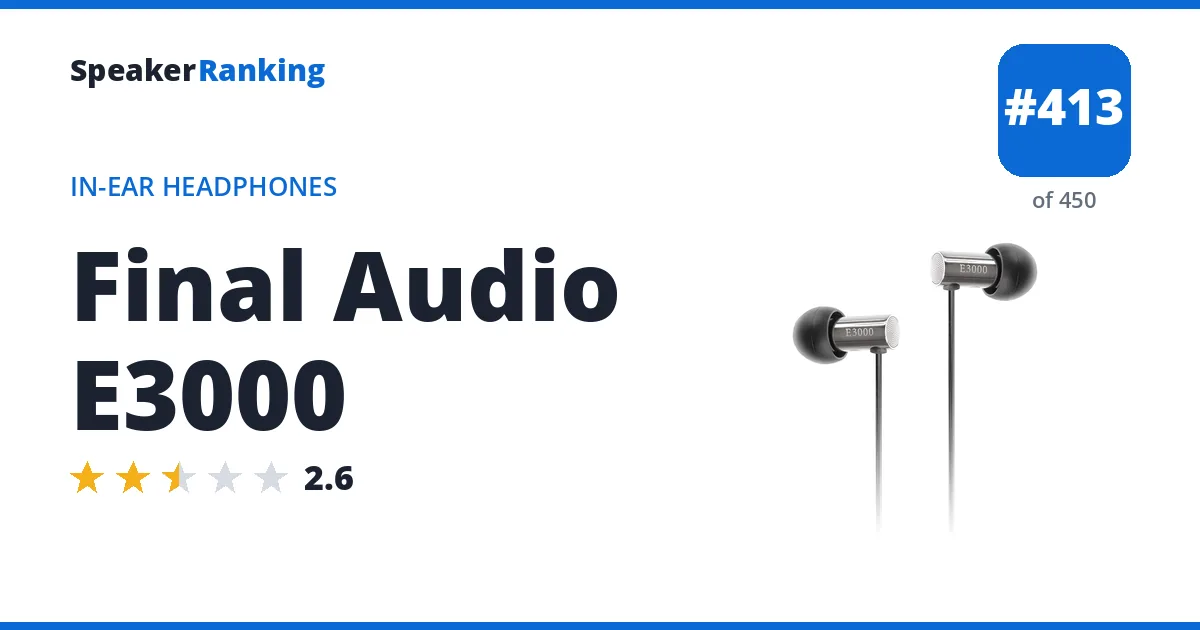
Pros: Bass at 60 to 200 Hz sits about 5.5 dB above the Harman target in oratory1990’s measurement, and the low mids are lifted about 3.2 dB, giving a warm, full and weighty sound. Treble from 6 to 10 kHz is only 1.6 dB over target, so highs stay fairly gentle and non-fatiguing. The single 6.4mm dynamic driver is easy to drive at 16 ohms and 100 dB/mW, and the price is low.
Cons: The strong bass and low mid lift can muddy vocals, and presence from 3 to 6 kHz is down about 3 dB with a 3.7 dB dip near 4.5 kHz, so voices lack clarity. A preference score of 57 with a 3.4 dB deviation shows the balance is far from target. The KZ AS10, KZ DQ6S and SoundMAGIC E50C are all rated higher.
Full Final Audio E3000 review and specifications →
| Released | 2017 (9 years ago) |
|---|---|
| Back | Closed |
| Connection | Wired |
| Deviation From Target | 3.40 dB standard deviation |
| Driver Type | Dynamic |
| Drivers | 1 x 6.4mm dynamic |
| Form Factor | In-ear |
| Harman Preference Score | 57 (measured by oratory1990, via AutoEQ) |
| Impedance | 16 ohms |
| Sensitivity | 100 dB/mW |
| Sub-bass Extension | Within 6 dB of target down to 20 Hz (-3.8 dB at 30 Hz) |
| Tonal Tilt | -0.57 (negative is warmer, positive brighter) |
EQ preset to match the Harman target
Set a preamp of -4.9 dB, then add these filters in any parametric equalizer (Wavelet, Equalizer APO, Peace, or a player with parametric EQ). Calculated by AutoEQ from its measured frequency response.
| Filter | Frequency | Gain | Q |
|---|---|---|---|
| Low shelf | 105 Hz | +14.3 dB | 0.70 |
| Peak | 53 Hz | -13.7 dB | 0.28 |
| Peak | 5,187 Hz | +4.0 dB | 1.54 |
| Peak | 1,381 Hz | +2.9 dB | 0.32 |
| Peak | 6,770 Hz | -2.0 dB | 1.49 |
| High shelf | 10,000 Hz | +0.3 dB | 0.70 |
| Peak | 1,242 Hz | -0.9 dB | 2.59 |
| Peak | 810 Hz | +0.7 dB | 2.40 |
| Peak | 361 Hz | -0.2 dB | 1.45 |
| Peak | 2,087 Hz | +0.5 dB | 3.04 |
- Reviews, Comparisons and Sound Samples
- Head-to-Head Comparisons
 Tin HiFi T2 Evo: $55.00 Amazon eBay

Pros: Listeners who want a neutral or bright presentation are the best match, with presence and treble lifted 2 to 3 dB for clear, crisp detail. The largest peak is a moderate 5.3 dB near 8.4 kHz and no deep dips appear between 1.5 and 12 kHz. It is an inexpensive single dynamic driver design.
Cons: Sub-bass sits about 4 dB below target in hobbyist measurements on squig.link, so kick drums and synth bass lack depth. The bright tilt can make harsh recordings fatiguing, and the Final Audio E3000 matches it in rating for less money.
Full Tin HiFi T2 Evo review and specifications →
| Released | Sep 2021 (5 years ago) |
|---|---|
| Back | Closed |
| Connection | Wired |
| Deviation From Target | 3.20 dB standard deviation |
| Driver Type | Dynamic |
| Drivers | 1 x 10mm dynamic |
| Form Factor | In-ear |
| Frequency Response | 10Hz - 20kHz (Manufacturer specified) |
| Harman Preference Score | 57 (measured by crinacle, via AutoEQ) |
| Impedance | 32 ohms |
| Sensitivity | 93 dB @ 1kHz (0.126V) |
| Sub-bass Extension | Within 6 dB of target down to 20 Hz (-5.1 dB at 30 Hz) |
| Tonal Tilt | +1.31 (negative is warmer, positive brighter) |
EQ preset to match the Harman target
Set a preamp of -6.0 dB, then add these filters in any parametric equalizer (Wavelet, Equalizer APO, Peace, or a player with parametric EQ). Calculated by AutoEQ from its measured frequency response.
| Filter | Frequency | Gain | Q |
|---|---|---|---|
| Low shelf | 105 Hz | +6.1 dB | 0.70 |
| Peak | 5,329 Hz | -5.3 dB | 1.82 |
| Peak | 766 Hz | +3.1 dB | 1.12 |
| Peak | 155 Hz | -1.4 dB | 0.80 |
| Peak | 9,585 Hz | +2.1 dB | 2.63 |
| High shelf | 10,000 Hz | -4.3 dB | 0.70 |
| Peak | 2,410 Hz | +1.3 dB | 2.63 |
| Peak | 1,331 Hz | -1.1 dB | 3.32 |
| Peak | 3,617 Hz | -0.4 dB | 3.19 |
| Peak | 978 Hz | +0.6 dB | 4.33 |
- Reviews, Comparisons and Sound Samples
- Head-to-Head Comparisons