Short answer: the Yamaha HS3, though neither ranks well in its class. Both are rated 2.9/5 for sound quality (#40 and #37 of 47 powered bookshelf speakers), and the Yamaha HS3 costs $229.99 against $299.99 for the Fiio SP3, and with sound quality even, the cheaper one is the better buy. Both are rated below 3.0/5 among the 47 powered bookshelf speakers, so if sound quality matters, consider the ADAM Audio D3v instead, ranked #3 at $349.99.
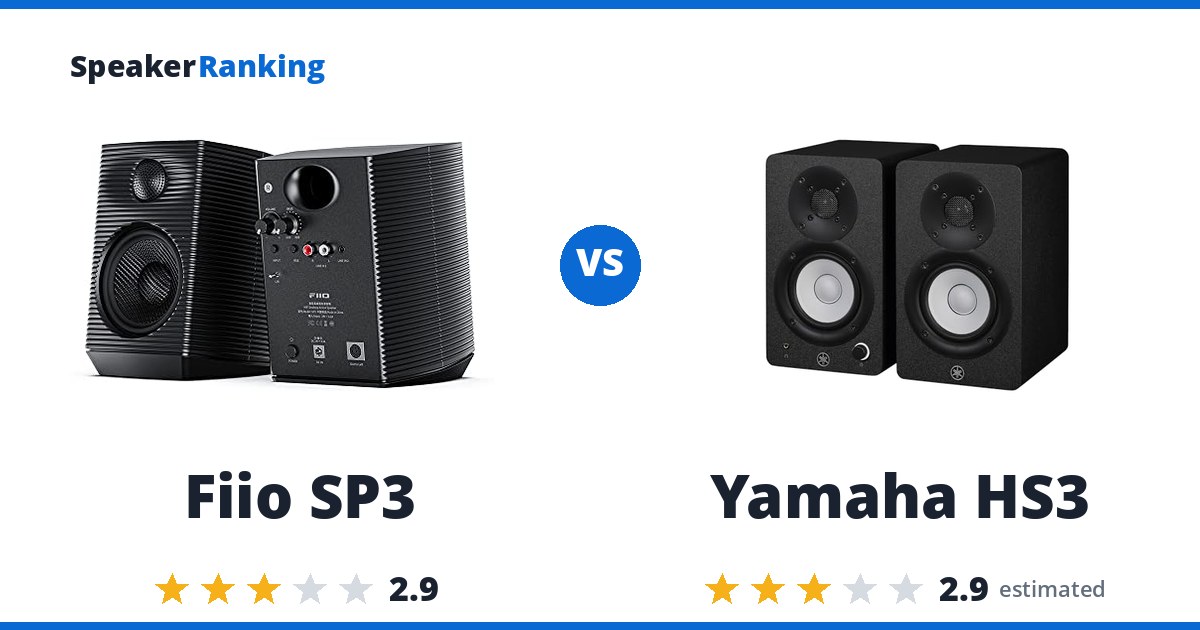
What the Fiio SP3 does well: Compact cabinets and angled bases fit a small desk. Watch for: The response rises strongly toward the treble, about 1.13dB per octave, with a recessed midrange and problematic crossover behavior.
Why pick the Yamaha HS3: Compact desktop studio monitor system translating the iconic Yamaha HS white-cone aesthetic and neutral voicing into an ultra-compact footprint. The tradeoff: Rating estimated based on acoustic specs and larger HS-series (Yamaha HS5, Yamaha HS7, Yamaha HS8) laboratory data.
Buy the Yamaha HS3. Both are rated the same for sound quality, and it costs $70 less than the Fiio SP3.
About the ratings: the Yamaha HS3’s rating is estimated from measured siblings and predecessors rather than its own measurements, with a likely range of 2.7 to 3.1, so this verdict could change once it is measured.
Looking for alternatives? See the complete Powered Home rankings.
Specifications Side By Side
| Fiio SP3 | Yamaha HS3 | |
|---|---|---|
| Price | $299.99 per pair | $229.99 per pair |
| Ranked | #37 of 47 in Small Size Powered Bookshelf Speakers | #40 of 47 in Small Size Powered Bookshelf Speakers Estimated |
| Drivers | 3.5” carbon fiber midwoofer, 1” silk dome tweeter | 0.75” soft dome tweeter, 3.5” cone woofer |
| Amplifier Power | 40W total (30W midwoofer + 10W tweeter) | 52W (26W + 26W dynamic) |
| Dimensions | 6.4”H x 4.7”W x 5.2”D (163 x 120 x 132 mm) | 8.8” x 5.2” x 7.4” (223 x 132 x 189 mm) |
| Weight | 4.3 lbs (1.95 kg) each | 6.2 lbs (2.8 kg) (pair total) |
| Bass Extension (-3dB) | 59Hz (measured, Erin’s Audio Corner) | - |
| Bass Extension (-10dB) | 53Hz (measured, Erin’s Audio Corner) | - |
| Inputs | AUX, RCA | - |
| Spinorama Preference Score | 3.56 | - |
| Spinorama Preference Score with Perfect Sub | 6.17 | - |
| XLR Input | No | - |
| RCA Input | Yes | - |
| TRS Input | No | - |
| Optical Input | No | - |
| Coaxial Input | No | - |
| USB Input | No | - |
| HDMI Input | No | - |
| AES Input | No | - |
| Aux Input | Yes | - |
| Bluetooth | No | No |
| Frequency Response | 65Hz - 20kHz (±2dB) (Manufacturer specified) | 70Hz - 22kHz (-10dB) |
| Crossover Frequency | - | 3.2kHz |
Related Speaker Comparisons
More worthwhile head-to-heads for Fiio SP3:
- Genelec 8010A vs Fiio SP3
- ADAM Audio D3v vs Fiio SP3
- Cambridge Audio L/R S vs Fiio SP3
- IK Multimedia iLoud Micro Monitor vs Fiio SP3
- Edifier M60 vs Fiio SP3
Prices on this page were last checked October 11, 2026 at 4:59 PM UTC. Product prices and availability are accurate as of that date/time and are subject to change; the price and availability shown on Amazon at the time of purchase will apply to the purchase of this product.
As an eBay Partner, we may be compensated if you make a purchase.
The Two Speakers In Full
 Fiio SP3: $299.99 per pair Amazon eBay
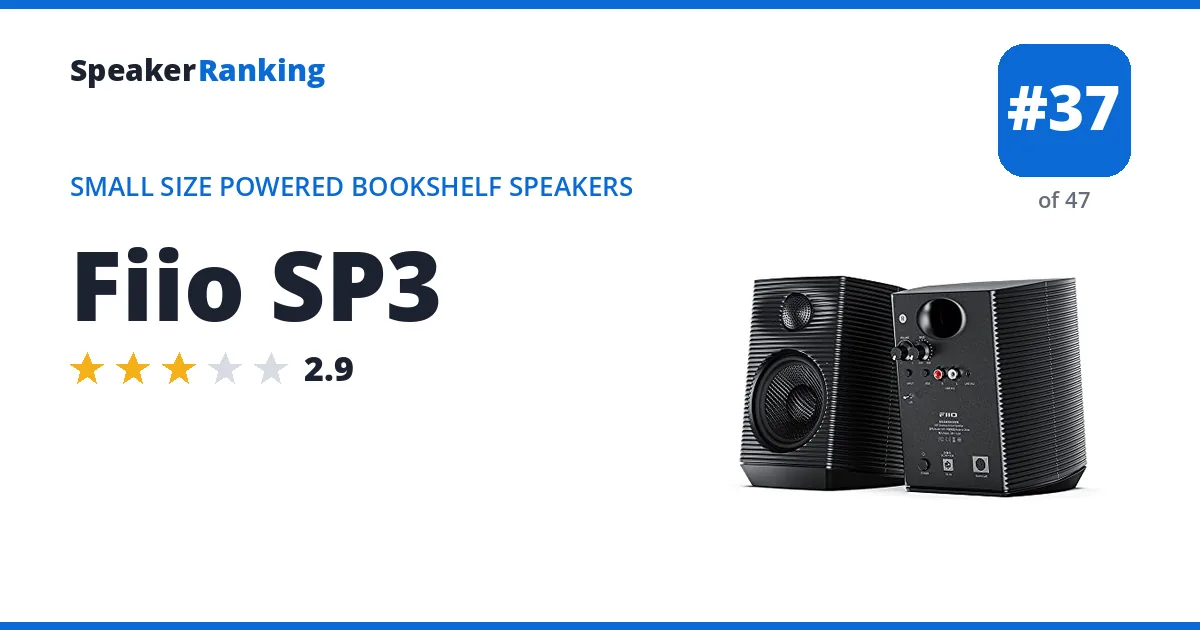
Pros: Compact cabinets and angled bases fit a small desk. The existing review found useful dynamic capability at higher frequencies, so lack of output is not the only issue. Erin’s Klippel data shows a measured -3dB bass point around 60Hz, deeper than several similarly sized alternatives. Measured bass extension of 59Hz (-3dB).
Cons: The response rises strongly toward the treble, about 1.13dB per octave, with a recessed midrange and problematic crossover behavior. Its 3.56 standalone and 6.17 ideal-subwoofer scores do not capture the full practical impact of the review’s boomy bass and off-axis tonal problems. Changing angle trades one coloration for another. Those audible limitations weigh against it more heavily than its numerical score or build quality.
Full Fiio SP3 review and specifications →
| Released | Jan 2023 (3 years ago) |
|---|---|
| AES Input | No |
| Amplifier Power | 40W total (30W midwoofer + 10W tweeter) |
| Aux Input | Yes |
| Bass Extension (-10dB) | 53Hz (measured, Erin’s Audio Corner) |
| Bass Extension (-3dB) | 59Hz (measured, Erin’s Audio Corner) |
| Bluetooth | No |
| Coaxial Input | No |
| Dimensions | 6.4”H x 4.7”W x 5.2”D (163 x 120 x 132 mm) |
| Drivers | 3.5” carbon fiber midwoofer, 1” silk dome tweeter |
| Frequency Response | 65Hz - 20kHz (±2dB) (Manufacturer specified) |
| HDMI Input | No |
| Inputs | AUX, RCA |
| Optical Input | No |
| RCA Input | Yes |
| Spinorama Preference Score | 3.56 |
| Spinorama Preference Score with Perfect Sub | 6.17 |
| TRS Input | No |
| USB Input | No |
| Weight | 4.3 lbs (1.95 kg) each |
| XLR Input | No |
- Links
- Reviews, Comparisons and Sound Samples
- Head-to-Head Comparisons
 Yamaha HS3: $229.99 per pair Estimated Amazon eBay
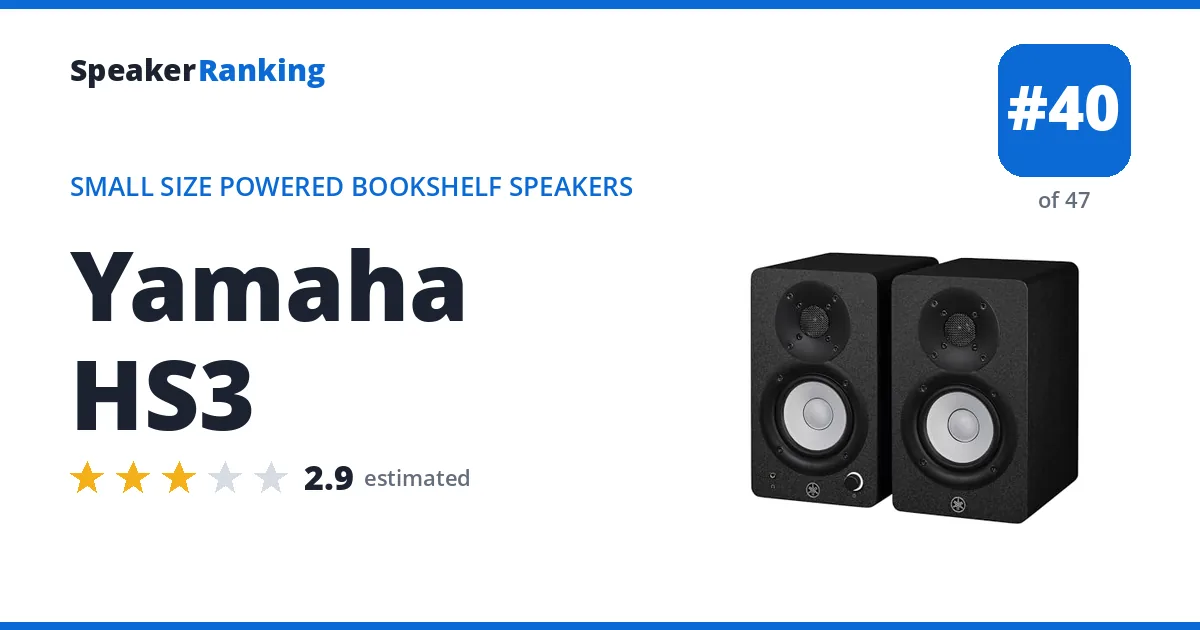
Same family: the Yamaha HS4 (larger bookshelf, ranked higher, estimated 3.1/5), the Yamaha HS5 (larger bookshelf, rated 3.6/5), the Yamaha HS7 (larger bookshelf, rated 3.9/5), the Yamaha HS8 (larger bookshelf, rated 4.4/5) and the Yamaha HS8S (subwoofer, rated 3/5).
Pros: Compact desktop studio monitor system translating the iconic Yamaha HS white-cone aesthetic and neutral voicing into an ultra-compact footprint. Features a 3.5-inch woofer and 0.75-inch dome tweeter driven by a Class-D 26W + 26W amplifier. Equipped with rear Room Control (0/-2/-4dB below 500Hz) and High Trim (0/±2dB above 2kHz) switches to correct boundary proximity buildup on desktop surfaces.
Cons: Rating estimated based on acoustic specs and larger HS-series (Yamaha HS5, Yamaha HS7, Yamaha HS8) laboratory data. Small 3.5-inch woofer and rear Twisted Flare port roll off sharply below 70Hz (-10dB), with limited maximum SPL compared to full nearfield studio monitors.
Full Yamaha HS3 review and specifications →
| Released | Nov 2023 (2 years ago) |
|---|---|
| Amplifier Power | 52W (26W + 26W dynamic) |
| Bluetooth | No |
| Crossover Frequency | 3.2kHz |
| Dimensions | 8.8” x 5.2” x 7.4” (223 x 132 x 189 mm) |
| Drivers | 0.75” soft dome tweeter, 3.5” cone woofer |
| Frequency Response | 70Hz - 22kHz (-10dB) |
| Weight | 6.2 lbs (2.8 kg) (pair total) |
- Links
- Reviews, Comparisons and Sound Samples
- No independent measurement review is linked for this model; it is ranked from hands-on listening and comparison against similarly priced speakers.
- Head-to-Head Comparisons