Short answer: the Anker Soundcore Space One. It ranks #161 of 216 over-ear headphones by sound quality, rated 3.1/5, at $84.99; the Sennheiser ACCENTUM ranks #181, rated 2.9/5, and costs $99.95, so there is little reason to consider the other one.

Why pick the Anker Soundcore Space One: Wireless noise cancelling headphones with LDAC, AAC and SBC support, Bluetooth 5.3 and a rated 40 hours of battery (55 without ANC), plus a wired option and a built-in microphone. It supports LDAC Bluetooth, which the Sennheiser ACCENTUM lacks. The tradeoff: The treble is far hotter than the target, about 6 dB over from 6 to 16 kHz with a sharp peak of 12.6 dB near 9 kHz, so cymbals and sibilant vocals turn bright and can sound harsh.
Why pick the Sennheiser ACCENTUM: Active noise cancelling, a long 50 hour battery, aptX HD support and a wired option make it a practical everyday headphone at 0.5 lbs (222 g). Watch for: A 7 dB dip near 4.3 kHz and a presence band about 2.4 dB low push vocals back and soften detail.
Buy the Anker Soundcore Space One. It is rated higher for sound quality than the Sennheiser ACCENTUM and costs less, so only choose the other one for a particular feature it does better.
Still deciding? The full Headphones rankings cover every ranked option.
Specifications Side By Side
| Anker Soundcore Space One | Sennheiser ACCENTUM | |
|---|---|---|
| Price | $84.99 | $99.95 |
| Ranked | #161 of 216 in Over-Ear Headphones | #181 of 216 in Over-Ear Headphones |
| Form Factor | Over-ear | Over-ear |
| Harman Preference Score | 62 (measured by oratory1990, via AutoEQ) | 56 (measured by oratory1990, via AutoEQ) |
| Deviation From Target | 3.96 dB standard deviation | 2.78 dB standard deviation |
| Tonal Tilt | -0.17 (negative is warmer, positive brighter) | -1.51 (negative is warmer, positive brighter) |
| Sub-bass Extension | Within 6 dB of target down to 20 Hz (+7.3 dB at 30 Hz) | Within 6 dB of target down to 20 Hz (+5.0 dB at 30 Hz) |
| Connection | Wireless and wired | Wireless and wired |
| Back | Closed | Closed |
| Driver Type | Dynamic | Dynamic |
| Drivers | 1 x 40mm dynamic | 1 x 37mm dynamic |
| Impedance | 16 ohms | - |
| Weight | 0.6 lbs (260 g) | 0.5 lbs (222 g) |
| Frequency Response | 20Hz - 20kHz (Manufacturer specified) | 10Hz - 22kHz (Manufacturer specified) |
| Active Noise Cancelling | Yes | Yes |
| Battery Life | 40 hours (55 without ANC, Manufacturer specified) | 50 hours (Manufacturer specified) |
| Bluetooth Version | 5.3 | 5.2 |
| Bluetooth Codecs | SBC, AAC, LDAC | SBC, AAC, aptX, aptX HD |
| Built-in Microphone | Yes | Yes |
| IP Rating | None | None |
| Sensitivity | - | 106 dB SPL (1 kHz / 0 dBFS) |
Related Headphone Comparisons
How Anker Soundcore Space One compares with other leading options:
- Sennheiser HD 280 Pro vs Anker Soundcore Space One
- Anker Soundcore Space One vs Razer BlackShark V2 Pro
- Anker Soundcore Space One vs Shure SRH440A
- Sennheiser HD 280 Pro vs Sennheiser ACCENTUM
- Shure SRH440A vs Sennheiser ACCENTUM
Prices on this page were last checked October 11, 2026 at 4:59 PM UTC. Product prices and availability are accurate as of that date/time and are subject to change; the price and availability shown on Amazon at the time of purchase will apply to the purchase of this product.
As an eBay Partner, we may be compensated if you make a purchase.
The Two Headphones In Full
 Anker Soundcore Space One: $84.99 Wireless Amazon eBay
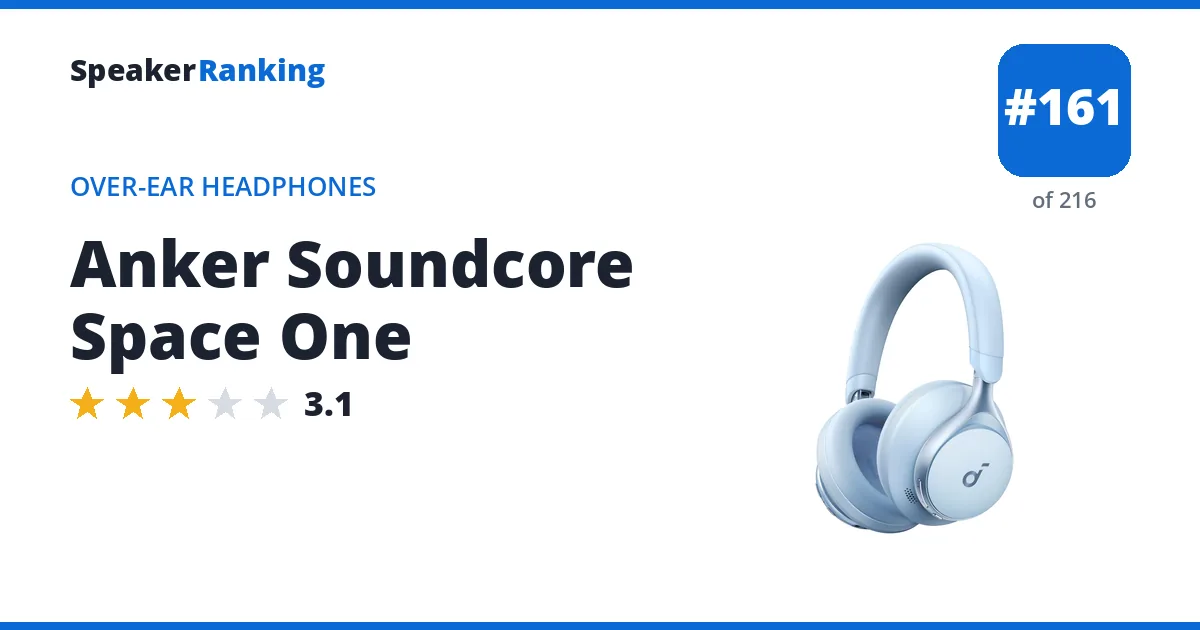
Pros: Wireless noise cancelling headphones with LDAC, AAC and SBC support, Bluetooth 5.3 and a rated 40 hours of battery (55 without ANC), plus a wired option and a built-in microphone. The bass lift of about 4 dB below 60 Hz and 3 dB through the upper bass gives kick drums and synth bass a strong rumble, which suits bassy and v-shaped tastes. At 260 g it is on the light side for an ANC over-ear.
Cons: The treble is far hotter than the target, about 6 dB over from 6 to 16 kHz with a sharp peak of 12.6 dB near 9 kHz, so cymbals and sibilant vocals turn bright and can sound harsh. A 5.6 dB dip near 3.3 kHz and a 3 dB hole in the low mids pull back vocal presence and body. The response is uneven overall, with a standard deviation near 4 dB.
Full Anker Soundcore Space One review and specifications →
| Released | Aug 2023 (3 years ago) |
|---|---|
| Active Noise Cancelling | Yes |
| Back | Closed |
| Battery Life | 40 hours (55 without ANC, Manufacturer specified) |
| Bluetooth Codecs | SBC, AAC, LDAC |
| Bluetooth Version | 5.3 |
| Built-in Microphone | Yes |
| Connection | Wireless and wired |
| Deviation From Target | 3.96 dB standard deviation |
| Driver Type | Dynamic |
| Drivers | 1 x 40mm dynamic |
| Form Factor | Over-ear |
| Frequency Response | 20Hz - 20kHz (Manufacturer specified) |
| Harman Preference Score | 62 (measured by oratory1990, via AutoEQ) |
| IP Rating | None |
| Impedance | 16 ohms |
| Sub-bass Extension | Within 6 dB of target down to 20 Hz (+7.3 dB at 30 Hz) |
| Tonal Tilt | -0.17 (negative is warmer, positive brighter) |
| Weight | 0.6 lbs (260 g) |
EQ preset to match the Harman target
Set a preamp of -4.7 dB, then add these filters in any parametric equalizer (Wavelet, Equalizer APO, Peace, or a player with parametric EQ). Calculated by AutoEQ from its measured frequency response.
| Filter | Frequency | Gain | Q |
|---|---|---|---|
| Low shelf | 105 Hz | -4.6 dB | 0.70 |
| Peak | 494 Hz | +4.5 dB | 0.46 |
| Peak | 1,335 Hz | -6.2 dB | 1.43 |
| Peak | 123 Hz | -3.7 dB | 1.54 |
| Peak | 3,318 Hz | +5.1 dB | 3.60 |
| High shelf | 10,000 Hz | -7.0 dB | 0.70 |
| Peak | 8,910 Hz | -5.2 dB | 1.18 |
| Peak | 5,539 Hz | +4.9 dB | 3.90 |
| Peak | 2,387 Hz | +2.3 dB | 6.00 |
| Peak | 382 Hz | -1.5 dB | 6.00 |
- Reviews, Comparisons and Sound Samples
- Head-to-Head Comparisons
 Sennheiser ACCENTUM: $99.95 Wireless B&H Photo Video eBay

Pros: Active noise cancelling, a long 50 hour battery, aptX HD support and a wired option make it a practical everyday headphone at 222 g. Sub-bass sits about 6 dB above target and reaches down to 20 Hz, a good fit for listeners who like a warm, bass rich sound. Its 2.78 dB standard deviation is smoother than many headphones at its price.
Cons: A 7 dB dip near 4.3 kHz and a presence band about 2.4 dB low push vocals back and soften detail. It has no IP rating for water or sweat. The Anker Soundcore Space One is rated higher and costs less.
Full Sennheiser ACCENTUM review and specifications →
| Released | Oct 2023 (3 years ago) |
|---|---|
| Active Noise Cancelling | Yes |
| Back | Closed |
| Battery Life | 50 hours (Manufacturer specified) |
| Bluetooth Codecs | SBC, AAC, aptX, aptX HD |
| Bluetooth Version | 5.2 |
| Built-in Microphone | Yes |
| Connection | Wireless and wired |
| Deviation From Target | 2.78 dB standard deviation |
| Driver Type | Dynamic |
| Drivers | 1 x 37mm dynamic |
| Form Factor | Over-ear |
| Frequency Response | 10Hz - 22kHz (Manufacturer specified) |
| Harman Preference Score | 56 (measured by oratory1990, via AutoEQ) |
| IP Rating | None |
| Sensitivity | 106 dB SPL (1 kHz / 0 dBFS) |
| Sub-bass Extension | Within 6 dB of target down to 20 Hz (+5.0 dB at 30 Hz) |
| Tonal Tilt | -1.51 (negative is warmer, positive brighter) |
| Weight | 0.5 lbs (222 g) |
EQ preset to match the Harman target
Set a preamp of -5.6 dB, then add these filters in any parametric equalizer (Wavelet, Equalizer APO, Peace, or a player with parametric EQ). Calculated by AutoEQ from its measured frequency response.
| Filter | Frequency | Gain | Q |
|---|---|---|---|
| Low shelf | 105 Hz | -4.5 dB | 0.70 |
| Peak | 571 Hz | -1.6 dB | 0.18 |
| Peak | 1,870 Hz | +5.7 dB | 2.57 |
| Peak | 4,181 Hz | +5.4 dB | 3.61 |
| Peak | 33 Hz | -2.0 dB | 1.01 |
| High shelf | 10,000 Hz | -5.9 dB | 0.70 |
| Peak | 3,003 Hz | -1.9 dB | 4.46 |
| Peak | 8,989 Hz | +3.3 dB | 0.91 |
| Peak | 5,774 Hz | -3.0 dB | 5.50 |
| Peak | 3,777 Hz | +0.4 dB | 2.96 |
- Reviews, Comparisons and Sound Samples
- Head-to-Head Comparisons